
Study Guides
Cambridge International AS & A Level Global Perspectives & Research (9239): Research Report – Research Methods and Methodology
How to choose, design and explain research methods for the 9239 Cambridge Research Report, and how methodology shapes what your conclusion can claim.
- Subject
- Global Perspectives
- Level
- A LEVEL
- Topic
- Component 4 – Cambridge Research Report
- Author
- Marlbridge Academic Team
- Updated
- Reviewed by
- Ammar Bilal (what this means)
Aligned to Cambridge A Level Global Perspectives (9239), 2026-2028. Official specification .
Syllabus page (what it covers and how it is assessed): Cambridge A Level Global Perspectives.
Syllabus points this page covers
9239 (A Level)
- 4.3 Research methods and methodology
This guide covers the “Research methods and methodology” section of Component 4, the Cambridge Research Report, in the Cambridge International AS & A Level Global Perspectives & Research (9239) syllabus for 2026-2028. The syllabus says: “Candidates should select research methods that are appropriate for their chosen topic”, and “In their research report, candidates must explain their choice and use of appropriate research methods, and consider the methodology which has informed this. Candidates should explain how they carried out the research.” The matching assessment point is “use appropriate research methods (AO1)”. For the component as a whole, read the Cambridge Research Report study guide first; it lists the methods and their general strengths. This page goes further, into choosing, designing and writing about them.
Methods and methodology: the working difference
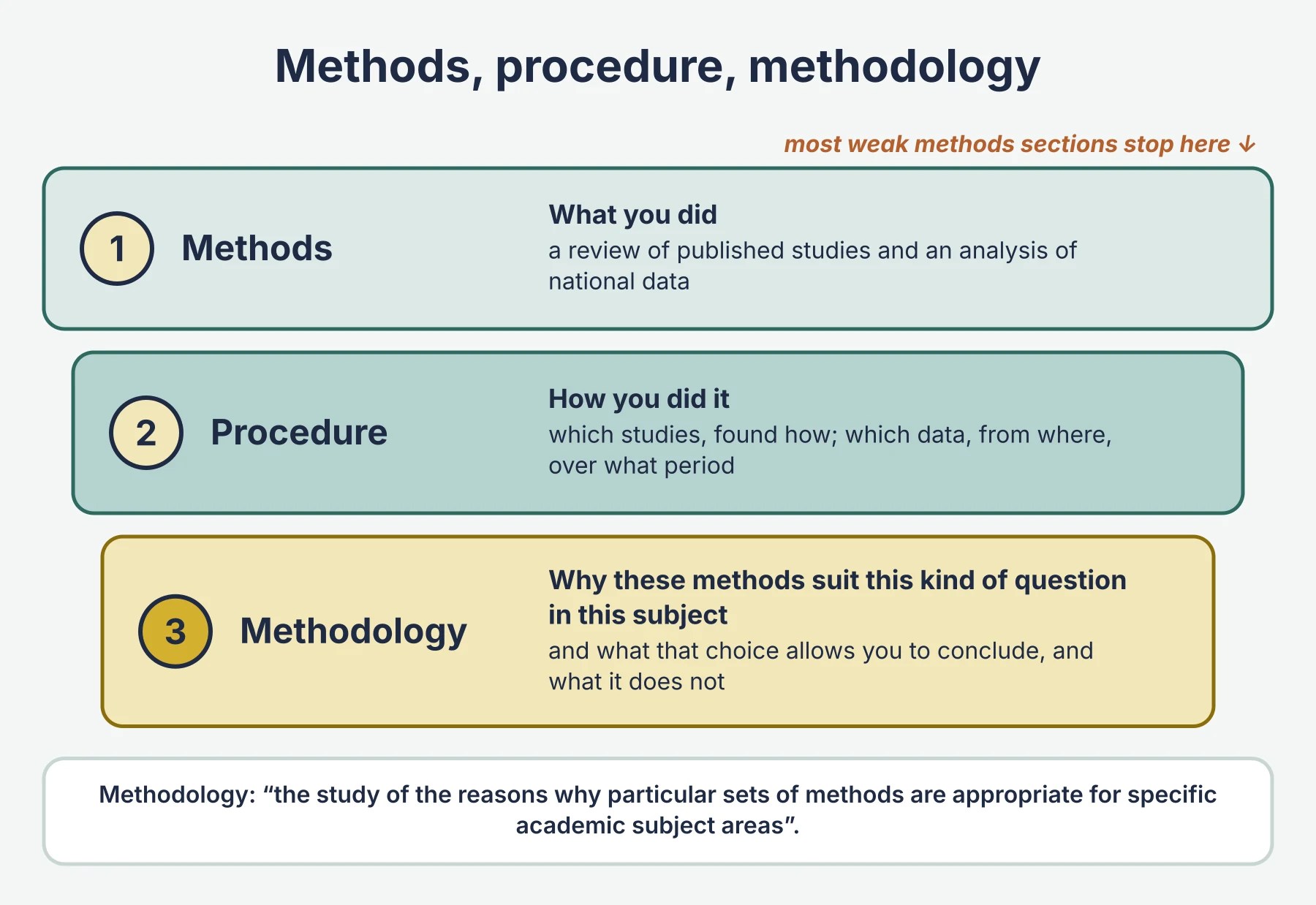
The syllabus defines methodology as “the study of the reasons why particular sets of methods are appropriate for specific academic subject areas”, and expects you “to engage with the methodology underlying their choice of research methods, and consider the impact of their choice on their report”.
So your report needs three layers, not one:
- Methods: what you did (for example, a review of published studies and an analysis of national data).
- Procedure: how you did it (which studies, found how; which data, from where, over what period).
- Methodology: why those methods suit this kind of question in this subject, and what that choice allows you to conclude and what it does not.
Most weak methods sections stop at layer 1.
Step 1: work out what kind of question you have asked
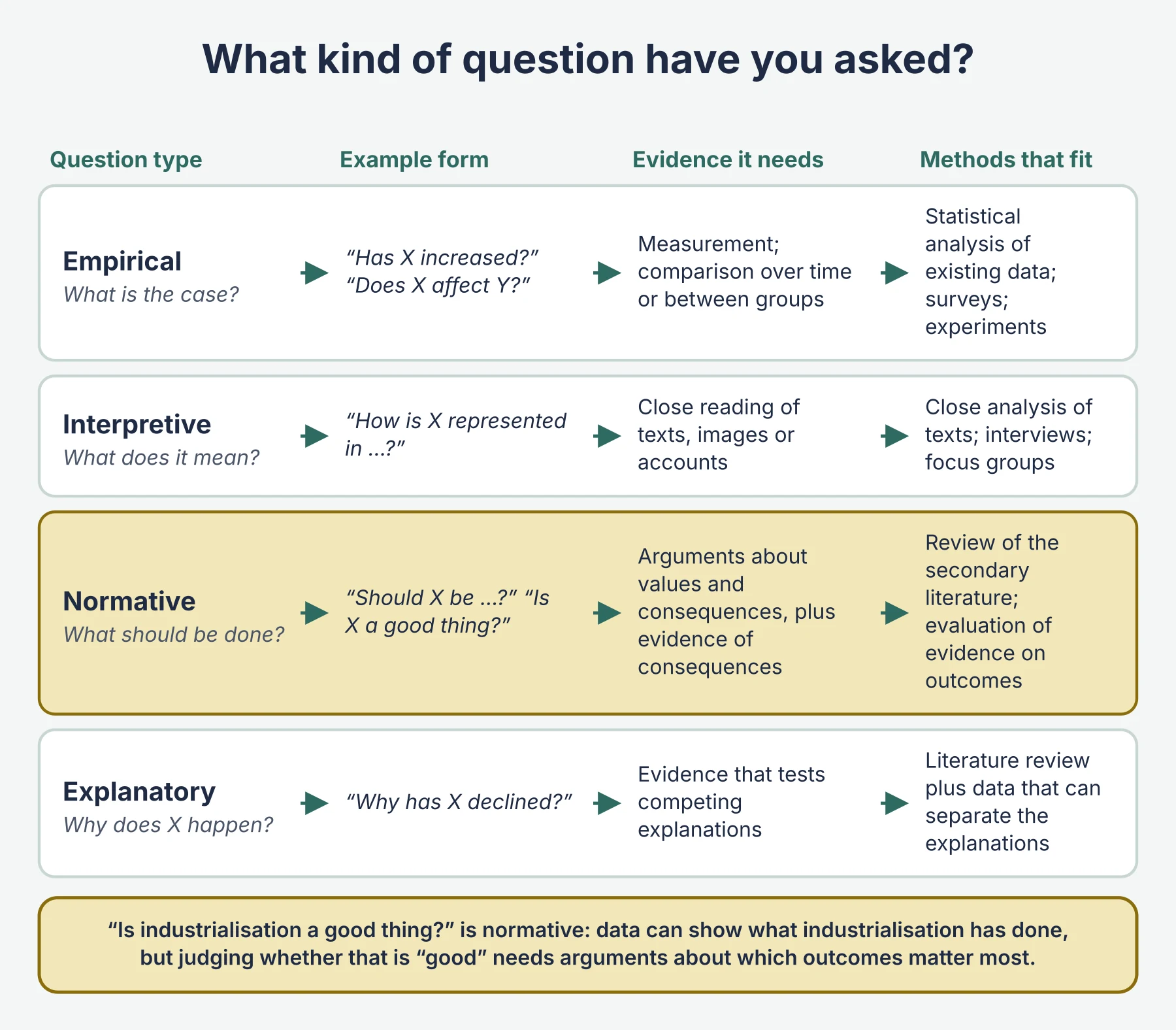
The fastest route to appropriate methods is to recognise what your question needs as evidence. Many research questions combine more than one of these.
| Question type | Example form | Evidence it needs | Methods that usually fit |
|---|---|---|---|
| Empirical: what is the case? | “Has X increased?” “Does X affect Y?” | Measurement, comparison over time or between groups | Statistical analysis of existing data; surveys; experiments |
| Interpretive: what does it mean? | “How is X represented in …?” | Close reading of texts, images or accounts | Close analysis of texts; interviews; focus groups |
| Normative: what should be done? | “Should X be …?” “Is X a good thing?” | Arguments about values and consequences, plus evidence of consequences | Review of the secondary literature; evaluation of evidence on outcomes |
| Explanatory: why does X happen? | “Why has X declined?” | Evidence that tests competing explanations | Literature review plus data that can separate the explanations |
The syllabus’s own suggested title, “Is industrialisation a good thing?”, is normative. A normative question cannot be answered by data alone: data can tell you what industrialisation has done, but a judgement about whether that is “good” needs arguments about which outcomes matter most. Your methodology should say so.
Step 2: check the conventions of the subject area
Methodology is tied to “specific academic subject areas”. Ask how specialists in the field you are working in normally answer this kind of question. The syllabus’s own examples of key concepts show the range: a project on the representation of women in poetry draws on gender and feminism, which points towards close analysis of texts; a project on explanations for the movement of fluids draws on the conservation of energy and Brownian motion, which points towards scientific sources and data.
If your question crosses subject areas, say which conventions you follow for which part, and why.
Step 3: design each method so it can be defended
Choosing a method is not enough; the syllabus asks you to explain “how they carried out the research”. Each method has design decisions you should be able to justify.
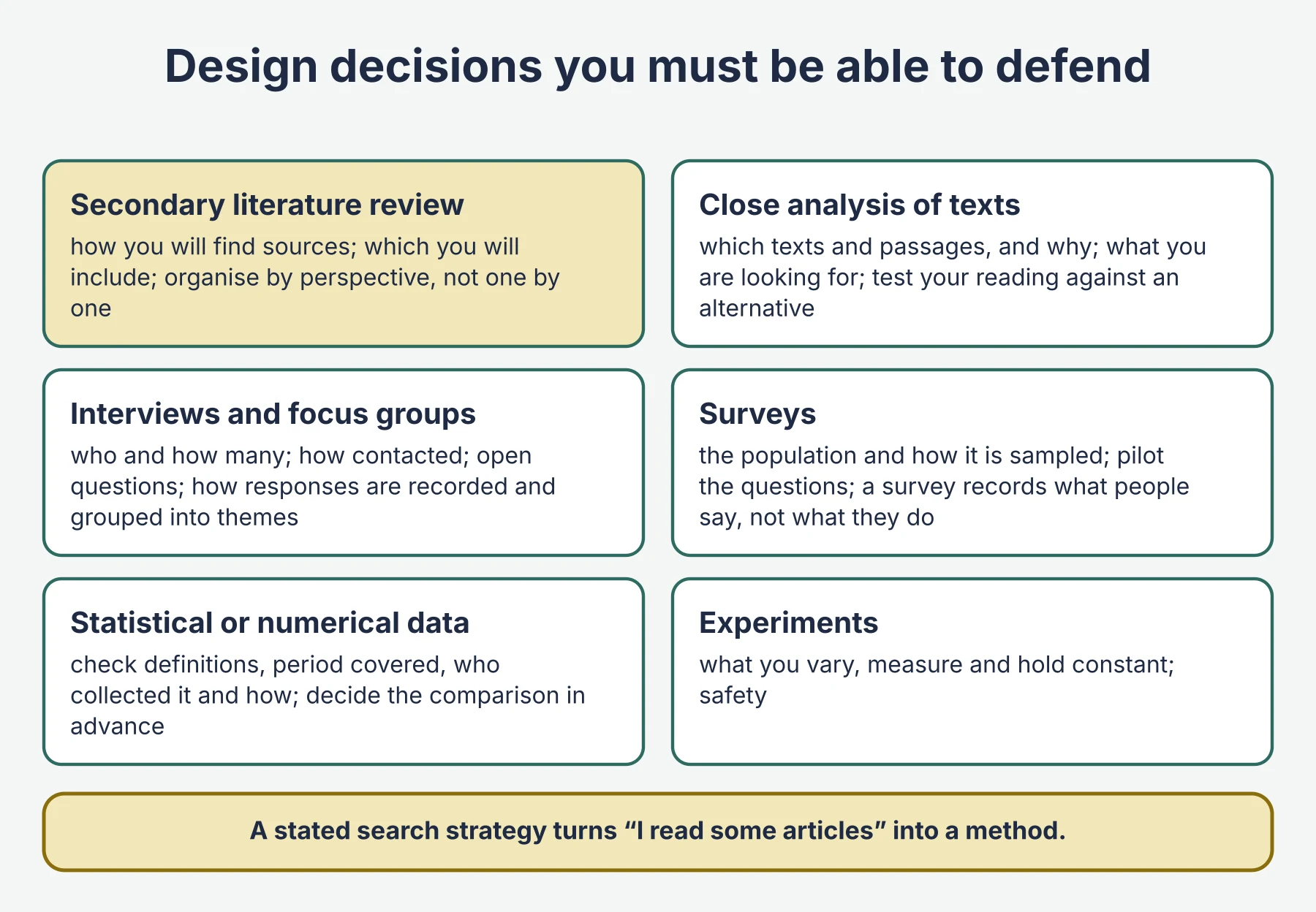
Reviewing the secondary literature. Decide how you will find sources (search terms, databases or libraries, reference lists of key works), which you will include (for example, studies from the last fifteen years, or from more than one region) and how you will organise them (by perspective, not one by one). A stated search strategy turns “I read some articles” into a method.
Close analysis of texts. Decide which texts and which passages, and why those are representative or significant. State what you are looking for: particular language, imagery, framing or arguments. Interpretations can be contested, so show your reading against at least one alternative reading.
Interviews and focus groups. Decide who and how many, how you will contact them, and what you will ask. Open questions (“How has … affected your work?”) produce richer answers than closed ones. Plan how you will record and analyse responses, for example by grouping answers into themes.
Surveys. Decide the population you want to describe and how you will sample it. Pilot the questions on a few people to catch ambiguous or leading wording. Remember that a survey records what people say, which may differ from what they do.
Analysis of statistical or numerical data. Check definitions (does “unemployment” mean the same in every country you compare?), the period covered, and who collected the data and how. Decide in advance what comparison will answer your question.
Experiments. Decide what you will vary, what you will measure and what you will hold constant. Consider safety; the syllabus says teachers “should be satisfied that the research does not raise safety issues for the candidates”.
Step 4: combine methods where one is not enough
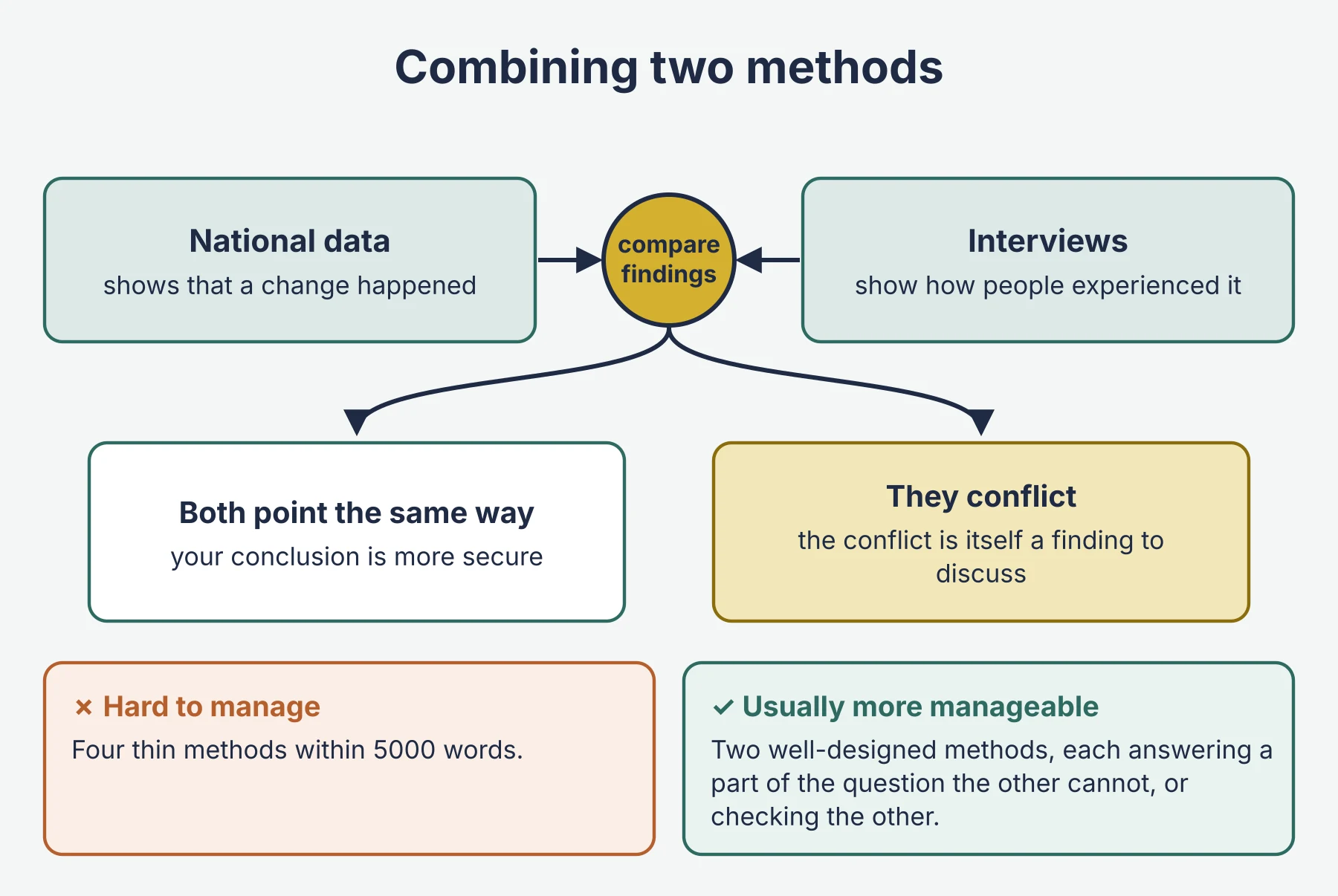
The syllabus allows “a mixture of the methods above”. Mixing works when each method answers a part of the question the other cannot, or when one checks the other. For example, national data can show that a change happened, and interviews can show how people experienced it. If both point the same way, your conclusion is more secure; if they conflict, the conflict is itself a finding to discuss. Within 5000 words, two well-designed methods are usually more manageable than four thin ones.
Step 5: research ethics
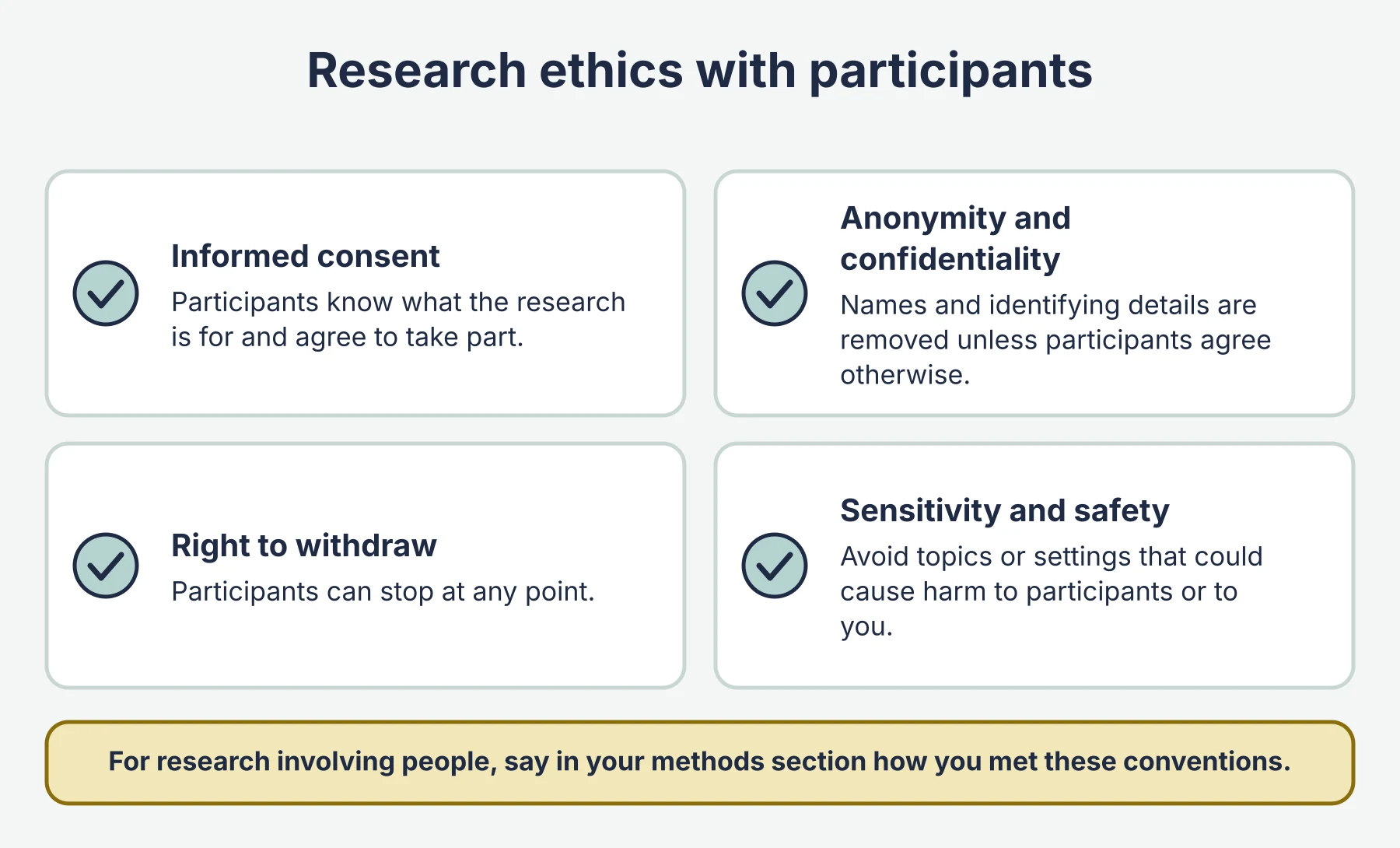
The syllabus asks teachers to help candidates “consider research ethics and conventions in relation to specific research questions”. For research involving people, that means at least:
- Informed consent: participants know what the research is for and agree to take part.
- Anonymity and confidentiality: names and identifying details are removed unless participants agree otherwise.
- Right to withdraw: participants can stop at any point.
- Sensitivity and safety: avoid topics or settings that could cause harm to participants or to you.
Mention in your methods section how you met these conventions.
Step 6: write the methods section
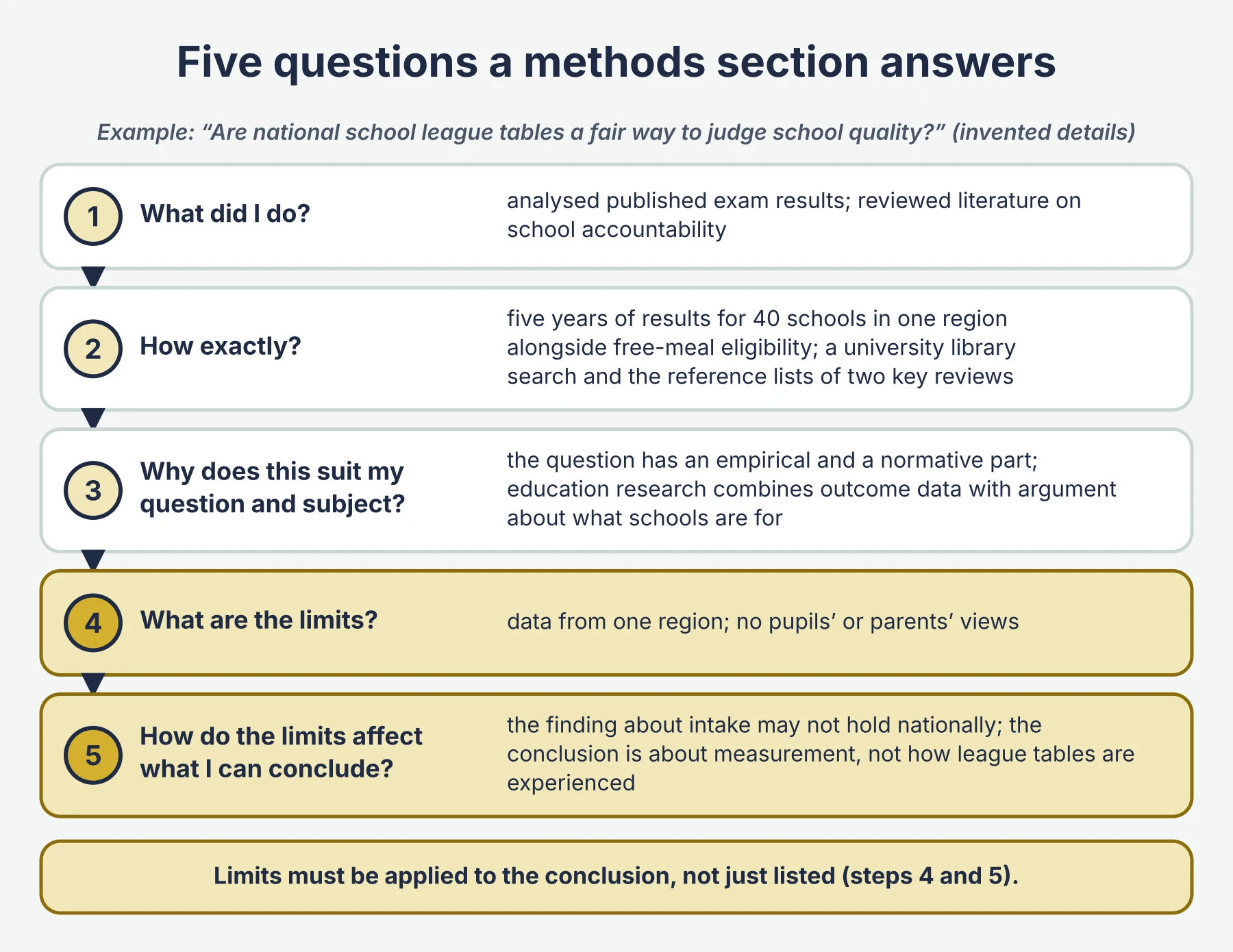
A strong methods section answers five questions in order: What did I do? How exactly? Why does this suit my question and subject? What are the limits of this approach? How do those limits affect what I can conclude?
Worked example. Research question: “Are national school league tables a fair way to judge school quality?” The details below are invented for illustration.
“This question has an empirical part (what league tables measure) and a normative part (whether that is a fair basis for judgement), so I used two methods. First, I analysed five years of published exam results for 40 schools in one region alongside the share of pupils eligible for free meals, to test whether rankings mainly reflected intake rather than teaching. I chose published data because it is the information league tables are actually built from. Second, I reviewed academic and policy literature on school accountability, found through a university library search and the reference lists of two key reviews, and grouped it into perspectives that defend and criticise league tables. Education research usually combines outcome data with argument about what schools are for, because data alone cannot settle what ‘quality’ means. The limit of this approach is that my data come from one region, so my finding about intake may not hold nationally, and it does not include pupils’ or parents’ views, so my conclusion is about measurement rather than about how league tables are experienced.”
The paragraph names the methods, explains the procedure briefly, justifies the choice by the question’s two parts and by subject conventions, and states limits with their consequences.
How methodology shapes your conclusion
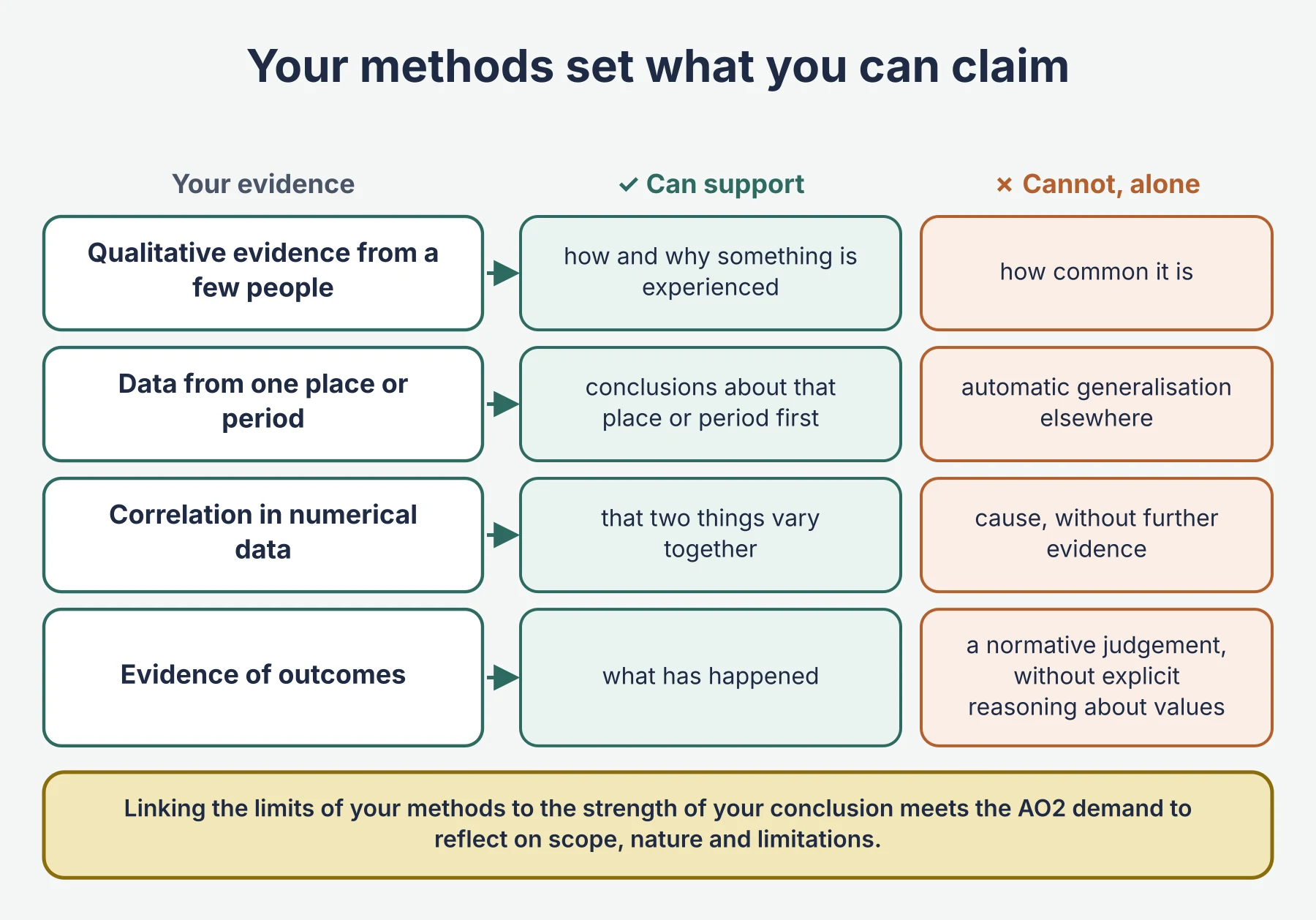
Your methods set the boundary of what you can claim. Some common boundaries:
- Qualitative evidence from a few people can show how and why something is experienced, not how common it is.
- Data from one place or period supports conclusions about that place or period first.
- Correlation in numerical data does not establish cause without further evidence.
- A normative judgement needs explicit reasoning about values, not only evidence of outcomes.
The syllabus asks you to “reflect on their conclusions (AO2)” and to “reflect on and justify the scope, nature and limitations” of your report. Linking the limits of your methods to the strength of your conclusion meets both.
Common mistakes
- Methods named, not designed: “I did interviews” with no who, how many, or what was asked.
- Methods that cannot answer the question: a survey of opinions used to answer whether a policy works.
- Methodology as a definition: copying a definition instead of explaining why your methods suit your subject.
- Limits listed but not applied to the conclusion.
- No ethics: research with people that does not mention consent or anonymity.
- Too many methods for the word limit, each done thinly.
Condense this with the research methods revision notes and practise it with the research methods practice questions. Record your method decisions as you go; the companion unit on the research log shows how.
Frequently asked questions
Do I have to collect my own primary data? No. The syllabus says research “can be based on primary and/or secondary evidence, depending on the subject matter and the approach”. Choose what suits your question and explain why.
Where should methodology go in the report? The syllabus does not prescribe a section. Many reports explain methods and methodology near the start, then return to the limits in the conclusion.
Is a literature review a real research method? Yes. “Reviewing the secondary literature in the field” is the first method the syllabus lists. It needs a clear search strategy and an organisation by perspective to count as a method rather than background reading.
Related resources
-
Practice questions
Cambridge International AS & A Level Global Perspectives & Research (9239): Research Report – Research Methods and Methodology – Practice Questions
Original practice on 9239 Research Report methods: matching methods to questions, search strategies, survey wording, data definitions, ethics and limits.
Global Perspectives · Cambridge · A Level
Try questions -
Revision notes
Cambridge International AS & A Level Global Perspectives & Research (9239): Research Report – Research Methods and Methodology – Revision Notes
Recall notes on methods in the 9239 Research Report: question types, design decisions for each method, ethics, the methods section and its limits.
Global Perspectives · Cambridge · A Level
Revise topic -
Study guides
Cambridge International AS & A Level Global Perspectives & Research (9239): Research Report – The Research Log
How to keep the 10-mark research log for the 9239 Cambridge Research Report: what to record, plan and reflect on at each stage, with model entries.
Global Perspectives · Cambridge · A Level
Read guide
Studying Global Perspectives?
This page is free and stays free. Marlbridge is not offering Global Perspectives classes at the moment, so there is no tuition to book for it. The free study resources stay open to everyone.
Get free revision emails (optional)
Occasional emails with practice questions, worked explanations and links to free resources for the qualification and subjects you choose. No spam, and you can unsubscribe from any email. The free tools on this site never need an email.