
Revision Notes
Cambridge International AS & A Level Global Perspectives & Research (9239): Team Project – The Reflective Paper – Revision Notes
Recall notes on the 9239 reflective paper: the two AO2 strands, aspects of collaboration, evidence, improvements, learning, an 800-word plan and a self-test.
- Subject
- Global Perspectives
- Level
- AS LEVEL
- Topic
- Component 3 – Team Project
- Author
- Marlbridge Academic Team
- Updated
- Reviewed by
- Ammar Bilal (what this means)
Aligned to Cambridge A Level Global Perspectives (9239), 2026-2028. Official specification .
Syllabus page (what it covers and how it is assessed): Cambridge A Level Global Perspectives.
Syllabus points this page covers
9239 (AS Level)
- 3.2 Reflective paper
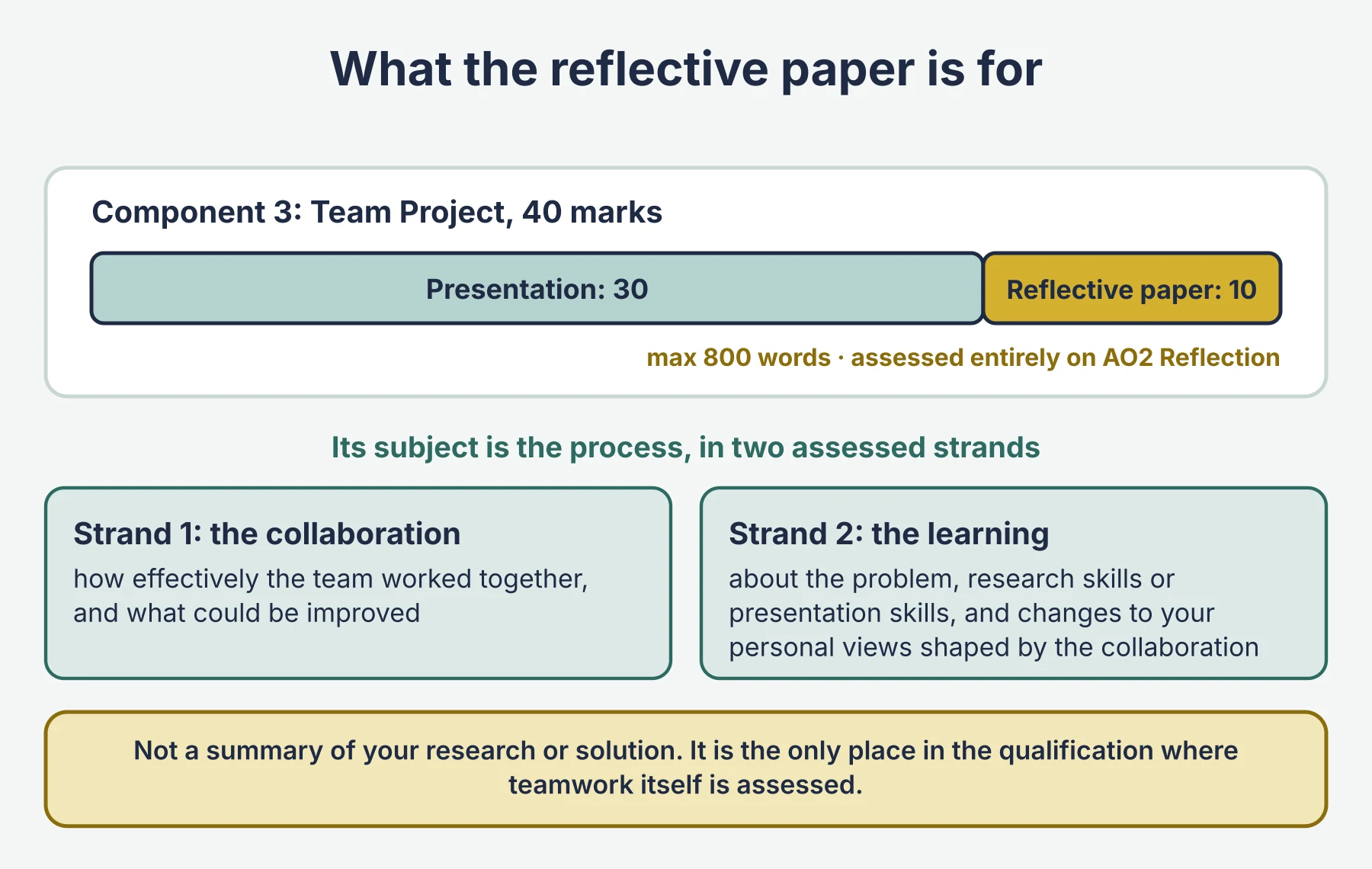
These notes cover the reflective paper in Component 3, the Team Project, of Cambridge International AS & A Level Global Perspectives & Research (9239), 2026-2028: “a reflective paper (maximum 800 words) focusing on how effectively the team worked together, what could be improved, and any changes to their personal views shaped by the collaborative experience”. For the component as a whole, see the Team Project study guide; for full explanations and model paragraphs, read the reflective paper study guide.
Core facts
- 10 marks of the component’s 40; maximum 800 words.
- Assessed entirely on AO2: “reflection on the effectiveness of the team collaboration” and “reflection on the learning”.
- AS-only AO2 objective: “reflect on and evaluate the effectiveness of collaboration with others”.
- Learning “may be about the problem itself, the research skills they have developed, and/or presentation skills”.
- Individual work; a statement of originality is required for each candidate.
The Critical Path collaboration questions
- “How effective was our work together?”
- “Identify the strengths and weaknesses of your teamwork.”
- “Consider what made the collaboration effective or ineffective in relation to the team’s goal.”
- “Make suggestions for improving teamwork in the future.”
- Working well means “maximising each person’s potential in pursuit of a common goal”.
Key terms
| Term | Meaning |
|---|---|
| Collaboration | Working together towards the team’s shared goal |
| Effectiveness | How far the way the team worked helped it reach its goal |
| Team’s goal | Agreeing a problem statement, allocating perspectives, researching and supporting each member’s presentation |
| Reflection | Interpreting and evaluating experience, not only describing it |
| Evidence (in reflection) | Specific events, dates, decisions and their effects |
| Improvement | A specific, actionable change that answers an identified weakness |
| Change in personal view | How the collaborative experience altered what you think |
Aspects of collaboration to evaluate
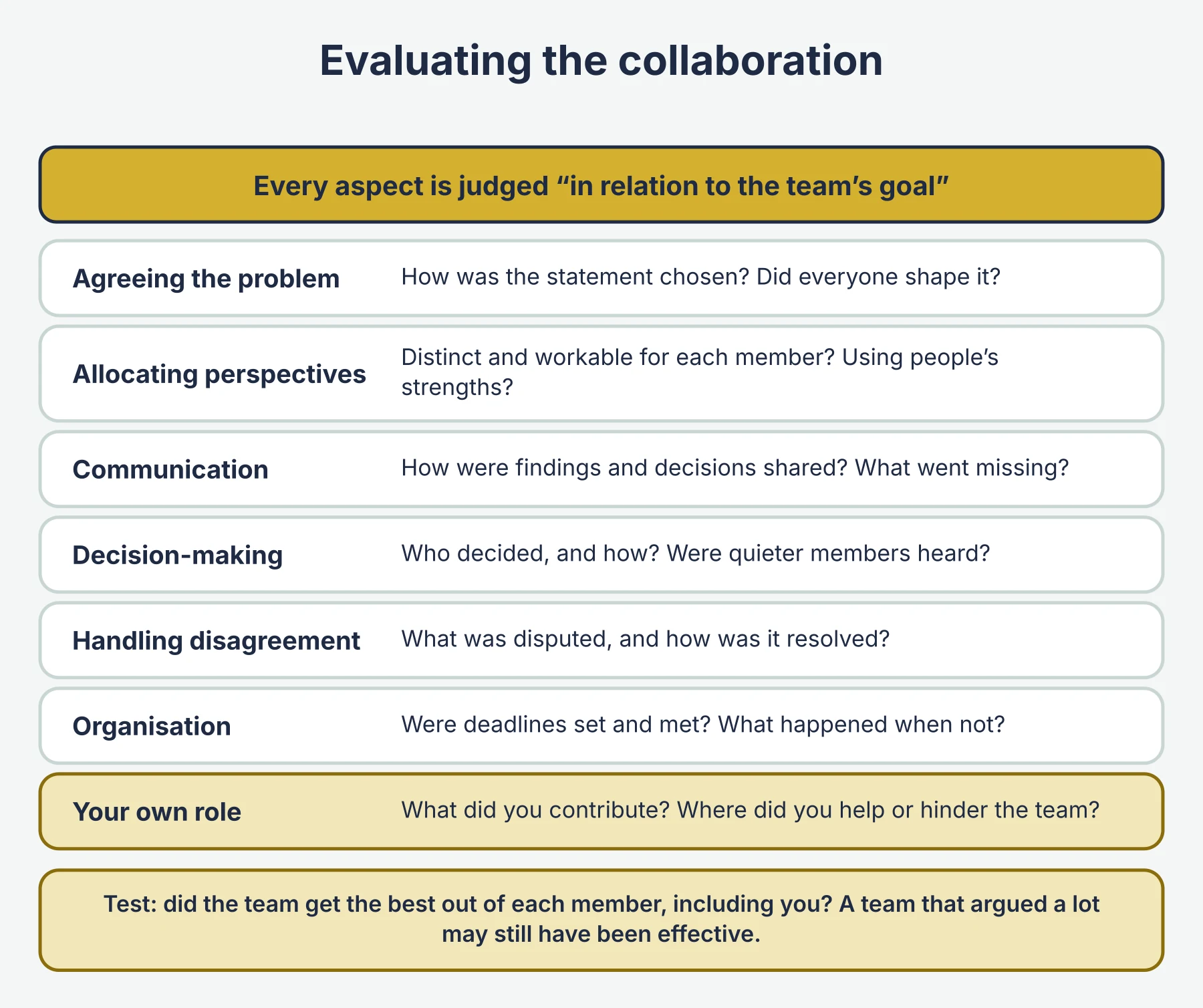
- Agreeing the problem statement.
- Allocating distinct perspectives.
- Communication and sharing research.
- Decision-making and including all voices.
- Handling disagreement.
- Organisation and deadlines.
- Your own role.
Choose two or three and go deep.
The reflective paragraph pattern
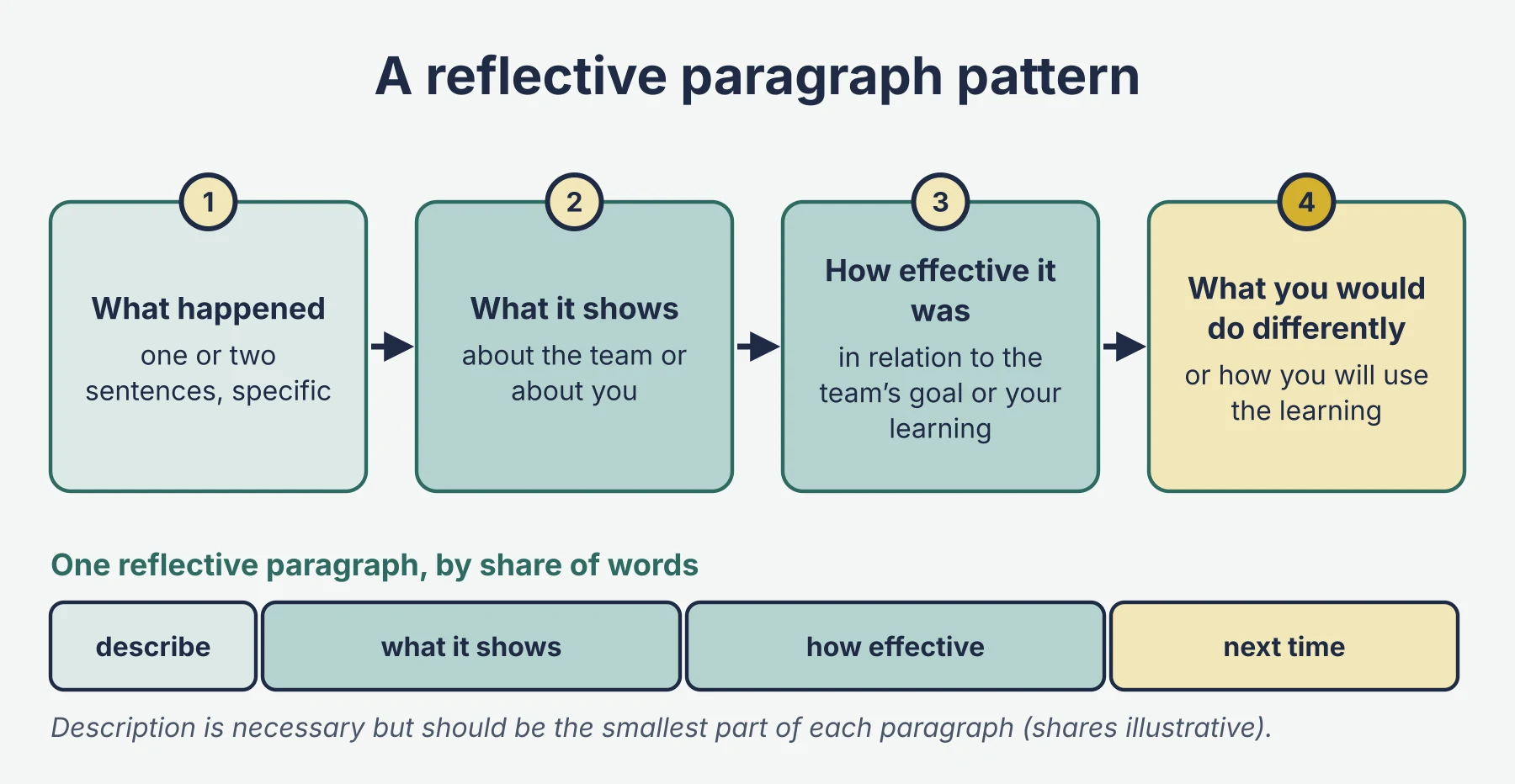
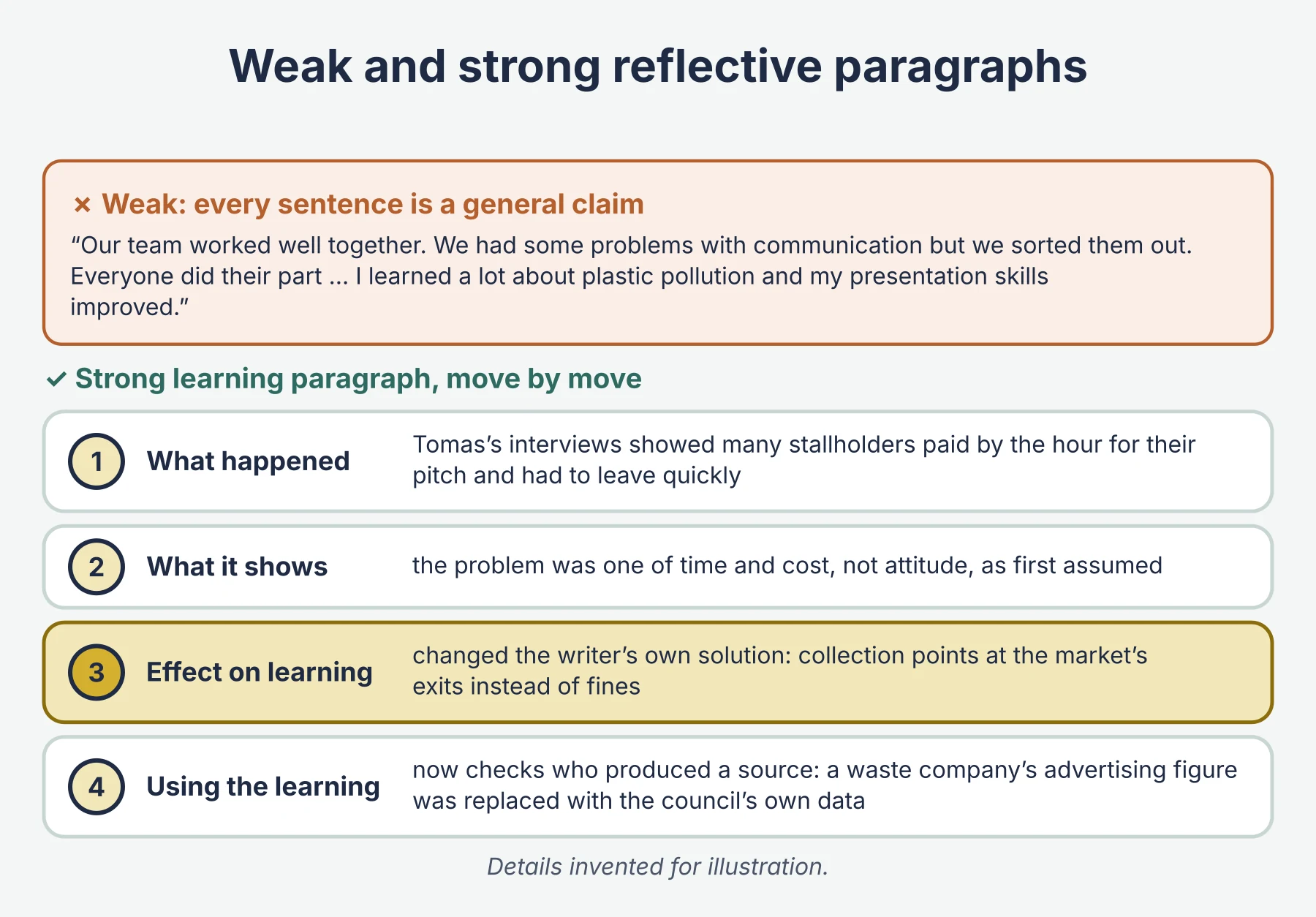
What happened (brief, specific) → what it shows → how effective it was for the goal or for your learning → what you would do differently or how you will use it.
Four areas of learning
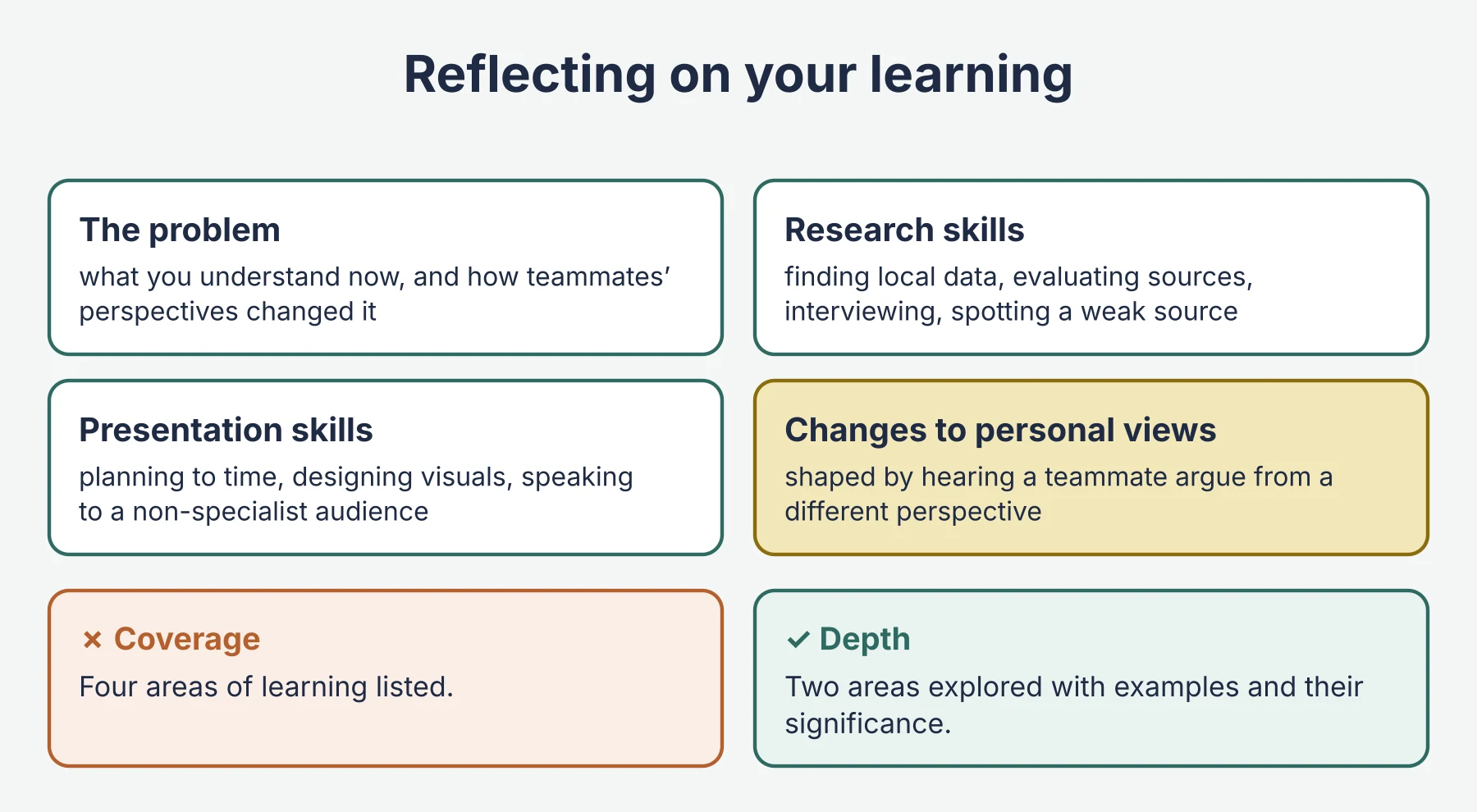
- The problem: what you now understand, and how teammates’ perspectives changed it.
- Research skills: a skill developed, with an example.
- Presentation skills: a skill developed, with an example.
- Personal views: a change shaped by the collaborative experience.
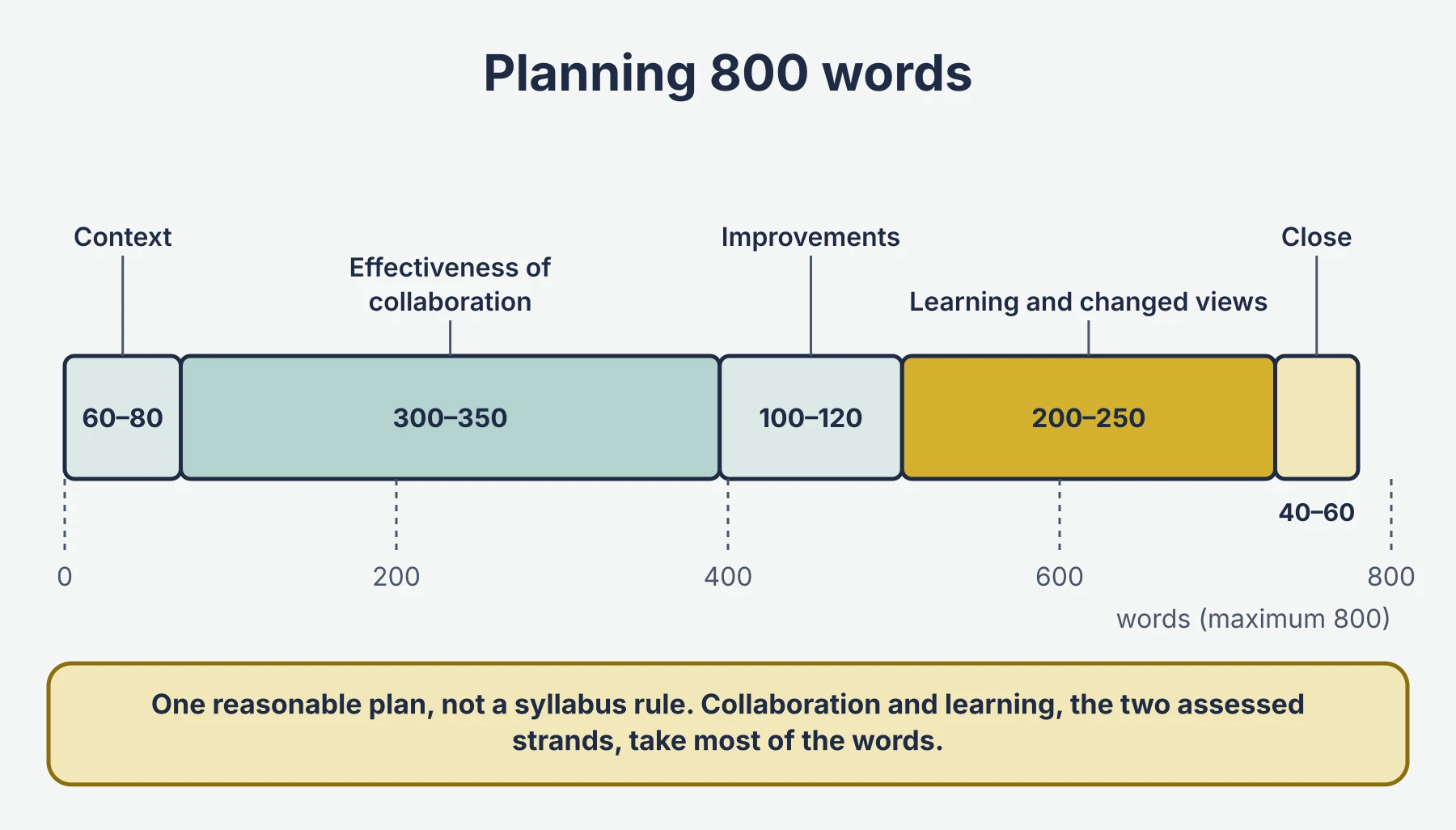
Suggested 800-word plan (not a syllabus rule)
| Section | Words |
|---|---|
| Context and your role | 60-80 |
| Collaboration, two or three aspects with evidence | 300-350 |
| Improvements | 100-120 |
| Learning and changed views | 200-250 |
| Closing judgement | 40-60 |
Condensed example
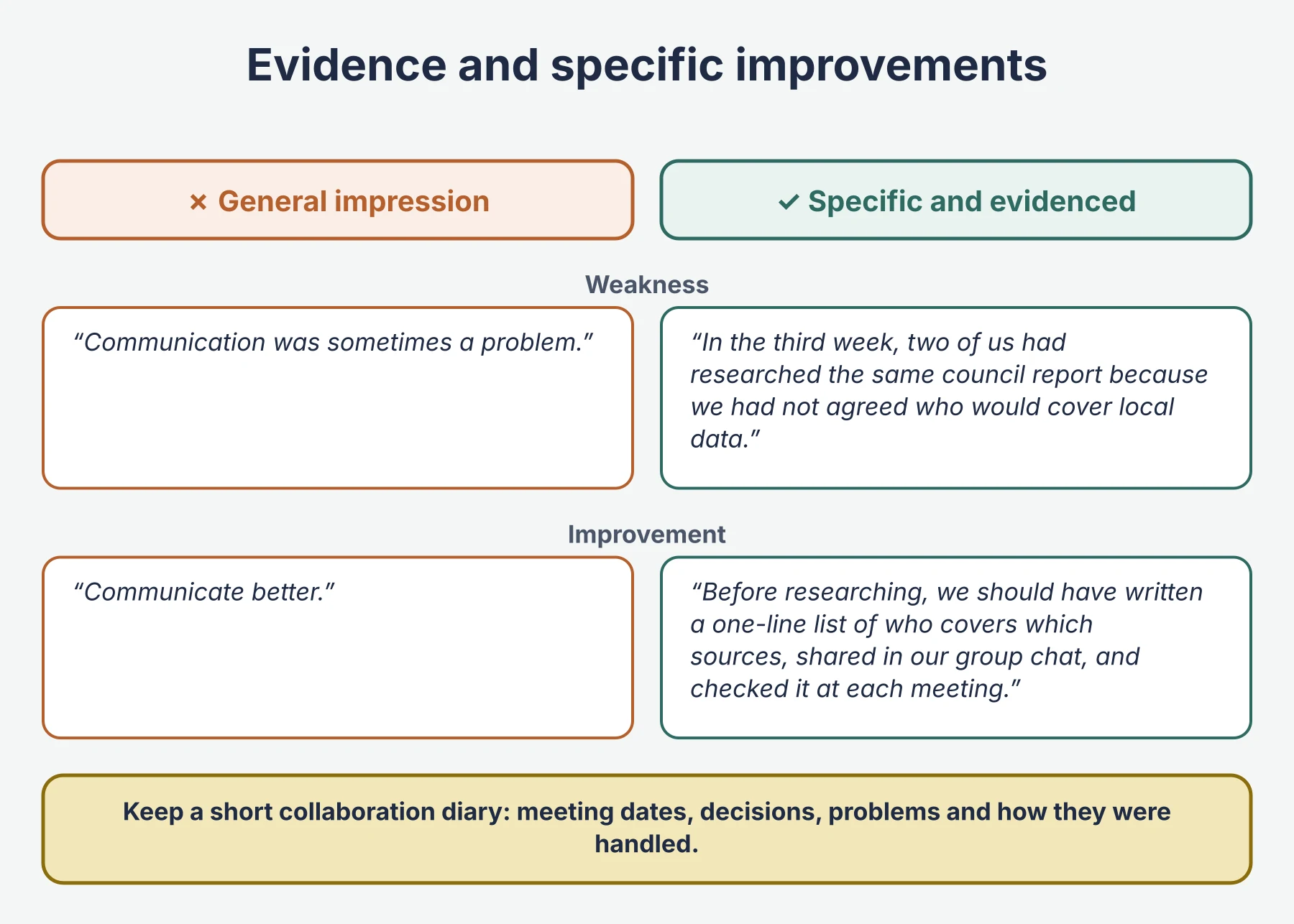
Weak: “We worked well but sometimes communication was difficult.” Strong: “We agreed perspectives in the first week but not who would cover which sources, so two of us researched the same report for several days. That cost me time for interviews. A shared source list, updated after each meeting, would have shown the overlap within a day.”
Sentence frames
- Strength: “Our most effective decision was …, because it meant that …”
- Weakness: “Because we had not …, [specific event] happened, which cost …”
- Own role: “My part in this was …; I could have …”
- Improvement: “Next time I would suggest …, so that …”
- Learning: “Before the project I …; after [specific experience] I now …”
- Changed view: “[Teammate]’s [perspective] showed me that …, which changed my view of …”
- Closing judgement: “Overall the collaboration was effective in … but less effective in …, mainly because …”
Each frame forces a specific detail and a consequence, which is what separates reflection from description.
Exam traps
- Summarising research or the solution.
- General claims (“we worked well”) with no evidence.
- All praise or all blame; omitting your own role.
- Improvements that do not answer a weakness you described.
- Listing learning instead of explaining what changed.
- Ignoring how teammates’ perspectives affected your views.
- Exceeding 800 words.
- Writing the paper before the project ends, so the reflection is guessed rather than earned.
Self-test
- What is the maximum length of the reflective paper, and how many marks is it worth?
- Which assessment objective is it assessed on?
- Name the two strands the paper is assessed on.
- Against what should the effectiveness of the collaboration be judged?
- Give three aspects of collaboration you could evaluate.
- Why does a collaboration diary help?
- What makes an improvement suggestion strong?
- Name the three areas of learning the syllabus mentions.
- What else must the paper address about personal views?
- Give the four steps of the reflective paragraph pattern.
- Can a team that disagreed often still have collaborated effectively? Explain.
- Why include your own weaknesses?
Answers
- 800 words; 10 marks.
- AO2, Reflection.
- Reflection on the effectiveness of the team collaboration; reflection on the learning.
- The team’s goal (“in relation to the team’s goal”).
- Any three: agreeing the problem; allocating perspectives; communication; decision-making; handling disagreement; organisation; your own role.
- It records specific events and decisions, which give the paper credible evidence.
- It answers a weakness you identified and is specific enough to act on.
- The problem itself; research skills; presentation skills.
- Any changes to personal views shaped by the collaborative experience.
- What happened; what it shows; how effective it was; what you would do differently.
- Yes, if the disagreements helped the team reach its goal, for example by sharpening the problem statement.
- Evaluation must be accurate and fair; your own role is part of how the team worked.
Practise with the reflective paper practice questions.
Related resources
-
Study guides
Cambridge A-Level Global Perspectives & Research: The Team Project (9239)
How the 9239 Team Project works: researching a local problem with global relevance, the individual presentation and reflective paper, for Cambridge AS Level.
Global Perspectives · Cambridge · AS Level
Read guide -
Practice questions
Cambridge A-Level Global Perspectives: The Team Project — Practice Questions
Practice questions with worked answers on the format, rules and 40-mark allocation of the Team Project in Cambridge AS & A Level Global Perspectives 9239.
Global Perspectives · Cambridge · AS Level
Try questions -
Revision notes
Cambridge A-Level Global Perspectives: The Team Project — Revision Notes
Recall notes on team formation, the 30-mark presentation and 10-mark reflective paper for the Cambridge AS & A Level Global Perspectives 9239 Team Project.
Global Perspectives · Cambridge · AS Level
Revise topic
Studying Global Perspectives?
This page is free and stays free. Marlbridge is not offering Global Perspectives classes at the moment, so there is no tuition to book for it. The free study resources stay open to everyone.
Get free revision emails (optional)
Occasional emails with practice questions, worked explanations and links to free resources for the qualification and subjects you choose. No spam, and you can unsubscribe from any email. The free tools on this site never need an email.