
Study Guides
Cambridge International AS & A Level Global Perspectives & Research (9239): Team Project – The Reflective Paper
How to write the 800-word 9239 Team Project reflective paper: evaluating collaboration with evidence, proposing improvements and reflecting on learning.
- Subject
- Global Perspectives
- Level
- AS LEVEL
- Topic
- Component 3 – Team Project
- Author
- Marlbridge Academic Team
- Updated
- Reviewed by
- Ammar Bilal (what this means)
Aligned to Cambridge A Level Global Perspectives (9239), 2026-2028. Official specification .
Syllabus page (what it covers and how it is assessed): Cambridge A Level Global Perspectives.
Syllabus points this page covers
9239 (AS Level)
- 3.2 Reflective paper
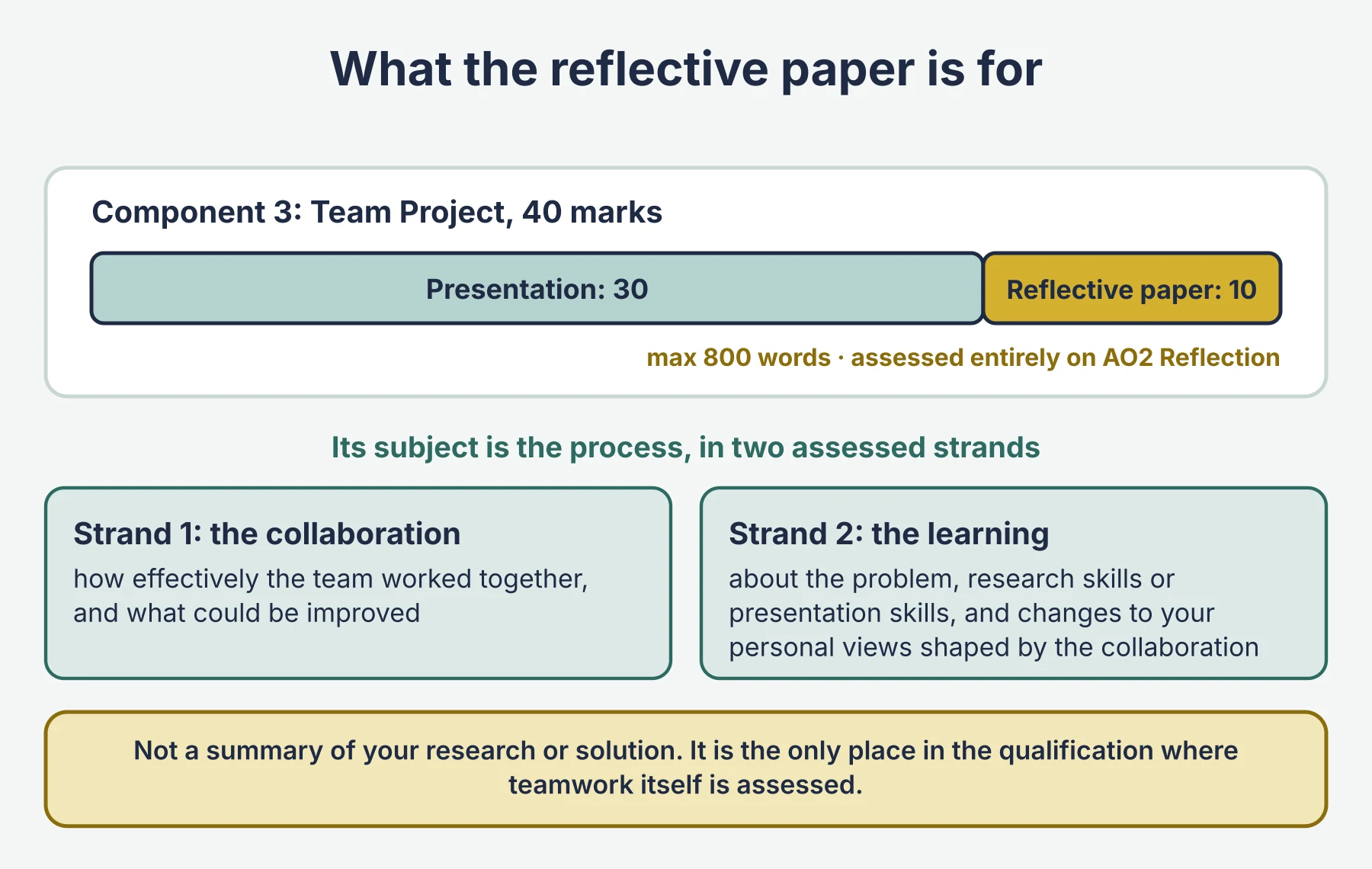
This guide covers the reflective paper in Component 3, the Team Project, of the Cambridge International AS & A Level Global Perspectives & Research (9239) syllabus for 2026-2028: “Each candidate will write a reflective paper (maximum 800 words) focusing on how effectively the team worked together, what could be improved, and any changes to their personal views shaped by the collaborative experience.” It is assessed on “reflection on the effectiveness of the team collaboration (AO2)” and “reflection on the learning (AO2)”. For the component as a whole, read the Team Project study guide first.
What the paper is for
The reflective paper is worth 10 of the component’s 40 marks and is assessed entirely on AO2, Reflection. One AO2 objective applies only at AS Level and only here: “reflect on and evaluate the effectiveness of collaboration with others”. The paper is the only place in the qualification where teamwork itself is assessed.
So the paper is not a summary of your research or your solution. Its subject is the process: how the team worked, what you learned, and how the experience changed your thinking.
Strand 1: evaluating the collaboration
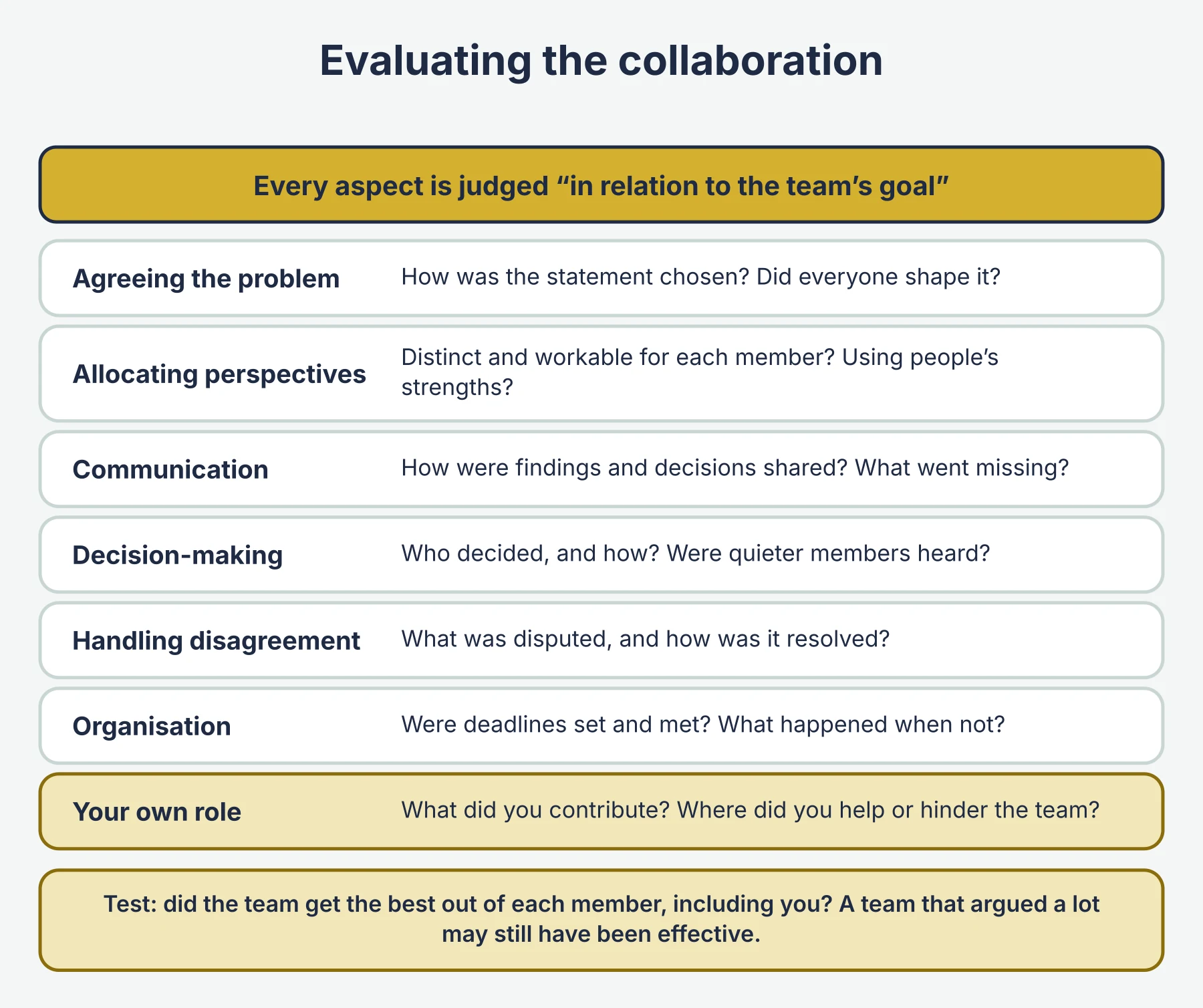
The Critical Path gives the core questions: “How effective was our work together? Identify the strengths and weaknesses of your teamwork. Consider what made the collaboration effective or ineffective in relation to the team’s goal. Make suggestions for improving teamwork in the future.”
Notice the phrase “in relation to the team’s goal”. Effectiveness is judged against what the team was trying to achieve, not against how pleasant it felt. The team’s goals included agreeing a problem statement, allocating distinct perspectives, researching, and helping each member produce a strong individual presentation. A team that argued a lot may still have been effective if the arguments sharpened the problem statement.
Useful aspects of collaboration to evaluate:
| Aspect | Questions to ask |
|---|---|
| Agreeing the problem | How did the team choose its statement? Did everyone shape it? |
| Allocating perspectives | Did each member get a distinct, workable perspective? Did the allocation use people’s strengths? |
| Communication | How did the team share findings and decisions? What went missing? |
| Decision-making | Who decided, and how? Were quieter members heard? |
| Handling disagreement | What did the team disagree about, and how was it resolved? |
| Organisation | Were deadlines set and met? What happened when they were not? |
| Your own role | What did you contribute, and where did you help or hinder the team? |
The Critical Path’s wording on collaboration includes “maximising each person’s potential in pursuit of a common goal”. That is a good test to apply honestly: did your team get the best out of each member, including you?
Evidence makes reflection credible
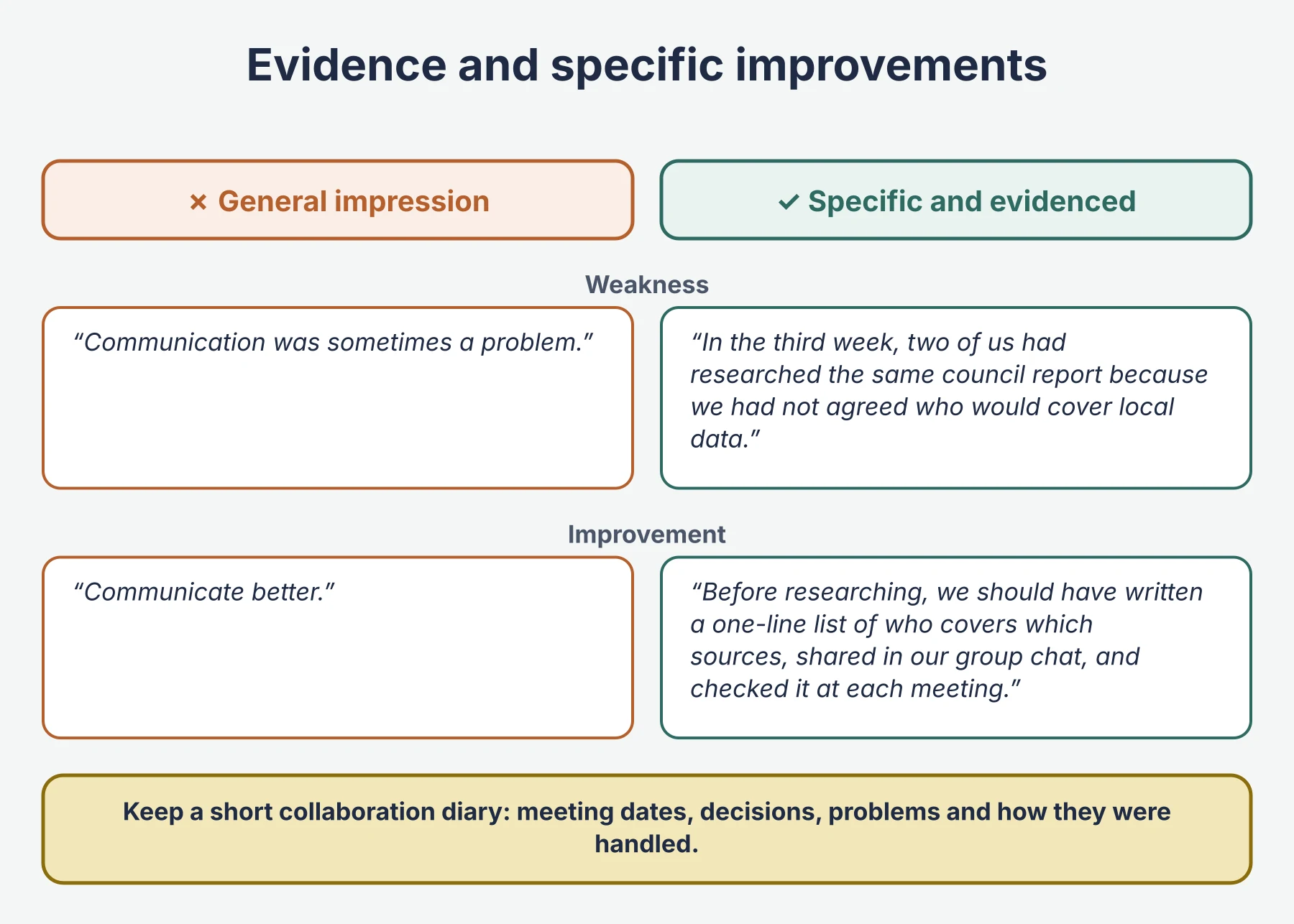
Strong reflection refers to specific moments, not general impressions. Keep a short collaboration diary during the project: dates of meetings, decisions made, problems that arose, how they were handled. Then the paper can say “In the third week, two of us had researched the same council report because we had not agreed who would cover local data”, which is far more convincing than “Communication was sometimes a problem.”
Improvements must be specific
“What could be improved” needs suggestions that follow from a weakness you have identified, and that someone could act on: “Before researching, we should have written a one-line list of who covers which sources, shared in our group chat, and checked it at each meeting.” A vague wish such as “communicate better” does not show reflection.
Strand 2: reflecting on your learning
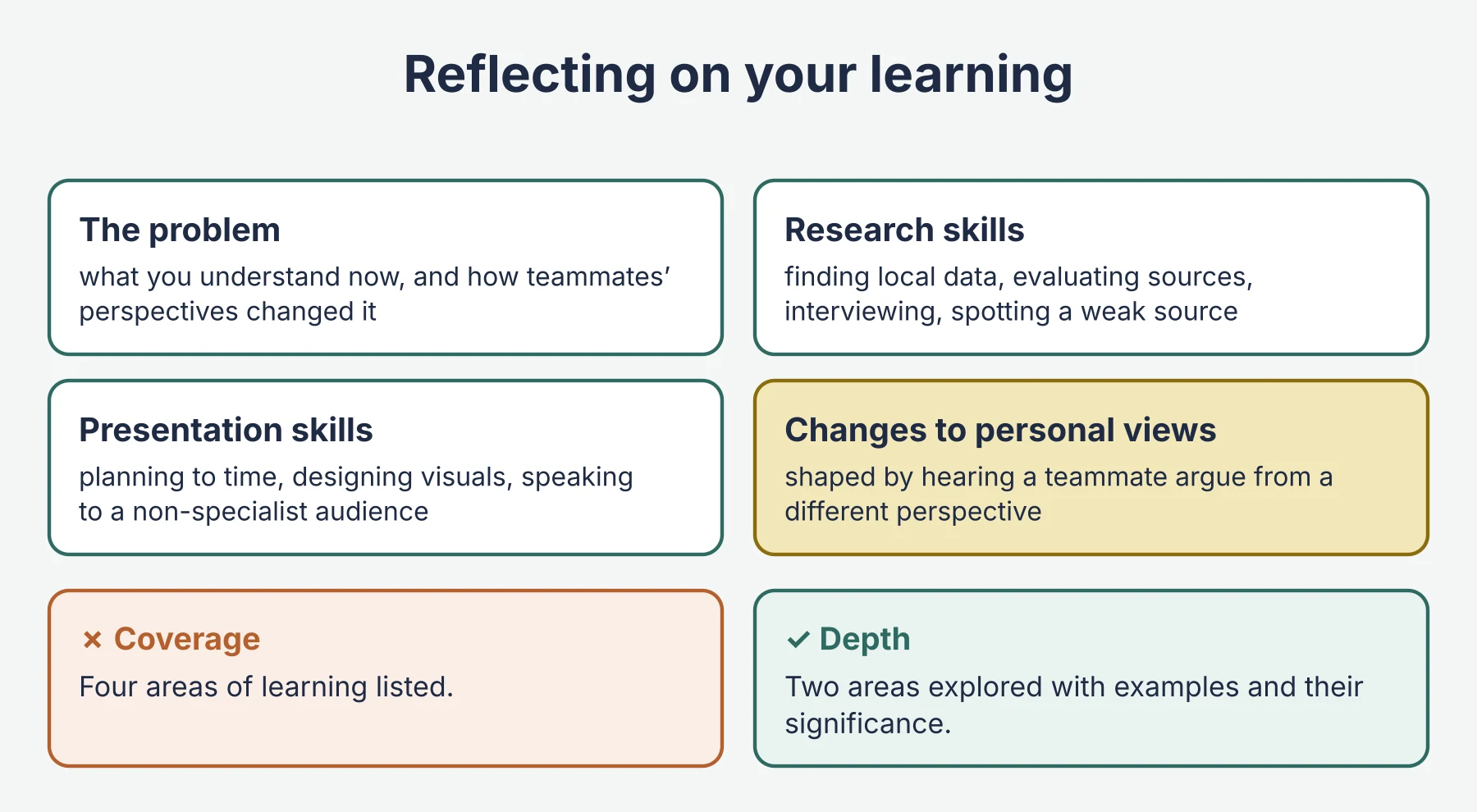
The syllabus says learning “may be about the problem itself, the research skills they have developed, and/or presentation skills”. The paper should also address “any changes to their personal views shaped by the collaborative experience”.
- The problem: what you understand now that you did not before, and how working with teammates’ perspectives changed that understanding.
- Research skills: for example, finding local data, evaluating sources, interviewing, or recognising a weak source.
- Presentation skills: planning to time, designing visuals, speaking to a non-specialist audience.
- Changes to personal views: the collaborative part matters here. Hearing a teammate argue from a different perspective is exactly the experience the paper asks you to reflect on.
Depth beats coverage. Two areas of learning explored with examples and their significance are stronger than four listed.
A reflective writing pattern
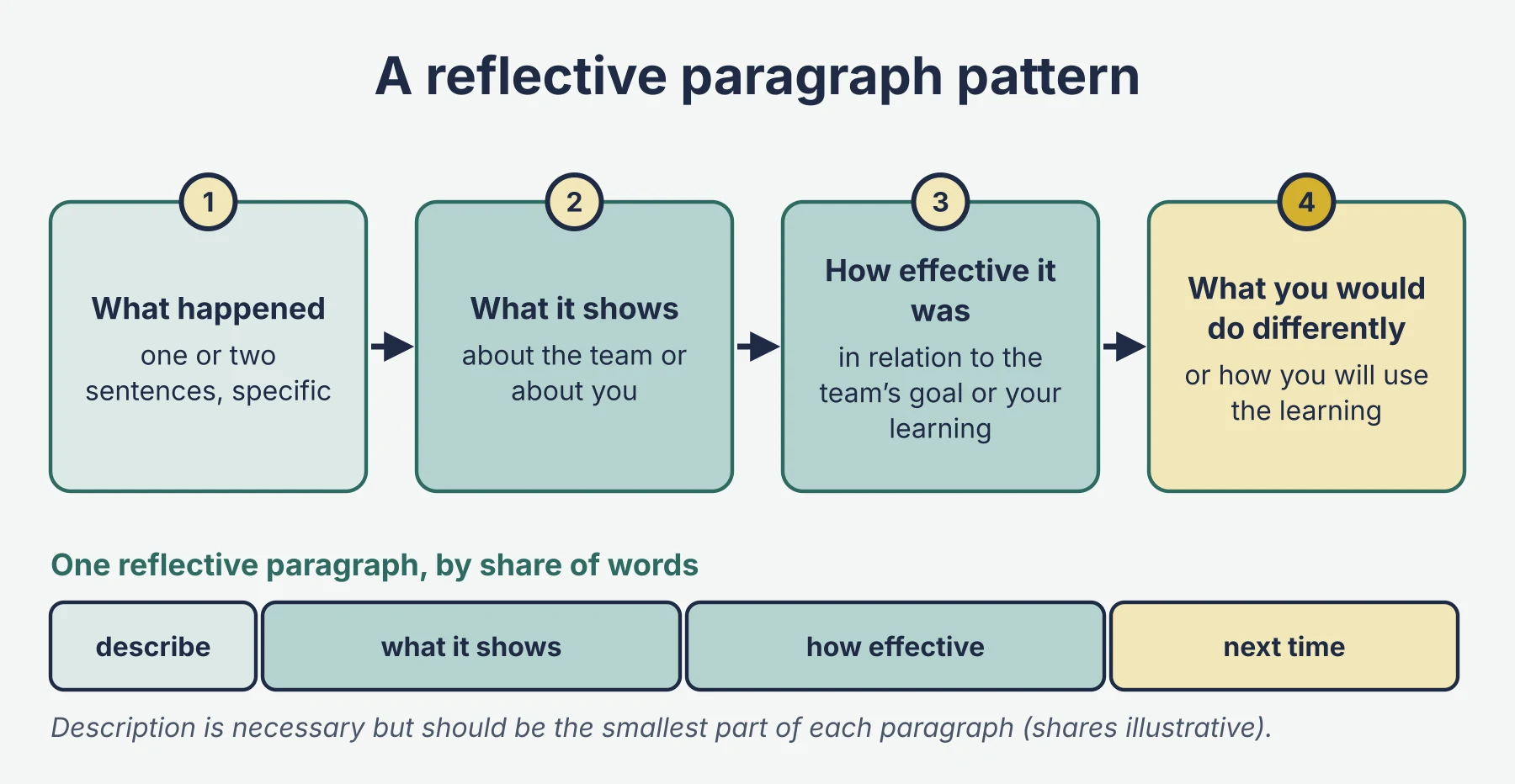
A simple pattern keeps each paragraph reflective rather than descriptive:
- What happened (one or two sentences, specific).
- What it shows about the team or about you.
- How effective it was in relation to the team’s goal or your learning.
- What you would do differently, or how you will use the learning.
Description is necessary but should be the smallest part of each paragraph.
Planning 800 words
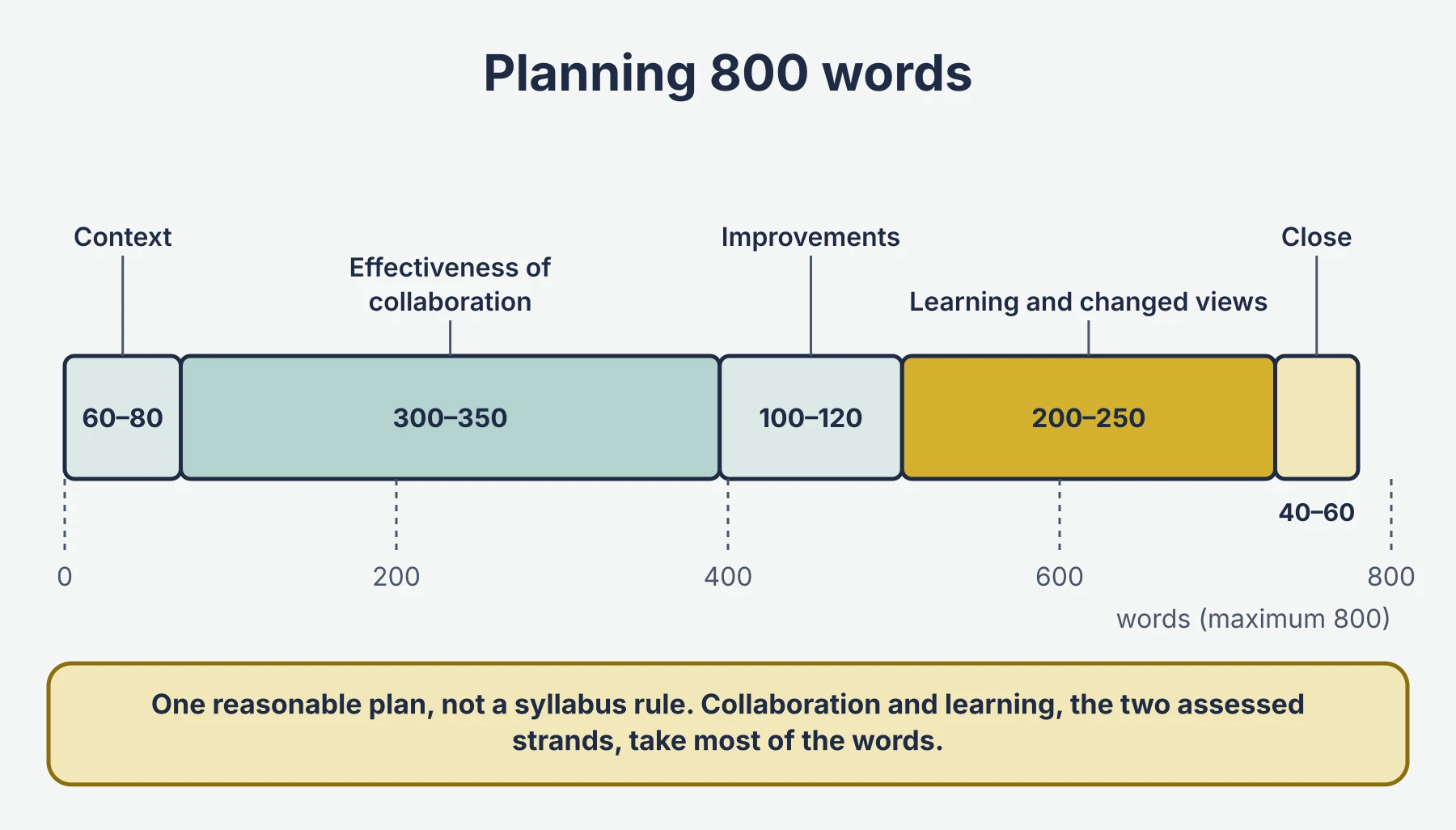
The syllabus sets a maximum of 800 words and names two assessed strands. One reasonable plan (not a syllabus rule):
| Section | Approximate words |
|---|---|
| Brief context: the problem statement and your role | 60-80 |
| Effectiveness of collaboration: two or three aspects with evidence | 300-350 |
| Improvements linked to weaknesses | 100-120 |
| Learning and changes to personal views | 200-250 |
| Closing judgement on the collaboration and your learning | 40-60 |
Worked example: weak and strong paragraphs
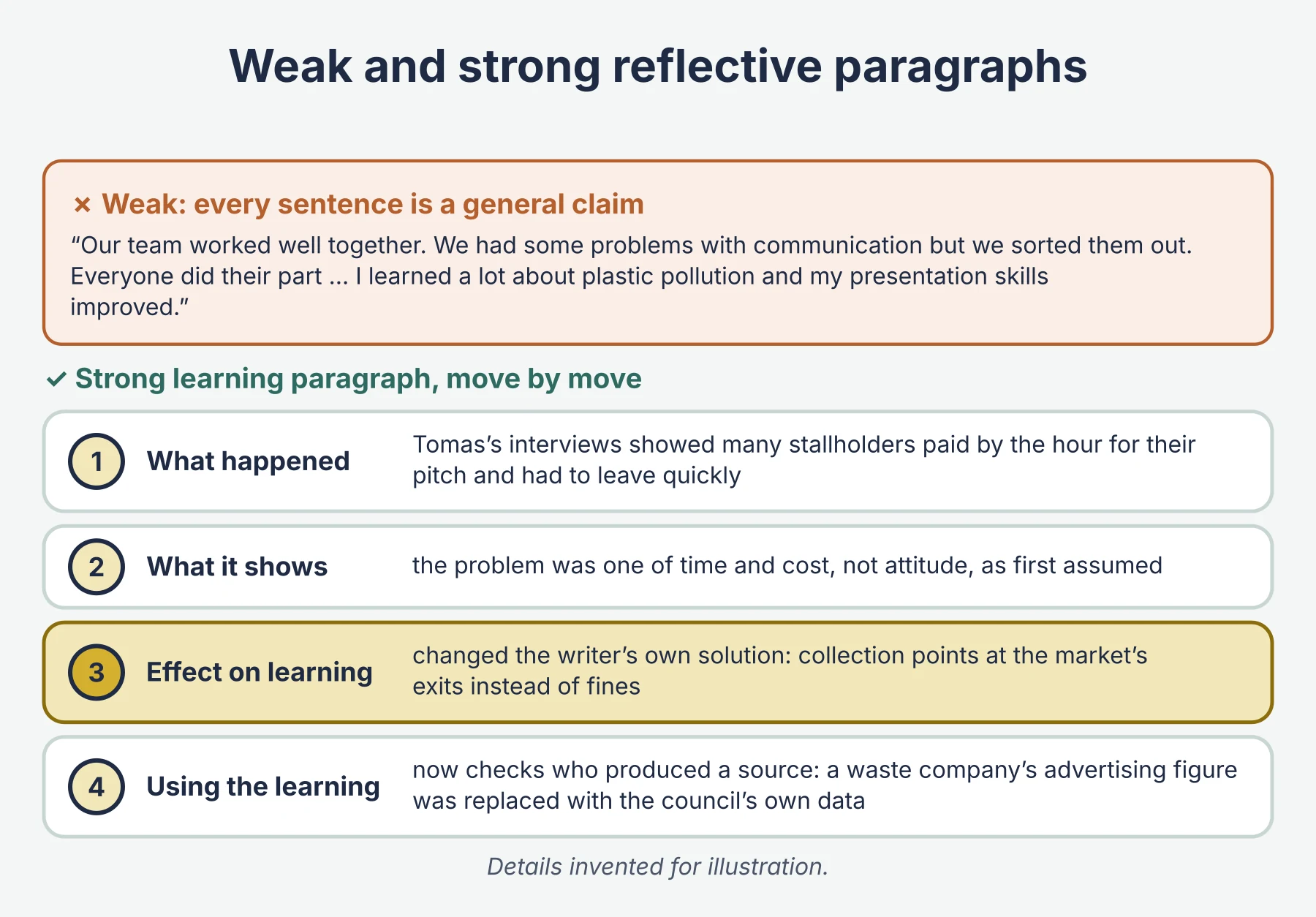
The details are invented for illustration.
Weak. “Our team worked well together. We had some problems with communication but we sorted them out. Everyone did their part and we all helped each other. I learned a lot about plastic pollution and my presentation skills improved.”
Every sentence is a general claim. There is no evidence, no evaluation against the goal, no improvement and no specific learning.
Strong (collaboration). “Our team’s main strength was the way we agreed the problem statement. Each of us brought one possible problem to the first meeting and we tested each against whether four distinct perspectives could be argued, which led us to choose waste from the town’s weekly market rather than plastic pollution in general. This made the rest of the project easier, because every member had a clear angle from the start. Our main weakness was sharing research: in the third week Amira and I discovered we had both spent several days on the same council report, because we had agreed perspectives but not who would cover which sources. That duplication cost time I needed for interviews, so it weakened my research. If we repeated the project, I would suggest a shared source list, updated after each session, so that overlaps are visible within a day.”
Strong (learning). “The most important change in my thinking came from Tomas’s economic perspective. I began the project assuming that stallholders who left waste behind simply did not care. His interviews showed that many paid by the hour for their pitch and had to leave quickly, which made me see the problem as one of time and cost rather than attitude. That changed my own solution: instead of fines, I proposed collection points at the market’s exits. I also learned to check who produced a source before using it; in my first draft I relied on a figure from a waste company’s advertising, which I replaced with the council’s own data.”
The strong paragraphs follow the pattern: specific event, what it shows, effect on the goal or on learning, and what would change.
Writing fairly about teammates
- Focus on what happened and its effect, not on blame.
- Include your own part in weaknesses as well as strengths.
- Use names or roles consistently, so that the reader can follow who did what.
- Recognise contributions: noticing what others did well is part of evaluating collaboration accurately.
Common mistakes
- Retelling the research or the solution, which belongs in the presentation.
- All praise or all blame: either hides the real strengths and weaknesses.
- No evidence: general claims about communication or effort.
- Improvements that do not match weaknesses you identified.
- Listing learning without saying what changed or why it matters.
- Ignoring the collaborative experience when reflecting on personal views.
- Going over 800 words: plan to the limit from the start.
Condense this with the reflective paper revision notes and practise it with the reflective paper practice questions. For the 30-mark part of the component, see the presentation and justifying a solution.
Frequently asked questions
Is the reflective paper a summary of my presentation? No. It focuses on “how effectively the team worked together, what could be improved, and any changes to their personal views shaped by the collaborative experience”.
Can I criticise my teammates? You should evaluate weaknesses honestly, but focus on events and their effects, include your own part, and recognise strengths too.
What if our team worked very well? Explain what made it effective in relation to the team’s goal, with evidence, and still identify what could be improved; even effective teams can say how they would work better next time.
Related resources
-
Practice questions
Cambridge International AS & A Level Global Perspectives & Research (9239): Team Project – The Reflective Paper – Practice Questions
Original practice on the 9239 Team Project reflective paper: evaluating collaboration, writing improvements, fair evaluation of teammates and learning.
Global Perspectives · Cambridge · AS Level
Try questions -
Revision notes
Cambridge International AS & A Level Global Perspectives & Research (9239): Team Project – The Reflective Paper – Revision Notes
Recall notes on the 9239 reflective paper: the two AO2 strands, aspects of collaboration, evidence, improvements, learning, an 800-word plan and a self-test.
Global Perspectives · Cambridge · AS Level
Revise topic -
Study guides
Cambridge A-Level Global Perspectives & Research: The Team Project (9239)
How the 9239 Team Project works: researching a local problem with global relevance, the individual presentation and reflective paper, for Cambridge AS Level.
Global Perspectives · Cambridge · AS Level
Read guide
Studying Global Perspectives?
This page is free and stays free. Marlbridge is not offering Global Perspectives classes at the moment, so there is no tuition to book for it. The free study resources stay open to everyone.
Get free revision emails (optional)
Occasional emails with practice questions, worked explanations and links to free resources for the qualification and subjects you choose. No spam, and you can unsubscribe from any email. The free tools on this site never need an email.