
Revision Notes
Cambridge International AS & A Level Global Perspectives & Research (9239): Team Project – The Presentation and Justifying a Solution – Revision Notes
Recall notes on the 9239 Team Project presentation: the seven assessed skills, analysing the problem, effective and workable solutions, AO3 and a self-test.
- Subject
- Global Perspectives
- Level
- AS LEVEL
- Topic
- Component 3 – Team Project
- Author
- Marlbridge Academic Team
- Updated
- Reviewed by
- Ammar Bilal (what this means)
Aligned to Cambridge A Level Global Perspectives (9239), 2026-2028. Official specification .
Syllabus page (what it covers and how it is assessed): Cambridge A Level Global Perspectives.
Syllabus points this page covers
9239 (AS Level)
- 3.1 Presentation
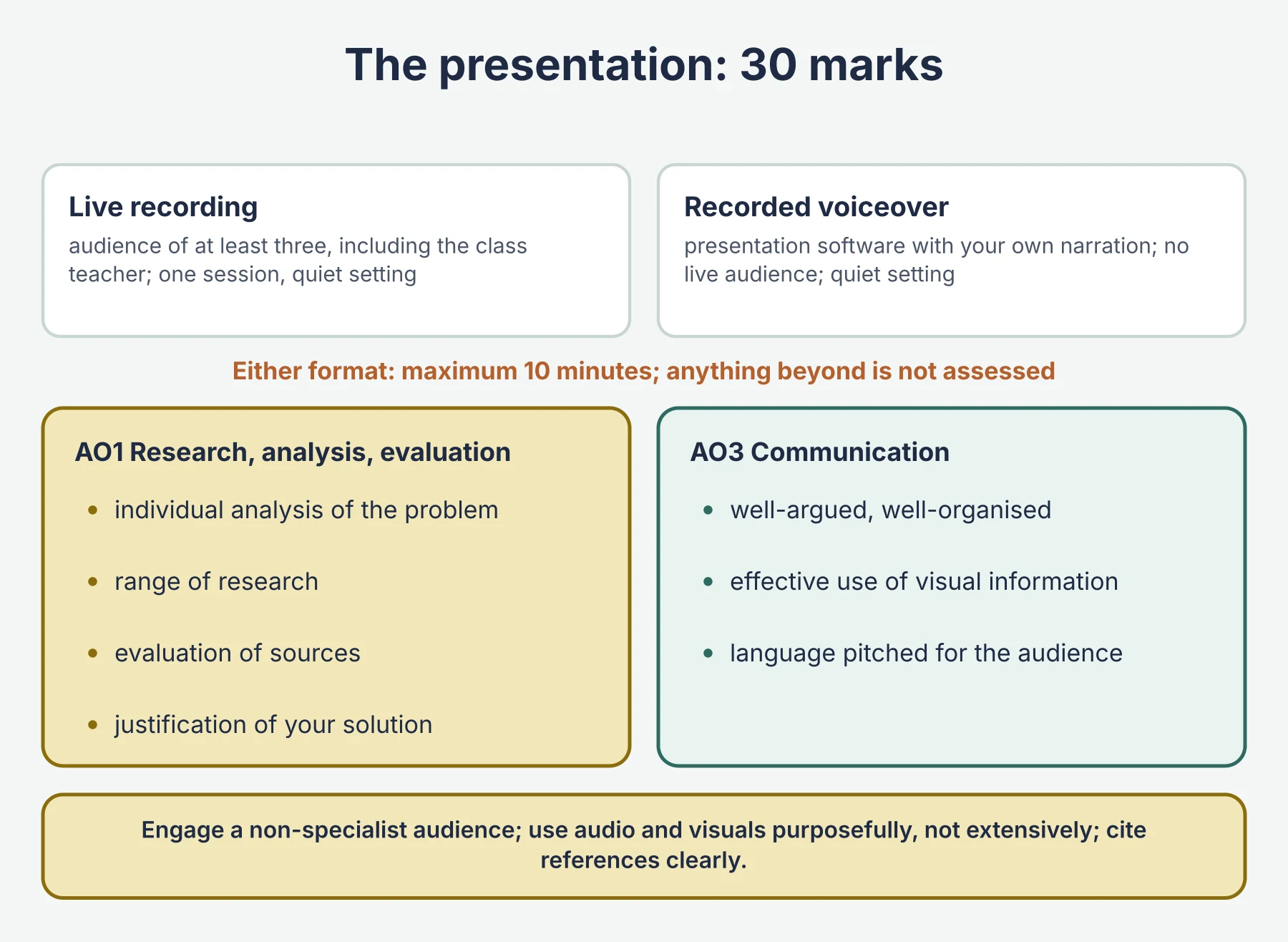
These notes cover the presentation in Component 3, the Team Project, of Cambridge International AS & A Level Global Perspectives & Research (9239), 2026-2028: “Each candidate will give a presentation about their research and preferred solution (10 minutes maximum)”, arguing “from their distinct perspective for an effective and workable solution to the problem”. For the component’s format and submission rules, see the Team Project study guide; for full explanations and a worked example, read the presentation study guide.
Core facts
- 30 marks of the component’s 40; maximum 10 minutes; work beyond 10 minutes is not assessed.
- Individual: “Team presentations are not permitted.”
- Live recording (audience of at least three, including the class teacher) or a presentation with recorded voiceover.
- Submitted with the audio and/or visual materials and a verbatim transcript.
- Component 3 weighting: AO1 40%, AO2 25%, AO3 35%. AO2 is assessed through the reflective paper, so the presentation carries the AO1 and AO3 marks.
The seven assessed skills
AO1: individual analysis of the problem; range of research; evaluation of sources; justification for the individual solution. AO3: a well-argued, well-organised argument; use of visual information; use of language to address the audience.
Key terms
| Term | Meaning |
|---|---|
| Problem statement | The team’s single statement of a local problem with global relevance |
| Individual analysis | Your own account of the problem’s nature, causes and scale through your perspective |
| Perspective | The lens you argue from, such as economic, environmental or social |
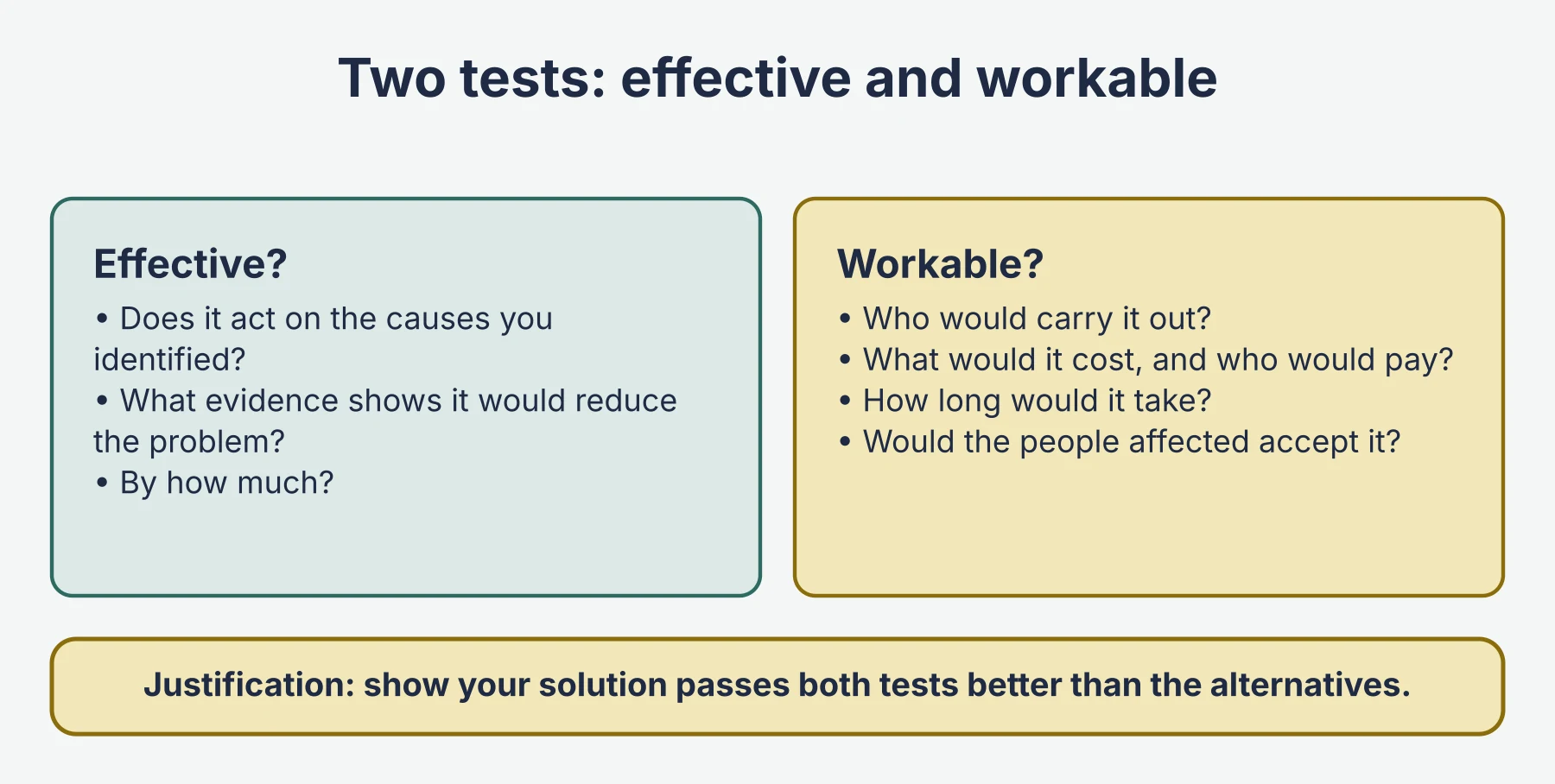
| Effective | The solution acts on the causes and would reduce the problem |
| Workable | The solution can be carried out: responsibility, cost, time, acceptance |
| Justification | Showing why your solution passes both tests better than alternatives |
| Non-specialist audience | Listeners without expert knowledge of the topic |
| Verbatim transcript | A word-for-word record of what you said |
Individual analysis: four questions
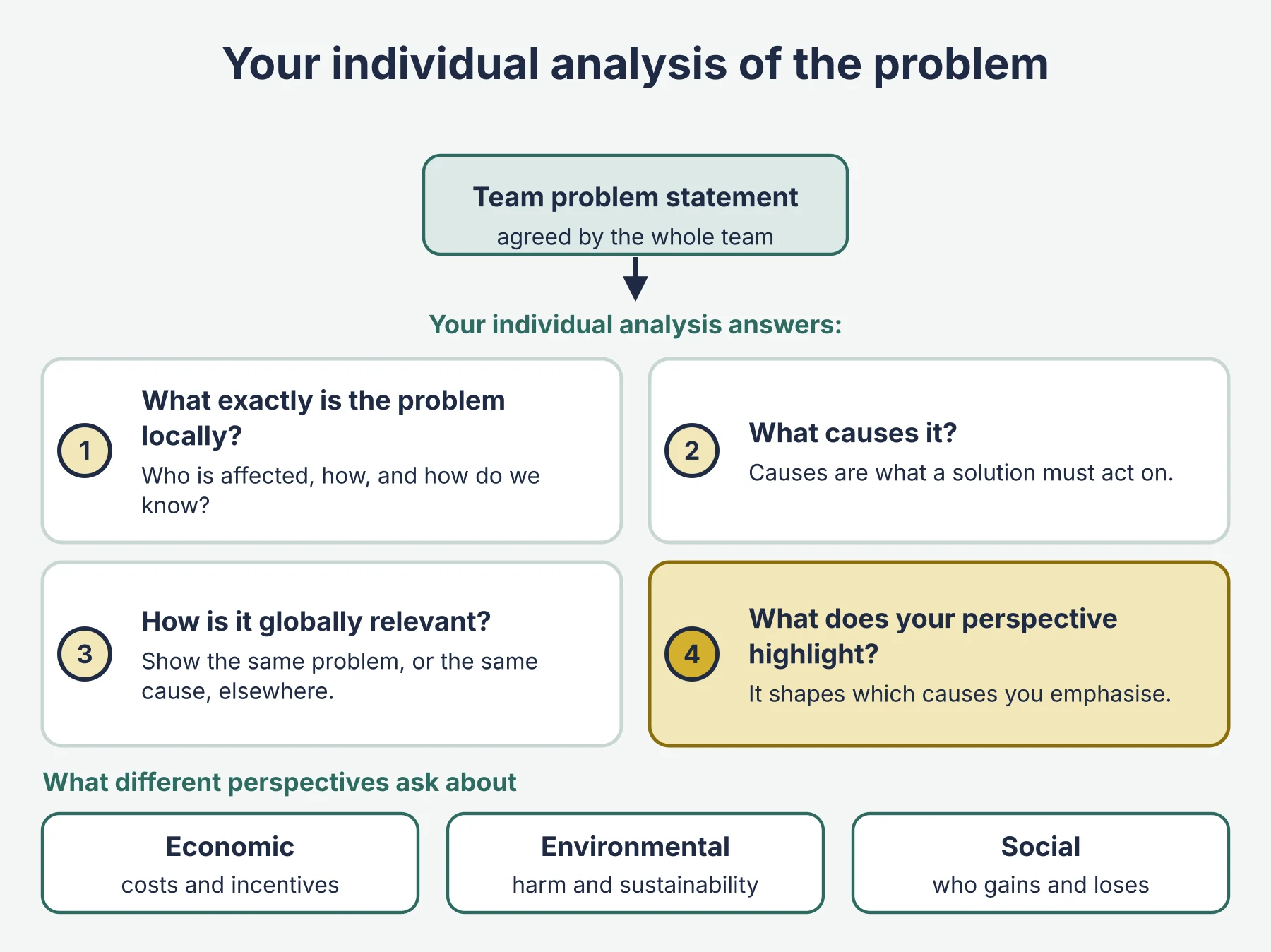
- What is the problem locally, for whom, and how do we know?
- What causes it?
- How is it globally relevant?
- What does your perspective highlight?
Range of research
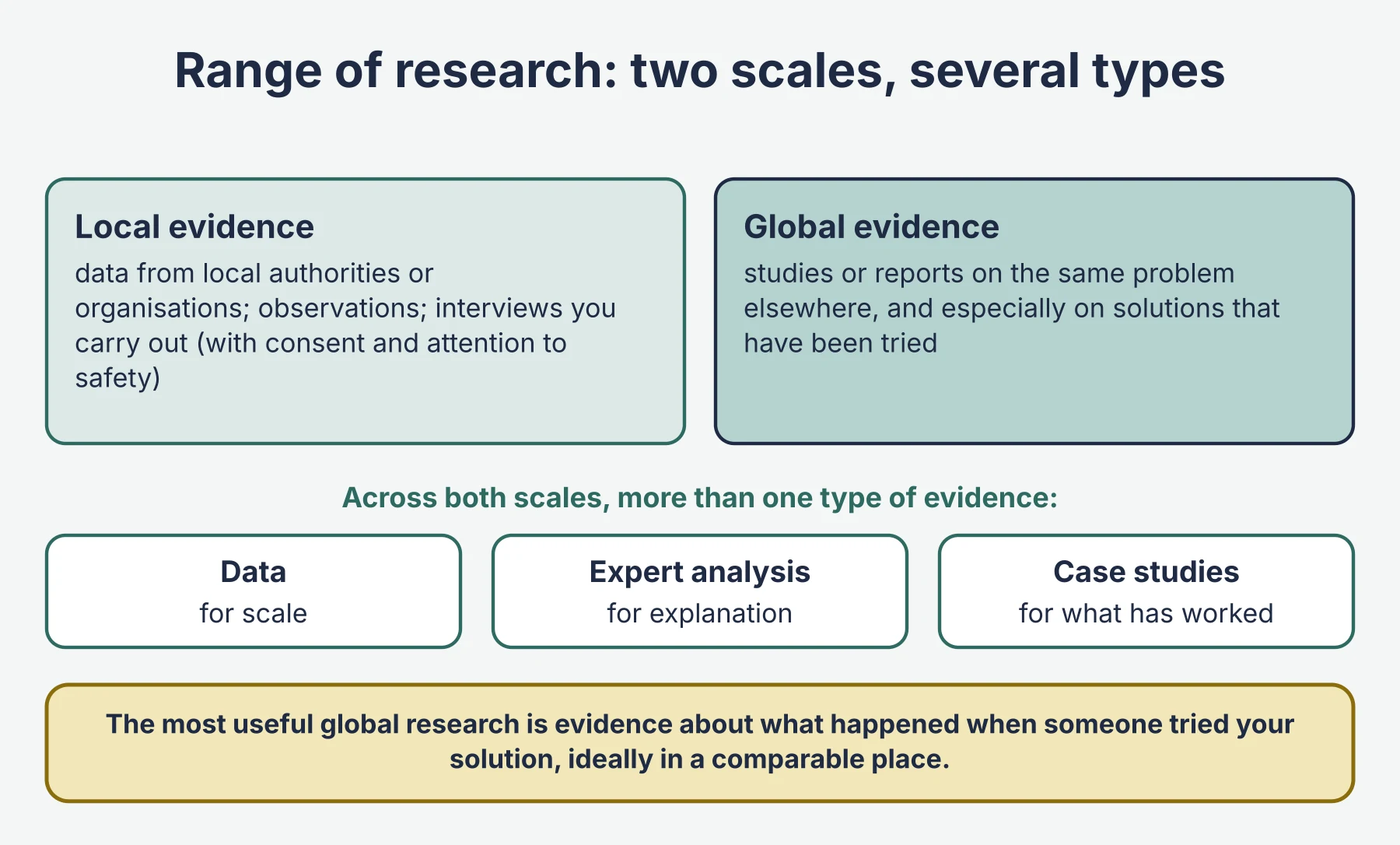
- Scale: local and global.
- Type: data, expert analysis, case studies, your own primary evidence.
- Most valuable: evidence from places that tried your solution.
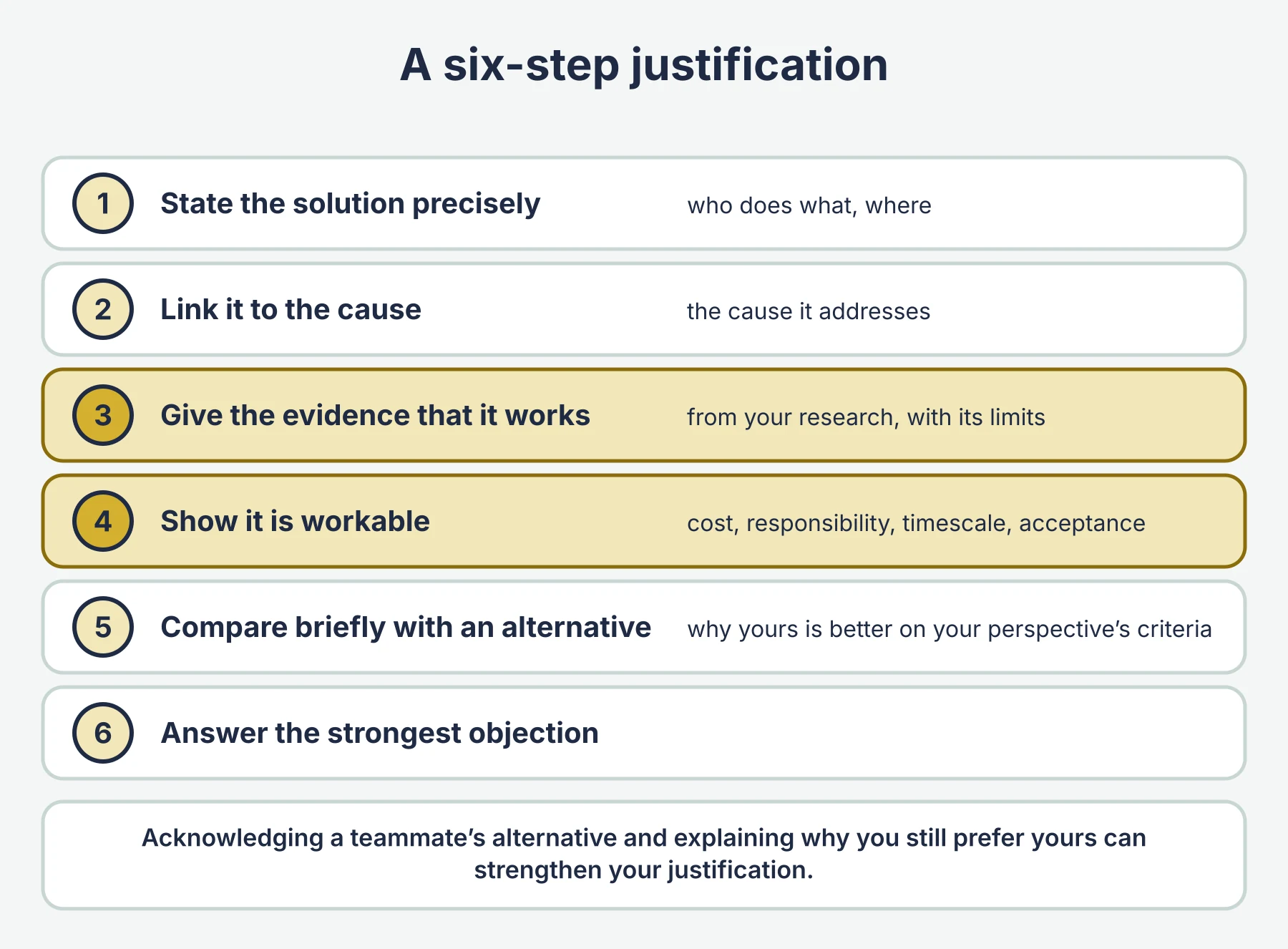
Justification in six moves
- State the solution precisely.
- Link it to a cause.
- Give evidence it works, with limits.
- Show it is workable.
- Compare with an alternative.
- Answer the strongest objection.
Condensed example: from assertion to justification
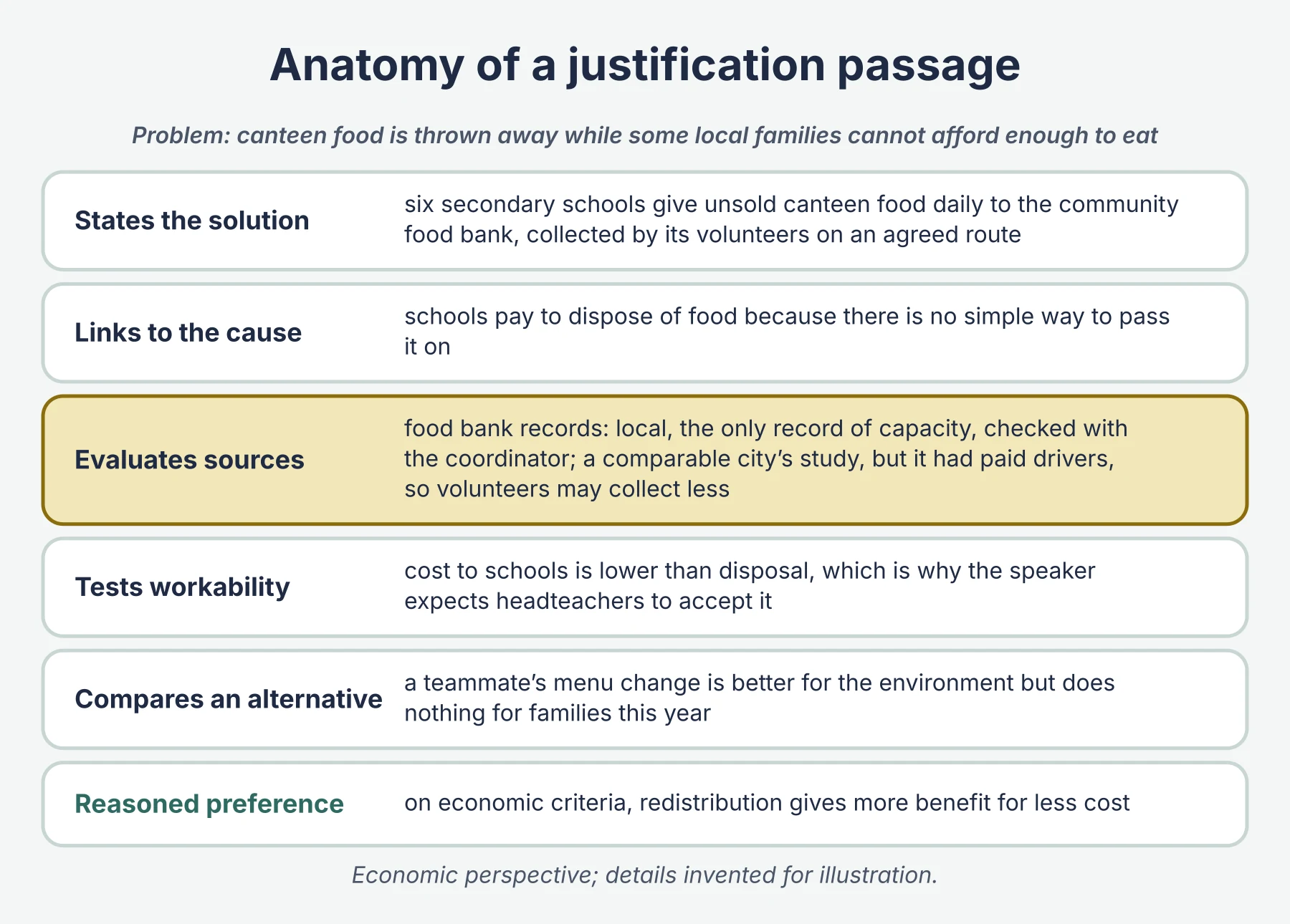
Problem: litter from takeaway packaging in a town’s central park; perspective: environmental.
- Assertion: “We should have more bins because litter is bad.”
- Justification: “The council’s own litter counts show most packaging is dropped within 50 metres of the three takeaway shops, where there are no bins (cause). A deposit scheme for takeaway containers, run with those shops, cut park litter in a comparable town, although that town also increased fines (evidence with limit). It costs the shops little because deposits are returned (workable). Extra bins are cheaper still, but they collect litter rather than prevent it, so on environmental criteria the deposit scheme is better (alternative compared).”
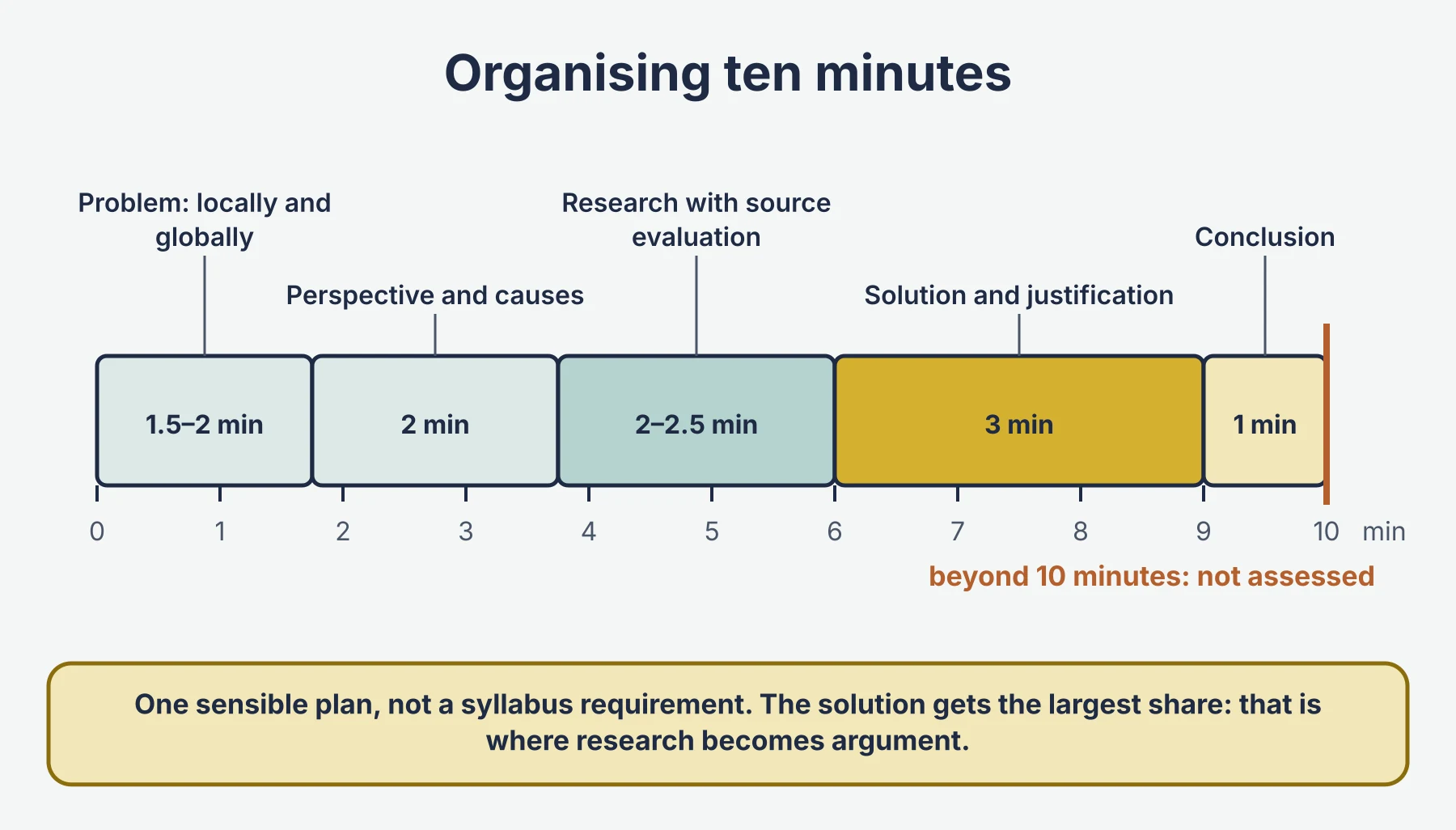
A ten-minute plan (suggested, not prescribed)
| Section | Time |
|---|---|
| Problem, local and global | 1.5-2 min |
| Perspective and causes | 2 min |
| Research with evaluation | 2-2.5 min |
| Solution and justification | 3 min |
| Conclusion | 1 min |
AO3 checklist
- Visuals that carry evidence; “fit for purpose”, not extensive.
- Short spoken sentences, signposts, defined terms, rounded numbers.
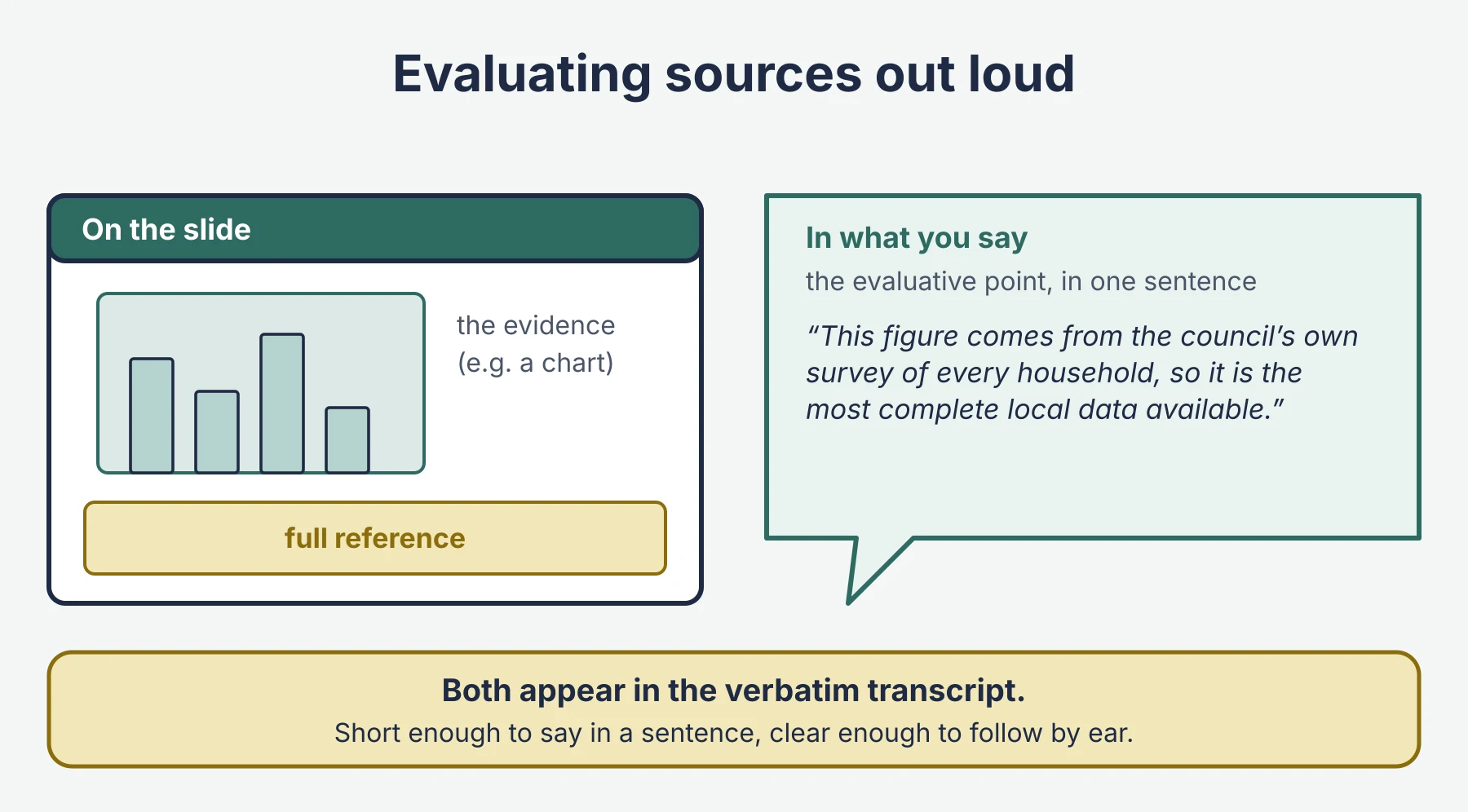
- References on slides where evidence appears, full list at the end.
- Transcript checked against the recording.
Exam traps
- Spending most of the time describing the problem.
- A solution that ignores the causes identified.
- No answer to who pays, who acts, or how long it takes.
- Summarising the whole team’s work instead of arguing your own perspective.
- Decorative images and crowded slides.
- Running over time so the solution is cut off.
- Evaluation of sources left off entirely because it “does not fit” a presentation.
Self-test
- What is the maximum length of the presentation, and what happens to anything beyond it?
- List the four AO1 skills assessed in the presentation.
- List the three AO3 skills.
- What is the difference between an effective and a workable solution?
- Why is evidence from places that tried your solution especially valuable?
- Give one way to evaluate a source in a single spoken sentence.
- What must be submitted alongside the recording?
- What does the syllabus say about the extent of audio and visual materials?
- Name two features of language suited to a listening audience.
- Why should the solution section get the largest share of time?
- Why can acknowledging a teammate’s alternative strengthen your justification?
Answers
- 10 minutes; work beyond the maximum running time is not included in the assessment.
- Individual analysis of the problem; range of research; evaluation of sources; justification for the individual solution.
- A well-argued, well-organised argument; use of visual information; use of language to address the audience.
- Effective: it acts on the causes and would reduce the problem. Workable: it can actually be carried out, considering responsibility, cost, time and acceptance.
- It shows whether the solution has worked in practice, which is direct support for justifying it.
- For example: “This survey covered every household in the town, so it is the most complete local data available.”
- The audio and/or visual materials used and a verbatim transcript.
- It “does not need to be extensive but rather should be fit for purpose”.
- Any two: short sentences; signposting; terms defined; numbers rounded and explained.
- It is where research becomes an argument and where justification, an AO1 skill, is shown.
- It shows you have weighed an alternative from another perspective and can explain why yours is better on your criteria.
Practise with the presentation practice questions.
Related resources
-
Study guides
Cambridge International AS & A Level Global Perspectives & Research (9239): Team Project – The Reflective Paper
How to write the 800-word 9239 Team Project reflective paper: evaluating collaboration with evidence, proposing improvements and reflecting on learning.
Global Perspectives · Cambridge · AS Level
Read guide -
Practice questions
Cambridge International AS & A Level Global Perspectives & Research (9239): Team Project – The Reflective Paper – Practice Questions
Original practice on the 9239 Team Project reflective paper: evaluating collaboration, writing improvements, fair evaluation of teammates and learning.
Global Perspectives · Cambridge · AS Level
Try questions -
Revision notes
Cambridge International AS & A Level Global Perspectives & Research (9239): Team Project – The Reflective Paper – Revision Notes
Recall notes on the 9239 reflective paper: the two AO2 strands, aspects of collaboration, evidence, improvements, learning, an 800-word plan and a self-test.
Global Perspectives · Cambridge · AS Level
Revise topic
Studying Global Perspectives?
This page is free and stays free. Marlbridge is not offering Global Perspectives classes at the moment, so there is no tuition to book for it. The free study resources stay open to everyone.
Get free revision emails (optional)
Occasional emails with practice questions, worked explanations and links to free resources for the qualification and subjects you choose. No spam, and you can unsubscribe from any email. The free tools on this site never need an email.