
Study Guides
Cambridge International AS & A Level Global Perspectives & Research (9239): Team Project – The Presentation and Justifying a Solution
How to build the 30-mark 9239 Team Project presentation: analysing the problem, researching your perspective and justifying a workable solution.
- Subject
- Global Perspectives
- Level
- AS LEVEL
- Topic
- Component 3 – Team Project
- Author
- Marlbridge Academic Team
- Updated
- Reviewed by
- Ammar Bilal (what this means)
Aligned to Cambridge A Level Global Perspectives (9239), 2026-2028. Official specification .
Syllabus page (what it covers and how it is assessed): Cambridge A Level Global Perspectives.
Syllabus points this page covers
9239 (AS Level)
- 3.1 Presentation
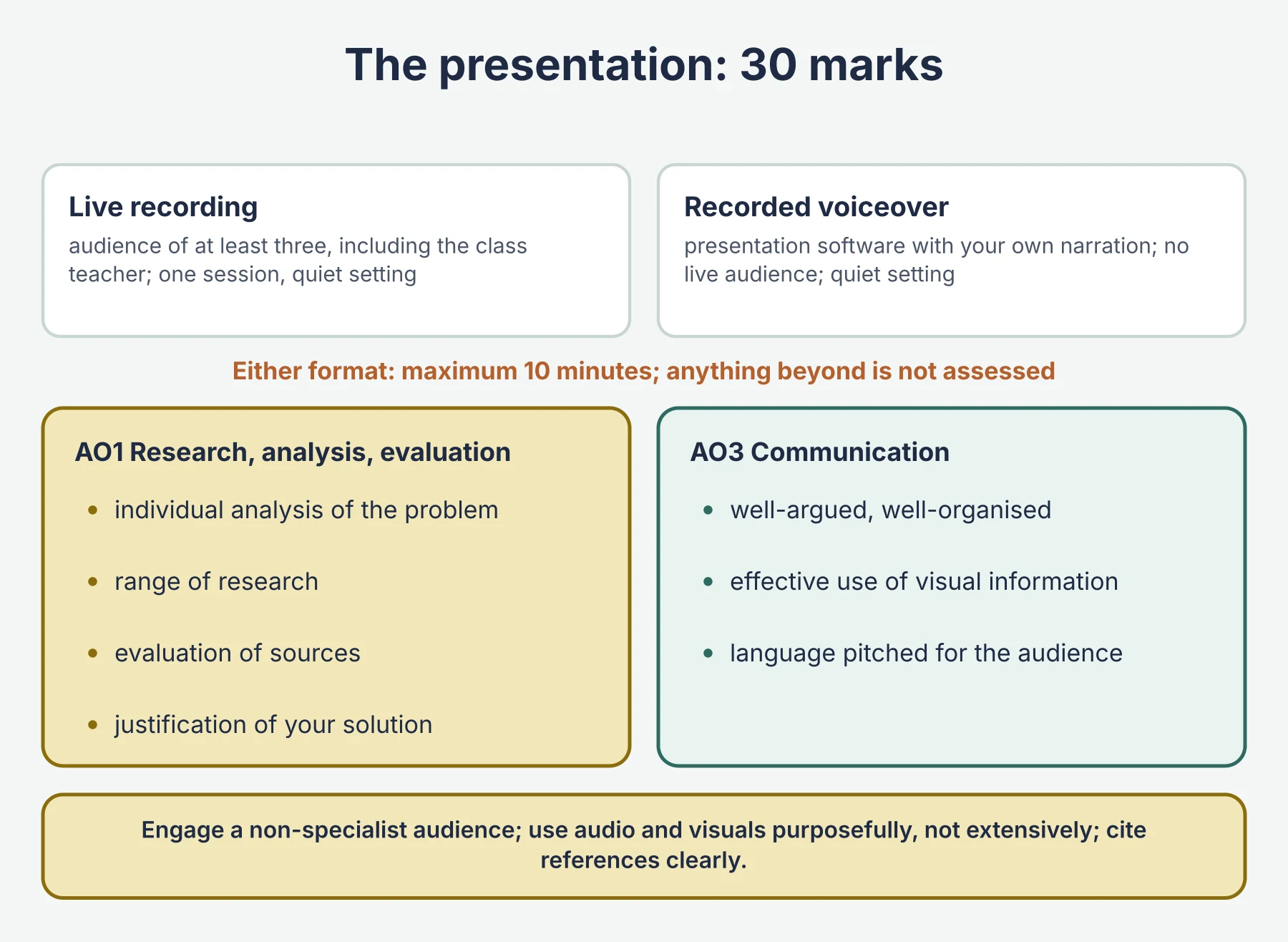
This guide covers the presentation in Component 3, the Team Project, of the Cambridge International AS & A Level Global Perspectives & Research (9239) syllabus for 2026-2028. The syllabus says: “Each candidate will give a presentation about their research and preferred solution (10 minutes maximum)”, and “Each team member is expected to argue from their distinct perspective for an effective and workable solution to the problem.” For the format, the recording options and what is submitted, read the Team Project study guide first. This page goes deeper on how to turn your research into a justified solution and a presentation that carries it.
What the presentation is assessed on
The syllabus lists seven skills, four under AO1 and three under AO3:
| Skill (syllabus wording) | AO | In practice |
|---|---|---|
| “individual analysis of the problem identified by the team” | AO1 | Your own account of the problem through your perspective |
| “range of research undertaken” | AO1 | Local and global sources, of more than one type |
| “evaluation of sources” | AO1 | Saying how far each key source can be trusted |
| “justification for their individual solution” | AO1 | Showing why your solution is effective and workable |
| “production of a well-argued, well-organised argument” | AO3 | A clear line from problem to solution |
| “use of visual information” | AO3 | Visuals that carry evidence, not decoration |
| “use of language to address the audience” | AO3 | Language a non-specialist listener can follow |
The presentation should also “be engaging to a non-specialist audience”, “include audio and visual elements in an effective way” and “use appropriate terms and cite references clearly and accurately”.
Step 1: your individual analysis of the problem
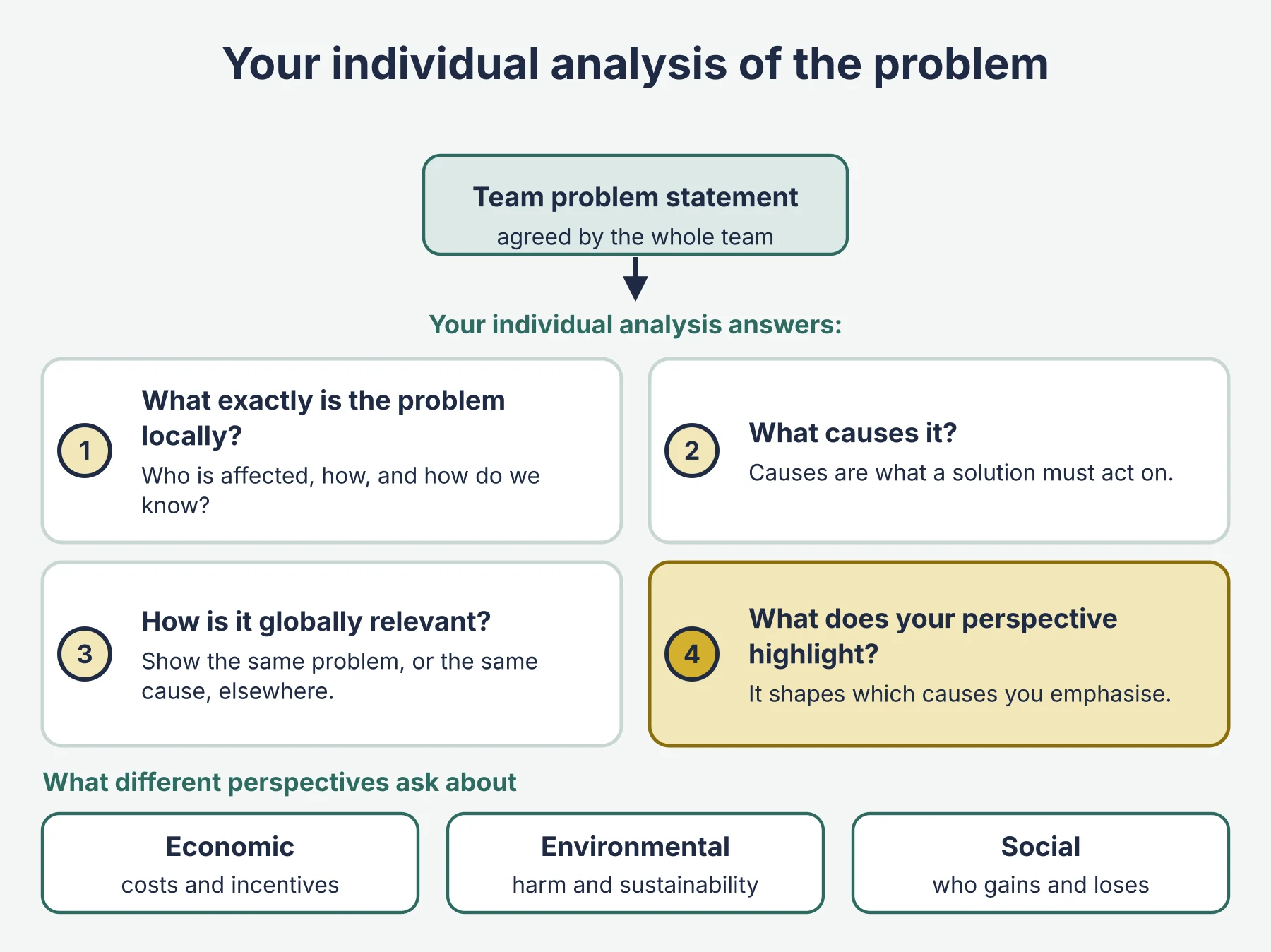
Your team agreed one problem statement. Your analysis is your own reading of it through your perspective. A strong analysis answers four questions:
- What exactly is the problem locally? Who is affected, how, and how do we know?
- What causes it? Causes are what a solution must act on; a solution that ignores the cause will not be effective.
- How is it globally relevant? The syllabus asks teams to explore the problem “from local and global perspectives”. Show the same problem, or the same cause, elsewhere.
- What does your perspective highlight? An economic perspective asks about costs and incentives; an environmental one about harm and sustainability; a social one about who gains and loses. Your perspective should shape which causes you emphasise.
Step 2: range of research
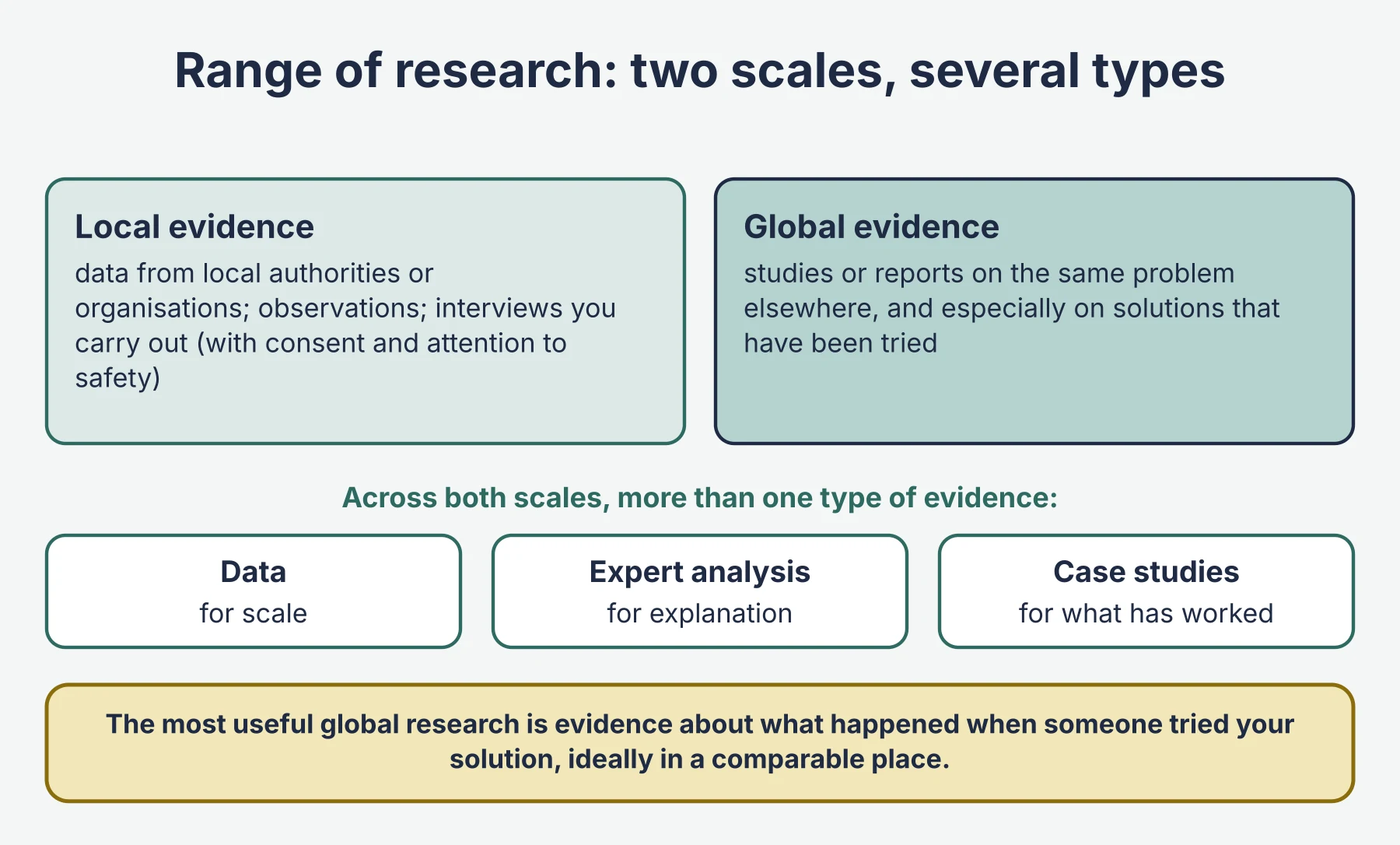
Aim for research that covers both scales and more than one type of evidence:
- Local evidence: data from local authorities or organisations, observations, or interviews you carry out (with consent and attention to safety).
- Global evidence: studies or reports on the same problem elsewhere, and especially on solutions that have been tried.
- Different types: data for scale, expert analysis for explanation, case studies for what has worked.
The most useful global research for your solution is evidence about what happened when someone tried it. A solution you can show working in a comparable place is much easier to justify.
Step 3: evaluating sources out loud
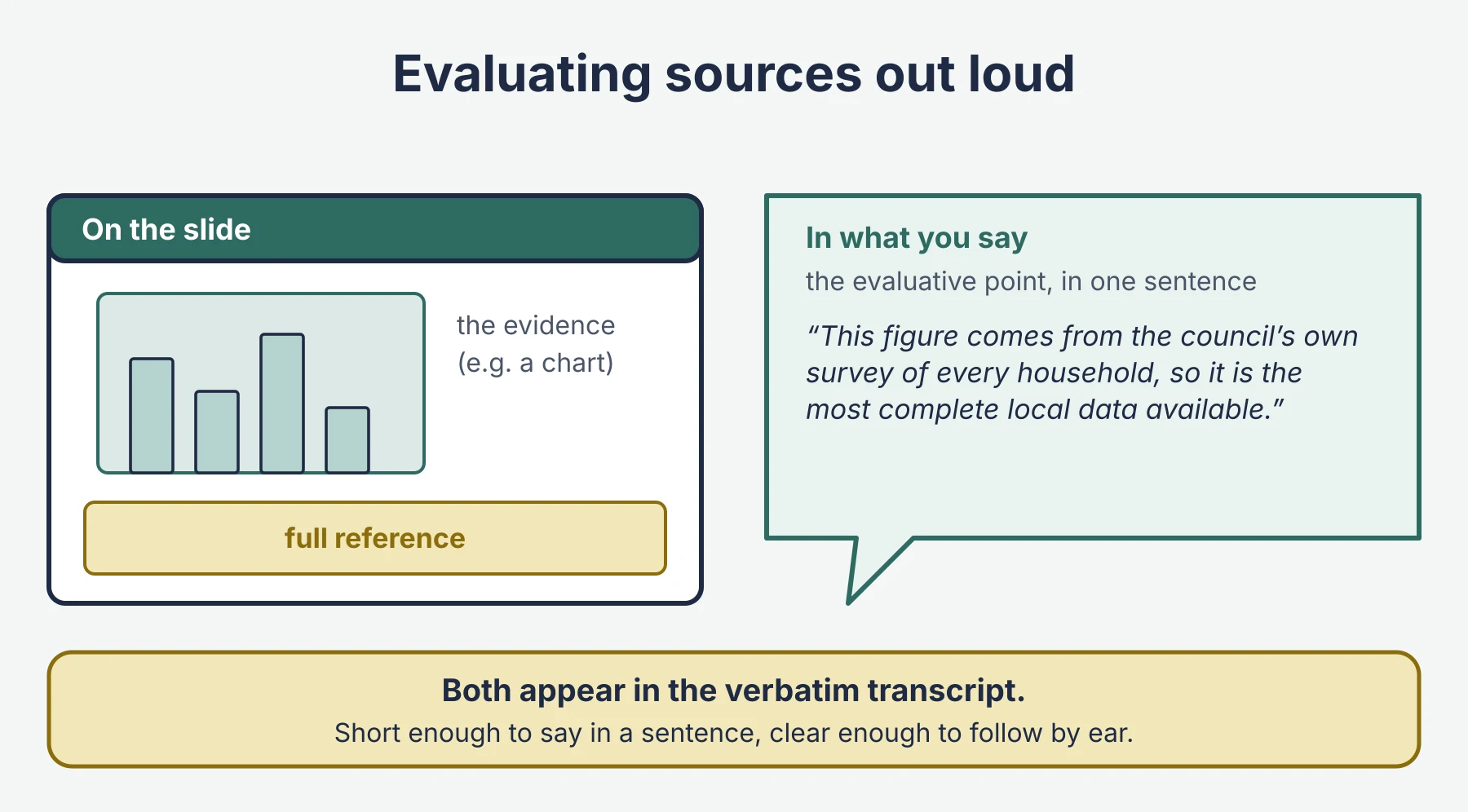
In a presentation, evaluation must be short enough to say in a sentence and clear enough to follow by ear:
- “This figure comes from the council’s own survey of every household, so it is the most complete local data available.”
- “This study is from a much larger city, so its results may overstate what we could achieve here.”
Put the full reference on the slide and the evaluative point in what you say. Both appear in the transcript.
Step 4: building a solution that is “effective and workable”
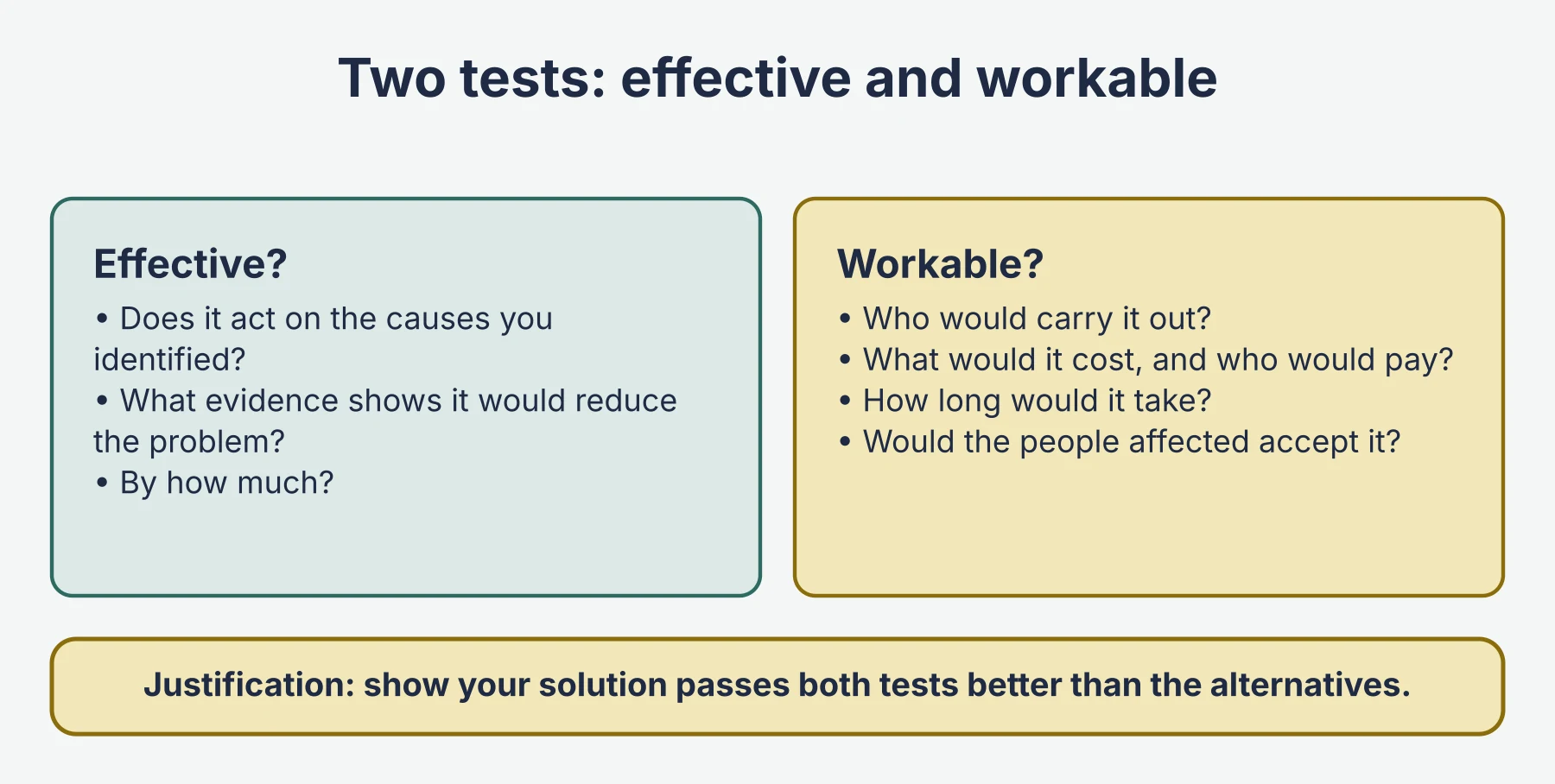
The syllabus pairs two words, and they are different tests:
| Test | Questions to answer |
|---|---|
| Effective | Does it act on the causes you identified? What evidence shows it would reduce the problem, and by how much? |
| Workable | Who would carry it out? What would it cost, and who would pay? How long would it take? Would the people affected accept it? |
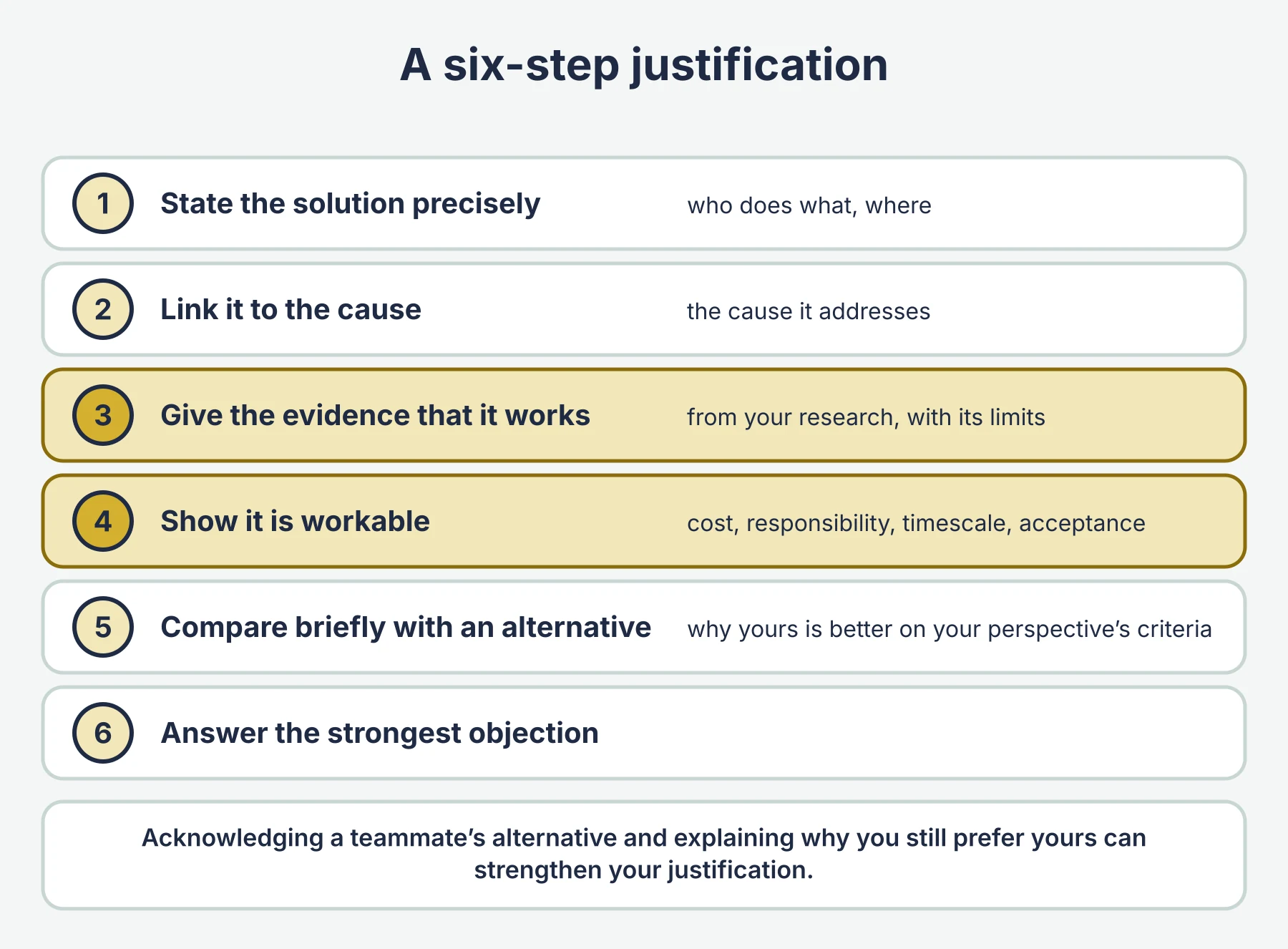
Justification means showing your solution passes both tests better than the alternatives. A clear structure is:
- State the solution precisely: who does what, where.
- Link it to the cause it addresses.
- Give the evidence that it works, from your research, with its limits.
- Show it is workable: cost, responsibility, timescale, acceptance.
- Compare briefly with an alternative and say why yours is better on your perspective’s criteria.
- Answer the strongest objection.
Your teammates will propose different solutions from their perspectives. You do not need to agree with them, but acknowledging a teammate’s alternative and explaining why you still prefer yours can strengthen your justification.
Step 5: organising ten minutes
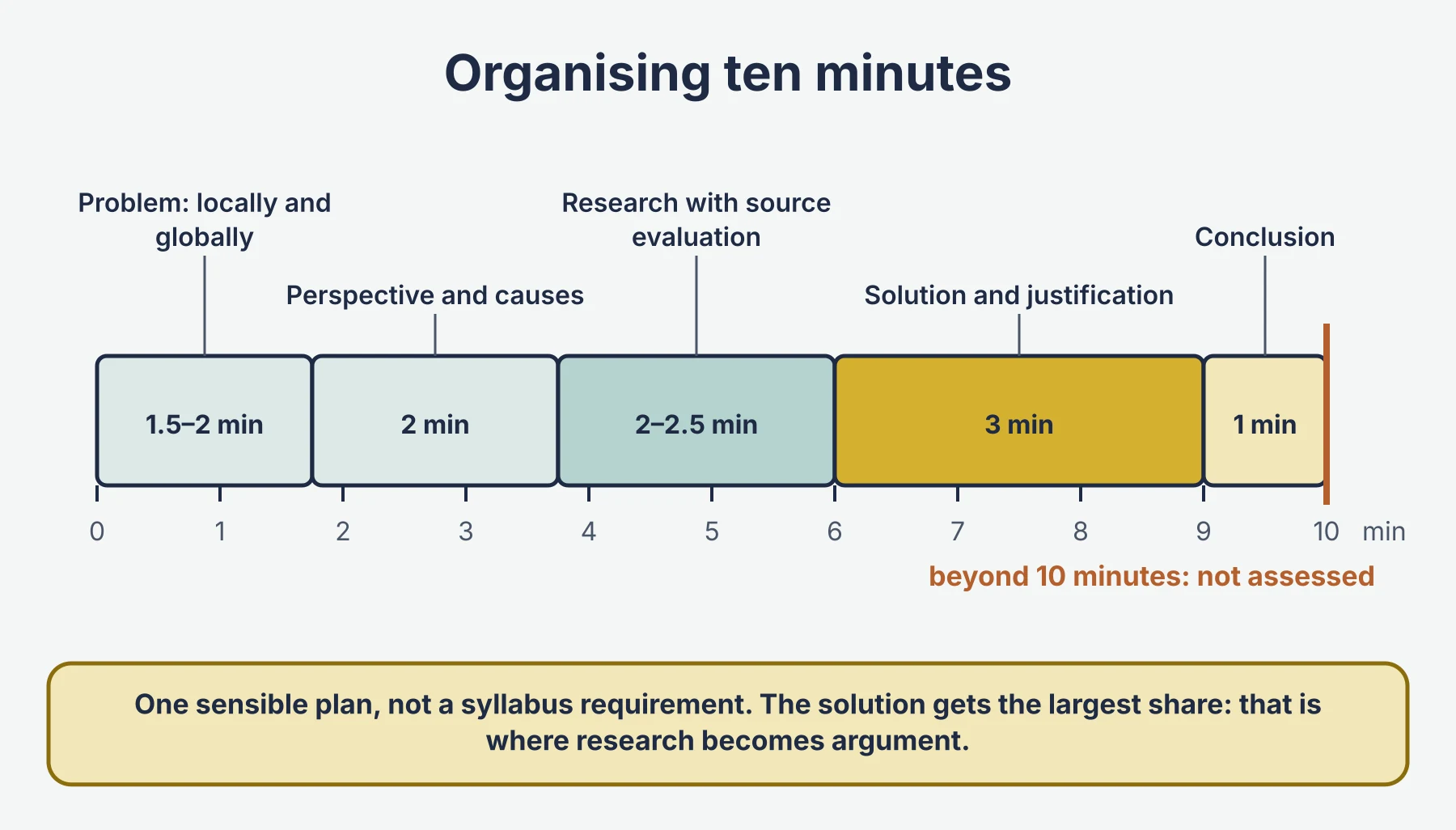
The syllabus sets a maximum of 10 minutes, and “Work beyond the maximum running time will not be included in the assessment.” The timing below is one sensible plan, not a syllabus requirement:
| Section | Approximate time |
|---|---|
| The problem and why it matters, locally and globally | 1.5-2 minutes |
| Your perspective and your analysis of causes | 2 minutes |
| Research findings with source evaluation | 2-2.5 minutes |
| Your solution and its justification | 3 minutes |
| Conclusion: why this solution, what next | 1 minute |
The solution and its justification deserve the largest share, because that is where your research becomes an argument.
Visual information and language (AO3)
- Visuals that carry evidence. A chart of local data, a map showing where the problem occurs, a before-and-after comparison from a place that tried your solution. Each visual should make a point you then explain.
- Fit for purpose. The syllabus notes that “the use of audio and/or visual materials does not need to be extensive but rather should be fit for purpose”. A few strong visuals beat many crowded slides.
- Language for a listener. Short sentences; signposts (“My solution has two parts”); key terms defined the first time; numbers rounded and explained.
- Citations. Short references on the slide where the evidence appears, with full references at the end.
- Transcript. A verbatim transcript is submitted, so rehearse from a script or detailed notes and check the transcript matches what you said.
Worked example: a justification passage
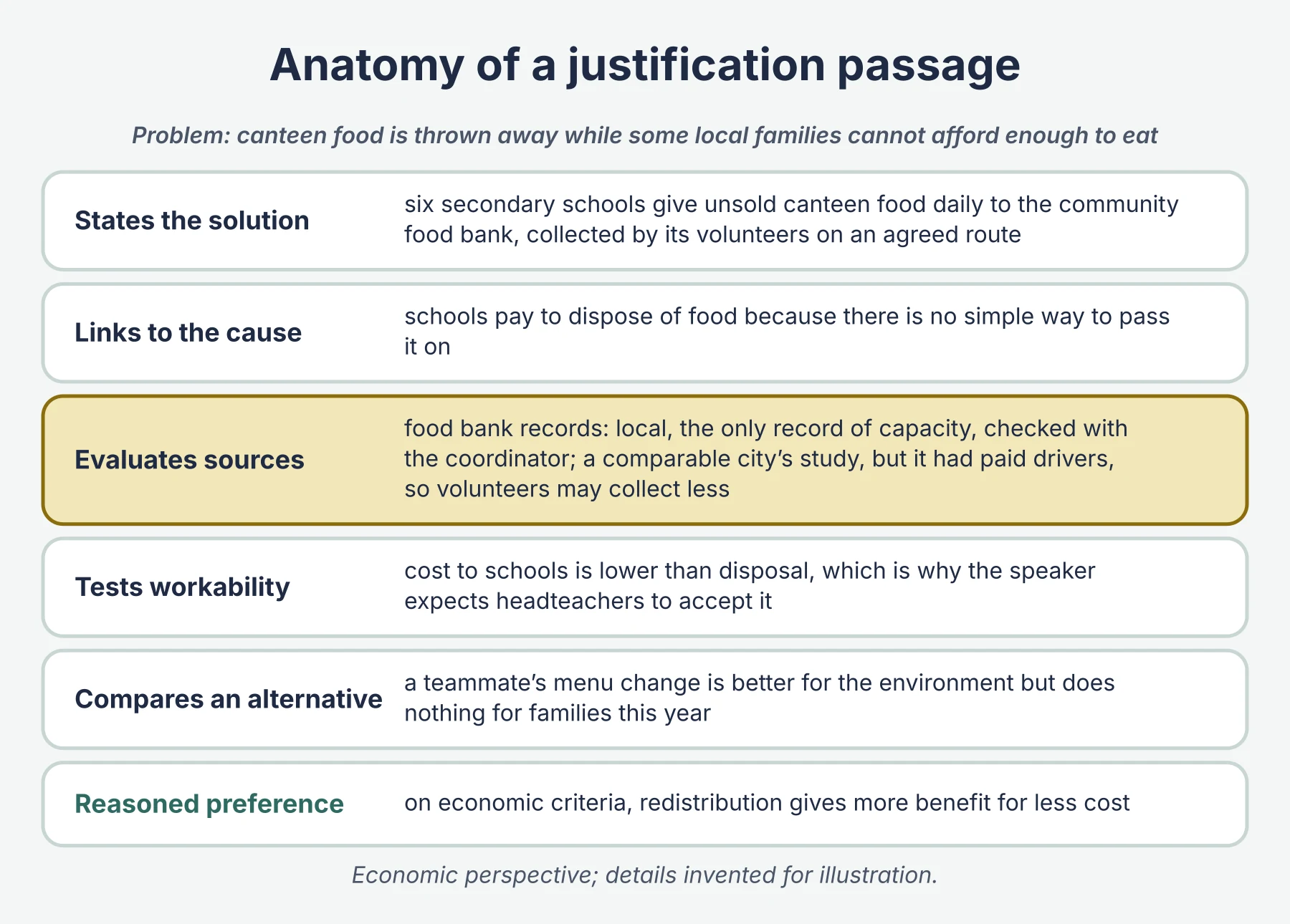
Team problem statement: “Food from school canteens in our town is thrown away while some local families cannot afford enough to eat.” One member presents from an economic perspective. The details below are invented for illustration.
“My solution is for the town’s six secondary schools to give their unsold canteen food each day to the community food bank, collected by its volunteers on an agreed route. This tackles the cause I identified: schools pay to dispose of food because there is no simple way to pass it on. The food bank’s own records show that it already collects from two supermarkets on the same streets, so the route exists; that is a local source, but it is the only record of the bank’s capacity, and I checked it with the bank’s coordinator. A study of a similar scheme in a city of comparable size found that most surplus school food could be redistributed this way, although that city had paid drivers, so our volunteer-based version may collect less. The cost to schools is lower than disposal, which is why I think headteachers will accept it. A teammate argued instead for reducing waste at source by changing menus; that is better for the environment, but it does nothing for families in need this year, and on my economic criteria the redistribution scheme gives more benefit for less cost.”
The passage states the solution, links it to a cause, evaluates two sources in passing, tests workability, compares with an alternative and reaches a reasoned preference.
Common mistakes
- Describing the problem for most of the time and leaving a minute for the solution.
- A solution that does not act on the causes the analysis identified.
- Effective but not workable: no answer to who pays, who acts or how long it takes.
- A team presentation in disguise: summarising all members’ findings instead of arguing your own perspective.
- Decorative visuals: images with no evidence or point.
- Specialist language that a non-specialist audience cannot follow.
- Running over 10 minutes, so the final part, often the solution, is not assessed.
Condense this with the Team Project presentation revision notes and practise it with the Team Project presentation practice questions. For the 10-mark written part of the component, see the reflective paper.
Frequently asked questions
Does my solution have to differ from my teammates’ solutions? Each member argues “from their distinct perspective” for their own solution, so solutions usually differ. What matters is that yours is justified from your own research and perspective.
Can my teacher check my presentation? Advice must stay general. The syllabus says teachers must not prepare any part of a presentation or suggest amendments to it.
How many visuals should I use? The syllabus does not set a number. It says materials should be “fit for purpose”, so use visuals that each support a point in your argument.
Related resources
-
Practice questions
Cambridge International AS & A Level Global Perspectives & Research (9239): Team Project – The Presentation and Justifying a Solution – Practice Questions
Original practice on the 9239 Team Project presentation: analysing problems, testing solutions, spoken source evaluation, timing and AO3 communication.
Global Perspectives · Cambridge · AS Level
Try questions -
Revision notes
Cambridge International AS & A Level Global Perspectives & Research (9239): Team Project – The Presentation and Justifying a Solution – Revision Notes
Recall notes on the 9239 Team Project presentation: the seven assessed skills, analysing the problem, effective and workable solutions, AO3 and a self-test.
Global Perspectives · Cambridge · AS Level
Revise topic -
Study guides
Cambridge International AS & A Level Global Perspectives & Research (9239): Team Project – The Reflective Paper
How to write the 800-word 9239 Team Project reflective paper: evaluating collaboration with evidence, proposing improvements and reflecting on learning.
Global Perspectives · Cambridge · AS Level
Read guide
Studying Global Perspectives?
This page is free and stays free. Marlbridge is not offering Global Perspectives classes at the moment, so there is no tuition to book for it. The free study resources stay open to everyone.
Get free revision emails (optional)
Occasional emails with practice questions, worked explanations and links to free resources for the qualification and subjects you choose. No spam, and you can unsubscribe from any email. The free tools on this site never need an email.