
Study Guides
Cambridge A Level Law (9084): Elements of a crime
Actus reus, omissions, causation, direct and oblique intention and recklessness, with leading cases and a worked problem, for Cambridge Law 9084 subtopic 2.1.
- Subject
- Law
- Level
- AS LEVEL
- Topic
- Topic 2 – Criminal Law
- Author
- Marlbridge Academic Team
- Updated
- Reviewed by
- Aizaz Raoof Ali (what this means)
Aligned to Cambridge A Level Law (9084), 2026-2028. Official specification .
Syllabus page (what it covers and how it is assessed): Cambridge A Level Law.
Syllabus points this page covers
9084 (AS Level)
- 2.1 Elements of a crime
Found an error? Report a correction.
Need help with this topic? Request a free trial class for A Level Law (9084).
Subtopic 2.1 sets out the principles of fault that underpin every offence on Paper 2 Criminal Law. The syllabus has two strands: actus reus (2.1.1), covering conduct, omissions and causation, and mens rea (2.1.2), covering direct and oblique intention and recklessness. The Topic 2 overview gives the definitions; this guide adds the cases, the tests and the reasoning you need to apply them to a scenario. Many leading cases on causation and intention are homicide cases, but the principles apply across the criminal law, including the property offences in 2.2.
The basic principle
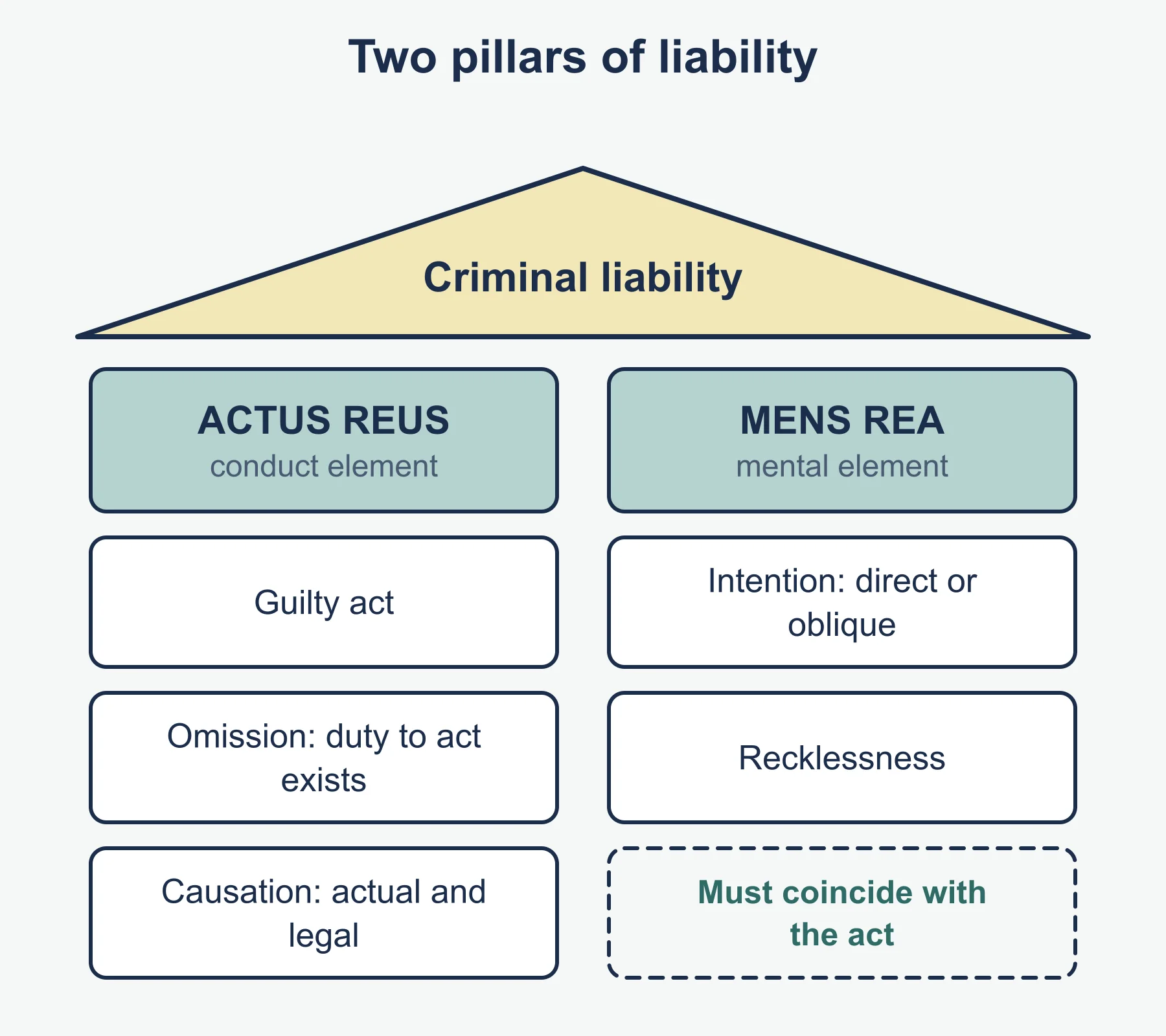
Actus non facit reum nisi mens sit rea: an act does not make a person guilty unless the mind is also guilty. Liability normally requires a prohibited act, omission or state of affairs, and a blameworthy state of mind. This reflects the idea that the criminal law should punish those who chose to do wrong, not those who caused harm by pure accident.
2.1.1 Actus reus
Actus reus as the conduct element
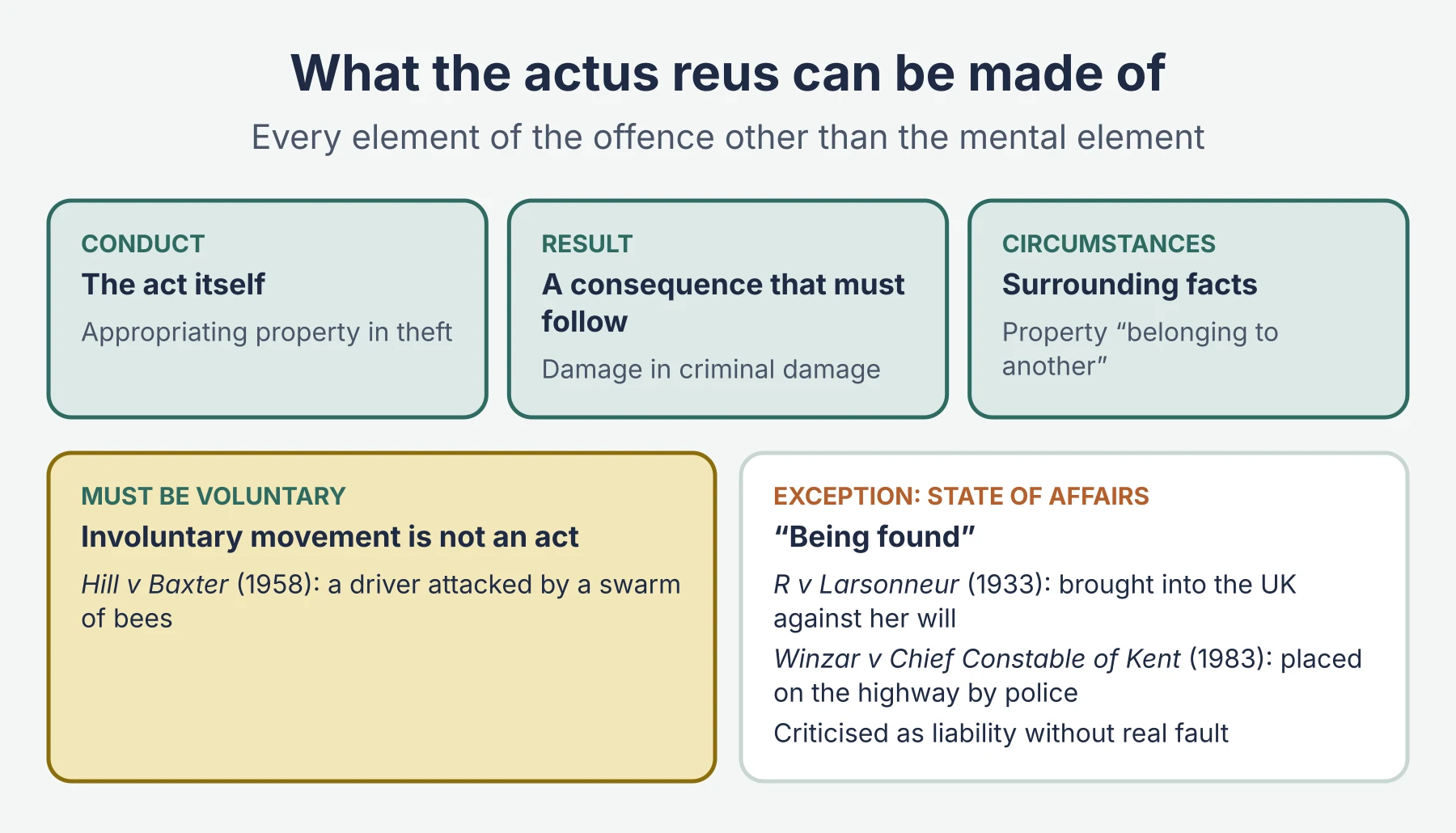
The actus reus is every element of the offence other than the mental element. It may be:
- conduct – the act itself, such as appropriating property in theft;
- a result – a consequence that must follow, such as damage in criminal damage;
- circumstances – surrounding facts, such as property “belonging to another”.
The conduct must be voluntary. In Hill v Baxter (1958) the court gave the example of a driver attacked by a swarm of bees, whose movements would not be voluntary acts. Exceptionally, some offences are committed by being in a state of affairs: in R v Larsonneur (1933) a woman brought into the UK against her will was convicted of “being found” in the UK as an alien without permission, and in Winzar v Chief Constable of Kent (1983) a drunk man removed from a hospital by police and placed on the highway was convicted of being found drunk on a highway. These cases are often criticised as imposing liability without real fault.
Actus reus by omission
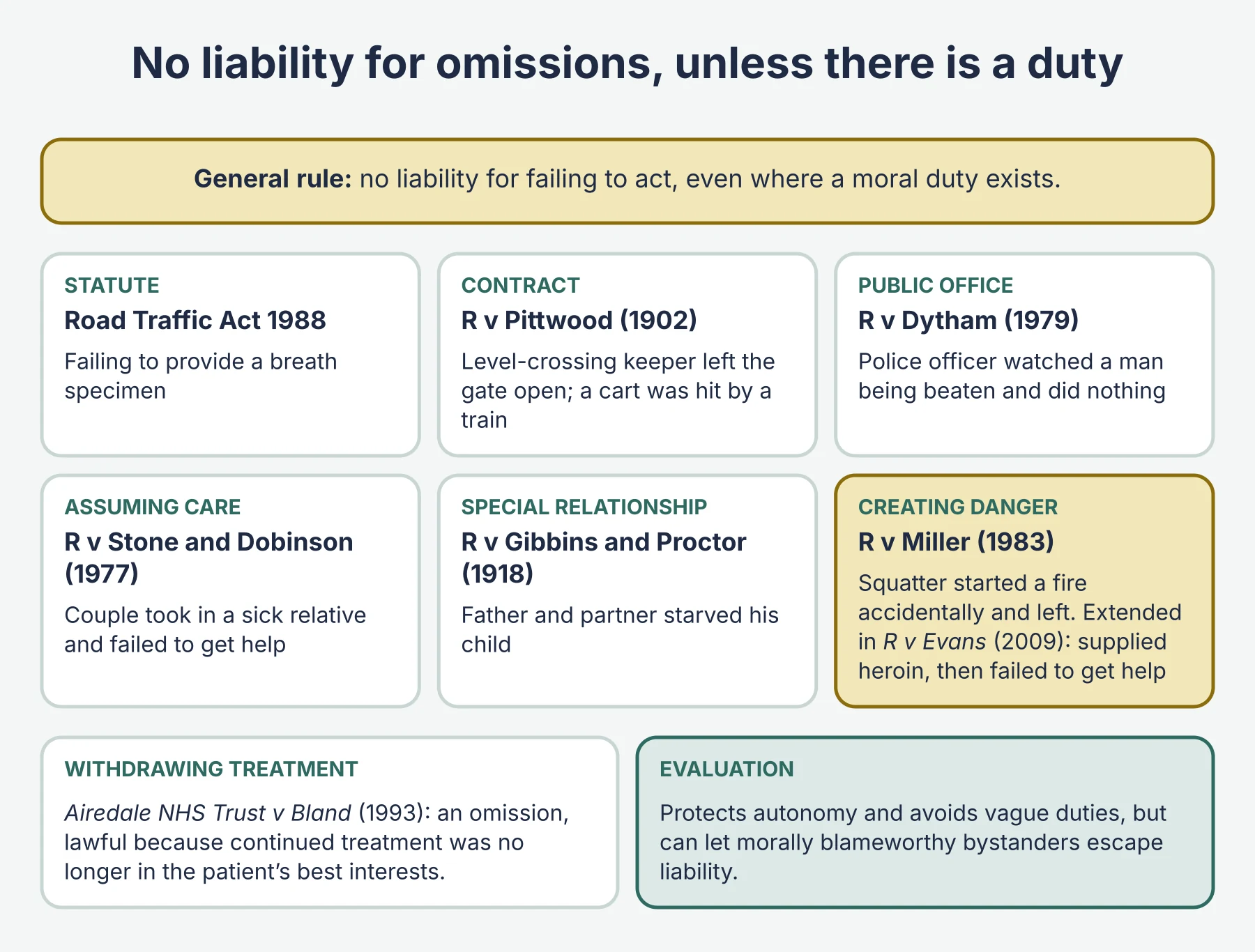
The general rule is that there is no liability for failing to act, even where a moral duty exists. Liability arises only where the defendant was under a legal duty to act:
| Duty | Case | Facts |
|---|---|---|
| Statute | Road Traffic Act 1988 | Failing to provide a breath specimen |
| Contract | R v Pittwood (1902) | Level-crossing keeper left the gate open; a cart was hit by a train |
| Public office | R v Dytham (1979) | Police officer watched a man being beaten and did nothing |
| Voluntary assumption of care | R v Stone and Dobinson (1977) | Couple took in a sick relative and failed to get help |
| Special relationship | R v Gibbins and Proctor (1918) | Father and partner starved his child |
| Creating a dangerous situation | R v Miller (1983) | Squatter started a fire accidentally and left without dealing with it |
R v Evans (2009) extended the Miller principle: a woman who supplied heroin to her half-sister, then failed to get help when she saw she had overdosed, was under a duty because she had contributed to the danger. In Airedale NHS Trust v Bland (1993) withdrawing treatment from a patient in a persistent vegetative state was treated as an omission, lawful because continued treatment was no longer in the patient’s best interests.
Evaluation: the narrow omissions rule protects individual autonomy and avoids vague duties, but it can let morally blameworthy bystanders escape liability.
Causation
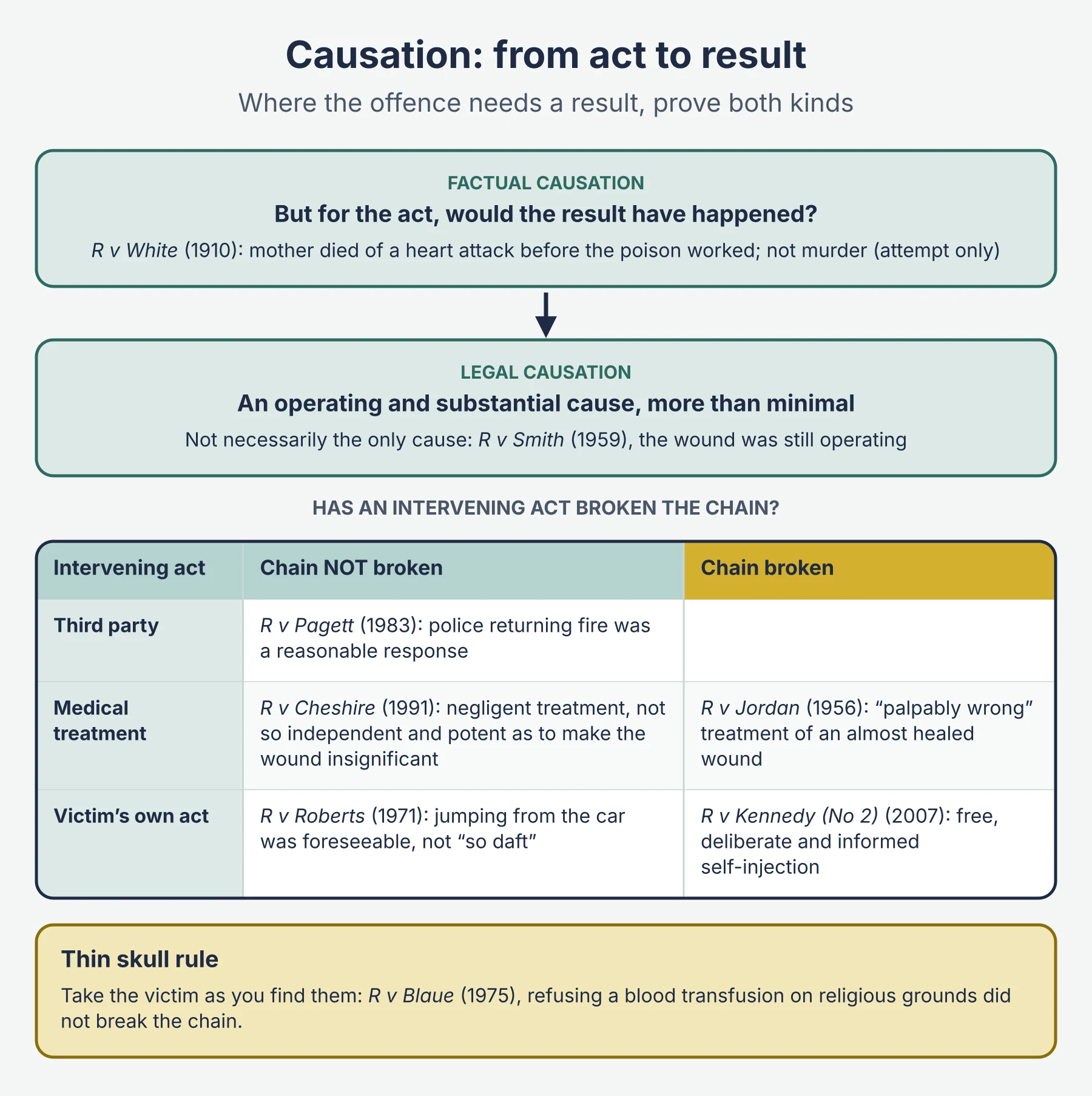
Where the offence requires a result, the prosecution must prove that the defendant’s conduct caused it, both factually and legally.
Factual causation – the “but for” test. In R v White (1910) the defendant poisoned his mother’s drink, but she died of a heart attack before the poison took effect. But for his act she would still have died, so he was not guilty of murder (he was guilty of attempt).
Legal causation. The defendant’s act must be an operating and substantial cause, though not necessarily the only one (R v Smith (1959), where a stabbed soldier was dropped twice and given poor treatment, but the wound was still operating). The contribution must be more than minimal.
Intervening acts (novus actus interveniens).
- Third party acts – in R v Pagett (1983) police returning fire killed a girl used as a human shield; their reasonable response did not break the chain.
- Medical treatment – rarely breaks the chain. In R v Cheshire (1991) negligent treatment did not break it unless so independent of the defendant’s act and so potent that the original wound became insignificant. Contrast R v Jordan (1956), where “palpably wrong” treatment of an almost healed wound did break the chain.
- The victim’s own act – in R v Roberts (1971) a woman jumped from a moving car to escape advances; the chain was not broken because her reaction was reasonably foreseeable, not “so daft” as to be unexpected. But in R v Kennedy (No 2) (2007) the victim’s free, deliberate and informed decision to inject himself with drugs supplied by the defendant broke the chain.
The thin skull rule. The defendant must take the victim as they find them, including physical and other characteristics. In R v Blaue (1975) a stabbed Jehovah’s Witness refused a blood transfusion on religious grounds and died; the refusal did not break the chain.
2.1.2 Mens rea
Mens rea as the mental element
Mens rea is the state of mind the definition of the offence requires. It is assessed subjectively – what this defendant intended or foresaw – rather than what a reasonable person would have intended. The main levels are intention and recklessness.
Intention
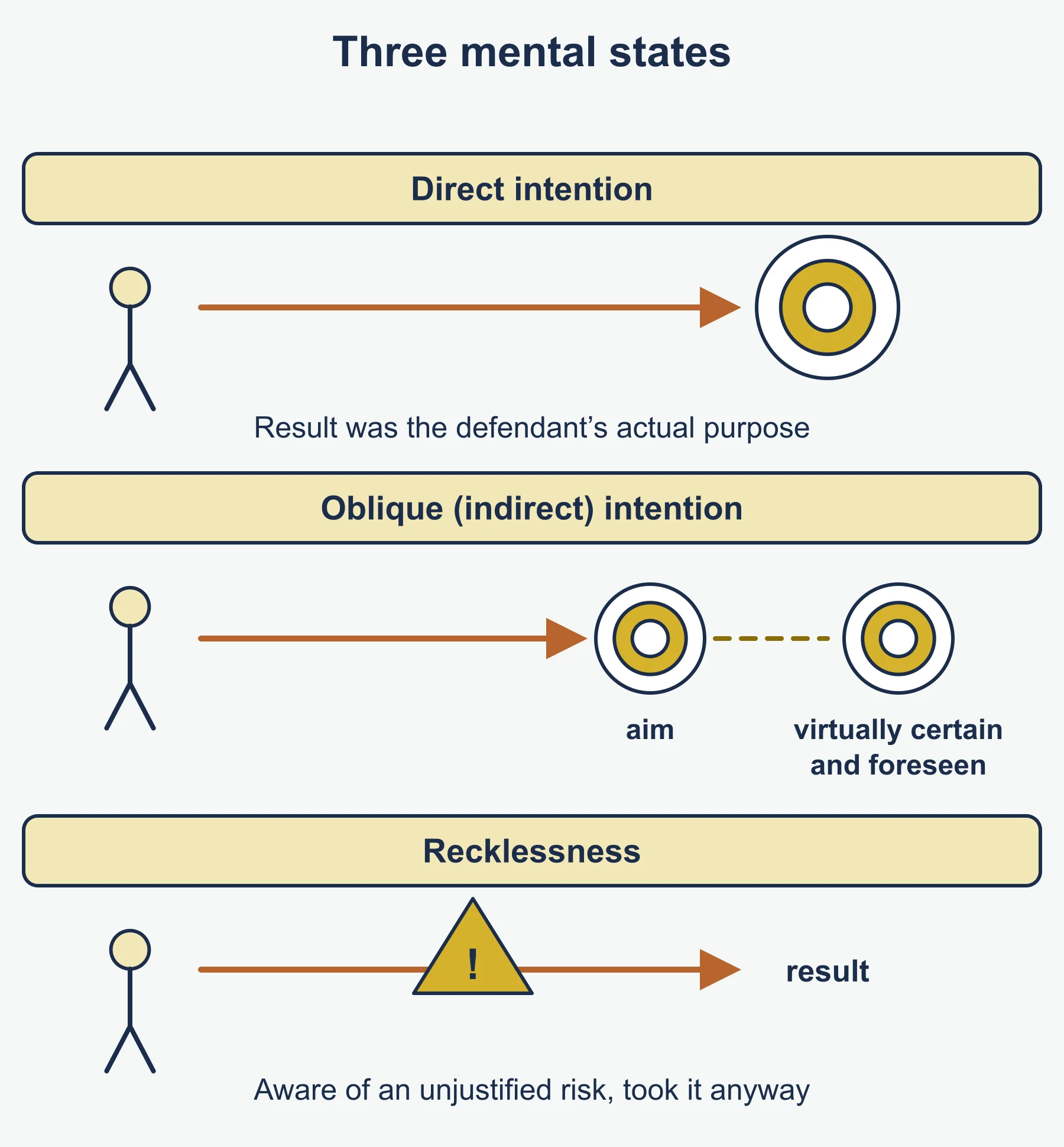
Direct intention is where the consequence is the defendant’s aim or purpose. R v Mohan (1975) described it as a decision to bring about the consequence, no matter whether the defendant desired it.
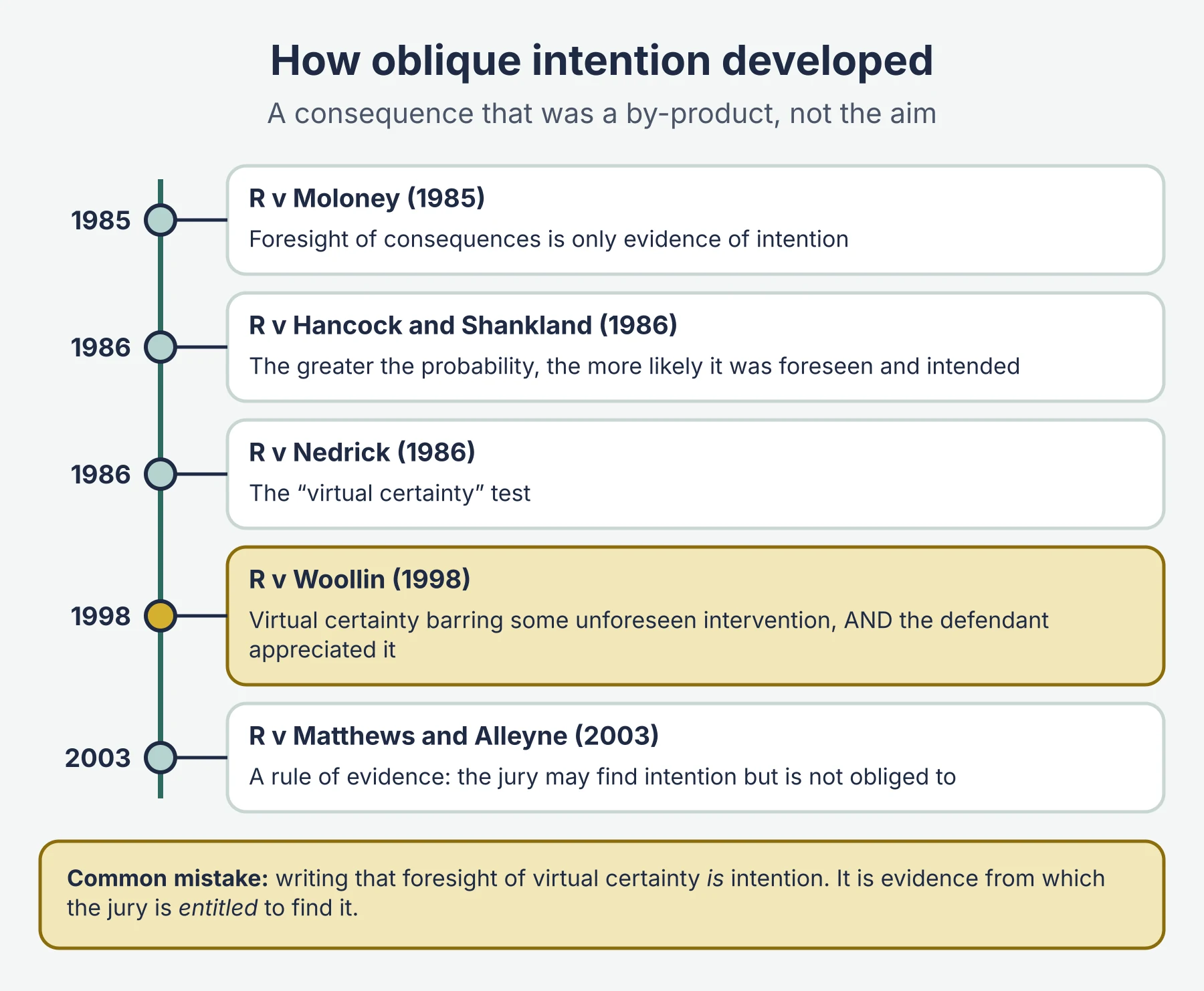
Indirect (oblique) intention covers consequences that were not the defendant’s aim but were a by-product of it. The law developed through several cases:
- R v Moloney (1985) – foresight of consequences is only evidence of intention, not intention itself.
- R v Hancock and Shankland (1986) – the greater the probability of a consequence, the more likely it was foreseen and intended.
- R v Nedrick (1986) – the “virtual certainty” test.
- R v Woollin (1998) – the jury is not entitled to find the necessary intention unless the consequence was a virtual certainty (barring some unforeseen intervention) as a result of the defendant’s actions, and the defendant appreciated that this was the case.
In R v Matthews and Alleyne (2003) the Court of Appeal confirmed that this is a rule of evidence: foresight of virtual certainty allows the jury to find intention but does not oblige it to.
Evaluation: the Woollin test keeps murder for the most culpable, but the word “entitled” leaves the jury a discretion that can make outcomes inconsistent.
Recklessness
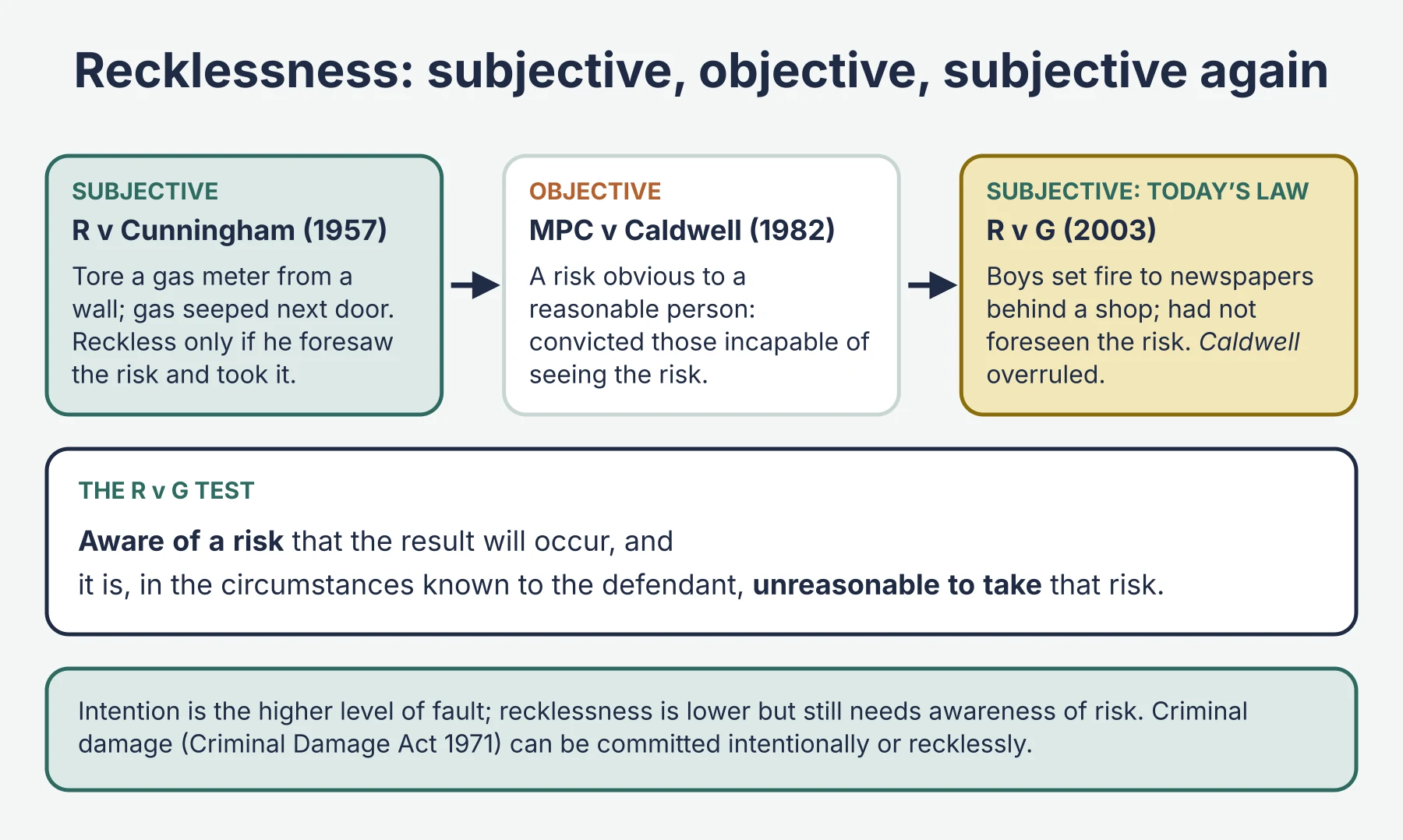
Recklessness is the unjustified taking of a risk. English law now uses a subjective test.
- R v Cunningham (1957): the defendant tore a gas meter from a wall to steal money, and gas seeped into the next house. He was reckless only if he foresaw the risk of harm and went on to take it.
- Metropolitan Police Commissioner v Caldwell (1982) introduced an objective test – a risk obvious to a reasonable person – which convicted defendants who were incapable of seeing the risk.
- R v G (2003) overruled Caldwell. Two young boys set fire to newspapers behind a shop, causing extensive damage; they had not foreseen the risk. A person is reckless as to a result when they are aware of a risk that it will occur and it is, in the circumstances known to them, unreasonable to take that risk.
Intention is the higher level of fault; recklessness is lower but still requires awareness of risk. Many property offences, such as criminal damage under the Criminal Damage Act 1971, can be committed intentionally or recklessly.
Worked example
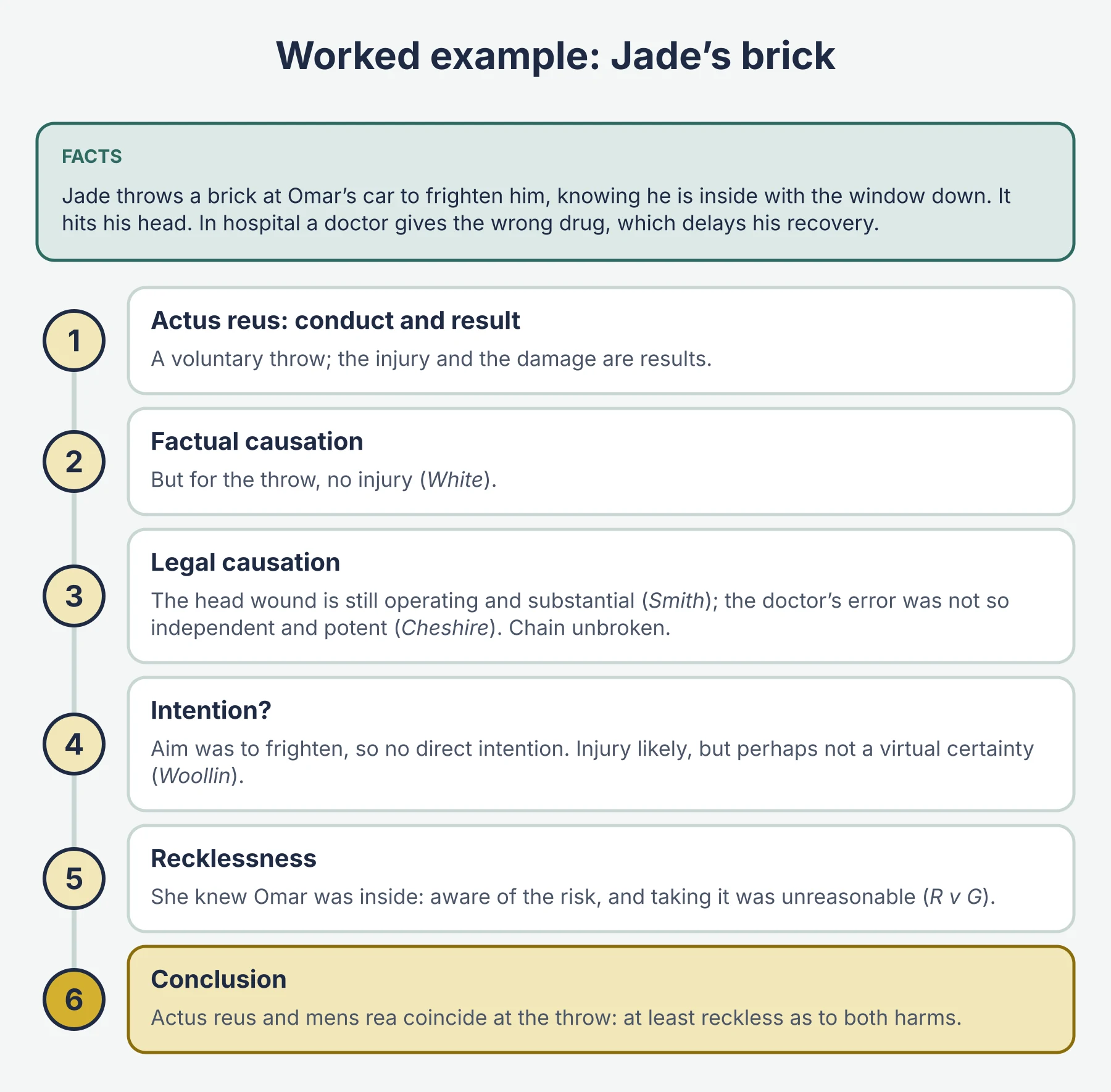
Jade throws a brick at Omar’s car to frighten him, knowing that Omar is sitting inside with the window down. The brick hits Omar on the head. In hospital a doctor misreads Omar’s chart and gives him the wrong drug, which delays his recovery. Discuss the elements of liability for Omar’s injury and the damage to the car.
- Actus reus – conduct and result: Jade voluntarily threw the brick; the injury and damage are results.
- Factual causation: but for the throw, Omar would not have been injured – satisfied (White).
- Legal causation: the head wound remains an operating and substantial cause (Smith). The doctor’s error delayed recovery but, applying Cheshire, it was not so independent and potent as to make Jade’s act insignificant. The chain is unbroken.
- Mens rea – intention: her aim was to frighten, not injure, so there is no direct intention. Oblique intention requires injury to be a virtual certainty and Jade to appreciate this (Woollin); throwing at an open window makes harm likely, but perhaps not virtually certain.
- Mens rea – recklessness: Jade knew Omar was inside, so she was aware of a risk of injury and damage, and taking that risk was unreasonable (R v G). At least recklessness is proved.
- Conclusion: actus reus and mens rea coincide at the moment of the throw; Jade caused both harms and was at least reckless as to each.
Common mistakes
- Treating the “but for” test as enough for causation without considering legal causation.
- Saying any medical negligence breaks the chain of causation.
- Writing that foresight of virtual certainty is intention, rather than evidence of it.
- Applying the overruled Caldwell test.
- Stating that there is never liability for omissions, without the duty situations.
Exam technique
In Section A, take each element in turn: identify the actus reus, establish causation where a result is required, then deal with mens rea, each with an authority. In a Section B essay, evaluate or discuss needs the development of the law and a judgement, for example on whether the omissions rule or the Woollin test is satisfactory. Revise with the elements of a crime revision notes and test yourself with the elements of a crime practice questions.
Related resources
-
Practice questions
Cambridge A Level Law (9084): Elements of a crime – Practice Questions
Original scenario and short-answer questions with mark-scheme answers on omissions, causation, intention and recklessness for Cambridge Law 9084 Paper 2.
Law · Cambridge · AS Level
Try questions -
Revision notes
Cambridge A Level Law (9084): Elements of a crime – Revision Notes
Condensed notes on actus reus, omissions, causation, intention and recklessness, with case tables and a self-test, for Cambridge Law 9084 subtopic 2.1.
Law · Cambridge · AS Level
Revise topic -
Study guides
Cambridge A Level Law (9084): Offences against property
Theft, robbery, burglary, blackmail, handling, making off, criminal damage and fraud: elements, cases and maximum sentences for Cambridge Law 9084 subtopic 2.2.
Law · Cambridge · AS Level
Read guide
Get free revision emails (optional)
Occasional emails with practice questions, worked explanations and links to free resources for the qualification and subjects you choose. No spam, and you can unsubscribe from any email. The free tools on this site never need an email.