
Revision Notes
Cambridge A Level Law (9084): Elements of a crime – Revision Notes
Condensed notes on actus reus, omissions, causation, intention and recklessness, with case tables and a self-test, for Cambridge Law 9084 subtopic 2.1.
- Subject
- Law
- Level
- AS LEVEL
- Topic
- Topic 2 – Criminal Law
- Author
- Marlbridge Academic Team
- Updated
- Reviewed by
- Aizaz Raoof Ali (what this means)
Aligned to Cambridge A Level Law (9084), 2026-2028. Official specification .
Syllabus page (what it covers and how it is assessed): Cambridge A Level Law.
Syllabus points this page covers
9084 (AS Level)
- 2.1 Elements of a crime
Found an error? Report a correction.
Need help with this topic? Request a free trial class for A Level Law (9084).
Recall notes for subtopic 2.1 of Cambridge International AS & A Level Law (9084). The elements of a crime study guide explains each rule and works through a full problem.
The structure of liability
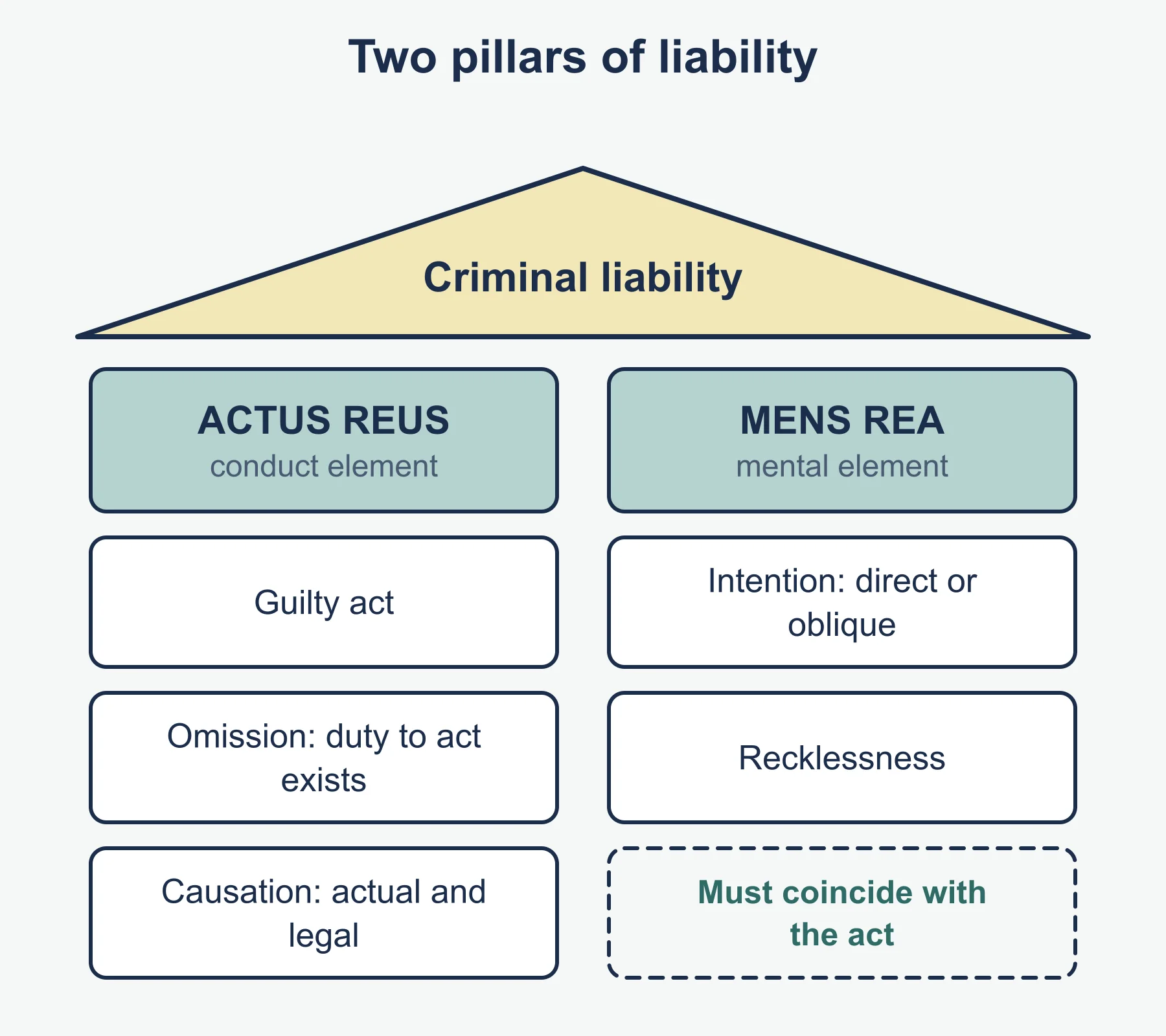
Actus reus + mens rea = liability (subject to defences). Actus reus is every element except the mental element; mens rea is the state of mind the offence definition requires, judged subjectively.
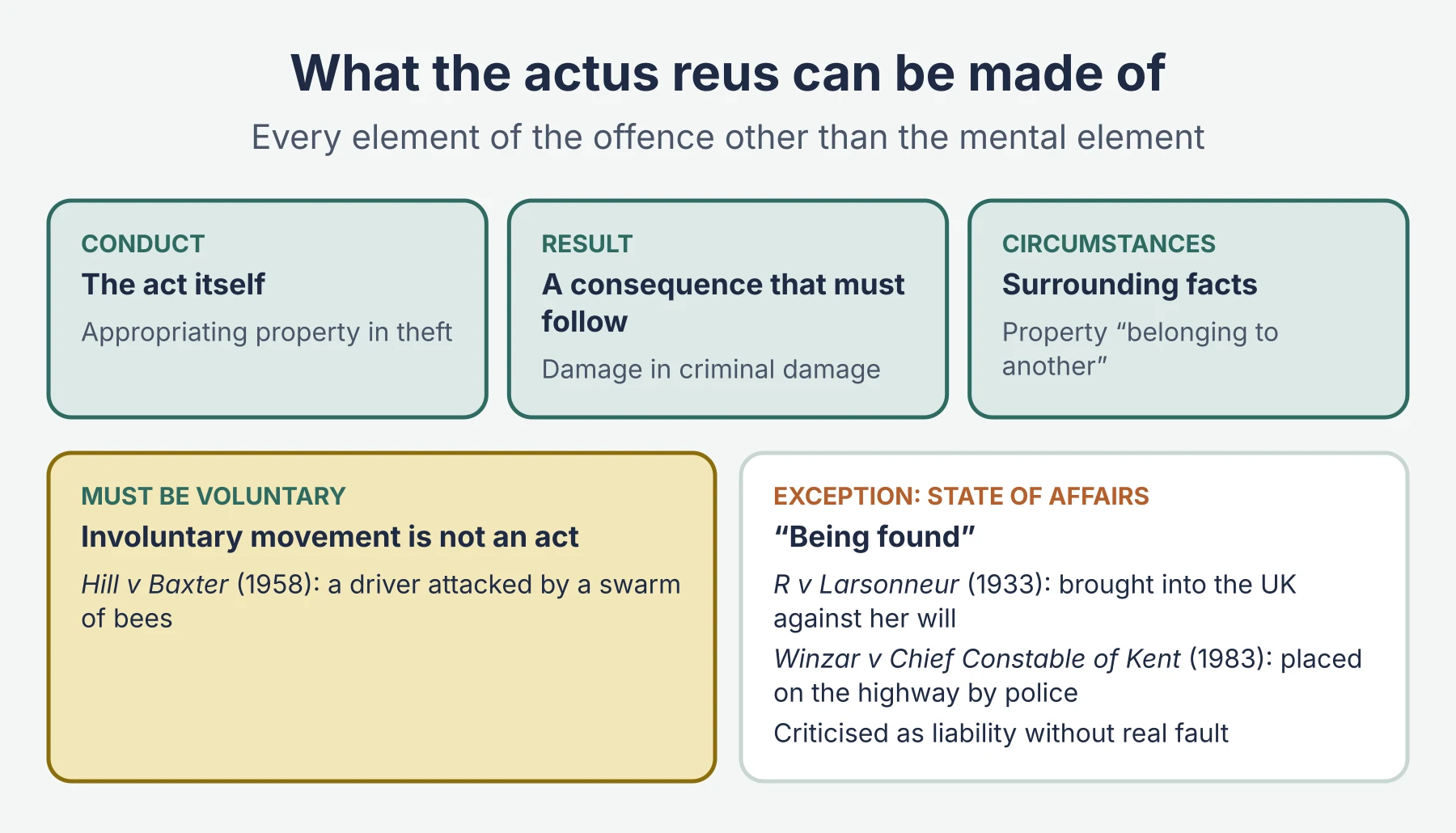
Three parts of actus reus: conduct (the act), result (the consequence), circumstances (surrounding facts).
Conduct must be voluntary
- Hill v Baxter (1958) – driver attacked by bees would not be acting voluntarily.
- State of affairs exceptions: R v Larsonneur (1933) – “found” in the UK after being brought in against her will; Winzar v Chief Constable of Kent (1983) – “found drunk on a highway” after police put him there. Criticised as liability without fault.
Omissions
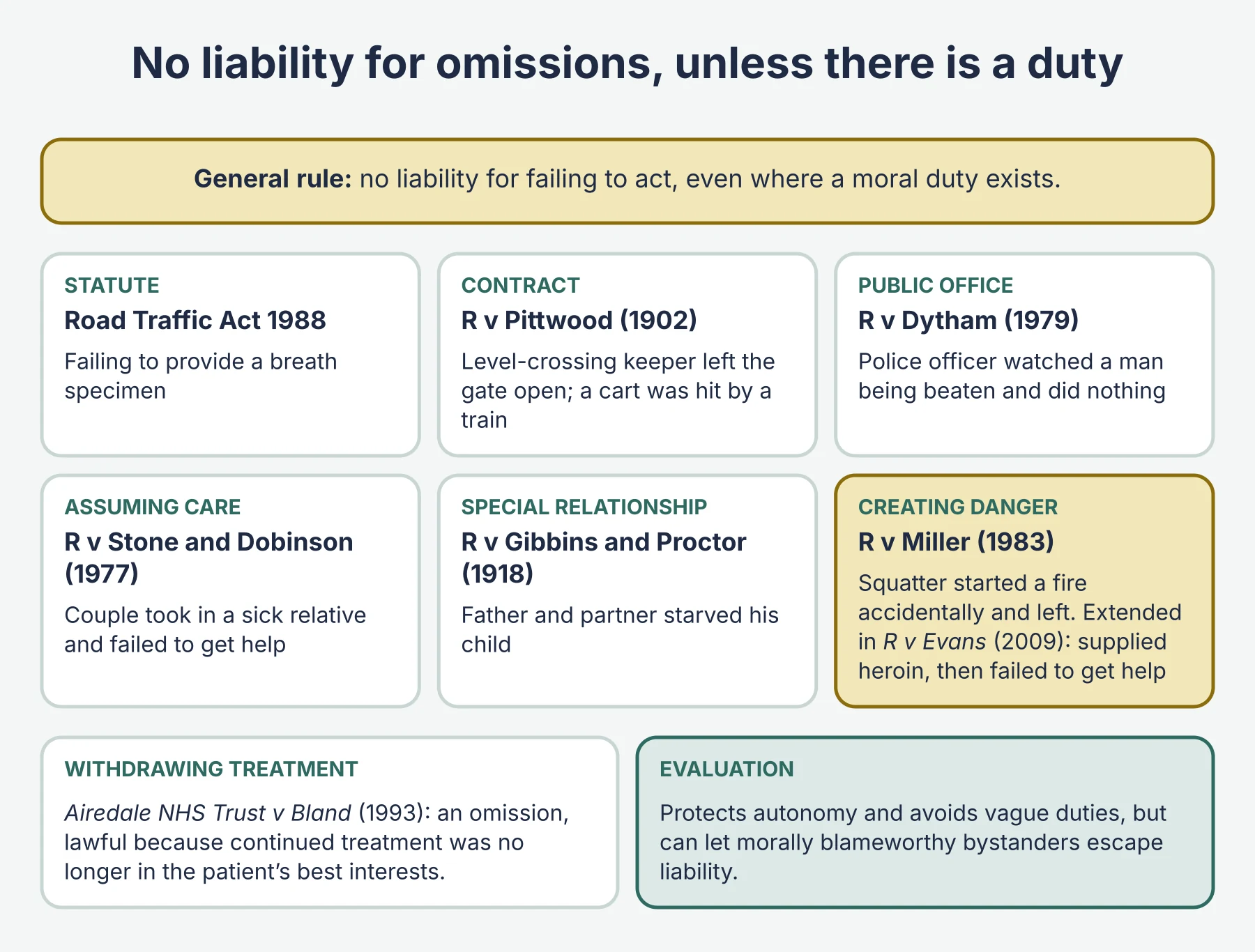
General rule: no liability for failing to act. Exceptions where there is a legal duty:
| Duty source | Case |
|---|---|
| Statute | Road Traffic Act 1988 – breath specimen |
| Contract | R v Pittwood (1902) |
| Public office | R v Dytham (1979) |
| Voluntary assumption | R v Stone and Dobinson (1977) |
| Relationship | R v Gibbins and Proctor (1918) |
| Created danger | R v Miller (1983); R v Evans (2009) |
Airedale NHS Trust v Bland (1993) – withdrawing treatment is an omission; no duty to continue treatment that is not in the patient’s best interests.
Causation
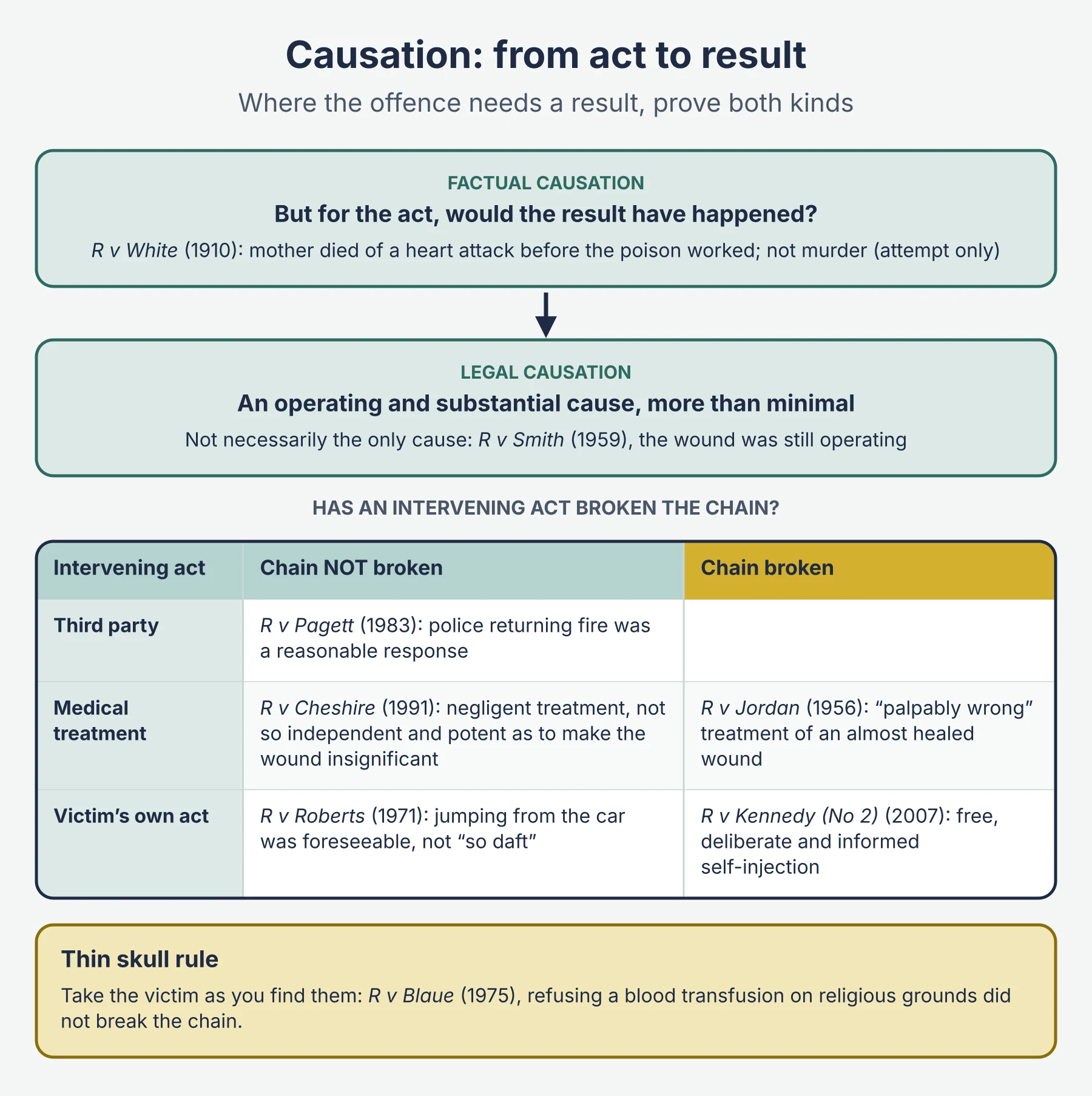
Step 1 – factual: “but for” – R v White (1910) (no causation; attempt only).
Step 2 – legal: operating and substantial cause, more than minimal, need not be sole cause – R v Smith (1959).
Step 3 – any break in the chain?
| Intervening act | Rule | Case |
|---|---|---|
| Third party | Reasonable, foreseeable reaction does not break | R v Pagett (1983) |
| Medical treatment | Breaks only if so independent and potent that original injury is insignificant | R v Cheshire (1991); contrast R v Jordan (1956) |
| Victim’s escape | Breaks only if “so daft” as to be unforeseeable | R v Roberts (1971) |
| Victim’s free choice | Free, deliberate, informed act breaks | R v Kennedy (No 2) (2007) |
| Victim’s characteristics | Thin skull rule – take the victim as you find them | R v Blaue (1975) |
Intention
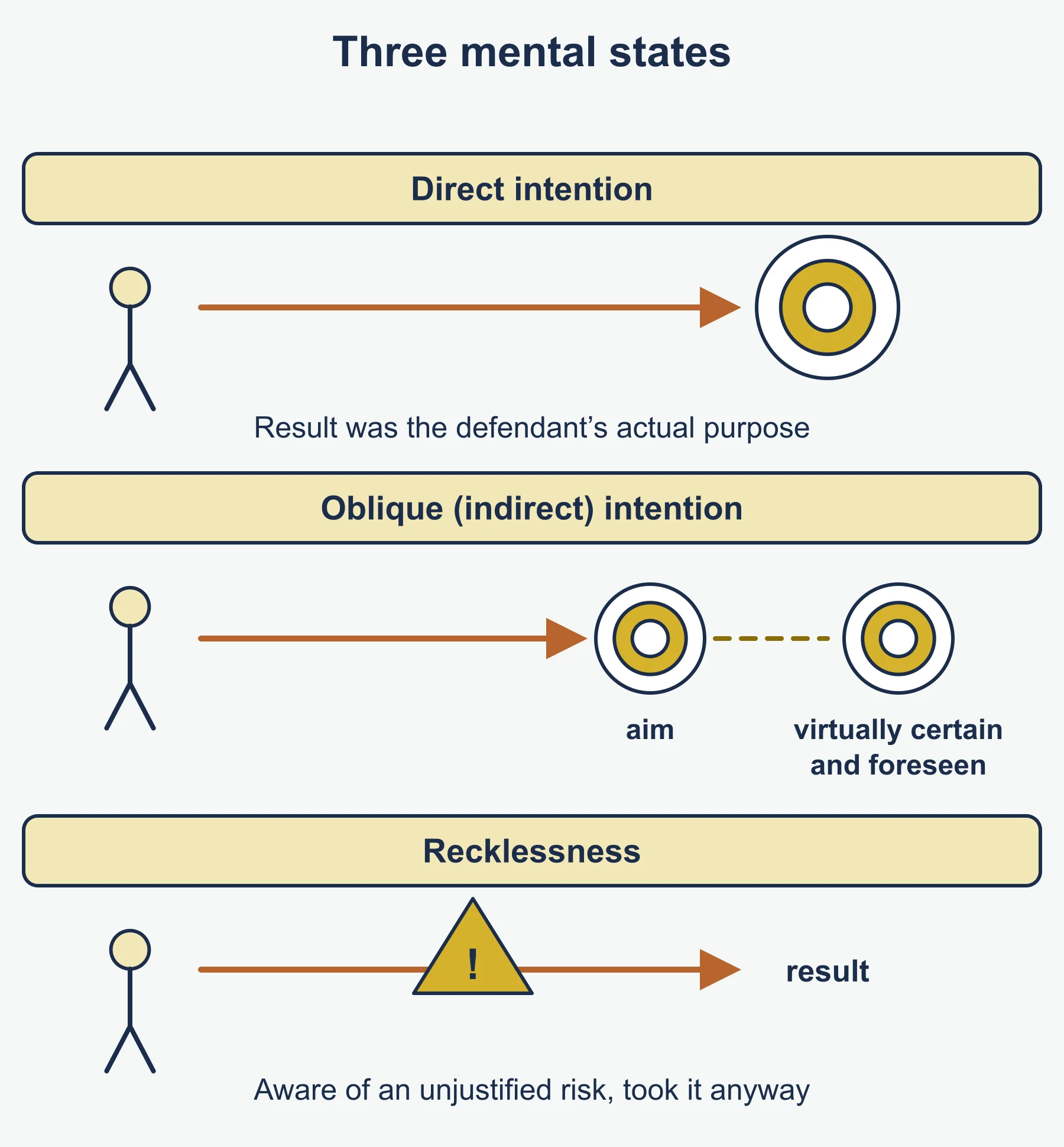
- Direct: aim or purpose – R v Mohan (1975).
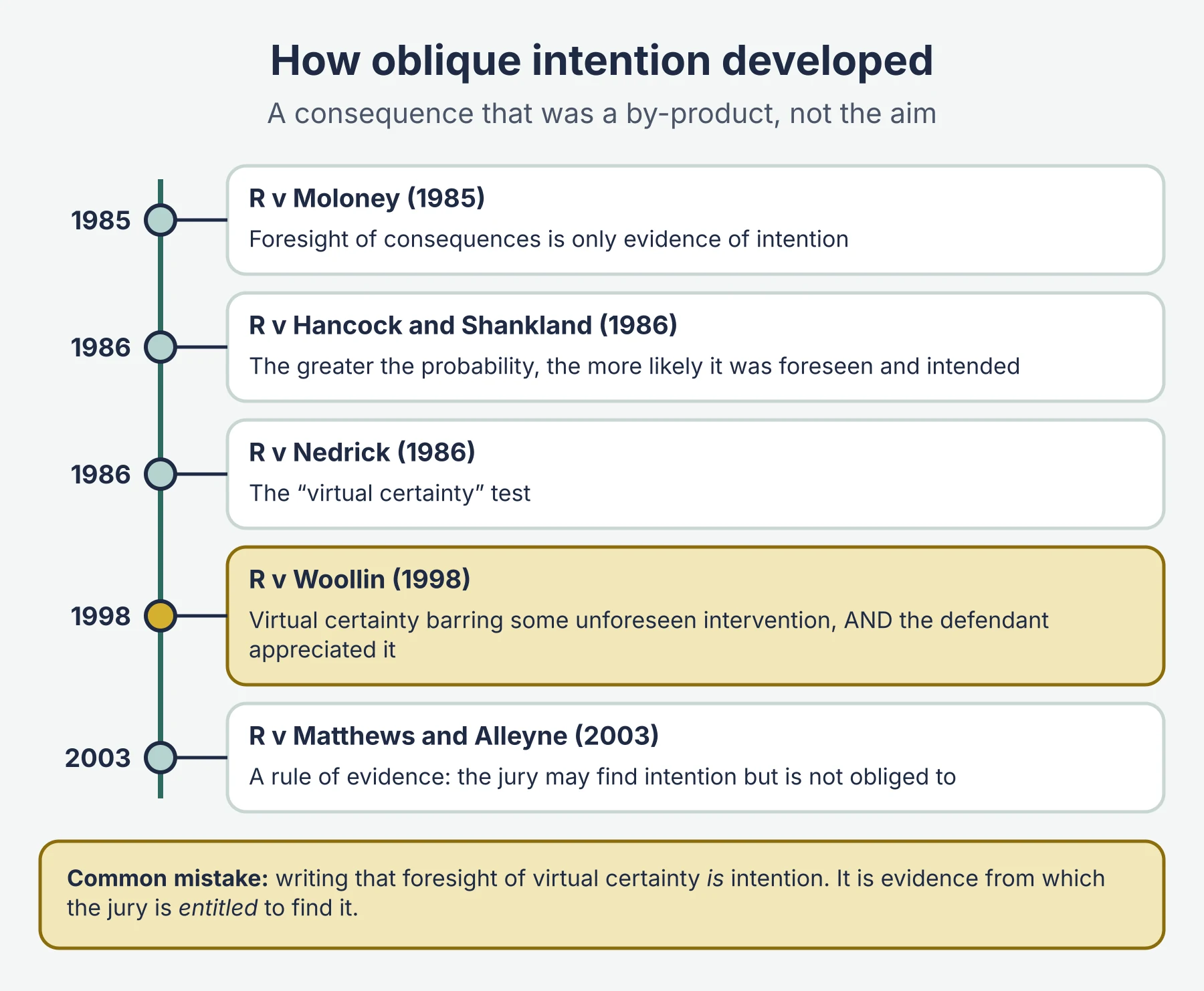
- Oblique: Moloney (1985) → Hancock and Shankland (1986) → Nedrick (1986) → R v Woollin (1998).
- Woollin test: jury not entitled to find intention unless the consequence was a virtual certainty (barring unforeseen intervention) and the defendant appreciated that.
- R v Matthews and Alleyne (2003) – foresight is evidence of intention, not intention itself.
Recklessness
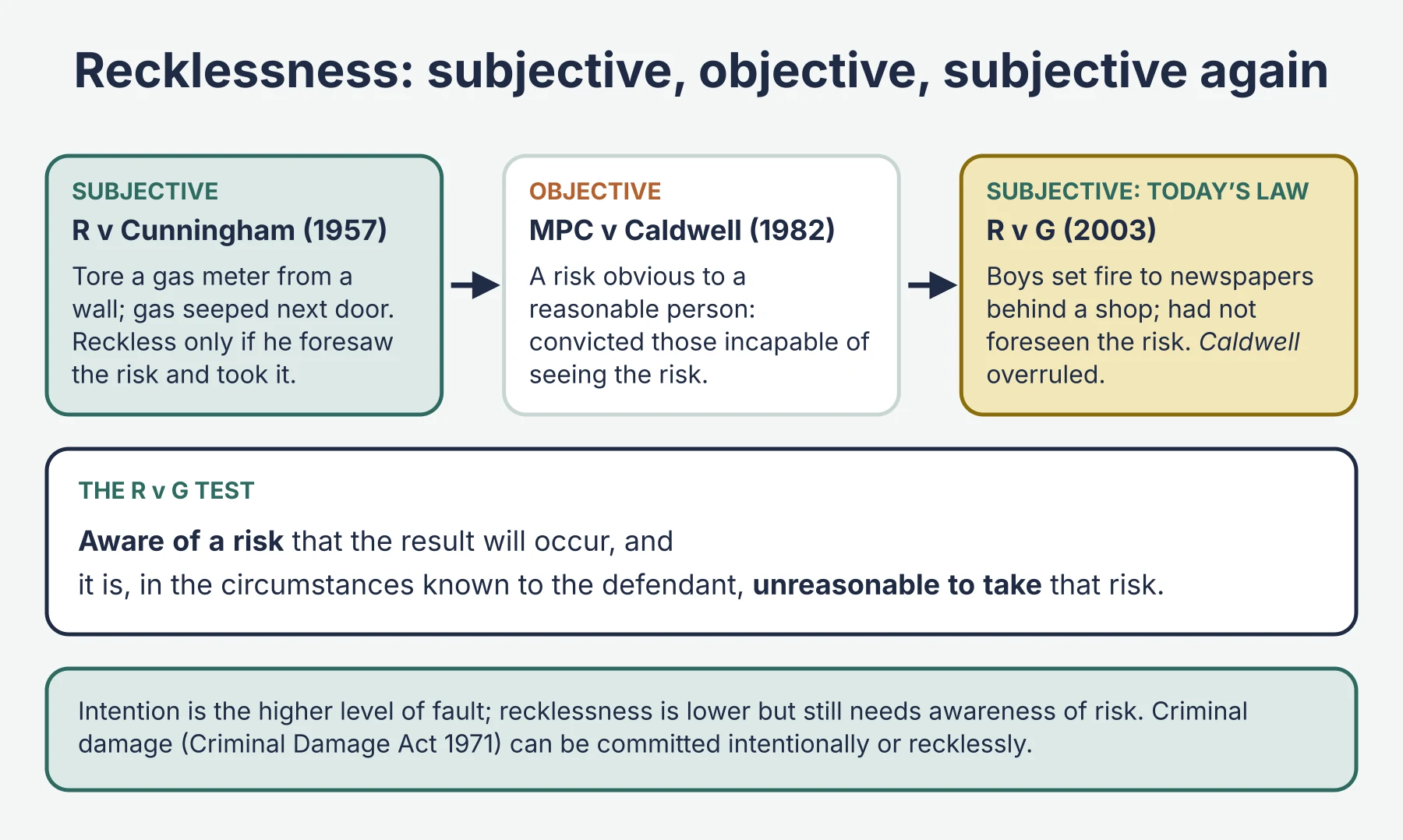
- Subjective test: R v Cunningham (1957) – gas meter.
- MPC v Caldwell (1982) – objective test, overruled.
- R v G (2003) – reckless if aware of a risk and it was unreasonable to take it in the circumstances known to the defendant.
Key terms
| Term | Meaning |
|---|---|
| Actus reus | Physical element: conduct, result, circumstances |
| Mens rea | Mental element required by the offence |
| Omission | Failure to act; criminal only where a duty exists |
| Factual causation | “But for” the defendant’s act, the result would not have happened |
| Legal causation | Act is an operating and substantial cause |
| Novus actus interveniens | New intervening act that breaks the chain |
| Thin skull rule | Defendant takes the victim as found |
| Direct intention | Consequence is the aim or purpose |
| Oblique intention | Consequence virtually certain and appreciated as such |
| Subjective recklessness | Defendant foresaw the risk and unreasonably took it |
Exam traps
- Stopping at “but for” and forgetting legal causation.
- Assuming poor medical treatment always breaks the chain – Cheshire sets a high bar.
- Confusing Roberts (victim’s reaction foreseeable, chain intact) with Kennedy (No 2) (free choice, chain broken).
- Writing that foresight of virtual certainty automatically equals intention.
- Using the Caldwell objective test, which no longer applies.
- Describing an omission duty without naming its source.
- Ignoring the requirement that conduct be voluntary.
Self-test
- What are the three possible components of an actus reus?
- Why was Larsonneur convicted, and why is the case criticised?
- Name the six situations in which a duty to act arises.
- What did R v Evans (2009) add to the duty situations?
- Why was White not guilty of murder?
- State the test for legal causation from R v Smith (1959).
- When does medical treatment break the chain of causation?
- What principle does R v Blaue (1975) establish?
- State the Woollin test for oblique intention.
- What did R v Matthews and Alleyne (2003) clarify?
- What is the definition of recklessness from R v G (2003)?
- Which case did R v G overrule, and why?
Answers
- Conduct, result and circumstances.
- She was “found” in the UK as an alien even though she was brought in against her will; it imposes liability without voluntary conduct or fault.
- Statute, contract, public office, voluntary assumption of care, special relationship, creating a dangerous situation.
- A person who contributes to a dangerous situation, such as supplying drugs, may be under a duty to get help.
- His mother died of a heart attack unrelated to the poison, so “but for” causation failed.
- The defendant’s act must be an operating and substantial cause, though not necessarily the only one.
- Only where it is so independent of the defendant’s act and so potent that the original injury becomes insignificant (Cheshire).
- The thin skull rule: the defendant takes the victim as they find them, including their beliefs.
- Intention may be found only if the consequence was a virtual certainty, barring unforeseen intervention, and the defendant appreciated this.
- That foresight of virtual certainty is evidence from which intention may be found, not a substantive definition of intention.
- The defendant was aware of a risk that the result would occur and it was, in the circumstances known to them, unreasonable to take it.
- MPC v Caldwell (1982), because its objective test convicted people, including children, who had not seen the risk.
Test the rules on scenarios with the elements of a crime practice questions.
Related resources
-
Study guides
Cambridge A Level Law (9084): Offences against property
Theft, robbery, burglary, blackmail, handling, making off, criminal damage and fraud: elements, cases and maximum sentences for Cambridge Law 9084 subtopic 2.2.
Law · Cambridge · AS Level
Read guide -
Practice questions
Cambridge A Level Law (9084): Offences against property – Practice Questions
Original scenario questions with mark-scheme answers on theft, robbery, burglary, blackmail, handling, making off, damage and fraud for Cambridge Law 9084.
Law · Cambridge · AS Level
Try questions -
Revision notes
Cambridge A Level Law (9084): Offences against property – Revision Notes
Checklists, cases and maximum sentences for theft, robbery, burglary, blackmail, handling, making off, criminal damage and fraud for Cambridge Law 9084.
Law · Cambridge · AS Level
Revise topic
Get free revision emails (optional)
Occasional emails with practice questions, worked explanations and links to free resources for the qualification and subjects you choose. No spam, and you can unsubscribe from any email. The free tools on this site never need an email.