
Revision Notes
Cambridge A Level Law (9084): Offences against property – Revision Notes
Checklists, cases and maximum sentences for theft, robbery, burglary, blackmail, handling, making off, criminal damage and fraud for Cambridge Law 9084.
- Subject
- Law
- Level
- AS LEVEL
- Topic
- Topic 2 – Criminal Law
- Author
- Marlbridge Academic Team
- Updated
- Reviewed by
- Aizaz Raoof Ali (what this means)
Aligned to Cambridge A Level Law (9084), 2026-2028. Official specification .
Syllabus page (what it covers and how it is assessed): Cambridge A Level Law.
Syllabus points this page covers
9084 (AS Level)
- 2.2 Offences against property
Found an error? Report a correction.
Need help with this topic? Request a free trial class for A Level Law (9084).
Element-by-element recall for subtopic 2.2 of Cambridge International AS & A Level Law (9084). For explanations and a worked scenario, use the offences against property study guide.
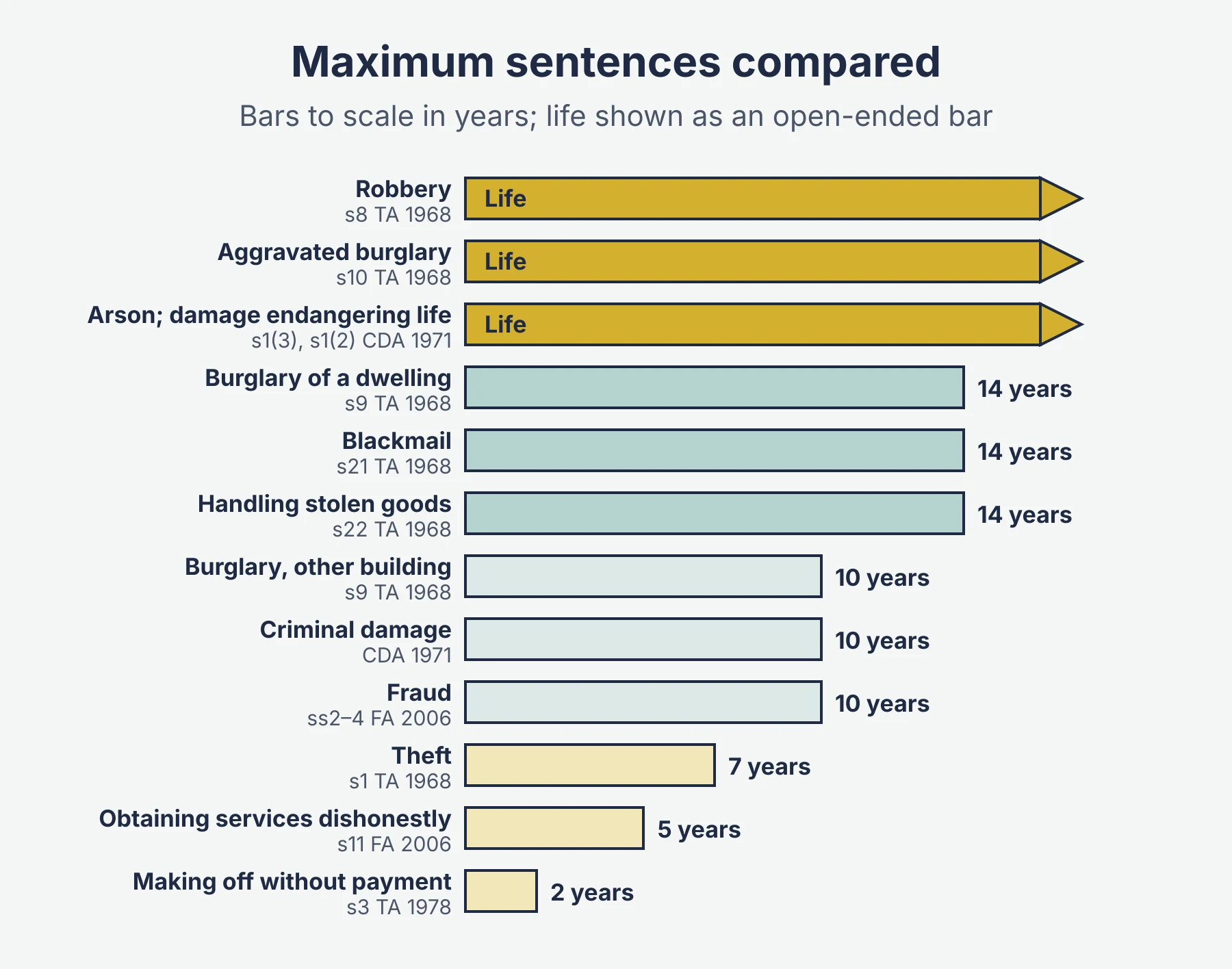
Maximum sentences at a glance
| Offence | Statute | Maximum |
|---|---|---|
| Theft | s7 Theft Act 1968 | 7 years |
| Robbery | s8(2) Theft Act 1968 | Life |
| Burglary – dwelling | s9(3) Theft Act 1968 | 14 years |
| Burglary – other building | s9(3) Theft Act 1968 | 10 years |
| Aggravated burglary | s10 Theft Act 1968 | Life |
| Blackmail | s21 Theft Act 1968 | 14 years |
| Handling stolen goods | s22 Theft Act 1968 | 14 years |
| Making off without payment | s4 Theft Act 1978 | 2 years |
| Criminal damage, threats, possession | s4 Criminal Damage Act 1971 | 10 years |
| Arson and endangering life | s4 Criminal Damage Act 1971 | Life |
| Fraud (ss2–4) | Fraud Act 2006 | 10 years |
| Obtaining services dishonestly | s11 Fraud Act 2006 | 5 years |
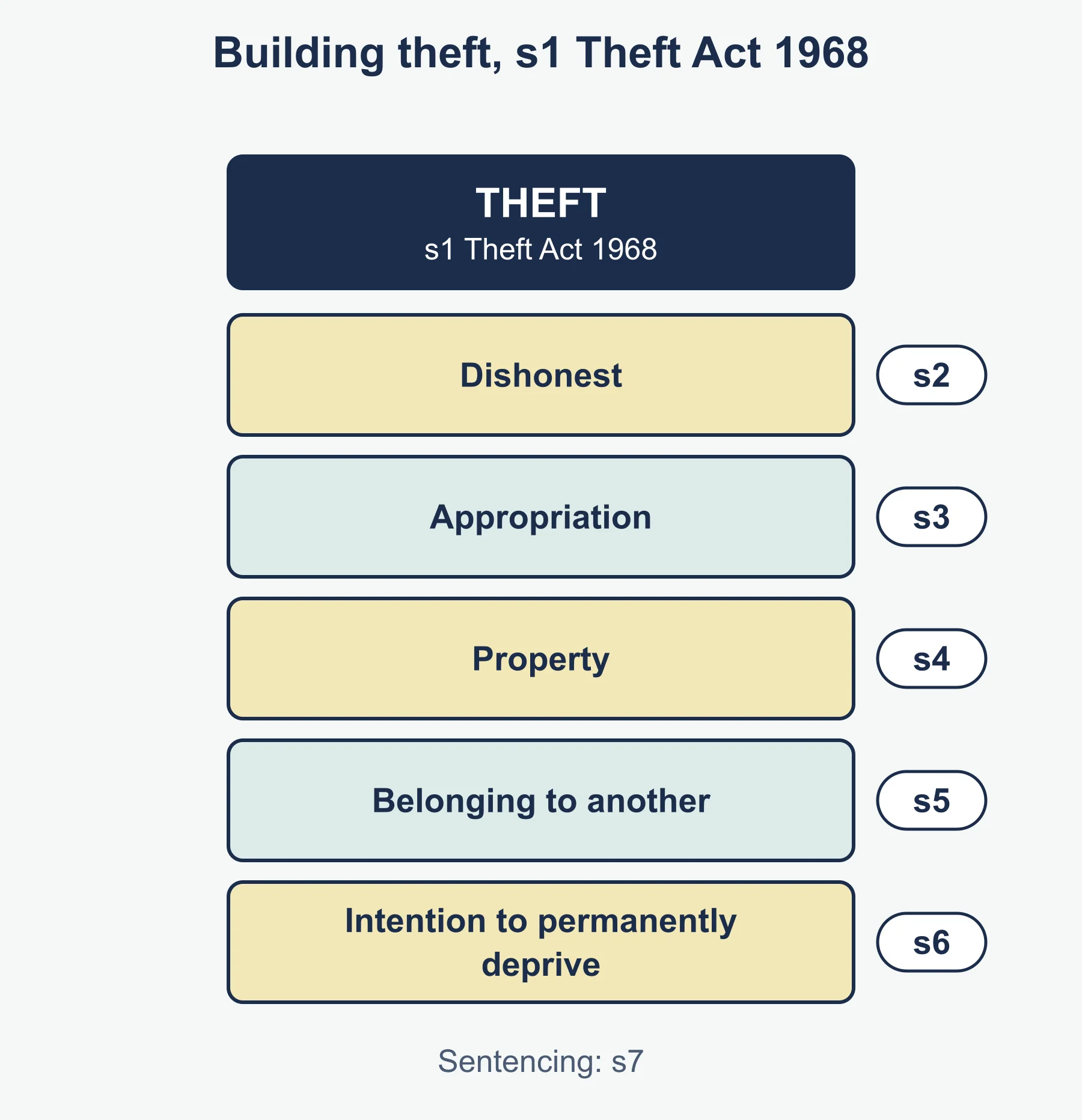
Theft checklist (s1)
- Appropriation (s3) – assuming any right of an owner. Morris (one right enough); Gomez (consent irrelevant); Hinks (gift).
- Property (s4) – includes intangibles; not land (generally), wild plants unless for sale (s4(3)), or confidential information (Oxford v Moss).
- Belonging to another (s5) – possession or control is enough (Turner (No 2)); obligation to deal (s5(3)); mistake and obligation to restore (s5(4)).
- Dishonesty (s2) – s2(1) beliefs: legal right, consent, owner untraceable. Then Ivey / Barton and Booth: actual belief, then ordinary decent people standard.
- Intention to permanently deprive (s6) – dispose regardless of rights; borrowing until value gone (Lloyd); replacing with equivalent notes (Velumyl).
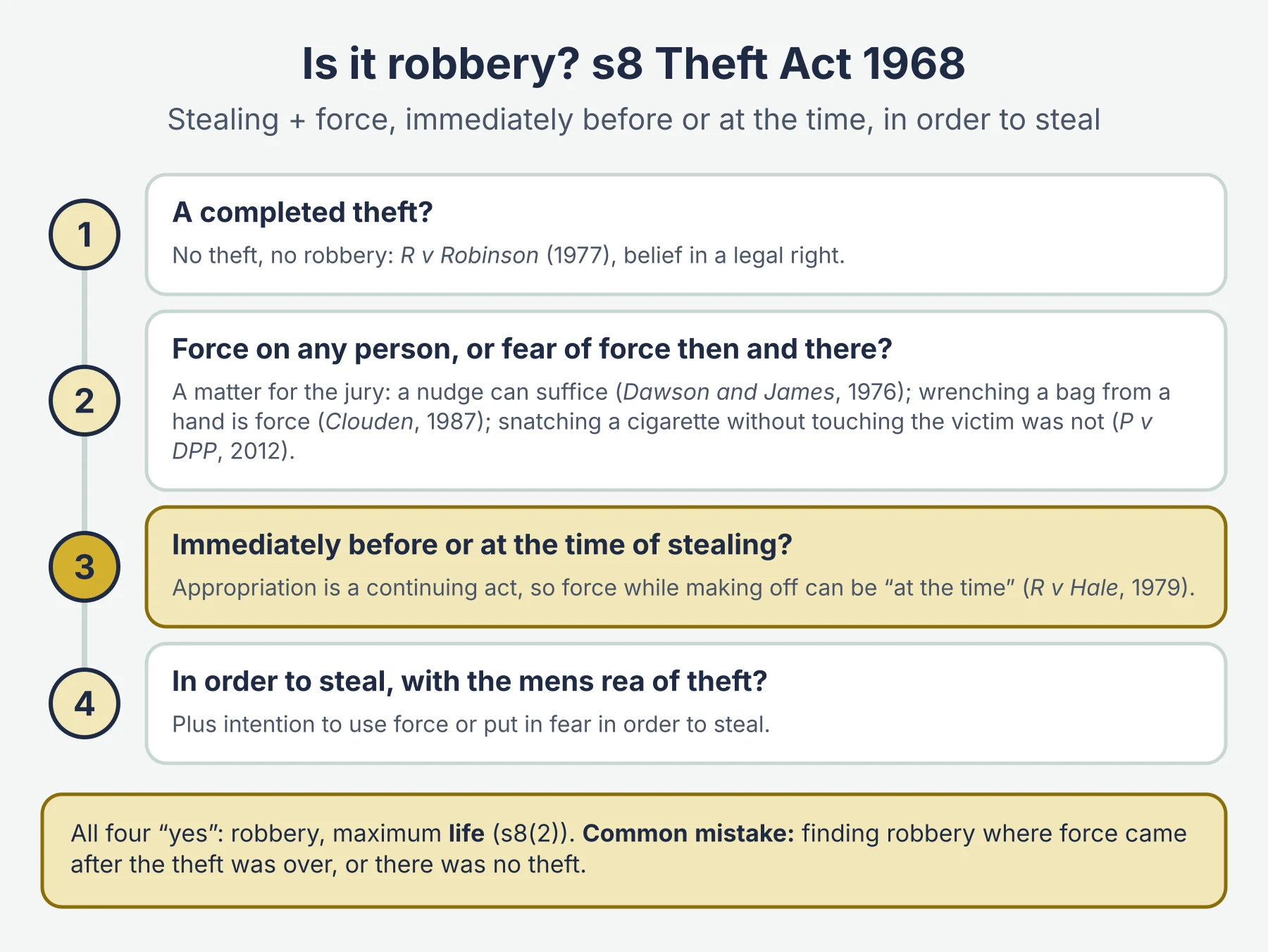
Robbery (s8)
- Theft + force or fear of force + immediately before or at the time + in order to steal.
- No theft → no robbery (Robinson).
- Continuing appropriation (Hale).
- Minimal force can be enough (Dawson and James); force via property (Clouden); no contact, no force (P v DPP).
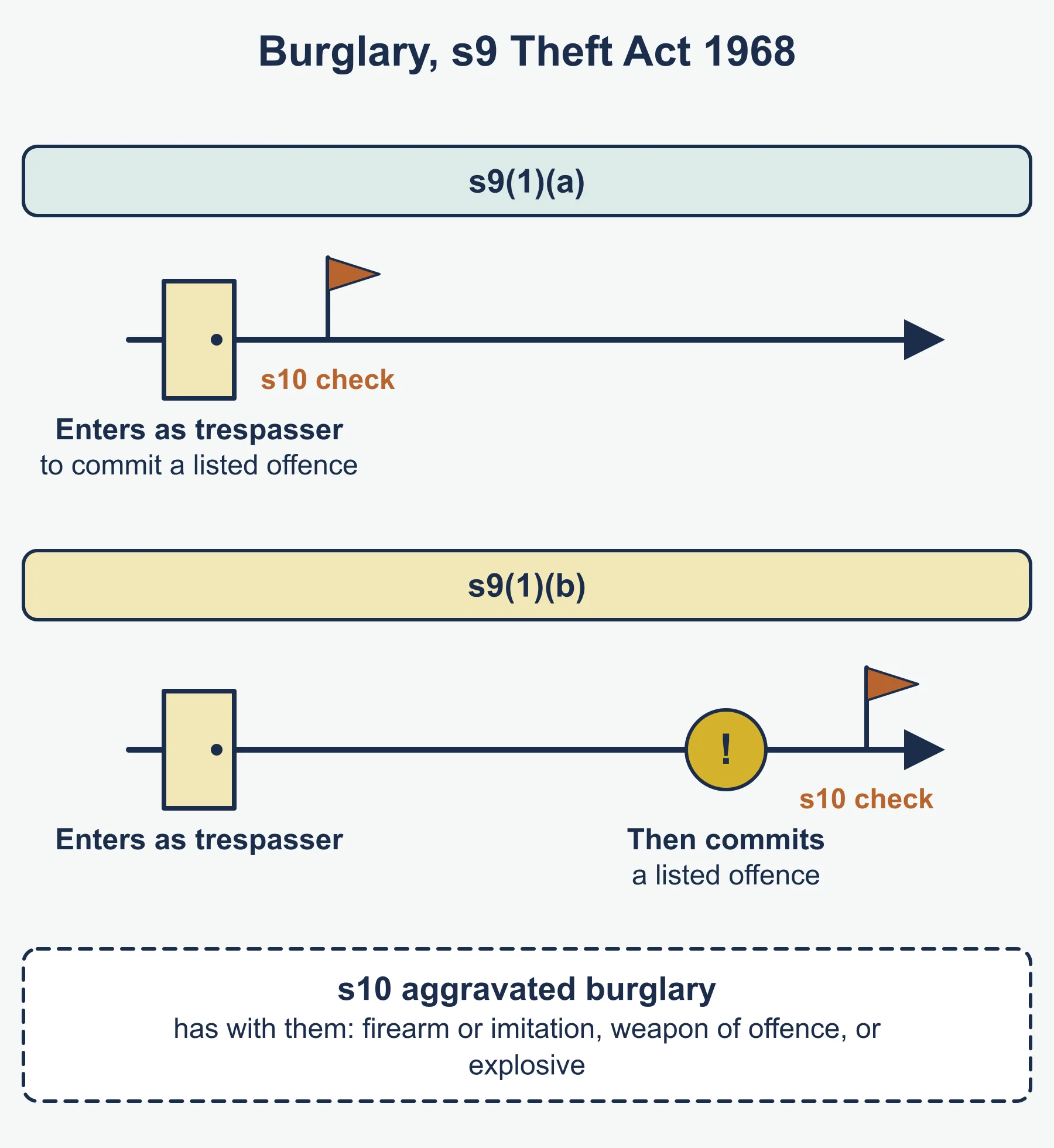
Burglary (s9) and aggravated burglary (s10)
- s9(1)(a): enter as trespasser with intent to steal, inflict grievous bodily harm or do unlawful damage – complete on entry.
- s9(1)(b): having entered as trespasser, steal or attempt, or inflict or attempt grievous bodily harm.
- Entry: effective (Brown); partial entry counts (Ryan).
- Trespass: exceeding permission (Jones and Smith); must know or be reckless as to trespass.
- Building: part of a building (Walkington); inhabited vehicle or vessel (s9(4)); container (B and S v Leathley).
- s10: firearm, imitation firearm, weapon of offence, explosive – at entry for (a), at the further offence for (b) (O’Leary).
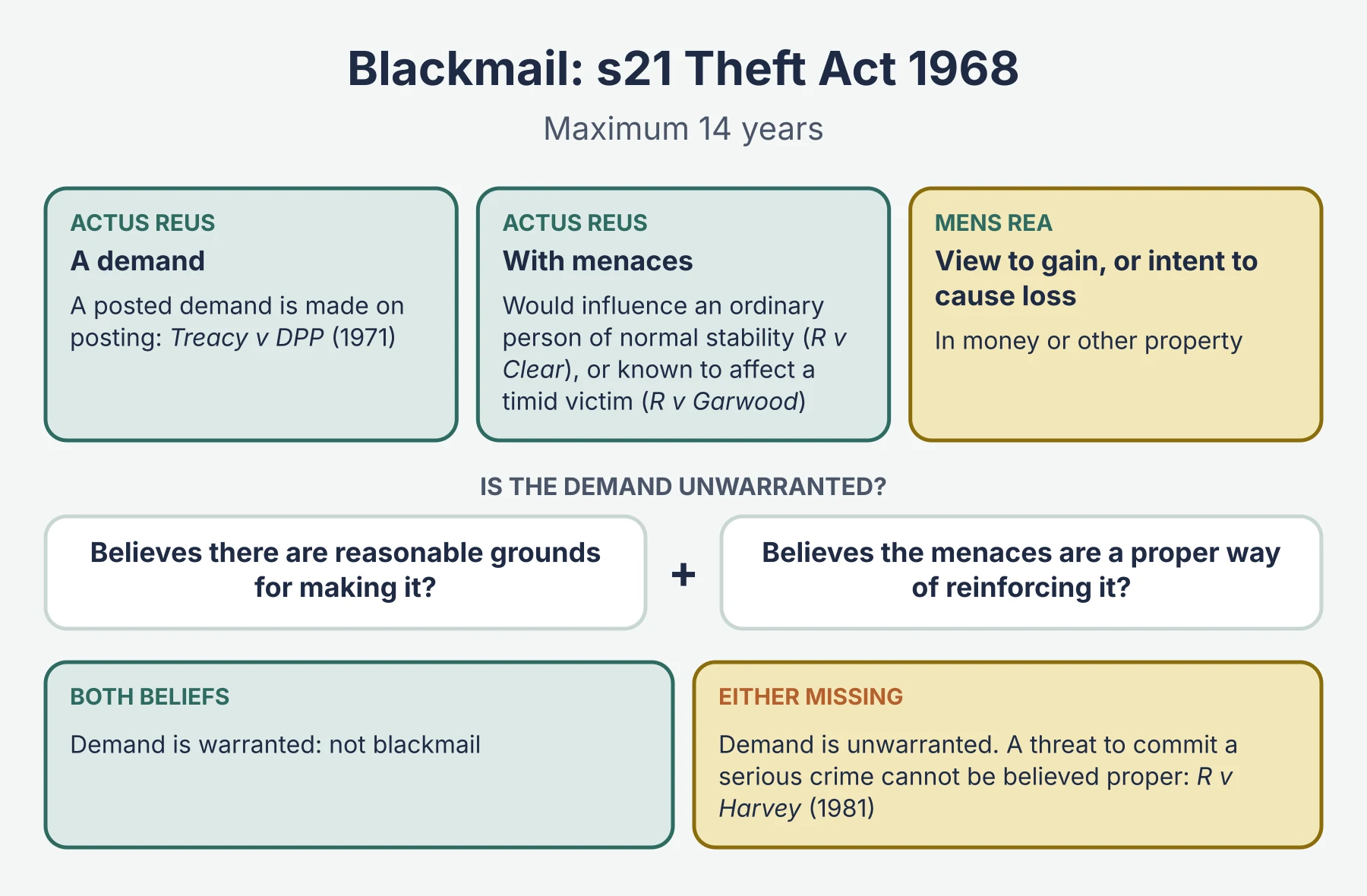
Blackmail (s21)
- Demand (express or implied; on posting – Treacy) with menaces (Clear: ordinary person of normal stability; Garwood: known timid victim).
- With a view to gain or intent to cause loss.
- Unwarranted unless the defendant believes in reasonable grounds and that menaces are proper; threats of serious crime cannot be proper (Harvey).
Handling (s22)
- Otherwise than in the course of stealing: receive, or undertake or assist in retention, removal, disposal or realisation by or for another, or arrange to do so.
- Retention by concealment (Kanwar); buyer is not “another” (Bloxham).
- Knowing or believing stolen – not suspicion (Moys); belief explained in Hall. Plus dishonesty.
Making off (s3 Theft Act 1978)
- Payment on the spot required or expected; goods supplied or service done.
- Makes off without paying.
- MR: knows payment is expected; dishonest; intent to avoid payment permanently (Allen).
- Service incomplete → no payment legally required (Troughton).
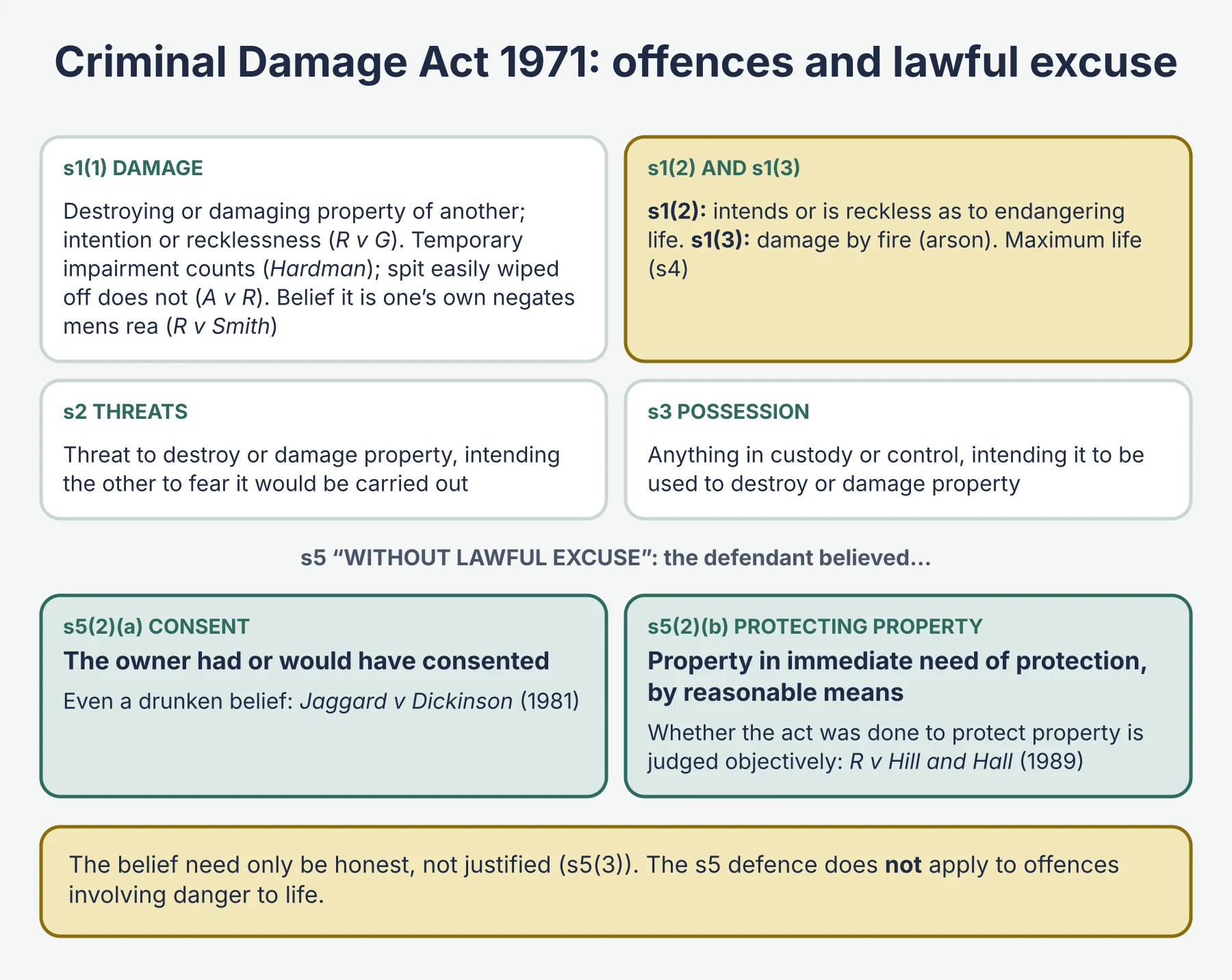
Criminal damage (Criminal Damage Act 1971)
| Section | AR | MR |
|---|---|---|
| s1(1) | Destroy or damage property belonging to another | Intention or recklessness (R v G) as to damage and as to ownership (Smith) |
| s1(2) | Destroy or damage any property, including one’s own | Plus intention or recklessness as to endangering life |
| s1(3) | Damage by fire | Arson |
| s2 | Threat to destroy or damage property | Intending the other to fear it will be carried out |
| s3 | Custody or control of anything | Intending it to be used to destroy or damage property |
- Damage: temporary impairment counts (Hardman); not where easily wiped away with no cost (A v R).
- s5 lawful excuse: belief in consent (Jaggard v Dickinson); protecting property in immediate need by reasonable means (Hill and Hall, objective element). Honest belief need not be reasonable (s5(3)). Not available where life is endangered.
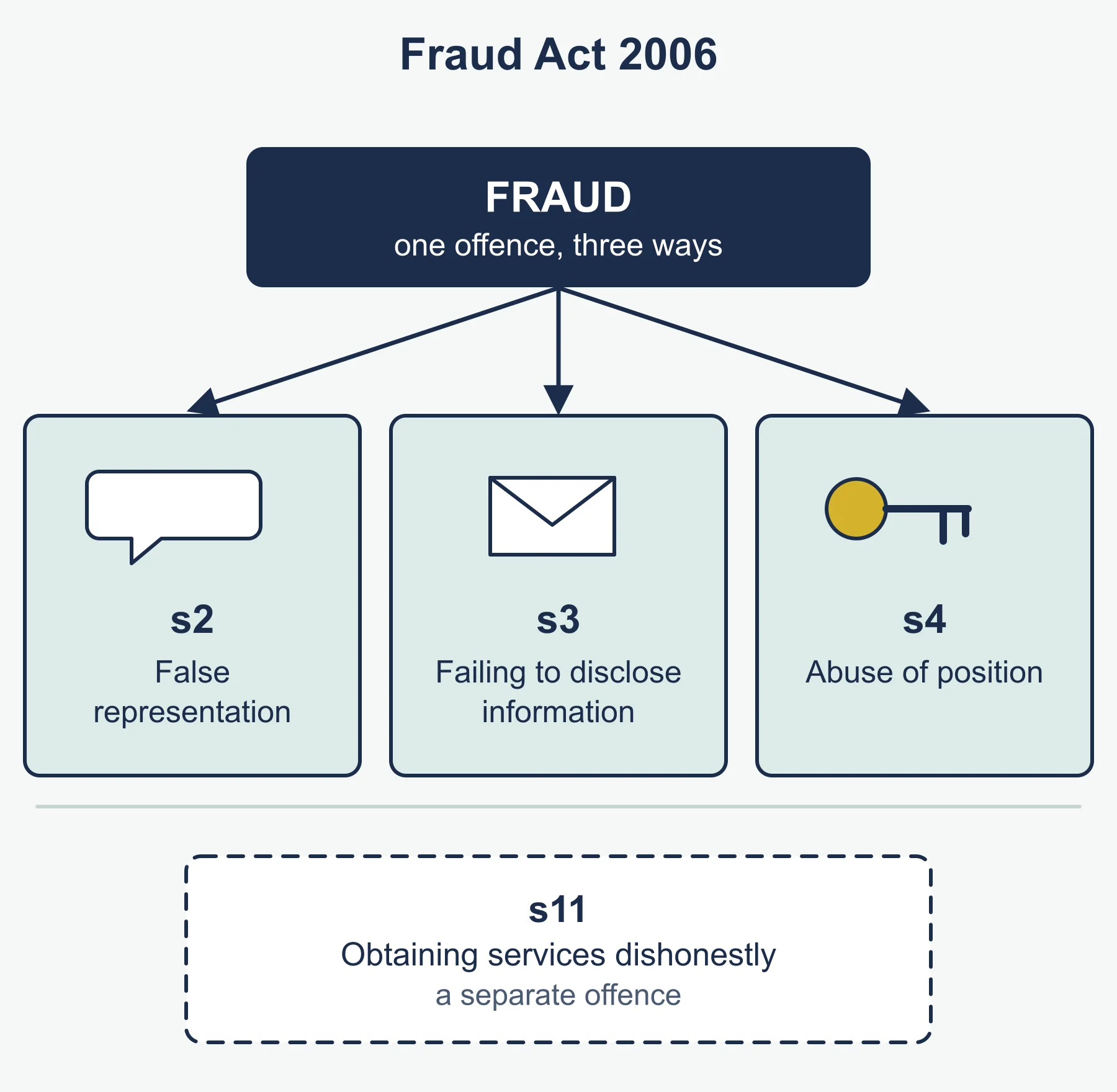
Fraud Act 2006
| Section | Core conduct | Shared MR |
|---|---|---|
| s2 | False representation – express or implied, to a person or machine; knows it is or might be untrue or misleading | Dishonesty + intent to gain or cause loss or risk of loss |
| s3 | Failing to disclose information under a legal duty | Same |
| s4 | Abusing a position of financial trust, by act or omission | Same |
| s11 | Obtaining services by a dishonest act, without paying in full | Knows payment expected; intends not to pay in full |
The fraud offences are complete when the representation, failure or abuse occurs – no one need be deceived and no gain need be made.
Key terms
| Term | Meaning |
|---|---|
| Appropriation | Assuming any right of an owner |
| Thing in action | Property that can be claimed only by legal action, such as a bank credit |
| Weapon of offence | Article made, adapted or intended for causing injury or incapacitating |
| Menaces | Threats that would influence an ordinary person |
| Realisation | Selling or exchanging stolen goods for value |
| Lawful excuse | A statutory defence to criminal damage under s5 |
Exam traps
- Applying Ghosh – dishonesty now follows Ivey and Barton and Booth.
- Forgetting that robbery requires every element of theft.
- Mixing up which s9 form needs intent at entry.
- Using the s5 lawful excuse defence for the aggravated s1(2) offence.
- Saying making off is committed by someone who intends to pay later.
- Treating fraud as needing a victim who is actually deceived.
Self-test
- Which section defines appropriation, and what did Gomez decide?
- Can land be stolen?
- State the test for dishonesty after Barton and Booth.
- What did R v Lloyd decide about borrowing?
- Why was there no robbery in R v Robinson?
- What is the maximum sentence for burglary of a dwelling?
- When must the weapon be present for aggravated burglary under s9(1)(b)?
- When is a demand with menaces unwarranted?
- Is strong suspicion that goods are stolen enough for handling?
- What intention is needed for making off without payment?
- Give the two limbs of lawful excuse under s5(2) Criminal Damage Act 1971.
- Which fraud offence requires a positive act rather than an omission?
Answers
- Section 3; consent of the owner does not prevent an appropriation.
- Generally no (s4(2)), with limited exceptions.
- Establish the defendant’s actual knowledge or belief as to the facts, then decide whether the conduct was dishonest by the standards of ordinary decent people.
- Borrowing is intention to permanently deprive only if the property is returned with its goodness, virtue and practical value gone.
- He believed he had a legal right to the money, so he was not dishonest; without theft there is no robbery.
- Fourteen years.
- At the time of the further offence (O’Leary).
- Unless the defendant believes there are reasonable grounds for the demand and that the menaces are a proper means of reinforcing it.
- No (Moys); knowledge or belief is required.
- An intention to avoid payment permanently (Allen).
- Belief in the owner’s consent; acting to protect property in immediate need of protection by reasonable means.
- Obtaining services dishonestly (s11).
Apply the checklists to scenarios in the offences against property practice questions.
Related resources
-
Study guides
Cambridge A Level Law (9084): Sentencing in England and Wales
Adult and youth sentences, sentencing factors, parental responsibility and the aims of sentencing, with a worked example, for Cambridge Law 9084 subtopic 2.3.
Law · Cambridge · AS Level
Read guide -
Practice questions
Cambridge A Level Law (9084): Sentencing in England and Wales – Practice Questions
Original questions with mark-scheme answers on adult and youth sentences, sentencing factors, parental responsibility and aims for Cambridge Law 9084.
Law · Cambridge · AS Level
Try questions -
Revision notes
Cambridge A Level Law (9084): Sentencing in England and Wales – Revision Notes
Condensed notes on adult and youth sentences, sentencing factors, parental responsibility and the aims of sentencing, with a self-test, for Cambridge Law 9084.
Law · Cambridge · AS Level
Revise topic
Get free revision emails (optional)
Occasional emails with practice questions, worked explanations and links to free resources for the qualification and subjects you choose. No spam, and you can unsubscribe from any email. The free tools on this site never need an email.