
Revision Notes
Cambridge A Level Law (9084): Sentencing in England and Wales – Revision Notes
Condensed notes on adult and youth sentences, sentencing factors, parental responsibility and the aims of sentencing, with a self-test, for Cambridge Law 9084.
- Subject
- Law
- Level
- AS LEVEL
- Topic
- Topic 2 – Criminal Law
- Author
- Marlbridge Academic Team
- Updated
- Reviewed by
- Aizaz Raoof Ali (what this means)
Aligned to Cambridge A Level Law (9084), 2026-2028. Official specification .
Syllabus page (what it covers and how it is assessed): Cambridge A Level Law.
Syllabus points this page covers
9084 (AS Level)
- 2.3 Sentencing in England and Wales
Found an error? Report a correction.
Need help with this topic? Request a free trial class for A Level Law (9084).
Recall notes for subtopic 2.3 of Cambridge International AS & A Level Law (9084). The sentencing study guide explains each sentence and works through a full sentencing problem.
The framework
- Sentencing Act 2020 (Sentencing Code) – consolidates most sentencing law.
- Sentencing Council guidelines – must be followed unless contrary to the interests of justice.
- Thresholds: custody only if so serious that neither a fine alone nor a community sentence can be justified; a community order only if serious enough to warrant one.
- Pre-sentence report – prepared by the Probation Service to inform the court.
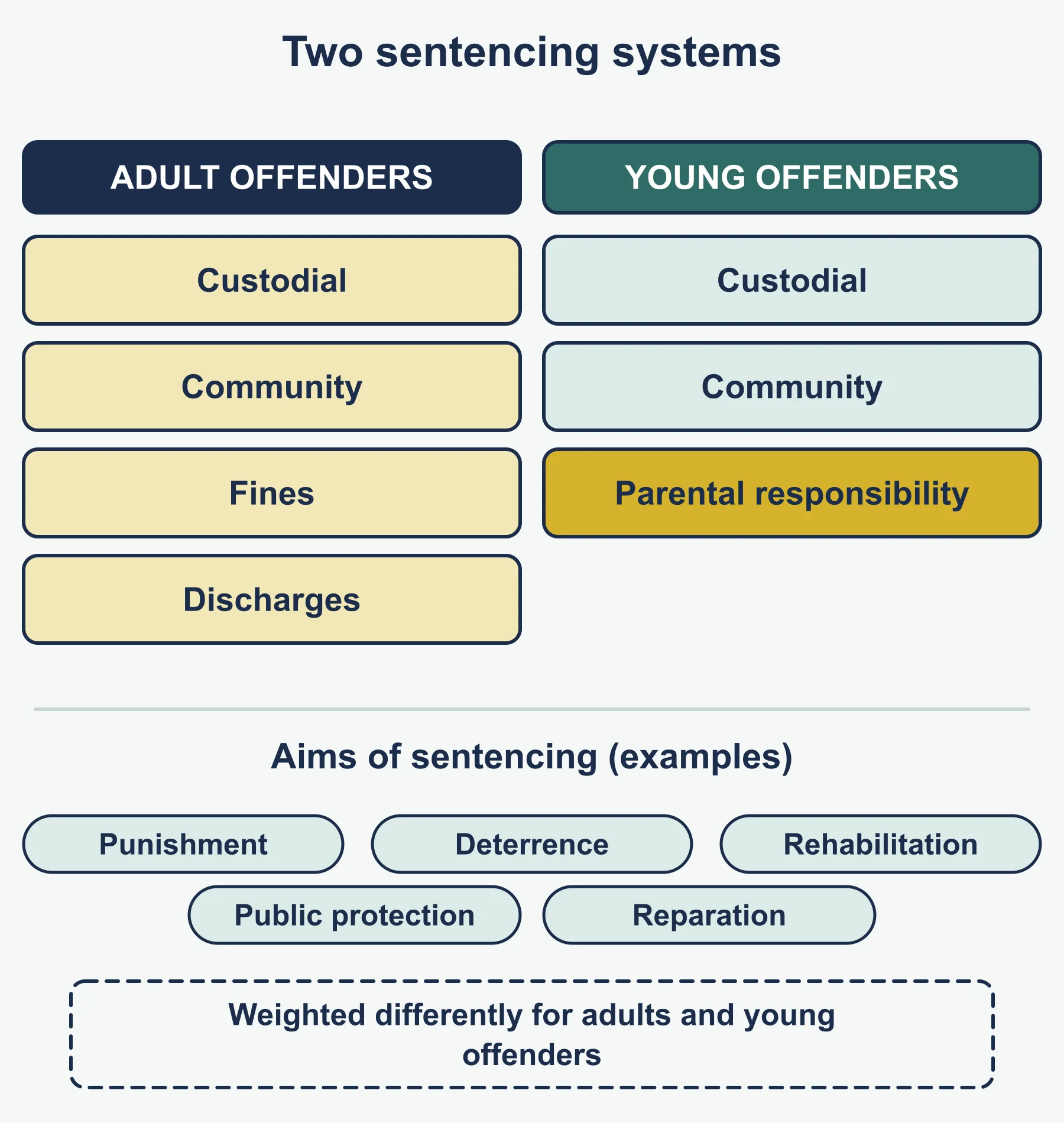
Adult sentences (2.3.1)
| Type | Key points |
|---|---|
| Immediate custody | Determinate term, part on licence with recall for breach |
| Suspended sentence order | Prison term up to two years suspended for six months to two years; activated on breach or reoffending |
| Life | Mandatory for murder with minimum term; discretionary for other serious offences |
| Extended sentence | Dangerous offenders; longer licence period |
| Minimum sentences | Repeat offences such as a third domestic burglary or third Class A trafficking |
| Community order | Up to three years; requirements such as unpaid work (40–300 hours), curfew, exclusion, rehabilitation activity, drug, alcohol or mental health treatment; at least one punitive element or a fine |
| Fine | Reflects seriousness and means; standard scale levels 1–5, top level unlimited since 2015 |
| Compensation order | Victim’s loss; takes priority over a fine |
| Absolute discharge | No penalty |
| Conditional discharge | No penalty unless reoffending within up to three years |
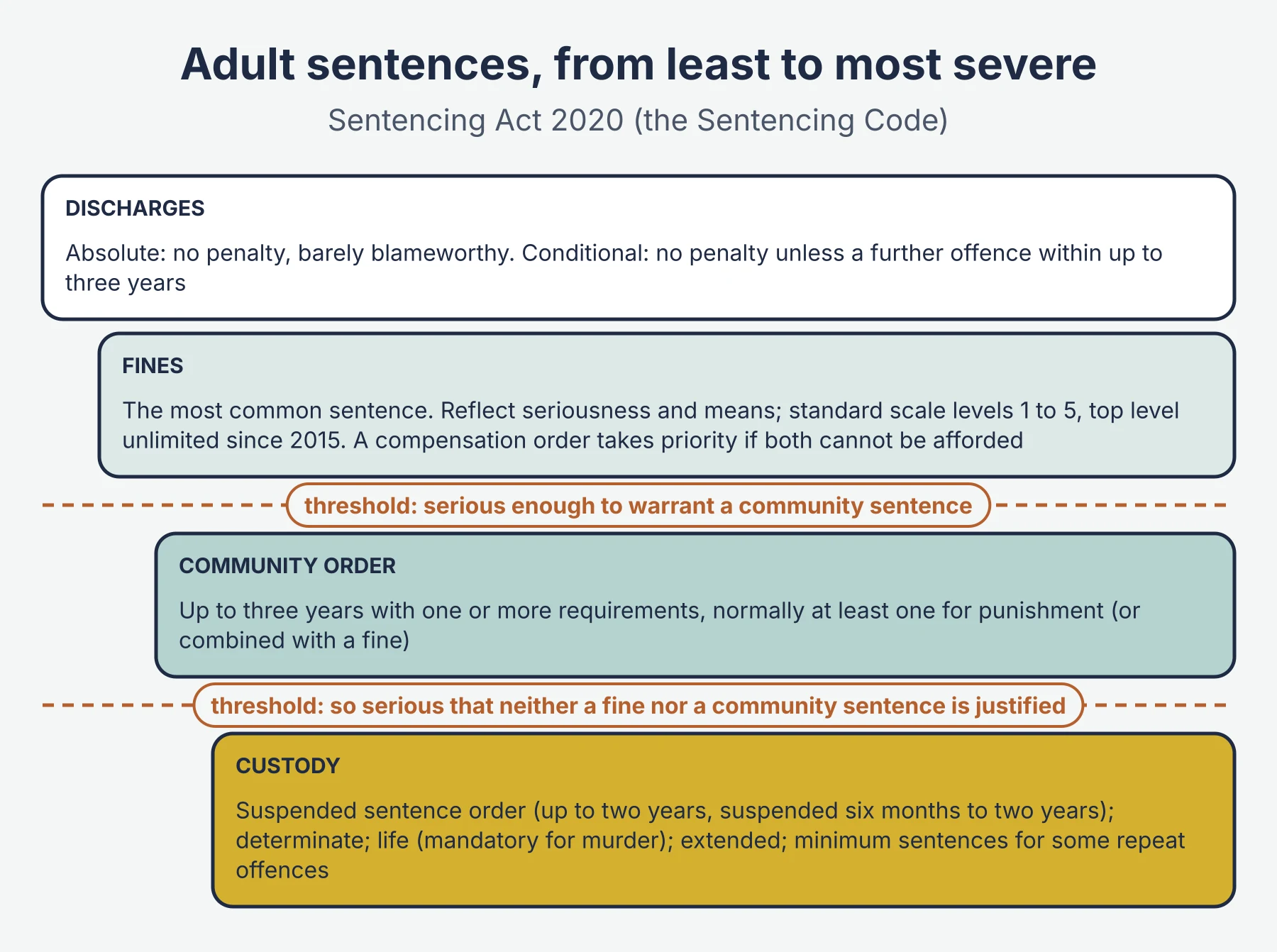
Factors – adults
- Culpability – planning, weapon, leading role, intention against recklessness.
- Harm – caused, intended or foreseeable.
- Statutory aggravation – previous convictions; offending on bail; hostility based on race, religion, disability, sexual orientation or transgender identity.
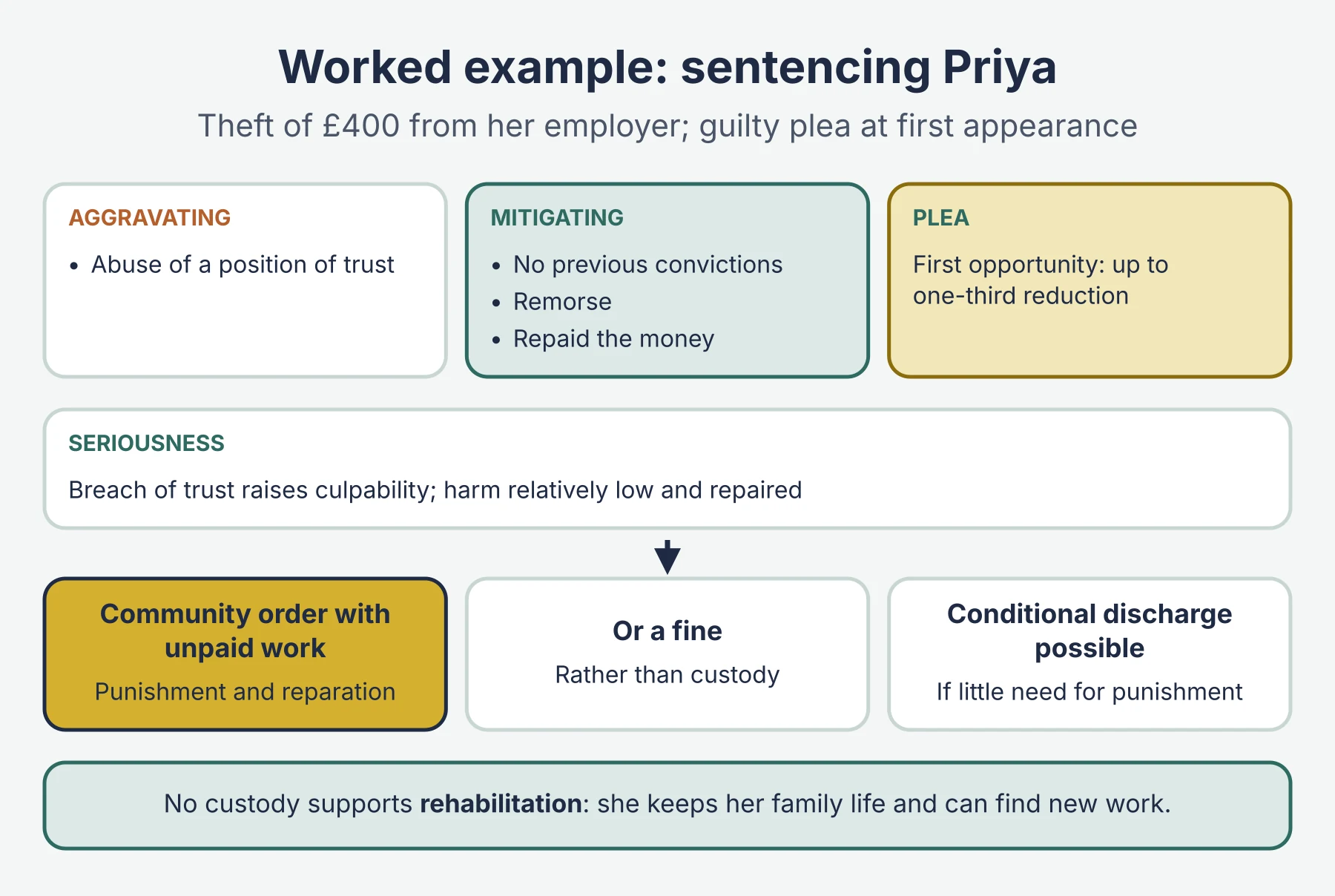
- Other aggravation – vulnerable victim, abuse of trust, group offending.
- Mitigation – no previous convictions, remorse, youth or immaturity, minor role, ill health, good character.
- Guilty plea – up to one-third at first opportunity, one-quarter later, about one-tenth on the first day of trial.
- Totality and reasons.
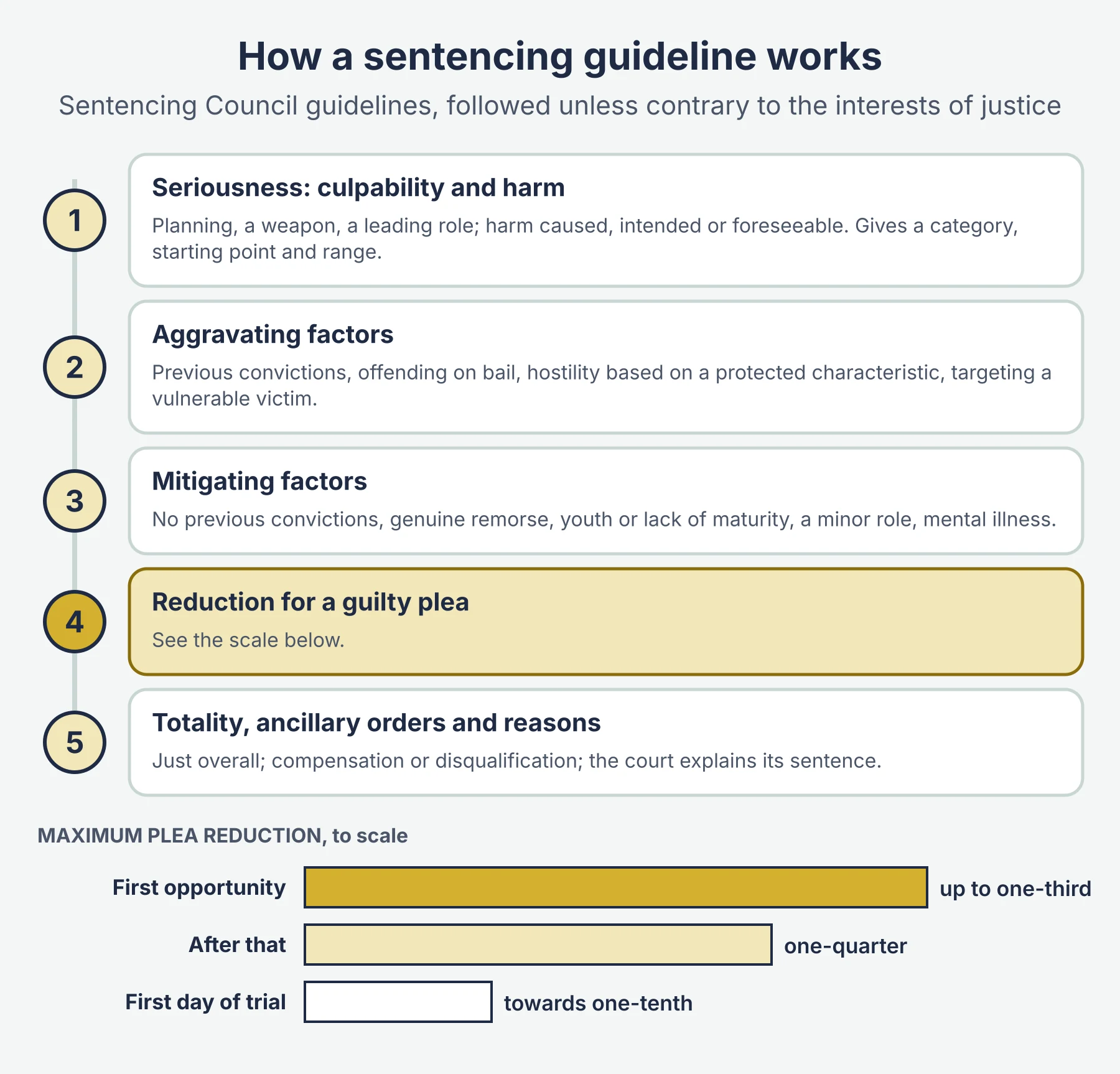
Young offenders (2.3.2)
- Age of criminal responsibility: 10.
- Court: youth court – private, specialist magistrates or district judges.
| Sentence | Age and length | Notes |
|---|---|---|
| Referral order | First-time guilty plea; 3–12 months | Youth offender panel contract; reparation; spent on completion |
| Youth rehabilitation order | Up to 3 years | Requirements: supervision, activity, curfew, exclusion, unpaid work (16–17), intensive supervision and surveillance |
| Detention and training order | 12–17; 4 months to 2 years | Half custody, half supervision; under-15s only if persistent |
| Long-term detention | Grave crimes (14 years+ for adults) | Longer than a detention and training order allows |
| Detention at His Majesty’s pleasure | Murder under 18 | Minimum term set |
Parental responsibility
- Parents of under-16s must normally attend court.
- Parents must pay fines, costs and compensation for under-16s; may be ordered for 16–17s.
- Parenting order (Crime and Disorder Act 1998) – counselling or guidance sessions plus requirements such as school attendance.
- Bind over – to take proper care of and exercise proper control over the child.
Factors – young offenders: age and maturity; welfare (Children and Young Persons Act 1933); background such as care, learning needs or exploitation; seriousness with lower starting points; guilty plea; custody as a last resort.
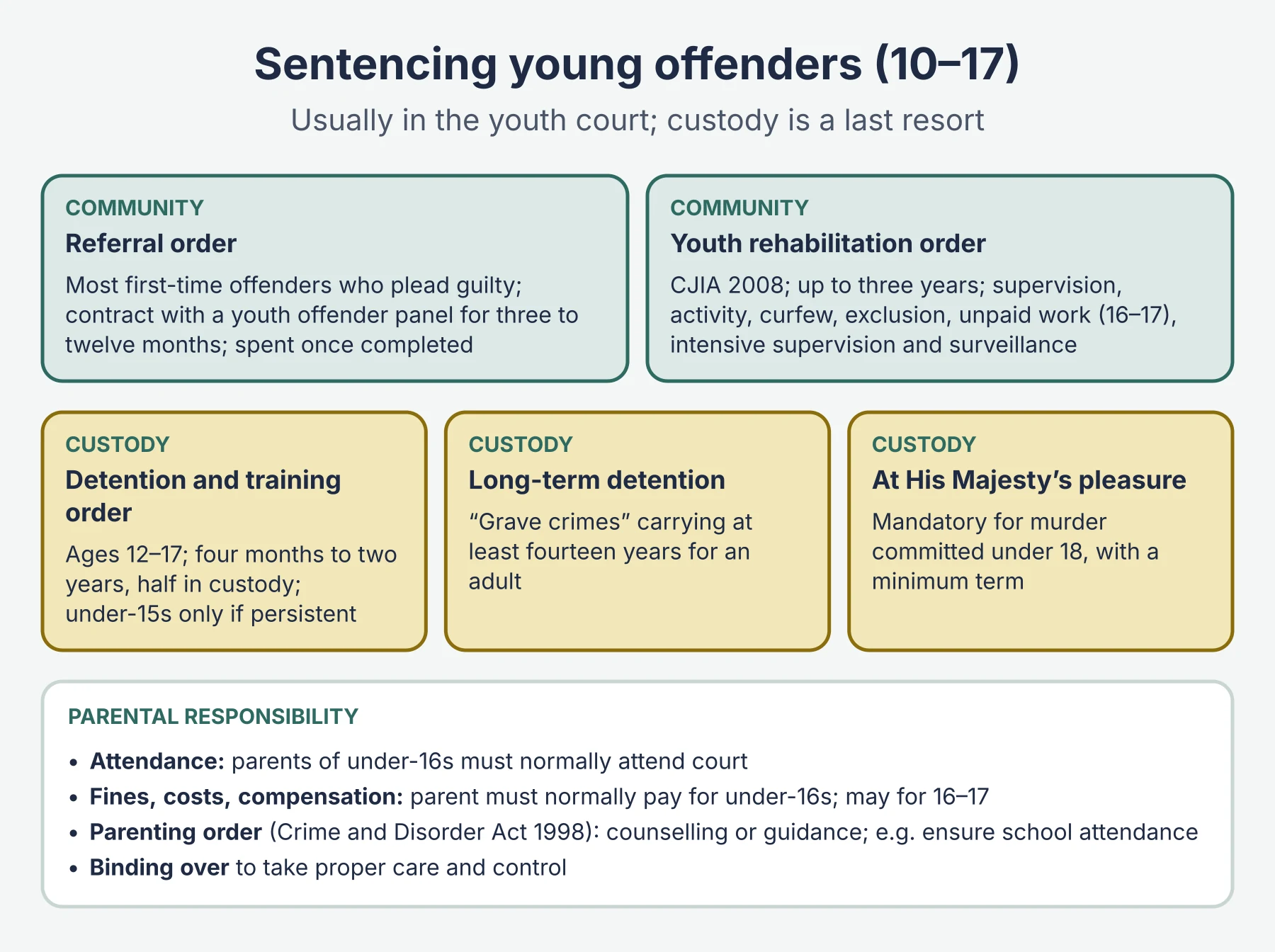
Aims of sentencing (2.3.3)
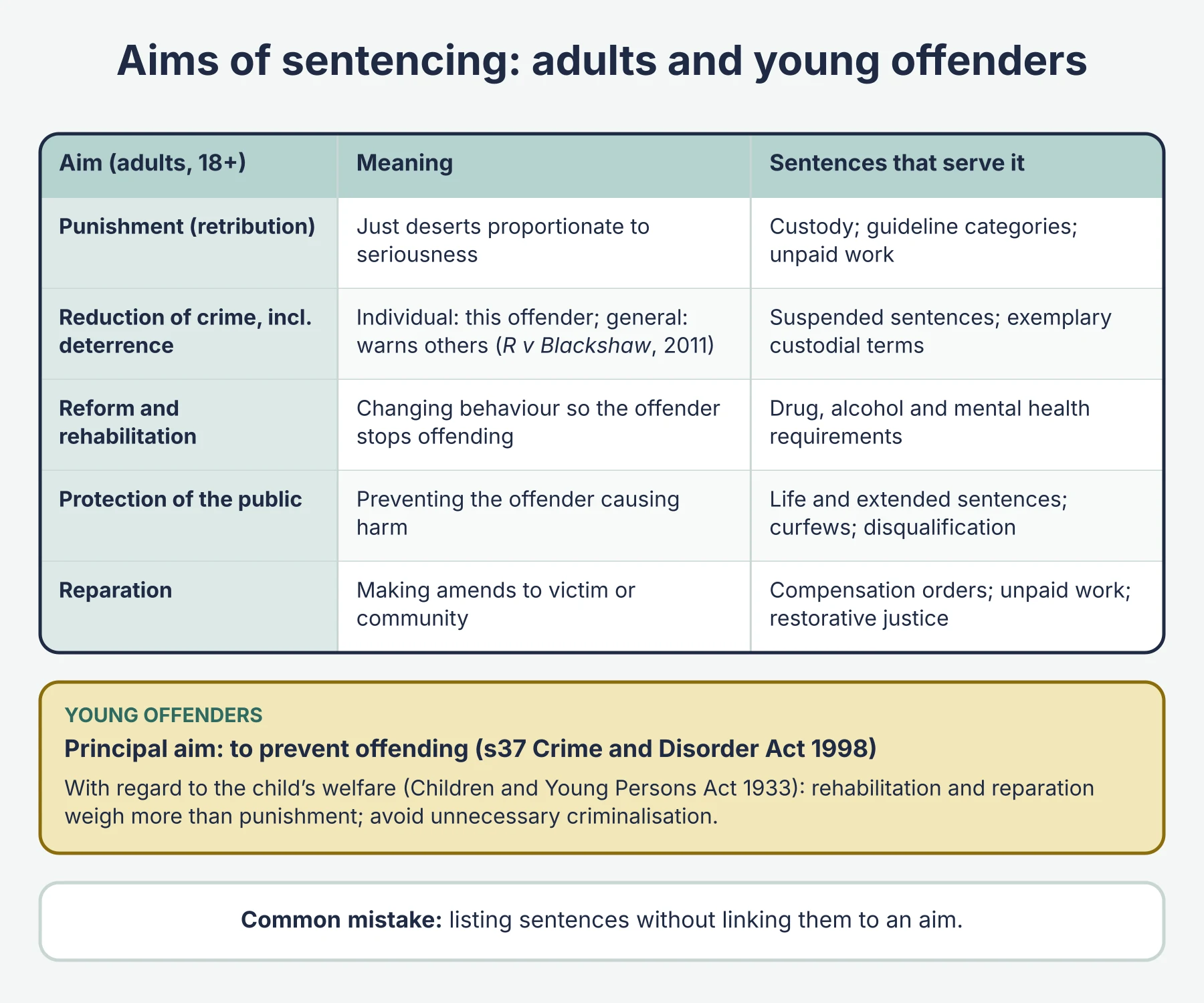
Adults – five purposes in the Sentencing Code:
- Punishment
- Reduction of crime, including deterrence
- Reform and rehabilitation
- Protection of the public
- Reparation
Example of deterrence: R v Blackshaw (2011) – four-year terms upheld for inciting riots on Facebook.
Young offenders: principal aim is preventing offending (s37 Crime and Disorder Act 1998), plus regard to welfare; rehabilitation and reparation outweigh punishment.
Matching aims to sentences
| Aim | Best served by |
|---|---|
| Punishment | Custody, unpaid work, fines |
| Deterrence | Exemplary sentences, suspended sentence orders |
| Rehabilitation | Treatment requirements, youth rehabilitation orders |
| Protection | Life, extended sentences, curfews, exclusion, disqualification |
| Reparation | Compensation orders, referral order contracts, unpaid work |
Key terms
| Term | Meaning |
|---|---|
| Culpability | The offender’s blameworthiness |
| Licence | Supervised period in the community after release |
| Starting point | Guideline sentence for a typical case in a category |
| Totality | Overall sentence must be just for all offences together |
| Youth offender panel | Panel that agrees a referral order contract |
| Persistent offender | Requirement before a detention and training order for under-15s |
Exam traps
- Calling a suspended sentence a community sentence.
- Forgetting the guilty plea reduction in a scenario.
- Giving adults’ aims for young offenders without the prevention and welfare focus.
- Naming an aim without matching it to a sentence.
- Omitting parental responsibility in young offender answers.
- Ignoring the offender’s means when recommending a fine.
Self-test
- What is the custody threshold?
- How long can a suspended sentence order’s operational period be?
- State the range of unpaid work hours in a community order.
- What is a conditional discharge?
- Name the two elements of seriousness.
- What is the maximum reduction for a guilty plea?
- Who receives a referral order?
- What is the age range and length of a detention and training order?
- Name two orders that make parents responsible for a young offender.
- List the five purposes of sentencing adults.
- What is the principal aim of the youth justice system?
- Which aim was emphasised in R v Blackshaw (2011)?
Answers
- The offence must be so serious that neither a fine alone nor a community sentence can be justified.
- Between six months and two years.
- 40 to 300 hours.
- No penalty is imposed unless the offender commits another offence within the set period, up to three years.
- Culpability and harm.
- One-third, for a plea at the first opportunity.
- Most first-time young offenders who plead guilty.
- Ages 12–17; four months to two years.
- Any two: parenting order; parental bind over; order to pay the child’s fine, costs or compensation.
- Punishment; reduction of crime including deterrence; reform and rehabilitation; protection of the public; reparation.
- To prevent offending by children and young persons.
- General deterrence.
Practise applying these rules with the sentencing practice questions.
Related resources
-
Study guides
Cambridge A-Level Law: Criminal Law (9084)
Elements of a crime, theft and other property offences, criminal damage, fraud and sentencing: Topic 2 of Cambridge AS and A Level Law 9084, on Paper 2.
Law · Cambridge · AS Level
Read guide -
Practice questions
Cambridge A-Level Law: Criminal Law — Practice Questions (9084)
Original practice questions with worked answers on elements of a crime, property offences and sentencing for Cambridge AS and A Level Law 9084 Topic 2.
Law · Cambridge · AS Level
Try questions -
Revision notes
Cambridge A-Level Law: Criminal Law — Revision Notes (9084)
Condensed revision notes on elements of a crime, offences against property, and sentencing for Cambridge AS & A Level Law Topic 2 Criminal Law (9084).
Law · Cambridge · AS Level
Revise topic
Get free revision emails (optional)
Occasional emails with practice questions, worked explanations and links to free resources for the qualification and subjects you choose. No spam, and you can unsubscribe from any email. The free tools on this site never need an email.