
Study Guides
Cambridge A Level Law (9084): Sentencing in England and Wales
Adult and youth sentences, sentencing factors, parental responsibility and the aims of sentencing, with a worked example, for Cambridge Law 9084 subtopic 2.3.
- Subject
- Law
- Level
- AS LEVEL
- Topic
- Topic 2 – Criminal Law
- Author
- Marlbridge Academic Team
- Updated
- Reviewed by
- Aizaz Raoof Ali (what this means)
Aligned to Cambridge A Level Law (9084), 2026-2028. Official specification .
Syllabus page (what it covers and how it is assessed): Cambridge A Level Law.
Syllabus points this page covers
9084 (AS Level)
- 2.3 Sentencing in England and Wales
Found an error? Report a correction.
Need help with this topic? Request a free trial class for A Level Law (9084).
Subtopic 2.3 deals with what happens after conviction. The syllabus has three strands: sentences for adult offenders and the factors in sentencing them (2.3.1), sentences for young offenders, including parental responsibility, and the factors in sentencing them (2.3.2), and the aims of sentencing for each group (2.3.3). The Topic 2 overview introduces these strands; this guide sets out the detail and the evaluation you need for Paper 2. Since 2020 most sentencing law has been consolidated in the Sentencing Act 2020, known as the Sentencing Code.
2.3.1 Adult offenders
Types of sentence
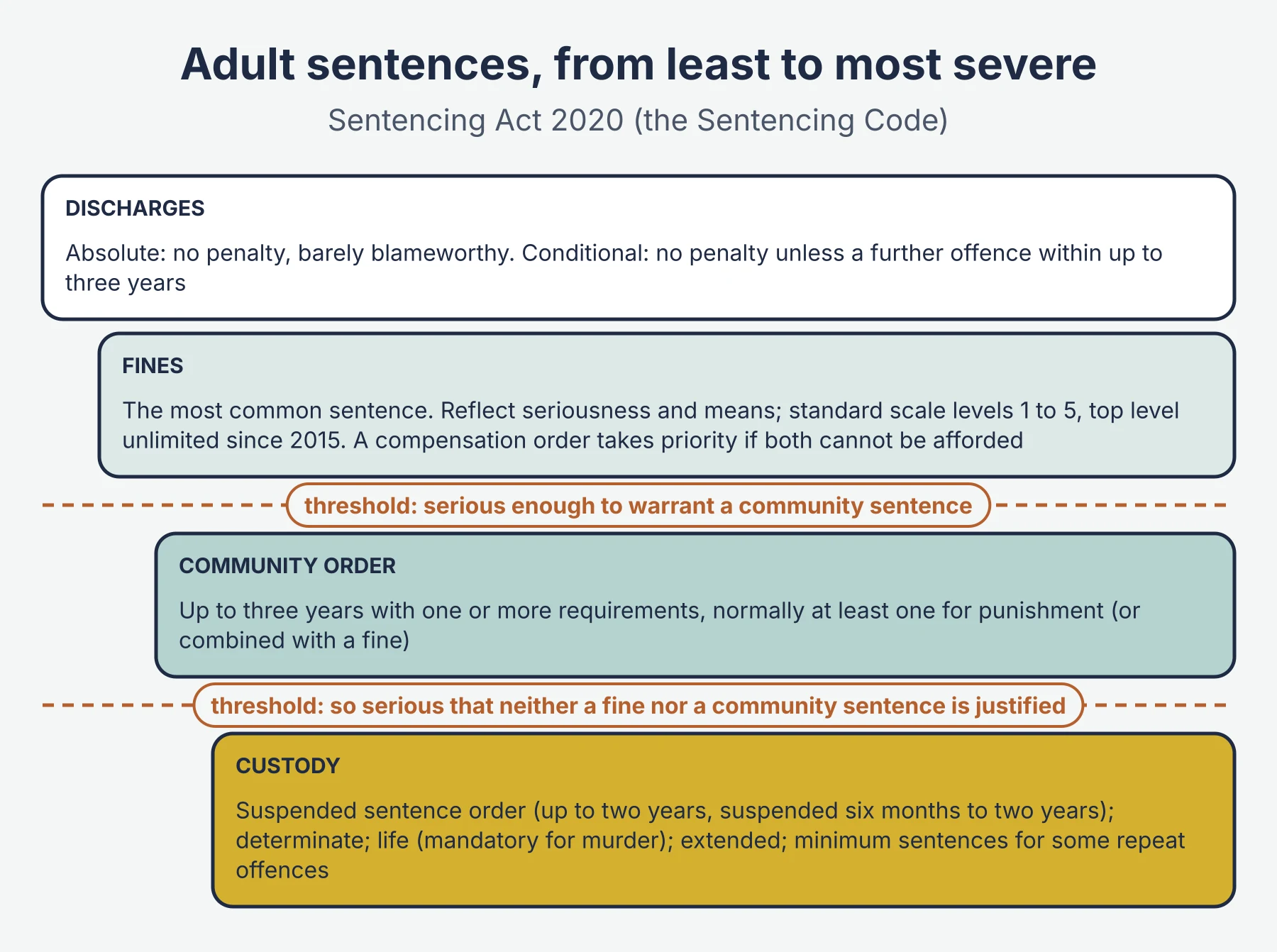
Custodial sentences. A court may impose custody only if the offence is so serious that neither a fine alone nor a community sentence can be justified.
- Determinate sentences – a fixed term, part served in prison and the rest on licence in the community, where breach can lead to recall.
- Suspended sentence orders – a prison term of up to two years suspended for between six months and two years. The offender stays in the community, often with requirements; a further offence or breach can activate the prison term.
- Life sentences – mandatory for murder, with the judge setting a minimum term before parole can be considered; discretionary life for some other serious offences.
- Extended sentences – for dangerous offenders, adding an extended licence period to protect the public.
- Minimum sentences – Parliament has set them for some repeat offences, such as a third domestic burglary or a third Class A drug trafficking offence, unless this would be unjust.
Community sentences. A community order requires the offence to be serious enough to warrant it. It can last up to three years and contains one or more requirements, for example:
| Requirement | Purpose |
|---|---|
| Unpaid work (40–300 hours) | Punishment and reparation |
| Curfew, often electronically monitored | Punishment and public protection |
| Exclusion from a place | Public protection |
| Rehabilitation activity | Reform |
| Drug rehabilitation or alcohol treatment | Reform |
| Mental health treatment | Reform |
The order must normally include at least one requirement imposed for punishment, or be combined with a fine.
Fines. The most common sentence. Fines must reflect the seriousness of the offence and the offender’s means. Summary offences are fined on a standard scale of levels 1 to 5, and since 2015 the top level has been unlimited. A compensation order for the victim takes priority over a fine where the offender cannot afford both.
Discharges.
- Absolute discharge – no penalty, used where the offender is barely blameworthy.
- Conditional discharge – no penalty unless the offender commits a further offence within a set period of up to three years, when they can be sentenced for the original offence too.
Factors in sentencing adults
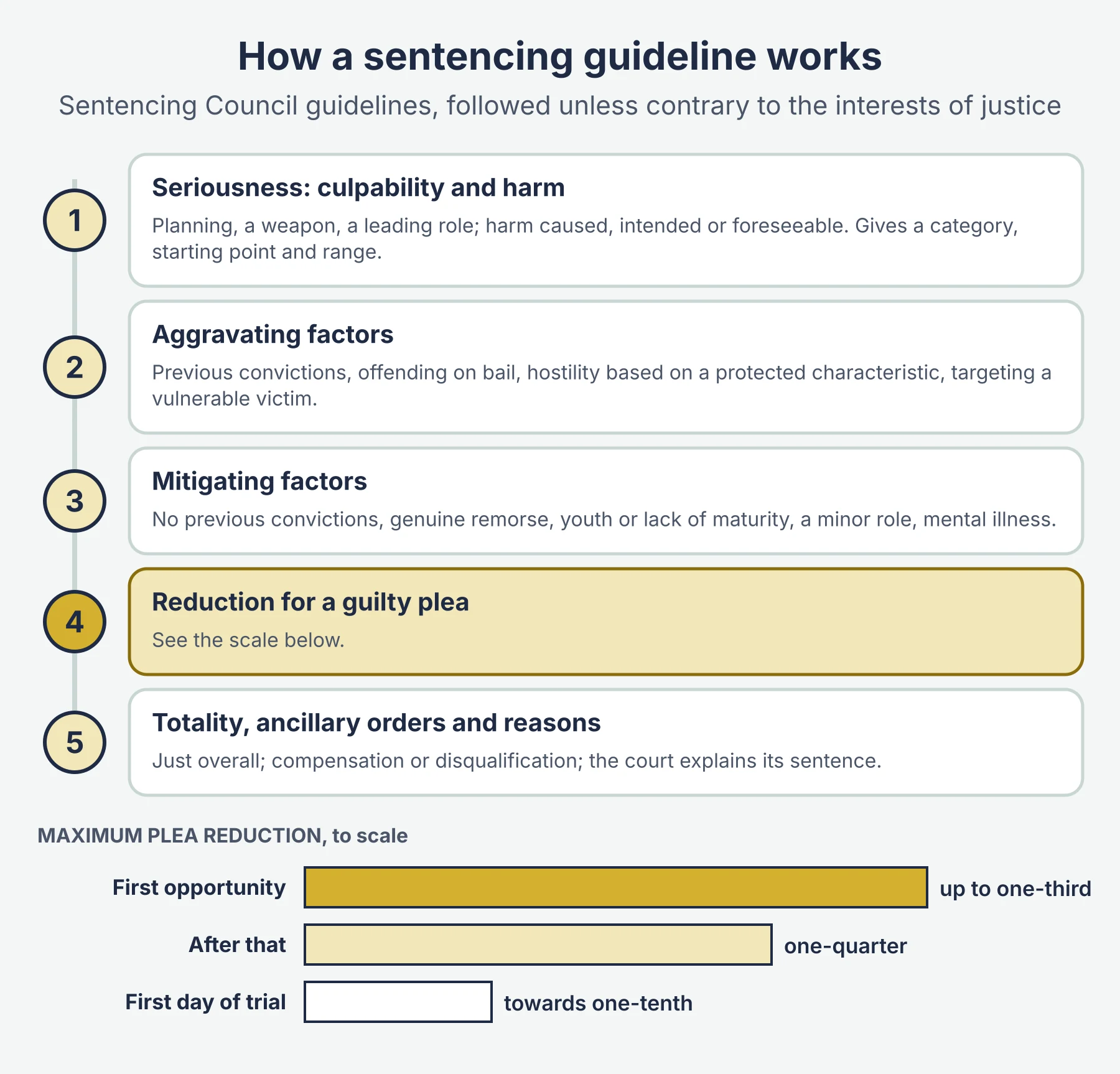
The court follows the Sentencing Council’s guidelines unless that would be contrary to the interests of justice. A typical guideline works in steps:
- Seriousness – assess culpability (for example planning, use of a weapon, leading role) and harm caused, intended or foreseeable, to place the offence in a category with a starting point and range.
- Aggravating factors – statutory ones include previous convictions, offending while on bail and hostility based on race, religion, disability, sexual orientation or transgender identity; others include targeting a vulnerable victim.
- Mitigating factors – such as no previous convictions, genuine remorse, youth or lack of maturity, a minor role, or mental illness.
- Reduction for a guilty plea – up to one-third for a plea at the first opportunity, reducing to one-quarter after that and towards one-tenth on the first day of trial.
- Totality, ancillary orders and reasons – the overall sentence must be just for all the offences, with orders such as compensation or disqualification, and the court must explain its sentence.
A pre-sentence report from the Probation Service often informs the decision, especially when custody or a community order is being considered.
2.3.2 Young offenders
The age of criminal responsibility is 10. Offenders aged 10–17 are normally dealt with in the youth court, a private court staffed by specially trained magistrates or district judges.
Types of sentence
Community sentences.
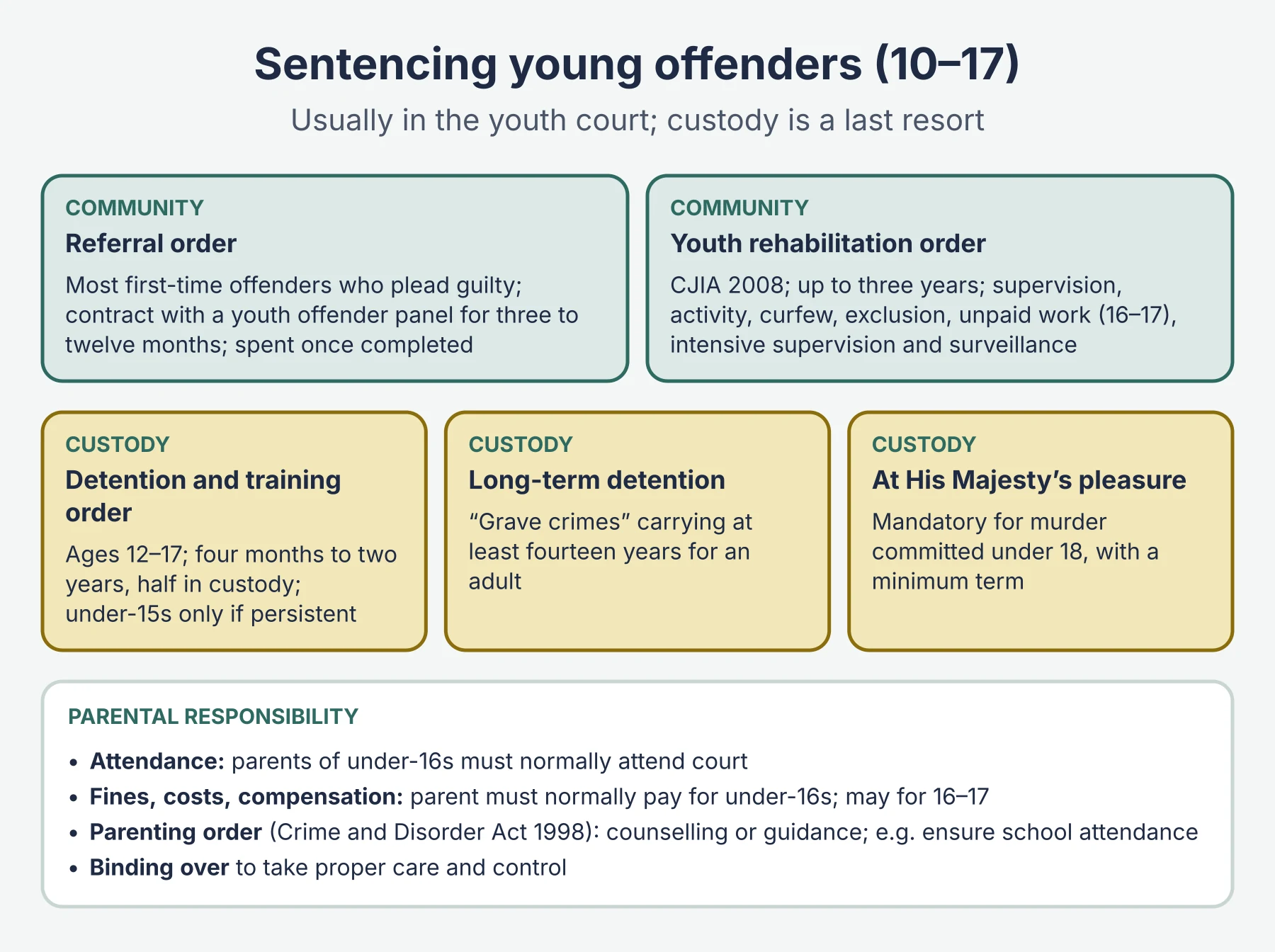
- Referral order – for most first-time offenders who plead guilty. The young person agrees a contract with a youth offender panel, lasting three to twelve months, which may include reparation to the victim, and the conviction is spent once it is completed.
- Youth rehabilitation order – introduced by the Criminal Justice and Immigration Act 2008. It can last up to three years with requirements such as supervision, activity, curfew, exclusion, unpaid work (for 16–17 year olds) and intensive supervision and surveillance as an alternative to custody.
Custodial sentences.
- Detention and training order – for those aged 12–17, lasting between four months and two years; half is normally served in custody and half under supervision in the community. Under-15s can receive one only if they are persistent offenders.
- Long-term detention – for “grave crimes” that carry at least fourteen years for an adult, where a detention and training order is too short.
- Detention at His Majesty’s pleasure – the mandatory sentence for murder committed under 18, with a minimum term.
Custody is a last resort for children, used only where no other sentence is suitable.
Parental responsibility
The law holds parents partly responsible for supporting their children away from offending.
- Attendance: parents of under-16s must normally attend court.
- Fines, costs and compensation: for an offender under 16 the court must normally order the parent to pay; for 16–17 year olds it may do so.
- Parenting order (Crime and Disorder Act 1998): requires the parent to attend counselling or guidance sessions and to comply with other requirements, such as ensuring the child attends school.
- Binding over: a parent may be bound over to take proper care of and exercise proper control over the child.
Factors in sentencing young offenders
The Sentencing Council’s guideline on sentencing children and young people requires the court to focus on the child rather than only the offence. The court considers:
- age, and emotional and developmental maturity;
- welfare, which the Children and Young Persons Act 1933 requires every court to have regard to;
- background factors such as care history, learning difficulties or exploitation by adults;
- the seriousness of the offence, using reduced starting points compared with adults;
- a guilty plea, which earns a reduction as for adults.
2.3.3 Aims of sentencing
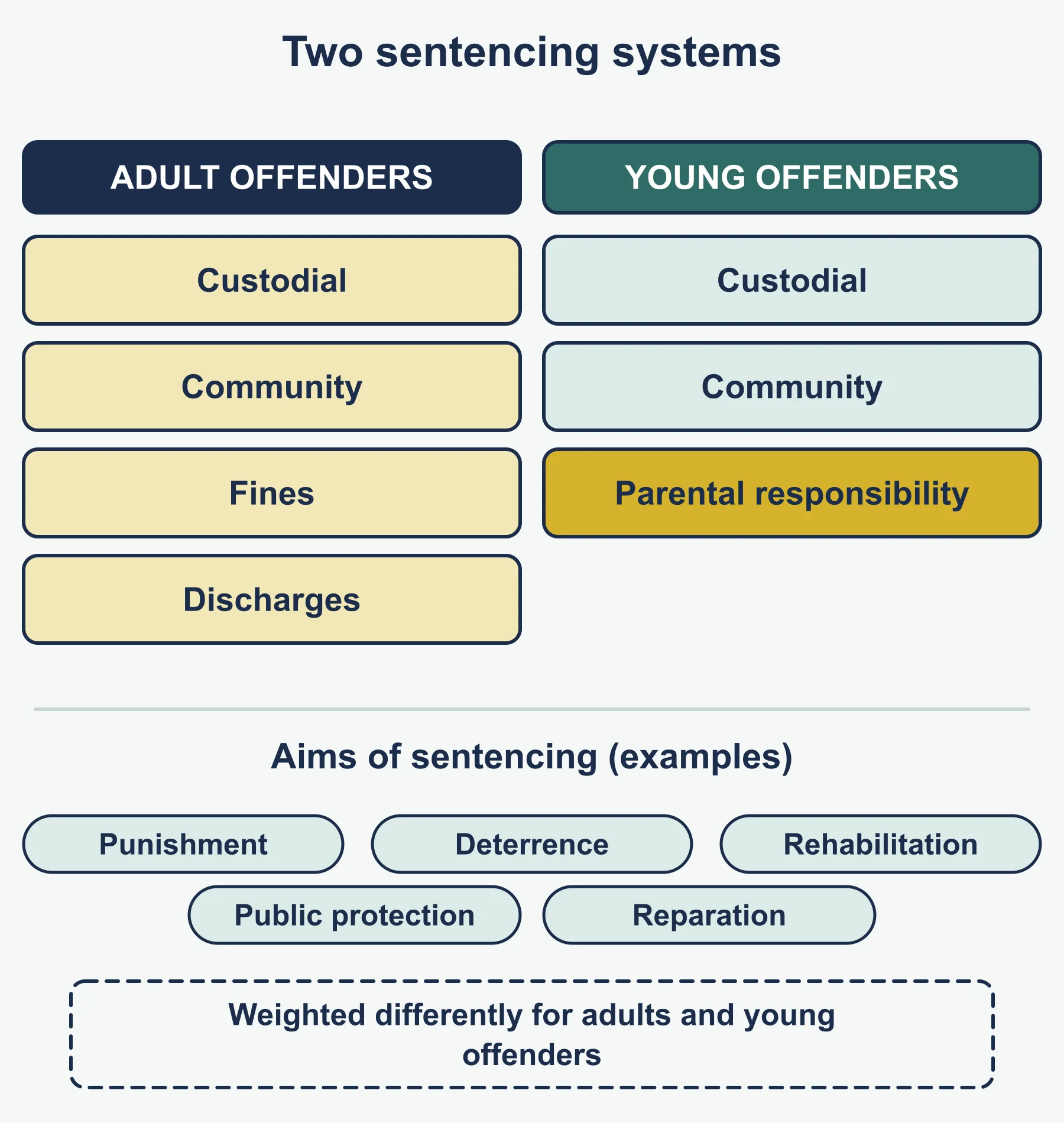
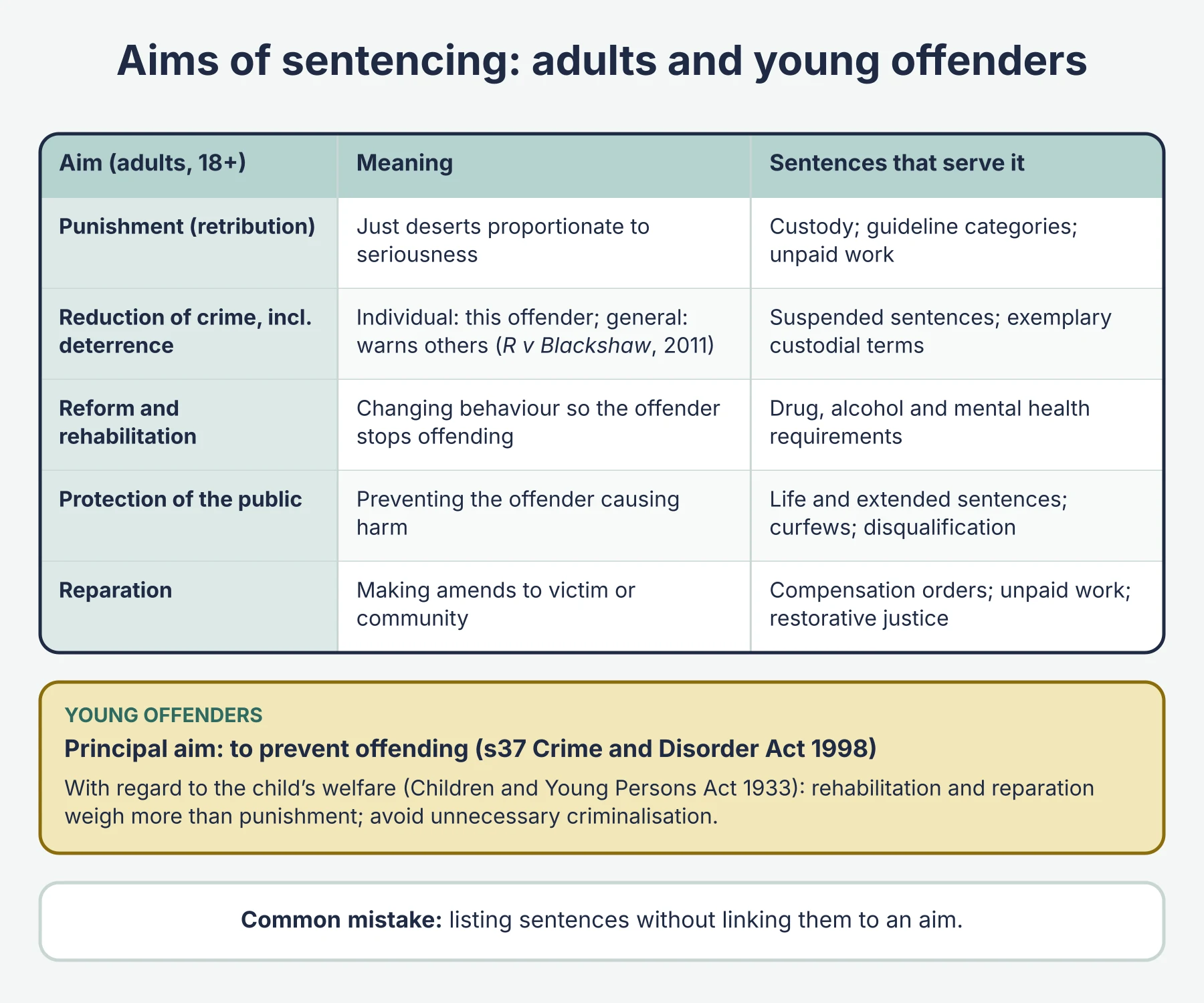
Adults. The Sentencing Code sets out five purposes the court must have regard to for offenders aged 18 or over:
| Aim | Meaning | Sentences that serve it |
|---|---|---|
| Punishment (retribution) | Just deserts proportionate to the seriousness | Custody; guideline categories; unpaid work |
| Reduction of crime, including deterrence | Individual deterrence stops this offender; general deterrence warns others | Suspended sentences; exemplary custodial terms |
| Reform and rehabilitation | Changing behaviour so the offender stops offending | Drug, alcohol and mental health requirements |
| Protection of the public | Preventing the offender from causing harm | Life and extended sentences; curfews; disqualification |
| Reparation | Making amends to the victim or community | Compensation orders; unpaid work; restorative justice |
General deterrence was stressed after the 2011 riots: in R v Blackshaw (2011) the Court of Appeal upheld four-year sentences for using Facebook to encourage rioting, though no riot took place, because of the need to deter.
Young offenders. The principal aim of the youth justice system is to prevent offending by children and young persons (s37 Crime and Disorder Act 1998), alongside the court’s duty to have regard to the child’s welfare. Rehabilitation and reparation are therefore weighted more heavily than punishment, and the system aims to avoid unnecessary criminalisation.
Evaluation. The aims conflict: a long sentence may punish and protect but do little to rehabilitate, and short prison terms disrupt jobs and housing without time for meaningful rehabilitation. Deterrence assumes offenders weigh consequences, which impulsive or addicted offenders may not. The youth emphasis on prevention reflects children’s greater capacity for change, but critics argue a sharp change at 18 ignores individual maturity.
Worked example
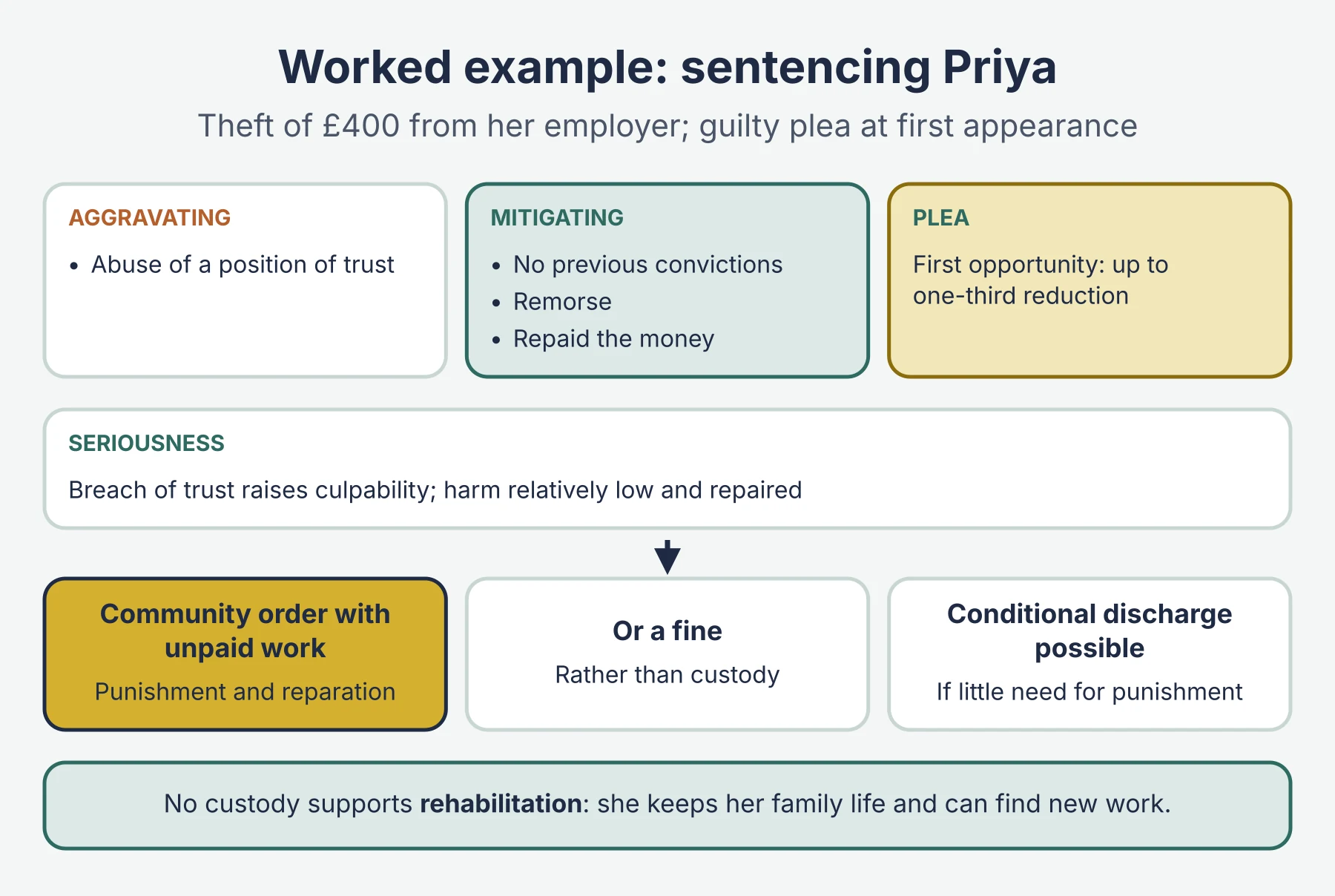
Priya, 32, with no previous convictions, pleads guilty at her first appearance to theft of £400 from her employer to pay a debt. She shows remorse and has repaid the money. Advise on the likely sentence and the aims served.
- Seriousness: a breach of trust raises culpability; the harm is relatively low and has been repaired.
- Aggravating: abuse of a position of trust. Mitigating: no previous convictions, remorse, repayment.
- Plea: a first-opportunity guilty plea earns up to a one-third reduction.
- Likely outcome: a community order with unpaid work, or a fine, rather than custody; a conditional discharge is possible if the court sees little need for punishment.
- Aims: unpaid work serves punishment and reparation; the absence of custody supports rehabilitation, as she can keep her family life and find new work.
Common mistakes
- Listing sentences without linking them to an aim.
- Applying adult sentences, such as standard community orders, to under-18s.
- Treating a suspended sentence as a community sentence; it is a custodial sentence.
- Forgetting parental responsibility when writing about young offenders.
Exam technique
In Section A, identify the offender’s age, assess seriousness, apply aggravating and mitigating factors and the plea reduction, then recommend a sentence with reasons. In a Section B essay, evaluate or assess requires you to weigh the aims against each other and compare the adult and youth systems before concluding. Revise with the sentencing revision notes and practise with the sentencing practice questions.
Related resources
-
Practice questions
Cambridge A Level Law (9084): Sentencing in England and Wales – Practice Questions
Original questions with mark-scheme answers on adult and youth sentences, sentencing factors, parental responsibility and aims for Cambridge Law 9084.
Law · Cambridge · AS Level
Try questions -
Revision notes
Cambridge A Level Law (9084): Sentencing in England and Wales – Revision Notes
Condensed notes on adult and youth sentences, sentencing factors, parental responsibility and the aims of sentencing, with a self-test, for Cambridge Law 9084.
Law · Cambridge · AS Level
Revise topic -
Study guides
Cambridge A-Level Law: Criminal Law (9084)
Elements of a crime, theft and other property offences, criminal damage, fraud and sentencing: Topic 2 of Cambridge AS and A Level Law 9084, on Paper 2.
Law · Cambridge · AS Level
Read guide
Get free revision emails (optional)
Occasional emails with practice questions, worked explanations and links to free resources for the qualification and subjects you choose. No spam, and you can unsubscribe from any email. The free tools on this site never need an email.