
Study Guides
Cambridge A Level Law (9084): Principles and sources of English law
Legal systems, the rule of law, Parliament and its influences, delegated legislation, interpretation and precedent for Cambridge Law 9084 subtopic 1.1.
- Subject
- Law
- Level
- AS LEVEL
- Topic
- Topic 1 – English Legal System
- Author
- Marlbridge Academic Team
- Updated
- Reviewed by
- Aizaz Raoof Ali (what this means)
Aligned to Cambridge A Level Law (9084), 2026-2028. Official specification .
Syllabus page (what it covers and how it is assessed): Cambridge A Level Law.
Syllabus points this page covers
9084 (AS Level)
- 1.1 Principles and sources of English law
Found an error? Report a correction.
Need help with this topic? Request a free trial class for A Level Law (9084).
Subtopic 1.1 opens Paper 1 English Legal System and is assumed knowledge for every other 9084 paper. It has five strands: context (1.1.1), parliamentary law making (1.1.2), delegated legislation (1.1.3), statutory interpretation (1.1.4) and judicial precedent (1.1.5). This guide goes beyond the Topic 1 overview into the detail each strand lists, with supporting cases.
1.1.1 The legal system in context
Families of legal systems. Civil law systems rest on comprehensive codes (France, Germany). Common law systems, which began in England, give judicial decisions the status of law through precedent. Customary law draws on community practice, religious law on religious texts and scholarship, and mixed systems combine traditions, as Scotland and South Africa blend civil and common law.
Adversarial and inquisitorial procedure. English trials are adversarial: each side presents its own evidence and the judge is a neutral umpire. In an inquisitorial system the judge directs the investigation and questions witnesses. The adversarial model protects party autonomy but can favour the better-resourced side.
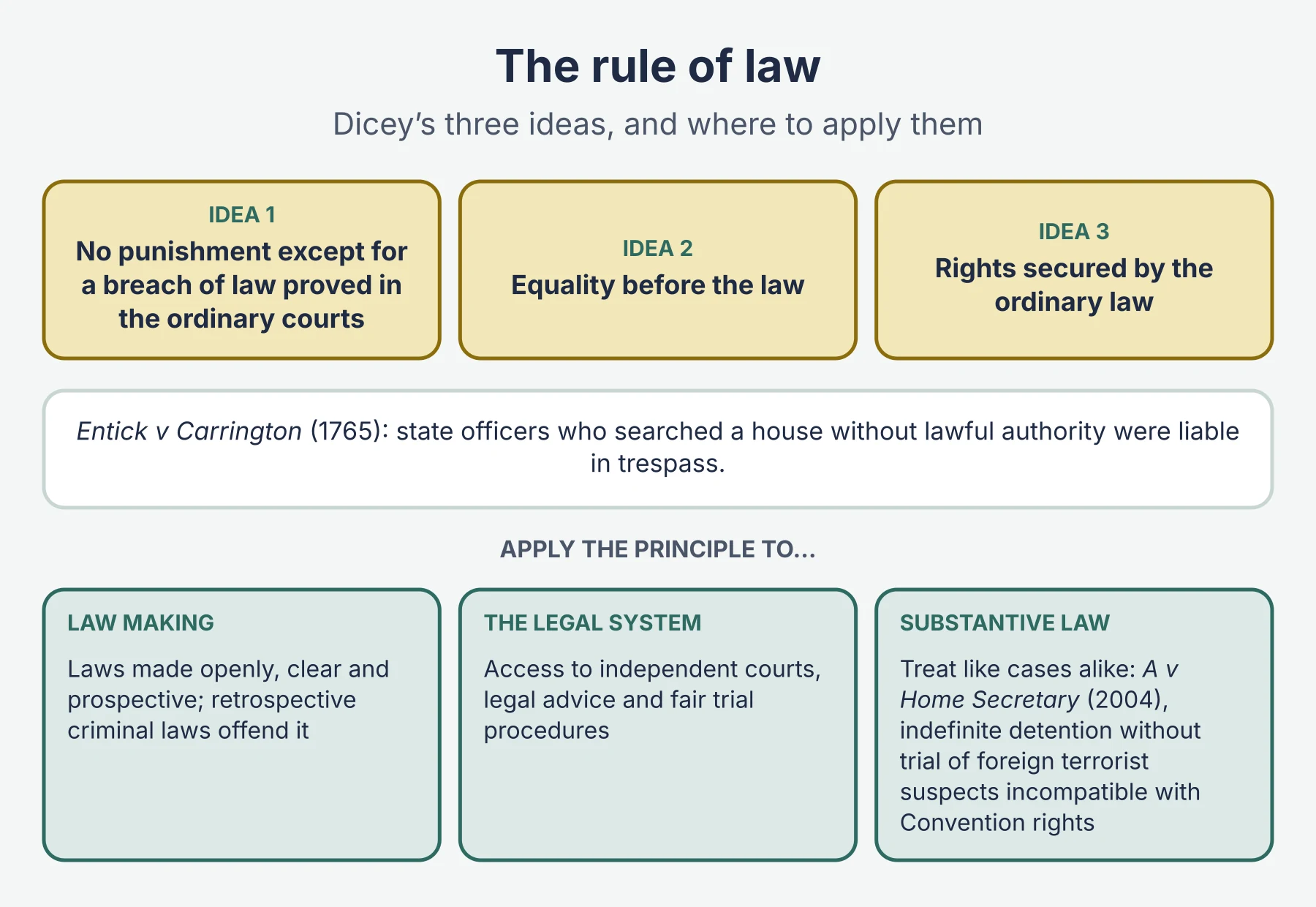
The rule of law. Dicey’s three ideas: no punishment except for a breach of law proved in the ordinary courts; equality before the law; rights secured by the ordinary law. In Entick v Carrington (1765) state officers who searched a house without lawful authority were liable in trespass. Apply the principle to:
- Law making – laws should be made openly and be clear and prospective; retrospective criminal laws offend it.
- The legal system – access to independent courts, legal advice and fair trial procedures.
- Substantive law – rules should treat like cases alike; in A v Secretary of State for the Home Department (2004) the House of Lords declared indefinite detention without trial of foreign terrorist suspects incompatible with Convention rights.
Law and morality. Law is enforceable; morality is belief about right and wrong. They overlap (murder, theft) but diverge: adultery is immoral to many but not a crime. The Hart–Devlin debate followed the Wolfenden Report (1957): Devlin argued that society may use law to protect its shared morality, while Hart, following Mill, limited law to preventing harm to others. Judges reflect changing morality: R v R (1991) removed the marital exemption for rape, while R v Brown (1993) held that consent was no defence to injuries inflicted in sadomasochistic activity.
Law, justice and society. Justice may be formal (rules applied consistently), substantive (fair outcomes) or corrective (putting right a wrong); equity and appeals exist because law does not always deliver it. Law keeps order, resolves disputes, protects rights and reflects social change.
Fault. Most crimes need mens rea and most torts need negligence. Strict liability dispenses with fault for at least one element; Gammon (Hong Kong) Ltd v Attorney-General of Hong Kong (1985) explains when courts accept this, chiefly for regulatory matters of social concern.
1.1.2 Parliamentary law making
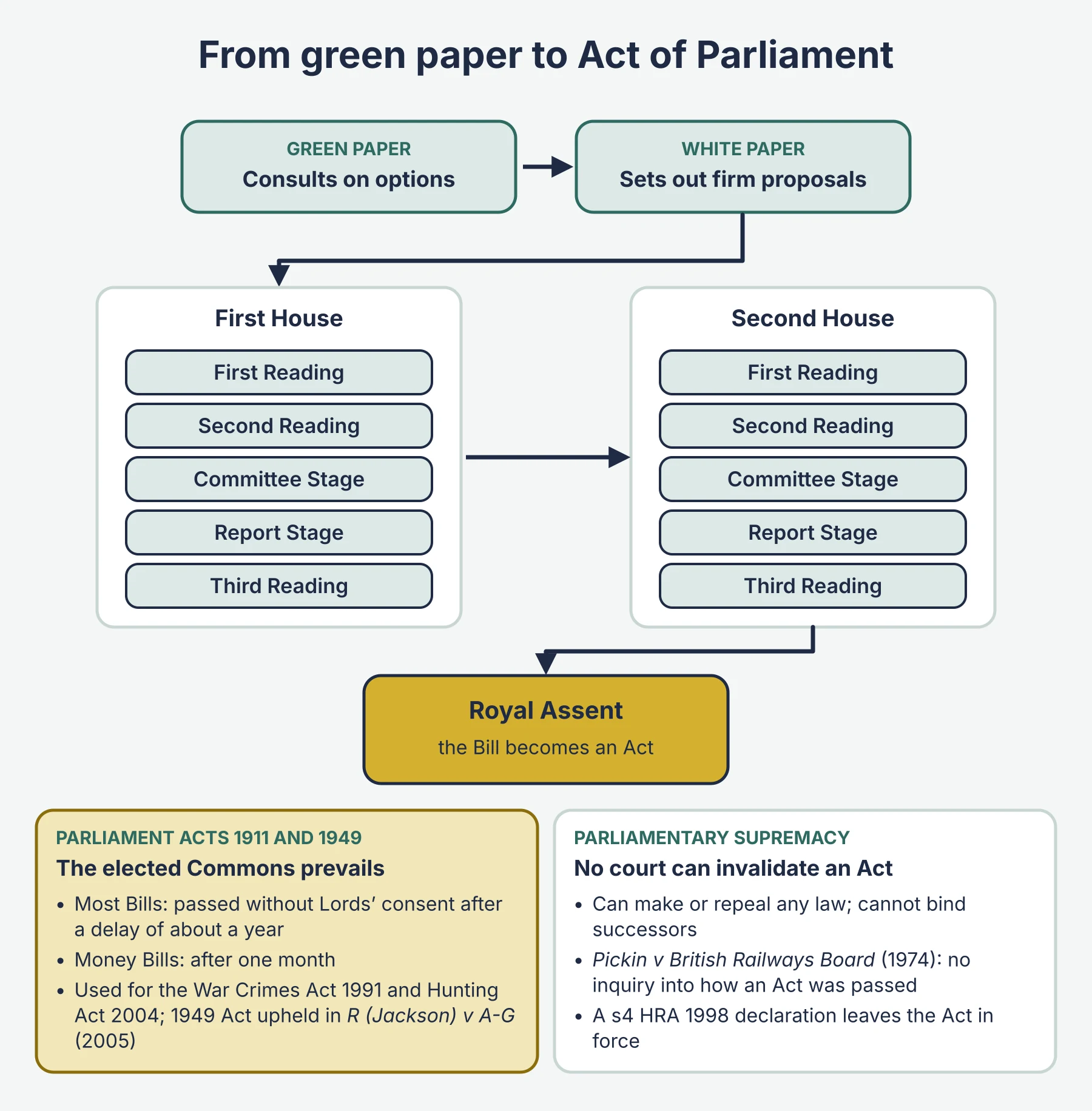
From green paper to Royal Assent. A green paper consults on options; a white paper sets out firm proposals. The Bill then passes First Reading, Second Reading, Committee Stage, Report Stage and Third Reading in each House, followed by Royal Assent.
Types of Bill. Public Bills are usually introduced by a minister; Private Members’ Bills by a backbencher (the Abortion Act 1967 began as David Steel’s); Private Bills by a body seeking powers for itself; Hybrid Bills are public Bills affecting particular private interests.
The Commons and the Lords. The elected Commons prevails; the Lords revises and delays: under the Parliament Acts 1911 and 1949 most Bills can be passed without Lords’ consent after a delay of about a year, and money Bills after one month. The Acts were used for the War Crimes Act 1991 and the Hunting Act 2004, and R (Jackson) v Attorney General (2005) upheld the validity of the 1949 Act.
Parliamentary supremacy. Parliament can make or repeal any law, cannot bind its successors, and no court can invalidate an Act. In Pickin v British Railways Board (1974) the House of Lords refused to inquire into how an Act had been passed. A declaration of incompatibility under s4 Human Rights Act 1998 leaves the Act in force.
Influences on Parliament.
Political pressure comes from the manifesto and the need to win votes. Public opinion after the Dunblane shooting (1996) contributed to the Firearms (Amendment) Act 1997, which banned most handguns. Pressure groups are sectional (protecting members, such as trade unions) or cause groups (promoting a belief). Media campaigns raise issues fast, but rushed laws such as the Dangerous Dogs Act 1991 can be badly drafted.
The Law Commission was set up by the Law Commissions Act 1965 as a full-time, independent body. A senior judge chairs it, with four other commissioners. It researches, consults and drafts Bills. Successes include the Contracts (Rights of Third Parties) Act 1999 and the Fraud Act 2006; but many reports, including the draft Criminal Code, were never enacted because implementation needs government time.
1.1.3 Delegated legislation
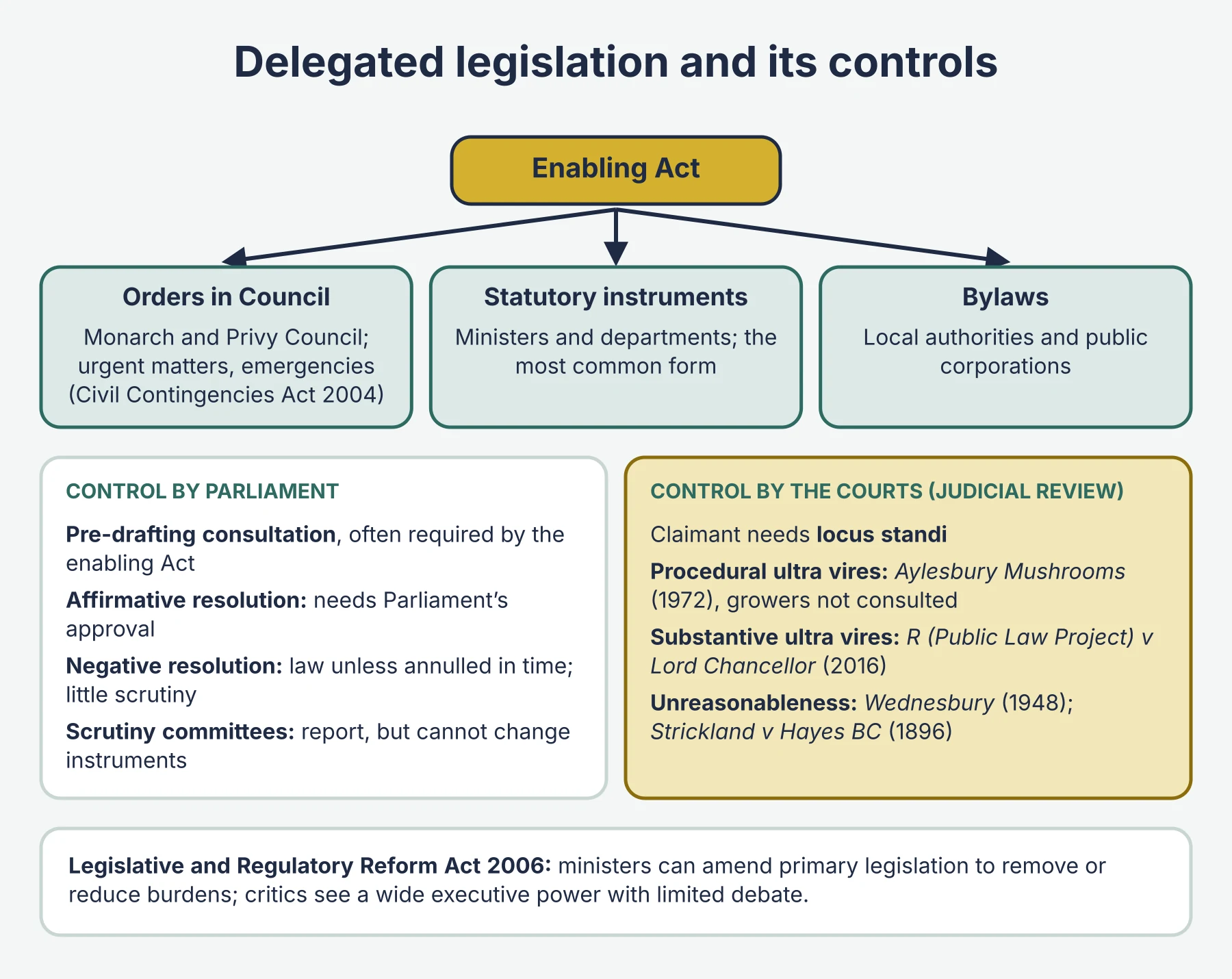
- Orders in Council – made by the monarch and the Privy Council, used for urgent matters and, under the Civil Contingencies Act 2004, emergencies.
- Statutory instruments – made by ministers and government departments; the most common form.
- Bylaws – made by local authorities and public corporations for their area or undertaking.
The Legislative and Regulatory Reform Act 2006 lets ministers make orders amending primary legislation to remove or reduce burdens, subject to conditions and parliamentary procedures. Critics see a wide executive power to change Acts with limited debate.
Parliamentary controls. Pre-drafting consultation with affected bodies, often required by the enabling Act. Affirmative resolution: the instrument needs the approval of Parliament. Negative resolution: it becomes law unless annulled within a set period, so many receive little scrutiny. Scrutiny committees, such as the Joint Committee on Statutory Instruments and the Lords Secondary Legislation Scrutiny Committee, report on instruments but cannot change them.
Court controls (judicial review). The claimant must have locus standi, a sufficient interest in the matter.
- Procedural ultra vires – the required procedure was not followed: Agricultural Training Board v Aylesbury Mushrooms (1972), where a mushroom growers’ association was not consulted.
- Substantive ultra vires – the content goes beyond the powers granted: R (Public Law Project) v Lord Chancellor (2016), where a residence test for legal aid was outside the enabling Act.
- Unreasonableness – a decision no reasonable body could have made, the test in Associated Provincial Picture Houses v Wednesbury Corporation (1948); Strickland v Hayes Borough Council (1896) struck down a bylaw banning obscene language in private as well as public places.
1.1.4 Statutory interpretation
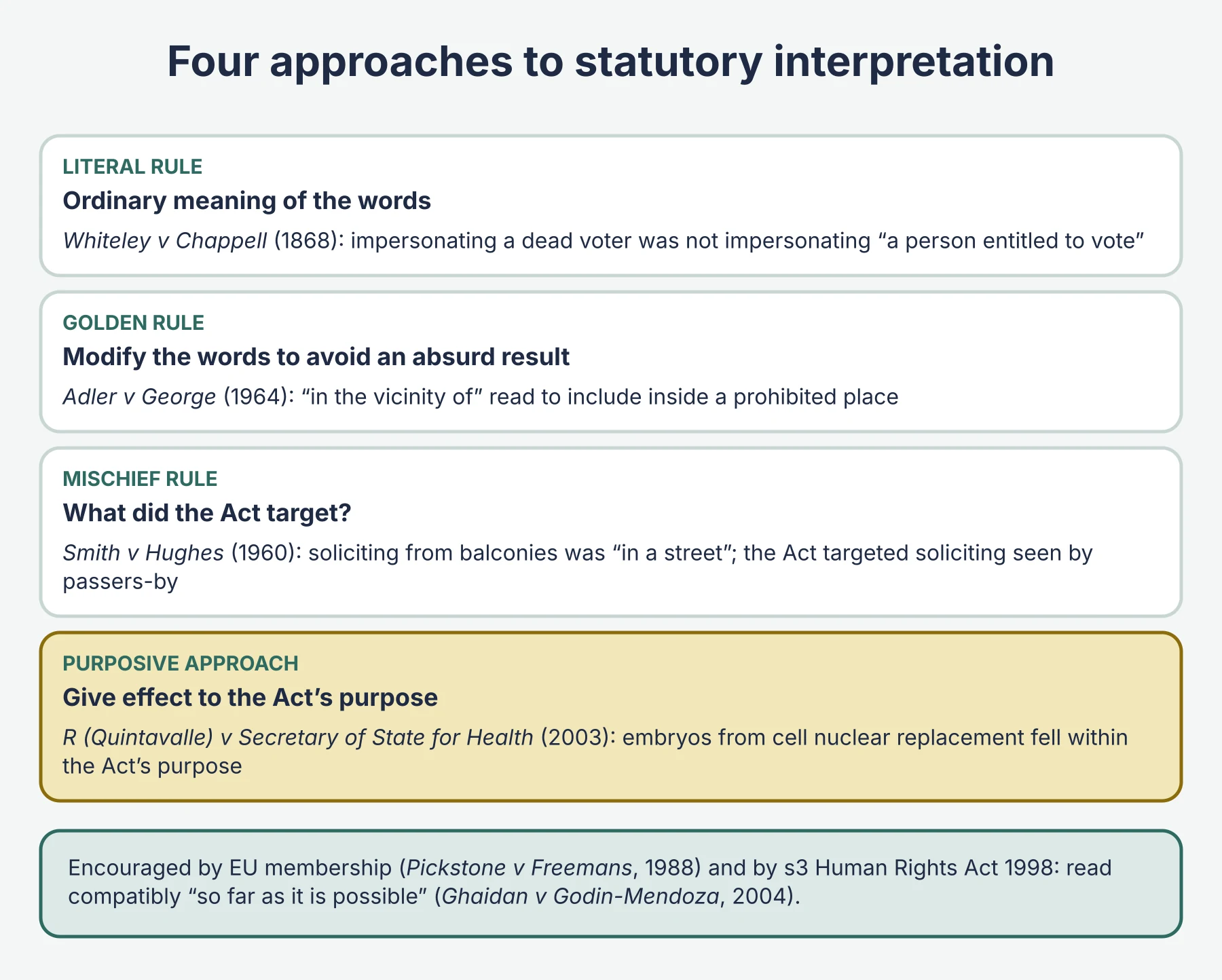
| Approach | Key case |
|---|---|
| Literal rule | Whiteley v Chappell (1868): impersonating a dead voter was not impersonating “a person entitled to vote” |
| Golden rule | Adler v George (1964): “in the vicinity of” read to include inside a prohibited place |
| Mischief rule | Smith v Hughes (1960): soliciting from balconies was “in a street”, because the Act targeted soliciting seen by passers-by |
| Purposive approach | R (Quintavalle) v Secretary of State for Health (2003): embryos created by cell nuclear replacement fell within the Act’s purpose |
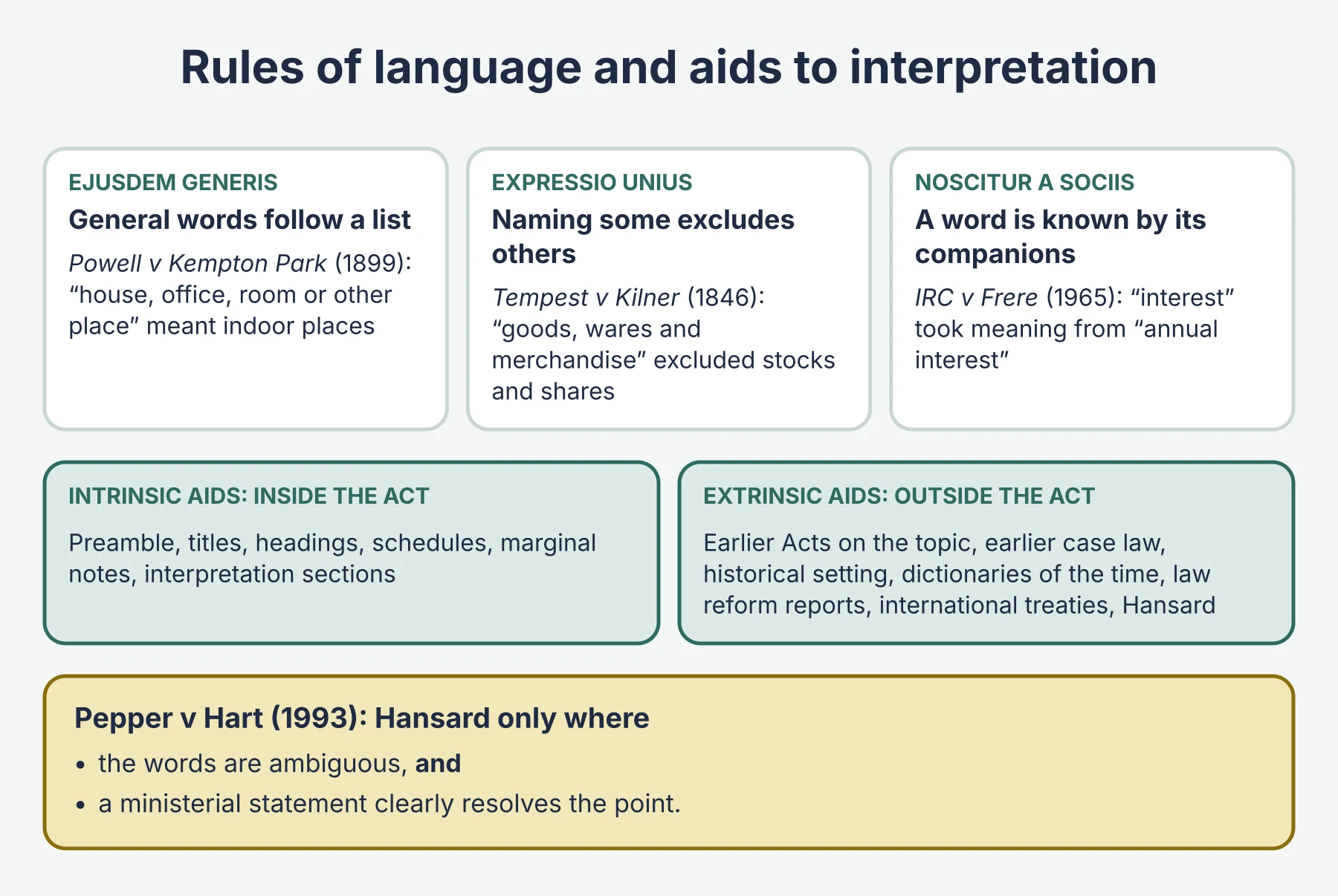
Rules of language. Ejusdem generis: in Powell v Kempton Park Racecourse (1899) “house, office, room or other place” was limited to indoor places. Expressio unius exclusio alterius: in Tempest v Kilner (1846) “goods, wares and merchandise” did not include stocks and shares. Noscitur a sociis: in Inland Revenue Commissioners v Frere (1965) “interest” took its meaning from “annual interest”.
Aids. Intrinsic aids sit in the Act: preamble, titles, headings, schedules, marginal notes, interpretation sections. Extrinsic aids are outside it: earlier Acts on the same topic, earlier case law, the historical setting, dictionaries of the time, law reform reports, international treaties and Hansard, which Pepper v Hart (1993) allowed where the words are ambiguous and a ministerial statement clearly resolves the point.
EU law and the Human Rights Act 1998. During UK membership, courts read domestic law to give effect to EU law (Pickstone v Freemans (1988)), encouraging purposive interpretation. Section 3 requires legislation to be read compatibly with Convention rights “so far as it is possible to do so”: in Ghaidan v Godin-Mendoza (2004) “as his or her wife or husband” included a same-sex partner.
1.1.5 Judicial precedent
Law reporting makes stare decisis workable: the Incorporated Council of Law Reporting has published reports since 1865, and neutral citations identify judgments by court and number.
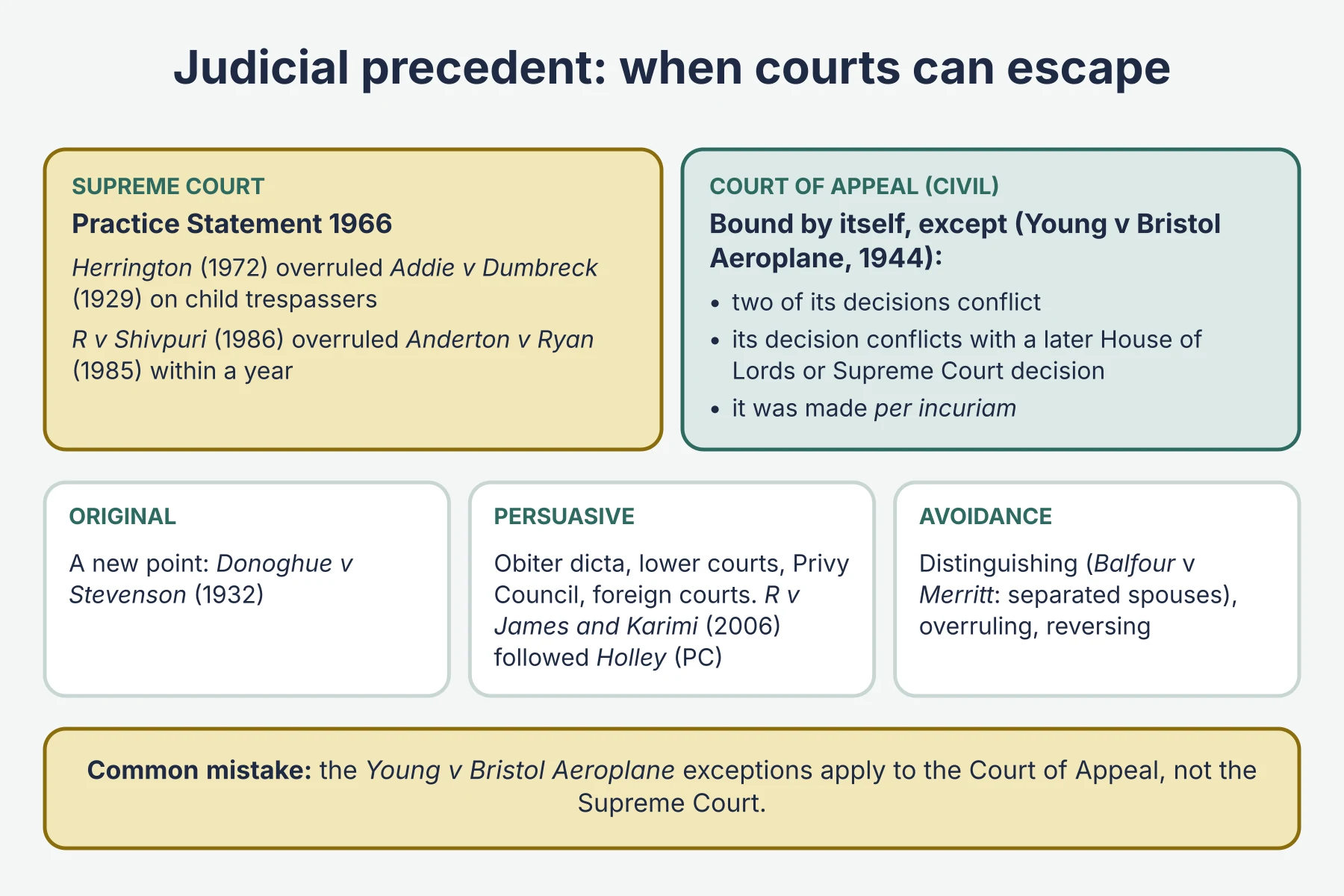
- Original precedent – a new point, as in Donoghue v Stevenson (1932).
- Persuasive precedent – obiter dicta, lower courts, the Privy Council and foreign courts. In R v James and Karimi (2006) the Court of Appeal followed the Privy Council in Attorney-General for Jersey v Holley (2005) rather than a House of Lords decision.
The Supreme Court and the Practice Statement 1966. Examples include British Railways Board v Herrington (1972), overruling Addie v Dumbreck (1929) on child trespassers, and R v Shivpuri (1986), overruling Anderton v Ryan (1985) within a year.
The Court of Appeal and Young v Bristol Aeroplane Co (1944). The Civil Division is bound by its own decisions except where two of its decisions conflict, where its decision conflicts with a later House of Lords or Supreme Court decision, or where it was made per incuriam (without reference to a relevant authority).
Avoidance. Distinguishing (Balfour v Balfour (1919) and Merritt v Merritt (1970) differ because the spouses in Merritt had separated), overruling and reversing.
Annotated model answer
Explain how the courts control delegated legislation. (part (a) style)
The courts control delegated legislation through judicial review, brought by a claimant with sufficient interest (locus standi). [identifies mechanism] A court may declare an instrument procedurally ultra vires where the maker failed to follow a required procedure, as in Aylesbury Mushrooms, where failure to consult made the order ineffective against the growers. [rule + case + outcome] It may be substantively ultra vires where it goes beyond the enabling Act, as in Public Law Project. [second ground] Finally, it may be struck down as unreasonable, as in Strickland v Hayes. [third ground] The courts cannot, however, review an Act of Parliament itself. [limit linked to supremacy]
Each ground is stated, supported and linked to its outcome, as “explain” demands.
Common mistakes
- Treating a declaration of incompatibility as striking down an Act.
- Citing Pepper v Hart as permitting Hansard whenever the court wishes.
- Describing the Young v Bristol Aeroplane exceptions as applying to the Supreme Court.
Exam technique
Describe rewards accurate features; explain needs reasons linking rule to effect; assess and evaluate need arguments weighed to a justified conclusion. For any rule of interpretation, state it, cite a case and show its result.
Consolidate with the principles and sources revision notes and test yourself with the principles and sources practice questions.
Related resources
-
Practice questions
Cambridge A Level Law (9084): Principles and sources of English law – Practice Questions
Original questions with mark-scheme answers on the rule of law, Parliament, delegated legislation, interpretation and precedent for Cambridge Law 9084.
Law · Cambridge · AS Level
Try questions -
Revision notes
Cambridge A Level Law (9084): Principles and sources of English law – Revision Notes
Condensed notes on the rule of law, law and morality, Parliament, delegated legislation, interpretation and precedent for Cambridge Law 9084 subtopic 1.1.
Law · Cambridge · AS Level
Revise topic -
Practice questions
The English Legal System: Practice Questions
Original exam-style practice questions with full worked answers on sources of law, civil court tracks, ADR, judicial precedent and statutory interpretation.
Law · Cambridge · AS Level
Try questions
Get free revision emails (optional)
Occasional emails with practice questions, worked explanations and links to free resources for the qualification and subjects you choose. No spam, and you can unsubscribe from any email. The free tools on this site never need an email.