
Revision Notes
Cambridge A Level Law (9084): Principles and sources of English law – Revision Notes
Condensed notes on the rule of law, law and morality, Parliament, delegated legislation, interpretation and precedent for Cambridge Law 9084 subtopic 1.1.
- Subject
- Law
- Level
- AS LEVEL
- Topic
- Topic 1 – English Legal System
- Author
- Marlbridge Academic Team
- Updated
- Reviewed by
- Aizaz Raoof Ali (what this means)
Aligned to Cambridge A Level Law (9084), 2026-2028. Official specification .
Syllabus page (what it covers and how it is assessed): Cambridge A Level Law.
Syllabus points this page covers
9084 (AS Level)
- 1.1 Principles and sources of English law
Found an error? Report a correction.
Need help with this topic? Request a free trial class for A Level Law (9084).
Recall notes for subtopic 1.1 of Cambridge International AS & A Level Law (9084). The full explanations and an annotated answer are in the principles and sources study guide.
1.1.1 Context in one screen
- Legal families: civil (codified – France, Germany), common law (precedent – England), customary, religious, mixed (Scotland, South Africa).
- Adversarial (parties lead, judge as umpire) against inquisitorial (judge investigates).
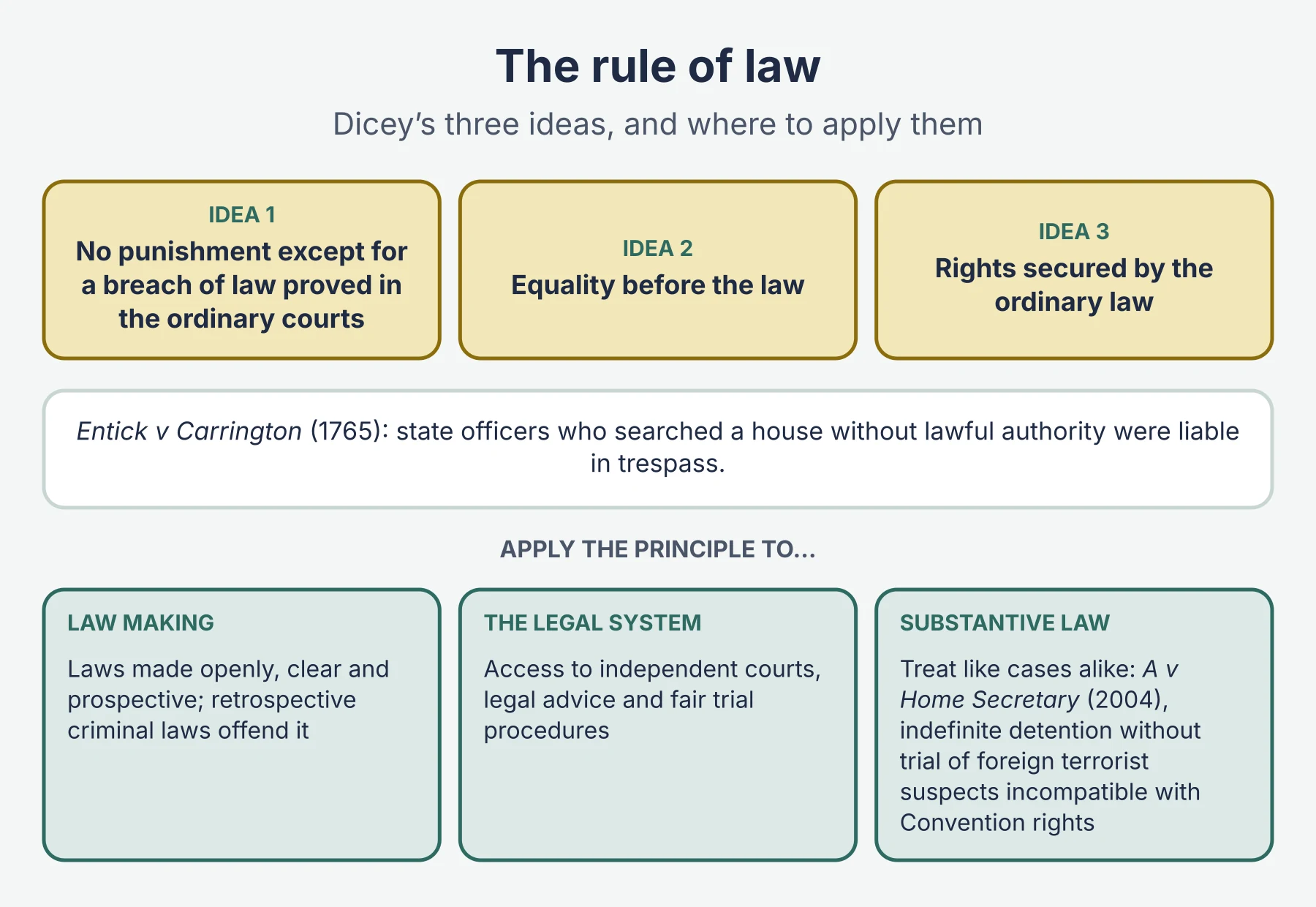
- Rule of law (Dicey): no punishment without breach of law proved in ordinary courts; equality before the law; rights protected by ordinary law. Entick v Carrington (1765) – state officers need legal authority.
- Applications: law making (clear, open, prospective), legal system (independent courts, access to justice), substantive law (A v Secretary of State for the Home Department (2004) – detention without trial incompatible with Convention rights).
- Law and morality: overlap but differ; Hart (harm principle) against Devlin (protect shared morality) after the Wolfenden Report (1957); R v R (1991), R v Brown (1993).
- Justice: formal, substantive, corrective.
- Fault: central to crime (mens rea) and tort (negligence); strict liability is the exception (Gammon v Attorney-General of Hong Kong (1985)).
1.1.2 Parliament
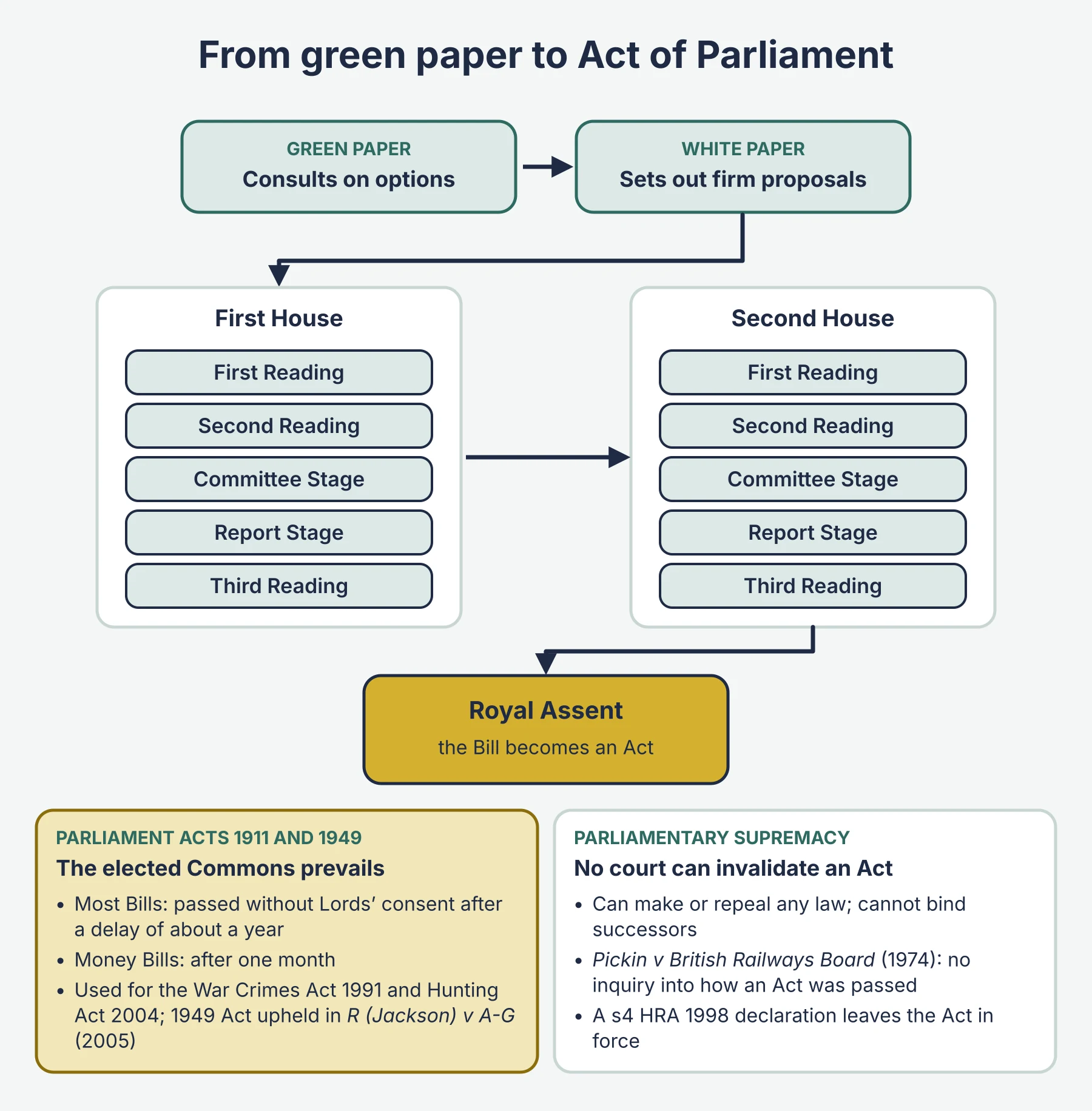
Sequence: green paper (consultation) → white paper (firm proposals) → First Reading → Second Reading → Committee → Report → Third Reading → other House → Royal Assent.
Lords’ power: delay only. Parliament Acts 1911 and 1949 – about a year for most Bills, one month for money Bills. Used for the War Crimes Act 1991 and the Hunting Act 2004; 1949 Act upheld in R (Jackson) v Attorney General (2005).
Supremacy: Pickin v British Railways Board (1974) – courts will not look behind an Act. Human Rights Act 1998 s4 declaration does not invalidate an Act.
Influences: political (manifesto), public opinion (Dunblane → Firearms (Amendment) Act 1997), pressure groups (sectional and cause), media (Dangerous Dogs Act 1991 as rushed law).
Law Commission: Law Commissions Act 1965; chair is a senior judge plus four commissioners; researches, consults, drafts Bills. Hits: Contracts (Rights of Third Parties) Act 1999, Fraud Act 2006. Miss: draft Criminal Code never enacted.
1.1.3 Delegated legislation
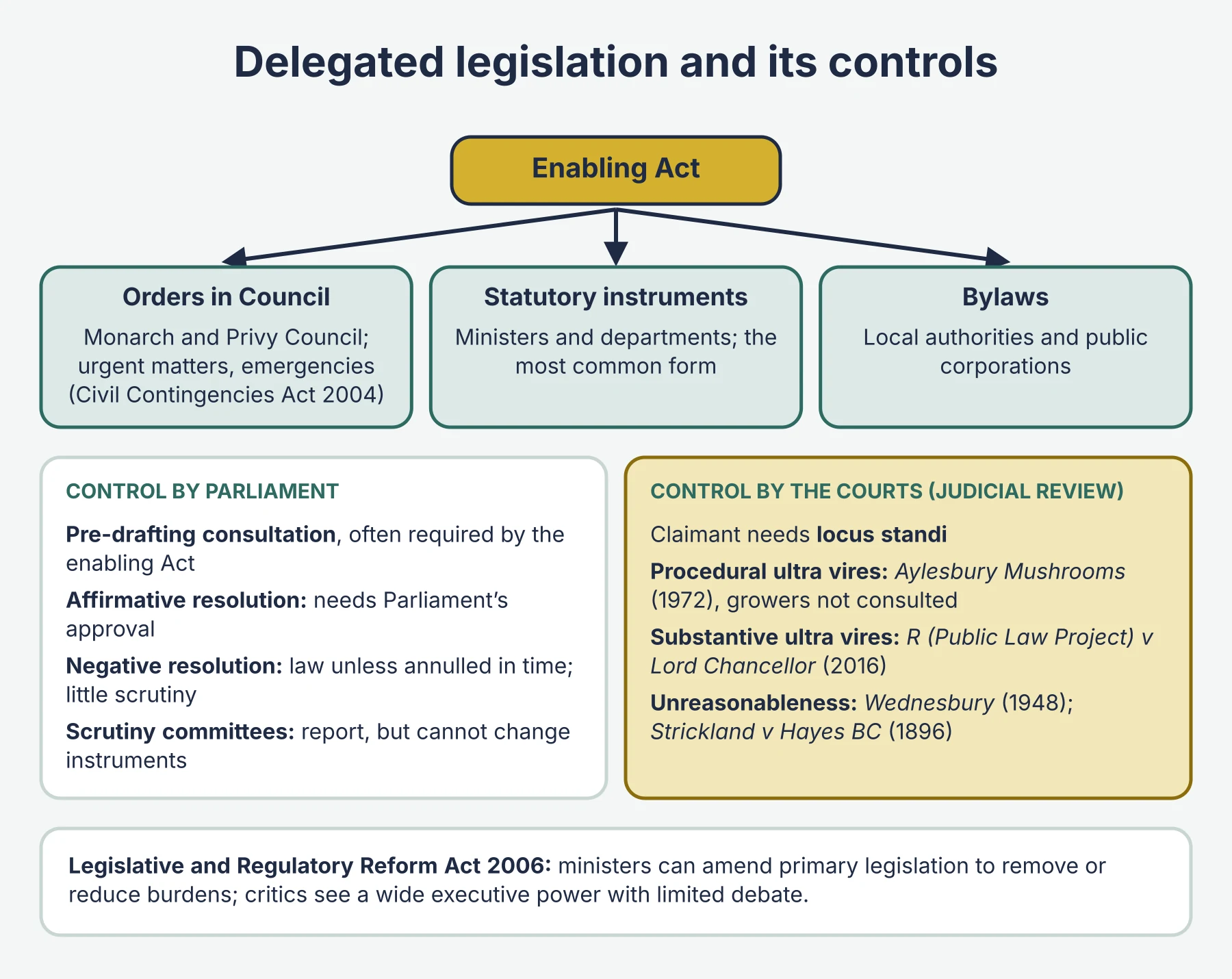
| Form | Made by |
|---|---|
| Order in Council | Monarch and Privy Council |
| Statutory instrument | Minister or department |
| Bylaw | Local authority or public corporation |
- Legislative and Regulatory Reform Act 2006: ministers may amend Acts by order to remove burdens – criticised as executive power.
- Parliament: pre-drafting consultation; affirmative resolution (must be approved); negative resolution (law unless annulled); scrutiny committees (report only).
- Courts: locus standi needed. Procedural ultra vires – Aylesbury Mushrooms (1972). Substantive ultra vires – R (Public Law Project) v Lord Chancellor (2016). Unreasonableness – Wednesbury (1948), Strickland v Hayes (1896).
1.1.4 Interpretation
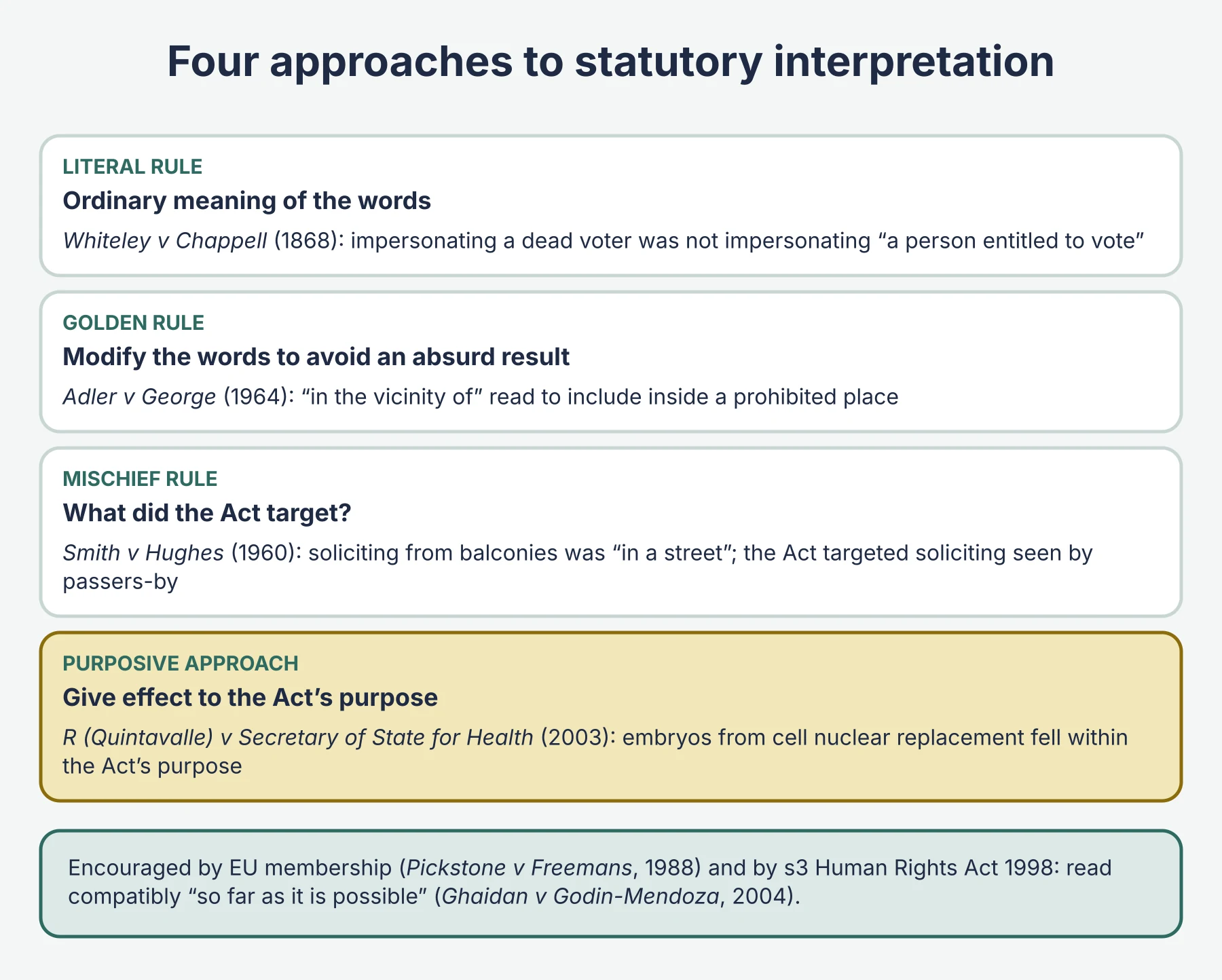
| Rule | Case | One-line outcome |
|---|---|---|
| Literal | Whiteley v Chappell (1868) | Dead voter not “entitled to vote”; acquitted |
| Golden | Adler v George (1964) | “In the vicinity of” includes inside |
| Mischief | Smith v Hughes (1960) | Balcony soliciting caught |
| Purposive | Quintavalle (2003) | Cloned embryos within the Act |
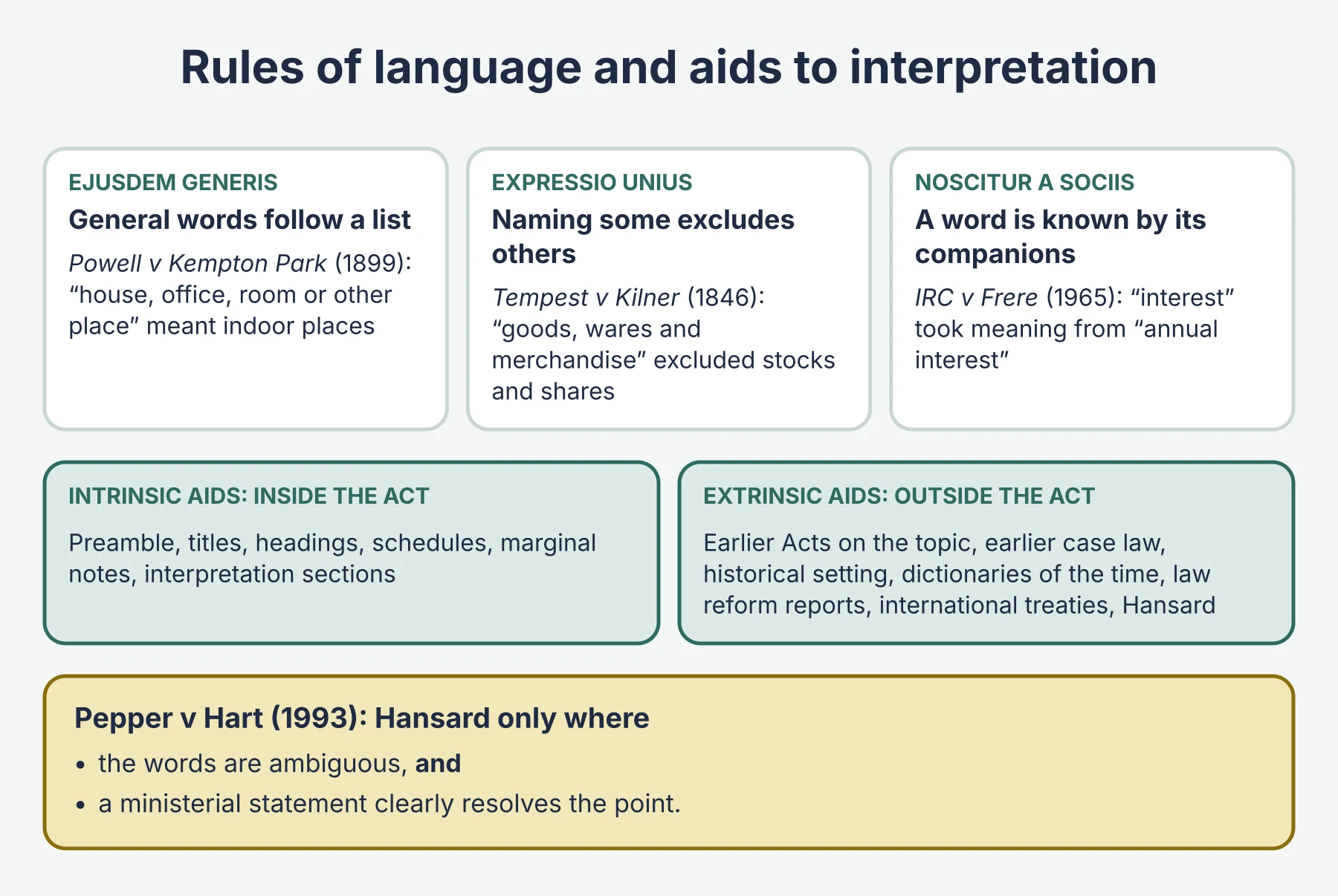
| Ejusdem generis | Powell v Kempton Park (1899) | “Other place” limited to indoor places |
| Expressio unius | Tempest v Kilner (1846) | Stocks and shares excluded |
| Noscitur a sociis | IRC v Frere (1965) | “Interest” means annual interest |
- Intrinsic aids: preamble, titles, headings, schedules, marginal notes, interpretation sections.
- Extrinsic aids: earlier Acts, earlier cases, historical setting, dictionaries of the time, Hansard (Pepper v Hart (1993)), law reform reports, treaties.
- EU law: purposive reading during membership (Pickstone v Freemans (1988)).
- Human Rights Act s3: read compatibly “so far as possible” (Ghaidan v Godin-Mendoza (2004)).
1.1.5 Precedent
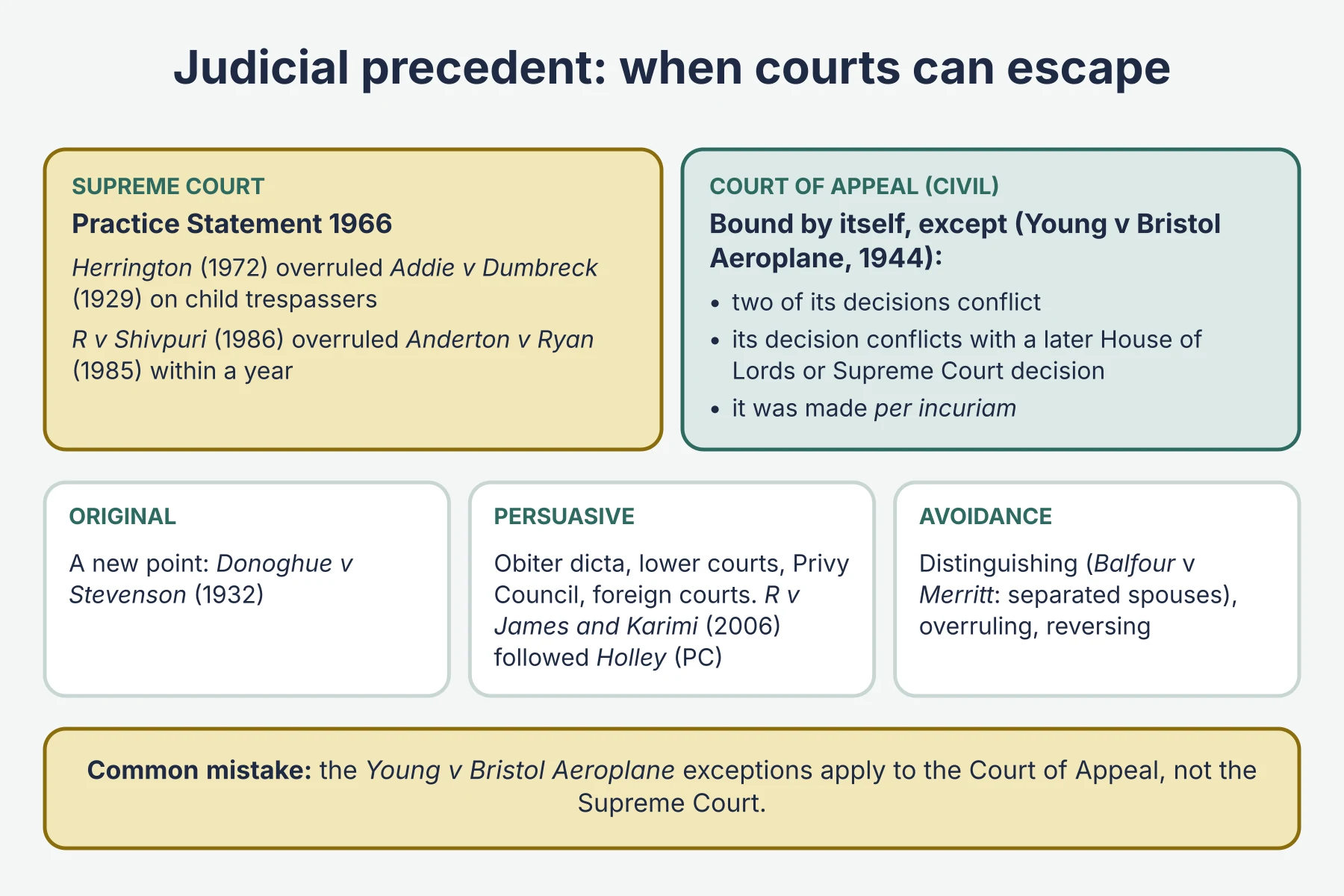
- Binding: ratio of a higher court. Original: first decision on a point (Donoghue v Stevenson (1932)). Persuasive: obiter, lower courts, Privy Council (Holley followed in R v James and Karimi (2006)), foreign courts.
- Law reporting: Incorporated Council of Law Reporting (1865); neutral citations.
- Practice Statement 1966: Herrington (1972) overruled Addie (1929); Shivpuri (1986) overruled Anderton v Ryan (1985).
- Young v Bristol Aeroplane (1944): conflicting Court of Appeal decisions; conflict with later House of Lords or Supreme Court decision; per incuriam.
- Avoidance: distinguishing (Balfour / Merritt), overruling, reversing.
Key terms
| Term | Meaning |
|---|---|
| Enabling Act | Act giving power to make delegated legislation |
| Ultra vires | Beyond the powers granted |
| Locus standi | Sufficient interest to bring judicial review |
| Declaration of incompatibility | Court statement that an Act conflicts with Convention rights; Act stays valid |
| Per incuriam | Decided without regard to a binding authority or statute |
| Hybrid Bill | Public Bill that affects particular private interests |
| Green paper | Consultation document of options |
| Intrinsic aid | Help found within the Act |
Exam traps
- Confusing affirmative and negative resolution: affirmative needs a vote of approval.
- Saying scrutiny committees can amend or reject an instrument.
- Writing that the Lords can veto a Bill.
- Treating Pepper v Hart as unlimited; it requires ambiguity and a clear ministerial statement.
- Citing the Young exceptions for the Criminal Division without noting that it also departs from its own decisions where liberty is at stake and the law was misapplied.
- Listing intrinsic aids under extrinsic, especially marginal notes and schedules.
- Describing Dicey’s principles without applying them to an example.
Self-test
- Name the three forms of delegated legislation and who makes each.
- What does negative resolution mean?
- Give the case on procedural ultra vires and explain what went wrong.
- State the three exceptions in Young v Bristol Aeroplane.
- What did Pickin v British Railways Board decide?
- Which rule of language was applied in Powell v Kempton Park?
- Give one successful and one unsuccessful Law Commission project.
- Distinguish a sectional pressure group from a cause group.
- What does s3 Human Rights Act 1998 require?
- Give an example of an original precedent.
- What is the difference between a green paper and a white paper?
- Name two features of an inquisitorial system.
Answers
- Orders in Council (monarch and Privy Council), statutory instruments (ministers), bylaws (local authorities and public corporations).
- The instrument becomes law unless Parliament annuls it within the set period.
- Aylesbury Mushrooms (1972): the mushroom growers’ association was not consulted as required, so the order did not bind it.
- Conflicting decisions of its own; conflict with a later House of Lords or Supreme Court decision; a decision made per incuriam.
- Courts will not inquire into the procedure by which an Act was passed.
- Ejusdem generis.
- Success: Contracts (Rights of Third Parties) Act 1999 or Fraud Act 2006. Failure: the draft Criminal Code.
- Sectional groups protect the interests of their members; cause groups promote a belief or cause.
- Legislation must be read and given effect compatibly with Convention rights so far as it is possible to do so.
- Donoghue v Stevenson (1932).
- A green paper consults on options; a white paper states the government’s firm proposals.
- The judge leads the investigation and questions witnesses; there is less reliance on the parties presenting their own evidence.
Apply these points under timed conditions with the principles and sources practice questions.
Related resources
-
Practice questions
The English Legal System: Practice Questions
Original exam-style practice questions with full worked answers on sources of law, civil court tracks, ADR, judicial precedent and statutory interpretation.
Law · Cambridge · AS Level
Try questions -
Practice questions
A Level Law: The English Legal System — Practice Questions
Original practice questions with worked answers on civil and criminal law, courts, offences, juries, legal personnel and judicial independence for Law 9084.
Law · Cambridge · AS Level
Try questions -
Revision notes
A Level Law: The English Legal System — Revision Notes
Revision notes on sources of law, legislation, precedent, statutory interpretation, the courts and legal personnel for Cambridge AS and A Level Law 9084.
Law · Cambridge · AS Level
Revise topic
Get free revision emails (optional)
Occasional emails with practice questions, worked explanations and links to free resources for the qualification and subjects you choose. No spam, and you can unsubscribe from any email. The free tools on this site never need an email.