
Study Guides
Cambridge A Level Law (9084): Machinery of justice
Civil courts and the Woolf reforms, ADR and arbitration, criminal process and bail, and police powers under PACE for Cambridge Law 9084 subtopic 1.2.
- Subject
- Law
- Level
- AS LEVEL
- Topic
- Topic 1 – English Legal System
- Author
- Marlbridge Academic Team
- Updated
- Reviewed by
- Aizaz Raoof Ali (what this means)
Aligned to Cambridge A Level Law (9084), 2026-2028. Official specification .
Syllabus page (what it covers and how it is assessed): Cambridge A Level Law.
Syllabus points this page covers
9084 (AS Level)
- 1.2 Machinery of justice
Found an error? Report a correction.
Need help with this topic? Request a free trial class for A Level Law (9084).
Subtopic 1.2 covers how disputes and prosecutions move through the system, in four strands: civil courts and process (1.2.1), alternative dispute resolution (1.2.2), criminal courts and process (1.2.3) and police powers (1.2.4). The Topic 1 overview introduces the courts; this guide adds procedure, statutes and evaluation.
1.2.1 Civil courts and civil process
| Court | Civil role |
|---|---|
| Magistrates’ Court | Limited civil work: licensing, enforcing some debts such as council tax, and family cases when magistrates sit in the Family Court |
| County Court | Most civil claims: contract, tort, housing, small claims |
| High Court | King’s Bench (contract, tort, judicial review), Chancery (trusts, companies, insolvency), Family |
| Court of Appeal (Civil Division) | Appeals from the High Court and County Court; headed by the Master of the Rolls |
| Supreme Court | Final appeals on points of law of general public importance, with permission |
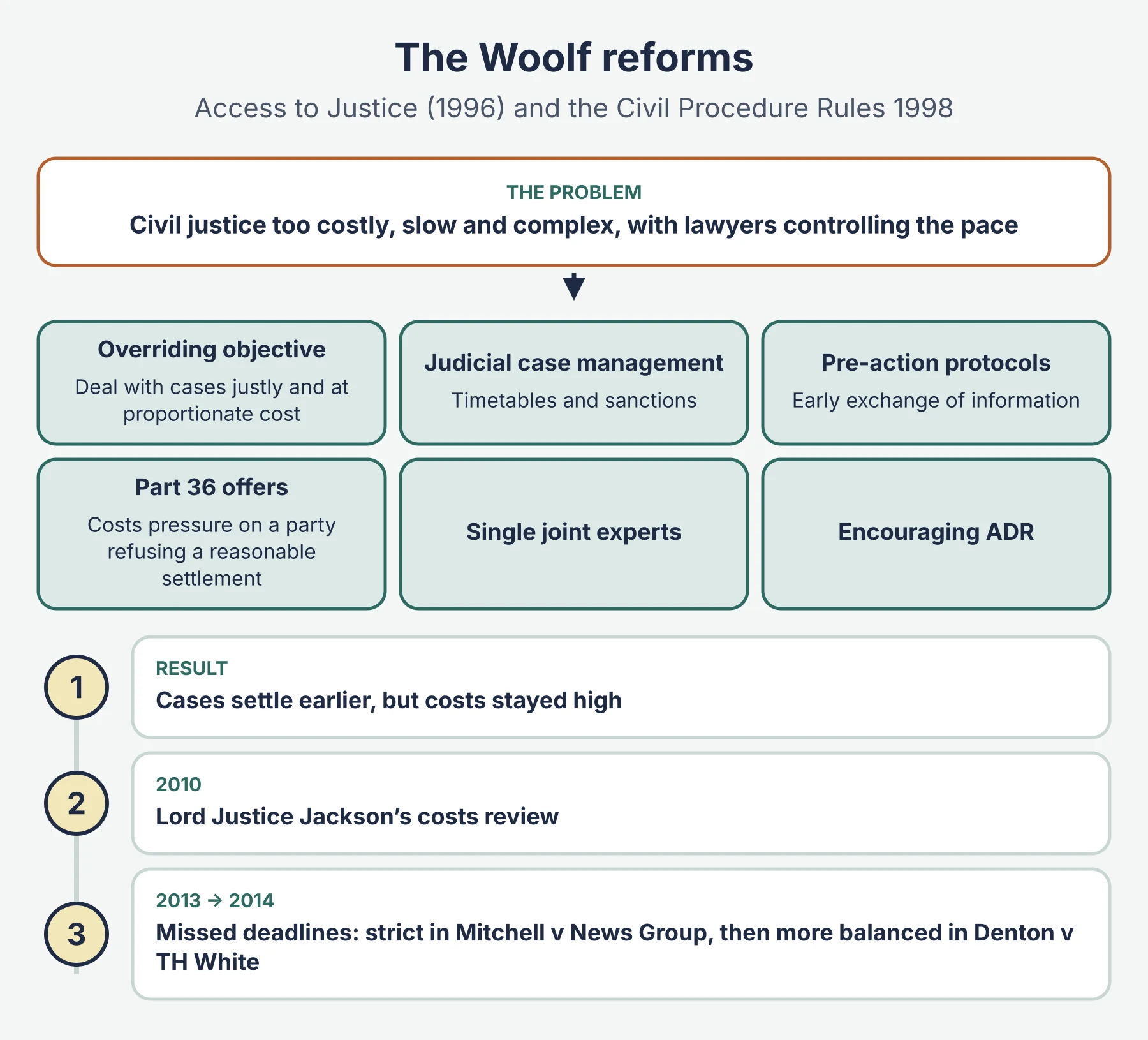
The Woolf reforms. Lord Woolf’s Access to Justice report (1996) found civil justice too costly, slow and complex, with lawyers controlling the pace. The Civil Procedure Rules 1998 (in force April 1999) introduced an overriding objective of dealing with cases justly and at proportionate cost, judicial case management with timetables and sanctions, pre-action protocols for early exchange of information, Part 36 offers that put costs pressure on a party refusing a reasonable settlement, single joint experts and encouragement of ADR.
Cases now settle earlier, but costs stayed high, prompting Lord Justice Jackson’s costs review (2010). The courts’ approach to missed deadlines swung from strict in Mitchell v News Group Newspapers (2013) to more balanced in Denton v TH White (2014).
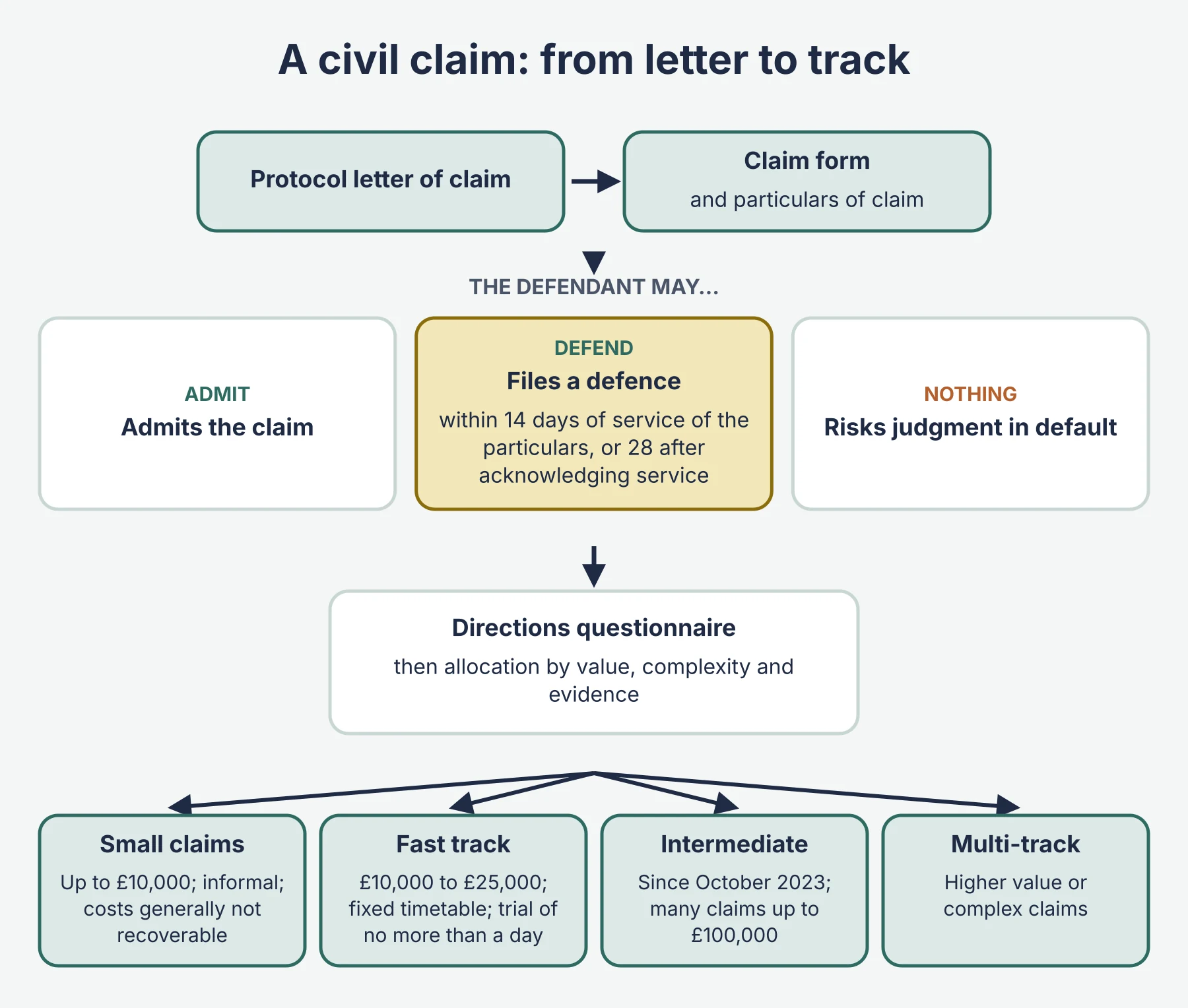
Pre-trial procedure. A protocol letter of claim comes first, then a claim form and particulars of claim. The defendant may admit, file a defence (within 14 days of service of the particulars, or 28 after an acknowledgement of service) or do nothing, risking judgment in default. A defended claim leads to a directions questionnaire and allocation.
Allocation depends on value, complexity and evidence:
- Small claims track – up to £10,000; informal hearing, costs generally not recoverable.
- Fast track – £10,000 to £25,000; fixed timetable, trial of no more than a day.
- Multi-track – higher value or complex claims.
Since October 2023 an intermediate track has sat between fast track and multi-track for many claims up to £100,000.
Appeals. Permission is normally needed. Appeals go to the next level of judge, then the Court of Appeal and, on points of law of general public importance, the Supreme Court; a “leapfrog” appeal can go from the High Court directly to the Supreme Court.
1.2.2 Alternative methods of dispute resolution
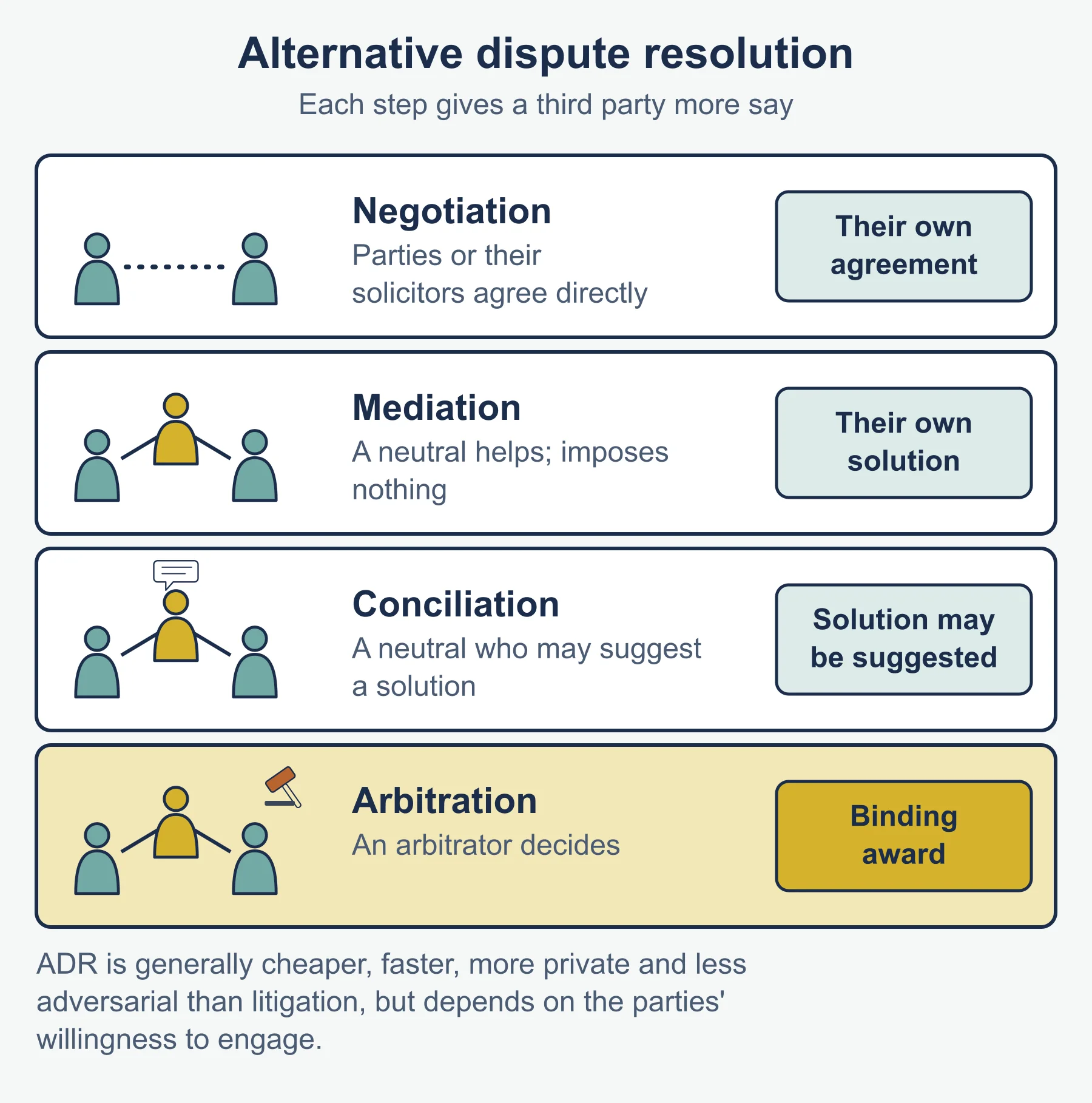
- Negotiation – the parties settle directly, privately and cheaply.
- Mediation – a neutral mediator helps the parties find their own solution.
- Conciliation – the conciliator takes a more active role and may suggest terms; ACAS does this in employment disputes.
- Arbitration – an arbitrator makes a binding award, enforceable as a court judgment.
Unreasonable refusal can lead to a costs penalty (Halsey v Milton Keynes General NHS Trust (2004)), and in Churchill v Merthyr Tydfil County Borough Council (2023) the Court of Appeal held that courts may order parties to engage in non-court dispute resolution.
The Arbitration Act 1996 sets out its principles in s1: fair resolution by an impartial tribunal without unnecessary delay or expense, party autonomy, and limited court intervention. If one party sues in breach of an arbitration agreement, the court will stay the proceedings (s9). An award can be challenged only on narrow grounds such as lack of jurisdiction, serious irregularity or, unless excluded, a point of law.
A Scott v Avery clause (Scott v Avery (1856)) makes an arbitration award a condition precedent to any court action, so a party cannot sue until arbitration is complete.
Evaluation. Arbitration is private, expert and usually quicker, but appeal is limited, arbitrators’ fees can be high and a weaker party may be bound by a clause it never negotiated.
1.2.3 Criminal courts and criminal process
The Crown Prosecution Service charges under the Code for Crown Prosecutors: an evidential test (realistic prospect of conviction) and a public interest test.
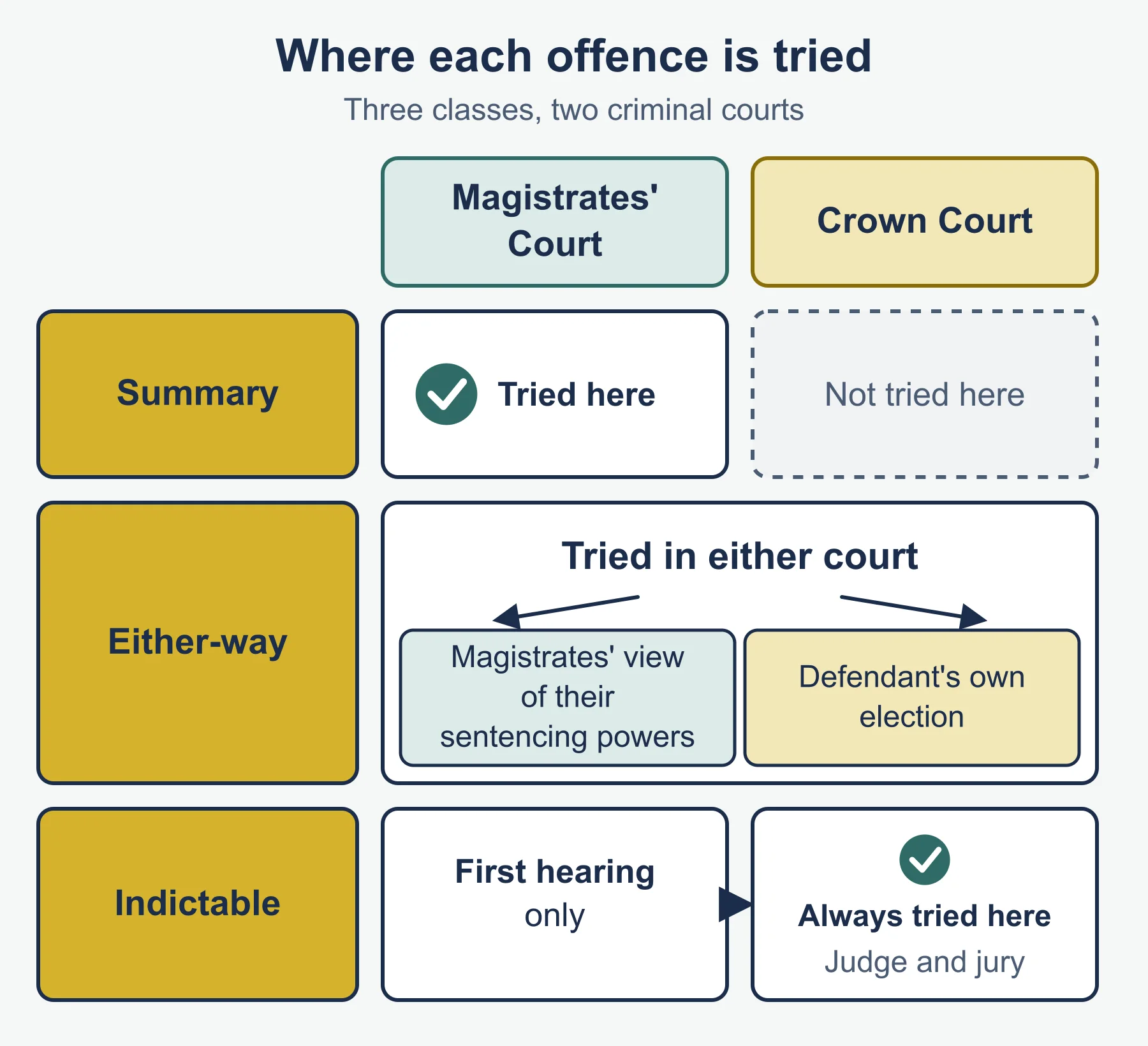
| Offence | Pre-trial route |
|---|---|
| Summary | First hearing in the Magistrates’ Court; plea taken; trial or sentence there. Many minor non-imprisonable offences use the Single Justice Procedure on the papers |
| Triable either way | Plea before venue. A guilty plea is sentenced by magistrates or committed to the Crown Court for sentence. On a not guilty plea, magistrates decide allocation using their sentencing powers and allocation guidance; if they accept jurisdiction the defendant may still elect jury trial |
| Indictable only | Sent straight to the Crown Court under s51 Crime and Disorder Act 1998; a plea and trial preparation hearing follows |
Appeals.
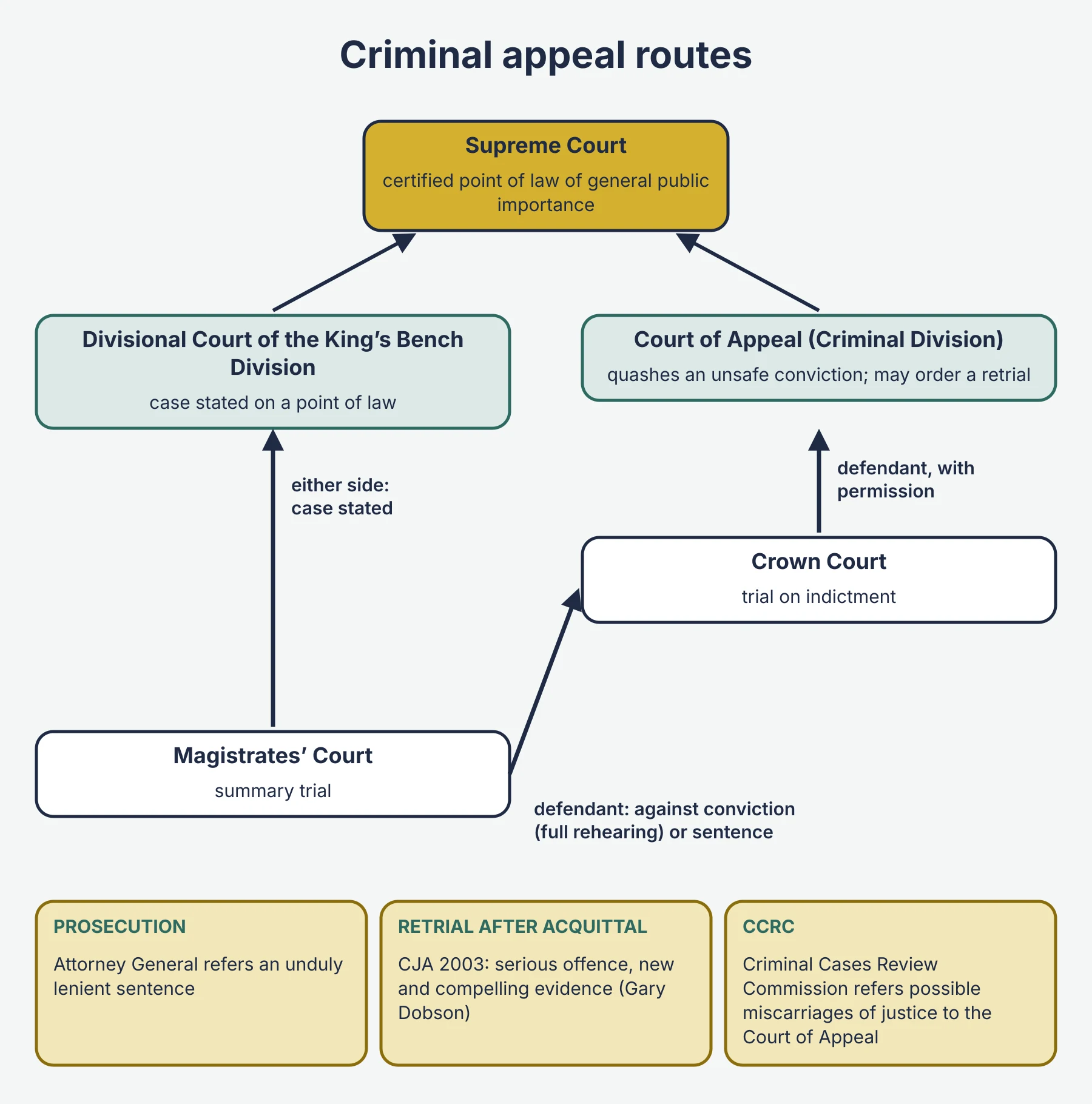
- From the Magistrates’ Court: the defendant may appeal to the Crown Court against conviction (a full rehearing) or sentence. Either side may appeal by case stated on a point of law to the Divisional Court of the King’s Bench Division.
- From the Crown Court: the defendant needs permission to appeal to the Court of Appeal (Criminal Division), which quashes a conviction it considers unsafe and may order a retrial. The prosecution may ask the Attorney General to refer an unduly lenient sentence, and under the Criminal Justice Act 2003 an acquitted person can be retried for a serious offence where there is new and compelling evidence, as with Gary Dobson in the Stephen Lawrence case.
- To the Supreme Court: on a certified point of law of general public importance. The Criminal Cases Review Commission can refer possible miscarriages of justice to the Court of Appeal.
Bail.
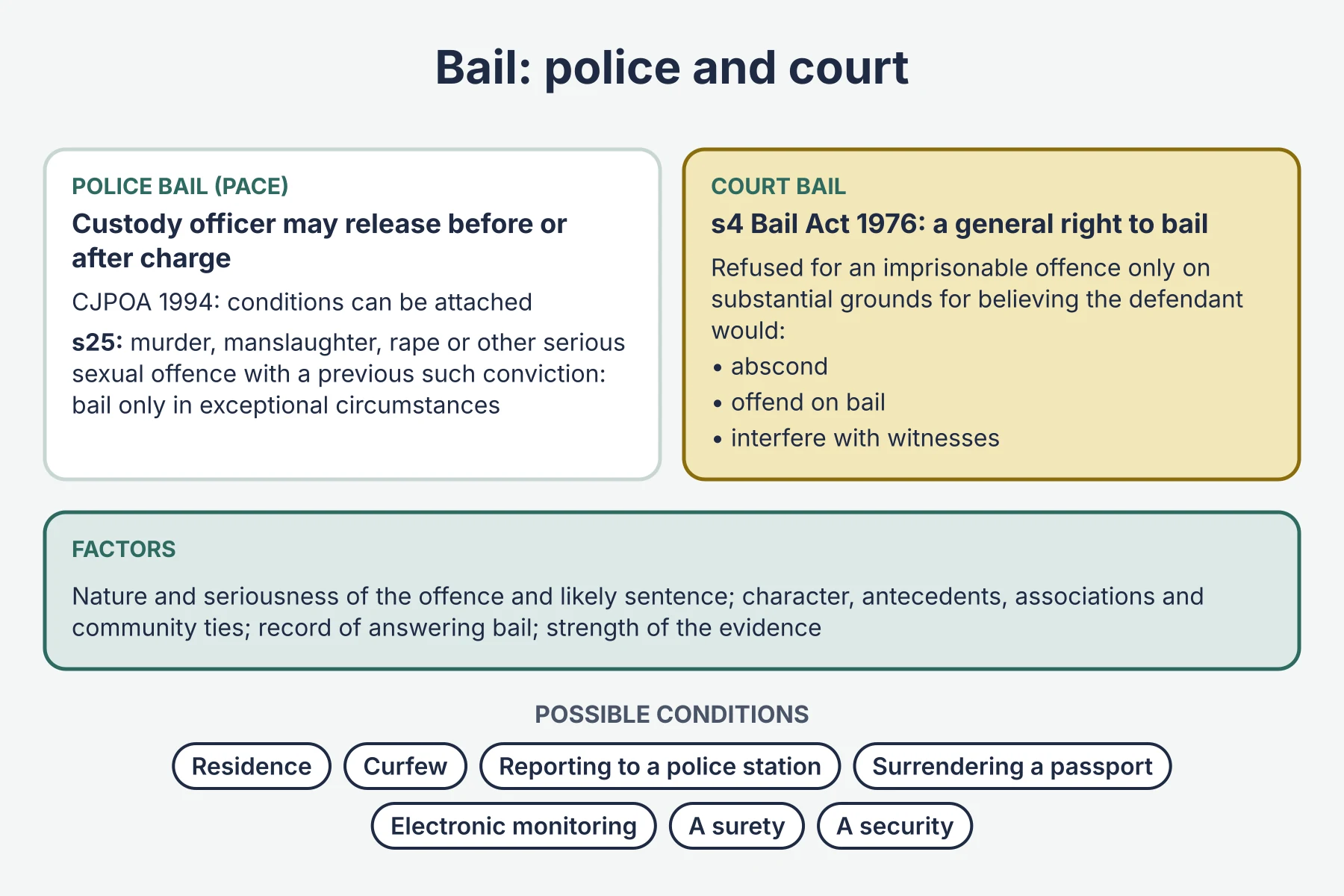
- Police bail. Under PACE the custody officer may release a suspect on bail before or after charge. The Criminal Justice and Public Order Act 1994 allowed police to attach conditions to bail and, in s25, restricted bail for those charged with murder, manslaughter, rape and other serious sexual offences who have a previous conviction for such an offence: bail only in exceptional circumstances.
- Court bail. Section 4 Bail Act 1976 gives a general right to bail, refused for an imprisonable offence only on substantial grounds for believing the defendant would abscond, offend on bail or interfere with witnesses.
- Factors include the nature and seriousness of the offence and likely sentence, the defendant’s character, antecedents, associations and community ties, their record of answering bail, and the strength of the evidence.
- Conditions include residence, curfew, reporting to a police station, surrendering a passport, electronic monitoring, a surety or a security.
1.2.4 Police powers
Stop and search. Section 1 PACE allows a constable to search a person or vehicle in a public place for stolen or prohibited articles (such as offensive weapons), only on reasonable suspicion. Under s2 the officer gives their name, station, the object and grounds of the search, and the right to a record (s3). PACE Code A states that suspicion cannot rest on personal factors such as race, age or appearance alone. Other powers: s23 Misuse of Drugs Act 1971 for controlled drugs; s43 Terrorism Act 2000 for a suspected terrorist, and s47A for authorised searches without individual suspicion, introduced after Gillan and Quinton v UK (2010) held the earlier no-suspicion power breached Article 8.
Arrest. Section 24 PACE, as amended by the Serious Organised Crime and Police Act 2005, lets a constable arrest without warrant anyone committing, about to commit or reasonably suspected of an offence, but only if arrest is necessary for a listed reason, such as finding out the person’s name or address, preventing injury or loss, or allowing prompt and effective investigation. The person must be told they are under arrest and why (s28; Christie v Leachinsky (1947)). Code G governs the necessity test.
Detention at the police station.
| Rule | Source |
|---|---|
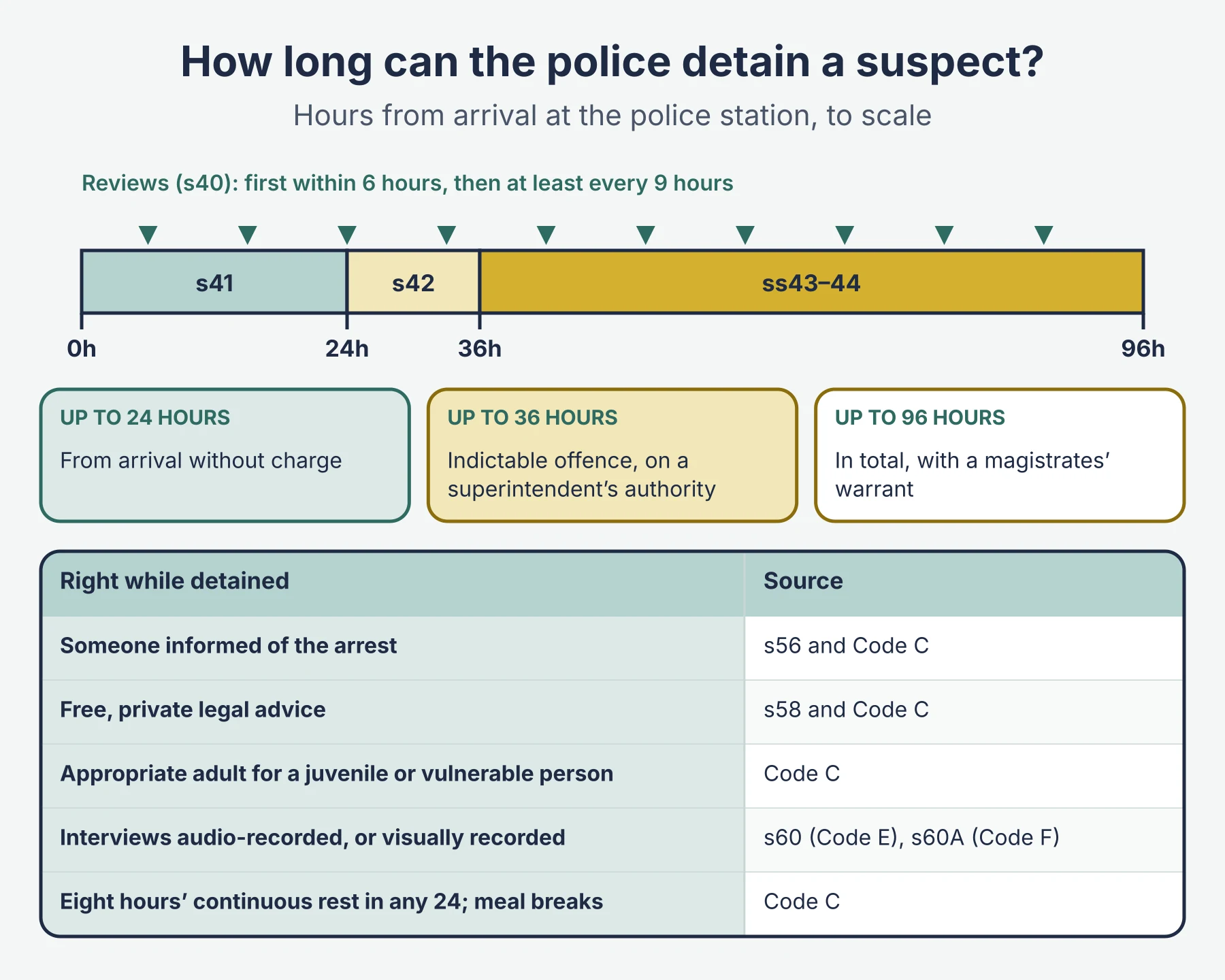
| 24 hours from arrival without charge | s41 |
| Up to 36 hours for an indictable offence, on a superintendent’s authority | s42 |
| Up to 96 hours in total with a magistrates’ warrant | ss43–44 |
| Reviews: first within 6 hours, then at least every 9 hours | s40 |
| Right to have someone informed of the arrest | s56 and Code C |
| Free, private legal advice | s58 and Code C |
| Appropriate adult for a juvenile or vulnerable person | Code C |
| Interviews audio-recorded, or visually recorded | s60 (Code E), s60A (Code F) |
Treatment. The custody officer (at least a sergeant, independent of the investigation) keeps the custody record and protects welfare (Code C). Searches on arrival fall under s54; intimate searches (s55) need an inspector’s authority. Fingerprints (s61) and non-intimate samples such as mouth swabs (s63) can be taken without consent in defined circumstances; intimate samples (s62) need authority and written consent. Code C requires adequately heated, lit and ventilated interview rooms, meal breaks and eight hours’ continuous rest in any 24.
Impact of breaches. Under s76 a confession obtained by oppression, or in circumstances likely to make it unreliable, must be excluded; in R v Paris, Abdullahi and Miller (1993) a confession obtained through hours of hectoring questioning was excluded on appeal. Under s78 the court has a discretion to exclude any evidence whose admission would have an adverse effect on the fairness of the trial; in R v Samuel (1988) wrongful refusal of access to a solicitor led to the conviction being quashed.
Worked example
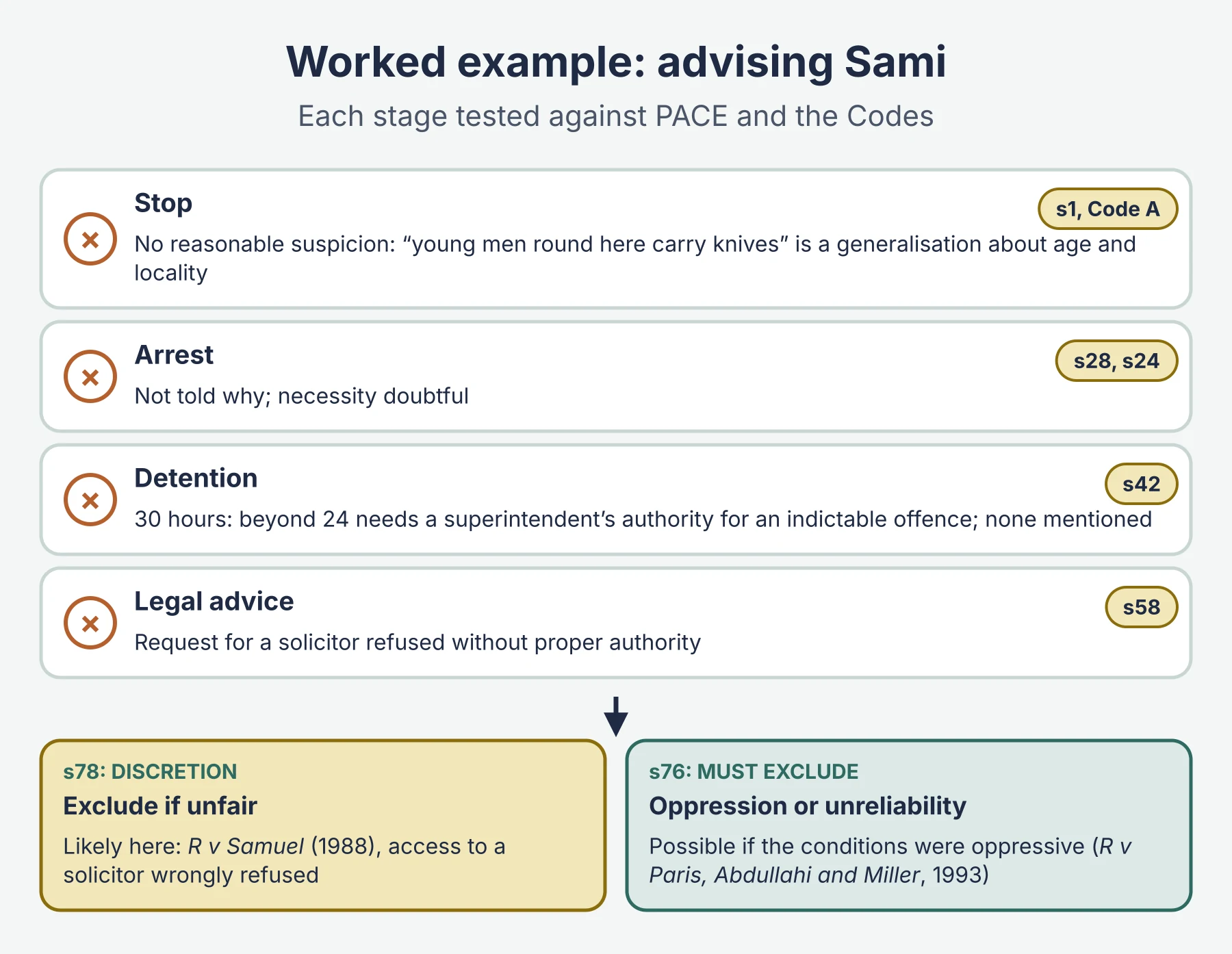
Sami, 19, is stopped because “young men round here carry knives”, arrested without being told why and held for 30 hours. His request for a solicitor is refused; he confesses. Advise Sami.
- Stop: no reasonable suspicion – a generalisation about age and locality breaches s1 and Code A.
- Arrest: failure to give grounds breaches s28; necessity under s24 is doubtful.
- Detention: beyond 24 hours needs a superintendent’s authority for an indictable offence (s42); none is mentioned.
- Legal advice: refusal breaches s58 without proper authority.
- Evidence: the confession is open to exclusion under s78, applying Samuel, and possibly s76 if the conditions were oppressive.
Common mistakes
- Stating that either-way defendants always choose their court: magistrates decide allocation first.
- Confusing case stated (point of law) with appeal to the Crown Court (rehearing).
- Writing that s76 gives the judge a discretion; it requires exclusion, while s78 is discretionary.
Exam technique
Describe needs procedure in order; explain needs the reason for each rule; assess weighs efficiency and cost against fairness and civil liberties, then concludes. Revise with the machinery of justice revision notes and practise with the machinery of justice practice questions.
Related resources
-
Practice questions
Cambridge A Level Law (9084): Machinery of justice – Practice Questions
Original questions with mark-scheme answers on the Woolf reforms, arbitration, criminal appeals, bail and PACE police powers for Cambridge Law 9084.
Law · Cambridge · AS Level
Try questions -
Revision notes
Cambridge A Level Law (9084): Machinery of justice – Revision Notes
Condensed notes on civil courts, Woolf, tracks, ADR, criminal pre-trial process, appeals, bail and PACE police powers for Cambridge Law 9084 subtopic 1.2.
Law · Cambridge · AS Level
Revise topic -
Study guides
Cambridge A Level Law (9084): Principles and sources of English law
Legal systems, the rule of law, Parliament and its influences, delegated legislation, interpretation and precedent for Cambridge Law 9084 subtopic 1.1.
Law · Cambridge · AS Level
Read guide
Get free revision emails (optional)
Occasional emails with practice questions, worked explanations and links to free resources for the qualification and subjects you choose. No spam, and you can unsubscribe from any email. The free tools on this site never need an email.