
Revision Notes
Cambridge A Level Law (9084): Machinery of justice – Revision Notes
Condensed notes on civil courts, Woolf, tracks, ADR, criminal pre-trial process, appeals, bail and PACE police powers for Cambridge Law 9084 subtopic 1.2.
- Subject
- Law
- Level
- AS LEVEL
- Topic
- Topic 1 – English Legal System
- Author
- Marlbridge Academic Team
- Updated
- Reviewed by
- Aizaz Raoof Ali (what this means)
Aligned to Cambridge A Level Law (9084), 2026-2028. Official specification .
Syllabus page (what it covers and how it is assessed): Cambridge A Level Law.
Syllabus points this page covers
9084 (AS Level)
- 1.2 Machinery of justice
Found an error? Report a correction.
Need help with this topic? Request a free trial class for A Level Law (9084).
Quick-recall notes for subtopic 1.2 of Cambridge International AS & A Level Law (9084). Full explanations and a worked police-powers problem are in the machinery of justice study guide.
Civil justice
- Courts: Magistrates’ (limited civil work: licensing, some debt enforcement, family work in the Family Court); County Court (most claims); High Court (King’s Bench, Chancery, Family); Court of Appeal (Civil Division, led by the Master of the Rolls); Supreme Court.
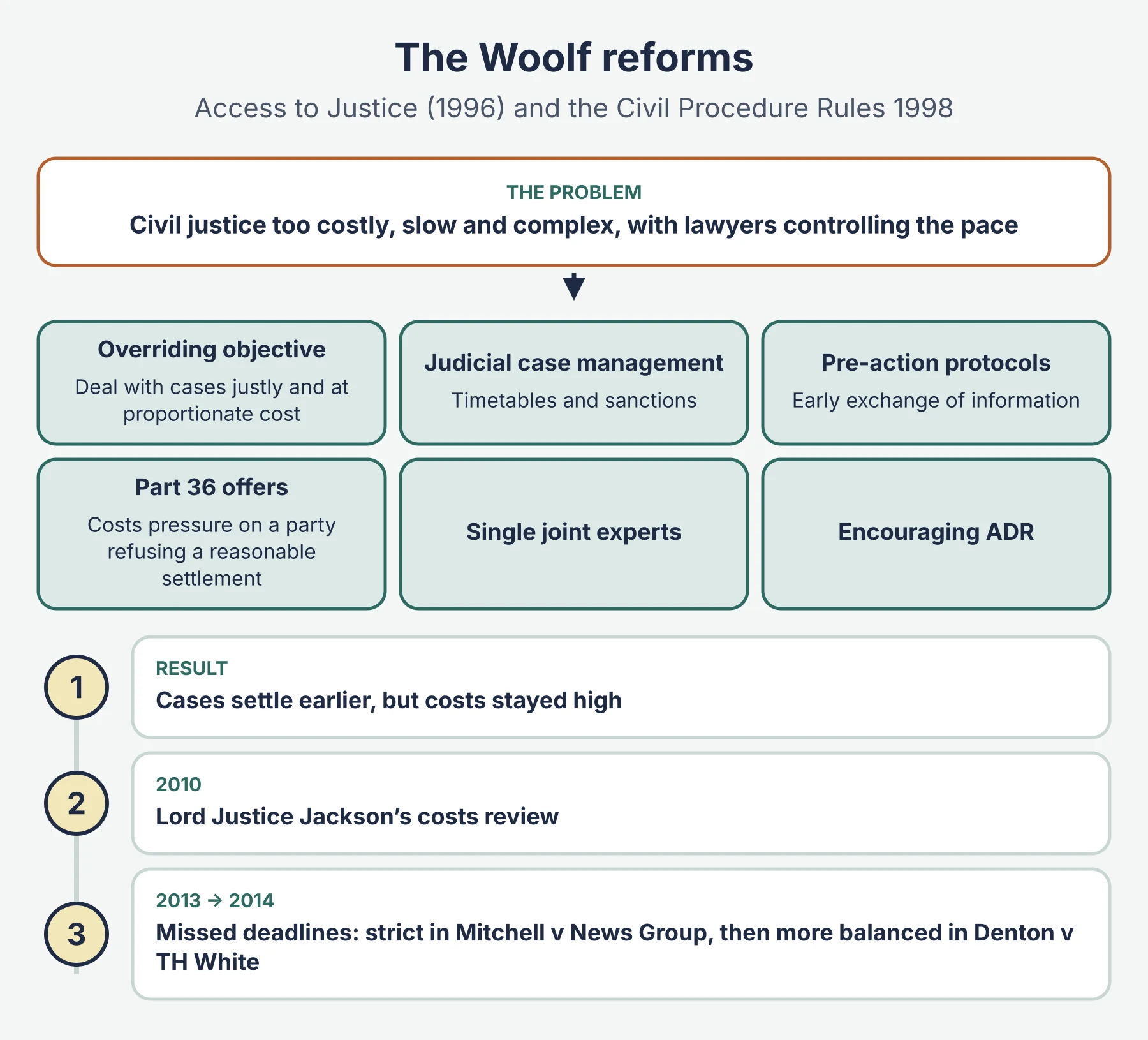
- Woolf – Access to Justice (1996) → Civil Procedure Rules 1998, in force April 1999. Problems tackled: cost, delay, complexity, adversarial culture.
- Tools: overriding objective (justly and at proportionate cost); case management; pre-action protocols; Part 36 offers; single joint experts; ADR encouraged.
- After Woolf: Jackson costs review (2010); compliance cases Mitchell (2013, strict) and Denton (2014, balanced).
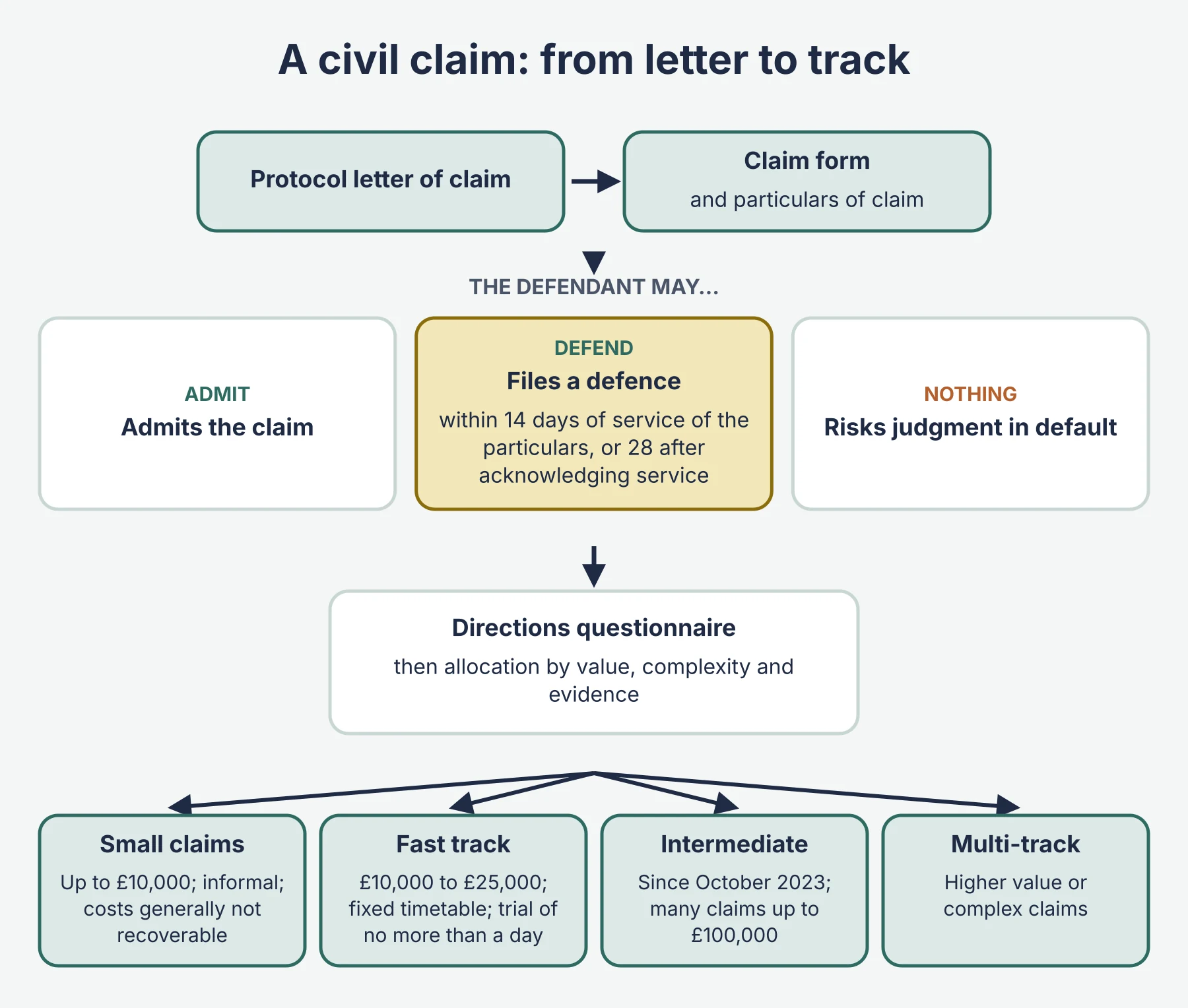
- Process: letter of claim → claim form and particulars → defence (14 days, or 28 after acknowledgement) or default judgment → directions questionnaire → allocation.
- Tracks: small claims (to £10,000), fast (£10,000–£25,000, one-day trial), multi-track (complex or high value); intermediate track since October 2023 for many claims up to £100,000.
- Appeals: permission needed; next level of judge → Court of Appeal → Supreme Court (point of law of general public importance); leapfrog from High Court.
ADR
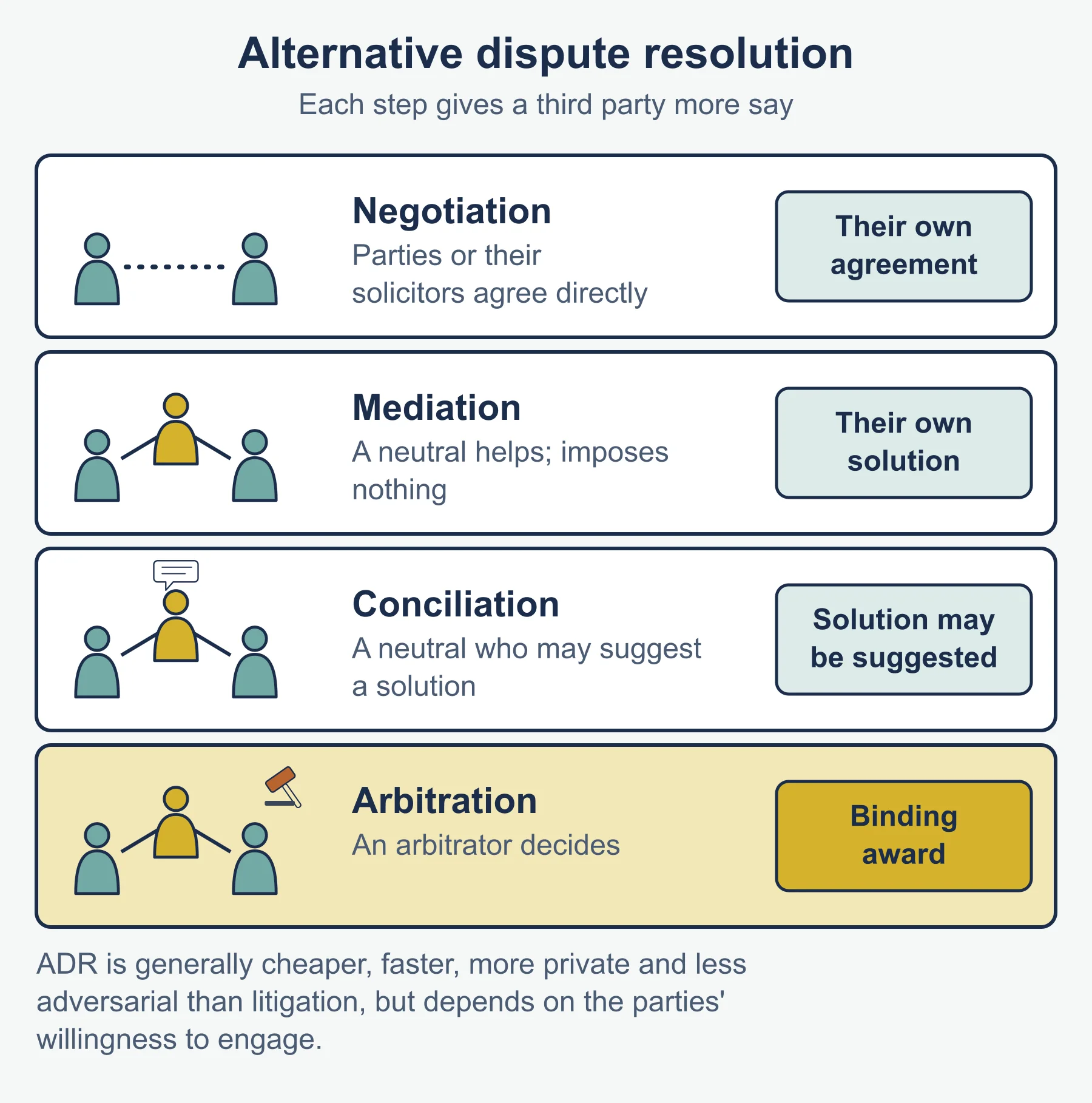
| Method | Third party role | Binding? |
|---|---|---|
| Negotiation | None | Only if the parties sign an agreement |
| Mediation | Facilitates; no solution imposed | Only if agreed |
| Conciliation | Active; may suggest terms (ACAS) | Only if agreed |
| Arbitration | Decides; makes an award | Yes, enforceable in court |
- Arbitration Act 1996: s1 principles (fair, impartial, no unnecessary delay or expense; party autonomy; limited court role); s9 stay of court action; narrow challenges (jurisdiction, serious irregularity, point of law unless excluded).
- Scott v Avery clause: arbitration award must come before any court action.
- Court pressure: costs penalty for unreasonable refusal (Halsey (2004)); courts may order engagement (Churchill v Merthyr Tydfil (2023)).
Criminal process
- Charging: CPS, Code for Crown Prosecutors – evidential test, then public interest test.
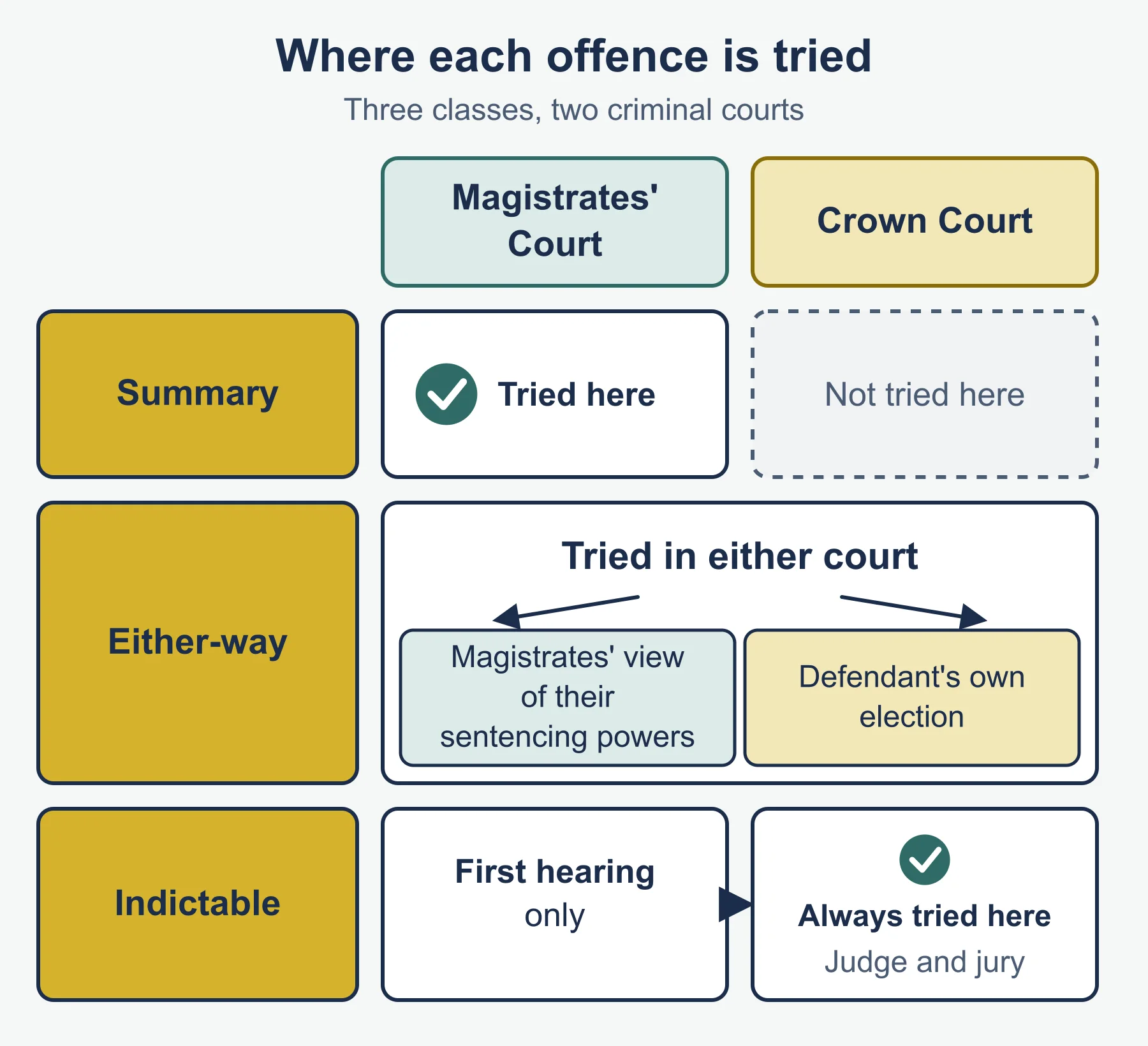
- Summary: magistrates hear and sentence; Single Justice Procedure for minor non-imprisonable offences.
- Either way: plea before venue → if not guilty, allocation by magistrates → defendant may elect Crown Court if magistrates accept jurisdiction. Guilty plea may be committed for sentence.
- Indictable only: sent to Crown Court under s51 Crime and Disorder Act 1998 → plea and trial preparation hearing.
Appeals
| From | To | Basis |
|---|---|---|
| Magistrates | Crown Court | Rehearing on conviction, or sentence (defence) |
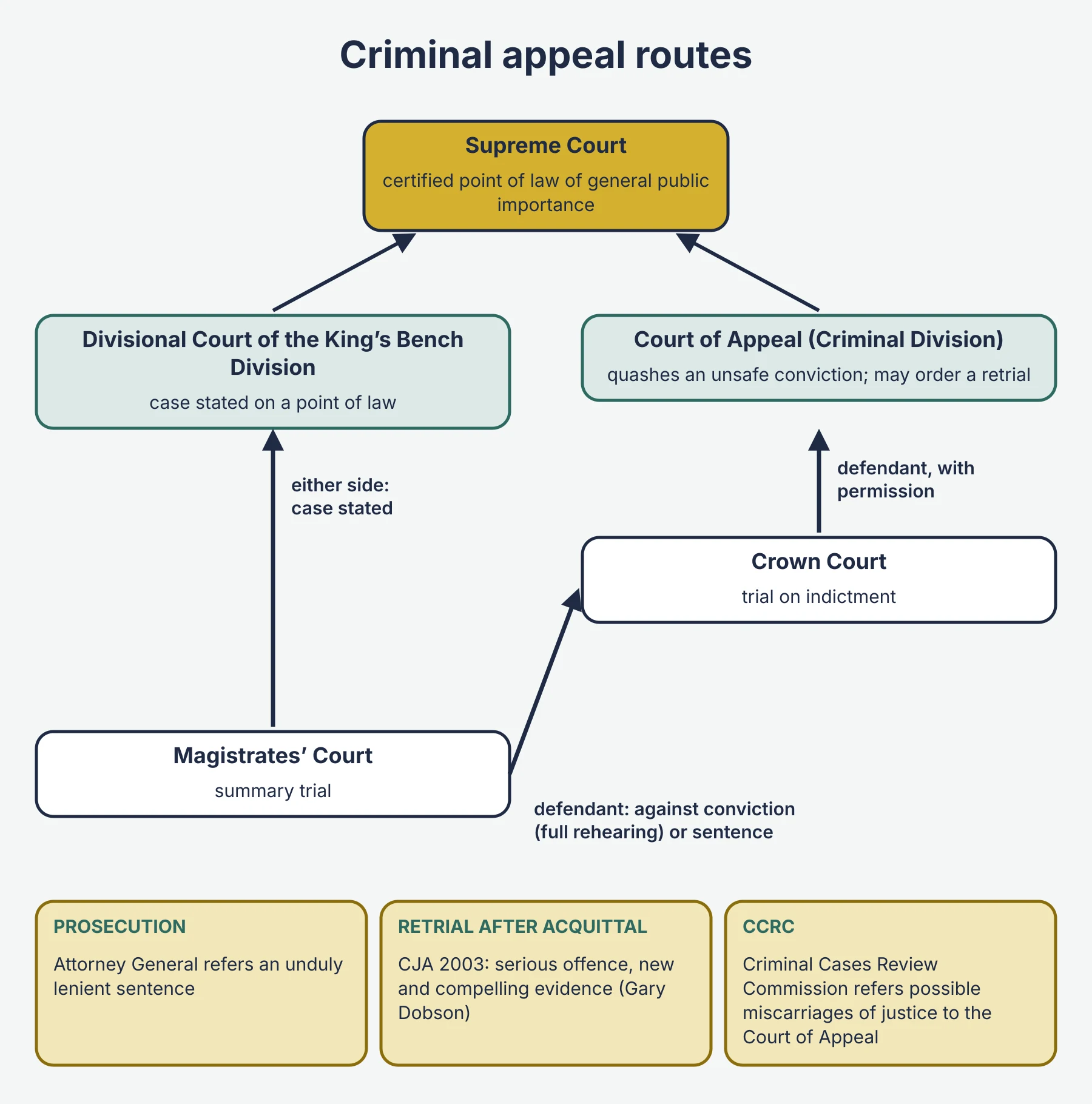
| Magistrates | Divisional Court (KBD) | Case stated, point of law (either side) |
| Crown Court | Court of Appeal (Criminal) | Permission; conviction “unsafe”; retrial possible |
| Court of Appeal | Supreme Court | Certified point of law of general public importance |
- Prosecution: Attorney General’s reference of unduly lenient sentence; retrial after acquittal for serious offences with new and compelling evidence (Criminal Justice Act 2003).
- Criminal Cases Review Commission: refers possible miscarriages of justice.
Bail
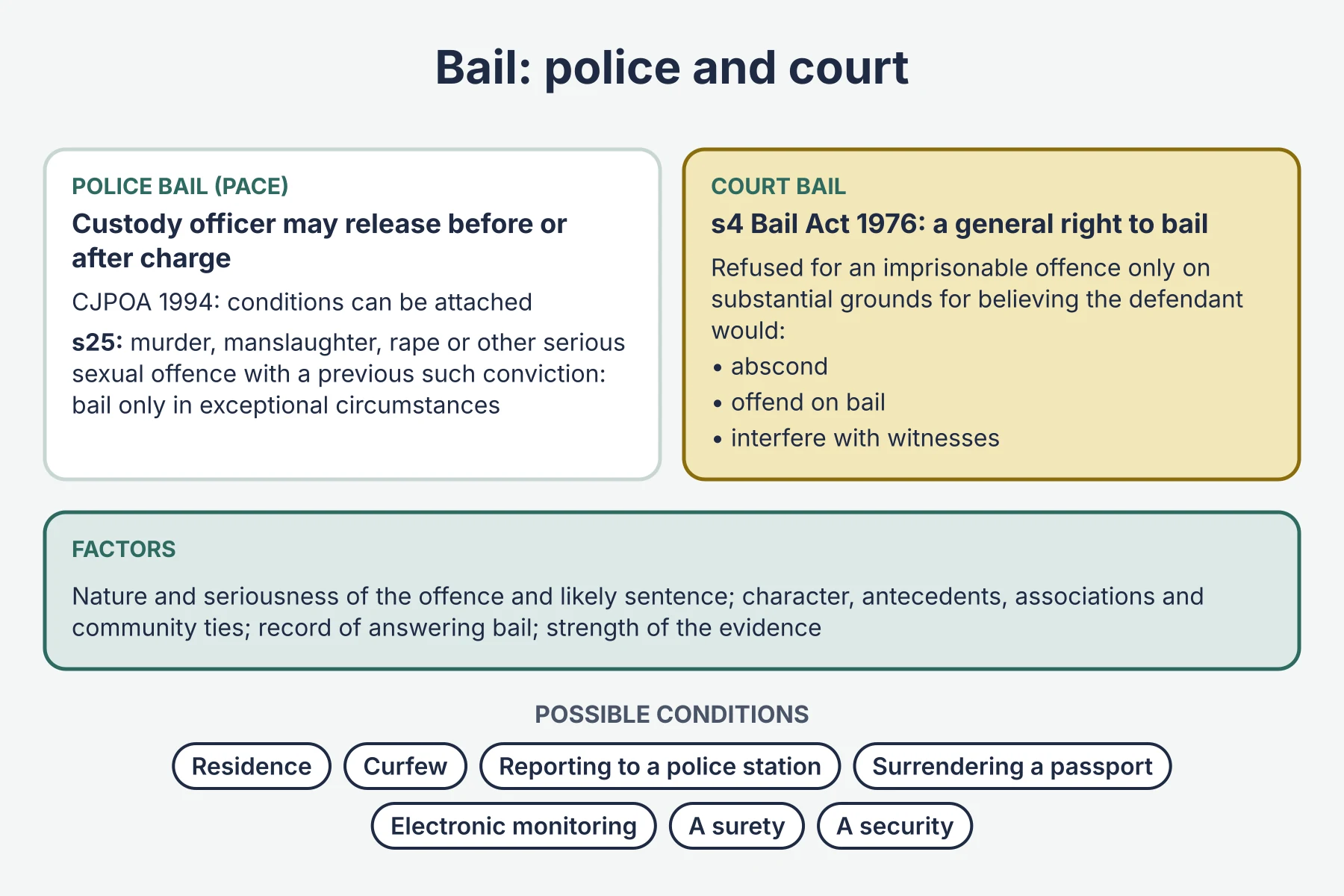
- Police: PACE (custody officer decides); Criminal Justice and Public Order Act 1994 – police conditional bail; s25 – bail for repeat homicide or rape charges only in exceptional circumstances.
- Court: Bail Act 1976 s4 – general right to bail.
- Refusal grounds: substantial grounds for believing the defendant would abscond, offend on bail or interfere with witnesses.
- Factors: seriousness and likely sentence; character, antecedents, associations, community ties; bail record; strength of evidence.
- Conditions: residence, curfew, reporting, passport, tag, surety, security.
Police powers (PACE 1984)
| Power | Key rule |
|---|---|
| s1 stop and search | Public place; reasonable suspicion of stolen or prohibited articles |
| s2–s3 | Give name, station, object, grounds; record available |
| Code A | Suspicion not based on personal factors alone |
| s23 Misuse of Drugs Act 1971 | Search for controlled drugs |
| Terrorism Act 2000 s43 / s47A | Suspected terrorist / authorised no-suspicion search |
| s24 arrest | Reasonable suspicion plus necessity reason; Code G |
| s28 | Told of arrest and grounds |
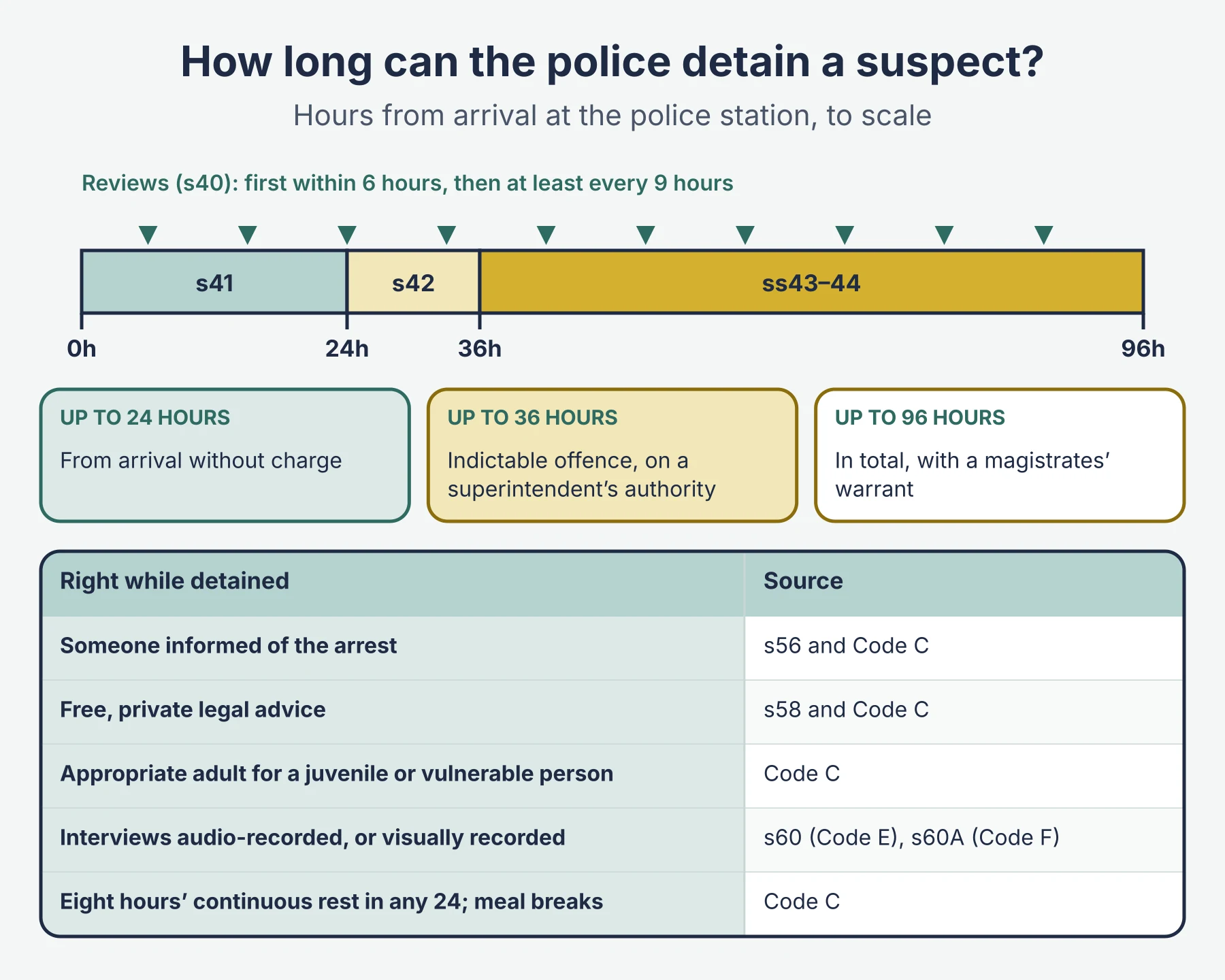
| s41 / s42 / ss43–44 | 24 hours / 36 hours (superintendent, indictable) / 96 hours (magistrates) |
| s40 | Reviews at 6 hours, then every 9 |
| s56 / s58 | Someone informed / free legal advice |
| Code C | Appropriate adult; conditions; custody officer |
| s60 / s60A | Audio recording (Code E) / visual recording (Code F) |
| s54 / s55 | Search on arrival / intimate search (inspector) |
| s61 / s62 / s63 | Fingerprints / intimate samples (consent) / non-intimate samples |
| s76 | Oppression or unreliability – confession must be excluded |
| s78 | Discretion to exclude unfair evidence |
Cases: Christie v Leachinsky (1947) reasons for arrest; Gillan and Quinton v UK (2010) no-suspicion search breached Article 8; R v Samuel (1988) solicitor wrongly refused; R v Paris, Abdullahi and Miller (1993) oppression.
Key terms
| Term | Meaning |
|---|---|
| Overriding objective | Deal with cases justly and at proportionate cost |
| Part 36 offer | Formal settlement offer with costs consequences |
| Case stated | Appeal on a point of law from magistrates’ findings |
| Surety | Person who promises money if the defendant absconds |
| Appropriate adult | Adult supporting a juvenile or vulnerable suspect |
| Oppression | Includes torture, inhuman or degrading treatment, violence or its threat |
Exam traps
- Calling mediation binding.
- Forgetting that magistrates decide allocation before the defendant elects.
- Treating s78 as mandatory and s76 as discretionary – it is the other way round.
- Giving 36 hours as the basic detention limit; the basic limit is 24.
- Omitting the necessity requirement for arrest under s24.
Self-test
- Which report led to the Civil Procedure Rules 1998?
- State the overriding objective.
- Name the small claims limit.
- What is a Scott v Avery clause?
- Which section of the Arbitration Act 1996 allows a court to stay proceedings?
- Where is an indictable-only offence tried, and under which provision is it sent there?
- What test does the Court of Appeal apply to a conviction?
- Give three factors a court considers when deciding bail.
- What must an officer tell a person before a s1 search?
- What is the maximum detention without charge with a magistrates’ warrant?
- Which case concerned refusal of a solicitor?
- Distinguish s76 from s78 PACE.
Answers
- Lord Woolf’s Access to Justice (1996).
- Dealing with cases justly and at proportionate cost.
- £10,000.
- A clause making an arbitration award a condition precedent to court action.
- Section 9.
- Crown Court, sent under s51 Crime and Disorder Act 1998.
- Whether the conviction is unsafe.
- Any three: seriousness and likely sentence; character and antecedents; community ties; bail record; strength of evidence.
- Name, station, object and grounds of the search, and the right to a record.
- 96 hours.
- R v Samuel (1988).
- Section 76 requires exclusion of a confession obtained by oppression or in unreliable circumstances; s78 gives a discretion to exclude any evidence that would make the trial unfair.
Practise applying these rules with the machinery of justice practice questions.
Related resources
-
Study guides
Cambridge A Level Law (9084): Principles and sources of English law
Legal systems, the rule of law, Parliament and its influences, delegated legislation, interpretation and precedent for Cambridge Law 9084 subtopic 1.1.
Law · Cambridge · AS Level
Read guide -
Practice questions
Cambridge A Level Law (9084): Principles and sources of English law – Practice Questions
Original questions with mark-scheme answers on the rule of law, Parliament, delegated legislation, interpretation and precedent for Cambridge Law 9084.
Law · Cambridge · AS Level
Try questions -
Revision notes
Cambridge A Level Law (9084): Principles and sources of English law – Revision Notes
Condensed notes on the rule of law, law and morality, Parliament, delegated legislation, interpretation and precedent for Cambridge Law 9084 subtopic 1.1.
Law · Cambridge · AS Level
Revise topic
Get free revision emails (optional)
Occasional emails with practice questions, worked explanations and links to free resources for the qualification and subjects you choose. No spam, and you can unsubscribe from any email. The free tools on this site never need an email.