
Study Guides
Cambridge A Level Law (9084): Legal personnel
Judges, barristers, solicitors, legal executives, magistrates and juries: qualifications, selection, training and regulation for Cambridge Law 9084 1.3.
- Subject
- Law
- Level
- AS LEVEL
- Topic
- Topic 1 – English Legal System
- Author
- Marlbridge Academic Team
- Updated
- Reviewed by
- Aizaz Raoof Ali (what this means)
Aligned to Cambridge A Level Law (9084), 2026-2028. Official specification .
Syllabus page (what it covers and how it is assessed): Cambridge A Level Law.
Syllabus points this page covers
9084 (AS Level)
- 1.3 Legal personnel
Found an error? Report a correction.
Need help with this topic? Request a free trial class for A Level Law (9084).
Subtopic 1.3 covers the judiciary (1.3.1), legal professionals (1.3.2) and lay personnel (1.3.3). Questions usually ask you to describe qualifications, selection or training, then assess effectiveness, independence or representativeness. The Topic 1 overview introduces each group; this guide adds detail and evaluation.
1.3.1 The judiciary
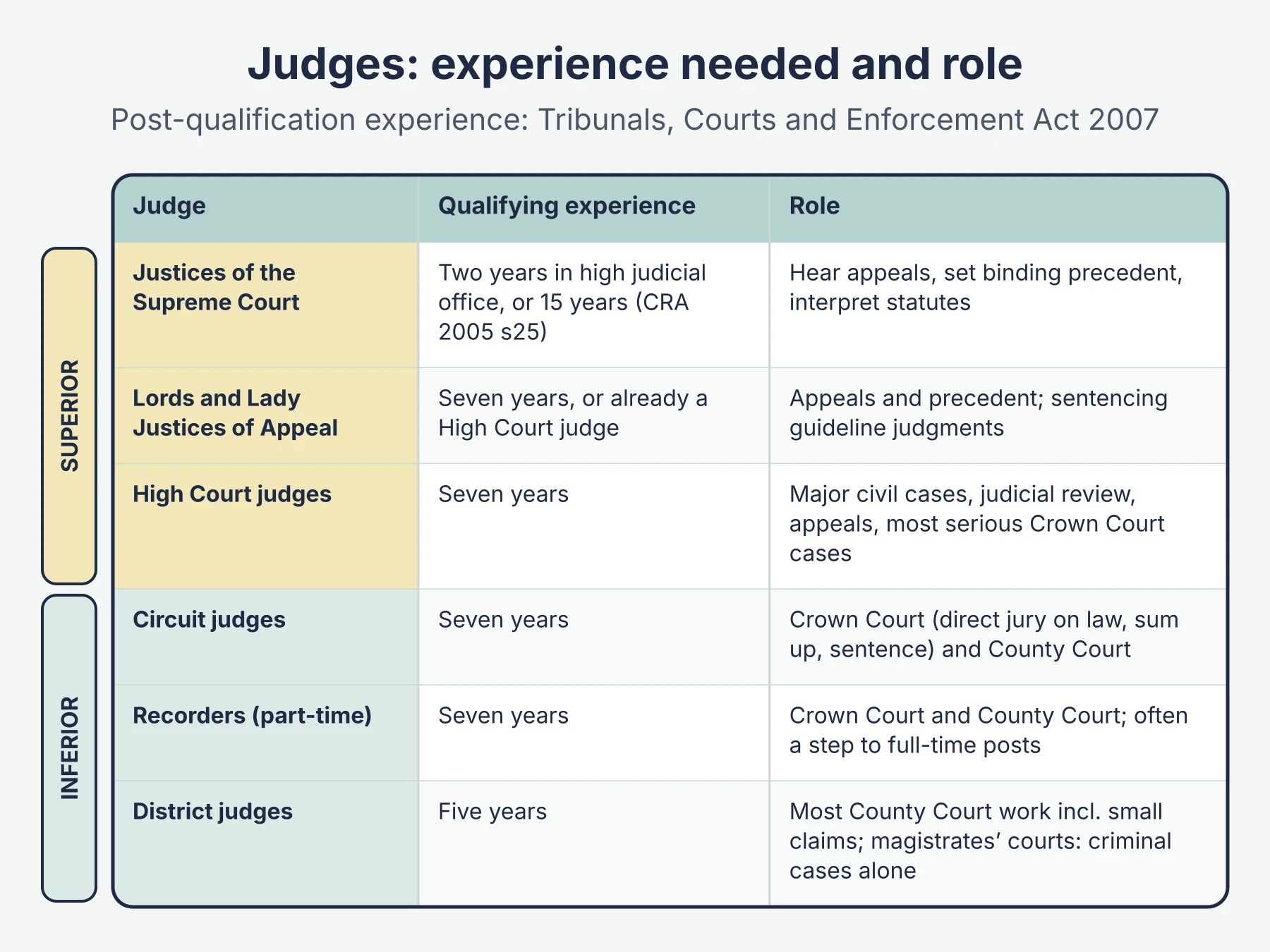
Superior and inferior judges. Superior judges are the Justices of the Supreme Court, the Heads of Division, the Lords and Lady Justices of Appeal and High Court judges. Inferior judges include circuit judges, recorders (part-time), district judges and district judges (magistrates’ courts).
Qualifications. Eligibility is measured in years of post-qualification legal experience, under the Tribunals, Courts and Enforcement Act 2007, which also opened some posts to chartered legal executives.
| Post | Requirement |
|---|---|
| Supreme Court | Two years in high judicial office, or 15 years’ qualifying experience (Constitutional Reform Act 2005 s25) |
| Court of Appeal | Seven years’ qualifying experience, or already a High Court judge |
| High Court | Seven years |
| Circuit judge and recorder | Seven years |
| District judge | Five years |
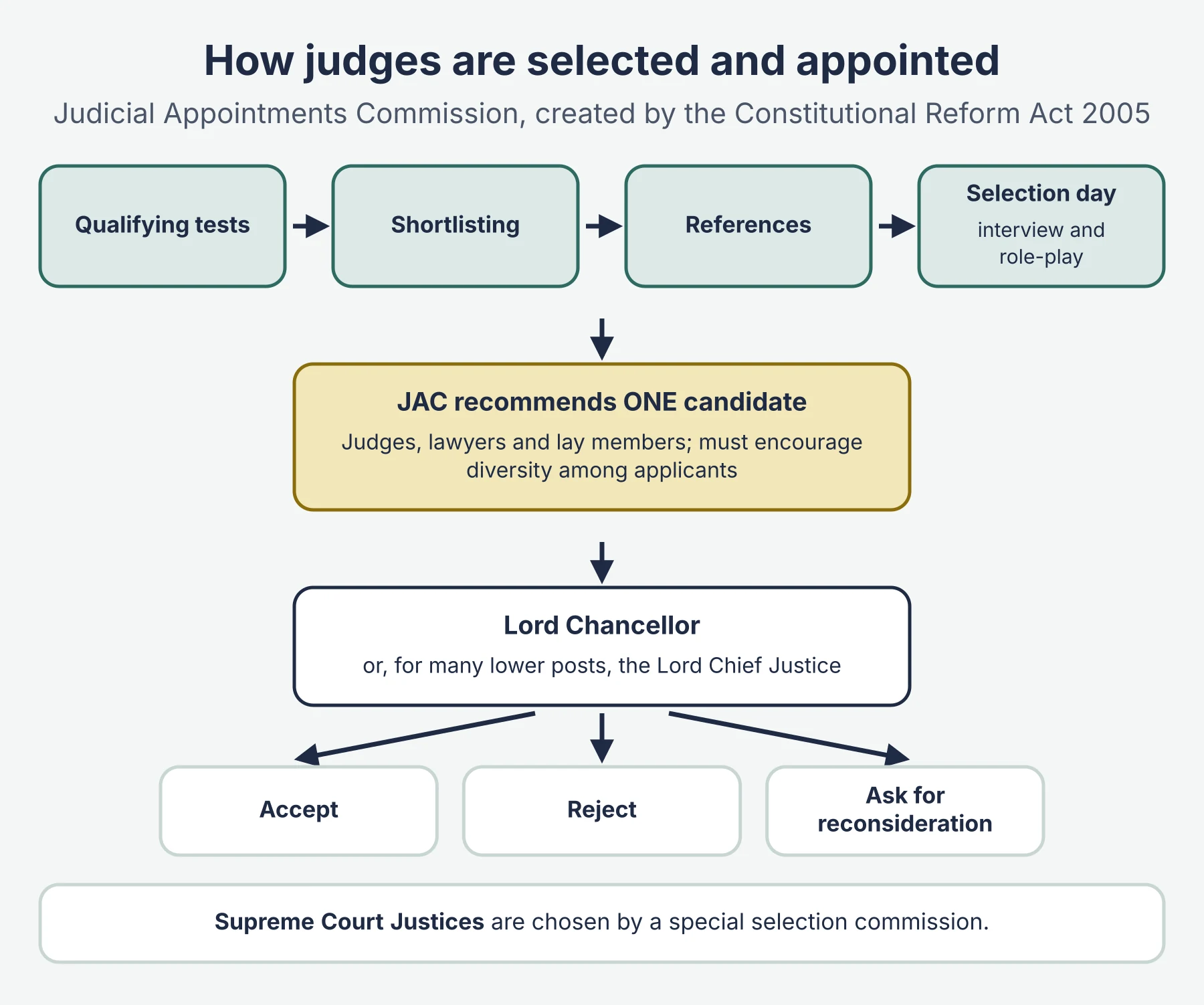
Selection and appointment. The Constitutional Reform Act 2005 created the independent Judicial Appointments Commission, made up of judges, lawyers and lay members. Candidates face qualifying tests, shortlisting, references and a selection day with interview and role-play. The Commission recommends one candidate; the Lord Chancellor (or, for many lower posts, the Lord Chief Justice) may accept, reject or ask for reconsideration. Supreme Court Justices are chosen by a special selection commission. It must encourage diversity among applicants.
Role.
- Supreme Court and Court of Appeal – hear appeals, set binding precedent and interpret statutes; the Court of Appeal also issues guideline judgments on sentencing.
- High Court judges – try major civil cases and judicial review, hear appeals, and try the most serious Crown Court cases.
- Circuit judges – try Crown Court cases (directing the jury on law, summing up and sentencing) and County Court cases.
- Recorders – part-time Crown Court and County Court judges, often a step to full-time posts.
- District judges – handle most County Court work, including small claims; district judges (magistrates’ courts) hear criminal cases sitting alone.
Training. The Judicial College, created in 2011, provides induction courses, sitting-in with an experienced judge, and continuing education on new law, equality and the treatment of vulnerable witnesses. Because English judges come from practice rather than a career judiciary, training assumes experience.
Retirement and removal. The compulsory retirement age is 75, raised from 70 by the Public Service Pensions and Judicial Offices Act 2022. Superior judges hold office “during good behaviour” and can be removed only by the monarch on an address from both Houses of Parliament, a power used once, for an Irish judge, Sir Jonah Barrington, in 1830. Inferior judges may be removed by the Lord Chancellor, with the agreement of the Lord Chief Justice, for incapacity or misbehaviour; a circuit judge was removed in 1983 after being convicted of smuggling. The Judicial Conduct Investigations Office handles complaints.
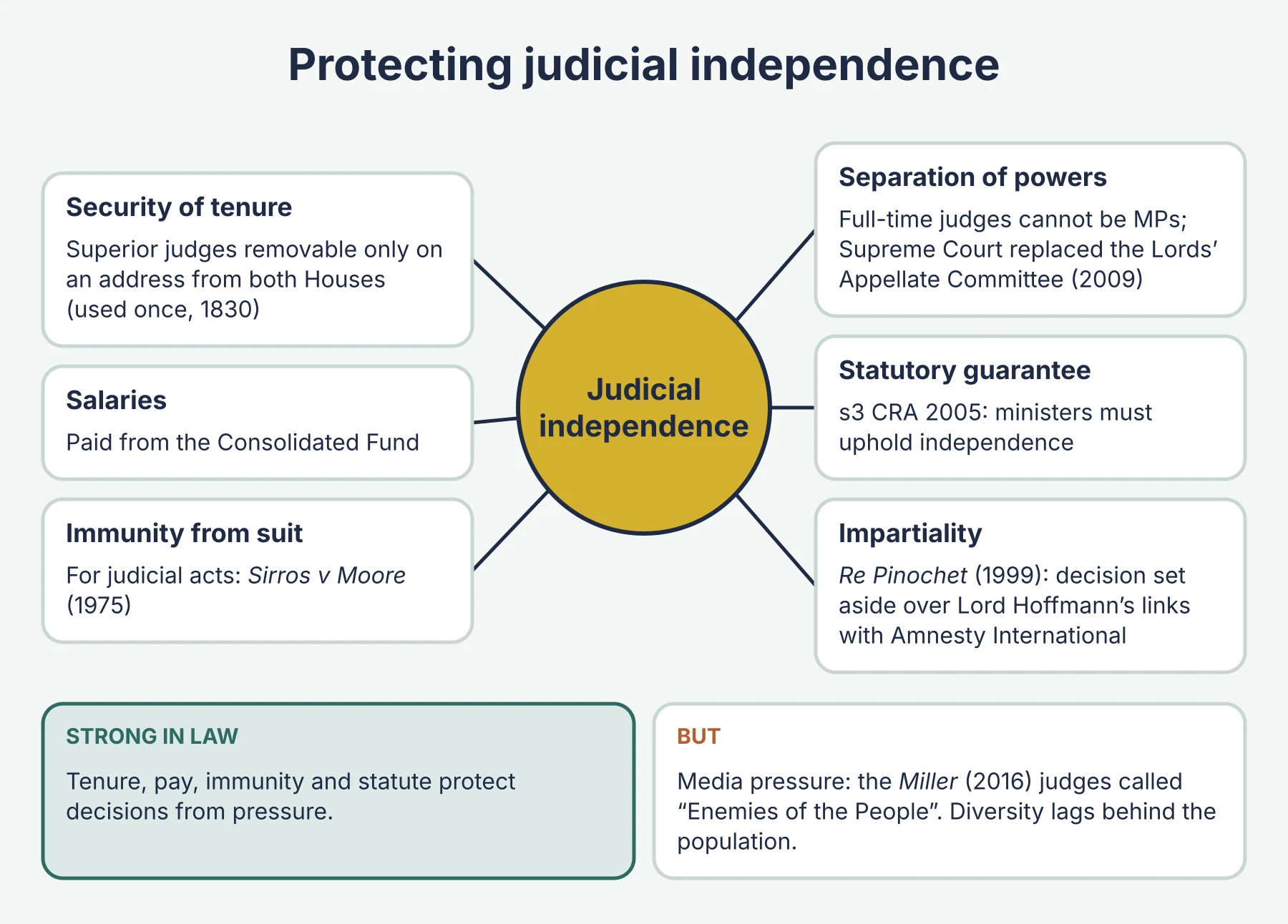
Independence.
- Security of tenure and salaries paid from the Consolidated Fund.
- Immunity from suit for judicial acts (Sirros v Moore (1975)).
- Separation of powers – full-time judges cannot sit as MPs, and the Supreme Court replaced the Appellate Committee of the House of Lords in 2009.
- Statutory guarantee – s3 Constitutional Reform Act 2005 requires ministers to uphold judicial independence.
- Impartiality – in Re Pinochet (1999) the House of Lords set aside its own decision because Lord Hoffmann had links with Amnesty International, a party to the appeal.
Evaluation: independence is strong in law, but media pressure exists, as when a newspaper called the judges in the 2016 Miller Article 50 case “Enemies of the People”; diversity also lags behind the population.
1.3.2 Legal professionals
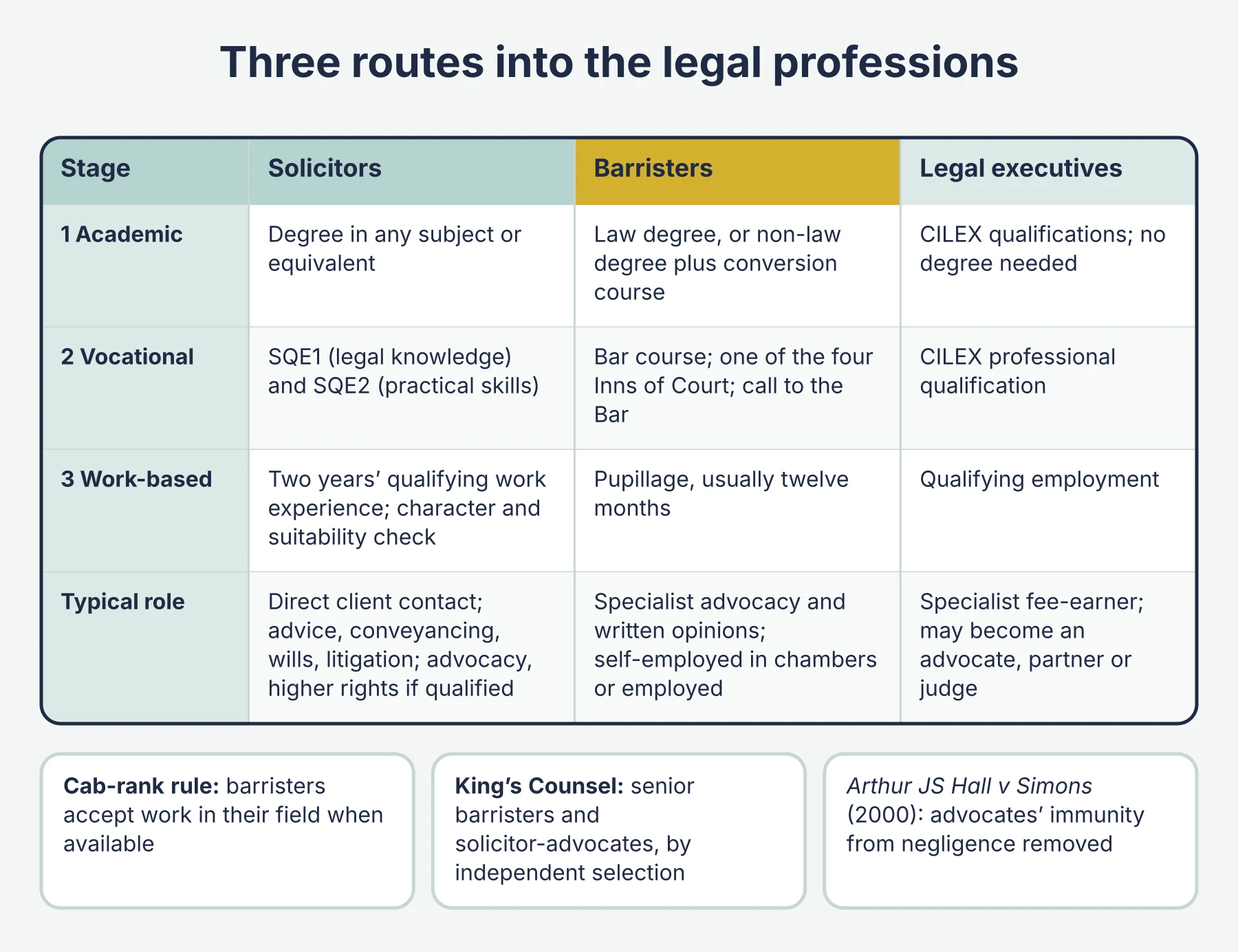
| Solicitors | Barristers | Legal executives | |
|---|---|---|---|
| Academic stage | Degree in any subject or equivalent | Law degree, or non-law degree plus conversion course | CILEX qualifications; no degree needed |
| Vocational stage | Solicitors Qualifying Examination: SQE1 (legal knowledge) and SQE2 (practical skills) | Bar course; membership of one of the four Inns of Court; call to the Bar | CILEX professional qualification |
| Work-based stage | Two years’ qualifying work experience; character and suitability check | Pupillage, usually twelve months | Qualifying employment |
| Typical role | Direct client contact; advice, conveyancing, wills, litigation; advocacy, with higher rights if qualified | Specialist advocacy and written opinions; self-employed in chambers or employed | Specialist fee-earner in one area; may become an advocate, partner or judge |
Further points on roles. Barristers are bound by the cab-rank rule, requiring them to accept work in their field when available. Under public access, clients can often instruct a barrister directly. Senior barristers and solicitor-advocates may become King’s Counsel through an independent selection process. Solicitors gained rights of audience in the higher courts under the Courts and Legal Services Act 1990 and the Access to Justice Act 1999. In Arthur JS Hall & Co v Simons (2000) the House of Lords removed advocates’ immunity from negligence claims.
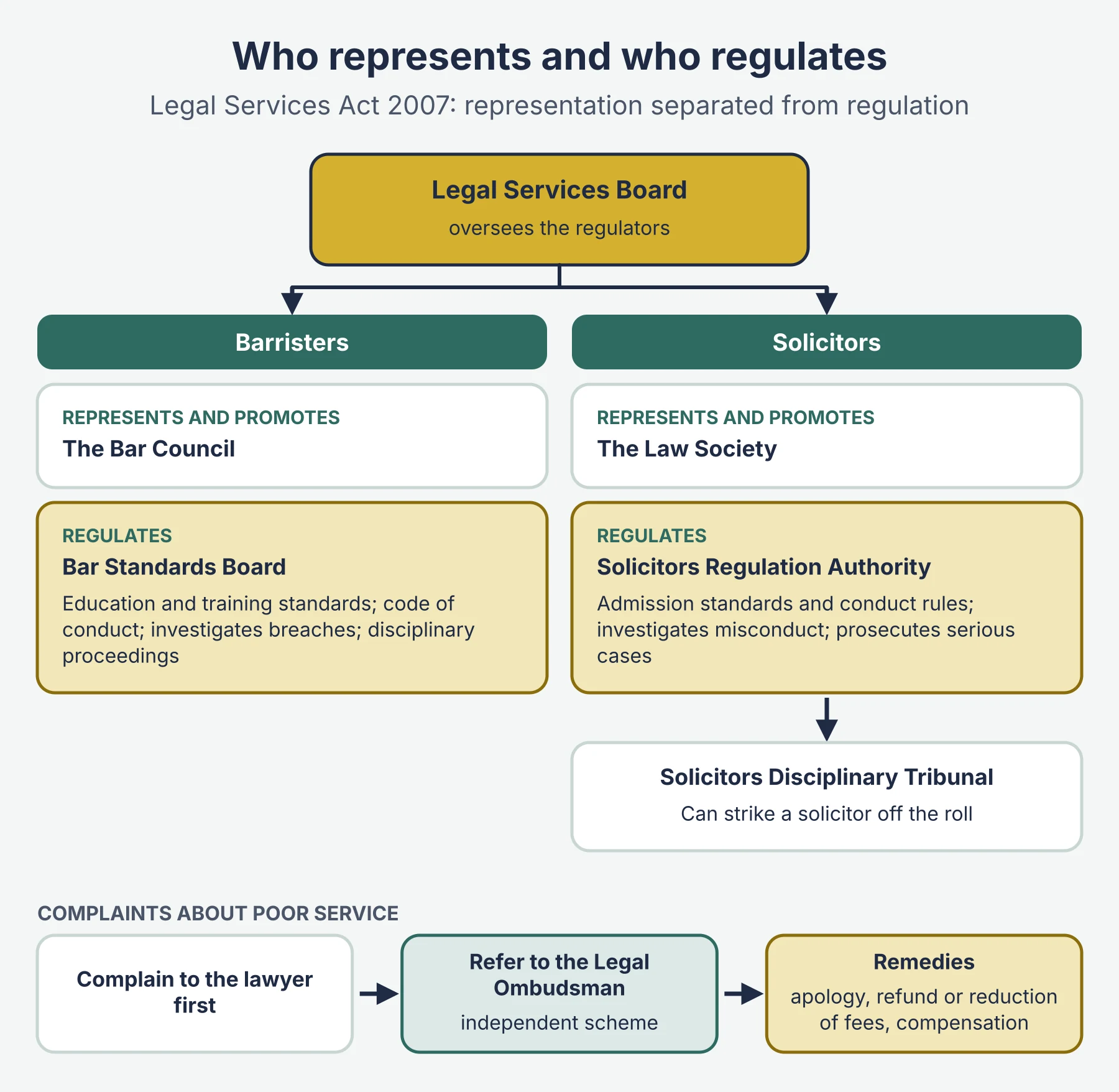
Regulation. The Legal Services Act 2007 separated the bodies that represent the professions from those that regulate them, under the oversight of the Legal Services Board.
| Body | Function |
|---|---|
| The Bar Council | Represents and promotes barristers |
| Bar Standards Board | Sets education and training standards, publishes the code of conduct, investigates breaches and brings disciplinary proceedings |
| The Law Society | Represents and promotes solicitors |
| Solicitors Regulation Authority | Sets admission standards and conduct rules, investigates misconduct and prosecutes serious cases before the Solicitors Disciplinary Tribunal, which can strike a solicitor off the roll |
| Legal Ombudsman | Independent complaints scheme for poor service: the client complains to the lawyer first, then may refer it; remedies include an apology, refund or reduction of fees and compensation |
Evaluation: separating regulation from representation improved confidence, but the cost of qualifying affects who can enter the professions.
1.3.3 Lay personnel
Lay magistrates
Role. Magistrates sit in benches of two or three, advised on law by a legal adviser. In criminal cases they try summary and many either-way offences, sentence, hold early hearings in indictable cases, decide bail, issue warrants and, with specialist training, sit in the youth court. In civil matters they hear family cases in the Family Court and deal with licensing and some debt enforcement.
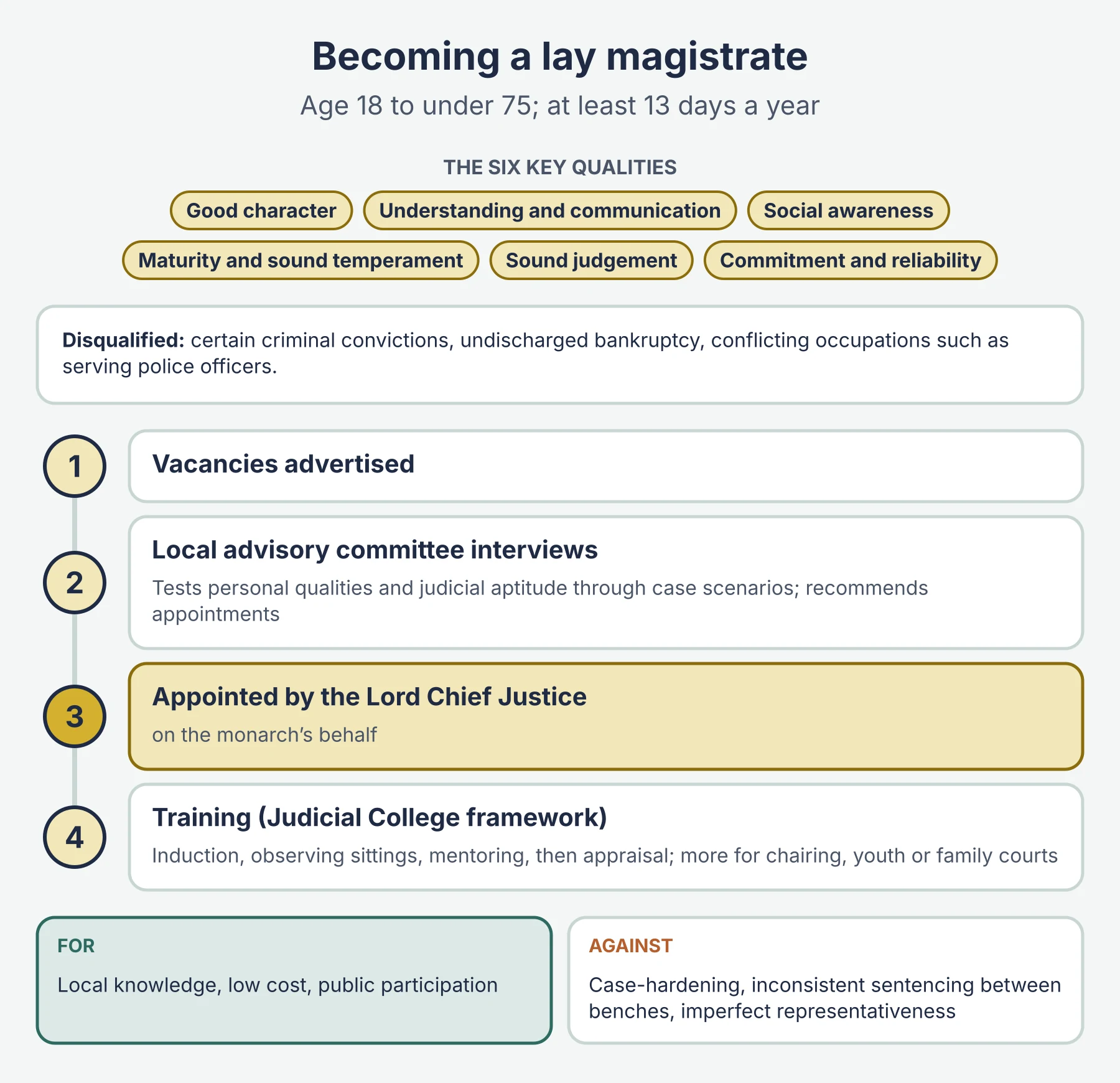
Qualifications. Applicants must be at least 18 and under the retirement age of 75, show the six key qualities (good character, understanding and communication, social awareness, maturity and sound temperament, sound judgement, commitment and reliability) and sit at least 13 days a year. Certain criminal convictions, undischarged bankruptcy and conflicting occupations, such as serving police officers, disqualify.
Selection and appointment. Vacancies are advertised; local advisory committees interview candidates, testing personal qualities and judicial aptitude through case scenarios, and recommend appointments, made on the monarch’s behalf by the Lord Chief Justice.
Training. Under the Judicial College framework, new magistrates complete induction, observe sittings, are mentored and then appraised; chairing a bench or sitting in youth or family courts needs further training.
Evaluation. For: local knowledge, low cost, public participation. Against: risk of case-hardening, inconsistent sentencing between benches, and imperfect representativeness.
The jury
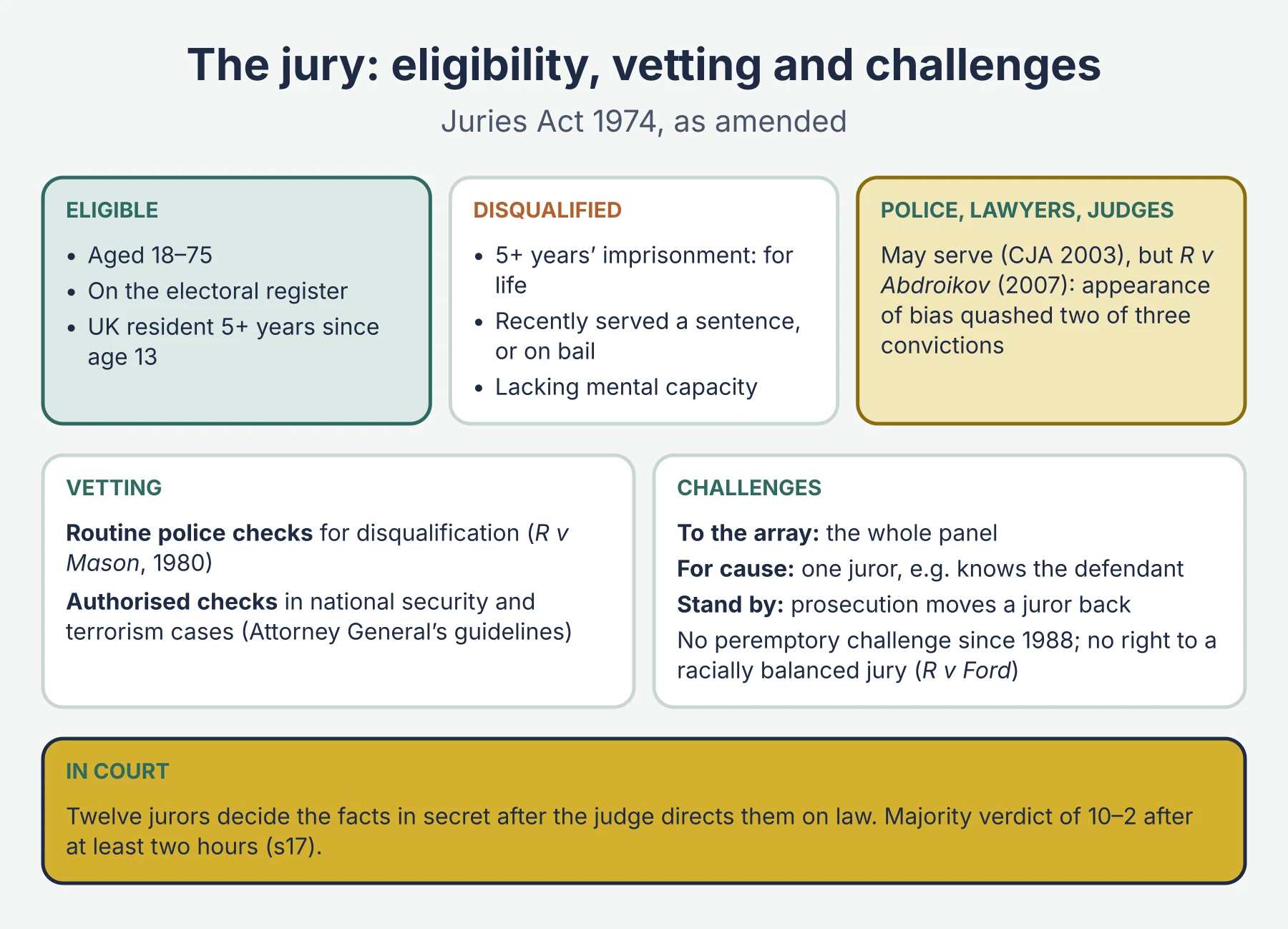
Role in criminal courts. Twelve jurors decide guilt in Crown Court trials where the defendant pleads not guilty. The judge directs them on law; they decide the facts in secret. A majority verdict of 10–2 is permitted after at least two hours’ deliberation (Juries Act 1974 s17).
Qualifications. Under the Juries Act 1974, as amended, a juror must be 18–75, on the electoral register and resident in the UK for at least five years since age 13. People sentenced to five years’ or more imprisonment are disqualified for life; those who have recently served a sentence or are on bail are also disqualified, as are those lacking mental capacity. The Criminal Justice Act 2003 allowed police, lawyers and judges to serve, but in R v Abdroikov (2007) convictions were quashed in two of three appeals because a police officer and a prosecution lawyer on the juries created an appearance of bias.
Vetting and challenges.
- Routine police checks confirm that jurors are not disqualified (R v Mason (1980)).
- Authorised checks in national security and terrorism cases follow the Attorney General’s guidelines.
- Challenge to the array attacks the whole panel as unfairly chosen.
- Challenge for cause targets an individual juror, for example one who knows the defendant.
- Stand by lets the prosecution move a juror to the back of the panel.
The defence’s peremptory challenge (without reasons) was abolished by the Criminal Justice Act 1988, and R v Ford (1989) held there is no right to a racially balanced jury.
Alternatives to the jury.
- Trial by judge alone – under s44 Criminal Justice Act 2003 where there is a real danger of jury tampering; first used in R v Twomey (2009).
- A panel of judges – as in the former Diplock courts in Northern Ireland.
- A judge with lay assessors or magistrates – the 2025 Independent Review of the Criminal Courts proposed a bench of a judge and two magistrates for some cases.
- Wider use of magistrates for either-way offences.
Evaluation. Juries offer public participation and jury equity (R v Ponting (1985)), but give no reasons, may misunderstand complex evidence, and can be influenced by outside material; in Attorney General v Fraill (2011) a juror was jailed for contacting a defendant on Facebook.
Annotated model answer
Explain how judicial independence is protected. (part (a) style)
Superior judges hold office during good behaviour and can be removed only by an address of both Houses, which has happened once. [rule + evidence] Their salaries come from the Consolidated Fund, so Parliament cannot cut pay to punish decisions. [rule + reason] Judges are immune from suit for judicial acts (Sirros v Moore), so they decide without fear of litigation. [case] Appointment by the independent Judicial Appointments Commission limits political influence, and s3 Constitutional Reform Act 2005 places a duty on ministers to uphold independence. [statute]
Common mistakes
- Confusing the Bar Council (representative) with the Bar Standards Board (regulator).
- Saying jurors decide the sentence or questions of law.
- Stating that the Legal Ombudsman handles negligence claims; it deals with service complaints.
Exam technique
Describe questions reward accurate facts in order (qualification, selection, training); explain needs the reason each safeguard exists; assess and evaluate need balanced arguments and a conclusion on effectiveness or representativeness. Revise with the legal personnel revision notes and practise with the legal personnel practice questions.
Related resources
-
Practice questions
Cambridge A Level Law (9084): Legal personnel – Practice Questions
Original questions with mark-scheme answers on judicial appointment, legal professions and regulation, magistrates and juries for Cambridge Law 9084.
Law · Cambridge · AS Level
Try questions -
Revision notes
Cambridge A Level Law (9084): Legal personnel – Revision Notes
Condensed notes on judges, lawyers and their regulators, magistrates and juries, with key cases and a self-test, for Cambridge Law 9084 subtopic 1.3.
Law · Cambridge · AS Level
Revise topic -
Study guides
Cambridge A Level Law (9084): Machinery of justice
Civil courts and the Woolf reforms, ADR and arbitration, criminal process and bail, and police powers under PACE for Cambridge Law 9084 subtopic 1.2.
Law · Cambridge · AS Level
Read guide
Get free revision emails (optional)
Occasional emails with practice questions, worked explanations and links to free resources for the qualification and subjects you choose. No spam, and you can unsubscribe from any email. The free tools on this site never need an email.