
Revision Notes
Cambridge A Level Law (9084): Legal personnel – Revision Notes
Condensed notes on judges, lawyers and their regulators, magistrates and juries, with key cases and a self-test, for Cambridge Law 9084 subtopic 1.3.
- Subject
- Law
- Level
- AS LEVEL
- Topic
- Topic 1 – English Legal System
- Author
- Marlbridge Academic Team
- Updated
- Reviewed by
- Aizaz Raoof Ali (what this means)
Aligned to Cambridge A Level Law (9084), 2026-2028. Official specification .
Syllabus page (what it covers and how it is assessed): Cambridge A Level Law.
Syllabus points this page covers
9084 (AS Level)
- 1.3 Legal personnel
Found an error? Report a correction.
Need help with this topic? Request a free trial class for A Level Law (9084).
Recall notes for subtopic 1.3 of Cambridge International AS & A Level Law (9084). The legal personnel study guide has the full explanations and an annotated answer.
1.3.1 Judiciary
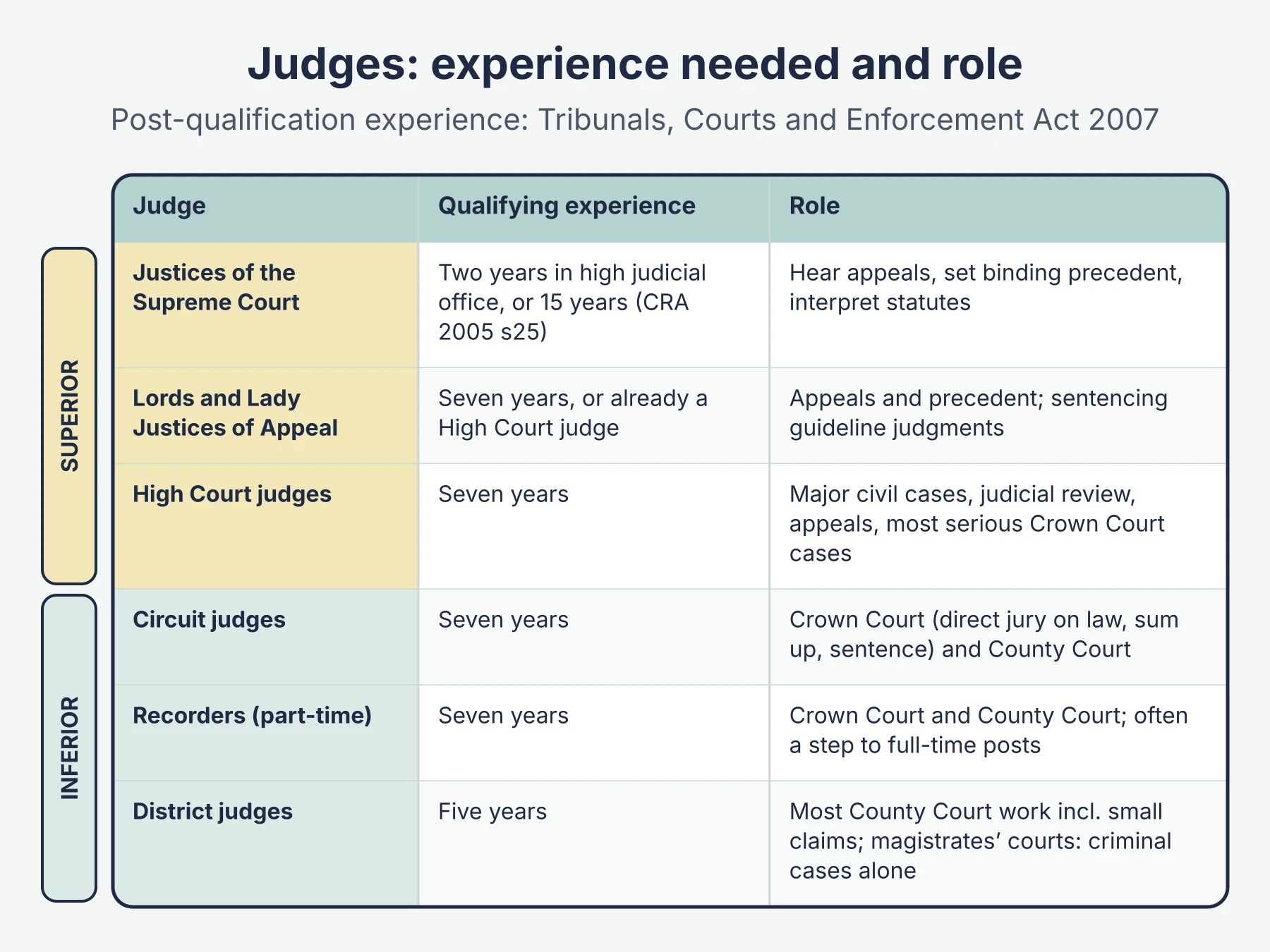
Superior: Supreme Court Justices, Heads of Division, Lords and Lady Justices of Appeal, High Court judges. Inferior: circuit judges, recorders, district judges, district judges (magistrates’ courts).
Eligibility (years of post-qualification experience): Supreme Court – 2 years’ high judicial office or 15 years; Court of Appeal – 7 (or a High Court judge); High Court – 7; circuit judge and recorder – 7; district judge – 5. Legal executives are eligible for some posts (Tribunals, Courts and Enforcement Act 2007).
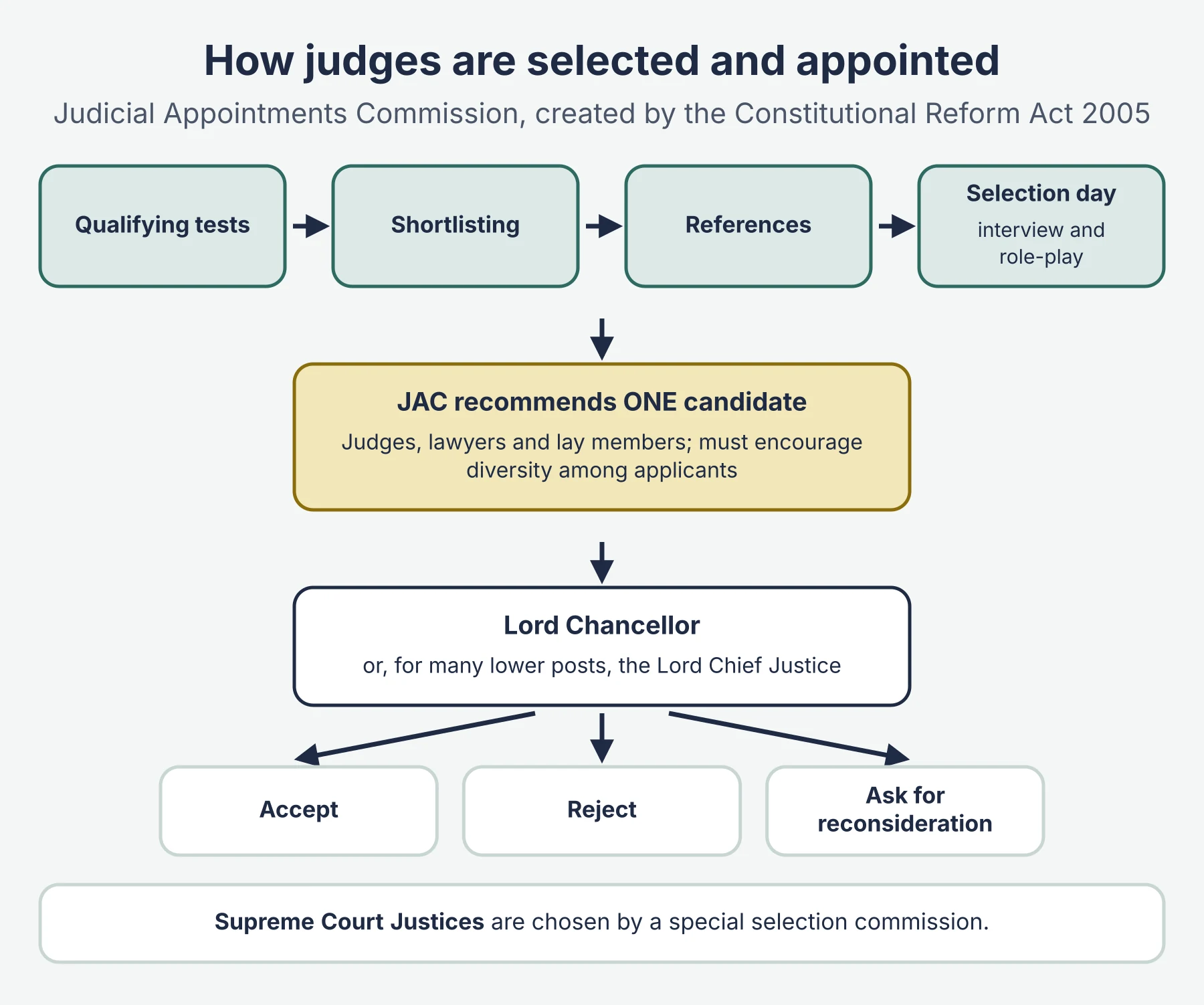
Appointment: Judicial Appointments Commission (Constitutional Reform Act 2005) – tests, shortlisting, references, selection day – recommends one name; Lord Chancellor or Lord Chief Justice accepts, rejects or asks for reconsideration. Supreme Court – special selection commission.
Roles in brief: appellate courts set precedent and interpret statutes; High Court tries major civil cases and judicial review; circuit judges direct juries and sentence; recorders sit part time; district judges handle most County Court work.
Training: Judicial College (2011) – induction, sitting-in, continuing education.
Retirement: 75 (Public Service Pensions and Judicial Offices Act 2022).
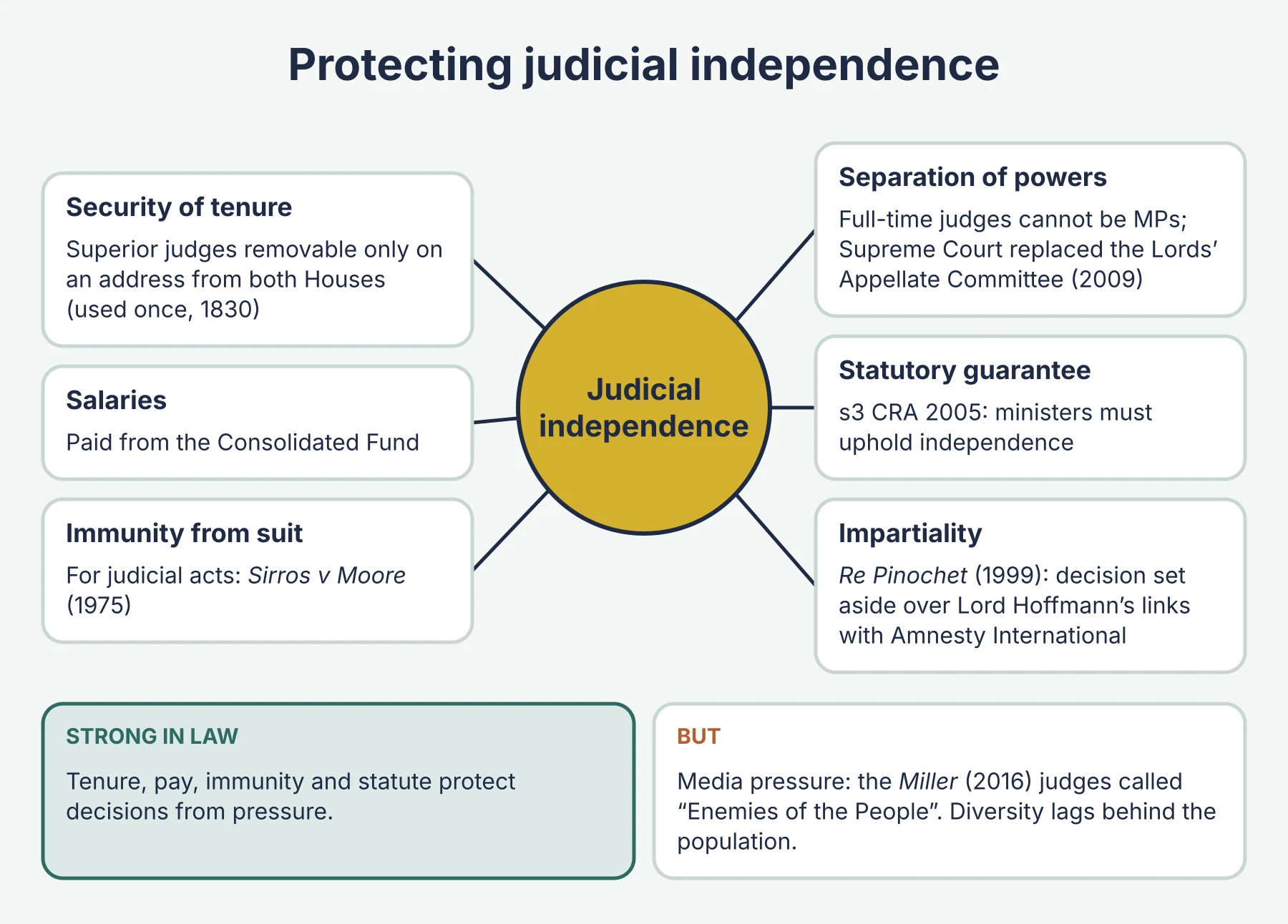
Removal: superior – address of both Houses (only Sir Jonah Barrington, 1830); inferior – Lord Chancellor with Lord Chief Justice’s agreement for incapacity or misbehaviour.
Independence: tenure; Consolidated Fund salaries; immunity (Sirros v Moore (1975)); separation of powers (Supreme Court 2009); s3 Constitutional Reform Act 2005; impartiality (Re Pinochet (1999)).
1.3.2 Legal professionals
| Solicitor | Barrister | Legal executive | |
|---|---|---|---|
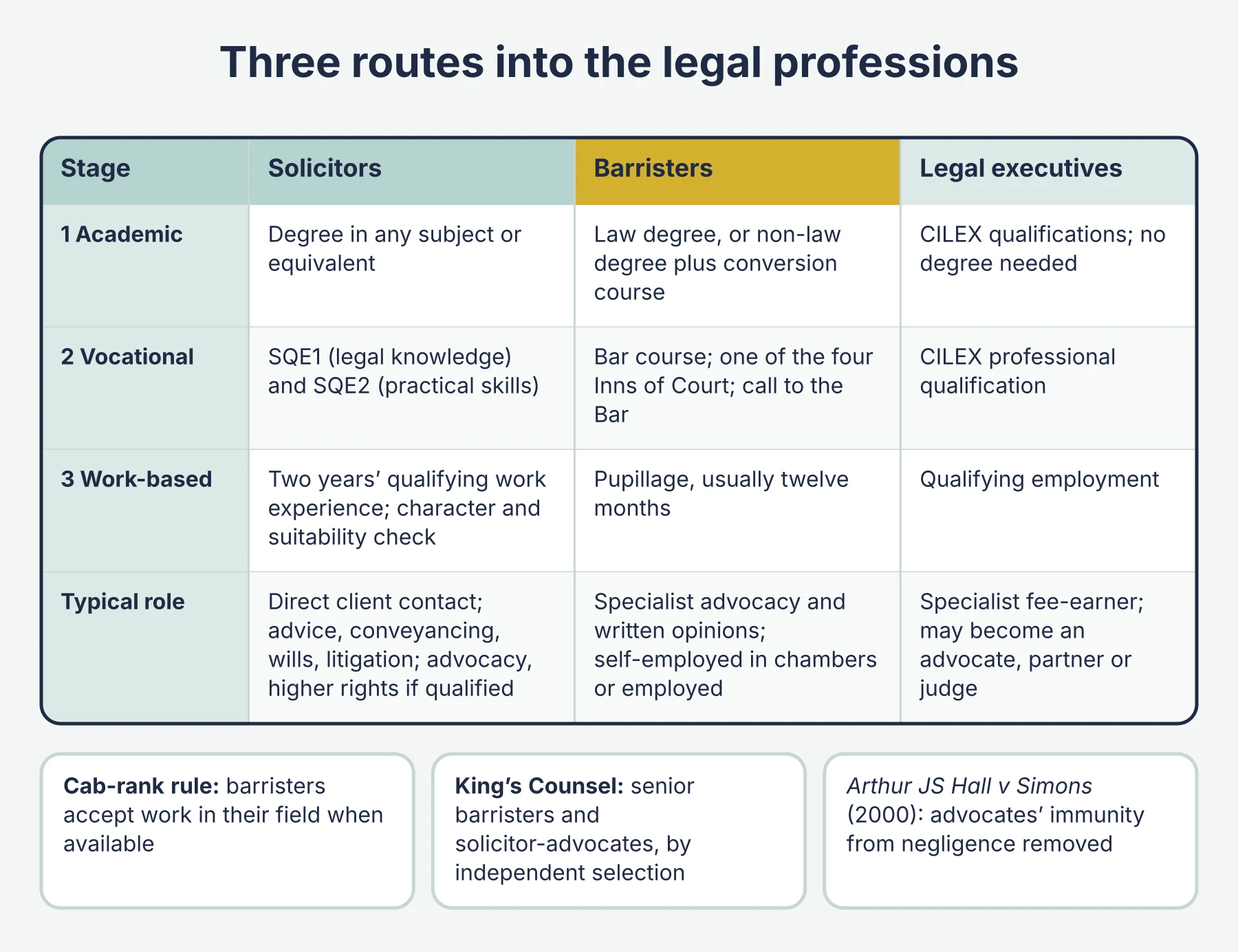
| Route | Degree or equivalent → SQE1 and SQE2 → two years’ qualifying work experience → character check | Law degree or conversion → Inn of Court → Bar course → call → pupillage | CILEX qualifications and qualifying employment |
| Work | Client contact, transactions, litigation, some advocacy | Advocacy, opinions, drafting; chambers or employed | Specialist in one area |
| Notes | Higher rights as solicitor-advocate | Cab-rank rule; public access | Can become partner, advocate or judge |
- Hall v Simons (2000): advocates lost immunity from negligence claims.
- King’s Counsel: senior advocates appointed through independent selection.
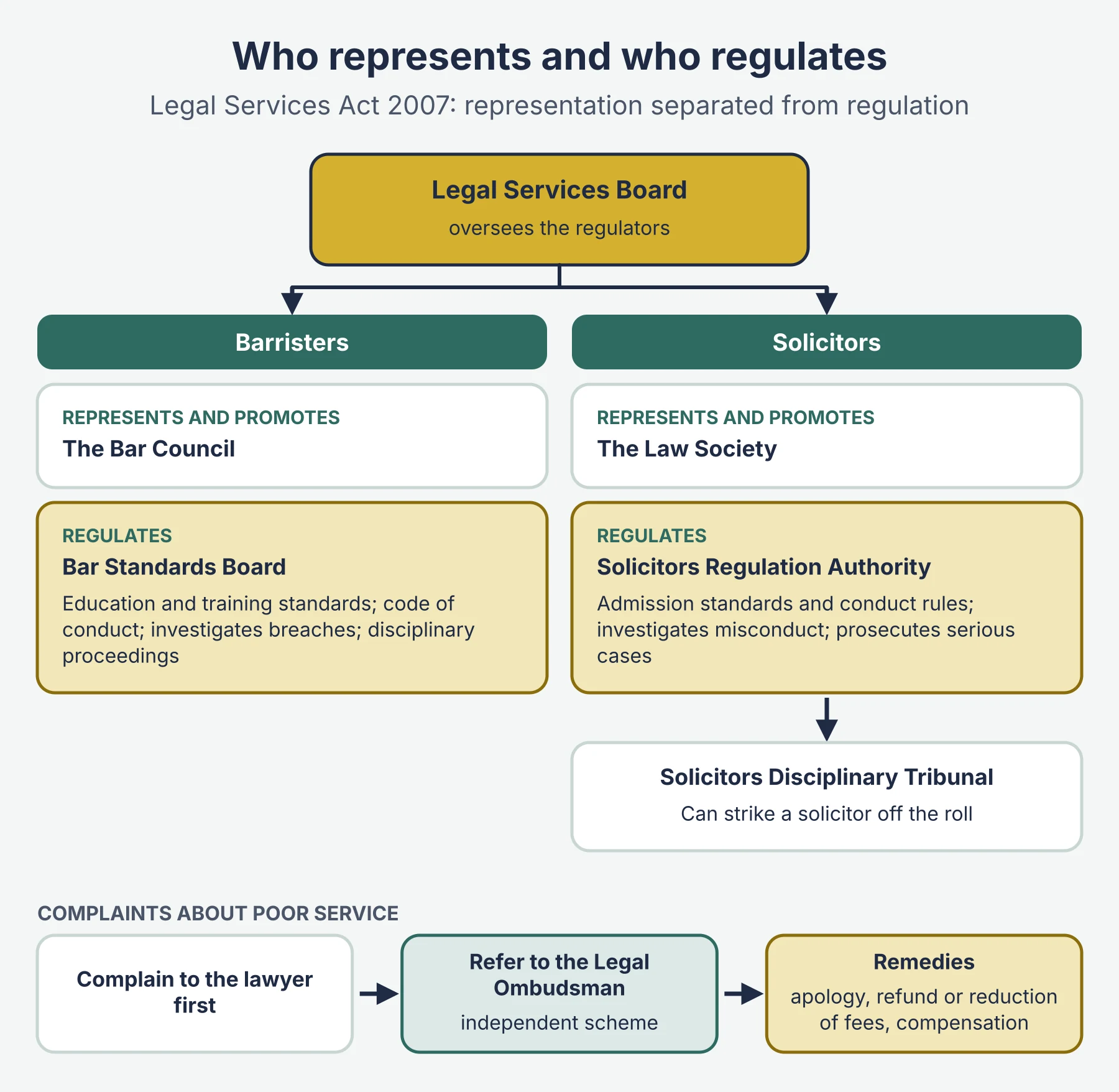
- Legal Services Act 2007: separated representation from regulation; Legal Services Board oversees regulators.
| Body | Represents or regulates? | Key powers |
|---|---|---|
| Bar Council | Represents barristers | Promotes the profession |
| Bar Standards Board | Regulates barristers | Training standards, code of conduct, discipline |
| Law Society | Represents solicitors | Promotes the profession |
| Solicitors Regulation Authority | Regulates solicitors | Admission, conduct rules, prosecutions before the Solicitors Disciplinary Tribunal |
| Legal Ombudsman | Independent complaints | Apology, fee refund or reduction, compensation |
1.3.3 Lay personnel
Magistrates
- Role: benches of two or three plus a legal adviser. Criminal – summary and either-way trials, sentencing, early hearings, bail, warrants, youth court. Civil – Family Court, licensing, some debt enforcement.
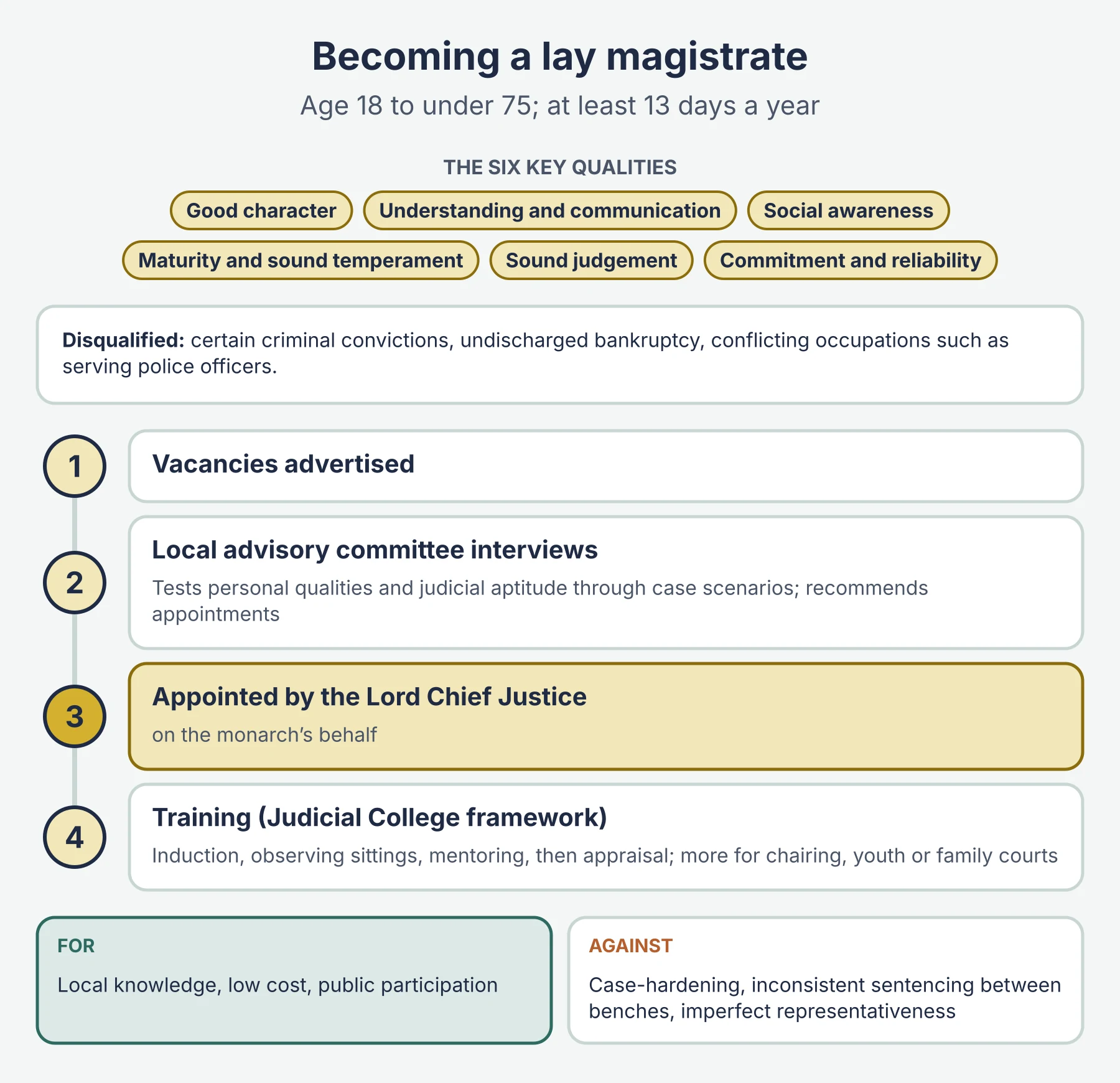
- Qualifications: 18 to under 75; six key qualities (good character; understanding and communication; social awareness; maturity and sound temperament; sound judgement; commitment and reliability); at least 13 days a year. Disqualified: certain convictions, undischarged bankrupts, conflicting jobs such as police officers.
- Selection: advisory committee interviews and recommendation.
- Training: induction, observations, mentor, appraisal.
Juries
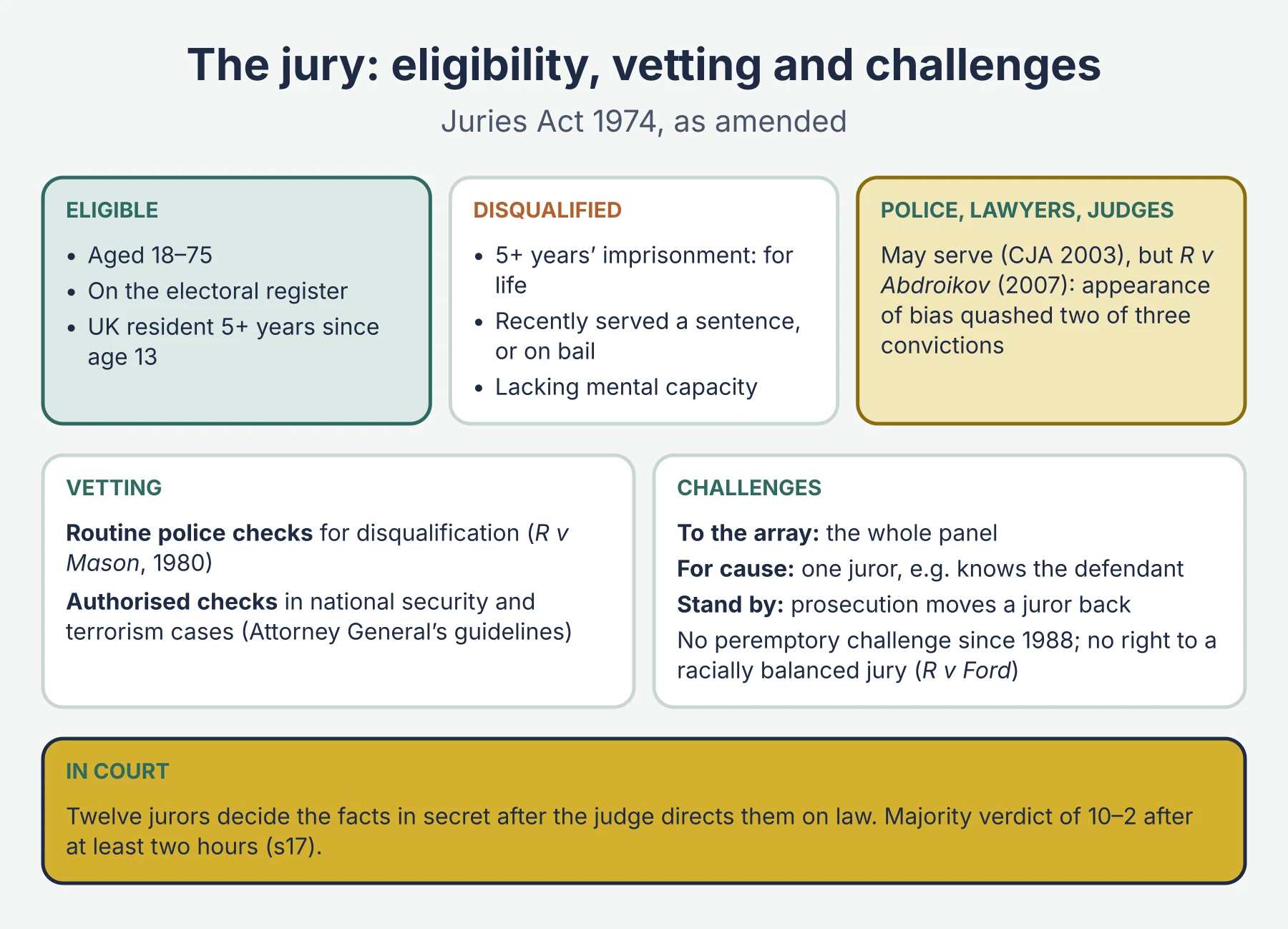
- Role: 12 jurors in Crown Court trials decide facts and verdict; judge decides law and sentence; majority 10–2 after at least two hours (Juries Act 1974 s17).
- Qualifications: 18–75; on electoral register; five years’ UK residence since age 13. Life disqualification for sentences of five years or more; disqualification for recent sentences and for people on bail; mental capacity required.
- Who serves: police and lawyers since 2003 – R v Abdroikov (2007) shows the bias risk.
- Vetting: routine checks (R v Mason (1980)); authorised checks in security cases under Attorney General guidelines.
- Challenges: to the array, for cause, prosecution stand by. Peremptory challenge abolished in 1988. R v Ford (1989) – no right to a racially balanced jury.
- Alternatives: judge alone for tampering (s44 Criminal Justice Act 2003; R v Twomey (2009)); panel of judges (Diplock courts); judge with lay assessors or magistrates (proposed by the 2025 Independent Review of the Criminal Courts); more summary trial.
Key terms
| Term | Meaning |
|---|---|
| Recorder | Part-time judge, usually a practising lawyer |
| Pupillage | Supervised training period for barristers |
| Cab-rank rule | Barrister must accept work within their field if available |
| Six key qualities | Personal attributes required of magistrates |
| Stand by | Prosecution moves a juror to the back of the panel |
| Challenge for cause | Objection to a juror with a reason, such as knowing the defendant |
| Jury equity | Acquittal on conscience despite the law, as in R v Ponting (1985) |
Exam traps
- Mixing up the Bar Council and the Bar Standards Board, or the Law Society and the Solicitors Regulation Authority.
- Saying the Legal Ombudsman can strike off a solicitor; only the Solicitors Disciplinary Tribunal can.
- Claiming jurors give reasons for their verdict.
- Saying the defence can still use peremptory challenges.
- Writing that the Lord Chancellor chooses judges personally.
- Evaluating representativeness without explaining why it matters for public confidence.
Self-test
- What eligibility does a district judge need?
- Which body recommends judicial appointments?
- How can a High Court judge be removed?
- What did Re Pinochet (1999) decide?
- Name the two stages of the SQE.
- Which body regulates barristers?
- What did Hall v Simons (2000) change?
- Give three of the six key qualities for magistrates.
- What is the minimum time before a majority verdict?
- Why were convictions quashed in R v Abdroikov (2007)?
- Which Act abolished the peremptory challenge?
- Name one statutory alternative to jury trial and the case where it was first used.
Answers
- Five years’ post-qualification experience.
- The Judicial Appointments Commission.
- By the monarch on an address of both Houses of Parliament.
- A judge with links to a party (Lord Hoffmann and Amnesty International) must not sit; the decision was set aside.
- SQE1 (functioning legal knowledge) and SQE2 (practical legal skills).
- The Bar Standards Board.
- Advocates lost their immunity from negligence claims.
- Any three: good character; understanding and communication; social awareness; maturity and sound temperament; sound judgement; commitment and reliability.
- Two hours.
- A police officer and a prosecution lawyer sat as jurors, creating an appearance of bias.
- The Criminal Justice Act 1988.
- Trial by judge alone for jury tampering under s44 Criminal Justice Act 2003, first used in R v Twomey (2009).
Test your recall under exam conditions with the legal personnel practice questions.
Related resources
-
Study guides
Cambridge A Level Law (9084): Machinery of justice
Civil courts and the Woolf reforms, ADR and arbitration, criminal process and bail, and police powers under PACE for Cambridge Law 9084 subtopic 1.2.
Law · Cambridge · AS Level
Read guide -
Practice questions
Cambridge A Level Law (9084): Machinery of justice – Practice Questions
Original questions with mark-scheme answers on the Woolf reforms, arbitration, criminal appeals, bail and PACE police powers for Cambridge Law 9084.
Law · Cambridge · AS Level
Try questions -
Revision notes
Cambridge A Level Law (9084): Machinery of justice – Revision Notes
Condensed notes on civil courts, Woolf, tracks, ADR, criminal pre-trial process, appeals, bail and PACE police powers for Cambridge Law 9084 subtopic 1.2.
Law · Cambridge · AS Level
Revise topic
Get free revision emails (optional)
Occasional emails with practice questions, worked explanations and links to free resources for the qualification and subjects you choose. No spam, and you can unsubscribe from any email. The free tools on this site never need an email.