
Study Guides
Cambridge International AS & A Level Psychology (9990): 2.1 The physical environment
Topic 2.1 for Cambridge 9990 Consumer Psychology: store exteriors and layouts, music and noise, North et al., the PAD model, odour and crowding.
- Subject
- Psychology
- Level
- A LEVEL
- Topic
- Specialist Option 2: Consumer Psychology
- Author
- Marlbridge Academic Team
- Updated
- Reviewed by
- Kanwal Aslam (what this means)
Aligned to Cambridge A Level Psychology (9990), 2024-2026. Official specification .
Syllabus page (what it covers and how it is assessed): Cambridge A Level Psychology.
Syllabus points this page covers
9990 (A Level)
- 2.1 The physical environment
Topic 2.1 is the first of five topics in Specialist Option 2, Consumer Psychology, of Cambridge International AS & A Level Psychology (9990). It asks how the physical features of a shop or restaurant (its design, its sound and its atmosphere) affect what consumers think, feel and spend. There are three parts: 2.1.1 retail store design, 2.1.2 sound and consumer behaviour, with the key study by North et al. (2003), and 2.1.3 retail atmospherics. This guide develops each further than the Consumer Psychology study guide, with more on evaluation and application.
Revise with the physical environment revision notes and test yourself with the physical environment practice questions.
2.1.1 Retail store design
Exterior design
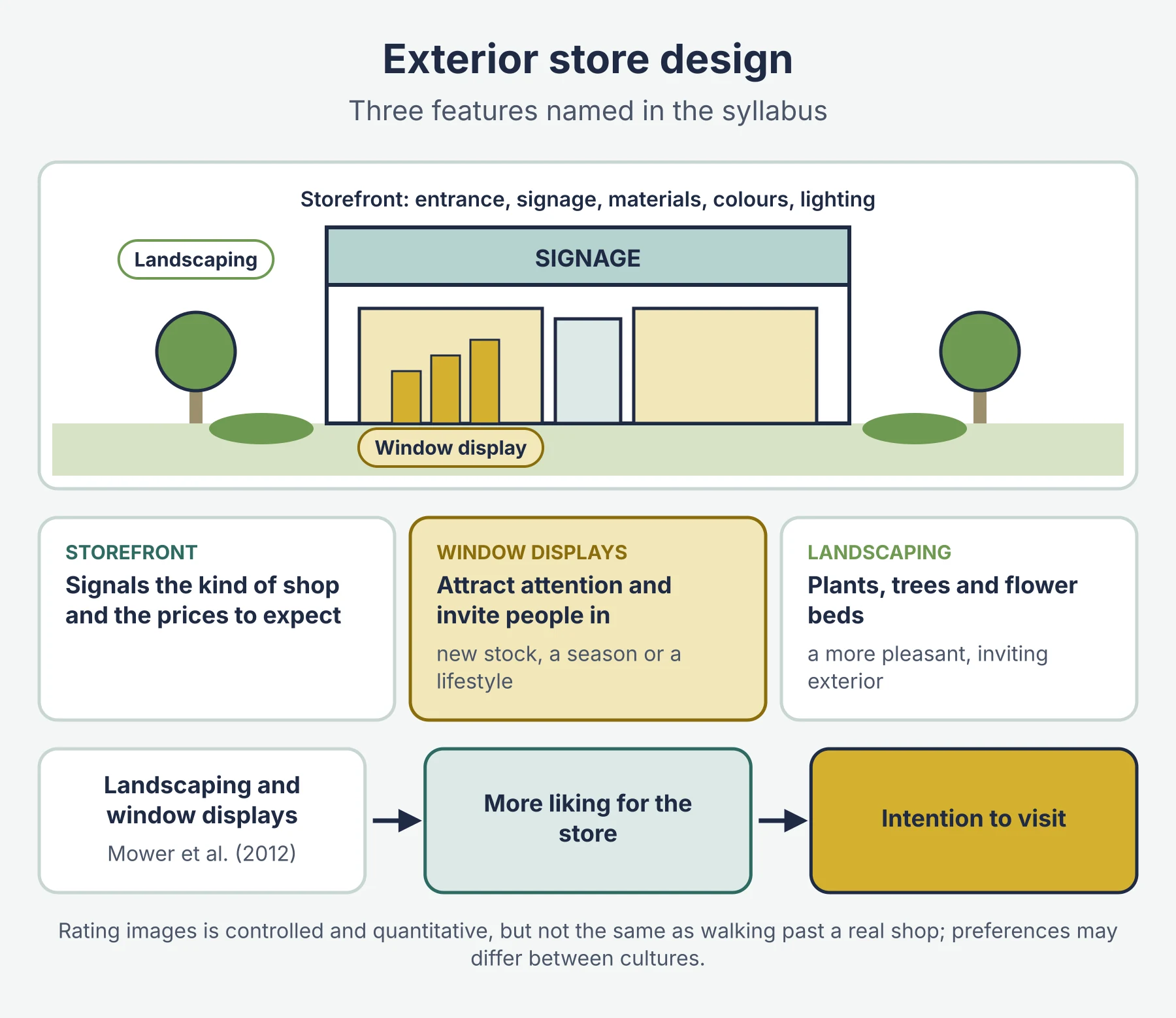
The syllabus names three exterior features.
- Storefront: the entrance, signage, building materials, colours and lighting. It tells passers-by what kind of shop it is and what prices to expect.
- Window displays: arrangements of products or themes that attract attention and invite people in; they can show new stock, a season or a lifestyle.
- Landscaping: plants, trees, flower beds and outdoor features around the shop, which can make the exterior more pleasant and inviting.
Mower et al. (2012) is the suggested study. They investigated how landscaping and window displays on a store exterior affected how much people liked the store and whether they intended to shop there; the findings suggested that these features increase liking, which in turn is linked to intentions to visit. Evaluation: rating images of a shop front is controlled and quantitative, but rating a picture is not the same as walking past a real shop, so ecological validity is limited, and preferences for exterior styles may differ between cultures.
Interior design
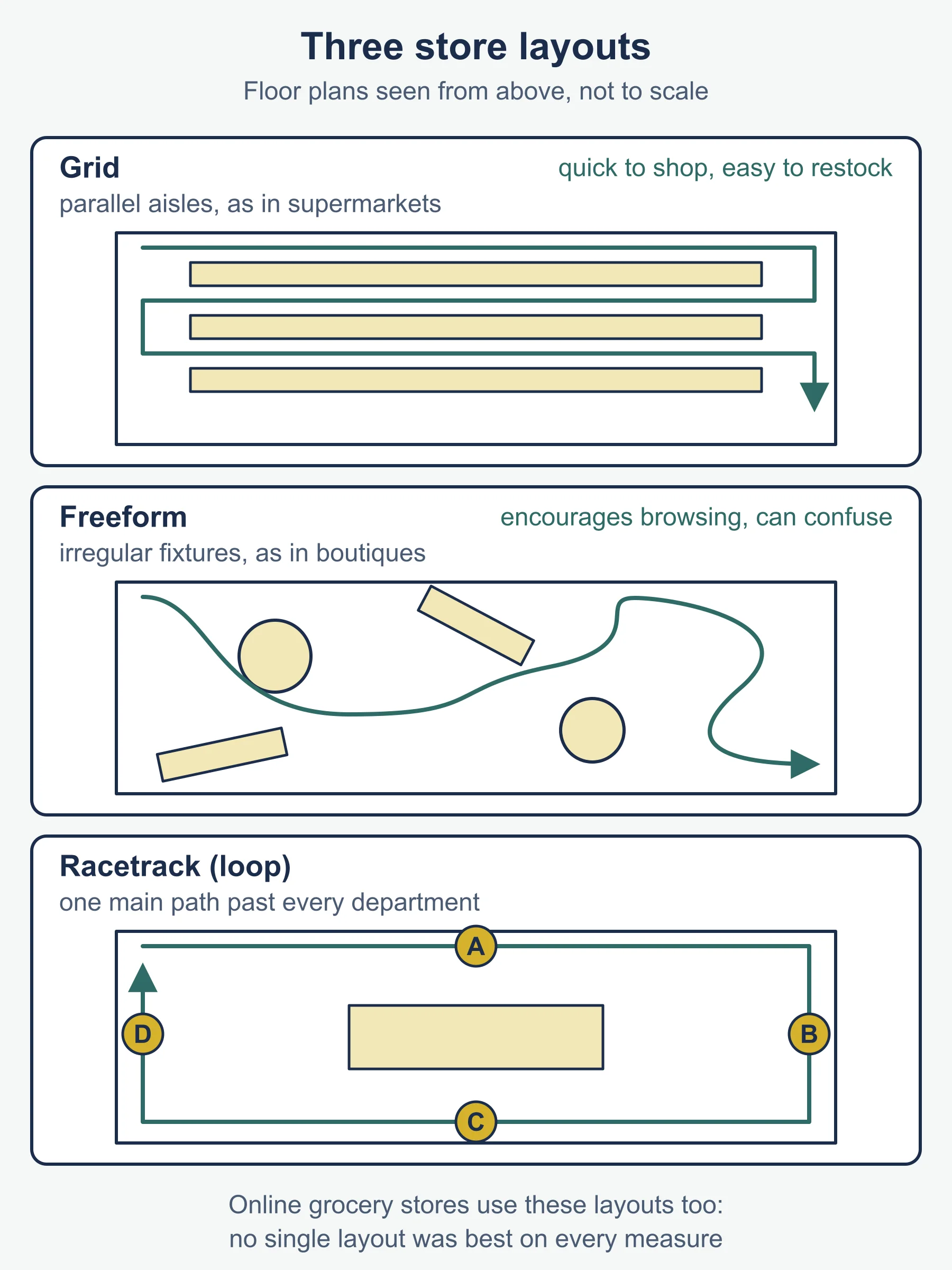
| Layout | Description | Strength | Weakness |
|---|---|---|---|
| Grid | Long parallel aisles, as in most supermarkets | Efficient use of space; easy to find staple items and restock | Encourages shoppers to move quickly; less browsing |
| Freeform | Fixtures arranged irregularly, as in boutiques | Encourages browsing and exploration | Can be confusing; uses space less efficiently |
| Racetrack (loop) | A main path leads shoppers past every department | Exposes shoppers to the whole store | Shoppers wanting one item may find it frustrating |
Virtual store layouts. Online shops can use the same layouts on screen. Vrechopoulos et al. (2004) compared grid, freeform and racetrack layouts in a virtual grocery store and measured how useful, easy to use and enjoyable shoppers found each. No single layout was best on every measure, so the choice depends on what the retailer wants: efficiency, browsing or enjoyment. Online experiments can record behaviour objectively (clicks, time), but findings from one product type and one country may not generalise.
2.1.2 Sound and consumer behaviour
Key study: North et al. (2003)
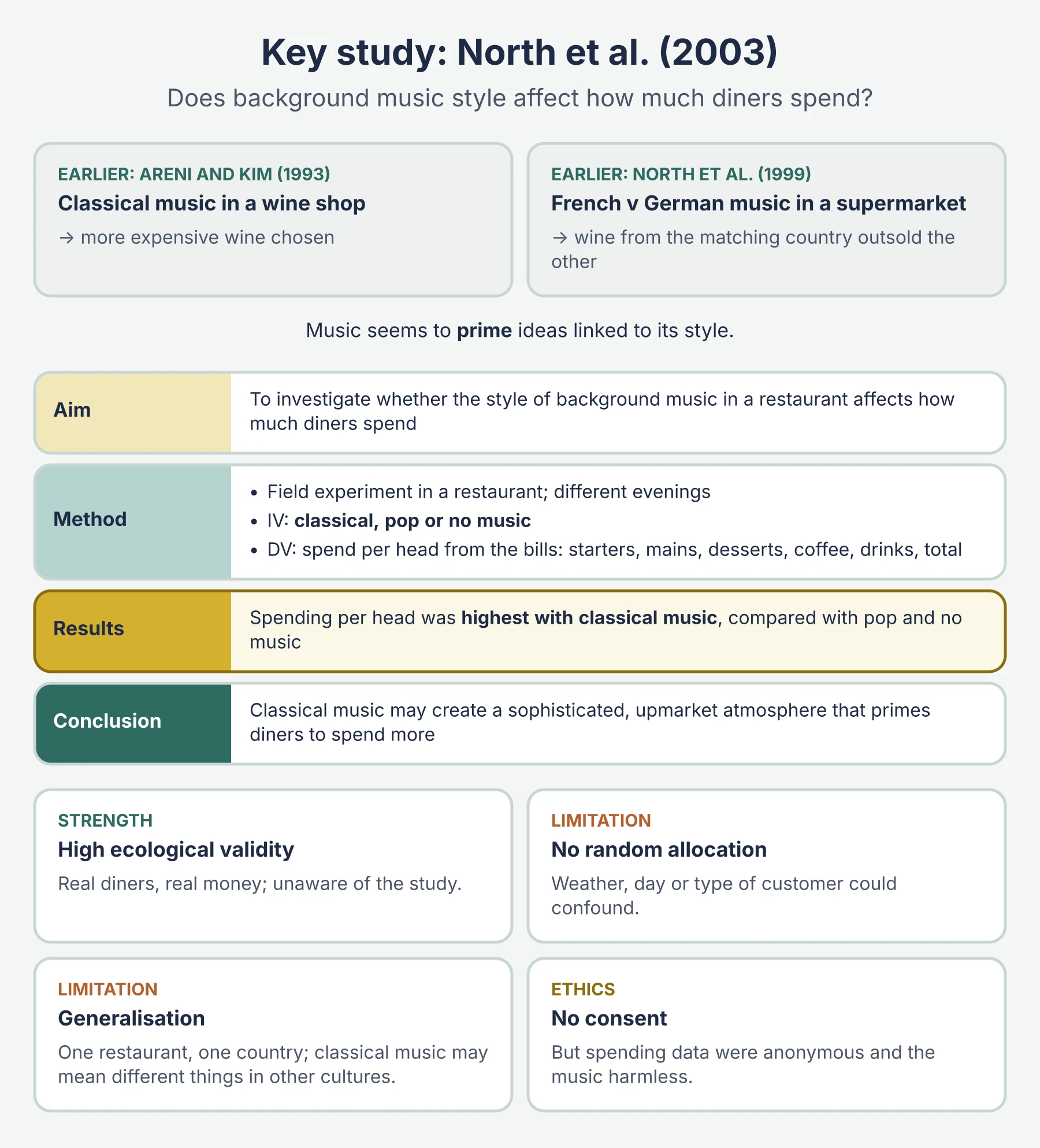
Context. Earlier research had shown that music can affect what people buy. Areni and Kim (1993) found that classical music in a wine shop led customers to choose more expensive wine, and North, Hargreaves and McKendrick (1999) found that French wine outsold German wine when French music played in a supermarket, and vice versa. Music seems to prime ideas linked to its style.
Aim. To investigate whether the style of background music in a restaurant affects how much diners spend.
Method. A field experiment in a restaurant. On different evenings the restaurant played classical music, pop music or no music. The IV was musical style; the DV was the amount spent per head on starters, main courses, desserts, coffee, drinks and in total, taken from the bills.
Results. Spending per head was highest when classical music was played, compared with pop music and no music.
Conclusions. Classical music may create a sophisticated, upmarket atmosphere that primes diners to spend more. Restaurants can use music style to increase spending.
Evaluation.
- Validity: real diners spending real money in a normal setting gives high ecological validity, and diners did not know they were in a study, so demand characteristics were unlikely.
- Controls: diners were not randomly allocated to evenings, so differences between evenings (weather, day of the week, type of customer) could be confounding variables.
- Generalisation: one restaurant in one country; the meaning of classical music may differ between cultures.
- Individual versus situational: the music is situational, but diners’ own tastes and budgets also matter.
- Ethics: no consent from diners, but spending data were anonymous and the music was harmless.
Background noise and taste
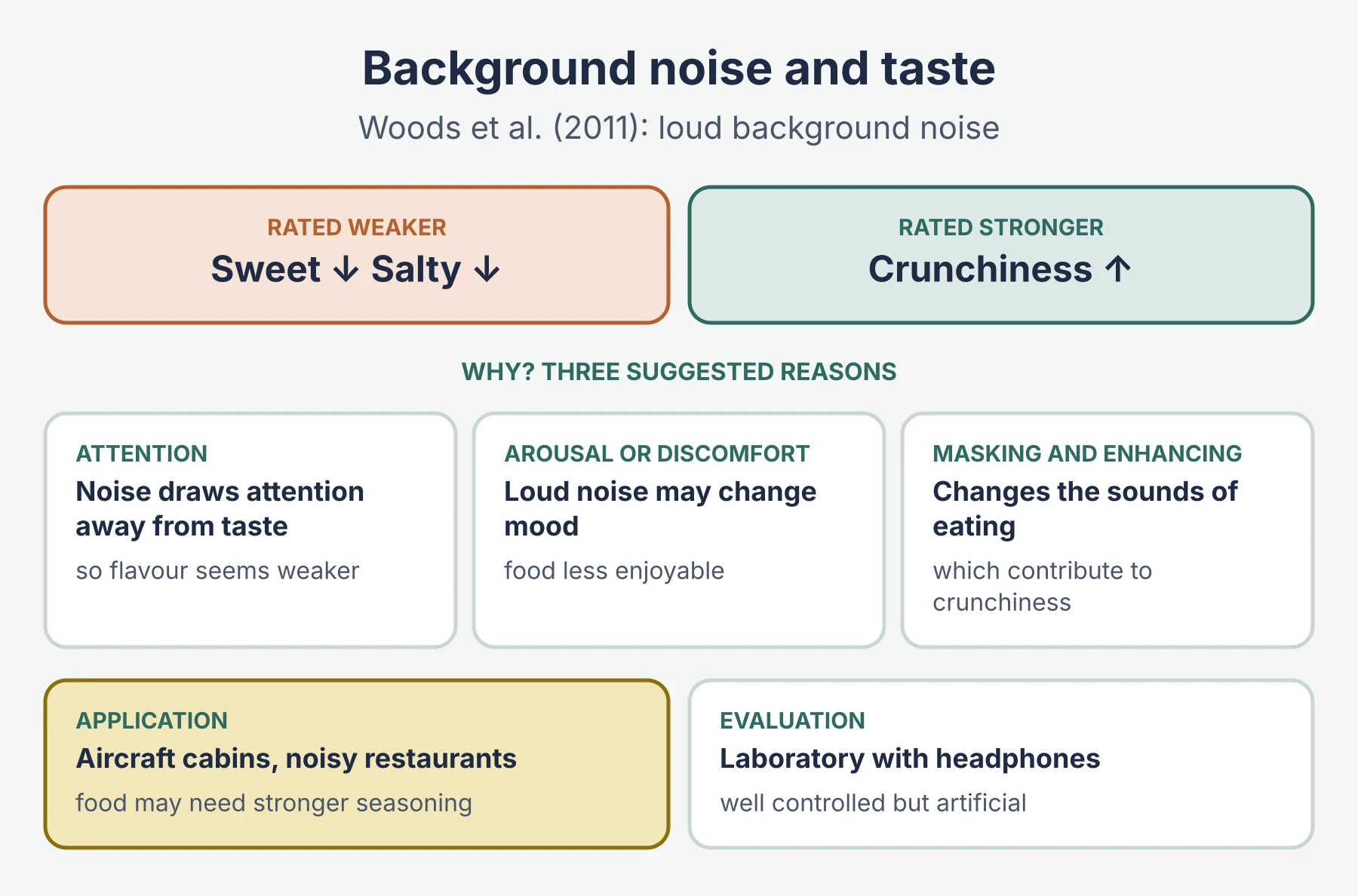
The syllabus asks how sound and noise affect the perception of food taste, and why. Woods et al. (2011) found that loud background noise reduced how sweet and salty foods were rated, while crunchiness was rated as stronger. Suggested reasons:
- Attention: noise draws attention away from taste, so flavour seems weaker.
- Arousal or discomfort: loud noise may change mood and make food less enjoyable.
- Masking and enhancing sounds: noise may mask or change the sounds of eating, which contribute to how crunchy food seems.
This matters for aircraft cabins and noisy restaurants, where food may need stronger seasoning. A laboratory study with headphones is well controlled but artificial.
2.1.3 Retail atmospherics
The PAD model
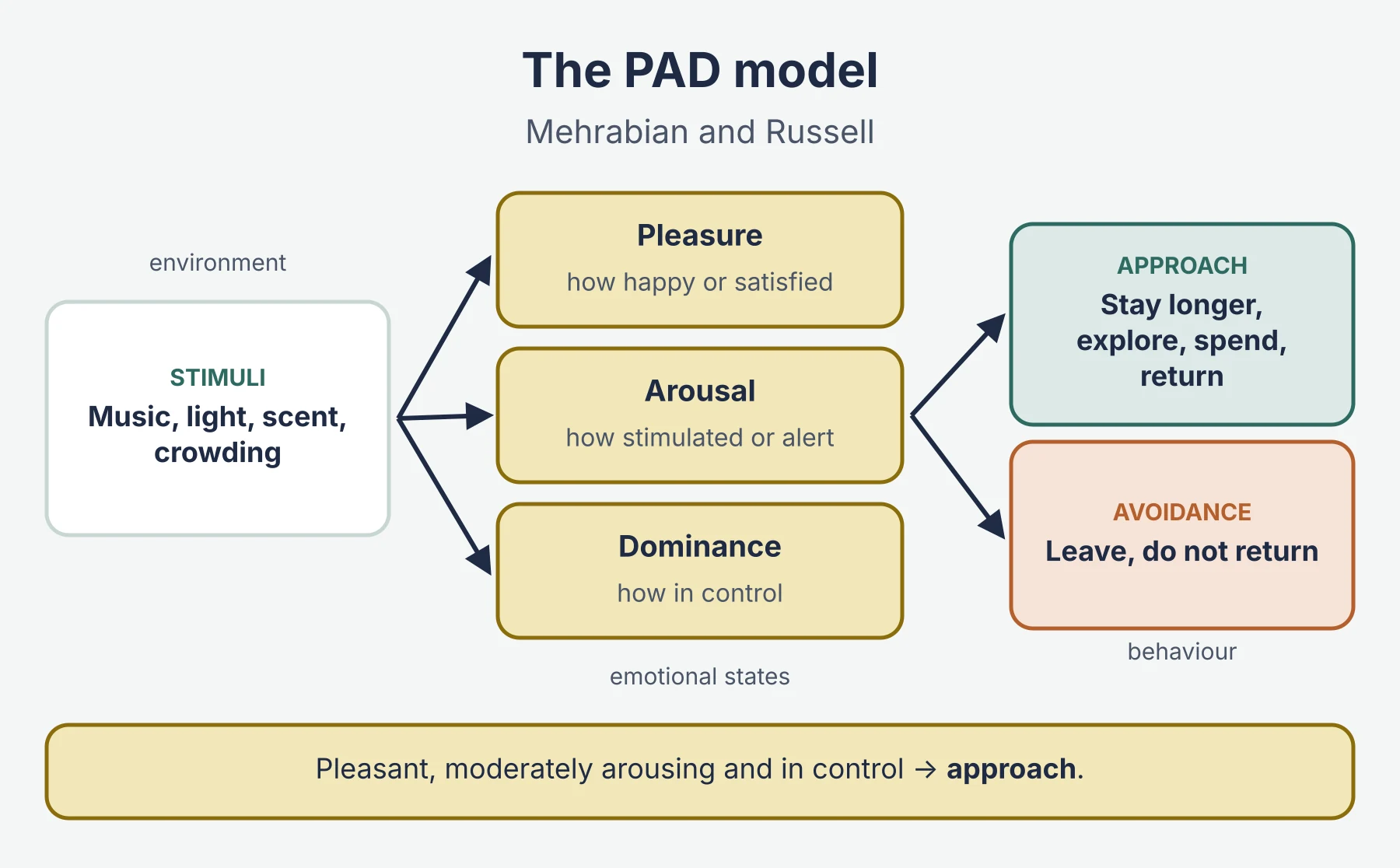
Mehrabian and Russell proposed that environmental stimuli (such as music, light, scent or crowding) produce three emotional states:
- Pleasure: how happy or satisfied the person feels.
- Arousal: how stimulated or alert they feel.
- Dominance: how in control they feel.
These states lead to approach behaviours (staying longer, exploring, spending, returning) or avoidance behaviours (leaving, not returning). A pleasant, moderately arousing environment where shoppers feel in control encourages approach.
Odour
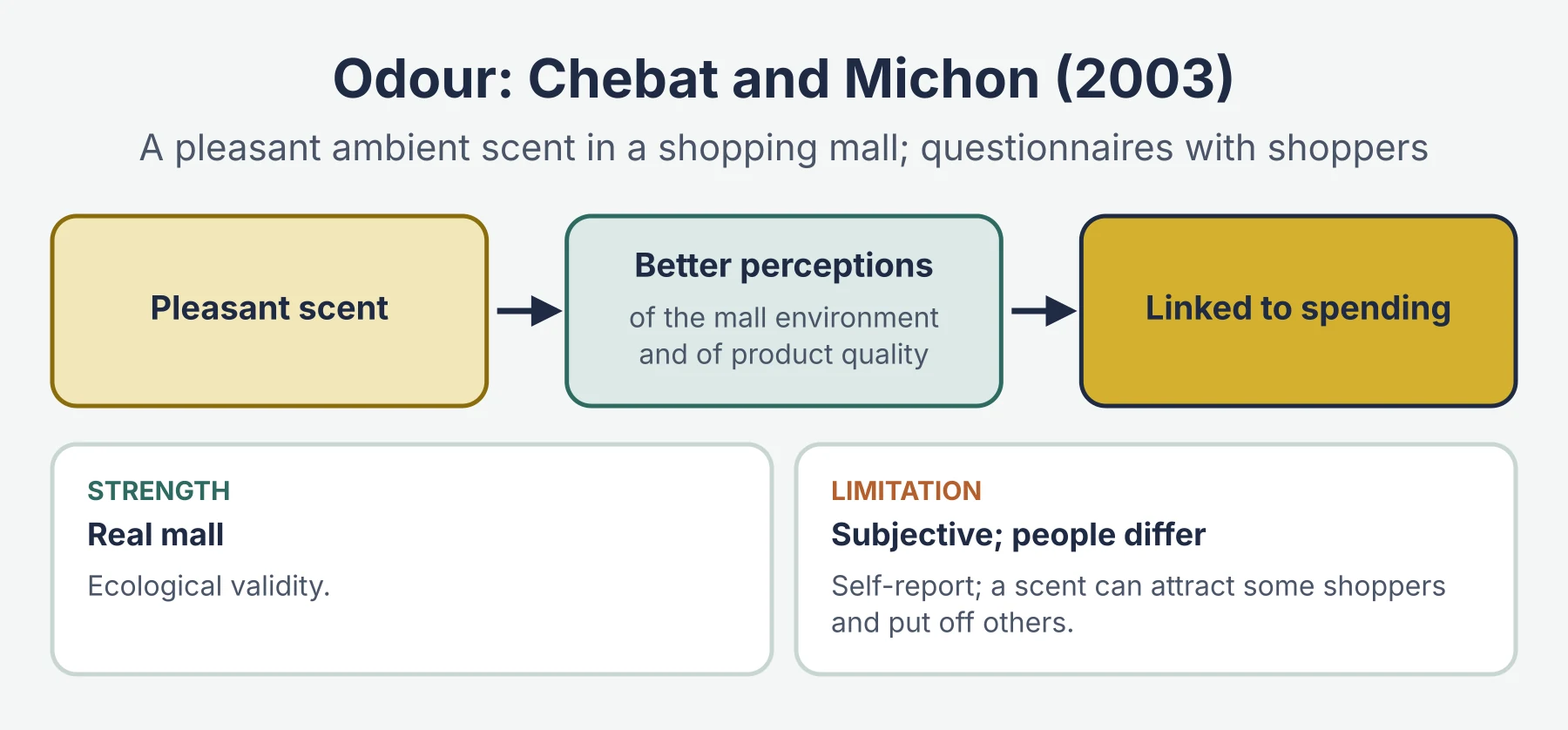
Chebat and Michon (2003) studied the effect of a pleasant ambient scent in a shopping mall, using questionnaires with shoppers. The scent improved shoppers’ perceptions of the mall environment and of the quality of its products, which were linked to spending. Evaluation: a real mall gives ecological validity, but self-report questionnaires are subjective, and people differ widely in which scents they like, so the same scent can attract some shoppers and put off others.
Crowding
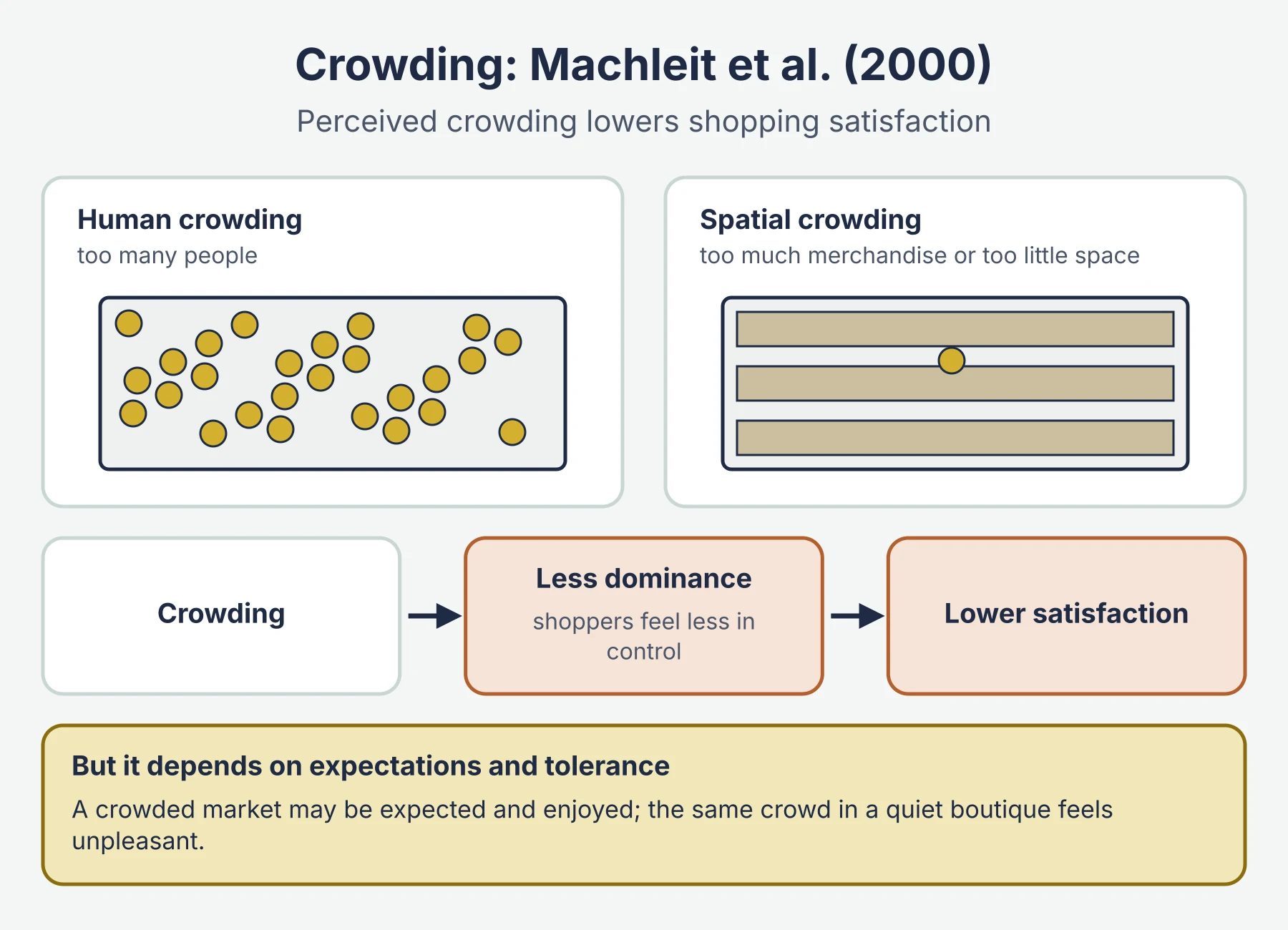
Machleit et al. (2000) found that perceived crowding lowers shopping satisfaction, but the effect depends on what the shopper expected and how tolerant they are of crowds. They distinguished human crowding (too many people) from spatial crowding (too much merchandise or too little space). In PAD terms, crowding reduces dominance, because shoppers feel less in control. A crowded market may be expected and enjoyed, while the same crowd in a quiet boutique feels unpleasant.
Applying the topic
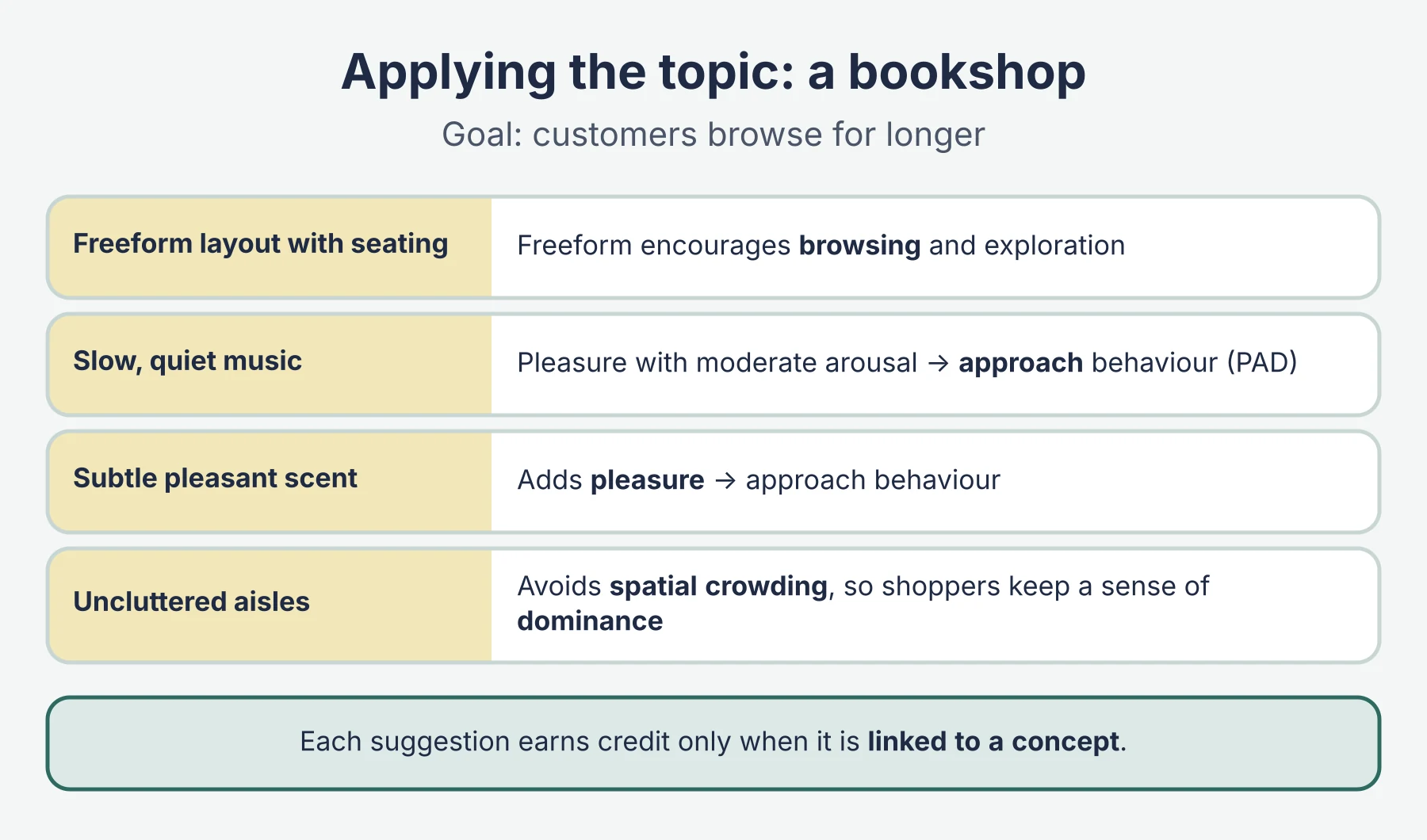
Scenario: a bookshop wants customers to browse for longer. Use a freeform layout with comfortable seating; play slow, quiet music; add a subtle pleasant scent; avoid crowding the aisles with stock. Each suggestion should be linked to a concept: browsing (freeform), approach behaviour (pleasure and moderate arousal in the PAD model), dominance (avoiding spatial crowding).
Common mistakes
- Describing the PAD model without the approach and avoidance outcomes.
- Saying North et al. randomly allocated diners.
- Mixing up the three layouts, especially freeform and racetrack.
- Treating crowding as purely the number of people; spatial crowding counts.
Exam technique
The syllabus pairs this topic with cultural differences, questionnaires, objective and subjective data and ecological validity, so expect evaluation questions on these. On Paper 4, North et al. is the key study, and you may be asked to plan a study, for example a field experiment on music in a café.
Official syllabus
Cambridge International AS & A Level Psychology 9990 syllabus for 2024, 2025 and 2026, Specialist Option 2: Consumer Psychology, 2.1 The physical environment — cambridgeinternational.org.
More resources on this topic
Related resources
-
Practice questions
Cambridge International AS & A Level Psychology (9990): 2.1 The physical environment – Practice Questions
Original Paper 3 and Paper 4 style questions with answers on 9990 Consumer Psychology topic 2.1: store design, North et al., noise, PAD, odour and crowding.
Psychology · Cambridge · A Level
Try questions -
Revision notes
Cambridge International AS & A Level Psychology (9990): 2.1 The physical environment – Revision Notes
Revision notes for 9990 Consumer Psychology topic 2.1: store design, layouts, North et al., noise and taste, the PAD model, odour, crowding and a self-test.
Psychology · Cambridge · A Level
Revise topic -
Study guides
Cambridge A Level Psychology (9990): The product
Cambridge 9990 topic 2.4 in depth: gift-wrapping, Becker et al. (2011) on packaging, shelf position, sales techniques, closing a sale and buying decisions.
Psychology · Cambridge · A Level
Read guide
Studying Psychology?
This page is free and stays free. Marlbridge is not offering Psychology classes at the moment, so there is no tuition to book for it. The free study resources stay open to everyone.
Get free revision emails (optional)
Occasional emails with practice questions, worked explanations and links to free resources for the qualification and subjects you choose. No spam, and you can unsubscribe from any email. The free tools on this site never need an email.