
Study Guides
Cambridge A Level Psychology (9990): The product
Cambridge 9990 topic 2.4 in depth: gift-wrapping, Becker et al. (2011) on packaging, shelf position, sales techniques, closing a sale and buying decisions.
- Subject
- Psychology
- Level
- A LEVEL
- Topic
- Specialist Option 2: Consumer Psychology
- Author
- Marlbridge Academic Team
- Updated
- Reviewed by
- Kanwal Aslam (what this means)
Aligned to Cambridge A Level Psychology (9990), 2024-2026. Official specification .
Syllabus page (what it covers and how it is assessed): Cambridge A Level Psychology.
Syllabus points this page covers
9990 (A Level)
- 2.4 The product
Topic 2.4, The product, is part of Specialist Option 2 (Consumer Psychology) in Cambridge International A Level Psychology 9990, syllabus for 2024 to 2026. It follows a product from the shelf to the customer’s home: how it is wrapped, packaged and positioned (2.4.1), how a salesperson sells it (2.4.2) and how the buyer decides where and whether to buy, and feels afterwards (2.4.3). The key study is Becker et al. (2011) on food package design and taste.
The broad Consumer Psychology study guide gives a summary of every topic. This page goes further on 2.4. Afterwards, use the product revision notes and the product practice questions.
What does the syllabus require?
| Sub-topic | Content | Named study |
|---|---|---|
| 2.4.1 Packaging and positioning | Gift-wrapping (beliefs of giver and recipient, why gifts are wrapped, types of wrapping); food package design; attention and shelf position, planograms, central gaze cascade, eye-tracking | Key study Becker et al. (2011); e.g. Atalay et al. (2012) |
| 2.4.2 Selling the product | Customer-, competitor- and product-focused sales techniques and their effect on the buyer–seller relationship; disrupt-then-reframe and the need for cognitive closure; Cialdini’s six ways to close a sale | e.g. Kardes et al. (2007) |
| 2.4.3 Buying the product | Engel Kollat Blackwell model; reasons for store choice and demographics such as age and gender; post-purchase cognitive dissonance, factors increasing it and ways to reduce it | e.g. Sinha et al. (2002); e.g. Nordvall (2014) |
2.4.1 Gift-wrapping
The syllabus asks why gifts are wrapped, what givers and recipients believe about wrapping, and the types of wrapping.
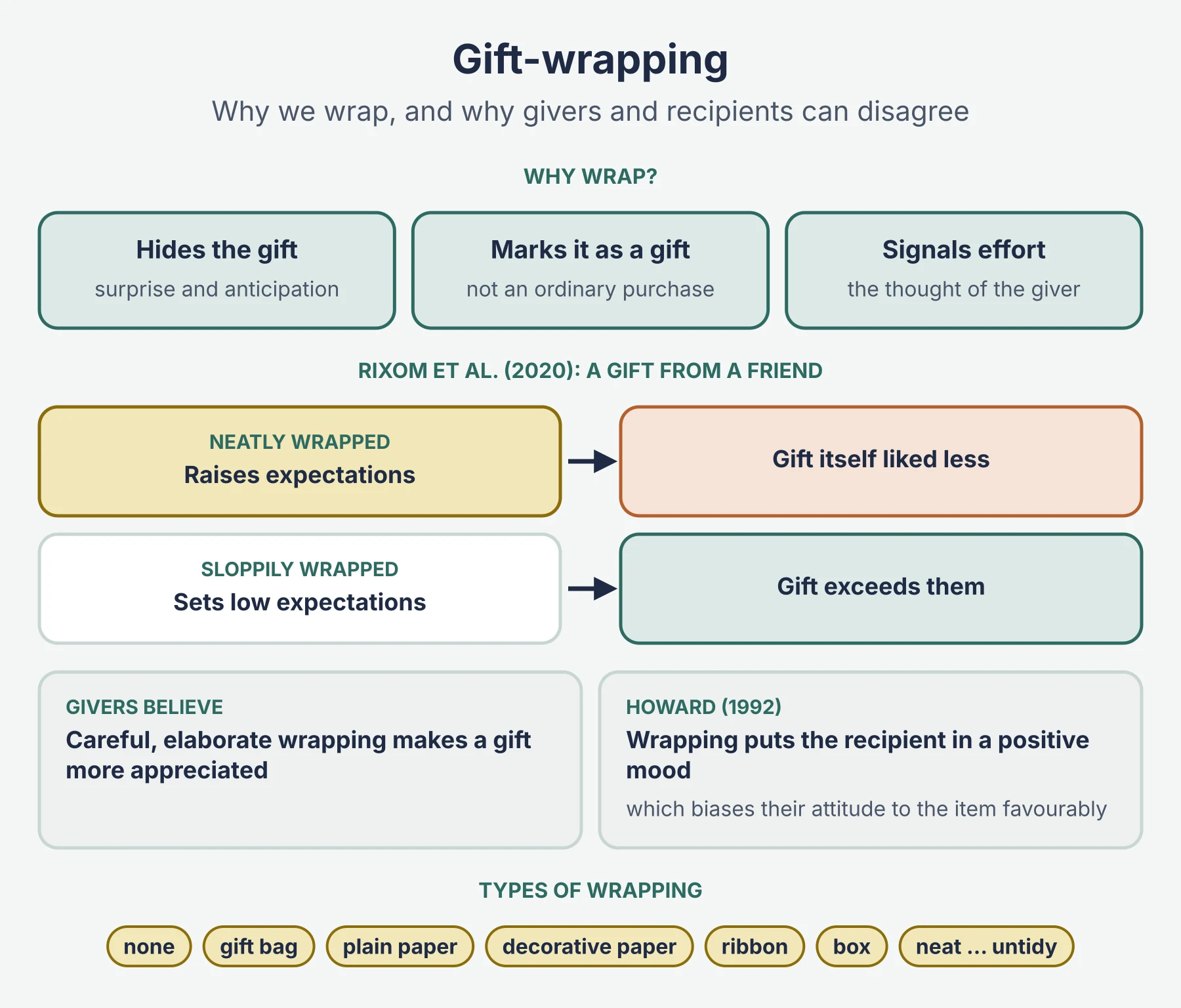
- Why wrap? Wrapping hides the gift, creating surprise and anticipation; it marks the item as a gift rather than an ordinary purchase; and it signals the effort and thought of the giver.
- Givers and recipients can disagree. Givers often believe careful, elaborate wrapping will make the gift more appreciated. Recipients’ reactions depend on their expectations. Rixom et al. (2020) found that a neatly wrapped gift from a friend could raise expectations so that the gift itself was liked less, whereas a sloppily wrapped one set low expectations that the gift then exceeded.
- Mood. Howard (1992) proposed that wrapping puts the recipient in a positive mood, which biases their attitude to the item inside in a favourable direction.
- Types of wrapping range from none, through gift bags and plain paper, to decorative paper, ribbon and boxes, and from neat to untidy.
An exam answer can apply these beliefs: a shop offering free gift-wrapping benefits because givers believe wrapping increases appreciation.
Key study: Becker et al. (2011)
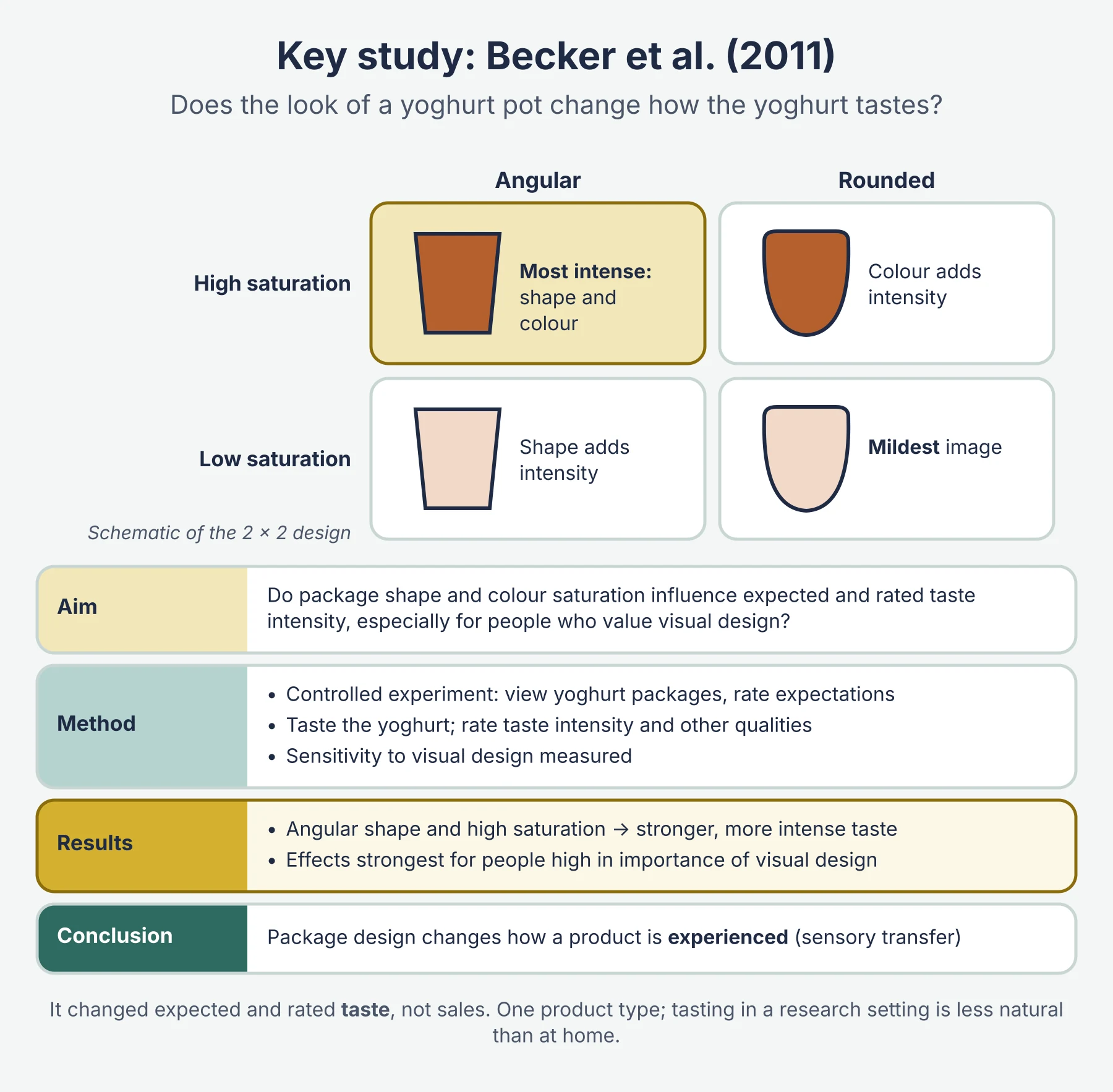
Context. Packaging is often the first contact a consumer has with a product. Becker, van Rompay, Schifferstein and Galetzka asked whether the look of a package changes how the food inside tastes, not just whether it is bought. The idea draws on sensory transfer: impressions from one sense carry over to another.
Aim. To investigate whether package shape (angular or rounded) and colour saturation (high or low) influence expectations and ratings of taste intensity and product evaluations, and whether people who value visual design are more affected.
Method. A controlled experiment. Participants were shown yoghurt packages that differed in shape and colour saturation, rated their expectations, then tasted yoghurt and rated it on taste intensity and other product qualities. Their sensitivity to visual design was also measured.
Results. Angular packages and highly saturated colours led to expectations and ratings of a stronger, more intense taste. The effects were strongest for participants who place high importance on visual design.
Conclusion. Package design changes how a product is experienced. A firm wanting a yoghurt to seem rich and intense might choose an angular, strongly coloured pot; one wanting a mild image might choose a rounded, pale one.
Evaluation.
- Validity: the controlled design allows cause-and-effect conclusions, but tasting in a research setting is less natural than eating at home.
- Generalisation: one product type was used; packaging effects for drinks, snacks or non-food items may differ.
- Reductionism versus holism: isolating shape and colour shows each effect clearly but ignores how brand, price and label text combine with them.
- Objective and subjective data: taste ratings are subjective, so participants’ interpretations of rating scales may differ.
Attention and shelf position
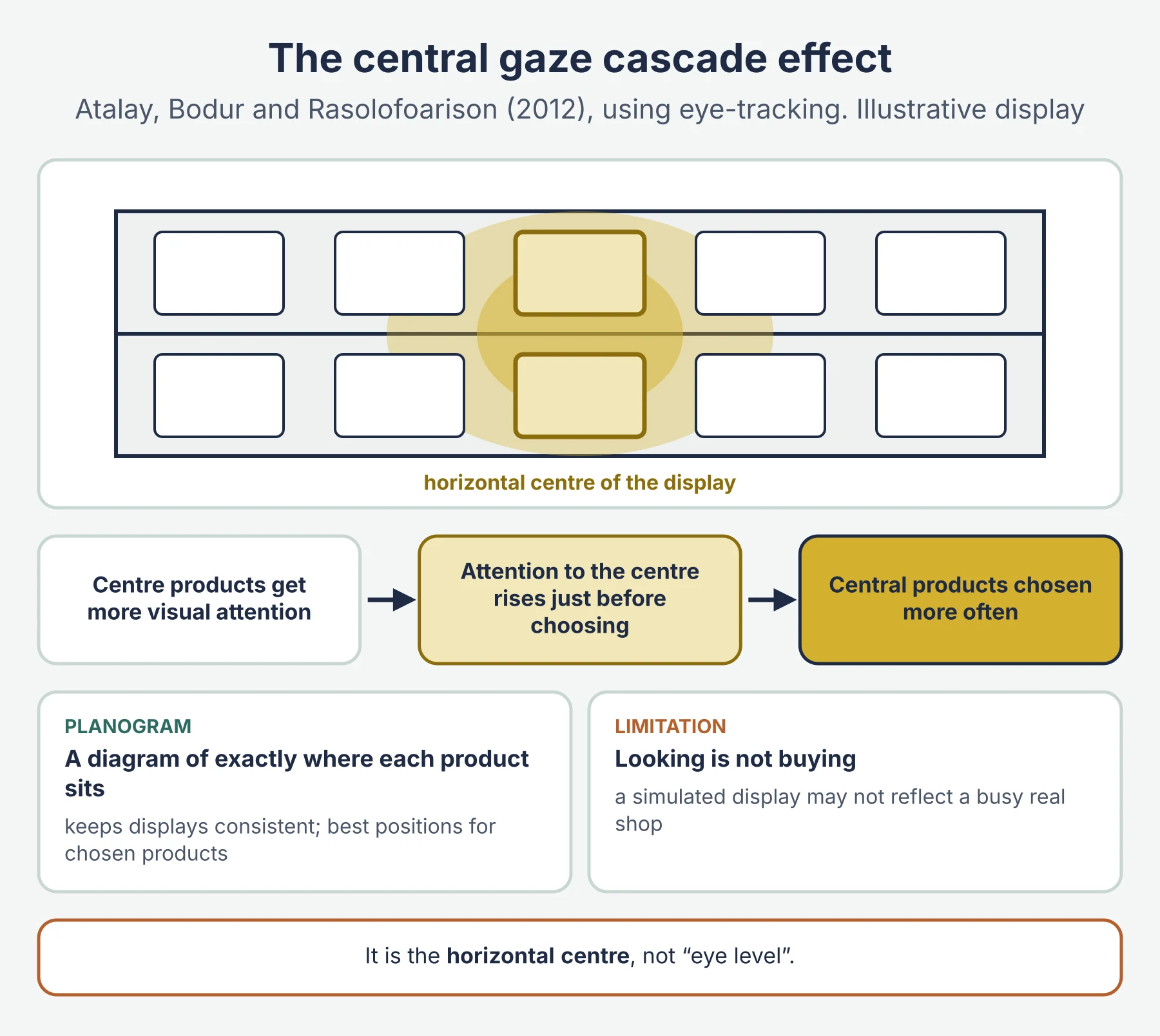
A planogram is a diagram that shows exactly where each product should sit on a shelf. Retailers use it to keep displays consistent and to give the best positions to products they want to sell. Eye-tracking records where and for how long a shopper looks, giving objective data on attention.
Atalay, Bodur and Rasolofoarison (2012) used eye-tracking with shelf displays and identified the central gaze cascade effect: products in the horizontal centre of a display receive more visual attention, and attention to the centre option increases just before the choice is made, so central products are chosen more often. This suggests position works partly through attention rather than through any belief about the product. The limitation is that looking is not buying; eye-tracking in a simulated display may not reflect a busy real shop.
2.4.2 Selling the product
Sales techniques and the buyer–seller relationship.
| Technique | Focus | Effect on the relationship |
|---|---|---|
| Customer-focused | Identifying and meeting the buyer’s needs | Builds trust and long-term loyalty; slower to close a sale |
| Competitor-focused | Showing the product is better than rivals’ | Can persuade a comparison shopper but may seem negative or pushy |
| Product-focused | Stressing features and benefits of the product | Informative, but may ignore whether the buyer needs those features |
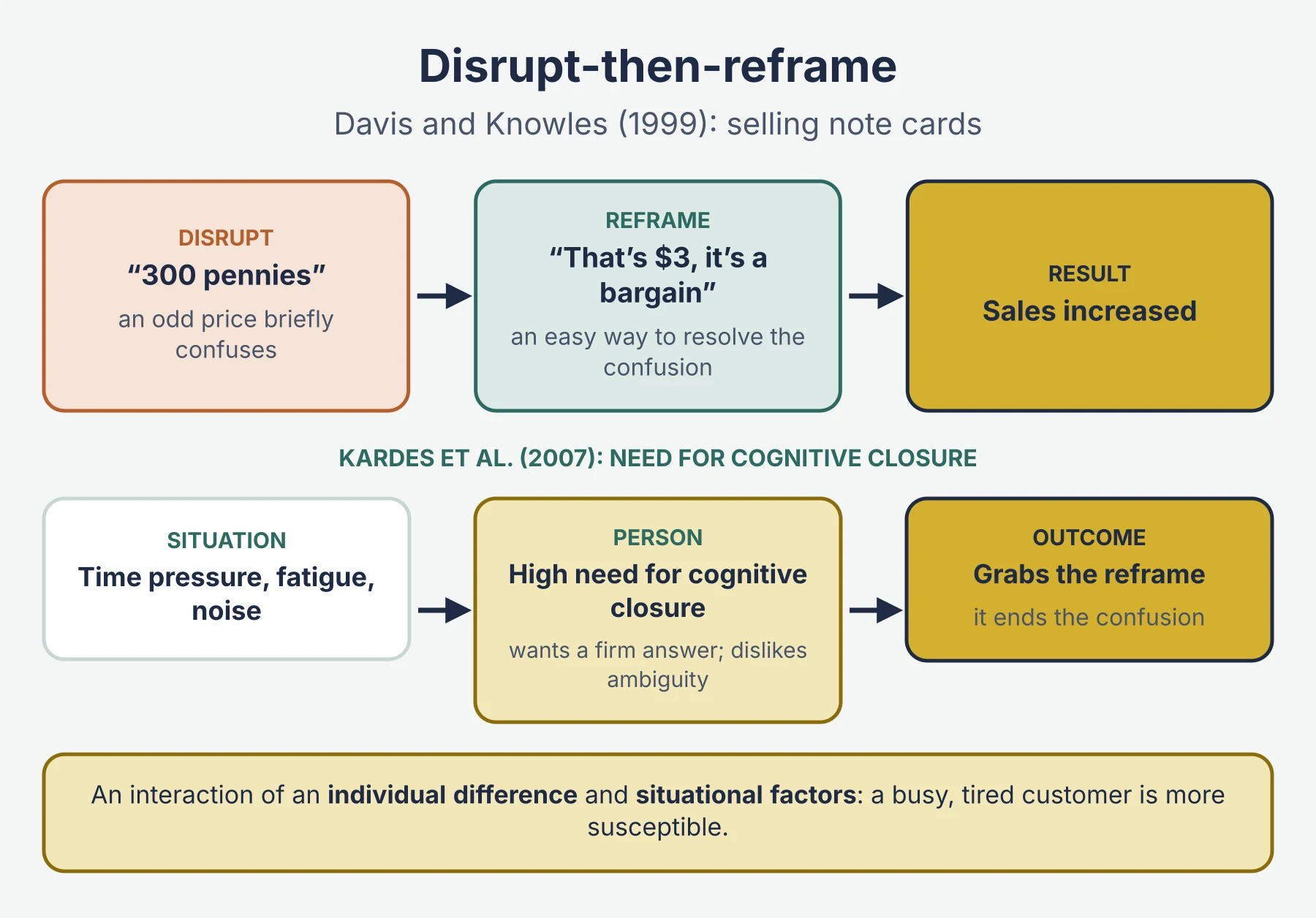
Disrupt-then-reframe. Davis and Knowles (1999) first showed the technique when selling note cards: stating the price in an odd way (“300 pennies”) and then reframing it (“that’s $3, it’s a bargain”) increased sales. The disruption briefly confuses the listener, and the reframe offers an easy way to resolve the confusion.
Need for cognitive closure. Kardes et al. (2007) linked the technique to the need for cognitive closure, the desire for a firm answer and a dislike of ambiguity. People high in this need grab the reframe because it ends the confusion. The need is raised by time pressure, fatigue and noise, so a busy, tired customer is more susceptible. This is an interaction between an individual difference and situational factors.
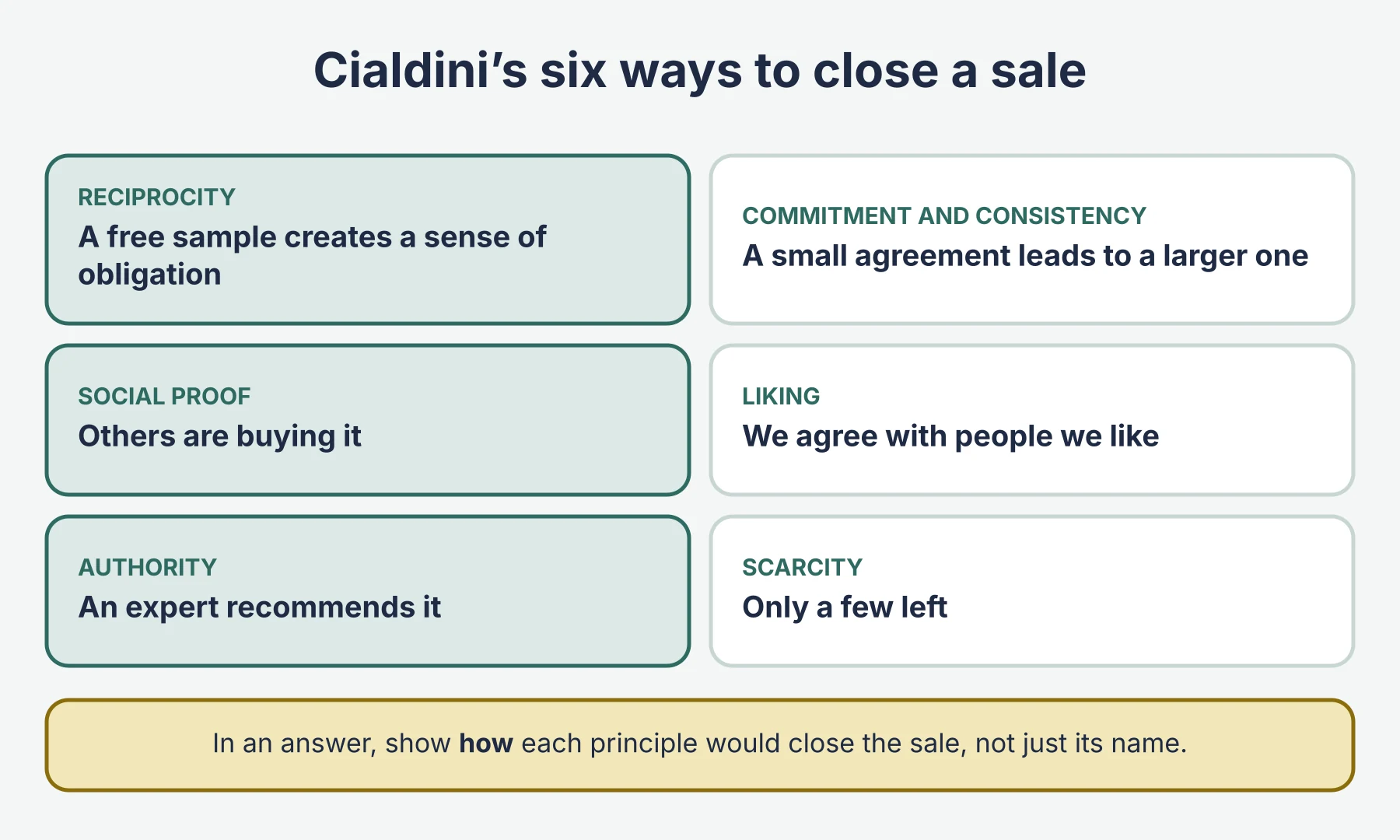
Cialdini’s six ways to close a sale. Reciprocity (a free sample creates a sense of obligation), commitment and consistency (a small agreement leads to a larger one), social proof (others are buying it), liking (we agree with people we like), authority (an expert recommends it) and scarcity (only a few left).
2.4.3 Buying the product
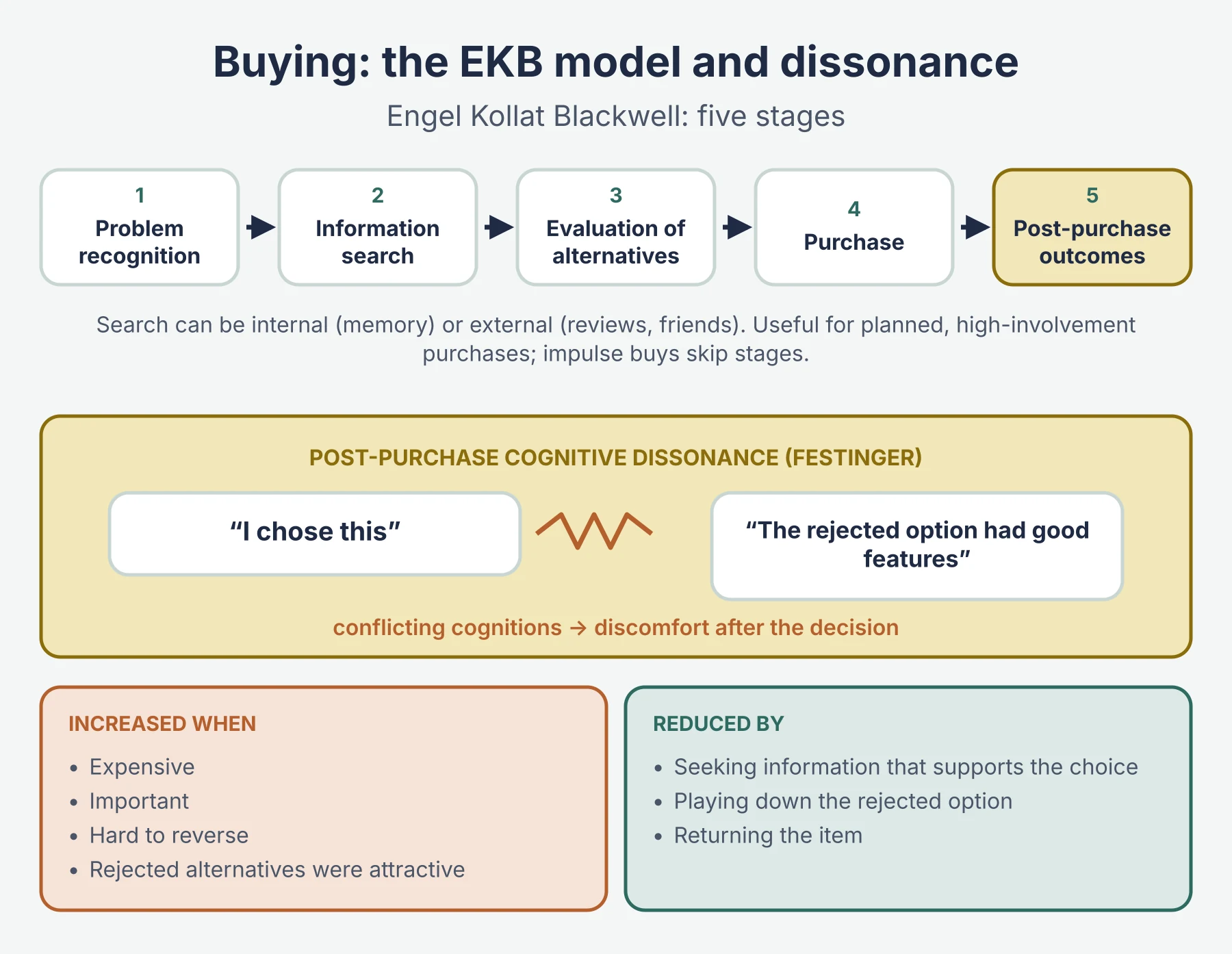
The Engel Kollat Blackwell model has five stages: problem recognition, information search, evaluation of alternatives, purchase, and post-purchase outcomes. Information search can be internal (memory) or external (reviews, friends). The model is useful for planned, high-involvement purchases but less so for impulse buys, where stages are skipped.
Deciding where to buy. Reasons for store choice include location and convenience, product range, price, service and atmosphere. Sinha et al. (2002) is the suggested study of store choice among Indian shoppers, which found that reasons varied with demographic factors such as age and gender. Cultural and demographic differences limit how far any one list of reasons generalises.
Post-purchase cognitive dissonance. Festinger’s cognitive dissonance is the discomfort of holding conflicting cognitions. After buying, the cognition “I chose this” can conflict with “the rejected option had good features”. Dissonance is greater when the purchase is expensive, important or hard to reverse, and when the rejected alternatives were attractive. It is reduced by seeking information that supports the choice, playing down the rejected option, or returning the item. Nordvall (2014) is the suggested study.
Annotated model answer: a 4-mark application
A sales assistant at an electronics shop says: “This laptop is 50,000 pence… so just £500. Great price.” Explain why this might work on a customer who is shopping late on a busy Saturday. [4]
“The assistant is using disrupt-then-reframe (1). The odd price in pence briefly confuses the customer, and ‘just £500, great price’ reframes the offer positively (1). Kardes et al. (2007) showed the technique works best on people high in need for cognitive closure, who want a quick, certain answer (1). Fatigue and noise in a busy shop raise this need, so this customer is likely to accept the reframe without thinking critically (1).”
Why it scores: names the technique, explains the mechanism, cites the research and applies the factors to the scenario.
Common mistakes
- Saying Becker et al. showed packaging changes sales. It showed packaging changes expected and rated taste.
- Describing the central gaze cascade as “products at eye level sell more”. It concerns the horizontal centre of a display.
- Listing Cialdini’s principles without showing how each would close a sale.
- Writing that dissonance happens before purchase. Post-purchase dissonance happens after the decision.
Exam technique
Describe questions on Becker et al. need aim, design, both variables, the design-sensitivity measure, results and conclusion. Evaluate questions reward the debates the syllabus lists for 2.4.1 (reductionism versus holism, determinism versus free will, generalisation, objective and subjective data, validity). Suggest questions want a concrete proposal for the shop in the scenario, linked to a named concept.
More resources on this topic
Official syllabus
Cambridge International AS & A Level Psychology 9990 syllabus for 2024, 2025 and 2026, Specialist Option 2: Consumer Psychology, topic 2.4 — cambridgeinternational.org.
Related resources
-
Practice questions
Cambridge A Level Psychology (9990): The product – Practice Questions
Original Paper 3 and Paper 4 style questions on Cambridge 9990 topic 2.4, The product: packaging, shelf position, selling and buying, with full mark schemes.
Psychology · Cambridge · A Level
Try questions -
Revision notes
Cambridge A Level Psychology (9990): The product – Revision Notes
Revision notes for Cambridge 9990 topic 2.4: packaging, Becker et al. (2011), shelf position, selling, the EKB model and dissonance, with a self-test.
Psychology · Cambridge · A Level
Revise topic -
Study guides
Cambridge International AS & A Level Psychology (9990): 2.2 The psychological environment
Topic 2.2 for Cambridge 9990 Consumer Psychology: wayfinding, shopper movement, menu design, personal space, Robson et al. and defending a place in a queue.
Psychology · Cambridge · A Level
Read guide
Studying Psychology?
This page is free and stays free. Marlbridge is not offering Psychology classes at the moment, so there is no tuition to book for it. The free study resources stay open to everyone.
Get free revision emails (optional)
Occasional emails with practice questions, worked explanations and links to free resources for the qualification and subjects you choose. No spam, and you can unsubscribe from any email. The free tools on this site never need an email.