
Revision Notes
Cambridge A Level Psychology (9990): The product – Revision Notes
Revision notes for Cambridge 9990 topic 2.4: packaging, Becker et al. (2011), shelf position, selling, the EKB model and dissonance, with a self-test.
- Subject
- Psychology
- Level
- A LEVEL
- Topic
- Specialist Option 2: Consumer Psychology
- Author
- Marlbridge Academic Team
- Updated
- Reviewed by
- Kanwal Aslam (what this means)
Aligned to Cambridge A Level Psychology (9990), 2024-2026. Official specification .
Syllabus page (what it covers and how it is assessed): Cambridge A Level Psychology.
Syllabus points this page covers
9990 (A Level)
- 2.4 The product
These notes condense topic 2.4, The product, from Specialist Option 2 of Cambridge International A Level Psychology 9990 (syllabus for 2024 to 2026). Think of the topic as a journey: the product is packaged and placed (2.4.1), sold (2.4.2) and bought, with feelings afterwards (2.4.3).
The product study guide explains each idea fully. Practise with the product practice questions.
The topic in brief
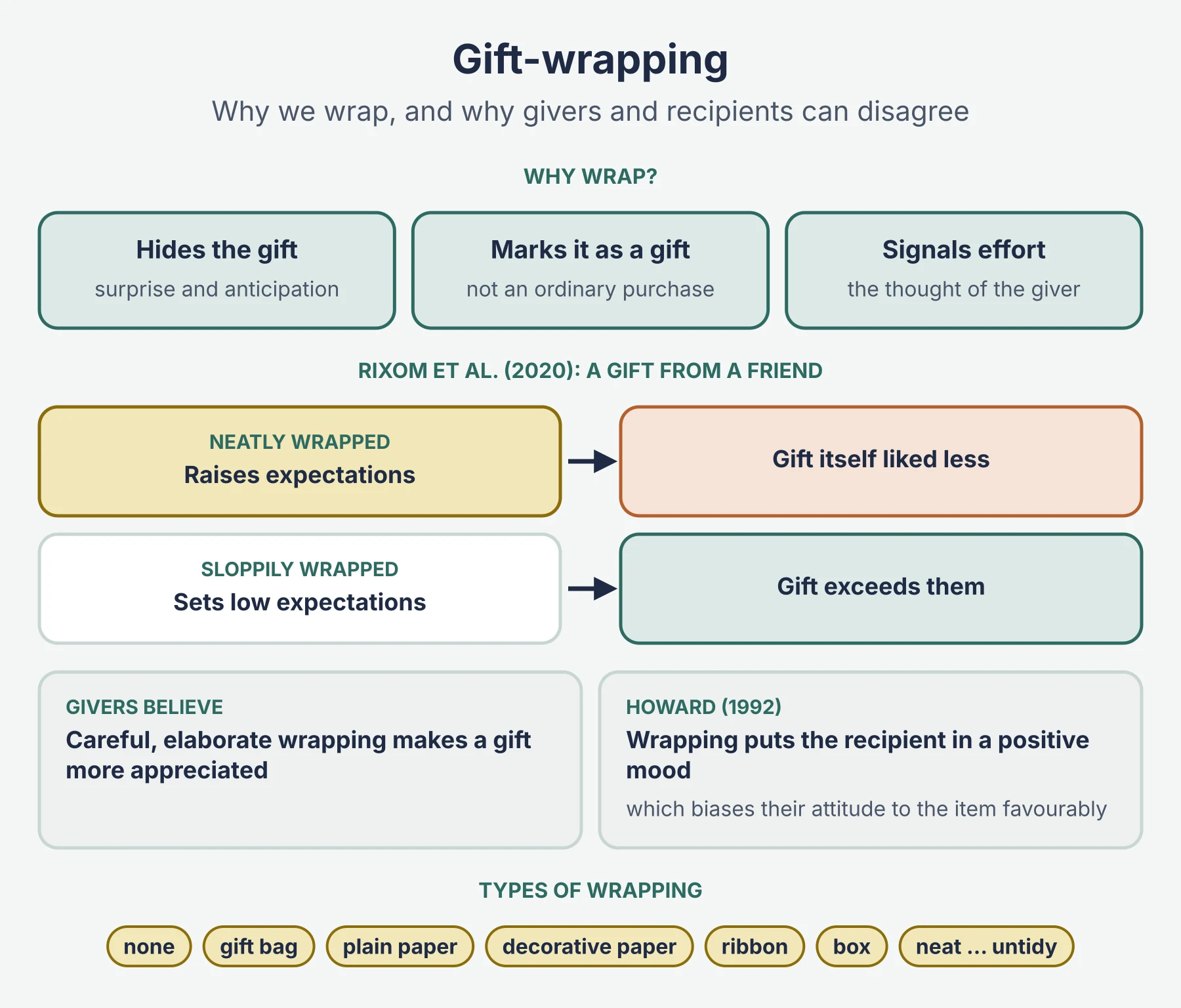
- 2.4.1 Gift-wrapping: why gifts are wrapped, giver and recipient beliefs, types of wrapping. Key study Becker et al. (2011): angular, saturated packaging means stronger taste. Shelf position: planograms, eye-tracking, central gaze cascade, e.g. Atalay et al. (2012).
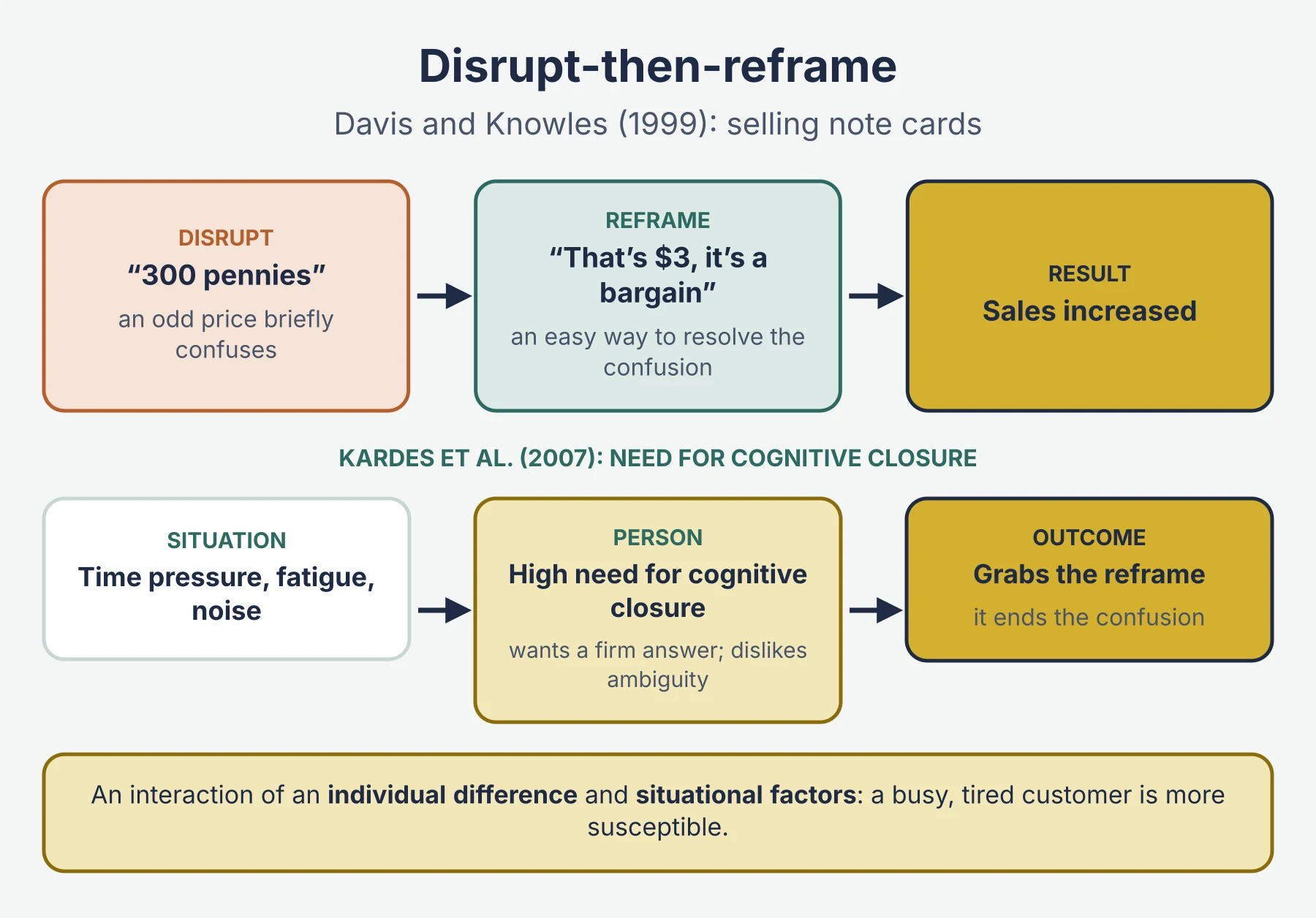
- 2.4.2 Customer-, competitor- and product-focused selling. Disrupt-then-reframe and need for cognitive closure, e.g. Kardes et al. (2007). Cialdini’s six ways to close a sale.
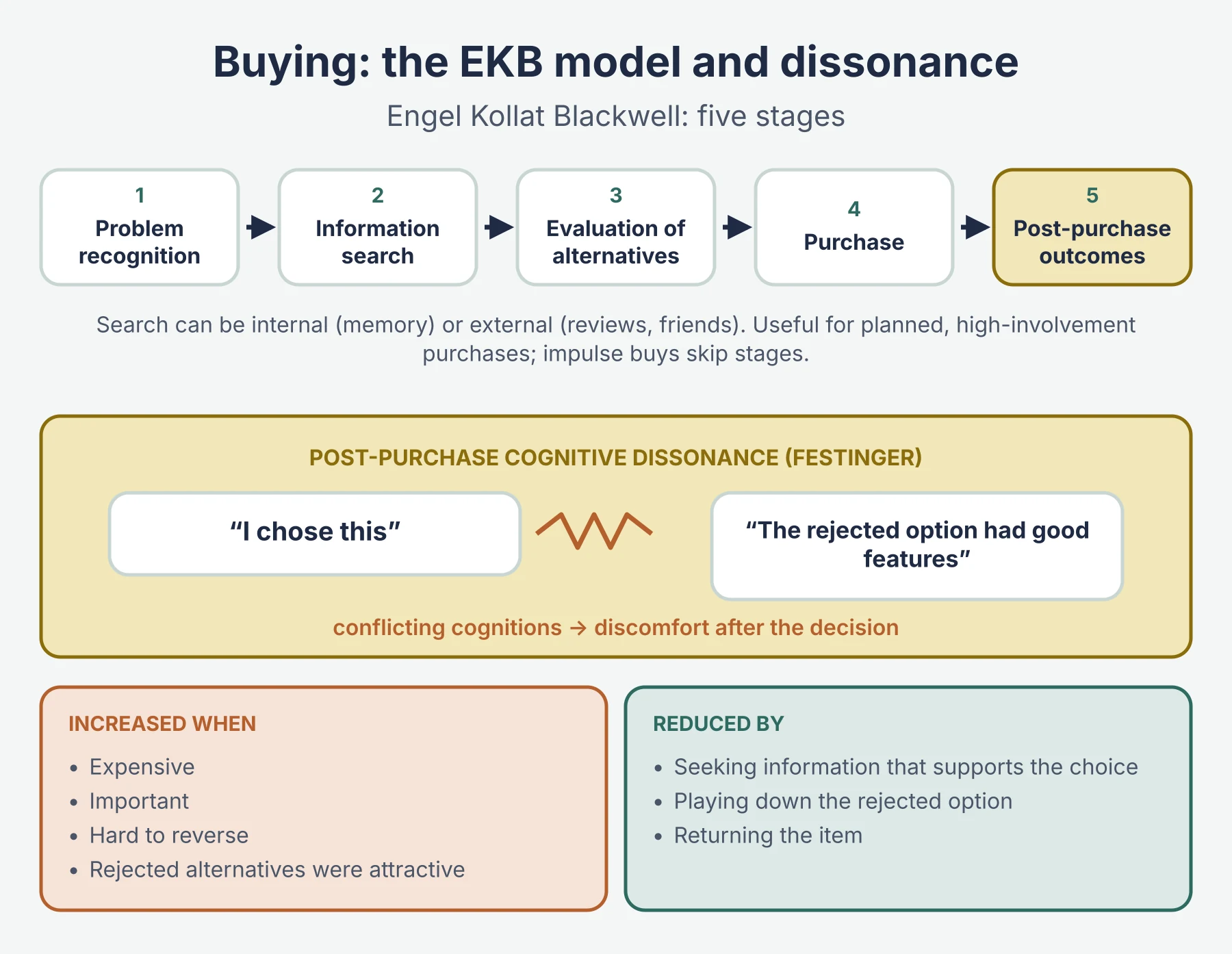
- 2.4.3 Engel Kollat Blackwell model. Store choice by age and gender, e.g. Sinha et al. (2002). Post-purchase dissonance, e.g. Nordvall (2014).
Key terms
| Term | Definition |
|---|---|
| Sensory transfer | An impression from one sense (sight of a package) carries over to another (taste) |
| Colour saturation | How strong or pure a colour is, from pale to vivid |
| Planogram | A diagram showing where each product is placed on a shelf |
| Eye-tracking | Recording where and how long a person looks, giving objective attention data |
| Central gaze cascade | Centre products get more attention, rising just before choice, and are chosen more |
| Customer-focused selling | Building the sale around the buyer’s needs and a long-term relationship |
| Competitor-focused selling | Persuading by comparison with rival products |
| Product-focused selling | Persuading by describing product features |
| Disrupt-then-reframe | A small, odd element confuses, then a positive reframe resolves the confusion |
| Need for cognitive closure | Desire for a definite answer and dislike of ambiguity |
| Reciprocity | Feeling obliged to return a favour, such as a free sample |
| Social proof | Copying what others appear to be doing |
| Scarcity | Valuing something more when it seems rare or limited |
| Post-purchase dissonance | Discomfort after buying when doubts conflict with the decision |
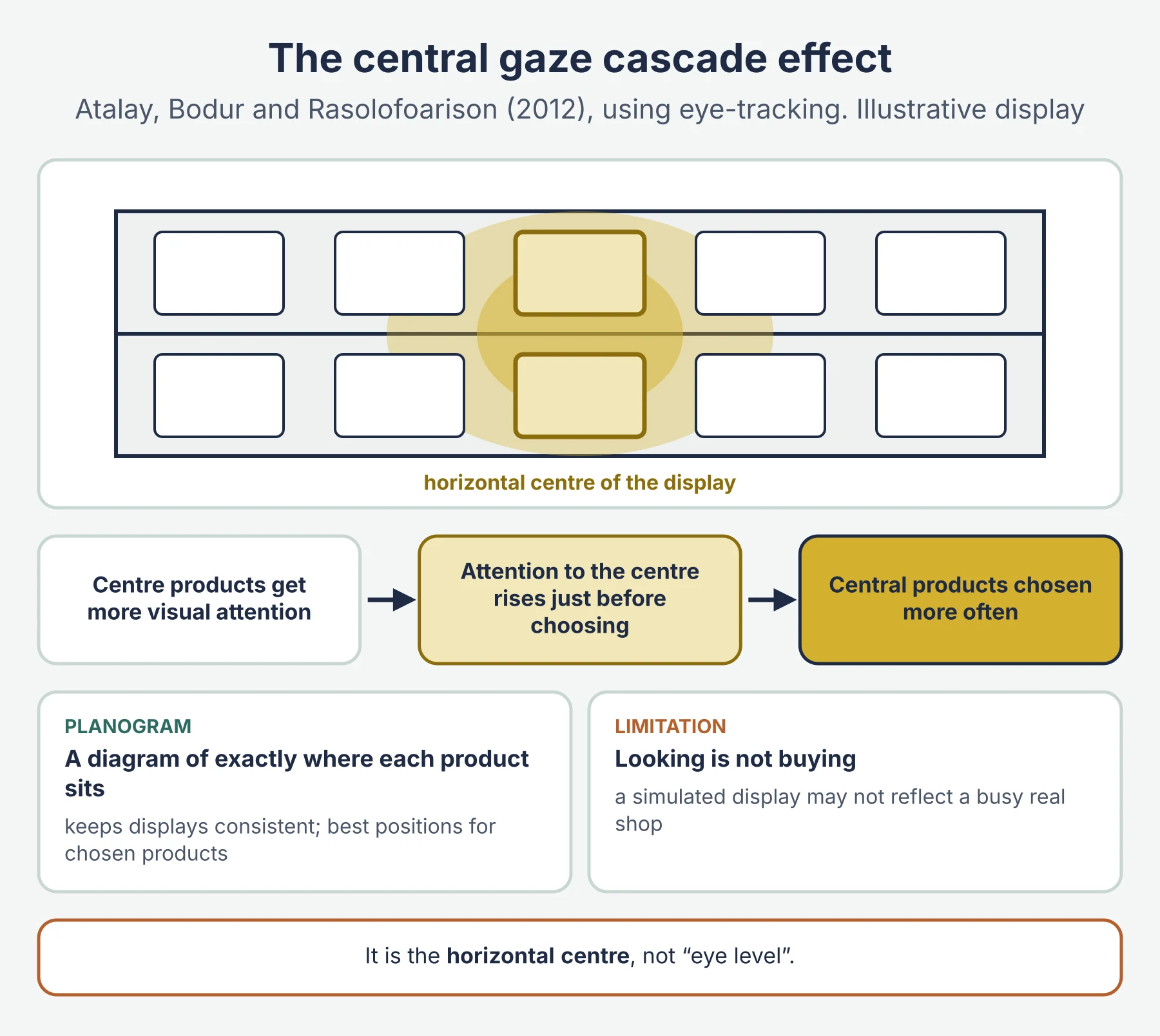
Key study grid: Becker et al. (2011)
| Feature | Detail |
|---|---|
| Aim | Does package shape and colour saturation change expected and rated taste? |
| Independent variables | Shape (angular or rounded) and colour saturation (high or low) |
| Dependent variables | Ratings of taste intensity and product evaluations |
| Moderator | How much the participant values visual design |
| Findings | Angular and saturated packaging led to stronger, more intense taste; strongest in design-sensitive people |
| Conclusion | Packaging changes the experience of the product |
| Debates | Reductionism (single features isolated); determinism (taste shaped without awareness) |
| Methods | Controlled experiment; subjective rating scales; one product type |
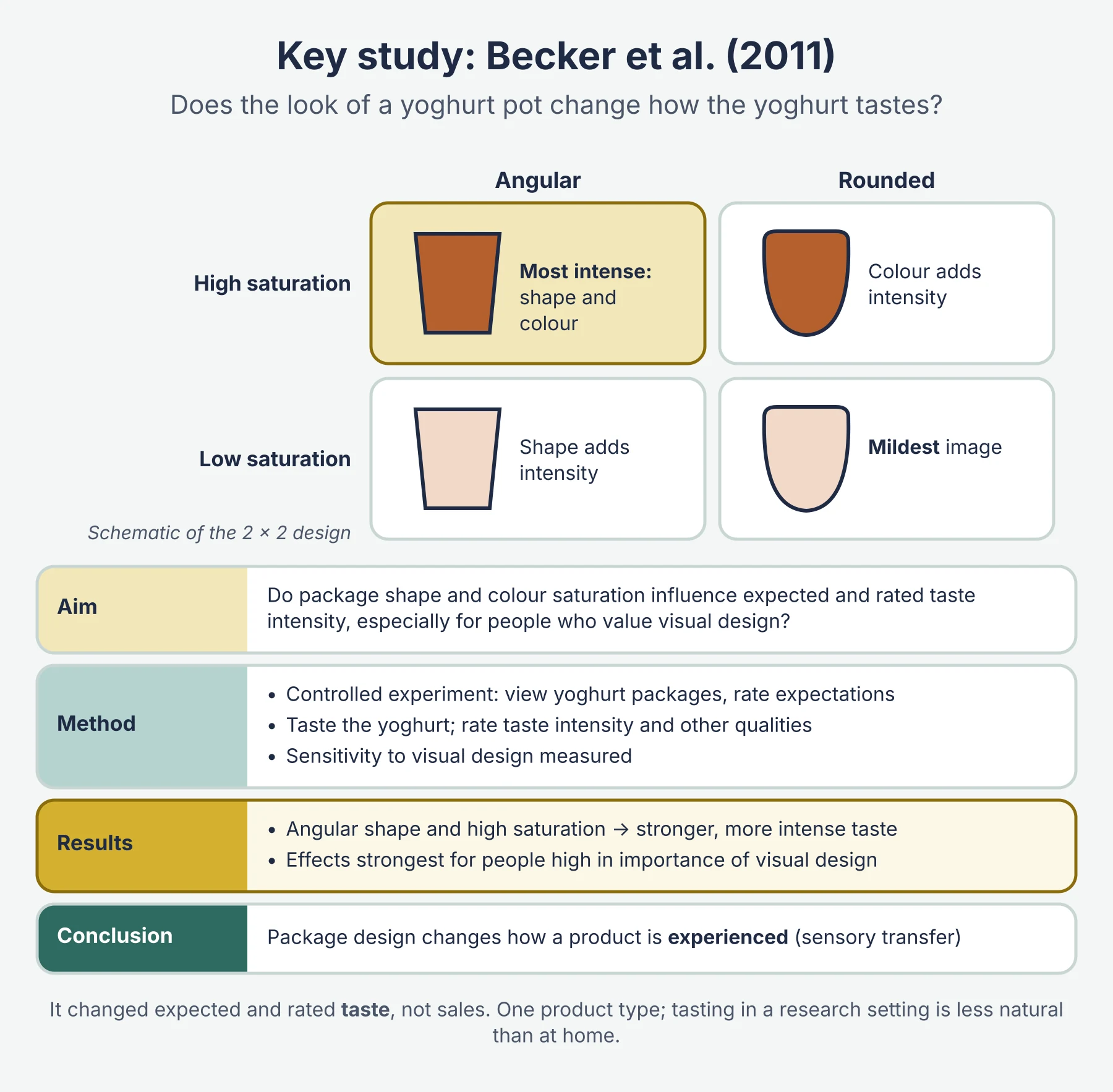
Cialdini’s six ways to close a sale, applied
| Principle | Sales example |
|---|---|
| Reciprocity | A free coffee while a customer looks at sofas |
| Commitment and consistency | Getting agreement to a test drive before discussing price |
| Social proof | “This is our best-selling model this month” |
| Liking | Finding common interests with the customer |
| Authority | A dentist recommending a toothbrush |
| Scarcity | “Only two left at this price” |
Post-purchase dissonance: increase and reduce
| Increases dissonance | Reduces dissonance |
|---|---|
| High price or importance | Reading positive reviews of the chosen item |
| Purchase hard to reverse | Focusing on the item’s strengths |
| Attractive rejected alternatives | Playing down the rejected alternatives |
| Little information before buying | Returning or exchanging the item |
Linking to issues and debates
- Reductionism versus holism (2.4.1, 2.4.3): Becker et al. isolate package features; the EKB model breaks buying into stages, though real decisions loop back and skip stages.
- Determinism versus free will (2.4.1, 2.4.2): central gaze cascade and disrupt-then-reframe work below awareness.
- Idiographic versus nomothetic (2.4.2, 2.4.3): need for cognitive closure varies between people, yet the techniques are taught as general rules.
- Cultural differences (2.4.2, 2.4.3): store choice in Sinha et al. was studied in India; reasons may differ elsewhere.
- Field experiments (2.4.2): disrupt-then-reframe was first shown in door-to-door selling, giving realism but less control.
Exam traps
- Becker et al. measured taste, not purchasing.
- The central gaze cascade concerns the horizontal centre of a display, not the top shelf.
- Disrupt-then-reframe needs both parts. A price stated oddly without a reframe is not the technique.
- The need for cognitive closure is the explanation for why the technique works; time pressure, fatigue and noise are the factors that raise it.
- The EKB model has five stages; do not stop at “purchase”.
- Dissonance is after buying. Anxiety before buying is not post-purchase dissonance.
Quick self-test
- Give two reasons why gifts are wrapped.
- In Becker et al. (2011), which package features were varied?
- Which kind of participant was most influenced by packaging in Becker et al.?
- What is a planogram?
- What did Atalay et al. (2012) use to measure attention?
- Name the three sales technique types on the syllabus.
- Give the two parts of disrupt-then-reframe.
- Name three factors that raise the need for cognitive closure.
- Name the principle: “Sign up today and you get a free gift.”
- List the five stages of the Engel Kollat Blackwell model.
- Give two factors that increase post-purchase dissonance.
- Which issue does Sinha et al. (2002) link to most clearly?
Answers
- Any two: to create surprise; to mark the item as a gift; to show the giver’s effort.
- Shape (angular or rounded) and colour saturation (high or low).
- People who place high importance on visual design.
- A diagram showing where each product goes on a shelf.
- Eye-tracking.
- Customer-focused, competitor-focused and product-focused.
- A disrupting element (such as an odd price) followed by a positive reframe.
- Time pressure, fatigue and noise.
- Reciprocity.
- Problem recognition, information search, evaluation of alternatives, purchase, post-purchase outcomes.
- Any two: high price; importance; difficulty of reversing; attractive rejected alternatives.
- Cultural differences, and demographic (age and gender) differences in store choice.
More resources on this topic
Related resources
-
Study guides
Cambridge International AS & A Level Psychology (9990): 2.2 The psychological environment
Topic 2.2 for Cambridge 9990 Consumer Psychology: wayfinding, shopper movement, menu design, personal space, Robson et al. and defending a place in a queue.
Psychology · Cambridge · A Level
Read guide -
Practice questions
Cambridge International AS & A Level Psychology (9990): 2.2 The psychological environment – Practice Questions
Original Paper 3 and Paper 4 style questions with answers on 9990 Consumer Psychology topic 2.2: wayfinding, menus, personal space, Robson et al. and queues.
Psychology · Cambridge · A Level
Try questions -
Revision notes
Cambridge International AS & A Level Psychology (9990): 2.2 The psychological environment – Revision Notes
Revision notes for 9990 Consumer Psychology topic 2.2: wayfinding, trip types, menu design, Hall's zones, Robson et al., queue intrusion and a self-test.
Psychology · Cambridge · A Level
Revise topic
Studying Psychology?
This page is free and stays free. Marlbridge is not offering Psychology classes at the moment, so there is no tuition to book for it. The free study resources stay open to everyone.
Get free revision emails (optional)
Occasional emails with practice questions, worked explanations and links to free resources for the qualification and subjects you choose. No spam, and you can unsubscribe from any email. The free tools on this site never need an email.