
Study Guides
Cambridge A Level Psychology (9990): Advertising
Cambridge 9990 topic 2.5 in depth: the Yale model, media and the 4 Cs, Snyder and DeBono (1985), product placement, children's logo recognition and slogans.
- Subject
- Psychology
- Level
- A LEVEL
- Topic
- Specialist Option 2: Consumer Psychology
- Author
- Marlbridge Academic Team
- Updated
- Reviewed by
- Kanwal Aslam (what this means)
Aligned to Cambridge A Level Psychology (9990), 2024-2026. Official specification .
Syllabus page (what it covers and how it is assessed): Cambridge A Level Psychology.
Syllabus points this page covers
9990 (A Level)
- 2.5 Advertising
Topic 2.5, Advertising, completes Specialist Option 2 (Consumer Psychology) in Cambridge International A Level Psychology 9990, syllabus for 2024 to 2026. It covers how adverts communicate (2.5.1), how consumers’ personalities and viewing habits shape their response (2.5.2), and how brands are recognised and remembered, including by young children (2.5.3). The key study is Snyder and DeBono (1985), with the syllabus directing you to study 3.
This guide adds depth to the advertising section of the Consumer Psychology study guide. Use the advertising revision notes to condense it and the advertising practice questions to apply it.
Syllabus content for 2.5
| Sub-topic | Content | Named study |
|---|---|---|
| 2.5.1 Types of advertising and techniques | Yale model of communication (five features); printed, television, internet and smartphone media; use of eye-tracking and EEG; Lauterborn’s 4 Cs | e.g. Ciceri et al. (2020) |
| 2.5.2 Advertising–consumer interaction | Advertising and consumer personality, including self-monitoring; product placement in films, mere exposure and reminders | Key study Snyder and DeBono (1985), study 3; e.g. Auty and Lewis (2004) |
| 2.5.3 Brand awareness and recognition | Children’s logo recognition and understanding of advertising; brand awareness, brand image, types and functions of slogans, guidelines for slogans | e.g. Fischer et al. (1991); e.g. Kohli et al. (2007) |
2.5.1 How adverts communicate
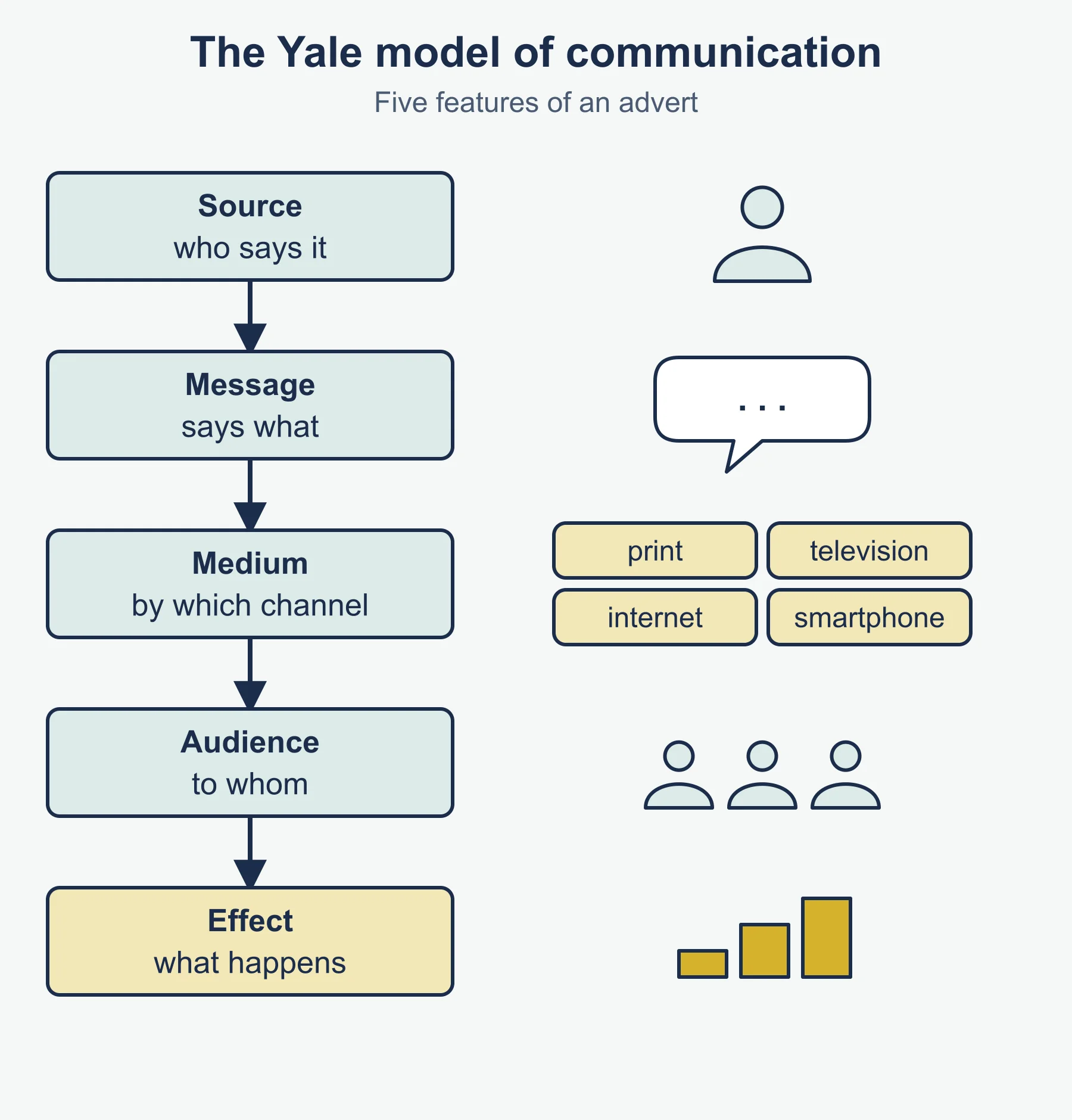
The Yale model. Hovland and colleagues at Yale University studied persuasion and identified five features of any persuasive communication. Learn them as a sentence: who (source) says what (message) through which channel (medium) to whom (audience) with what effect (effect).
- Source: credibility and attractiveness matter; an expert or a liked celebrity is more persuasive.
- Message: one-sided or two-sided arguments, emotional or factual appeals, and repetition.
- Medium: the channel, such as print, television, internet or smartphone.
- Audience: age, intelligence and prior attitudes change how a message is received.
- Effect: the change in attitude or behaviour, such as buying or recommending.
The model is useful because each feature can be varied in an experiment while the others are held constant.
Media. Printed adverts (magazines, newspapers, posters) can be studied at the reader’s own pace and kept. Television combines sound, image and movement, reaching large audiences. Internet adverts can be targeted by browsing history and measured by clicks. Smartphone adverts can use location and are seen on small screens in short bursts.
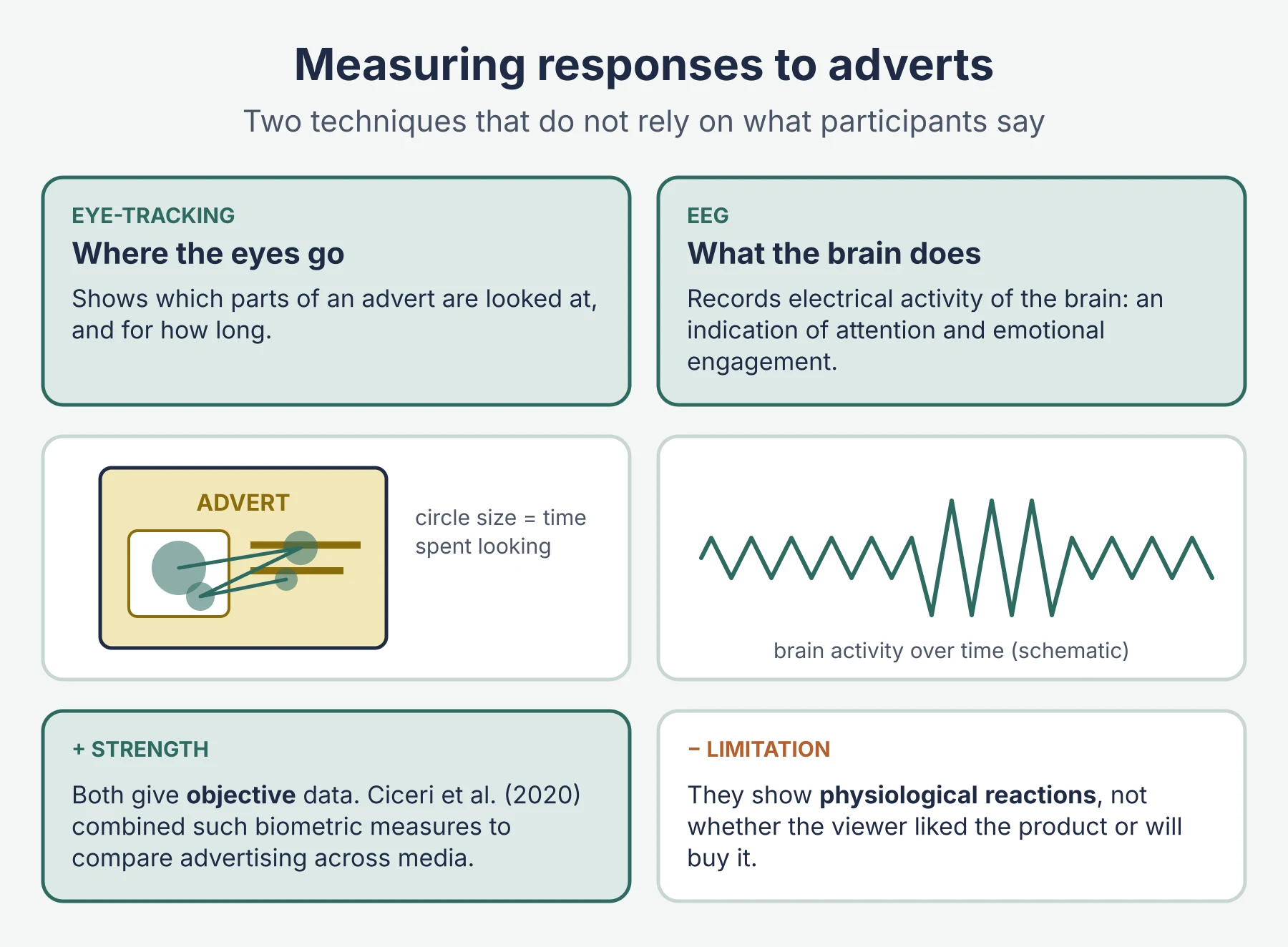
Measuring responses. Eye-tracking shows what parts of an advert are looked at and for how long. EEG records electrical activity of the brain, giving an indication of attention and emotional engagement without relying on what participants say. Ciceri et al. (2020) is the syllabus example of combining such biometric measures to compare advertising across media. Both techniques give objective data, but they show physiological reactions, not whether the viewer liked the product or will buy it.
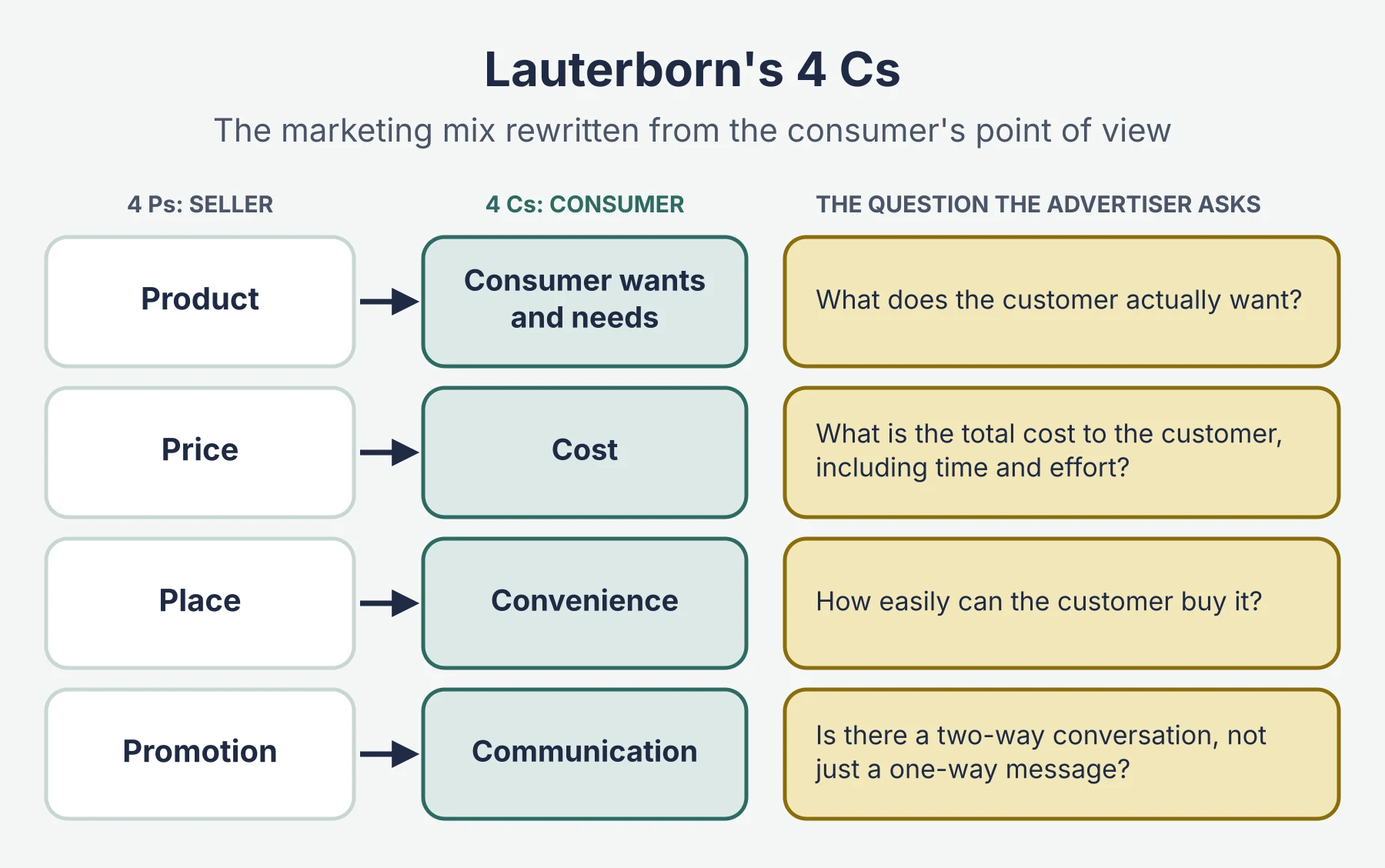
Lauterborn’s 4 Cs. Lauterborn proposed rewriting the traditional marketing mix (the 4 Ps: product, price, place, promotion) from the consumer’s point of view:
| 4 Ps (seller) | 4 Cs (consumer) | Question the advertiser asks |
|---|---|---|
| Product | Consumer wants and needs | What does the customer actually want? |
| Price | Cost | What is the total cost to the customer, including time and effort? |
| Place | Convenience | How easily can the customer buy it? |
| Promotion | Communication | Is there a two-way conversation, not just a one-way message? |
Key study: Snyder and DeBono (1985)
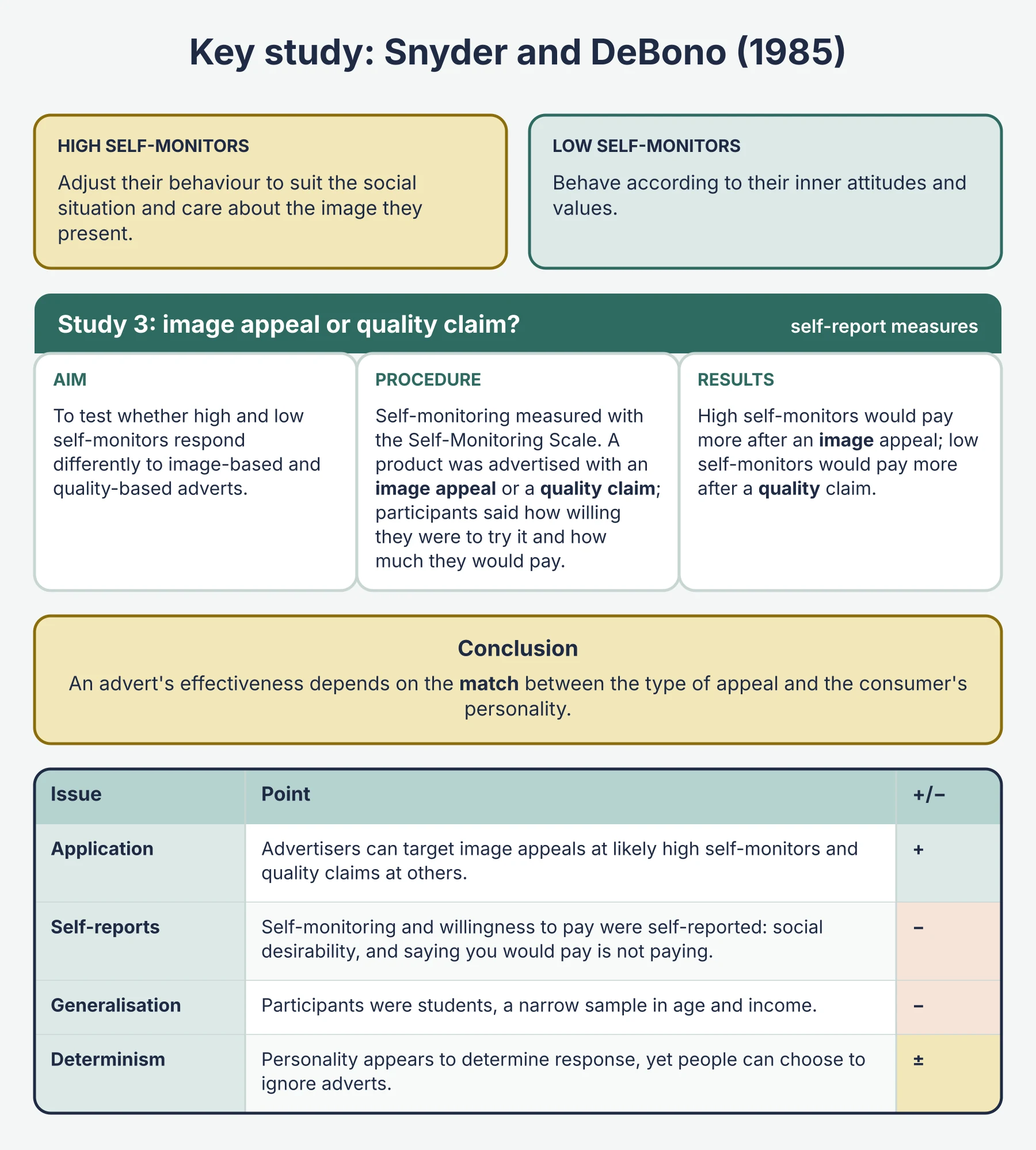
Context. Adverts tend to use either an image appeal (what using the product says about you) or a quality claim (what the product does). Snyder had developed the concept of self-monitoring: high self-monitors adjust their behaviour to suit the social situation and care about the image they present, whereas low self-monitors behave according to their inner attitudes and values.
Aim. To test whether high and low self-monitors respond differently to image-based and quality-based adverts.
Overview of the three studies. Across the studies, participants’ self-monitoring was measured with the Self-Monitoring Scale, a self-report questionnaire. Studies 1 and 2 examined evaluations of adverts and the kinds of adverts participants preferred; the syllabus says the specifics of their methods are not needed.
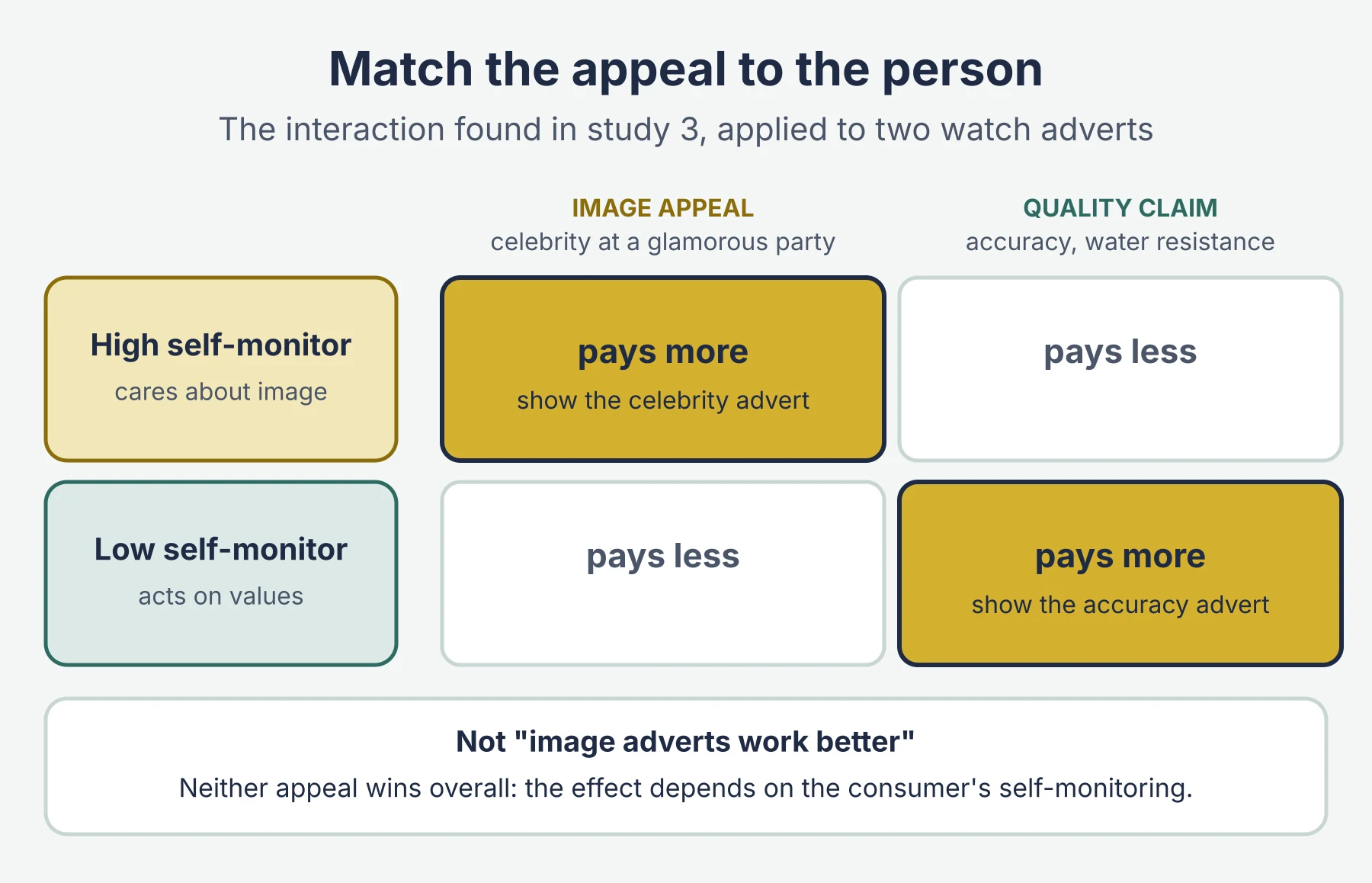
Study 3. Participants, divided into high and low self-monitors, were presented with a product advertised either with an image appeal or with a quality claim, and indicated how willing they were to try the product and how much they would pay for it. High self-monitors were willing to pay more for a product advertised with an image appeal; low self-monitors were willing to pay more for one advertised with a quality claim.
Conclusion. The effectiveness of an advert depends on the match between the type of appeal and the personality of the consumer.
Evaluation.
- Application: advertisers can target image appeals at audiences likely to be high self-monitors and quality claims at others.
- Self-reports: both self-monitoring and willingness to pay were self-reported, so responses may be affected by social desirability, and saying you would pay more is not the same as paying.
- Generalisation: participants were students, a narrow sample in age and income.
- Determinism versus free will: personality appears to determine response, yet people can choose to ignore adverts.
Product placement
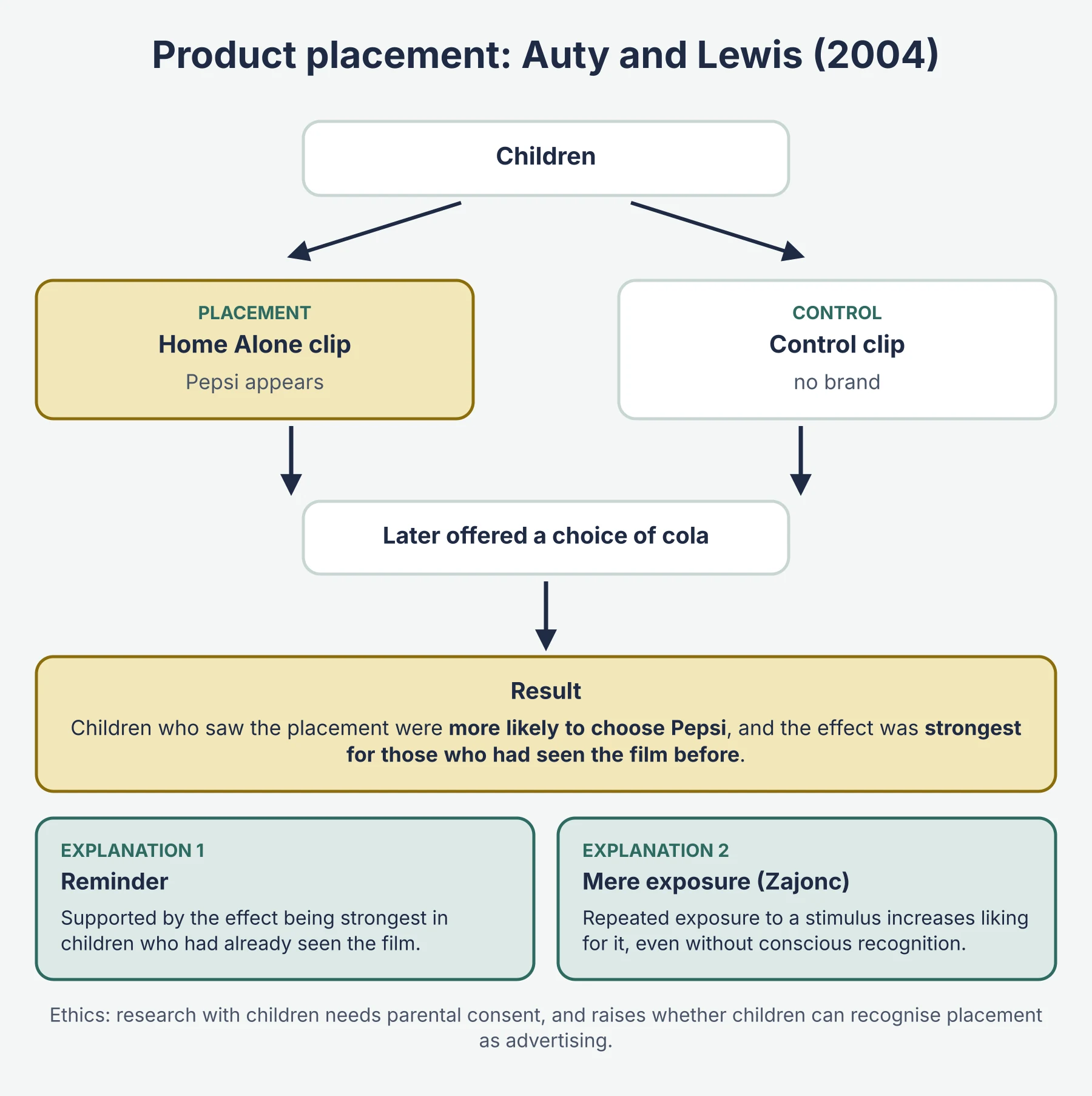
Product placement is the paid inclusion of a branded product in a film or television programme. Auty and Lewis (2004) showed children a clip from the film Home Alone in which Pepsi appears, or a control clip without the brand. When later offered a choice of cola, children who had seen the placement were more likely to choose Pepsi, and the effect was strongest for children who had seen the film before, which supports a reminder explanation. Mere exposure (Zajonc) offers a second explanation: repeated exposure to a stimulus increases liking for it, even without conscious recognition. Research with children raises the issue of informed consent, so parental consent is needed, and the question of whether children can recognise placement as advertising.
2.5.3 Brand awareness and recognition
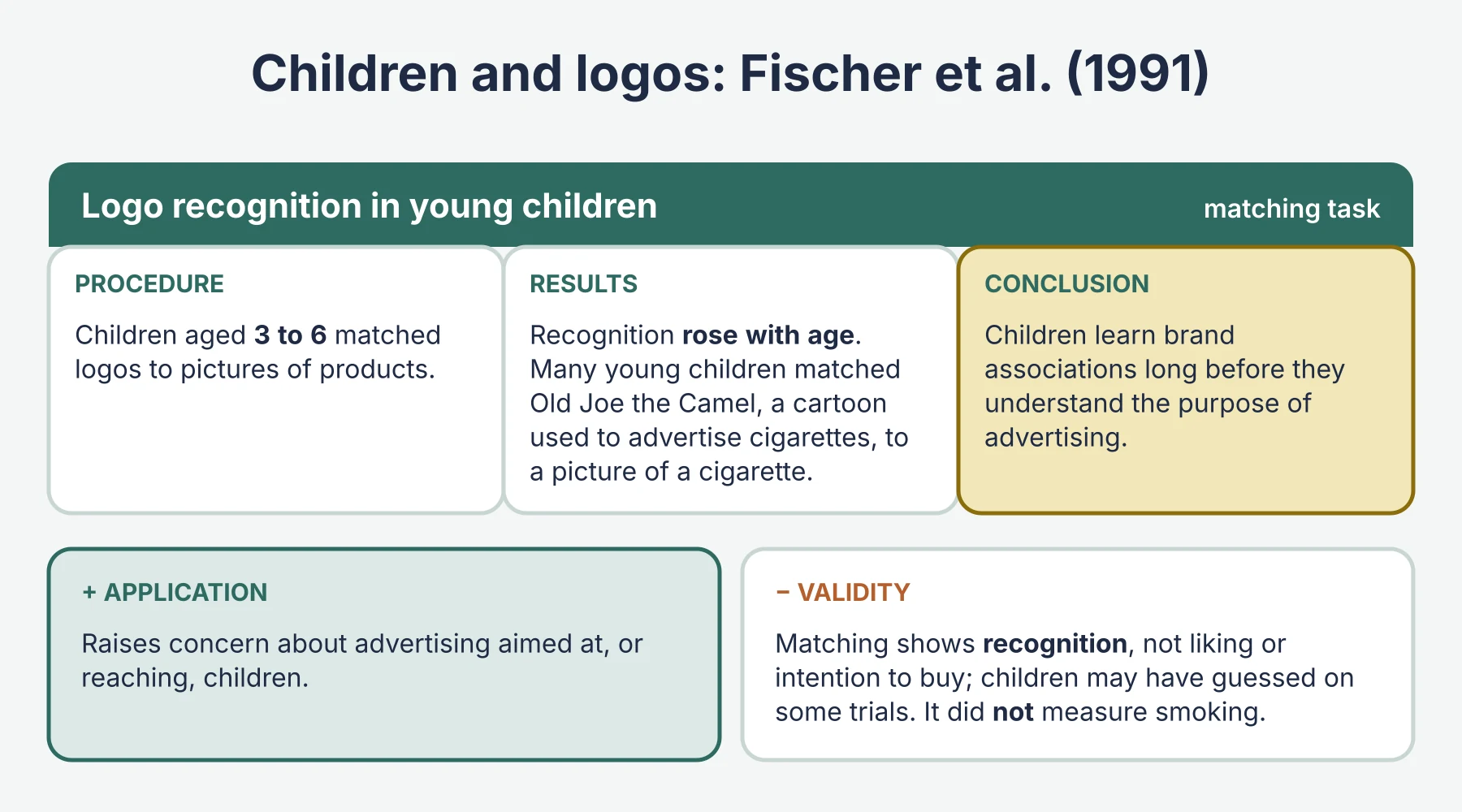
Children and logos. Fischer et al. (1991) asked children aged 3 to 6 to match logos to pictures of products. Recognition rose with age, and many young children matched Old Joe the Camel, a cartoon character used to advertise cigarettes, to a picture of a cigarette. This shows children learn brand associations long before they understand the purpose of advertising. The study raises concern about advertising aimed at, or reaching, children. A matching task shows recognition, not liking or intention to buy, and children may have guessed on some trials.
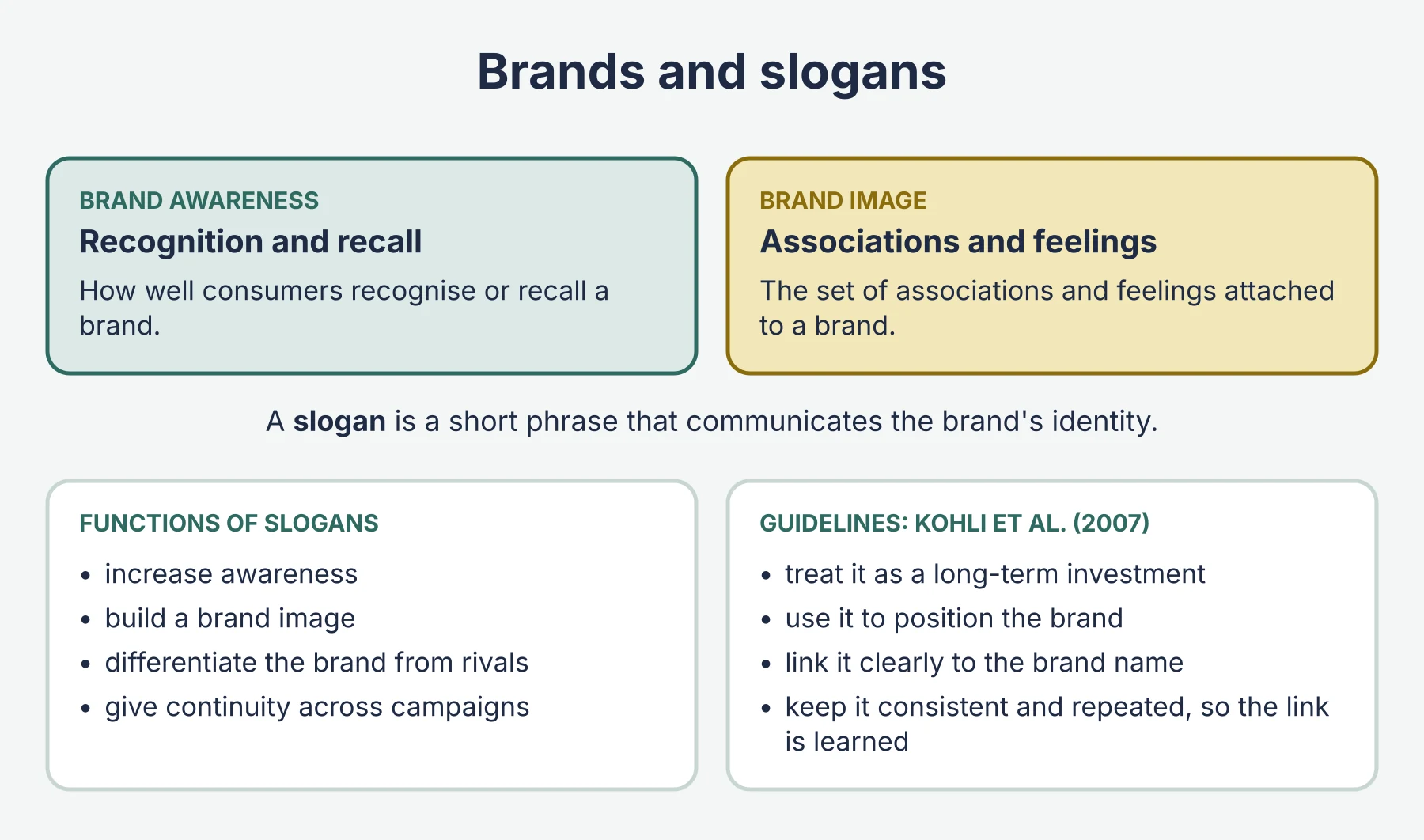
Brand awareness and image. Brand awareness is how well consumers recognise or recall a brand; brand image is the set of associations and feelings attached to it.
Slogans. A slogan is a short phrase that communicates the brand’s identity. Functions include increasing awareness, building a brand image, differentiating the brand from rivals and giving continuity across campaigns. Kohli, Leuthesser and Suri (2007) set out guidelines for effective slogans, including treating the slogan as a long-term investment, using it to position the brand, linking it clearly to the brand name, and keeping it consistent and repeated over time so that the link is learned.
Worked example: applying self-monitoring
A watch company has two adverts: one shows a celebrity at a glamorous party; the other describes the watch’s accuracy and water resistance. Suggest which audience should see each advert. [4]
“High self-monitors care about the image they present in social situations (1), so they should see the celebrity advert, which is an image appeal (1). Low self-monitors act on their values and care about what a product does (1), so they should see the quality-claim advert about accuracy (1).”
Common mistakes
- Saying Snyder and DeBono found that image adverts work better overall. The finding is an interaction with self-monitoring.
- Describing studies 1 and 2 in detail when the syllabus asks for study 3.
- Confusing brand awareness (recognition and recall) with brand image (associations).
- Writing that Fischer et al. showed children smoked more. It measured logo recognition only.
Exam technique
For describe questions, use the five features of the Yale model or the 4 Cs as a structure. For evaluate questions, the syllabus lists use of children in research, determinism versus free will, self-reports and validity for 2.5.2, and application, use of children and experiments for 2.5.3. For suggest questions, name the concept, apply it to the product in the stem and say what effect it should have.
More resources on this topic
Official syllabus
Cambridge International AS & A Level Psychology 9990 syllabus for 2024, 2025 and 2026, Specialist Option 2: Consumer Psychology, topic 2.5 — cambridgeinternational.org.
Related resources
-
Practice questions
Cambridge A Level Psychology (9990): Advertising – Practice Questions
Original Paper 3 and Paper 4 style questions on Cambridge 9990 topic 2.5 Advertising, from the Yale model to slogans, with mark schemes.
Psychology · Cambridge · A Level
Try questions -
Revision notes
Cambridge A Level Psychology (9990): Advertising – Revision Notes
Revision notes for Cambridge 9990 topic 2.5: Yale model, media, 4 Cs, self-monitoring, product placement, logos and slogans, with a self-test.
Psychology · Cambridge · A Level
Revise topic -
Study guides
Cambridge A Level Psychology (9990): Consumer decision-making
Cambridge 9990 topic 2.3 in depth: decision models and strategies, choice heuristics, system 1 and 2, choice blindness and interference, with model answers.
Psychology · Cambridge · A Level
Read guide
Studying Psychology?
This page is free and stays free. Marlbridge is not offering Psychology classes at the moment, so there is no tuition to book for it. The free study resources stay open to everyone.
Get free revision emails (optional)
Occasional emails with practice questions, worked explanations and links to free resources for the qualification and subjects you choose. No spam, and you can unsubscribe from any email. The free tools on this site never need an email.