
Study Guides
Cambridge A Level Psychology (9990): Consumer decision-making
Cambridge 9990 topic 2.3 in depth: decision models and strategies, choice heuristics, system 1 and 2, choice blindness and interference, with model answers.
- Subject
- Psychology
- Level
- A LEVEL
- Topic
- Specialist Option 2: Consumer Psychology
- Author
- Marlbridge Academic Team
- Updated
- Reviewed by
- Kanwal Aslam (what this means)
Aligned to Cambridge A Level Psychology (9990), 2024-2026. Official specification .
Syllabus page (what it covers and how it is assessed): Cambridge A Level Psychology.
Syllabus points this page covers
9990 (A Level)
- 2.3 Consumer decision-making
Topic 2.3, Consumer decision-making, is one of the five topics in Specialist Option 2 (Consumer Psychology) of Cambridge International A Level Psychology 9990, syllabus for 2024 to 2026. It asks how shoppers choose between products, which shortcuts they use, and why their choices are often less rational than they believe. It has three sub-topics: 2.3.1 Consumer decision-making (models and strategies), 2.3.2 Choice heuristics, and 2.3.3 Mistakes in decision-making, which contains the key study, Hall et al. (2010).
This guide goes deeper than the option-wide Consumer Psychology study guide. When you have read it, condense it with the consumer decision-making revision notes and test yourself with the consumer decision-making practice questions.
What does the syllabus list for topic 2.3?
| Sub-topic | What you must know | Named study |
|---|---|---|
| 2.3.1 | Utility theory, satisficing and prospect theory; compensatory, non-compensatory and partially compensatory strategies; strategies applied to internet shopping and website design | e.g. Jedetski et al. (2002) |
| 2.3.2 | Availability, representativeness, recognition, take-the-best and anchoring; multiple unit pricing and suggestive selling; heuristics and decision-making styles | e.g. Wansink et al. (1998); e.g. del Campo et al. (2016) |
| 2.3.3 | System 1 and system 2; choice blindness, preferences and defending a choice; retroactive and proactive interference in memory for advertising | e.g. Shleifer (2012); key study Hall et al. (2010); e.g. Burke and Srull (1988) |
The syllabus also names the issues and methods most relevant to each sub-topic, including determinism versus free will, individual and situational explanations, experiments and reliability. Plan an evaluation point for each.
Three models of how consumers decide
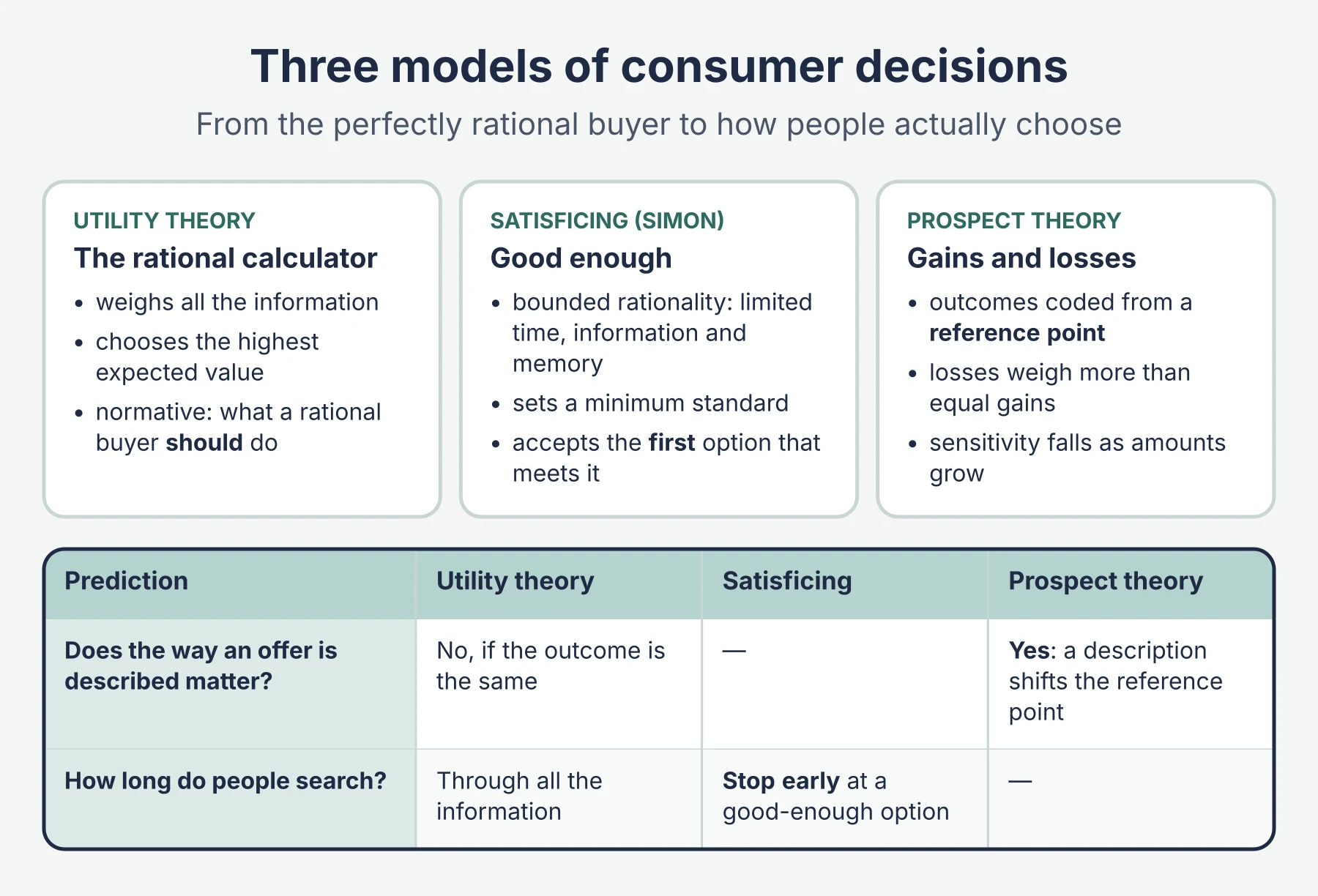
Utility theory treats the consumer as a rational calculator. Each option has a value (its utility) and the consumer chooses the one with the highest expected value after weighing all the information. It is a normative model: it says what a perfectly rational buyer should do.
Satisficing was proposed by Herbert Simon as part of his idea of bounded rationality. Real people have limited time, information and memory, so they set a minimum standard and accept the first option that meets it. A traveller who books the first hotel under a set price with a good rating, without checking every other hotel, is satisficing.
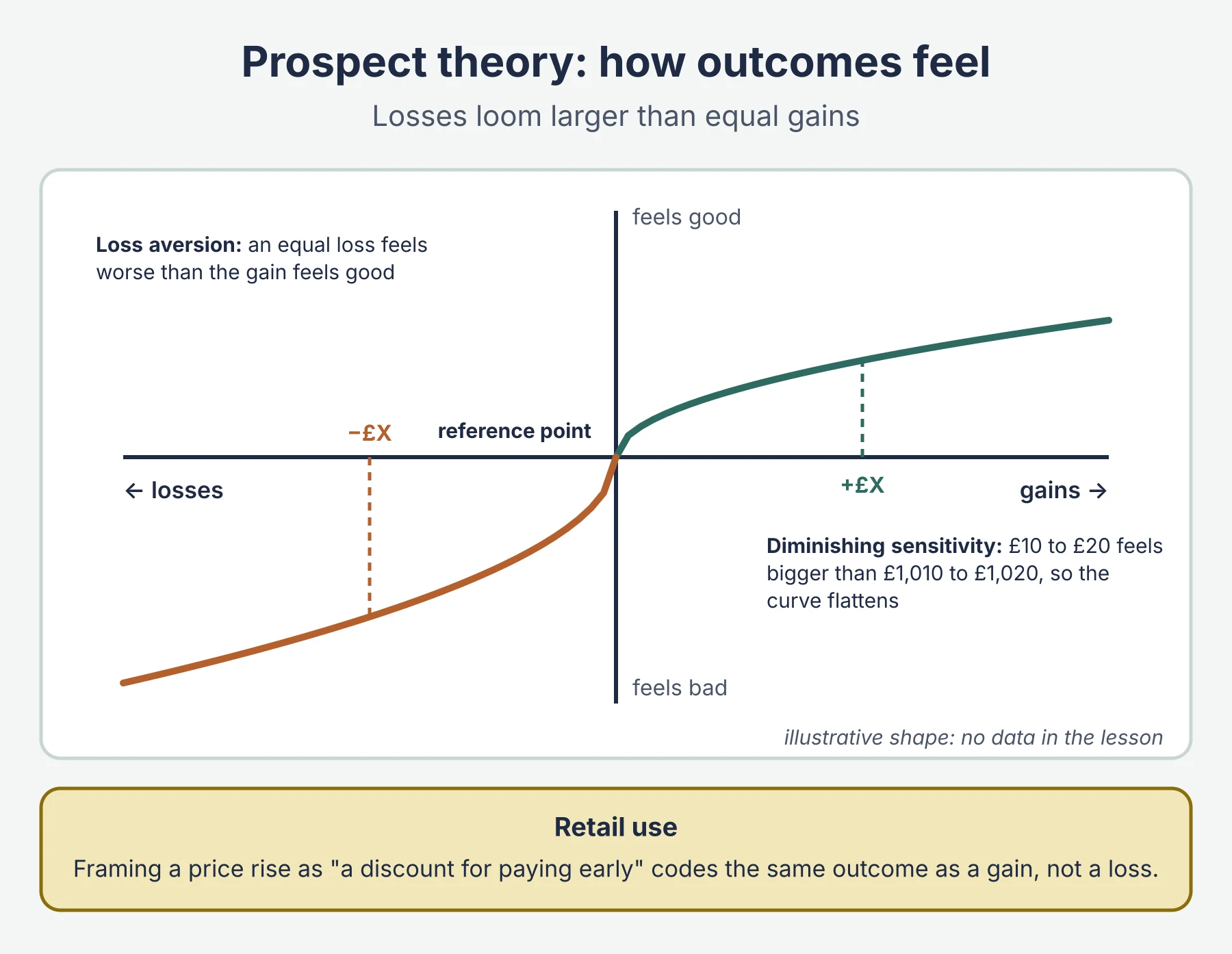
Prospect theory (Kahneman and Tversky) describes how people actually judge risky choices. Outcomes are coded as gains or losses from a reference point, not as final amounts of wealth, and losses weigh more heavily than equal gains (loss aversion). Sensitivity also falls as amounts grow: the difference between £10 and £20 feels larger than the difference between £1,010 and £1,020. Retailers apply this when they frame a price rise as “a discount for paying early”.
How the models compare. Utility theory predicts that the way an offer is described should not matter if the outcome is the same; prospect theory predicts that it will, because a description shifts the reference point. Satisficing predicts that people stop searching early. An exam answer that sets these predictions side by side is comparing, not just describing.
Strategies: compensatory, non-compensatory and partially compensatory
These strategies describe how a shopper combines information about the attributes of products.
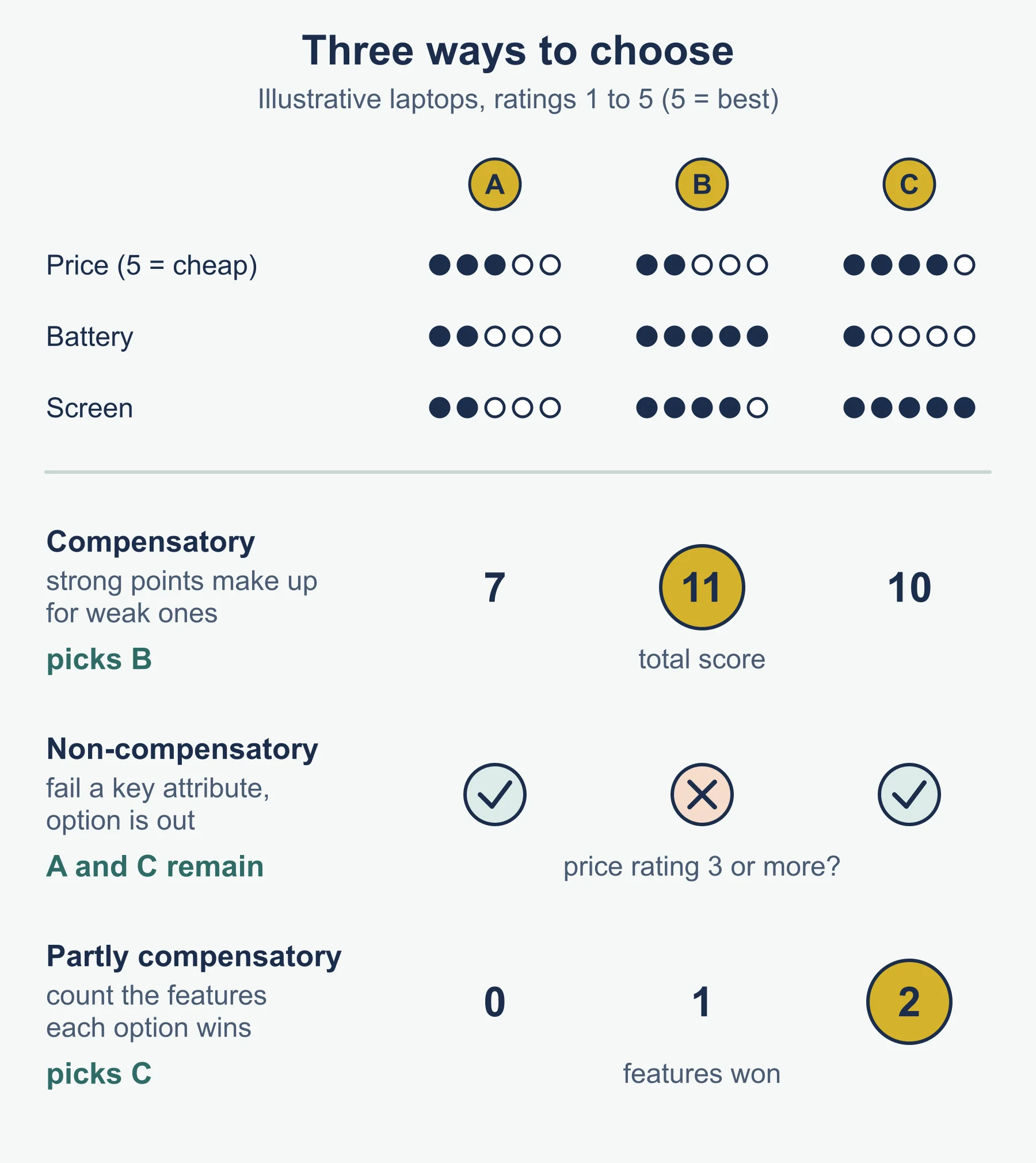
- Compensatory: every attribute is scored and the scores are combined, so a weakness on one attribute can be made up by a strength on another. It uses all the information but takes effort.
- Non-compensatory: an option that fails on an important attribute is rejected whatever its other strengths. Rules include setting a cut-off (“nothing over £400”) or working through attributes in order of importance. It is quick but can reject an option that is better overall.
- Partially compensatory: options are compared attribute by attribute, and the option that wins on the most attributes is chosen. Some trade-off happens, but the size of each difference is ignored.
Internet shopping. Website design can support one strategy more than another. A filter that removes every phone without a certain camera supports a non-compensatory strategy; a table placing several products side by side with scores on every feature supports a compensatory one. Jedetski et al. (2002) is the syllabus example of research on how decision tools on shopping websites interact with consumers’ strategies. The applied point is that a site matching the strategy its customers want to use is easier to use.
Choice heuristics (2.3.2)
A heuristic is a mental shortcut that gives a fast, usually good-enough answer.
| Heuristic | How it works | Consumer example |
|---|---|---|
| Availability | Judging likelihood by how easily examples come to mind | Overestimating how often a car brand breaks down after hearing one vivid story |
| Representativeness | Judging by how closely something matches a typical case | Assuming a plain, brown-packaged product is organic because it looks like organic products |
| Recognition | If one option is recognised and the other is not, choose the recognised one | Picking the familiar brand of batteries over an unknown one |
| Take-the-best | Comparing options on the most important cue only; if that cue separates them, decide | Choosing the hotel nearest the conference without comparing anything else |
| Anchoring | Estimates are pulled towards a starting number and adjusted too little | A “was £120, now £80” label making £80 seem cheap |
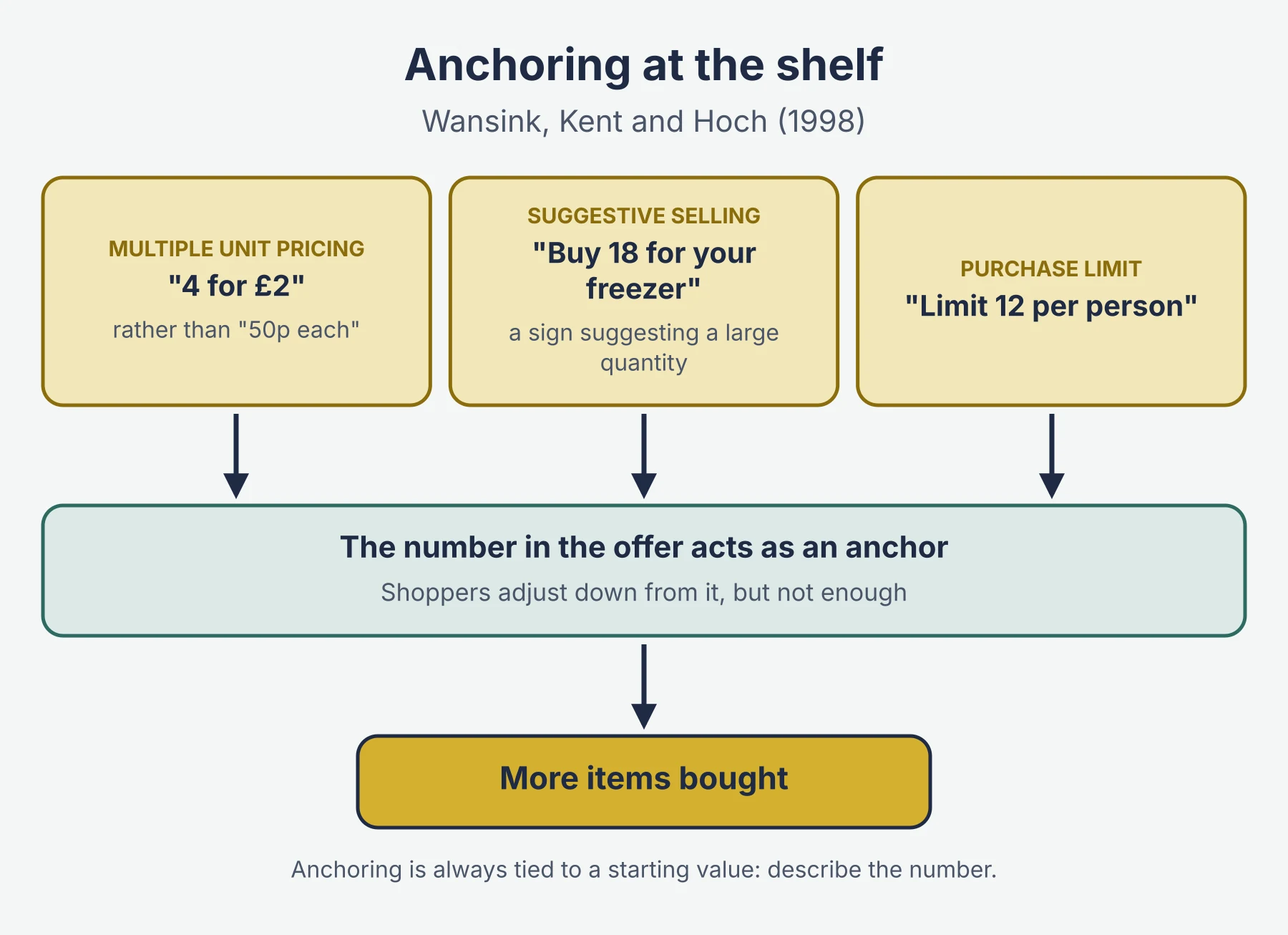
Point-of-purchase decisions. Wansink, Kent and Hoch (1998) applied anchoring to how many items shoppers buy. Multiple unit pricing (“4 for £2” rather than “50p each”) and suggestive selling (a sign suggesting a large quantity, such as “buy 18 for your freezer”) both increased purchase quantity, and so did purchase limits such as “limit 12 per person”. The number in the offer acts as an anchor, and shoppers adjust down from it insufficiently.
Decision-making styles. del Campo et al. (2016) is the suggested study for linking heuristic use to a person’s decision-making style, such as a more rational or a more intuitive style. This supports an individual explanation: two shoppers facing the same display may rely on heuristics to different degrees.
Mistakes in decision-making (2.3.3)
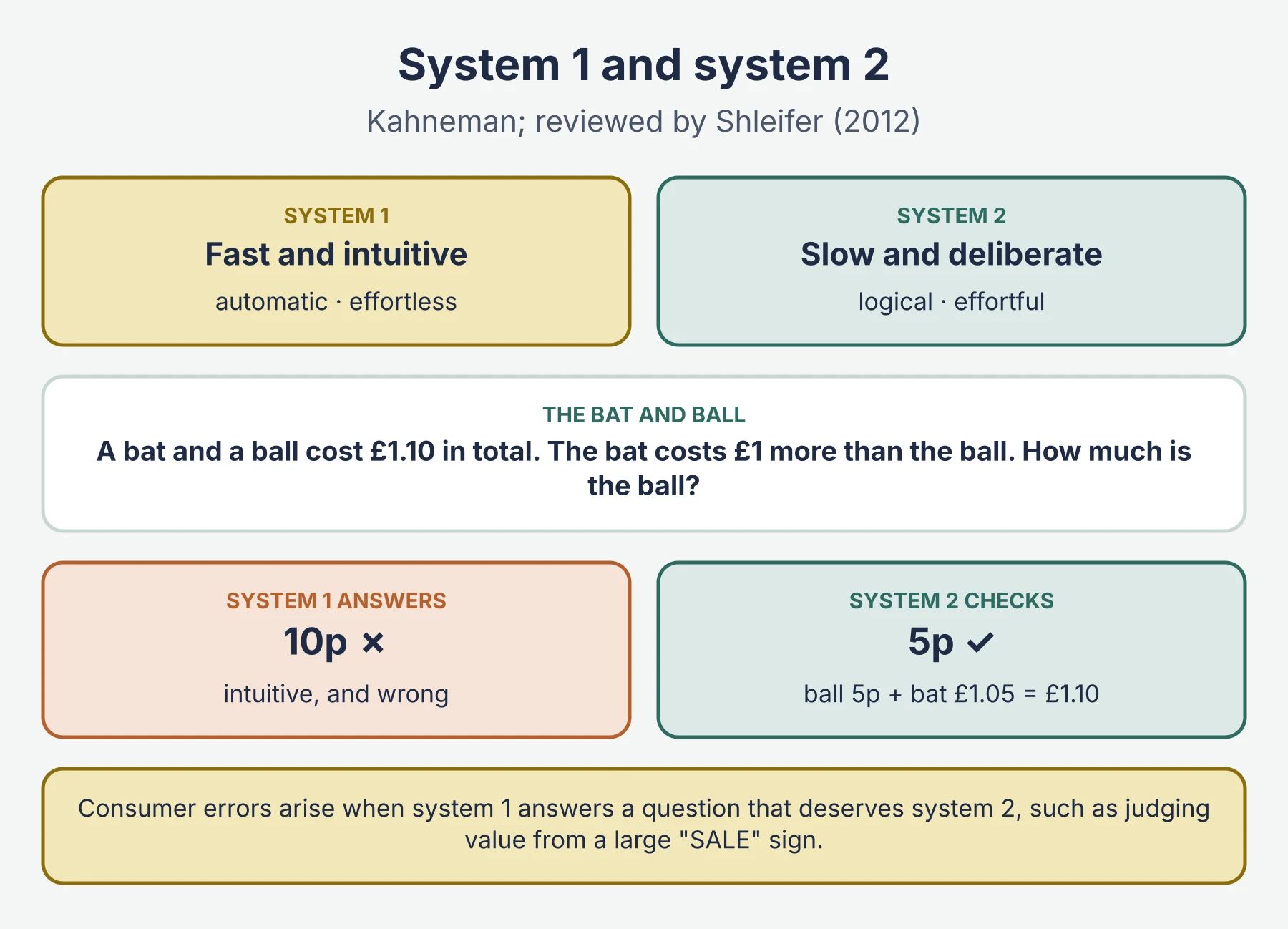
System 1 and system 2. Kahneman distinguished system 1, which is fast, automatic, intuitive and effortless, from system 2, which is slow, deliberate, logical and effortful. Shleifer (2012) reviewed this framework and its value to economists. A classic system 1 error: “A bat and a ball cost £1.10 in total. The bat costs £1 more than the ball. How much is the ball?” The intuitive answer, 10p, is wrong; system 2 checking gives 5p. Many consumer errors arise when system 1 answers a question that deserves system 2, such as judging value from a large “SALE” sign.
Key study: Hall et al. (2010), choice blindness. Choice blindness was first shown by Johansson et al. (2005) with photographs of faces. Hall, Johansson, Tärning, Sikström and Deutgen asked whether it would also occur for taste and smell in a real marketplace.
- Aim: to test whether shoppers would notice when their chosen jam or tea was secretly swapped for the one they had rejected.
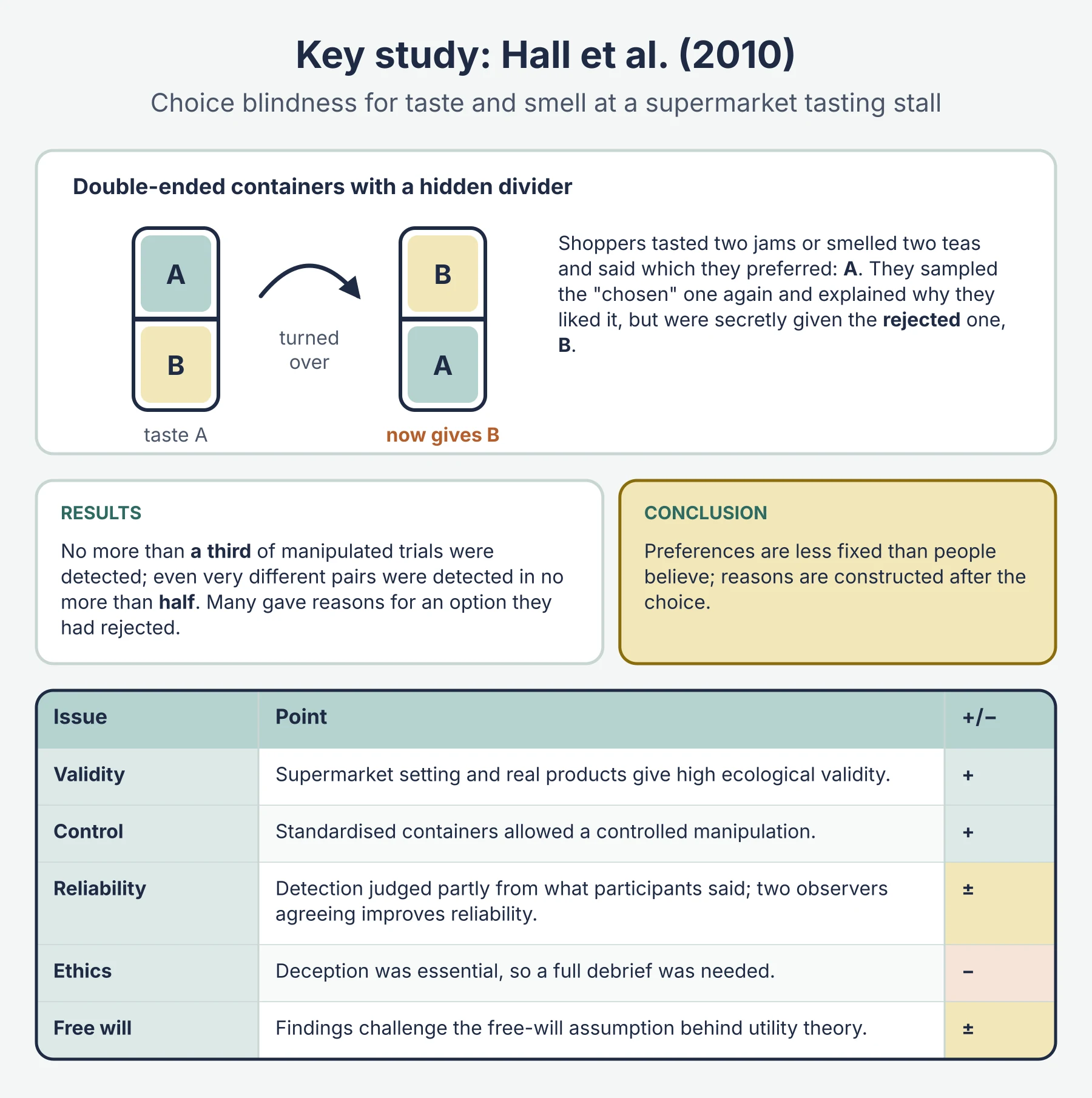
- Method: a field experiment at a tasting stall in a Swedish supermarket. Shoppers sampled two jams or smelled two teas and said which they preferred. They then sampled the “chosen” one again and explained why they liked it.
- Manipulation: the samples were in double-ended containers with a hidden divider, so the experimenter could turn the container over and give the rejected option instead.
- Results: no more than a third of the manipulated trials were detected, and even pairs that differed greatly were detected in no more than half of trials. Many participants gave reasons for preferring an option they had in fact rejected.
- Conclusion: people’s preferences are less fixed than they believe, and they construct reasons after the choice.
Evaluating Hall et al. The supermarket setting and real products give high ecological validity, and the standardised containers allowed a controlled manipulation. Deception was essential, so a full debrief was needed. Detection was judged partly from what participants said, which needs reliable coding; two observers agreeing on what counts as a detection improves reliability. The findings challenge the free-will assumption behind utility theory.
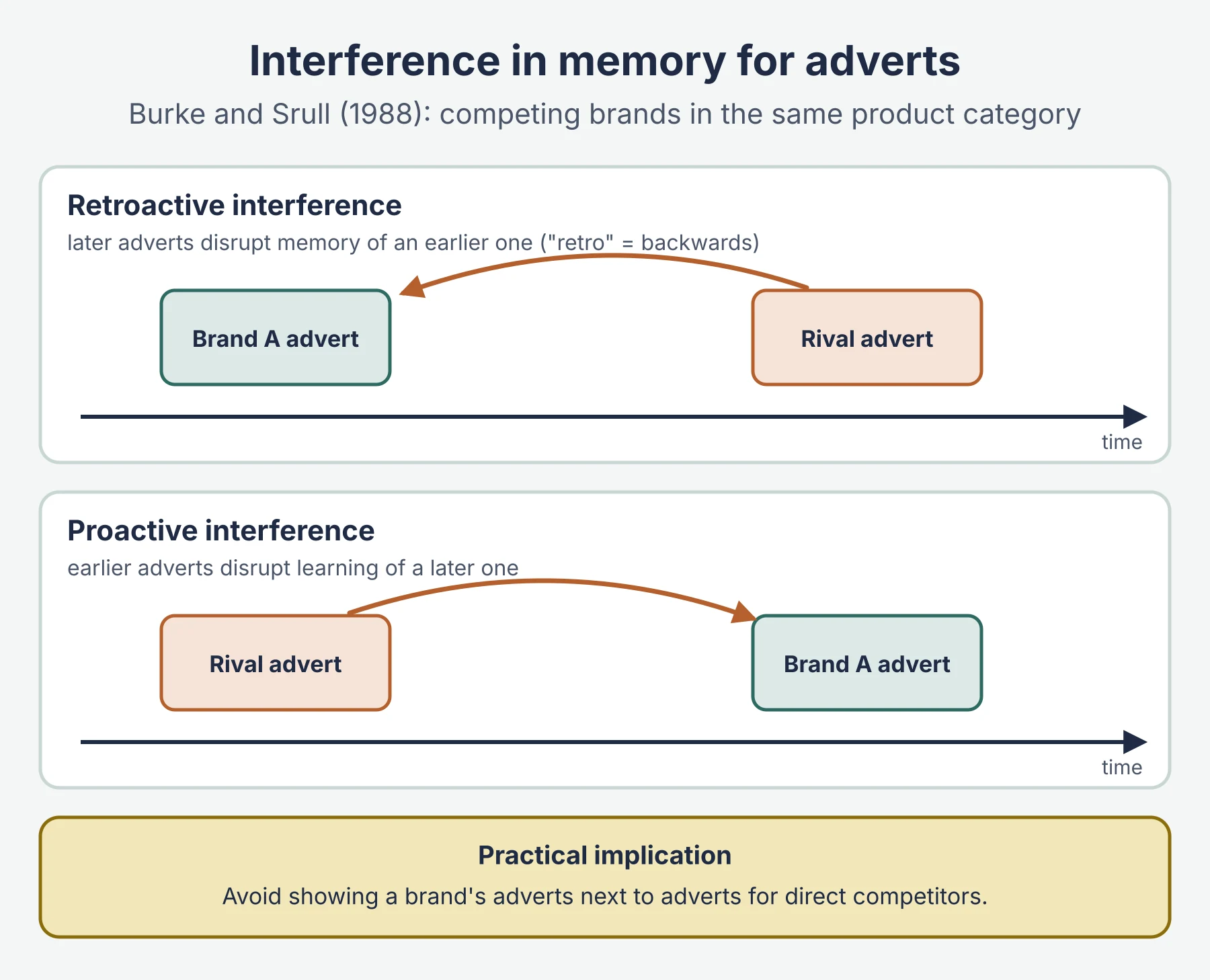
Memory for advertising. Burke and Srull (1988) showed that memory for an advert is impaired by adverts for competing brands in the same product category. Retroactive interference occurs when later adverts disrupt memory of an earlier one; proactive interference occurs when earlier adverts disrupt learning of a later one. A practical implication is that adverts for one brand should avoid being shown next to adverts for direct competitors.
Worked example: a 6-mark describe answer
Describe the study by Hall et al. (2010) on choice blindness. [6]
A strong answer: “Hall et al. carried out a field experiment at a supermarket tasting stall to see whether shoppers noticed when their choice was switched (1). Shoppers tasted two jams or smelled two teas and chose which they preferred (1). They were then asked to sample their chosen item again and explain their preference (1). The containers were double-ended with a hidden divider, so the researcher could secretly give them the option they had rejected (1). No more than a third of switches were detected, even for very different pairs (1). Many participants justified a choice they had not made, which shows choice blindness (1).”
Why it scores well: aim, setting, procedure, the switching technique, result and conclusion are all present, and nothing is evaluation.
Common mistakes
- Calling satisficing “choosing the best option”. It is choosing a good-enough option.
- Treating take-the-best and non-compensatory strategies as the same thing. Take-the-best is a heuristic using one cue; a non-compensatory strategy is any rule that lets one failed attribute rule out an option.
- Describing anchoring without a number. Anchoring is always tied to a starting value.
- Reversing retroactive and proactive interference. “Retro” means backwards: new information works back on old memories.
Exam technique for the command words
- Outline or describe: give the main features with an example; no evaluation.
- Explain: give the reason or mechanism, such as why a “limit 12” sign increases sales.
- Compare: state a similarity and a difference, for example utility theory and satisficing both describe how people choose but differ in how much information they assume people use.
- Suggest: apply a concept to the scenario given, such as recommending a website filter for shoppers who use a non-compensatory strategy.
- Evaluate: judge strengths and weaknesses using methods and the named issues, then conclude.
More resources on this topic
- Consumer decision-making revision notes
- Consumer decision-making practice questions
- Consumer Psychology study guide
Official syllabus
Cambridge International AS & A Level Psychology 9990 syllabus for 2024, 2025 and 2026, Specialist Option 2: Consumer Psychology, topic 2.3 — cambridgeinternational.org.
Related resources
-
Practice questions
Cambridge A Level Psychology (9990): Consumer decision-making – Practice Questions
Original Paper 3 and Paper 4 style questions on Cambridge 9990 consumer decision-making, from prospect theory to choice blindness, with full mark schemes.
Psychology · Cambridge · A Level
Try questions -
Revision notes
Cambridge A Level Psychology (9990): Consumer decision-making – Revision Notes
Revision notes for Cambridge 9990 topic 2.3: models, strategies, heuristics, system 1 and 2, Hall et al. (2010) and interference, with traps and a self-test.
Psychology · Cambridge · A Level
Revise topic -
Study guides
Cambridge International AS & A Level Psychology (9990): 2.1 The physical environment
Topic 2.1 for Cambridge 9990 Consumer Psychology: store exteriors and layouts, music and noise, North et al., the PAD model, odour and crowding.
Psychology · Cambridge · A Level
Read guide
Studying Psychology?
This page is free and stays free. Marlbridge is not offering Psychology classes at the moment, so there is no tuition to book for it. The free study resources stay open to everyone.
Get free revision emails (optional)
Occasional emails with practice questions, worked explanations and links to free resources for the qualification and subjects you choose. No spam, and you can unsubscribe from any email. The free tools on this site never need an email.