
Revision Notes
Cambridge International AS & A Level Psychology (9990): 2.2 The psychological environment – Revision Notes
Revision notes for 9990 Consumer Psychology topic 2.2: wayfinding, trip types, menu design, Hall's zones, Robson et al., queue intrusion and a self-test.
- Subject
- Psychology
- Level
- A LEVEL
- Topic
- Specialist Option 2: Consumer Psychology
- Author
- Marlbridge Academic Team
- Updated
- Reviewed by
- Kanwal Aslam (what this means)
Aligned to Cambridge A Level Psychology (9990), 2024-2026. Official specification .
Syllabus page (what it covers and how it is assessed): Cambridge A Level Psychology.
Syllabus points this page covers
9990 (A Level)
- 2.2 The psychological environment
These notes condense topic 2.2, the psychological environment, from Specialist Option 2, Consumer Psychology, of Cambridge International AS & A Level Psychology (9990), syllabus for 2024 to 2026. The topic covers how consumers find their way and move through shops, how menus influence choices, and how personal space affects diners and queues. Full explanations are in the psychological environment study guide; test yourself with the psychological environment practice questions.
2.2.1 Environmental influences
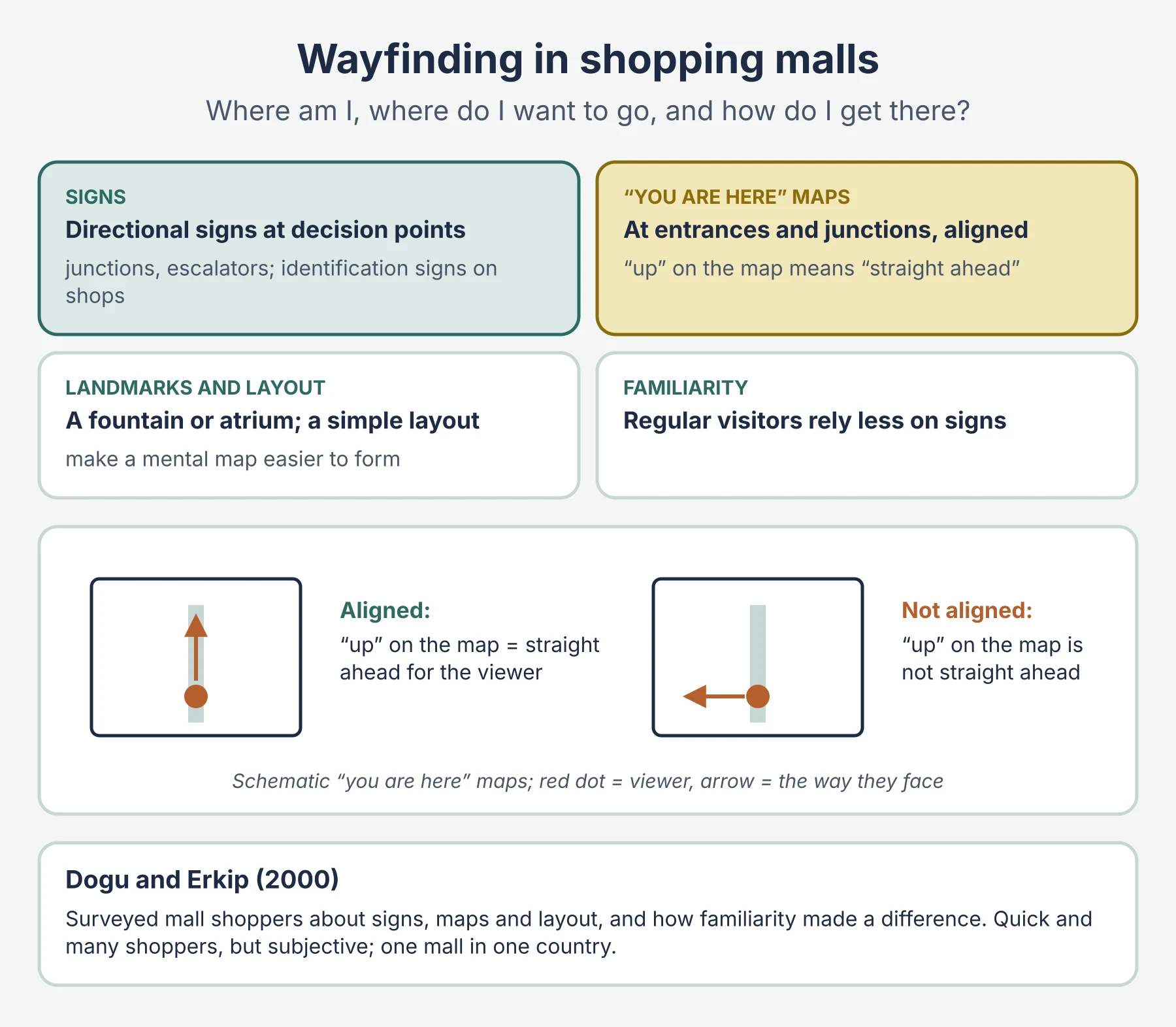
Wayfinding: knowing where you are, where you are going and how to get there.
- Helps: directional signs at decision points; “you are here” maps aligned with the viewer’s direction; landmarks; simple layouts; familiarity.
- Dogu and Erkip (2000): surveyed mall shoppers on how signs, maps and layout affected wayfinding, and the role of familiarity.
Trip types
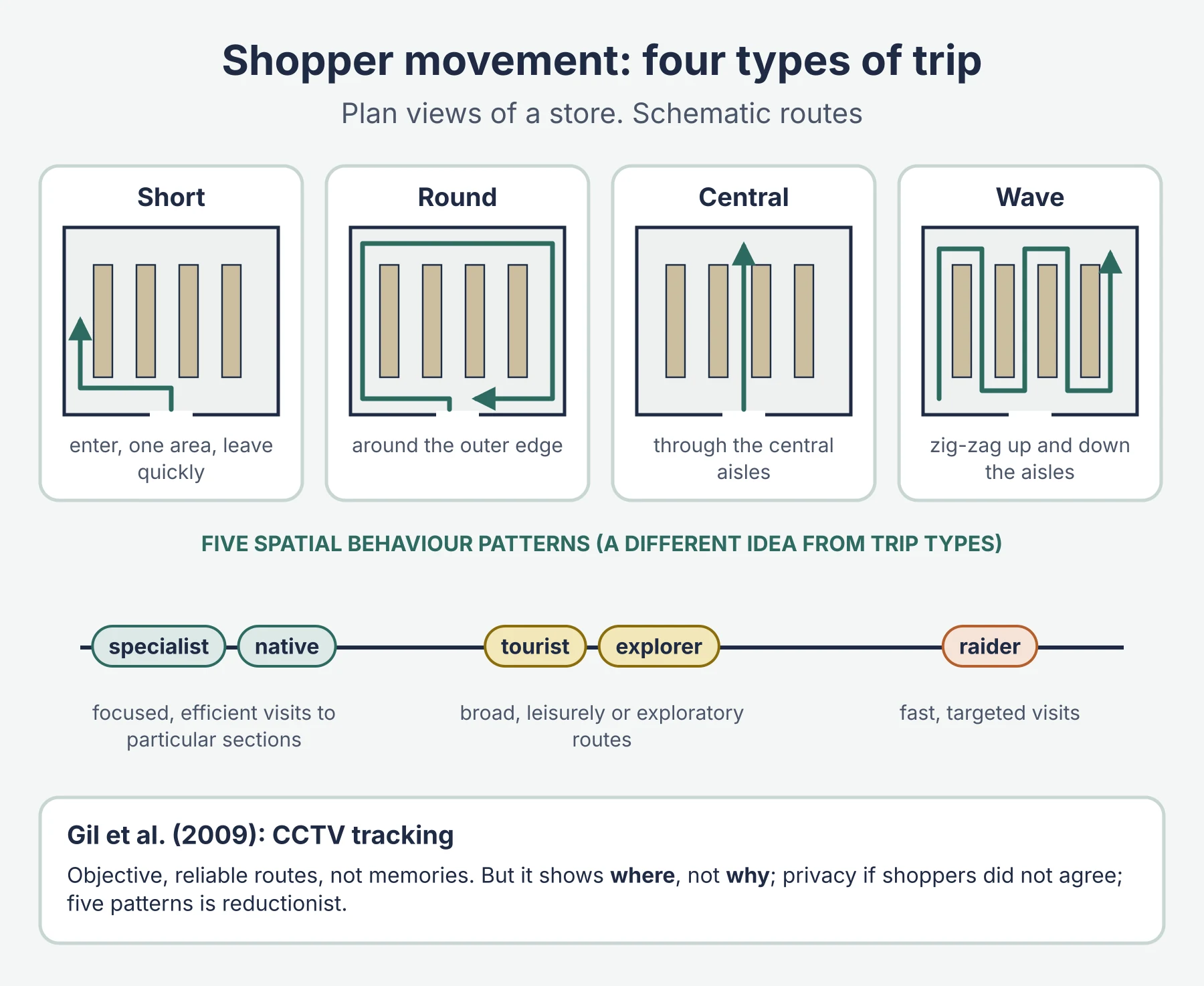
| Trip | Pattern |
|---|---|
| Short | One area, then leave |
| Round | Around the outer edge |
| Central | Through central aisles |
| Wave | Zig-zag up and down aisles |
Spatial behaviour patterns: specialist, native, tourist, explorer, raider.
CCTV tracking (e.g. Gil et al., 2009): objective, reliable record of routes; shows where, not why; privacy concerns; five patterns simplify real behaviour.
2.2.2 Menu design
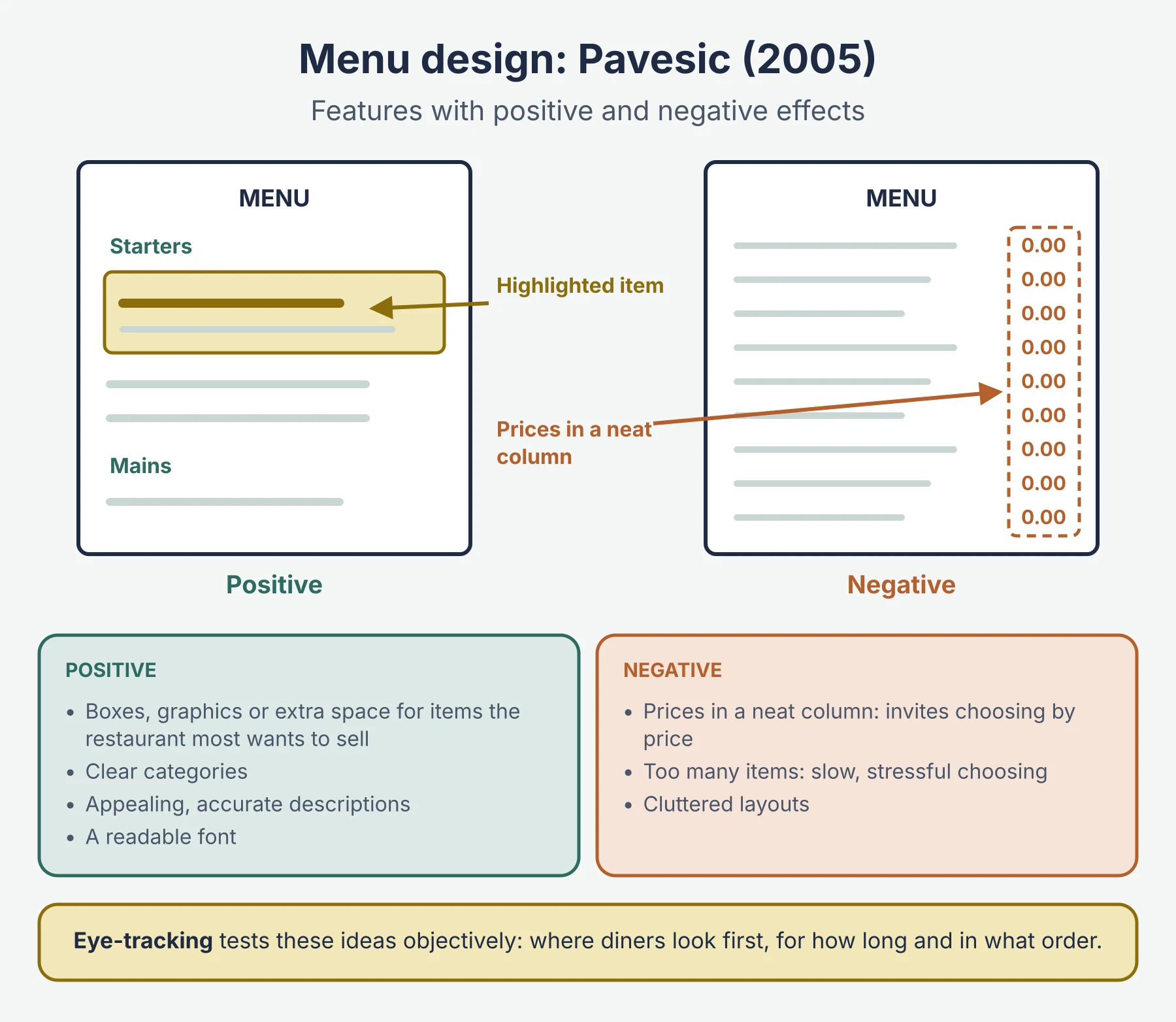
| Feature | Effect |
|---|---|
| Boxes, graphics, extra space around an item | Draws attention; item chosen more |
| Prices in a neat column | Encourages choosing by price |
| Too many items | Slower, more stressful choice |
| Appealing, accurate descriptions | Dish seems more attractive |
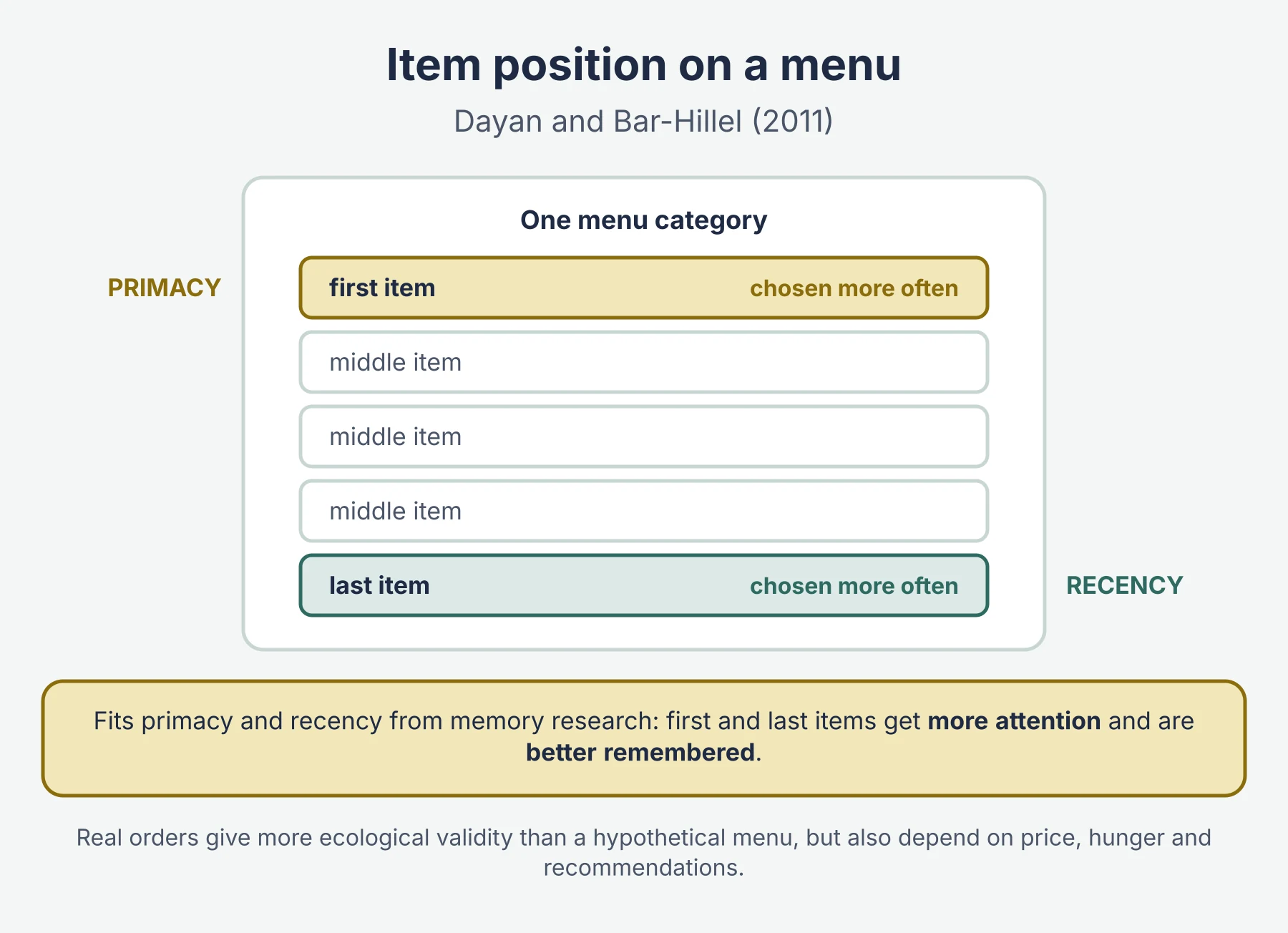
| Item first or last in a category | Chosen more (primacy and recency) |
- Pavesic (2005): positive and negative menu features.
- Eye-tracking: records where and for how long diners look.
- Dayan and Bar-Hillel (2011): items at the beginning or end of a category list chosen more often.
- Lockyer (2006): dish names and descriptions influence choice.
2.2.3 Personal space
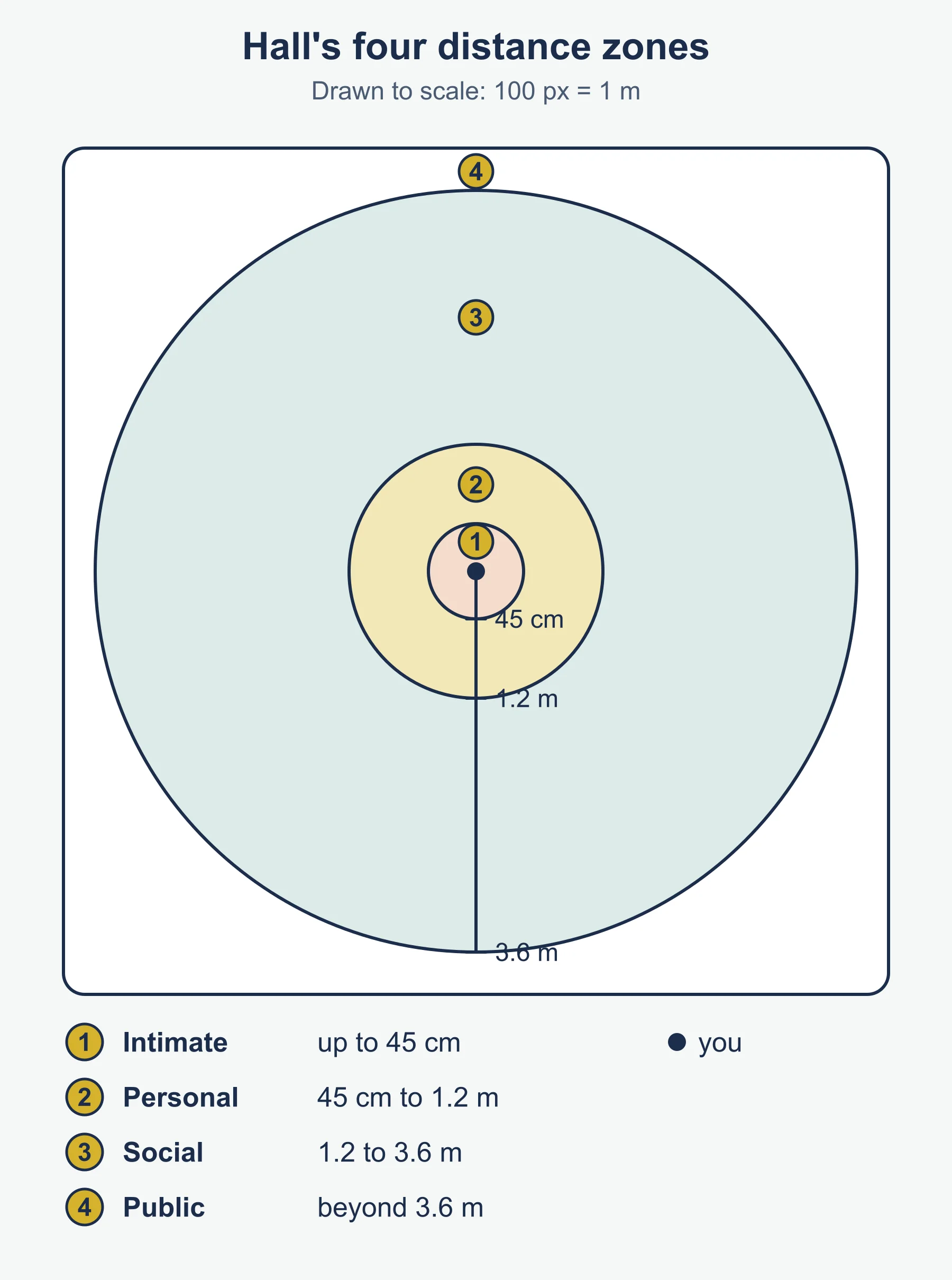
Hall’s zones: intimate (up to about 45 cm); personal (about 45 cm–1.2 m); social (about 1.2–3.6 m); public (beyond about 3.6 m).
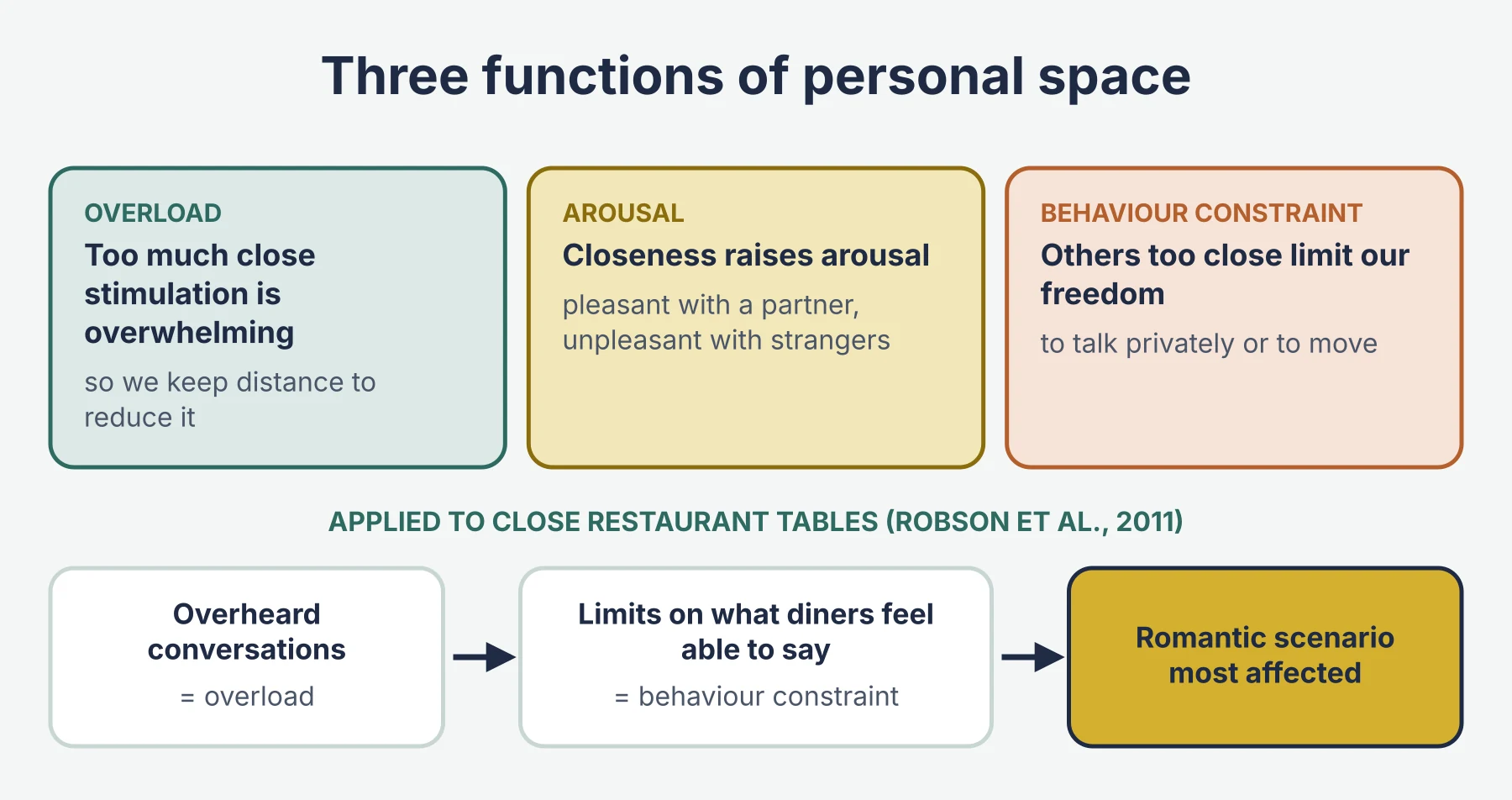
Functions: overload (too much stimulation); arousal (closeness raises arousal, interpreted by context); behaviour constraint (closeness limits freedom to act).
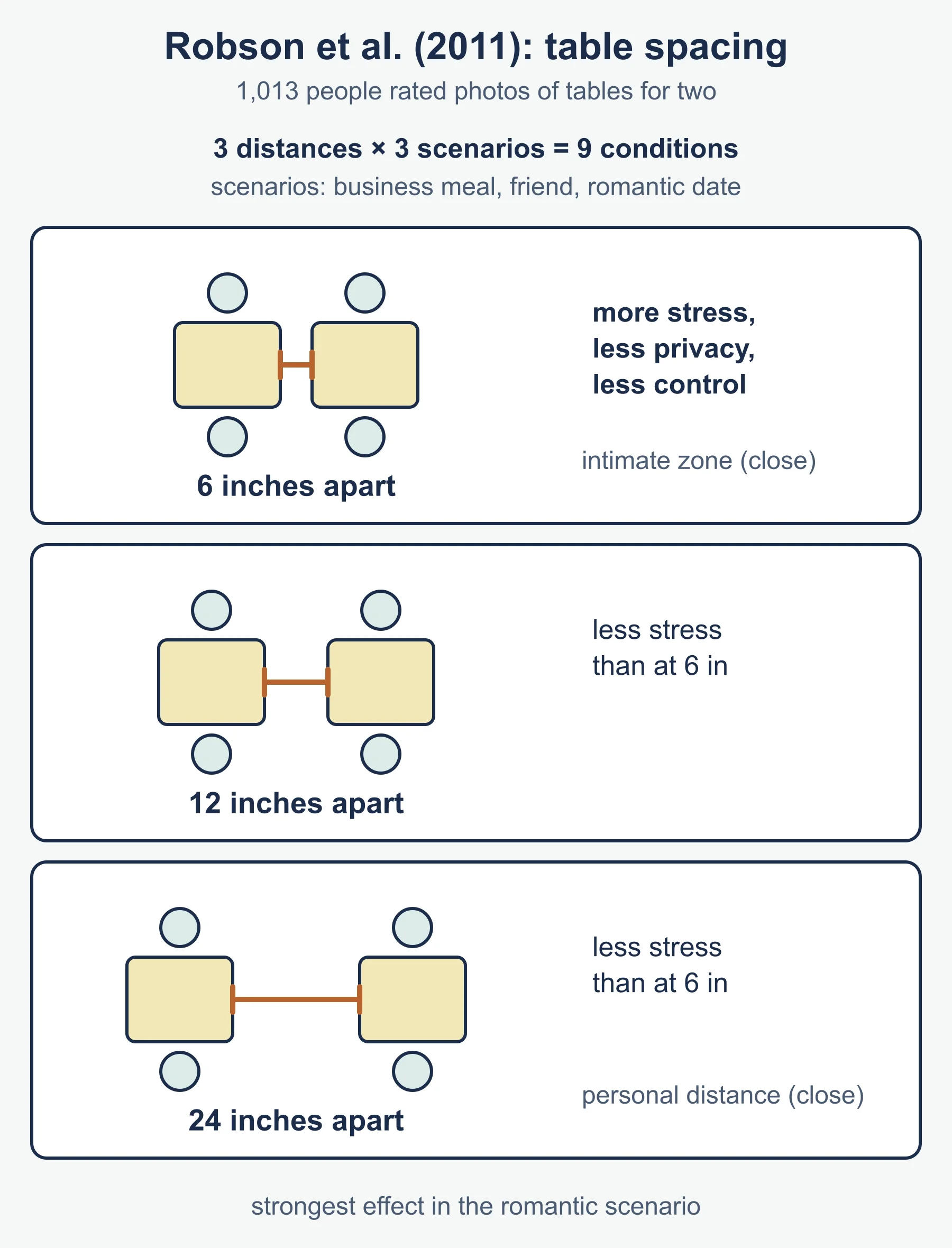
Key study: Robson et al. (2011)
| Element | Detail |
|---|---|
| Aim | Effect of table spacing on diners’ comfort, control and satisfaction |
| Method | Online survey experiment; over a thousand American respondents; photographs of tables at different distances; three dining scenarios |
| Key result | Closest spacing gave more stress and discomfort, less privacy and control; strongest in intimate scenarios |
| Explanation | Overload and behaviour constraint |
| Strength | Large sample; random assignment to conditions; clear application |
| Weakness | Imagined situations; one culture |
Queue intrusion: Milgram et al. (1986)
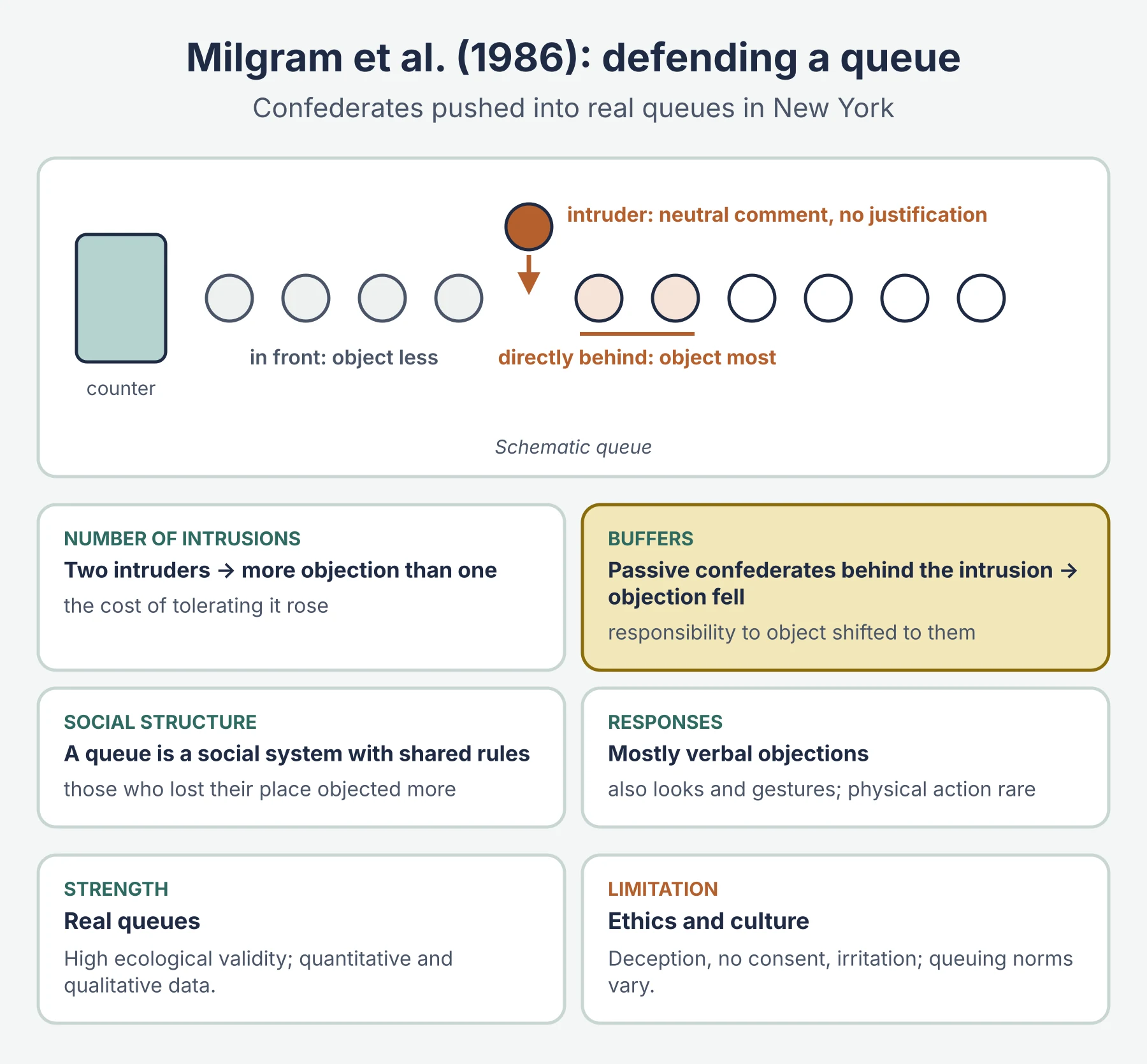
- Confederates pushed into real New York queues.
- Number: two intruders drew more objection than one.
- Social structure: people behind the intrusion point objected most; passive “buffers” reduced objection.
- Responses: mainly verbal; some non-verbal; physical action rare.
- Evaluate: high ecological validity; deception and no consent.
Key terms
| Term | Meaning |
|---|---|
| Wayfinding | Finding one’s way through a space |
| “You are here” map | Map showing the viewer’s position |
| Decision point | A place where a route choice must be made |
| Trip type | Overall route shape through a store |
| Spatial behaviour pattern | A typical style of moving through a store |
| Eye-tracking | Recording where and for how long a person looks |
| Primacy effect | Better attention to or memory for first items |
| Recency effect | Better attention to or memory for last items |
| Personal space | The area around a person that others should not enter uninvited |
| Behaviour constraint | Loss of freedom to act when others are too close |
| Buffer | A person standing between the intruder and others in a queue |
Issues and debates hooks
- Reductionism: five spatial patterns or one menu feature simplify complex behaviour.
- Idiographic versus nomothetic: tracking aggregates many shoppers into general patterns.
- Cultural differences: personal-space distances, queuing norms and menu language vary.
- Individual and situational: table spacing is situational; women reported more discomfort than men in Robson et al. (individual).
- Ethics: CCTV privacy; deception in queue intrusion.
Exam traps
- Mixing up trip types (four) and spatial behaviour patterns (five).
- Forgetting the distances for Hall’s zones.
- Explaining primacy and recency without linking them to menu position.
- Saying people in front of the intruder objected most.
- Treating Robson et al. as an observation of real diners.
Self-test
- Define wayfinding.
- Why should a “you are here” map be aligned with the viewer’s direction?
- Name the four trip types.
- Name the five spatial behaviour patterns.
- Give one strength and one weakness of CCTV tracking.
- Why might listing prices in a column reduce spending?
- Which menu positions did Dayan and Bar-Hillel find were chosen most?
- Give the approximate distance range of the personal zone.
- Explain the behaviour-constraint function of personal space.
- Which scenario in Robson et al. was most affected by close spacing?
- In Milgram et al., who objected most to an intrusion?
- What effect did buffers have?
Answers: (1) the process of working out where you are, where you want to go and how to get there. (2) so that “up” on the map means “straight ahead”, making it easier to use. (3) short, round, central, wave. (4) specialist, native, tourist, explorer, raider. (5) strength: objective record of real routes; weakness: shows where people go, not why, and raises privacy issues. (6) diners compare prices and choose cheaper items. (7) the beginning and end of a category list. (8) about 45 cm to 1.2 m. (9) when others are too close, our freedom to act is limited, for example to talk privately. (10) the romantic scenario. (11) people standing directly behind the point of intrusion. (12) they reduced objection.
Official syllabus
Cambridge International AS & A Level Psychology 9990 syllabus for 2024, 2025 and 2026, Specialist Option 2, 2.2 The psychological environment — cambridgeinternational.org.
More resources on this topic
Related resources
-
Study guides
Cambridge A Level Psychology 9990: Consumer Psychology (Specialist Option 2)
Study guide to Cambridge A Level Psychology 9990 Consumer Psychology: store design, atmospherics, menus, decision-making, packaging, selling and advertising.
Psychology · Cambridge · A Level
Read guide -
Practice questions
Cambridge A Level Psychology 9990: Consumer Psychology — Practice Questions
Original Paper 3 and Paper 4 style questions with mark-scheme answers for Cambridge 9990 Consumer Psychology, from store layout and menus to advertising.
Psychology · Cambridge · A Level
Try questions -
Revision notes
Cambridge A Level Psychology 9990: Consumer Psychology — Revision Notes
Condensed revision notes for Cambridge 9990 Consumer Psychology: models, heuristics, key studies and exam traps for topics 2.1 to 2.5, with a self-test.
Psychology · Cambridge · A Level
Revise topic
Studying Psychology?
This page is free and stays free. Marlbridge is not offering Psychology classes at the moment, so there is no tuition to book for it. The free study resources stay open to everyone.
Get free revision emails (optional)
Occasional emails with practice questions, worked explanations and links to free resources for the qualification and subjects you choose. No spam, and you can unsubscribe from any email. The free tools on this site never need an email.