
Study Guides
Cambridge International AS & A Level Psychology (9990): 2.2 The psychological environment
Topic 2.2 for Cambridge 9990 Consumer Psychology: wayfinding, shopper movement, menu design, personal space, Robson et al. and defending a place in a queue.
- Subject
- Psychology
- Level
- A LEVEL
- Topic
- Specialist Option 2: Consumer Psychology
- Author
- Marlbridge Academic Team
- Updated
- Reviewed by
- Kanwal Aslam (what this means)
Aligned to Cambridge A Level Psychology (9990), 2024-2026. Official specification .
Syllabus page (what it covers and how it is assessed): Cambridge A Level Psychology.
Syllabus points this page covers
9990 (A Level)
- 2.2 The psychological environment
Topic 2.2 of Specialist Option 2, Consumer Psychology, in Cambridge International AS & A Level Psychology (9990) is the psychological environment. Where topic 2.1 looks at physical features such as music and scent, this topic looks at how consumers find their way, move, read menus and use space around other people. It has three parts: 2.2.1 environmental influences on consumers, 2.2.2 menu design psychology and 2.2.3 consumer behaviour and personal space, with the key study by Robson et al. (2011). This guide builds on the Consumer Psychology study guide with more detail and evaluation.
Revise with the psychological environment revision notes and test yourself with the psychological environment practice questions.
2.2.1 Environmental influences on consumers
Wayfinding in shopping malls
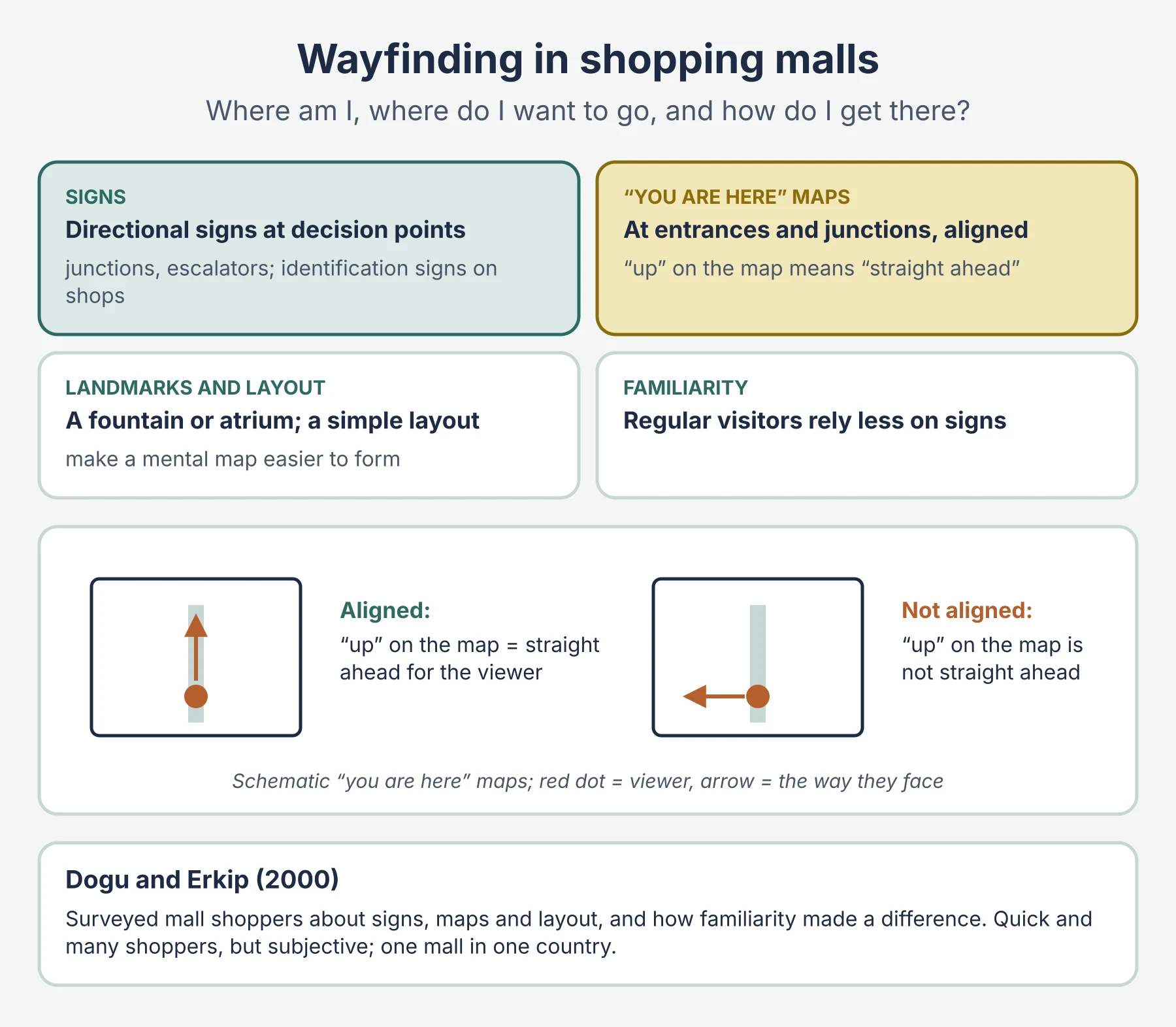
Wayfinding is the process of working out where you are, where you want to go and how to get there. Large malls are hard to navigate because corridors and floors look alike. Factors that help include:
- Signs: directional signs at decision points, such as junctions and escalators, and identification signs on shops.
- “You are here” maps: most useful when placed at entrances and junctions and aligned with the direction the viewer is facing, so that “up” on the map means “straight ahead”.
- Landmarks and layout: distinctive features, such as a fountain or atrium, and a simple layout make a mental map easier to form.
- Familiarity: regular visitors rely less on signs.
Dogu and Erkip (2000) is the suggested study. They surveyed shoppers in a shopping mall about how signs, maps and the building layout affected their ability to find their way, and examined how familiarity with the mall made a difference. Evaluation: questionnaires give quick access to many shoppers’ experiences but are subjective, and a single mall in one country may not represent malls with different layouts or cultures of use.
Shopper movement
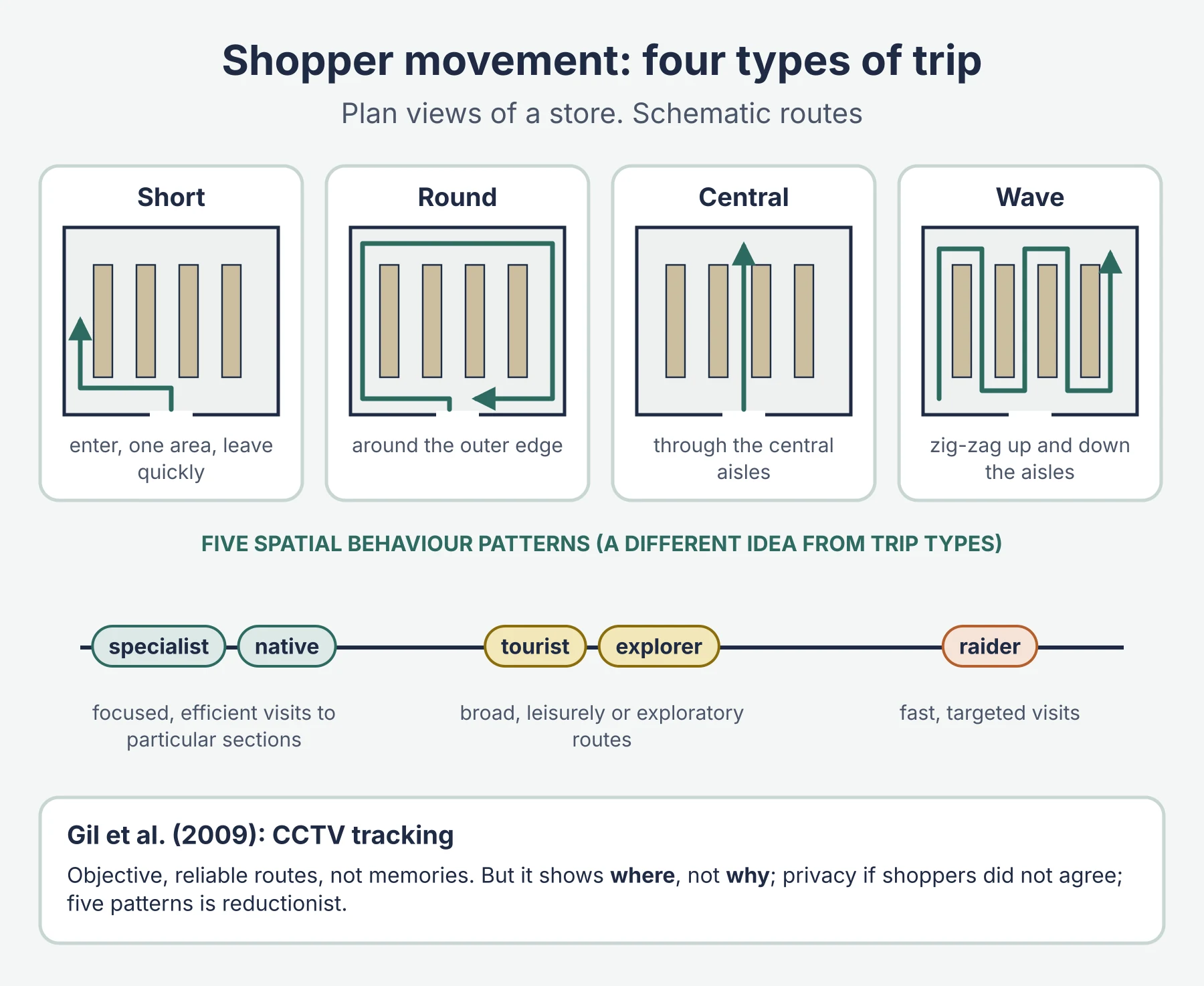
The syllabus names four types of trip:
| Trip type | Pattern |
|---|---|
| Short | Enter, go to one area, leave quickly |
| Round | Move around the outer edge of the store |
| Central | Travel through the central aisles |
| Wave | Zig-zag up and down the aisles |
It also names five spatial behaviour patterns: specialist, native, tourist, explorer and raider. Broadly, these range from focused, efficient visits to particular sections (specialist, native), through broad, leisurely or exploratory routes covering much of the store (tourist, explorer), to fast, targeted visits (raider).
CCTV tracking. Gil et al. (2009) is the suggested study. Tracking shoppers’ routes through a supermarket gives objective data about real movement, which can be grouped into patterns, rather than relying on what shoppers remember or report. Evaluation: tracking is objective and reliable (another researcher would code the same path in the same way), but it shows where people go, not why, and it raises privacy issues if shoppers have not agreed to be tracked. Reducing shopping to five patterns is also reductionist: real shoppers may mix patterns within one trip.
2.2.2 Menu design psychology
Features of menu design
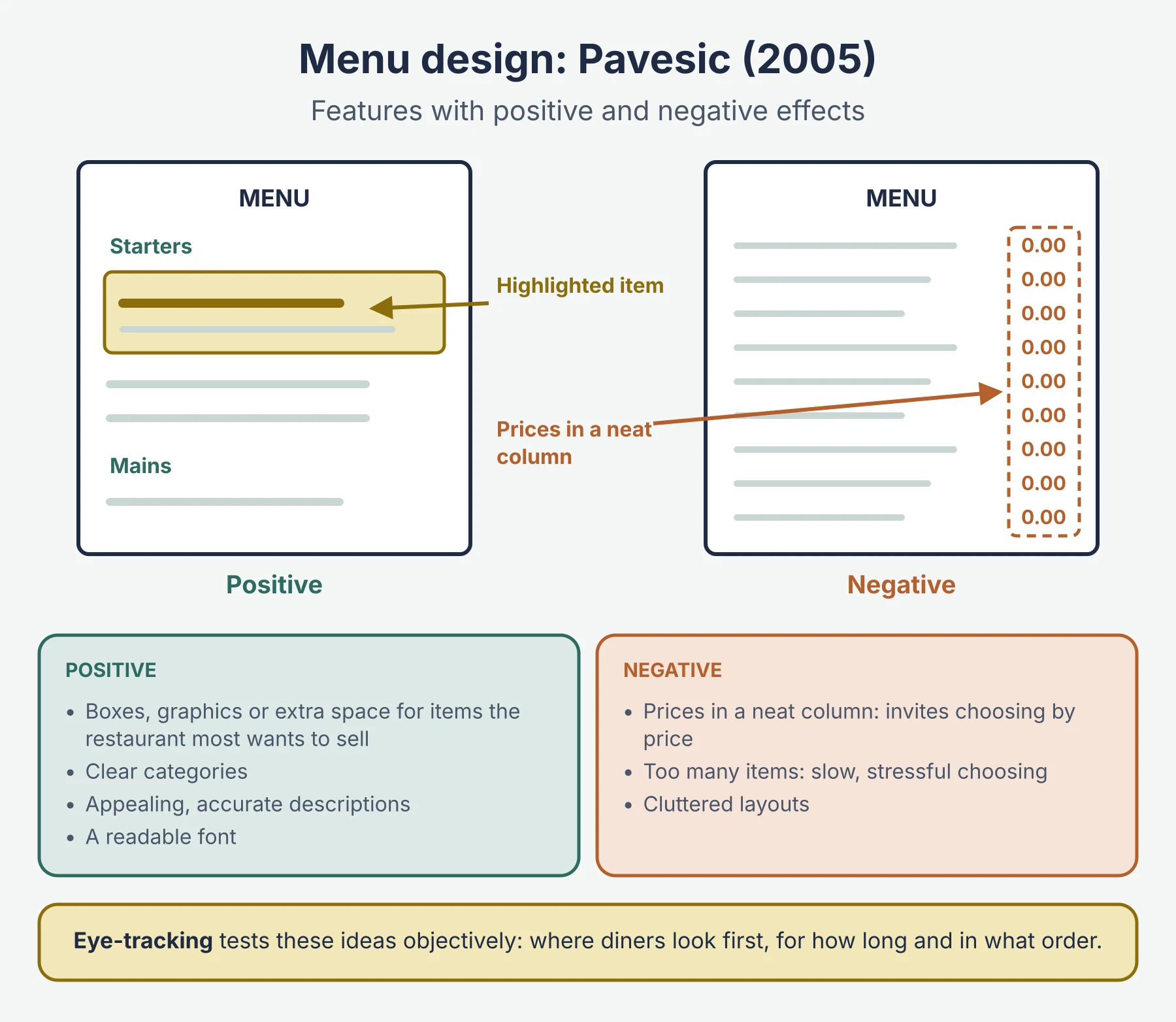
Pavesic (2005) is the suggested source on features of menus that have positive and negative effects.
- Positive features: highlighting items the restaurant most wants to sell with boxes, graphics or extra space; clear categories; appealing, accurate descriptions; a readable font.
- Negative features: listing prices in a neat column, which invites diners to compare and choose by price; too many items, which makes choosing slow and stressful; cluttered layouts.
Eye-tracking can test these ideas objectively by recording where diners look first, how long they look and in what order, rather than asking them.
Item position: primacy and recency
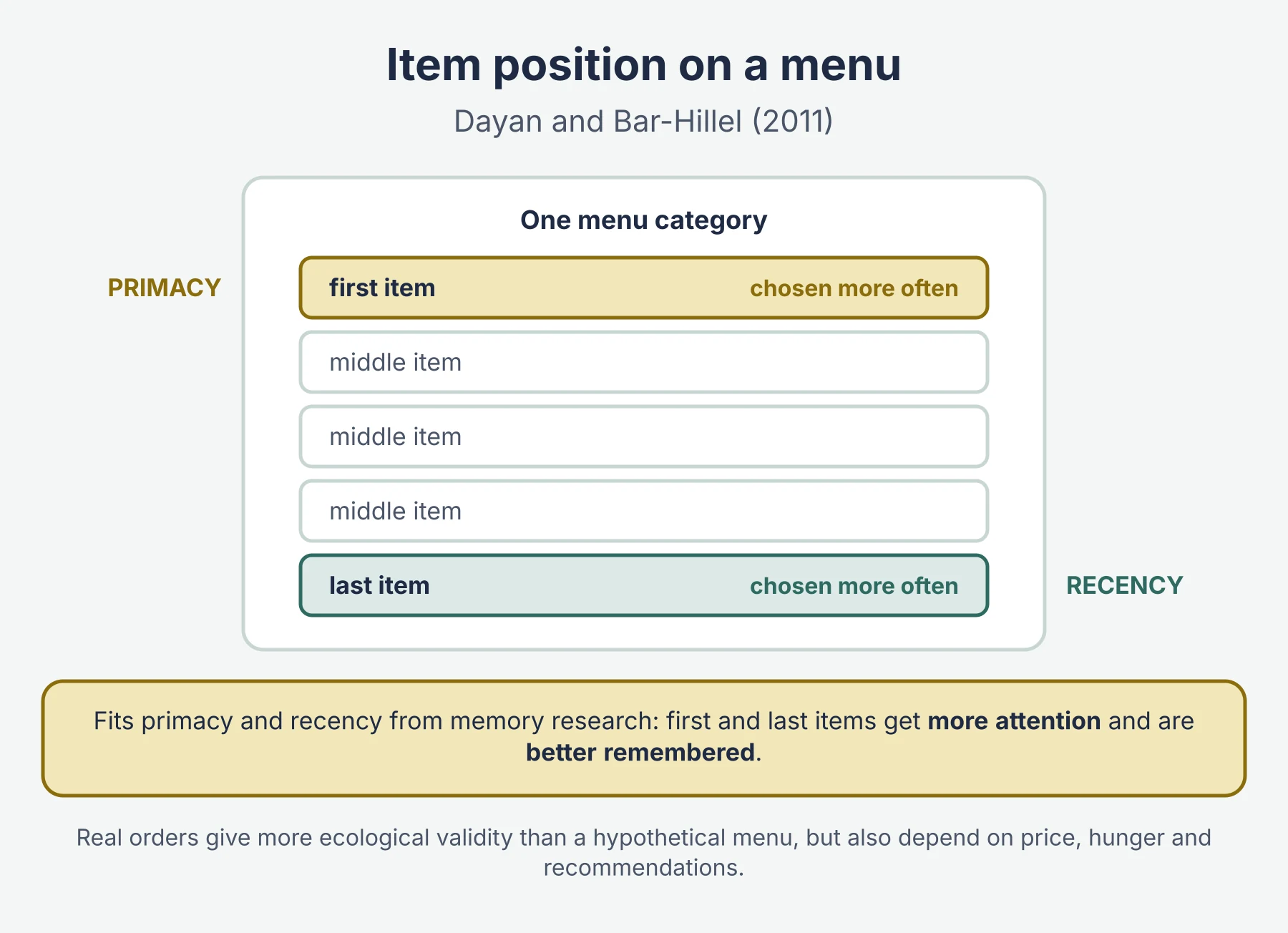
Dayan and Bar-Hillel (2011) found that items placed at the beginning or end of a list within a menu category were chosen more often than the same items in the middle. This fits the primacy and recency effects from memory research: the first and last items in a list receive more attention and are better remembered. Position effects measured on real orders have more ecological validity than choices from a hypothetical menu, though real orders also depend on price, hunger and recommendations.
Food names
Lockyer (2006) is the suggested study on how the names and descriptions of dishes influence diners’ choices. A descriptive name that suggests quality, freshness or origin may make a dish more appealing than a plain label. Evaluation: findings have direct application to menu writing, but what sounds appealing depends on culture and language, limiting generalisation.
2.2.3 Consumer behaviour and personal space
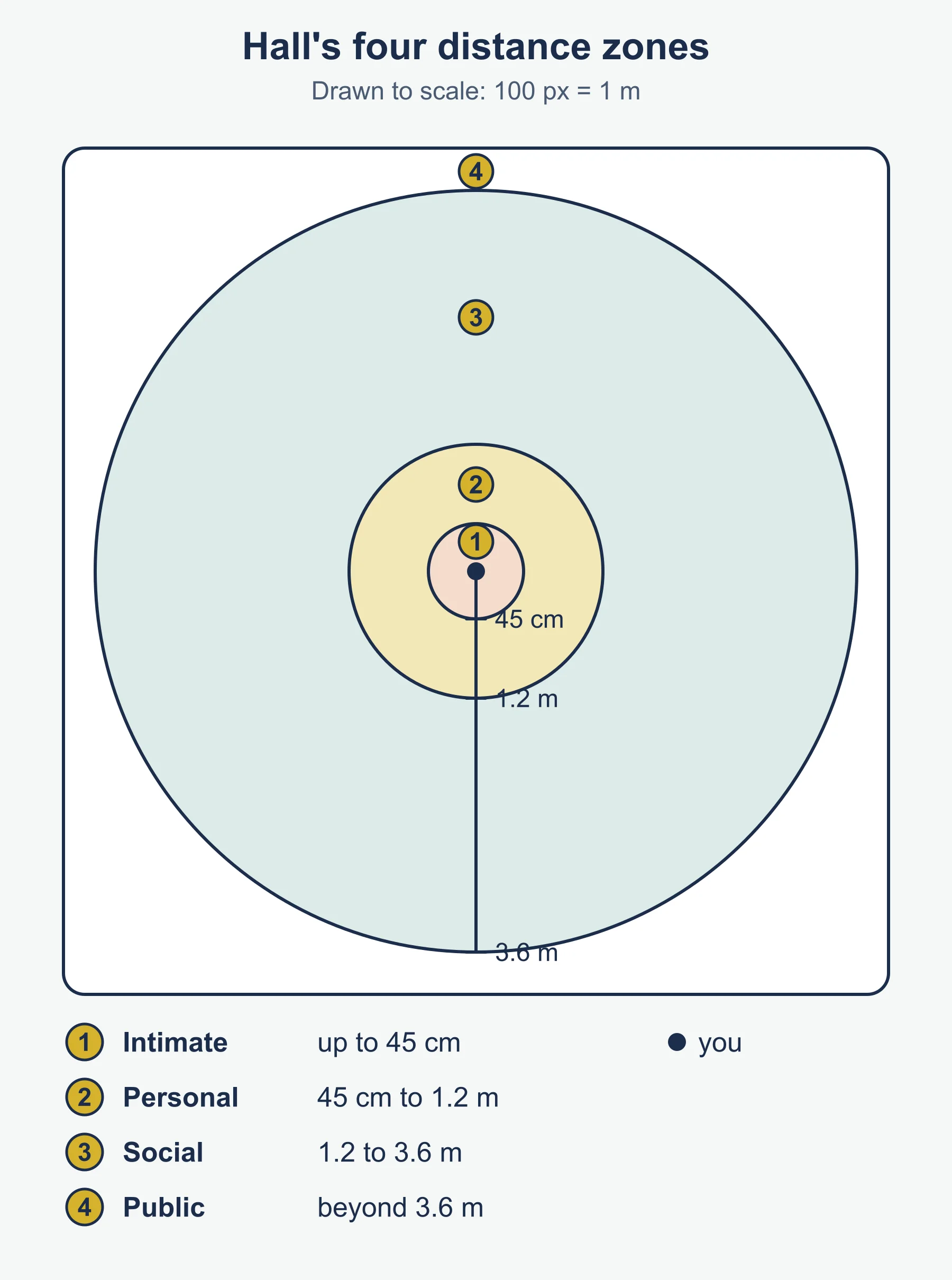
Hall’s four zones and the functions of personal space
| Zone | Approximate distance | Typical use |
|---|---|---|
| Intimate | Up to about 45 cm | Close relationships |
| Personal | About 45 cm to 1.2 m | Friends and conversation |
| Social | About 1.2 m to 3.6 m | Formal and business interaction |
| Public | Beyond about 3.6 m | Speeches and strangers |
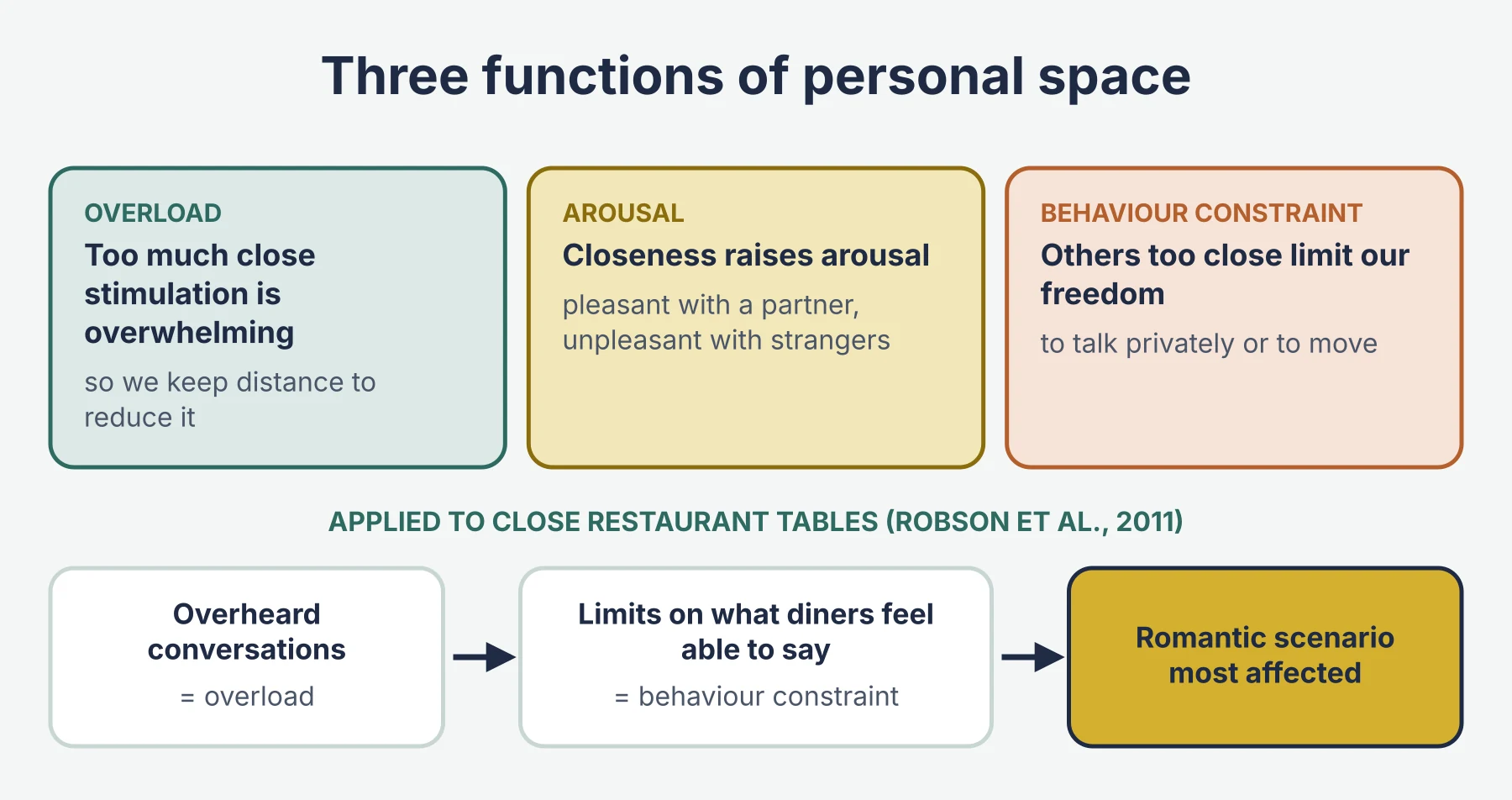
Personal space has three functions named in the syllabus:
- Overload: too much close stimulation from other people is overwhelming, so we keep distance to reduce it.
- Arousal: closeness raises arousal, which is interpreted as pleasant with a partner or unpleasant with strangers.
- Behaviour constraint: when others are too close, our freedom to act (to talk privately, to move) is reduced.
Key study: Robson et al. (2011)
Context. Restaurants can fit more tables by placing them closer together, but this may reduce diners’ comfort. Earlier research on personal space suggested close spacing would cause stress.
Aim. To investigate how the distance between restaurant tables affects diners’ comfort, perceived control and satisfaction in different dining situations.
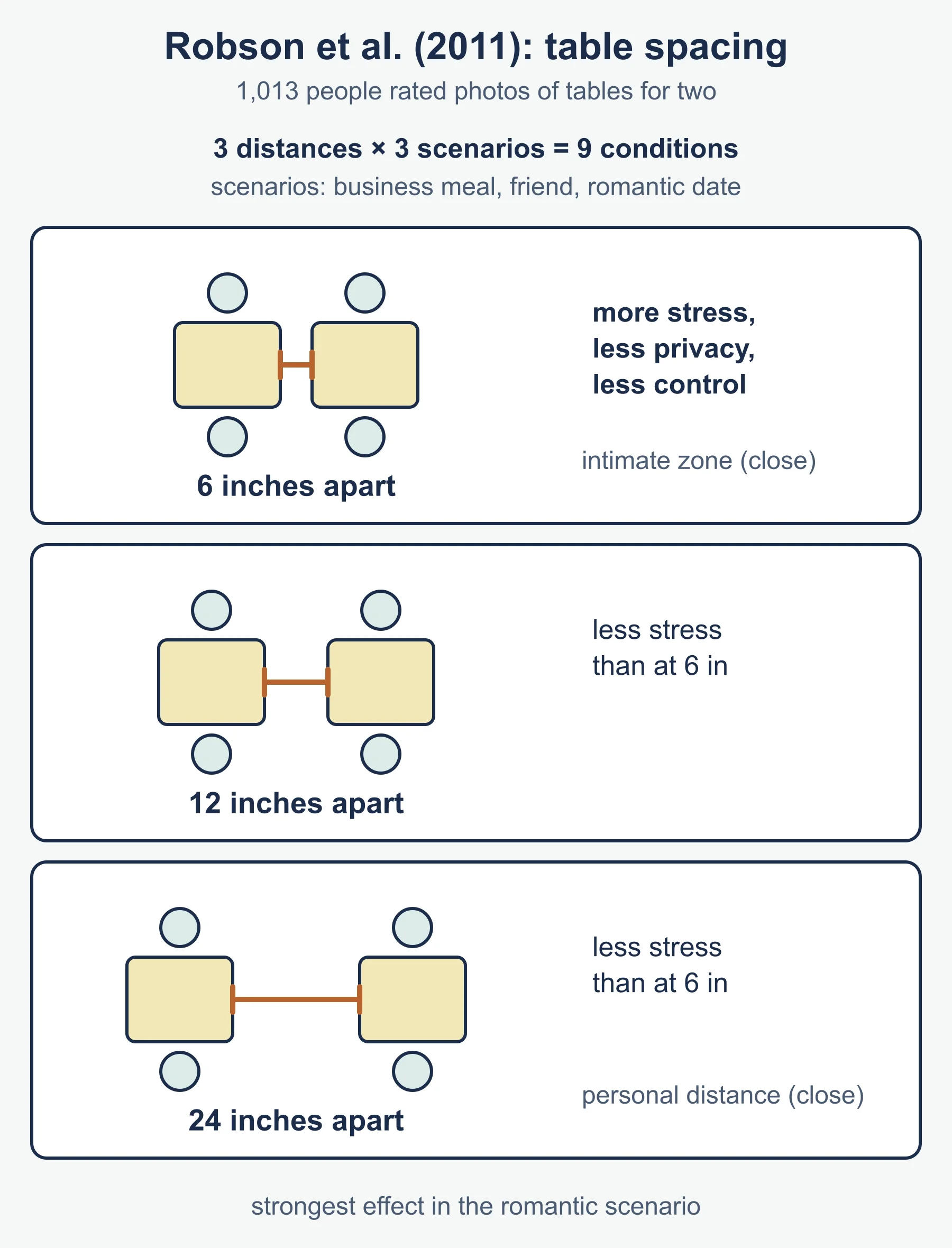
Method and results. An online survey experiment with over a thousand American respondents, who saw photographs of tables for two set at different distances and imagined one of three dining scenarios; the study guide linked above gives the full procedure and results. The key pattern was that the closest spacing produced more stress and discomfort and less privacy and control, especially in more intimate scenarios.
Evaluation beyond the basics.
- Overload and behaviour constraint: close tables mean overheard conversations (overload) and limits on what diners feel able to say (behaviour constraint), which explains why the romantic scenario was most affected.
- Validity: imagining a meal from a photograph lacks the sounds, smells and real neighbours of a restaurant, so real diners might react differently.
- Generalisation: an American sample; preferred distances differ across cultures.
- Application: managers must balance the extra income from more tables against lower satisfaction and return visits.
Defending a place in a queue
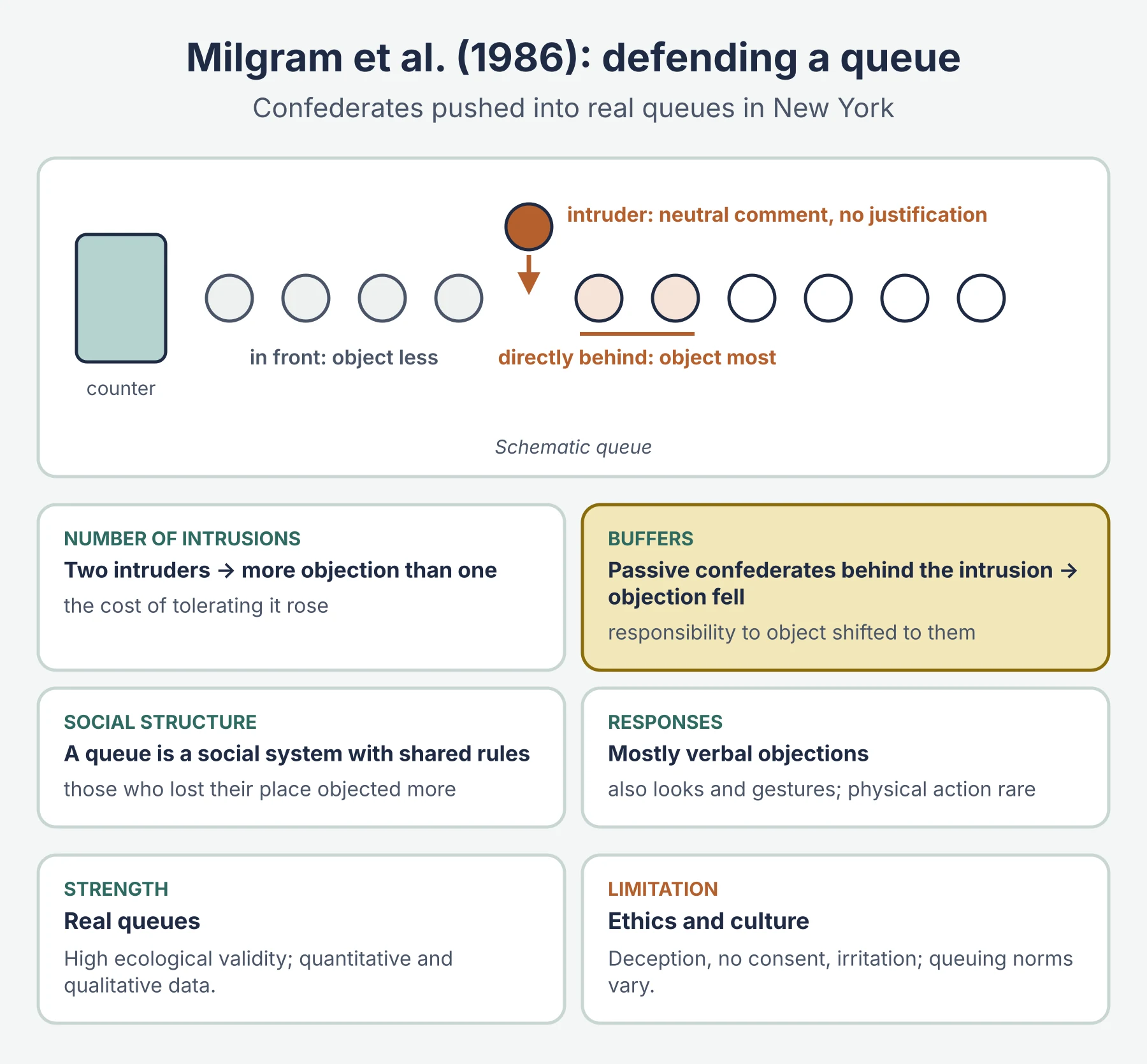
Milgram et al. (1986) is the suggested study. Confederates pushed into real queues in New York, for example at ticket counters, and observers recorded how people responded.
- Nature of intrusion: the confederate stepped into the line with a brief, neutral comment and gave no justification, so any objection was a response to a clear breach of the queue’s rules.
- Number of intrusions: two intruders produced more objection than one, as the cost of tolerating the intrusion rose.
- Social structure of a queue: the queue is a social system with shared rules; people directly behind the point of intrusion, who lost their place, objected more than those in front. When passive confederates (“buffers”) stood behind the intrusion point, objection fell, because the responsibility to object shifted to the buffers.
- Responses: mostly verbal objections; also non-verbal signs such as looks and gestures; physical action was rare.
Evaluation: observing real queues gives high ecological validity and both quantitative (how often objections occurred) and qualitative (what people said) data. But people were deceived and did not consent, and intrusion may have caused irritation, so ethics must be considered; queuing norms also vary across cultures.
Common mistakes
- Treating wayfinding as only signs; layout, landmarks and familiarity also matter.
- Confusing trip types with spatial behaviour patterns.
- Listing Hall’s zones without distances.
- Saying people in front of the intruder objected most in Milgram et al.
Exam technique
The syllabus pairs this topic with reductionism, generalisations, validity, observations and ethics. In application questions, such as advising a café on its menu or a mall on signage, name the concept, apply it to the scenario and cite the supporting study.
Official syllabus
Cambridge International AS & A Level Psychology 9990 syllabus for 2024, 2025 and 2026, Specialist Option 2: Consumer Psychology, 2.2 The psychological environment — cambridgeinternational.org.
More resources on this topic
Related resources
-
Practice questions
Cambridge International AS & A Level Psychology (9990): 2.2 The psychological environment – Practice Questions
Original Paper 3 and Paper 4 style questions with answers on 9990 Consumer Psychology topic 2.2: wayfinding, menus, personal space, Robson et al. and queues.
Psychology · Cambridge · A Level
Try questions -
Revision notes
Cambridge International AS & A Level Psychology (9990): 2.2 The psychological environment – Revision Notes
Revision notes for 9990 Consumer Psychology topic 2.2: wayfinding, trip types, menu design, Hall's zones, Robson et al., queue intrusion and a self-test.
Psychology · Cambridge · A Level
Revise topic -
Study guides
Cambridge A Level Psychology 9990: Consumer Psychology (Specialist Option 2)
Study guide to Cambridge A Level Psychology 9990 Consumer Psychology: store design, atmospherics, menus, decision-making, packaging, selling and advertising.
Psychology · Cambridge · A Level
Read guide
Studying Psychology?
This page is free and stays free. Marlbridge is not offering Psychology classes at the moment, so there is no tuition to book for it. The free study resources stay open to everyone.
Get free revision emails (optional)
Occasional emails with practice questions, worked explanations and links to free resources for the qualification and subjects you choose. No spam, and you can unsubscribe from any email. The free tools on this site never need an email.