
Revision Notes
Cambridge International AS & A Level Psychology (9990): 2.1 The physical environment – Revision Notes
Revision notes for 9990 Consumer Psychology topic 2.1: store design, layouts, North et al., noise and taste, the PAD model, odour, crowding and a self-test.
- Subject
- Psychology
- Level
- A LEVEL
- Topic
- Specialist Option 2: Consumer Psychology
- Author
- Marlbridge Academic Team
- Updated
- Reviewed by
- Kanwal Aslam (what this means)
Aligned to Cambridge A Level Psychology (9990), 2024-2026. Official specification .
Syllabus page (what it covers and how it is assessed): Cambridge A Level Psychology.
Syllabus points this page covers
9990 (A Level)
- 2.1 The physical environment
These notes condense topic 2.1, the physical environment, from Specialist Option 2, Consumer Psychology, of Cambridge International AS & A Level Psychology (9990), syllabus for 2024 to 2026. The topic has three parts: store design, sound, and atmospherics. Learn each concept with the study that supports it and one evaluation point. Full explanations are in the physical environment study guide; test yourself with the physical environment practice questions.
2.1.1 Retail store design
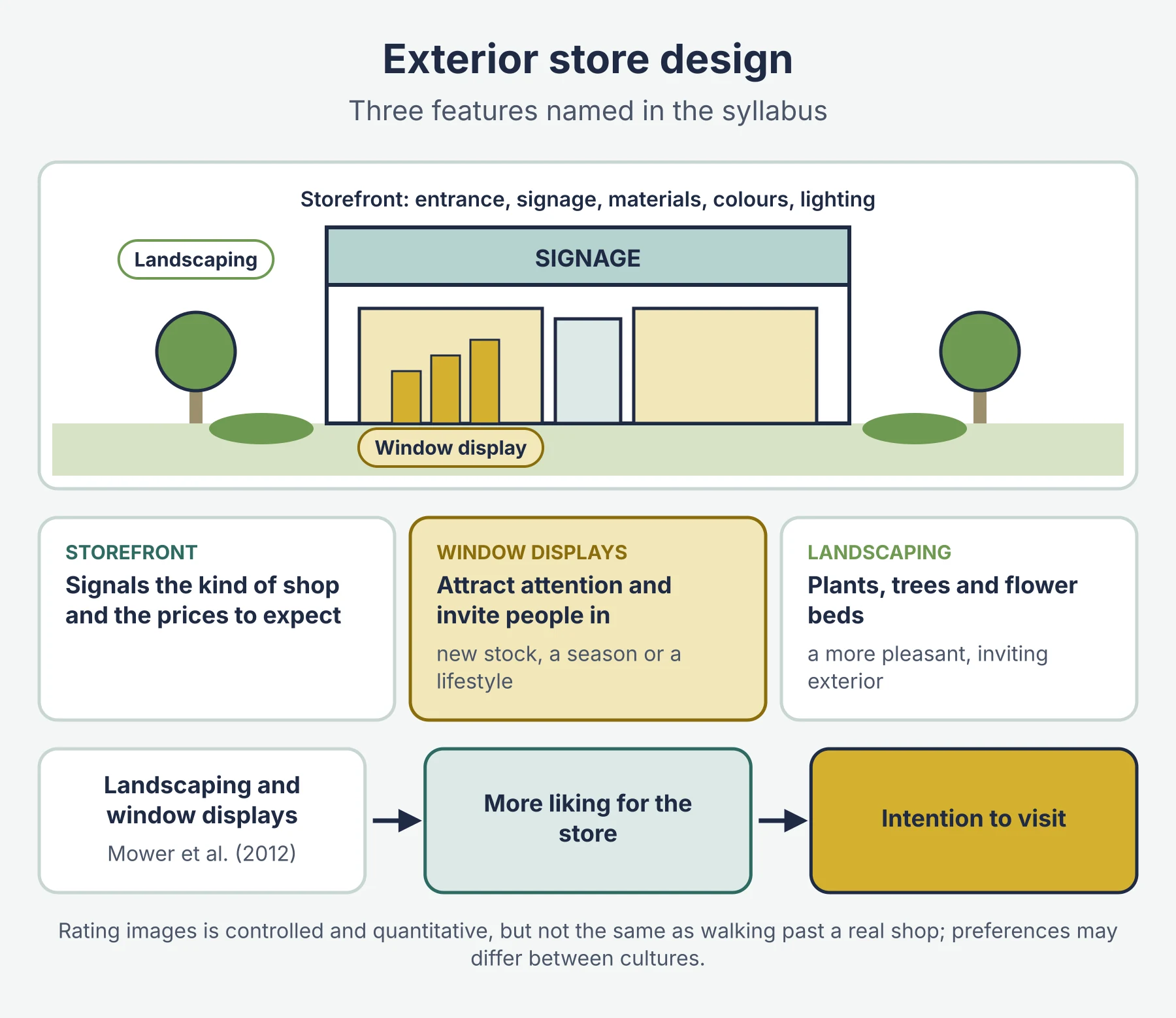
Exterior: storefront (entrance, signage, materials, lighting); window displays; landscaping (plants, trees, outdoor features).
- Mower et al. (2012): landscaping and window displays increased liking of the store, which was linked to intention to shop there.
- Evaluate: controlled ratings of images; low ecological validity; cultural differences in taste.
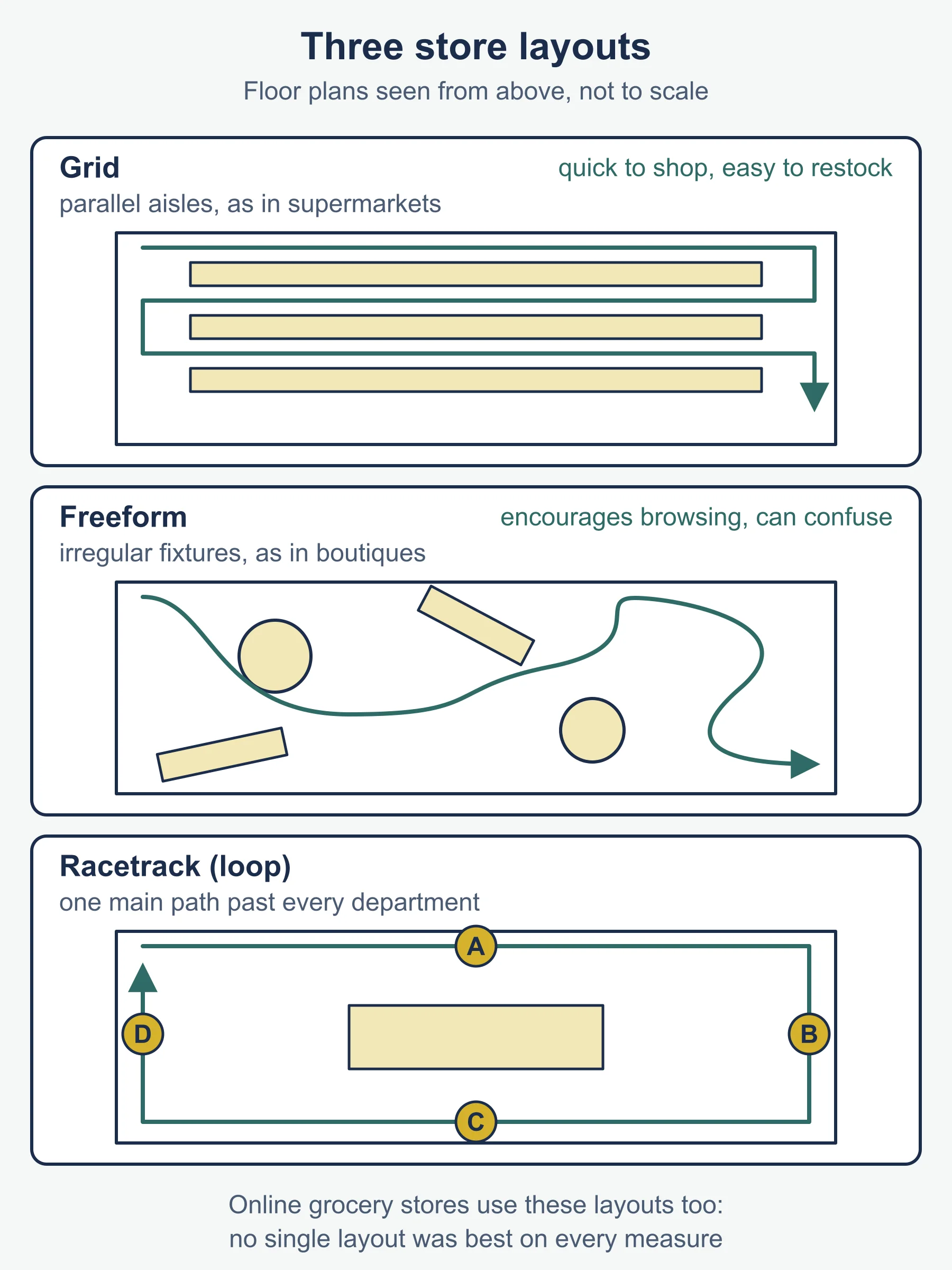
Interior layouts
| Layout | Key feature | Best for | Drawback |
|---|---|---|---|
| Grid | Parallel aisles | Efficiency, staples, restocking | Fast movement, little browsing |
| Freeform | Irregular fixtures | Browsing, boutiques | Confusing; less space-efficient |
| Racetrack | Loop past all departments | Exposure to the whole store | Frustrating for quick trips |
- Vrechopoulos et al. (2004): grid, freeform and racetrack in a virtual grocery store; layouts differed in usefulness, ease of use and enjoyment; none best on all.
2.1.2 Sound
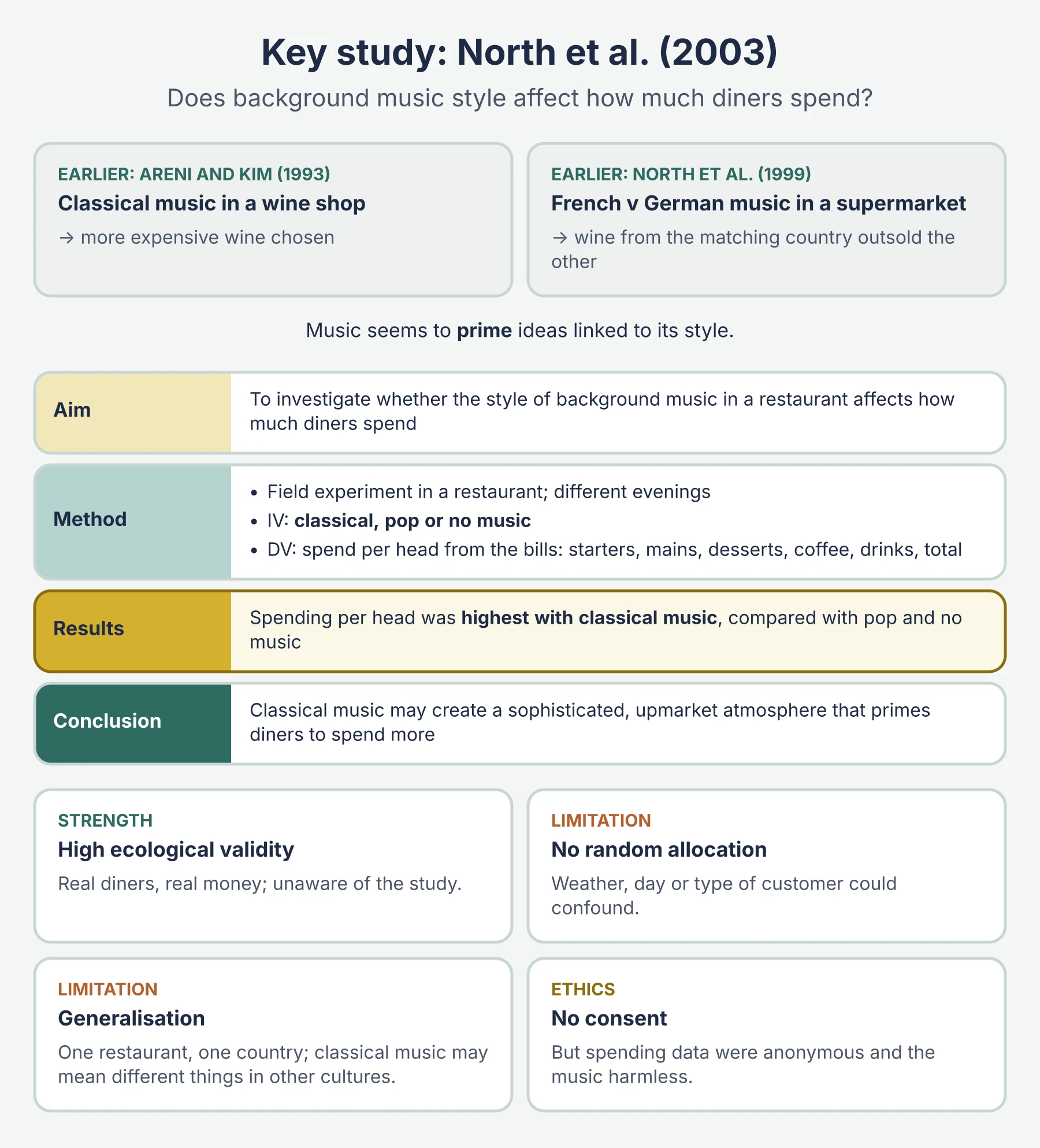
Key study: North et al. (2003)
| Element | Detail |
|---|---|
| Context | Areni and Kim (1993): classical music and pricier wine; North, Hargreaves and McKendrick (1999): French or German music and wine choice |
| Aim | Does musical style affect restaurant spending? |
| Method | Field experiment; classical, pop or no music on different evenings |
| DV | Spending per head on each course, drinks and in total |
| Result | Highest spending with classical music |
| Conclusion | Classical music may prime an upmarket atmosphere |
| Strength | Real diners, real money: high ecological validity; no demand characteristics |
| Weakness | No random allocation; evening-to-evening confounds; one restaurant |
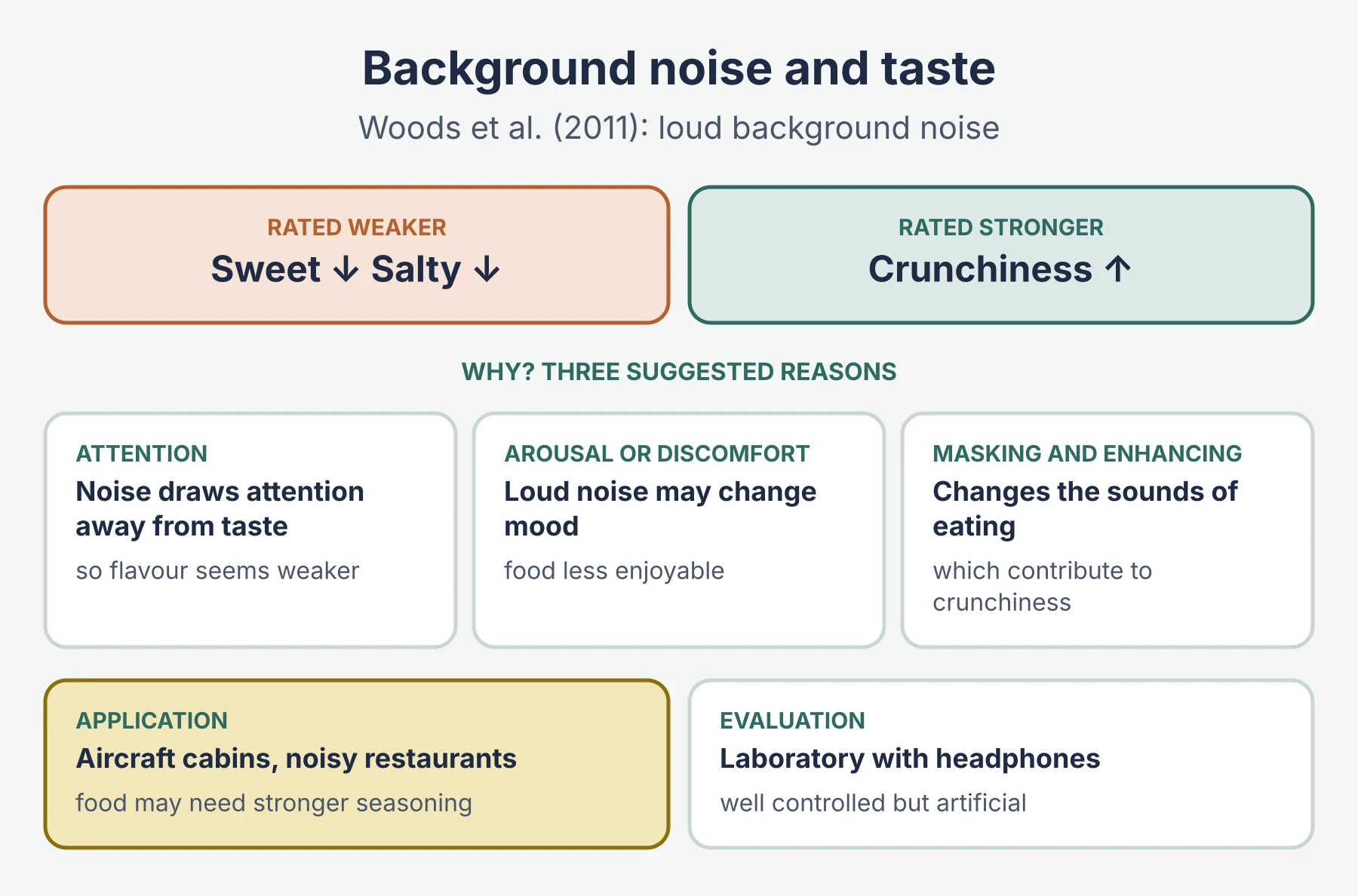
Background noise and taste
- Woods et al. (2011): loud noise lowered ratings of sweetness and saltiness; crunchiness rated stronger.
- Reasons: attention diverted from taste; arousal or discomfort; masking or changing the sounds of eating.
- Application: in-flight meals; loud restaurants.
2.1.3 Atmospherics
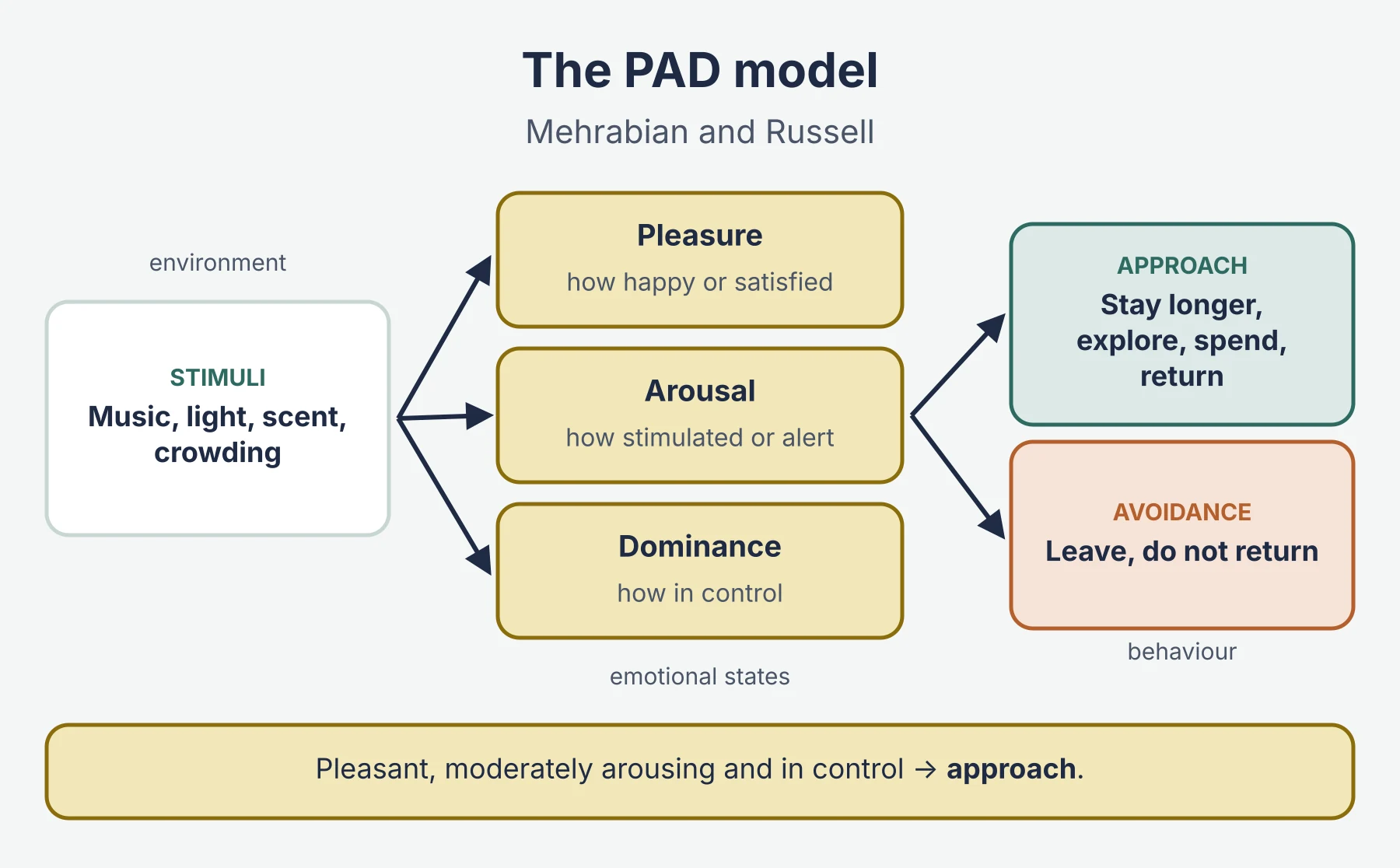
PAD model (Mehrabian and Russell): stimuli → Pleasure, Arousal, Dominance → approach (stay, spend, return) or avoidance (leave).
| Factor | Study | Finding | PAD link |
|---|---|---|---|
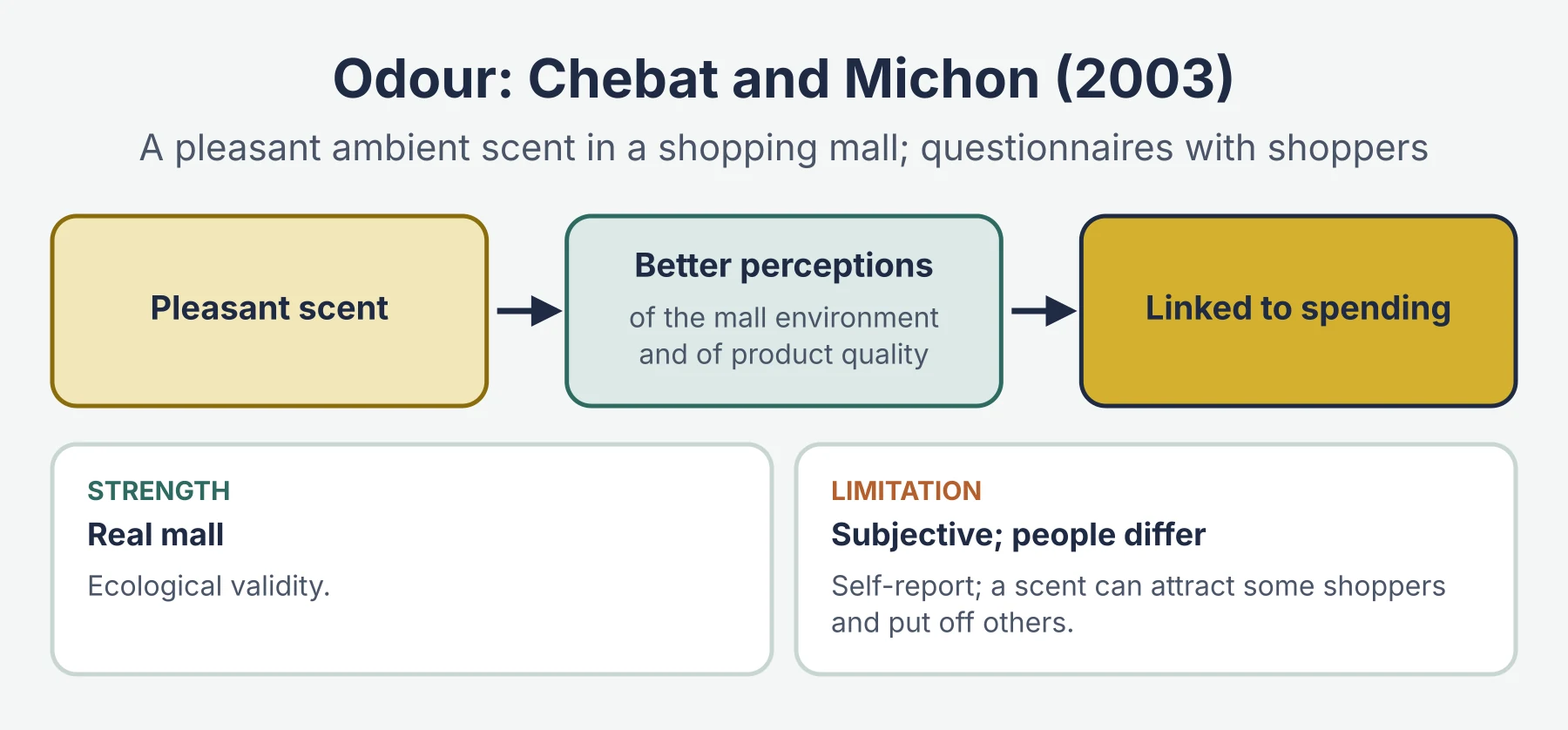
| Odour | Chebat and Michon (2003), shopping mall | Pleasant scent improved perceptions of the mall and product quality, linked to spending | Pleasure |
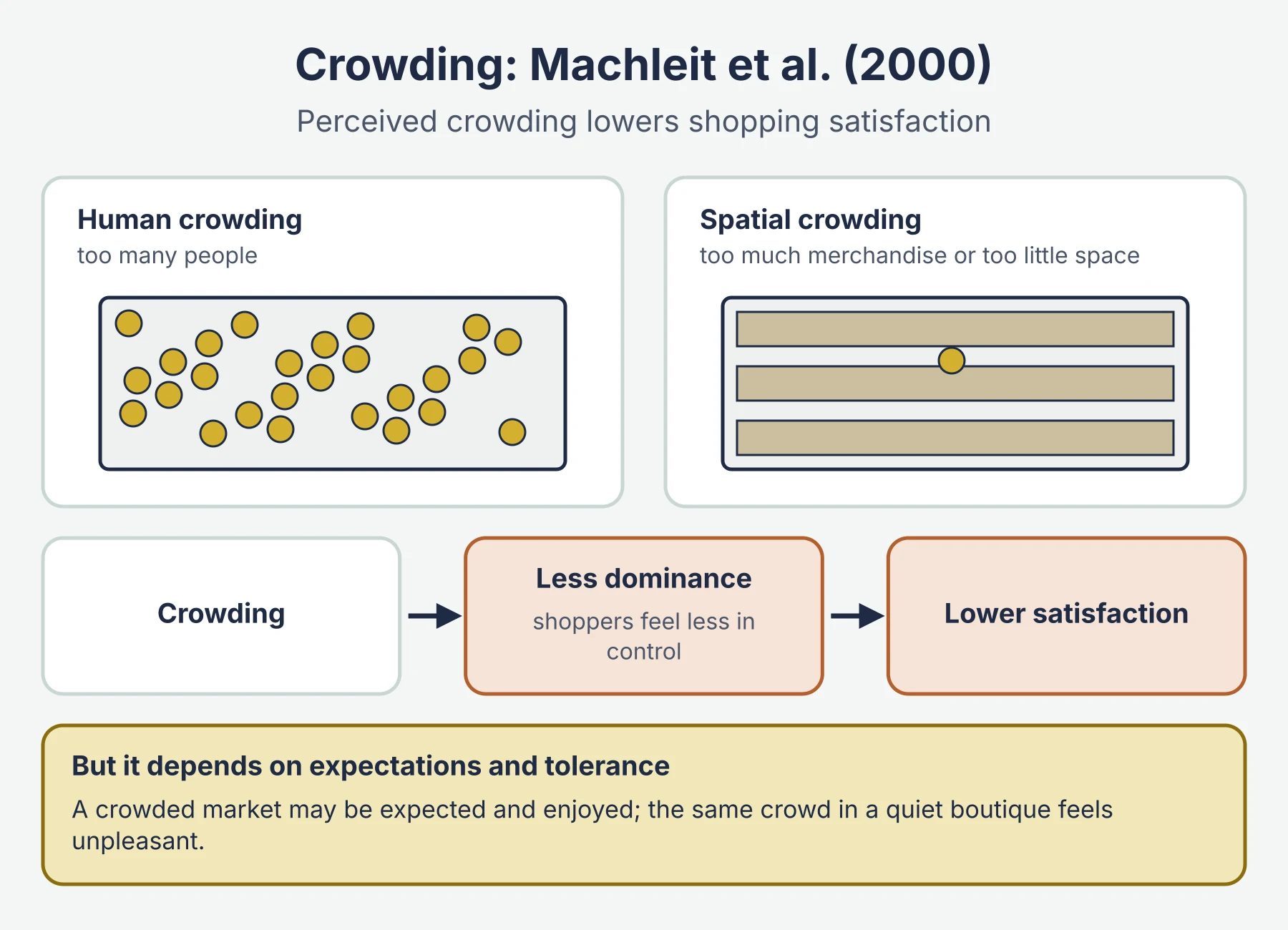
| Crowding | Machleit et al. (2000) | Perceived crowding reduced satisfaction, depending on expectations and tolerance; human vs spatial crowding | Dominance |
Applying the topic in one paragraph
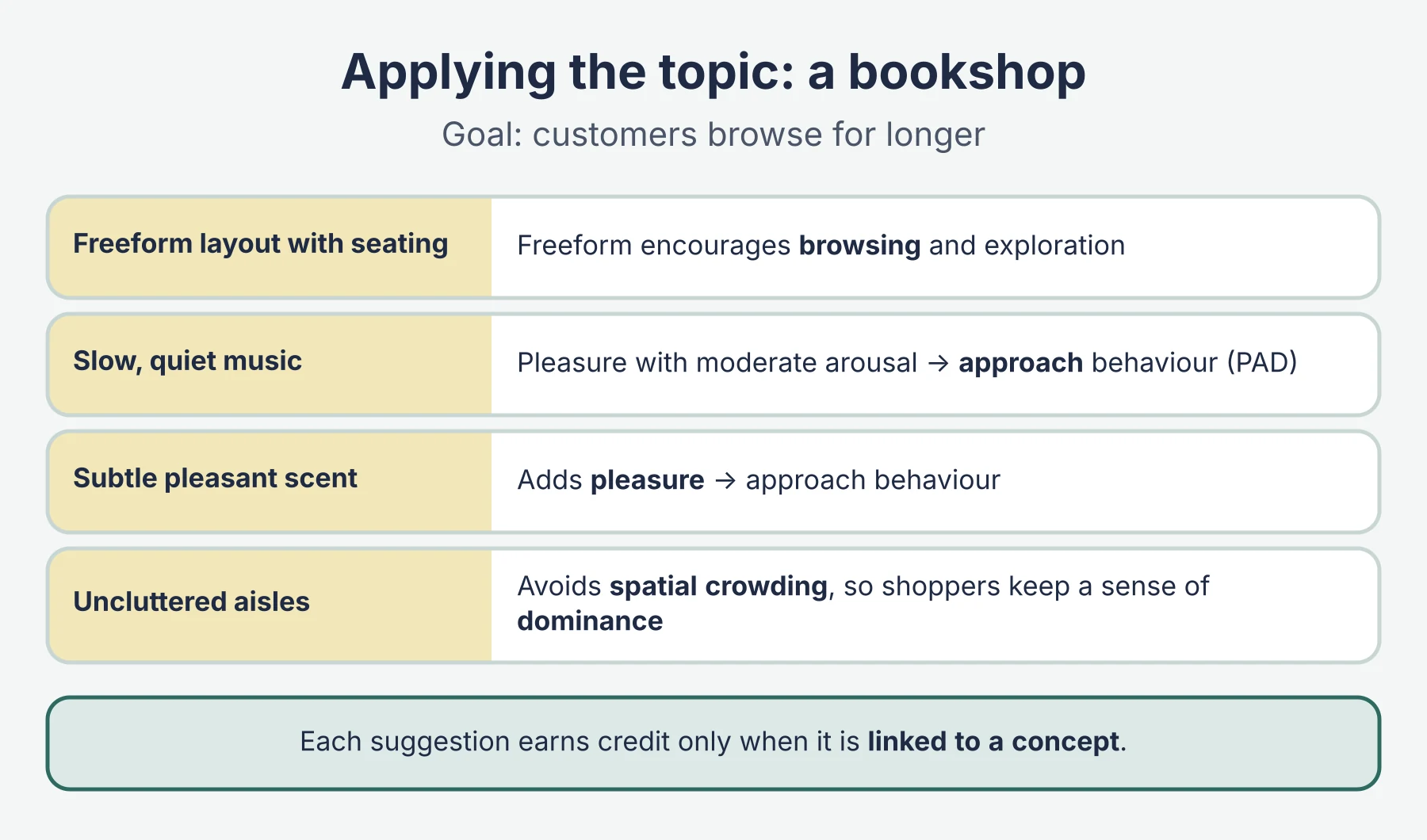
A café owner asks how to make customers stay longer and spend more. Choose a freeform seating plan that invites lingering; play quiet classical music, linking to North et al. (2003) and priming an upmarket feel; keep noise low so food tastes as intended (Woods et al., 2011); add a subtle pleasant scent (Chebat and Michon, 2003); and avoid packing in tables, so customers keep a sense of dominance in PAD terms. For each suggestion, name the concept, apply it to the café and cite the study: that three-step pattern is what application marks reward.
Key terms
| Term | Meaning |
|---|---|
| Storefront | The front of a shop: entrance, signage, materials |
| Landscaping | Plants and outdoor features around a shop |
| Virtual store | An online shop laid out on screen |
| Priming | Exposure to one stimulus activates related ideas, influencing later behaviour |
| Atmospherics | Designing the environment to create emotional effects in shoppers |
| Approach behaviour | Staying, exploring, spending, returning |
| Avoidance behaviour | Leaving or not returning |
| Human crowding | Feeling there are too many people |
| Spatial crowding | Feeling there is too little space or too much merchandise |
| Ambient scent | A background smell not tied to one product |
Issues and debates hooks
- Cultural differences: styles of storefront, music meanings, scent preferences and crowding tolerance vary.
- Individual and situational: music and crowding are situational; expectations and tolerance are individual (Machleit et al.).
- Determinism versus free will: shoppers may be influenced without awareness, raising ethical questions about manipulation.
- Reductionism: one factor (music) is isolated, although the whole atmosphere acts together.
- Objective versus subjective data: bills in North et al. (objective) versus questionnaires in Chebat and Michon (subjective).
Exam traps
- Leaving out approach and avoidance when describing PAD.
- Saying diners were randomly allocated in North et al.
- Confusing freeform and racetrack layouts.
- Forgetting that crowding can be spatial.
- Listing exterior features without examples.
Self-test
- Name the three exterior design features in the syllabus.
- Which layout is typical of supermarkets, and why?
- Which layout leads shoppers past every department?
- What did Vrechopoulos et al. compare?
- Name the three music conditions in North et al.
- In which condition was spending highest?
- Give one confounding variable in North et al.
- How did loud noise affect taste ratings in Woods et al.?
- What do the letters PAD stand for?
- Give one approach behaviour.
- Which PAD state does crowding most reduce?
- Distinguish human and spatial crowding.
Answers: (1) storefront, window displays, landscaping. (2) grid; efficient, easy to find staple items and restock. (3) racetrack. (4) grid, freeform and racetrack layouts in a virtual grocery store. (5) classical, pop, no music. (6) classical. (7) any one of weather, day of the week, type of diners on each evening. (8) sweetness and saltiness rated lower; crunchiness rated stronger. (9) pleasure, arousal, dominance. (10) any one of staying longer, exploring, spending, returning. (11) dominance. (12) human crowding is too many people; spatial crowding is too little space or too much merchandise.
Official syllabus
Cambridge International AS & A Level Psychology 9990 syllabus for 2024, 2025 and 2026, Specialist Option 2, 2.1 The physical environment — cambridgeinternational.org.
More resources on this topic
Related resources
-
Study guides
Cambridge A Level Psychology (9990): The product
Cambridge 9990 topic 2.4 in depth: gift-wrapping, Becker et al. (2011) on packaging, shelf position, sales techniques, closing a sale and buying decisions.
Psychology · Cambridge · A Level
Read guide -
Practice questions
Cambridge A Level Psychology (9990): The product – Practice Questions
Original Paper 3 and Paper 4 style questions on Cambridge 9990 topic 2.4, The product: packaging, shelf position, selling and buying, with full mark schemes.
Psychology · Cambridge · A Level
Try questions -
Revision notes
Cambridge A Level Psychology (9990): The product – Revision Notes
Revision notes for Cambridge 9990 topic 2.4: packaging, Becker et al. (2011), shelf position, selling, the EKB model and dissonance, with a self-test.
Psychology · Cambridge · A Level
Revise topic
Studying Psychology?
This page is free and stays free. Marlbridge is not offering Psychology classes at the moment, so there is no tuition to book for it. The free study resources stay open to everyone.
Get free revision emails (optional)
Occasional emails with practice questions, worked explanations and links to free resources for the qualification and subjects you choose. No spam, and you can unsubscribe from any email. The free tools on this site never need an email.