
Revision Notes
Cambridge A Level Psychology (9990): Consumer decision-making – Revision Notes
Revision notes for Cambridge 9990 topic 2.3: models, strategies, heuristics, system 1 and 2, Hall et al. (2010) and interference, with traps and a self-test.
- Subject
- Psychology
- Level
- A LEVEL
- Topic
- Specialist Option 2: Consumer Psychology
- Author
- Marlbridge Academic Team
- Updated
- Reviewed by
- Kanwal Aslam (what this means)
Aligned to Cambridge A Level Psychology (9990), 2024-2026. Official specification .
Syllabus page (what it covers and how it is assessed): Cambridge A Level Psychology.
Syllabus points this page covers
9990 (A Level)
- 2.3 Consumer decision-making
These notes condense topic 2.3, Consumer decision-making, from Specialist Option 2 of Cambridge International A Level Psychology 9990 (syllabus for 2024 to 2026). Learn the three sub-topics as three sets of contrasts: rational versus bounded models, strategies that trade off versus strategies that cut off, and fast versus slow thinking.
For full explanations and a model answer, use the consumer decision-making study guide. For exam practice, use the consumer decision-making practice questions.
The topic on one page
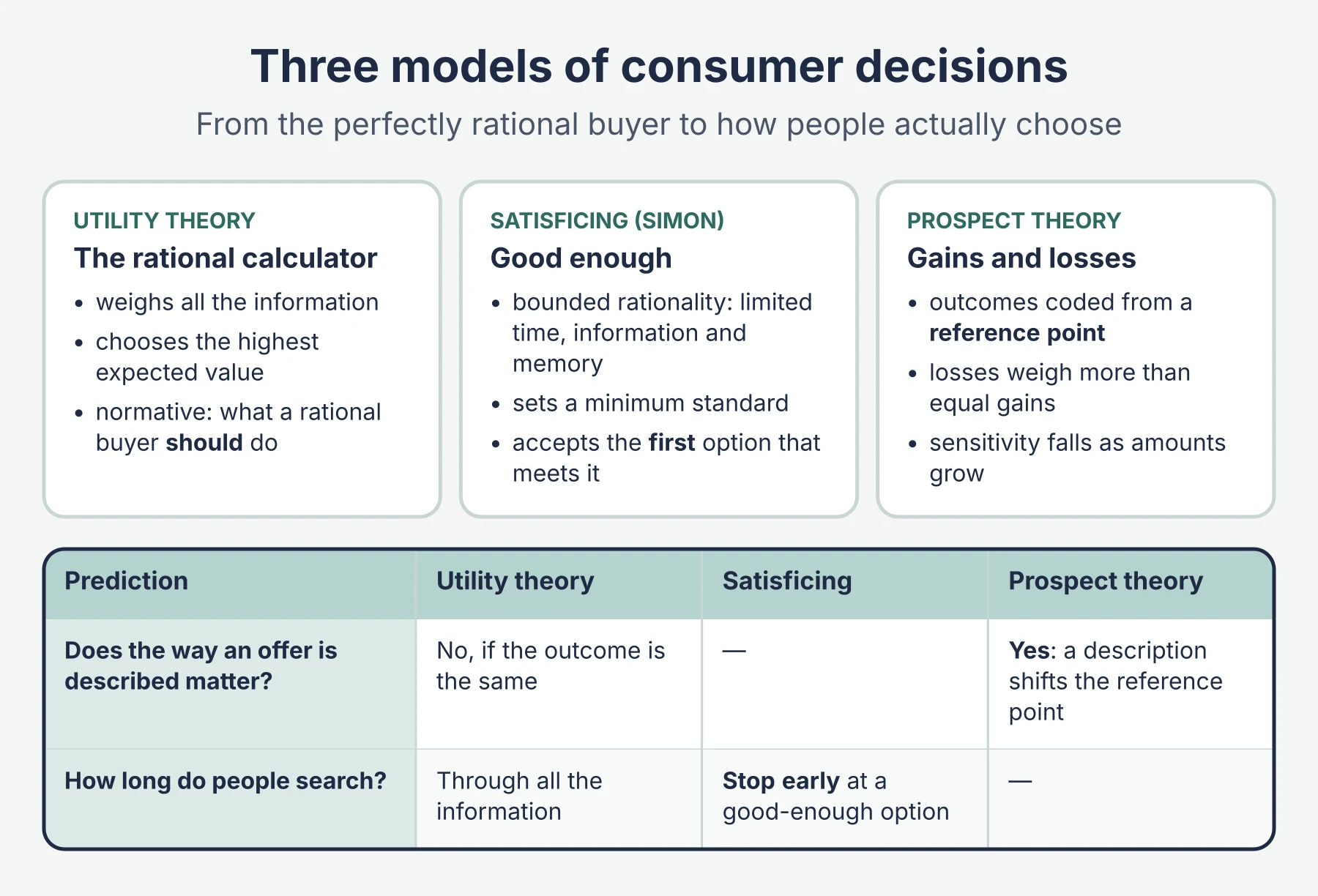
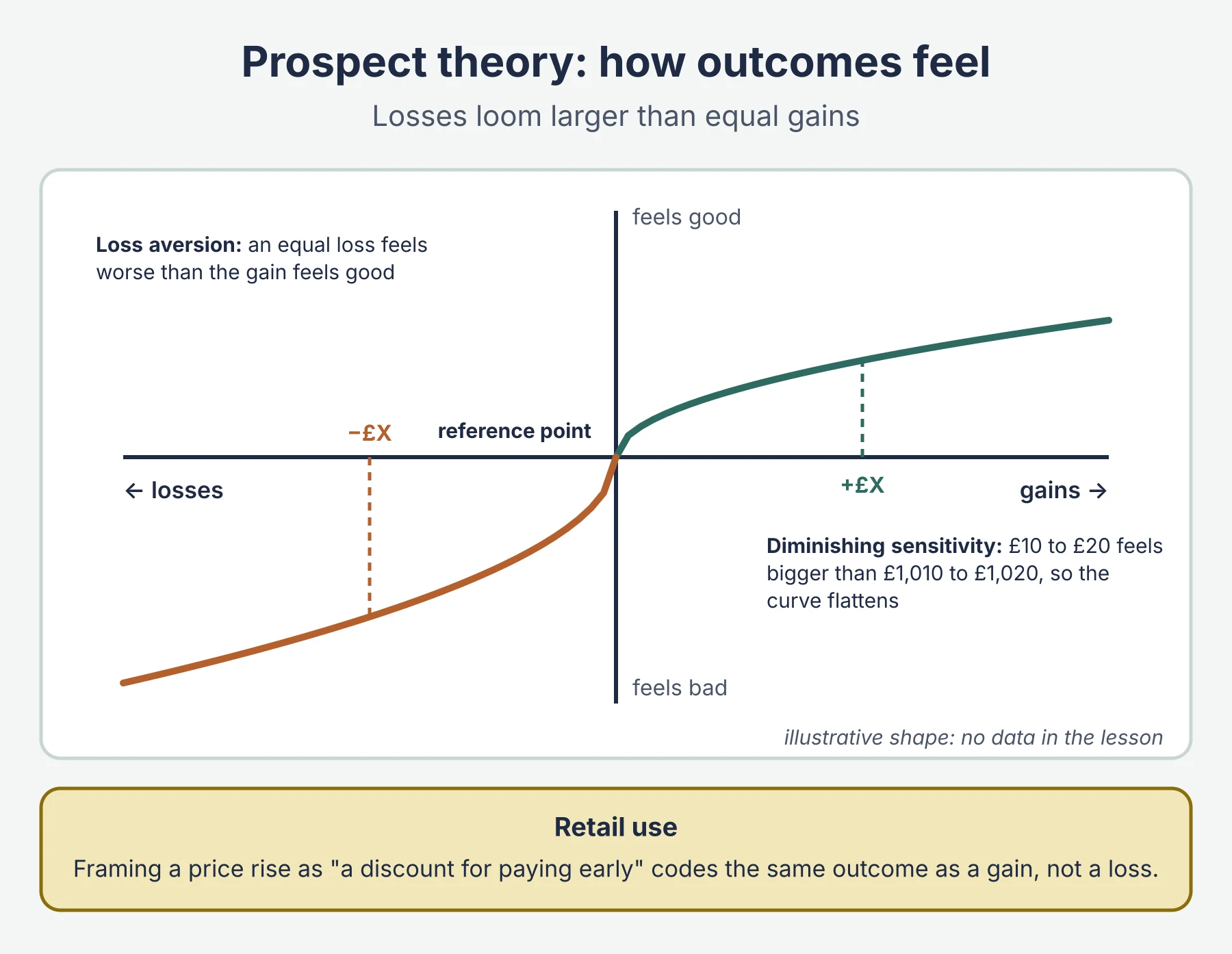
- 2.3.1 Models: utility theory (maximise value), satisficing (first good-enough option), prospect theory (gains and losses from a reference point; losses loom larger).
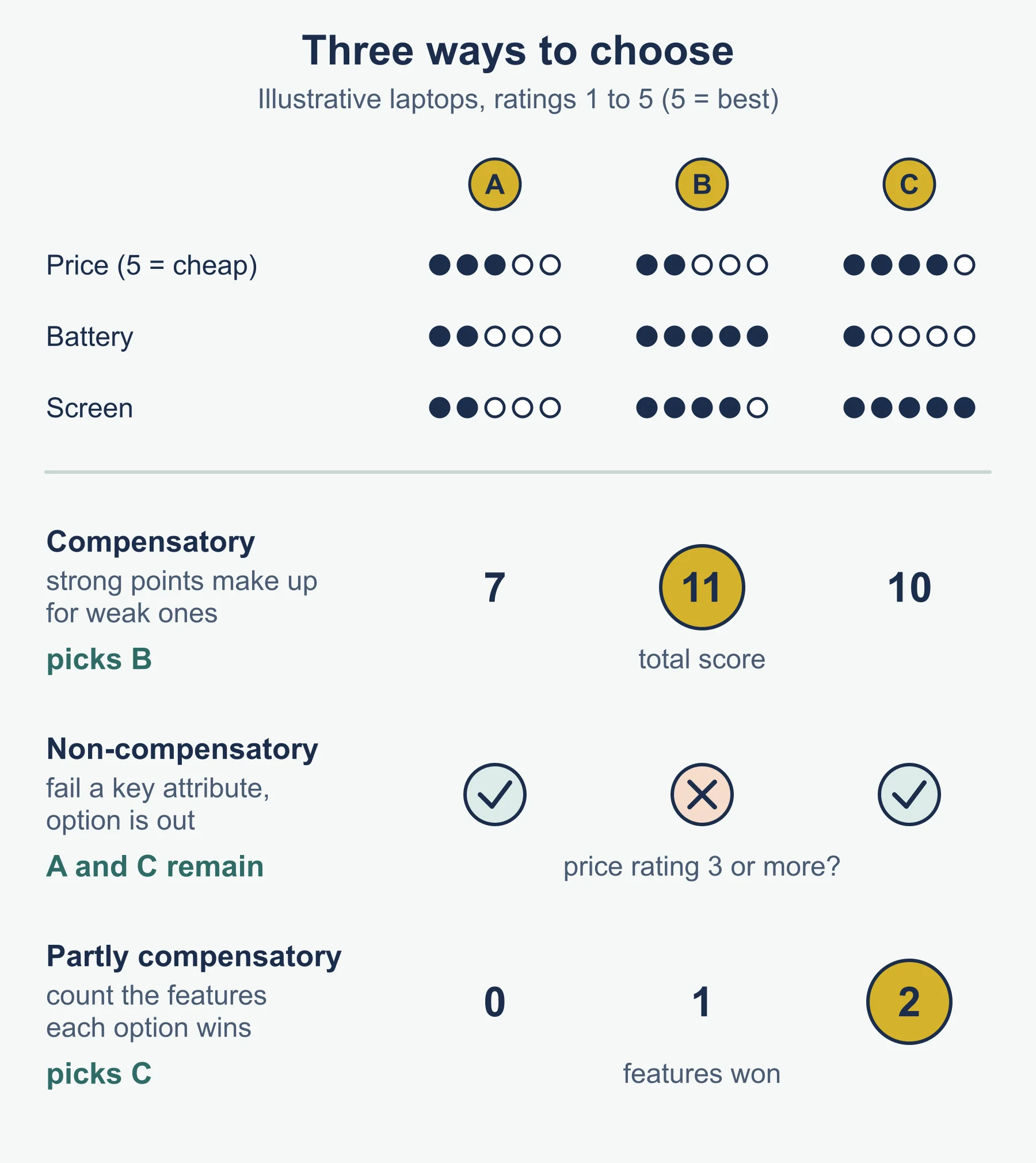
- 2.3.1 Strategies: compensatory (all attributes, trade-offs allowed), non-compensatory (one failure rules an option out), partially compensatory (count attribute wins). Applied to website design, e.g. Jedetski et al. (2002).
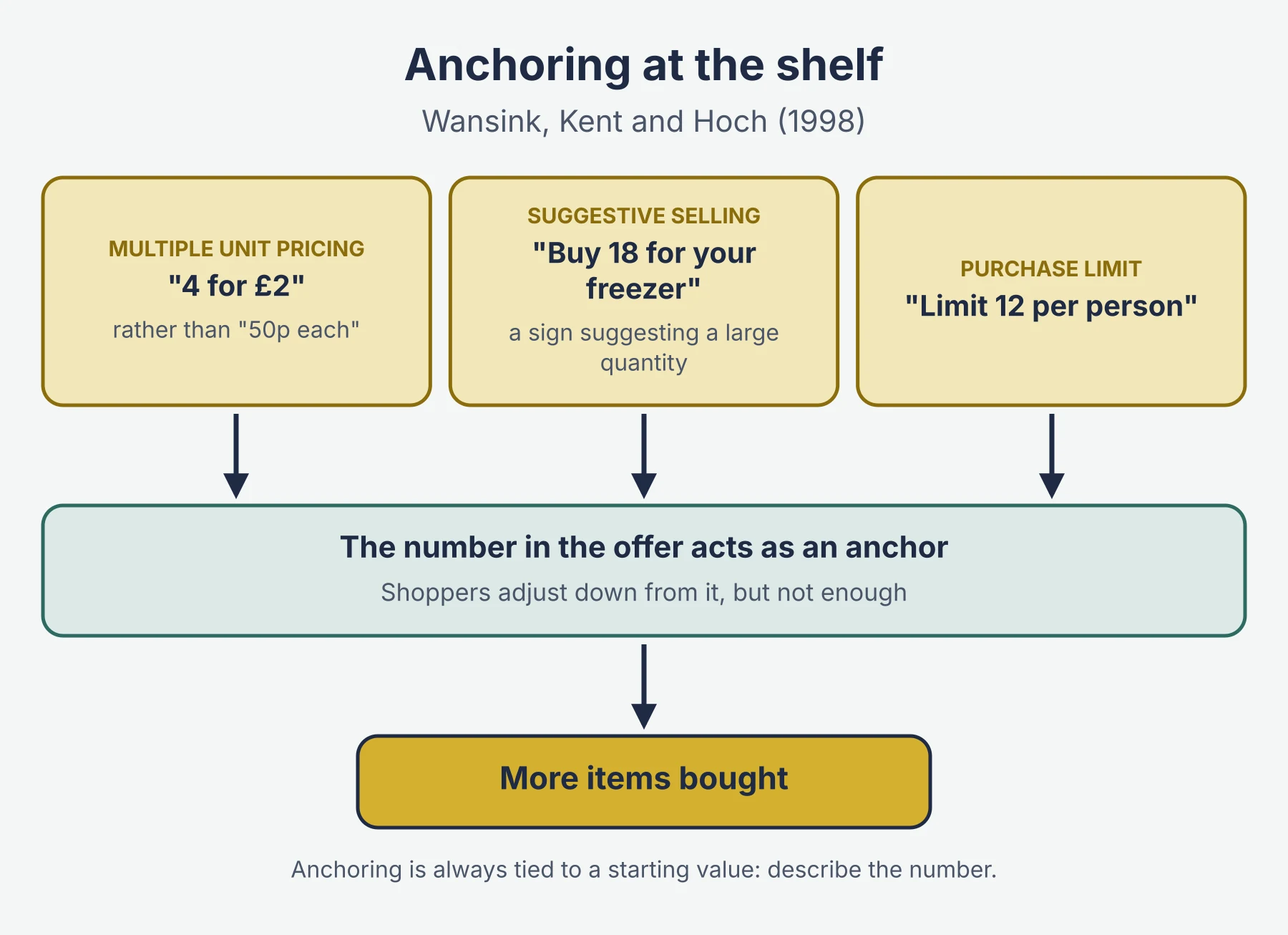
- 2.3.2 Heuristics: availability, representativeness, recognition, take-the-best, anchoring. Point-of-purchase anchors: multiple unit pricing and suggestive selling, e.g. Wansink et al. (1998). Styles and heuristics, e.g. del Campo et al. (2016).
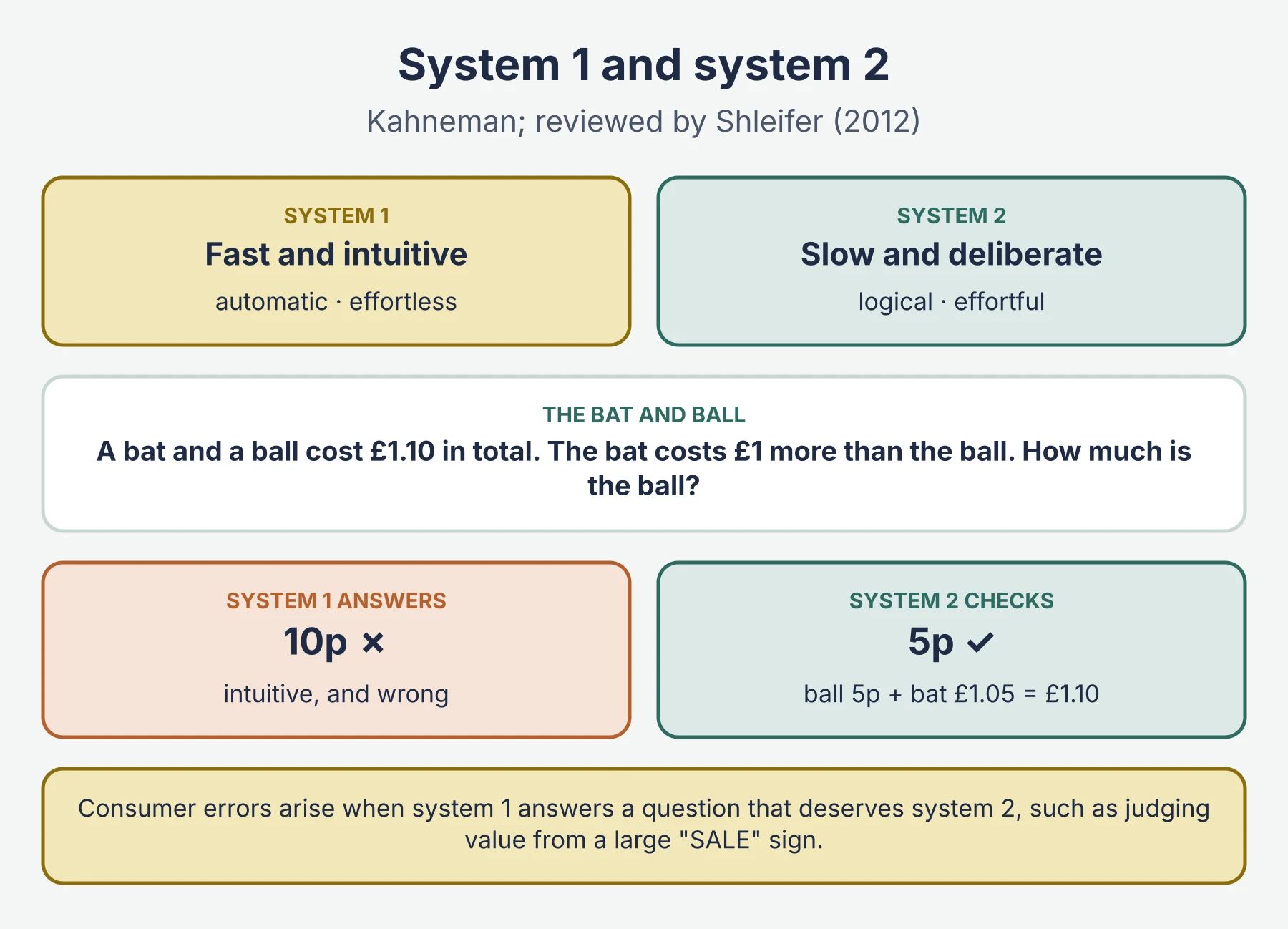
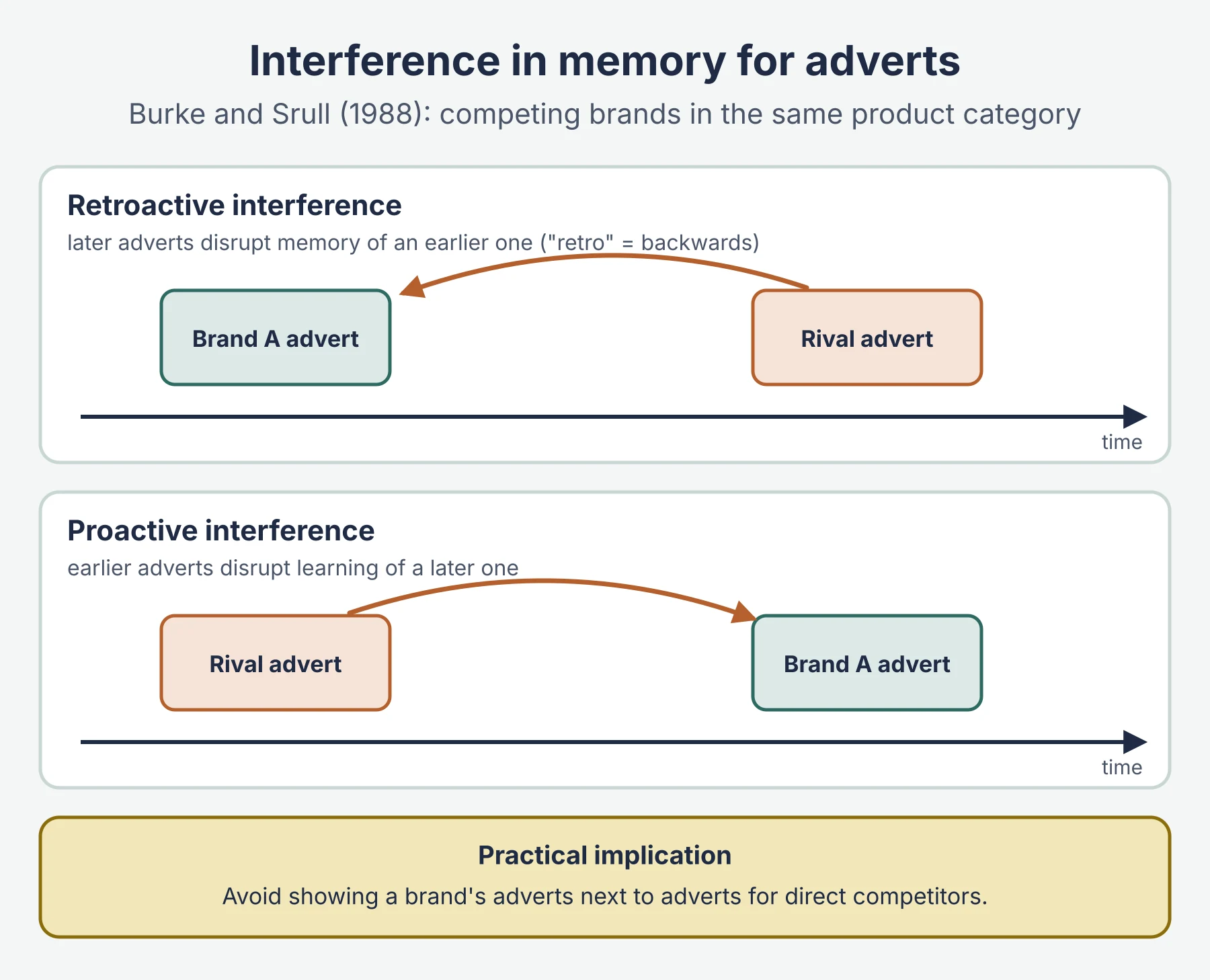
- 2.3.3 Mistakes: system 1 (fast, intuitive) and system 2 (slow, logical), e.g. Shleifer (2012). Key study Hall et al. (2010) on choice blindness. Retroactive and proactive interference in memory for adverts, e.g. Burke and Srull (1988).
Key terms
| Term | Definition to learn |
|---|---|
| Utility | The value or benefit a consumer gets from an option |
| Bounded rationality | Rational choice limited by time, information and mental capacity (Simon) |
| Satisficing | Accepting the first option that meets a minimum standard |
| Reference point | The baseline against which an outcome is judged as a gain or a loss |
| Loss aversion | A loss feels worse than a gain of the same size feels good |
| Framing | Describing the same outcome in different ways, which changes choices |
| Compensatory strategy | Strengths on some attributes can offset weaknesses on others |
| Non-compensatory strategy | Failing on a key attribute rules the option out regardless of others |
| Partially compensatory strategy | The option winning on the most attributes is chosen |
| Heuristic | A mental shortcut giving a quick, usually adequate judgement |
| Take-the-best | Decide using the single most valid cue that separates the options |
| Multiple unit pricing | Pricing several units together, e.g. “3 for £1” |
| Suggestive selling | A prompt suggesting how many to buy |
| System 1 | Fast, automatic, intuitive processing |
| System 2 | Slow, effortful, logical processing |
| Choice blindness | Failing to notice that the outcome of a choice has been switched |
| Retroactive interference | Later information disrupts memory of earlier information |
| Proactive interference | Earlier information disrupts learning of later information |
Key study summary: Hall et al. (2010)
| Feature | Detail |
|---|---|
| Context | Extends choice blindness from faces (Johansson et al., 2005) to taste and smell |
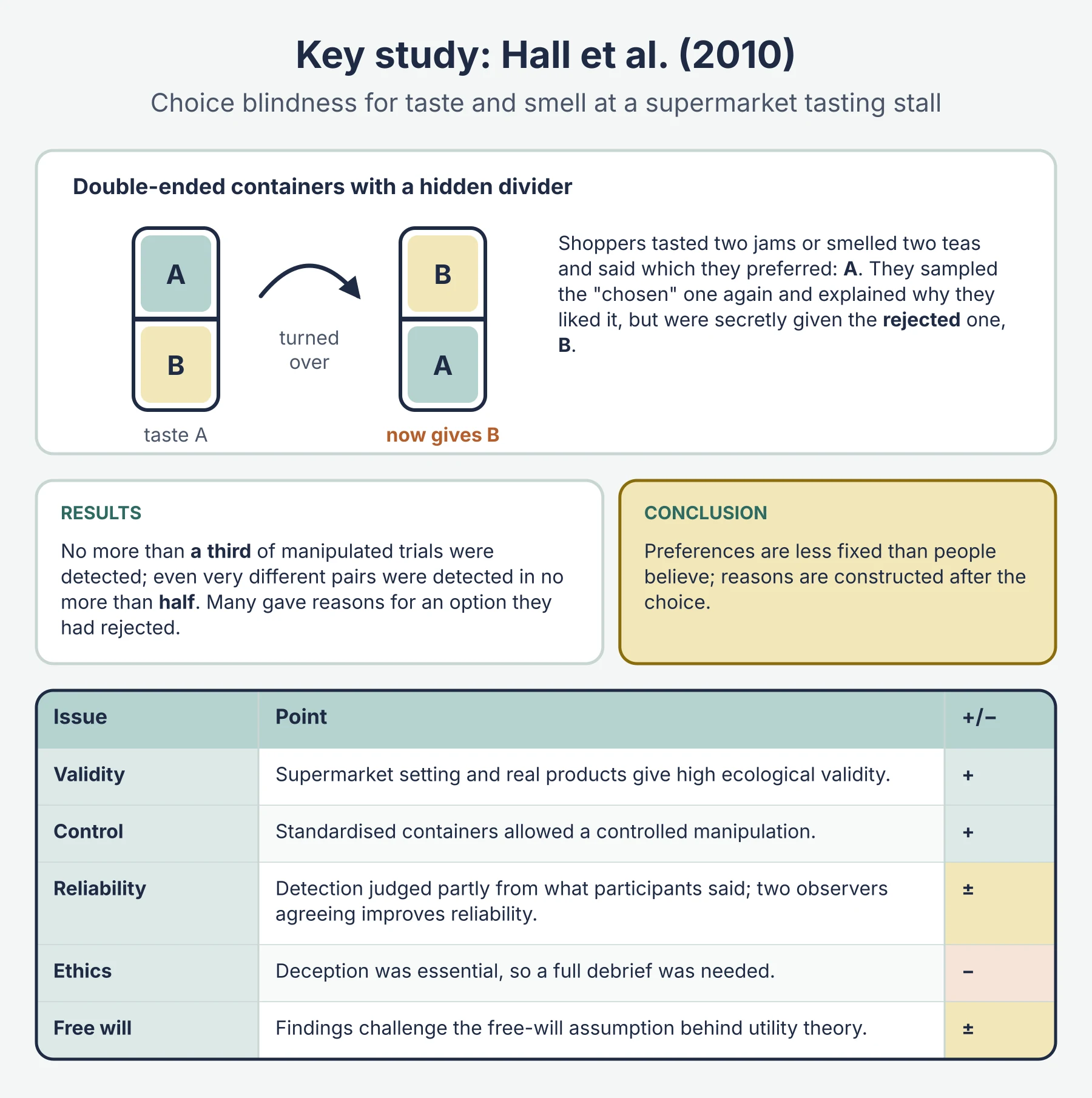
| Aim | To see whether shoppers detect a switch between the jam or tea they chose and the one they rejected |
| Design | Field experiment at a supermarket tasting stall |
| Procedure | Taste two jams or smell two teas; choose; re-sample the “chosen” one and explain the choice |
| Technique | Double-ended containers with a hidden divider allowed a secret switch |
| Results | No more than a third of switches detected; no more than half even for very different pairs |
| Conclusion | Preferences are flexible and reasons are often constructed after the choice |
| Strengths | Real setting and products; standardised switching procedure |
| Weaknesses | Deception; detection judged from verbal reports; one product type per trial |
Comparison grid: the three models
| Utility theory | Satisficing | Prospect theory | |
|---|---|---|---|
| View of consumer | Fully rational | Rational within limits | Biased by framing |
| How much information used | All | Enough to meet a standard | Depends on reference point |
| Explains | Careful, high-value purchases | Everyday, low-effort purchases | Loss-framed offers, discounts |
| Weakness | Unrealistic demands on memory and time | Does not predict which standard is set | Describes biases more than it predicts choices of specific products |
Linking to issues and debates
- Determinism versus free will: anchoring and choice blindness suggest choices are shaped by cues shoppers do not notice; utility theory assumes free, deliberate choice.
- Reductionism versus holism: strategies reduce a decision to attribute scores; real choices also involve mood, brand and social influence.
- Individual and situational explanations: del Campo et al. (2016) points to decision-making style (individual); Wansink et al. (1998) points to the price display (situational).
- Idiographic versus nomothetic: models propose general laws of choice, yet each consumer weights attributes differently.
- Cultural differences: what counts as a “good-enough” standard, and how risk is judged, may vary between cultures.
Exam traps
- Anchoring is not just “a high price”. Name the anchor value and the adjustment from it.
- Prospect theory is about gains and losses, not about probability alone. Mention the reference point.
- Hall et al. is not a laboratory study, and it did not use a questionnaire. It was a field experiment with interviews about reasons.
- Choice blindness is not forgetting. Participants tasted the switched item seconds later; they failed to notice a mismatch.
- Interference needs similar material. Burke and Srull’s effect came from competing brands in the same product category.
- Do not describe del Campo et al. (2016) in detail unless you are sure of it; the syllabus names it only as an example.
Quick self-test
- Who proposed satisficing, and what idea is it part of?
- State the two main features of prospect theory.
- A shopper rejects every laptop over 2 kg, then picks the cheapest of the rest. Which strategy is this?
- What makes a partially compensatory strategy different from a compensatory one?
- Name the heuristic: “I’ve never heard of that airline, so I’ll book the one I know.”
- Name the heuristic: “This bottle looks like the expensive wines, so it must be good.”
- Which two point-of-purchase techniques did Wansink et al. (1998) show increase purchase quantity?
- Give one feature each of system 1 and system 2.
- How did Hall et al. secretly switch the samples?
- Give one ethical issue in Hall et al. (2010) and how it was dealt with.
- An advert for Brand A crisps is shown, followed by three adverts for rival crisps. Which type of interference reduces memory of Brand A?
- Which issue is supported by the finding that shoppers defend choices they did not make?
Answers
- Herbert Simon; bounded rationality.
- Outcomes are judged as gains or losses relative to a reference point; losses weigh more than equal gains (loss aversion).
- Non-compensatory: failing on one attribute (weight) rules a laptop out, however good it is on everything else.
- It counts which option wins on each attribute rather than adding up the size of every difference.
- Recognition heuristic.
- Representativeness heuristic.
- Multiple unit pricing and suggestive selling (purchase limits worked in the same way).
- System 1: fast, automatic, intuitive. System 2: slow, effortful, logical.
- Double-ended containers with a hidden divider were turned over, so participants were given the option they had rejected.
- Deception; participants were fully debriefed and told the purpose of the study.
- Retroactive interference: later adverts disrupt memory of the earlier one.
- Determinism: choices and the reasons given for them are shaped by factors outside conscious control.
More resources on this topic
Related resources
-
Study guides
Cambridge International AS & A Level Psychology (9990): 2.1 The physical environment
Topic 2.1 for Cambridge 9990 Consumer Psychology: store exteriors and layouts, music and noise, North et al., the PAD model, odour and crowding.
Psychology · Cambridge · A Level
Read guide -
Practice questions
Cambridge International AS & A Level Psychology (9990): 2.1 The physical environment – Practice Questions
Original Paper 3 and Paper 4 style questions with answers on 9990 Consumer Psychology topic 2.1: store design, North et al., noise, PAD, odour and crowding.
Psychology · Cambridge · A Level
Try questions -
Revision notes
Cambridge International AS & A Level Psychology (9990): 2.1 The physical environment – Revision Notes
Revision notes for 9990 Consumer Psychology topic 2.1: store design, layouts, North et al., noise and taste, the PAD model, odour, crowding and a self-test.
Psychology · Cambridge · A Level
Revise topic
Studying Psychology?
This page is free and stays free. Marlbridge is not offering Psychology classes at the moment, so there is no tuition to book for it. The free study resources stay open to everyone.
Get free revision emails (optional)
Occasional emails with practice questions, worked explanations and links to free resources for the qualification and subjects you choose. No spam, and you can unsubscribe from any email. The free tools on this site never need an email.