
Revision Notes
Cambridge A Level Psychology (9990): Advertising – Revision Notes
Revision notes for Cambridge 9990 topic 2.5: Yale model, media, 4 Cs, self-monitoring, product placement, logos and slogans, with a self-test.
- Subject
- Psychology
- Level
- A LEVEL
- Topic
- Specialist Option 2: Consumer Psychology
- Author
- Marlbridge Academic Team
- Updated
- Reviewed by
- Kanwal Aslam (what this means)
Aligned to Cambridge A Level Psychology (9990), 2024-2026. Official specification .
Syllabus page (what it covers and how it is assessed): Cambridge A Level Psychology.
Syllabus points this page covers
9990 (A Level)
- 2.5 Advertising
These notes condense topic 2.5, Advertising, from Specialist Option 2 of Cambridge International A Level Psychology 9990 (syllabus for 2024 to 2026). The topic has three sub-topics: how adverts work and are measured (2.5.1), how they interact with the consumer (2.5.2), and how brands become recognised (2.5.3).
Read the advertising study guide for full explanations, and apply what you know with the advertising practice questions.
Topic map
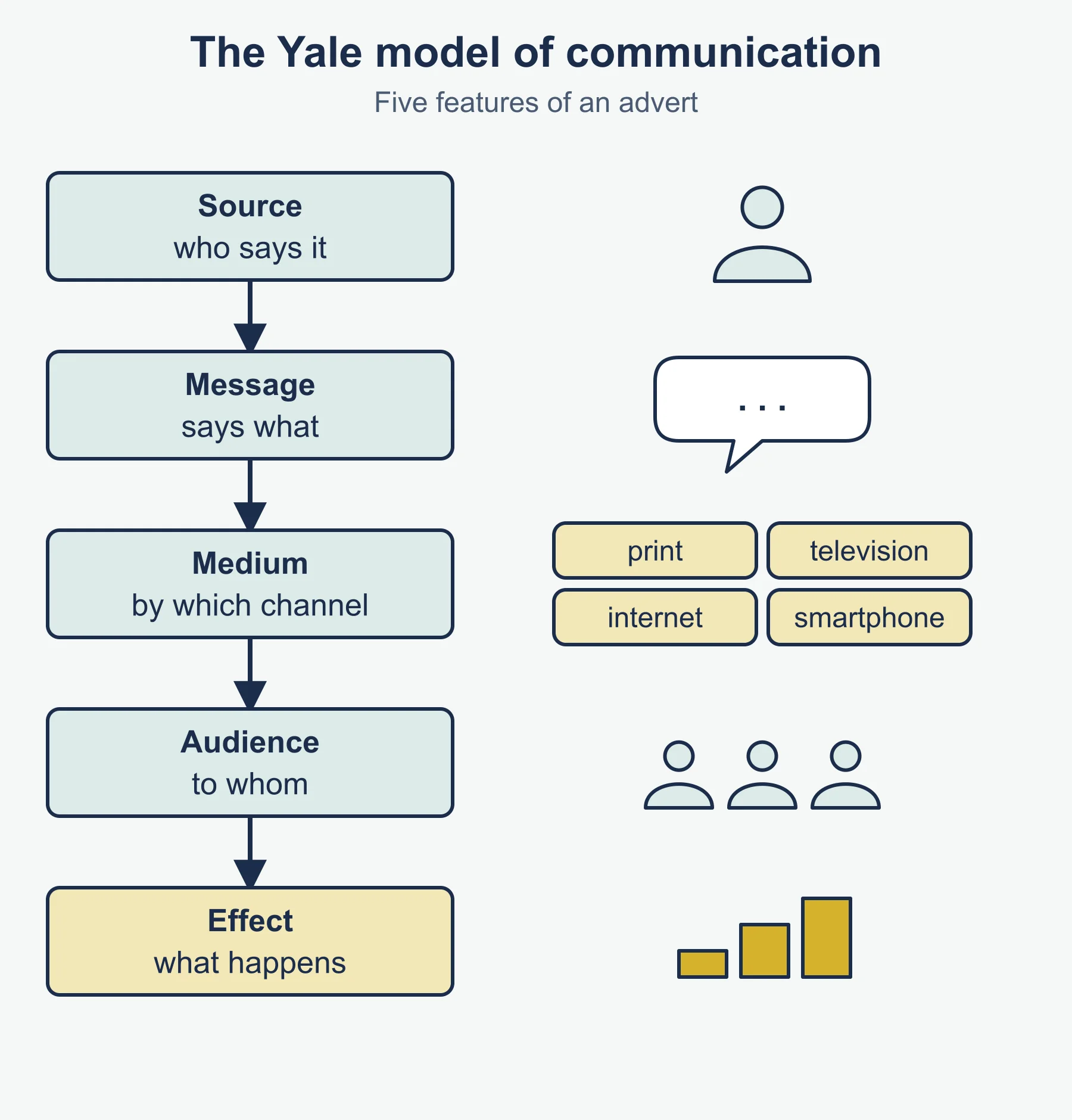
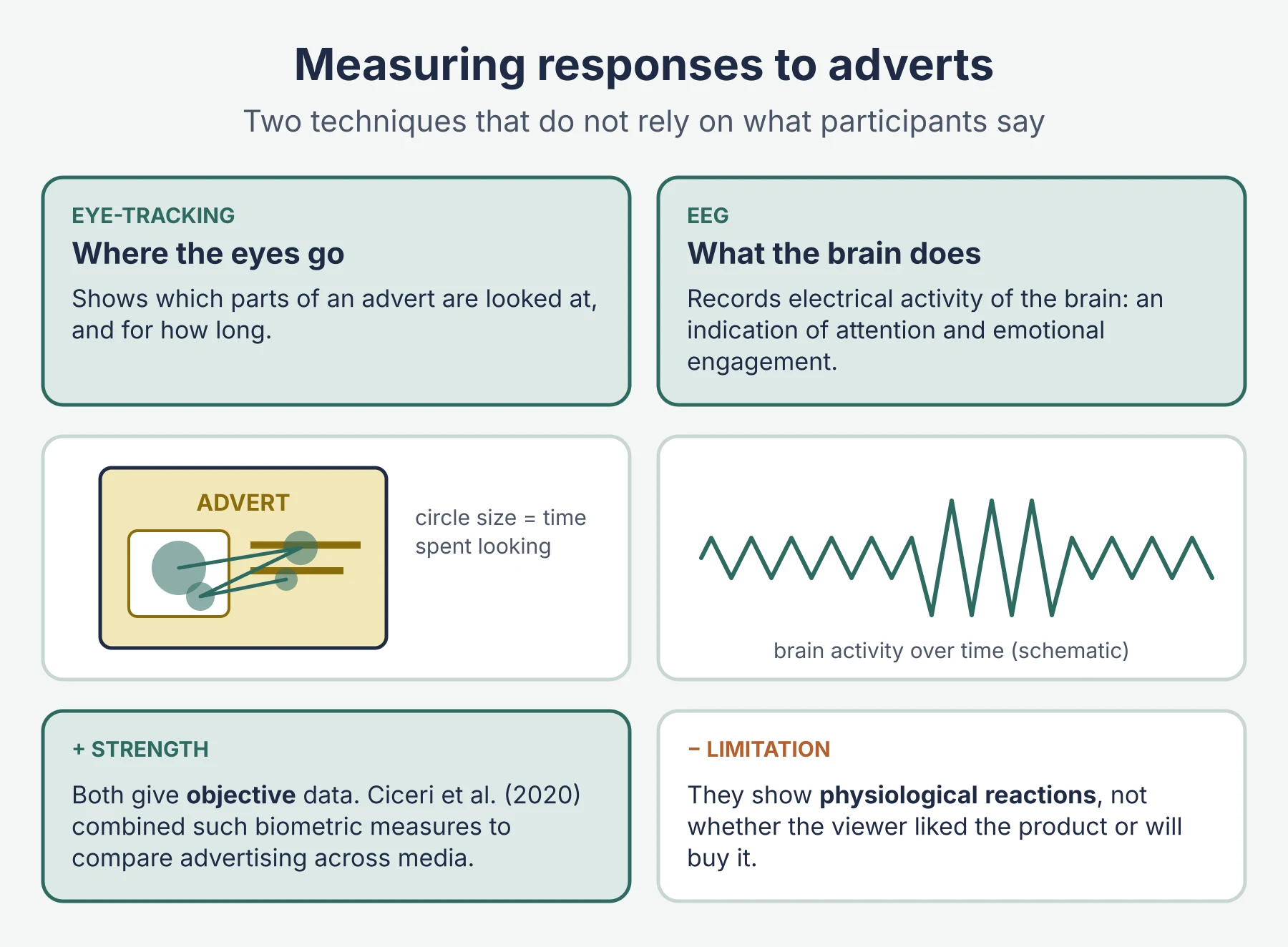
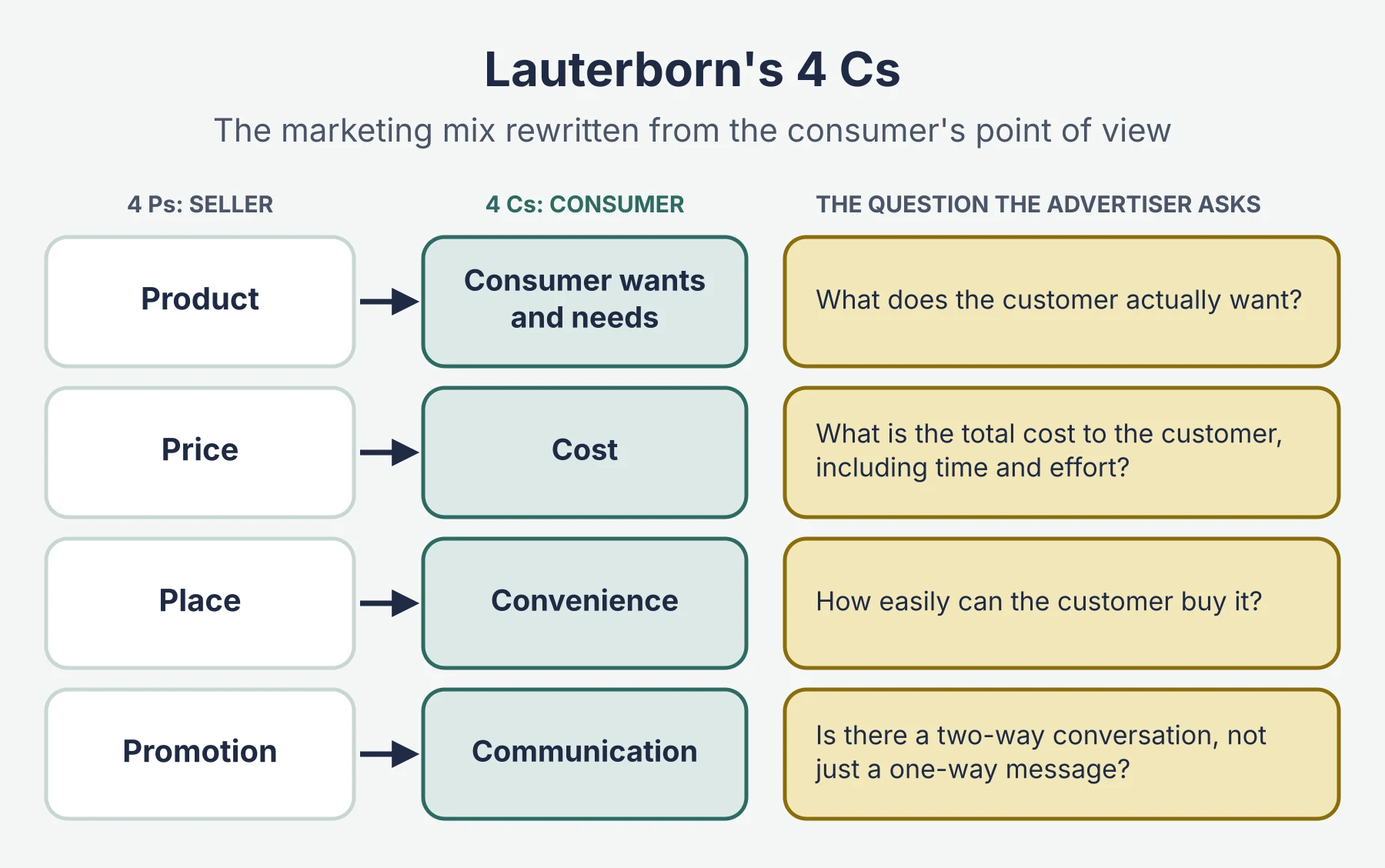
- 2.5.1: Yale model (source, message, medium, audience, effect); media (printed, television, internet, smartphone); eye-tracking and EEG, e.g. Ciceri et al. (2020); Lauterborn’s 4 Cs.
- 2.5.2: self-monitoring, key study Snyder and DeBono (1985), study 3; product placement in films, mere exposure and reminders, e.g. Auty and Lewis (2004).
- 2.5.3: children’s logo recognition, e.g. Fischer et al. (1991); brand awareness, brand image, slogans and guidelines, e.g. Kohli et al. (2007).
Key terms
| Term | Definition |
|---|---|
| Source | Who delivers the message; credibility and attractiveness matter |
| Message | What is said: content, structure and type of appeal |
| Medium | The channel used to deliver the message |
| Audience | Who receives the message |
| Effect | The resulting change in attitude or behaviour |
| EEG | Recording of the brain’s electrical activity through scalp electrodes |
| 4 Cs | Consumer wants and needs, cost, convenience, communication |
| Self-monitoring | How far a person adjusts behaviour to fit social situations |
| Image appeal | An advert stressing the image or status that comes with a product |
| Quality claim | An advert stressing what the product does and how well |
| Product placement | Paid appearance of a brand within a film or programme |
| Mere exposure | Repeated exposure increases liking |
| Reminder effect | Placement reminds viewers of a brand they already know |
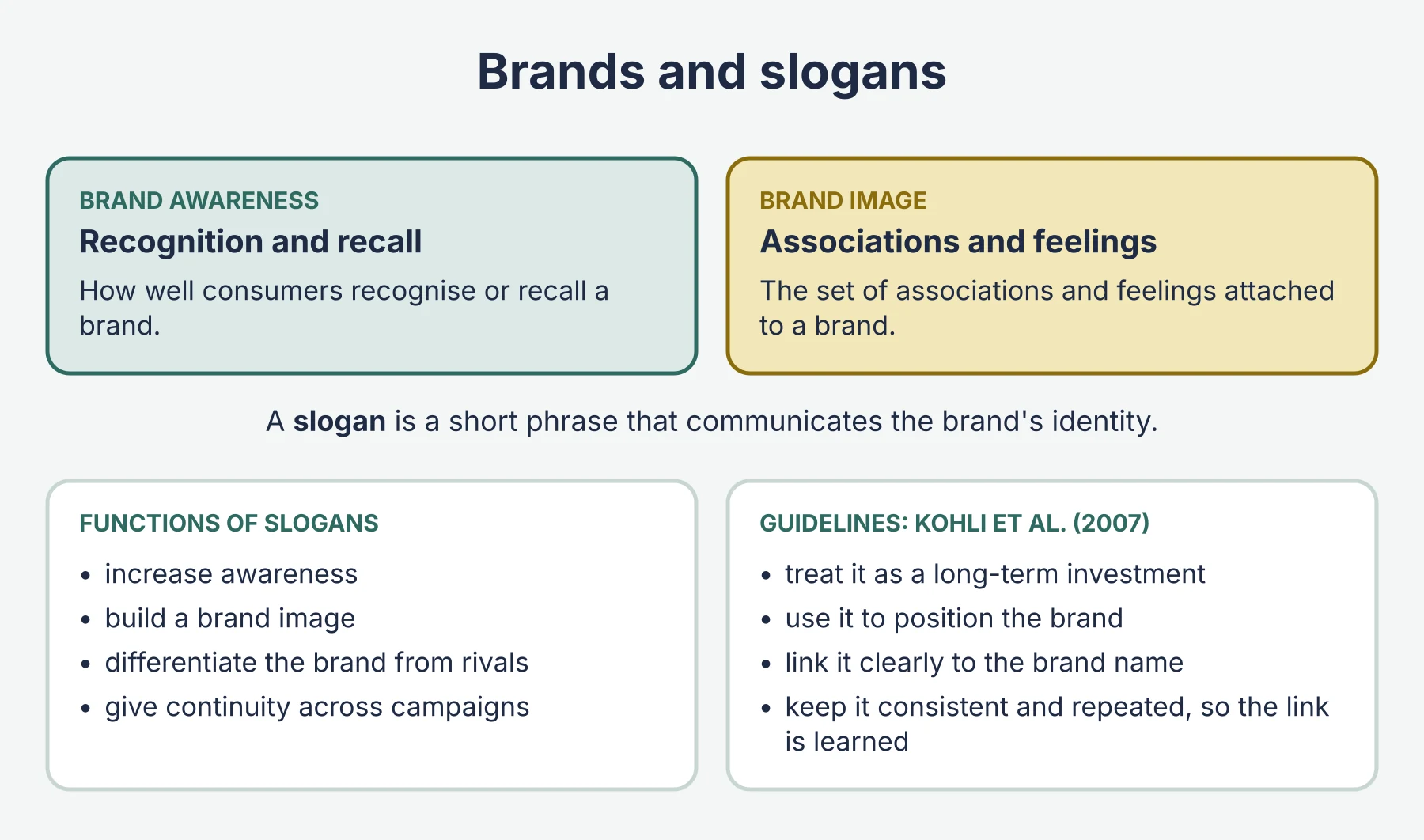
| Brand awareness | How easily a brand is recognised or recalled |
| Brand image | The associations and feelings linked to a brand |
| Slogan | A short memorable phrase expressing the brand’s identity |
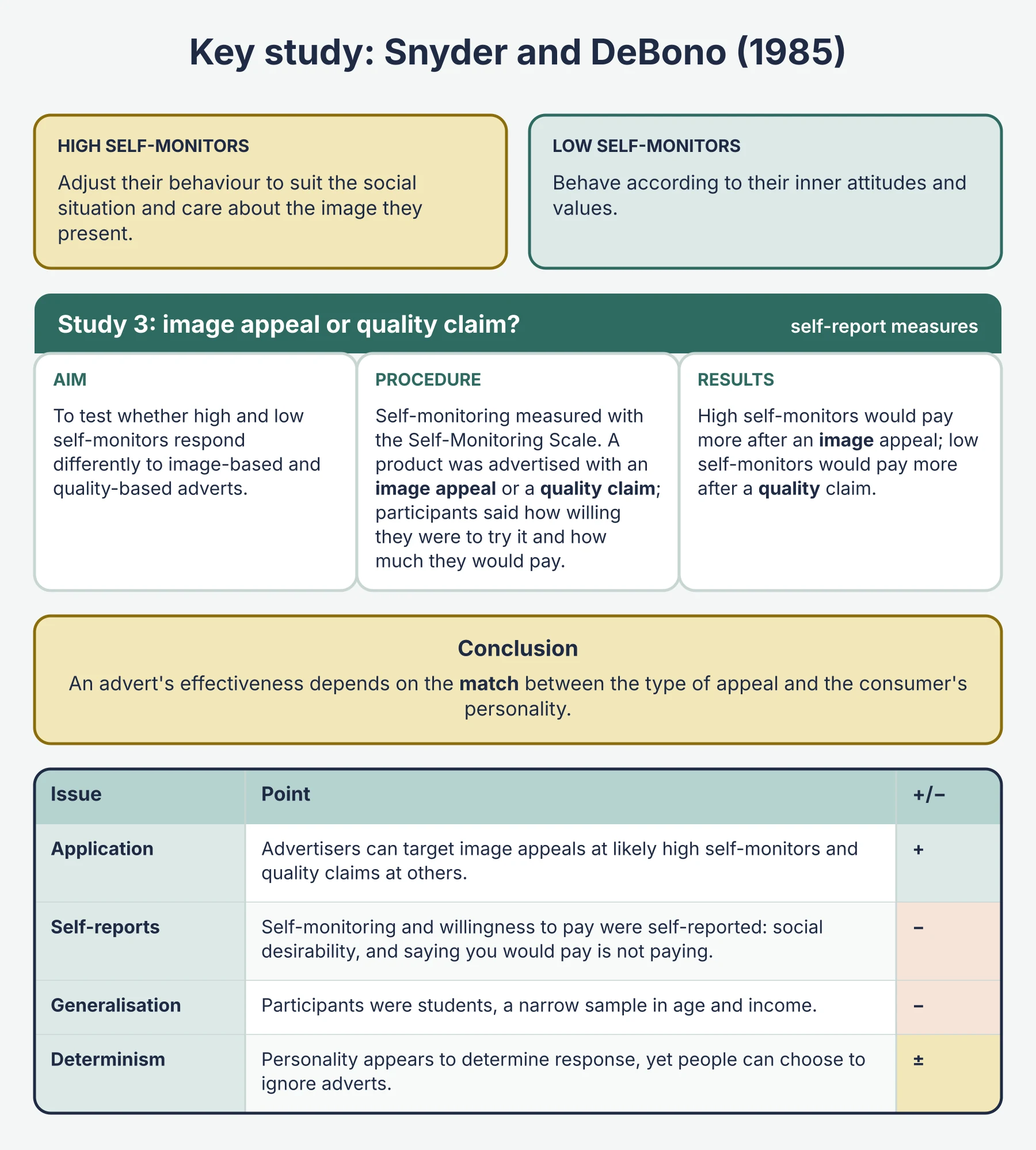
Key study grid: Snyder and DeBono (1985)
| Feature | Detail |
|---|---|
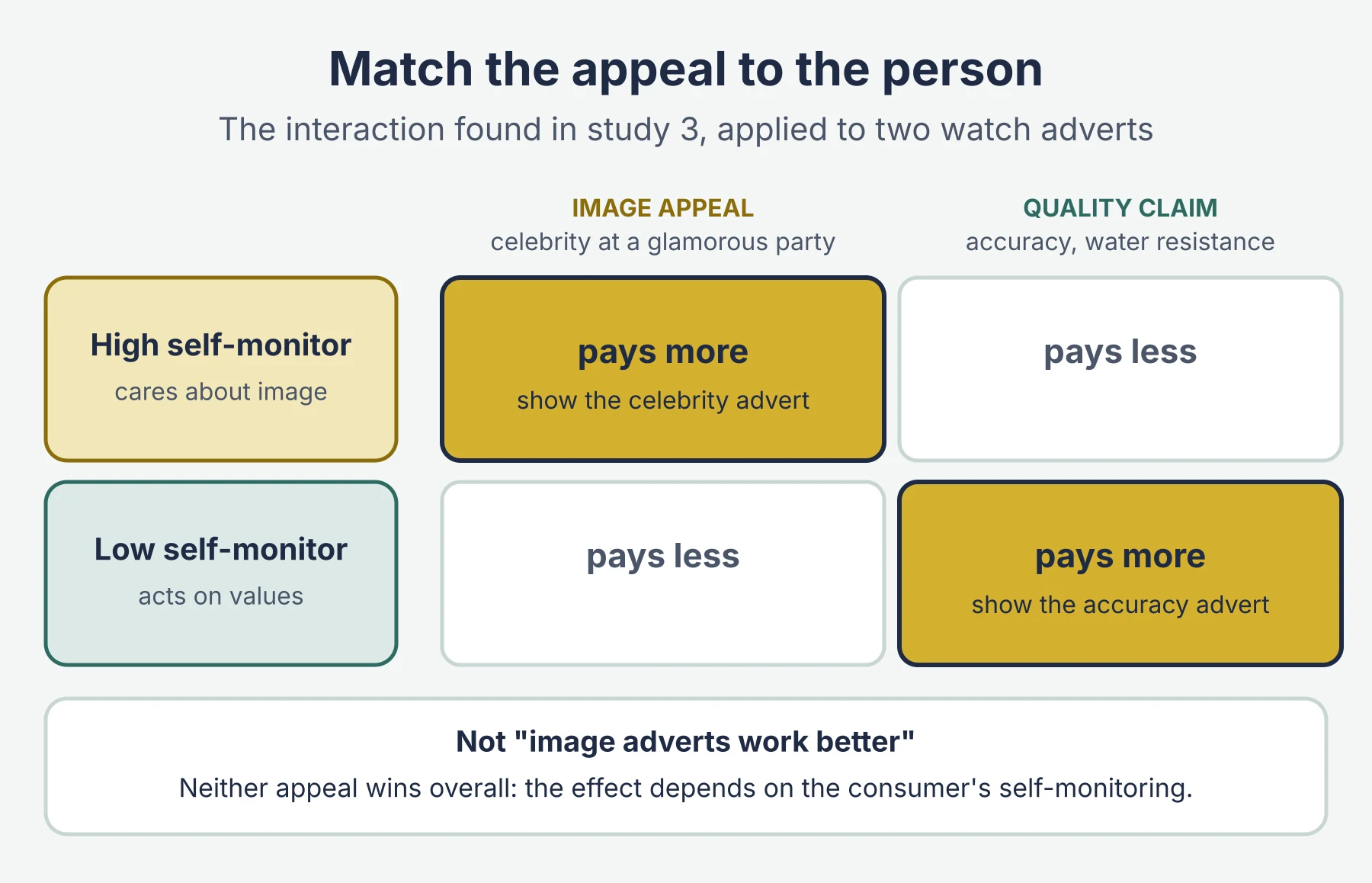
| Theory | Self-monitoring: high self-monitors manage image; low self-monitors follow inner values |
| Aim | Do high and low self-monitors respond differently to image and quality adverts? |
| Measure of personality | Self-Monitoring Scale (self-report) |
| Study 3 | Willingness to try a product and how much participants would pay, after image or quality adverts |
| Results | High self-monitors would pay more after image appeals; low self-monitors after quality claims |
| Conclusion | Match the appeal to the audience’s personality |
| Strength | Clear applied value for targeting |
| Weaknesses | Self-reports; hypothetical willingness to pay; student sample |
The two product placement explanations
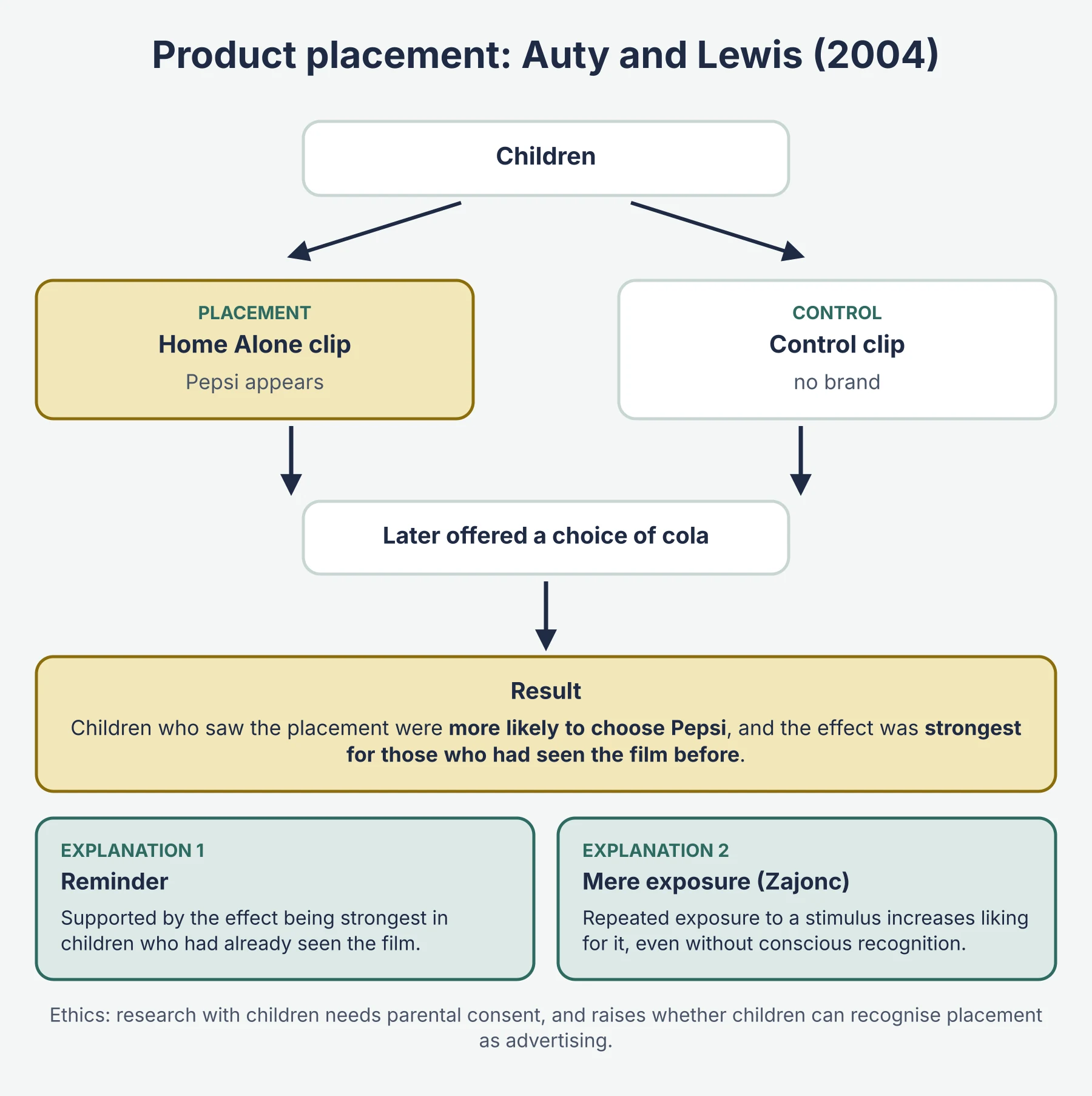
| Mere exposure | Reminder | |
|---|---|---|
| Mechanism | Familiarity from repeated exposure raises liking | Seeing the brand brings an existing brand to mind |
| Needs prior knowledge? | No | Yes |
| Support | General mere exposure research (Zajonc) | Auty and Lewis: strongest effect in children who had seen the film before |
Slogans: functions and guidelines
- Functions: build awareness, create an image, differentiate from competitors, give continuity between campaigns.
- Guidelines from Kohli et al. (2007): treat the slogan as a long-term investment; use it to position the brand; link it clearly to the brand name; repeat it consistently over time.
Linking to issues and debates
- Use of children in research: Auty and Lewis and Fischer et al. needed parental consent, child-friendly tasks and protection from distress.
- Determinism versus free will: mere exposure and logo learning occur without awareness; adults can still resist adverts.
- Self-reports and validity (2.5.2): self-monitoring scores and willingness to pay may not match real behaviour.
- Objective and subjective data (2.5.1): eye-tracking and EEG are objective, but interpreting what a brain signal means is not straightforward.
- Cultural differences (2.5.1): image appeals and media use vary between cultures.
Exam traps
- The Yale model has five features; “effect” is the one most often forgotten.
- The 4 Cs replace the 4 Ps; know which C matches which P.
- Snyder and DeBono: study 3 is the focus. Do not invent product names or sample sizes.
- Self-monitoring is a personality trait, not the act of watching yourself in the mirror.
- Fischer et al. measured recognition, not liking or smoking.
- Do not say product placement always works; Auty and Lewis’s effect was strongest for children who had seen the film before.
Quick self-test
- List the five features of the Yale model.
- Which two techniques for measuring responses to adverts does the syllabus name?
- Which C replaces “place” in Lauterborn’s model?
- Which C replaces “promotion”, and how does it differ?
- Define a high self-monitor.
- Which type of advert do low self-monitors prefer?
- What did study 3 of Snyder and DeBono ask participants?
- Which film clip and brand did Auty and Lewis (2004) use?
- Give the two syllabus explanations of product placement effects.
- What did Fischer et al. (1991) ask children to do?
- Give two functions of a slogan.
- Give one ethical issue in studying the effect of advertising on children.
Answers
- Source, message, medium, audience, effect.
- Eye-tracking and EEG.
- Convenience.
- Communication: a two-way exchange with the customer instead of one-way promotion.
- Someone who adjusts behaviour to suit social situations and cares about the image they present.
- Adverts with quality claims about what the product does.
- How willing they were to try a product and how much they would pay for it after image or quality adverts.
- A clip from Home Alone containing Pepsi.
- Mere exposure and reminders.
- Match logos to pictures of products.
- Any two: build awareness; create an image; differentiate the brand; give continuity.
- Children cannot give informed consent themselves, so parental consent is needed; also the risk of encouraging a preference for an unhealthy product.
More resources on this topic
Related resources
-
Study guides
Cambridge A Level Psychology (9990): Consumer decision-making
Cambridge 9990 topic 2.3 in depth: decision models and strategies, choice heuristics, system 1 and 2, choice blindness and interference, with model answers.
Psychology · Cambridge · A Level
Read guide -
Practice questions
Cambridge A Level Psychology (9990): Consumer decision-making – Practice Questions
Original Paper 3 and Paper 4 style questions on Cambridge 9990 consumer decision-making, from prospect theory to choice blindness, with full mark schemes.
Psychology · Cambridge · A Level
Try questions -
Revision notes
Cambridge A Level Psychology (9990): Consumer decision-making – Revision Notes
Revision notes for Cambridge 9990 topic 2.3: models, strategies, heuristics, system 1 and 2, Hall et al. (2010) and interference, with traps and a self-test.
Psychology · Cambridge · A Level
Revise topic
Studying Psychology?
This page is free and stays free. Marlbridge is not offering Psychology classes at the moment, so there is no tuition to book for it. The free study resources stay open to everyone.
Get free revision emails (optional)
Occasional emails with practice questions, worked explanations and links to free resources for the qualification and subjects you choose. No spam, and you can unsubscribe from any email. The free tools on this site never need an email.