
Study Guides
Cambridge A Level World History (9489): The Civil War and Reconstruction, 1820-77
Study guide to Cambridge 9489 History topic 4, the Civil War and Reconstruction 1820-77: sectional tension, secession, why the war lasted, and Reconstruction.
- Subject
- World History
- Level
- AS LEVEL
- Topic
- Paper 1 and Paper 2 – American Option: The History of the USA, 1820–1941
- Author
- Marlbridge Academic Team
- Updated
- Reviewed by
- Azam Siddique (what this means)
Aligned to Cambridge A Level World History (9489), 2027-2029. Official specification .
Syllabus page (what it covers and how it is assessed): Cambridge A Level World History.
Syllabus points this page covers
9489 (AS Level)
- 4 The Civil War and Reconstruction, 1820–77
Found an error? Report a correction.
Need help with this topic? Request a free trial class for A Level World History (9489).
The Civil War and Reconstruction, 1820-77 is the first topic of the American option at AS Level in Cambridge International History 9489. It runs from the Missouri Compromise to the Compromise of 1877 and asks four questions: why tension grew between North and South before 1860 (4.1), why war broke out in April 1861 (4.2), why the war lasted four years (4.3), and what Reconstruction aimed at and how successful it was (4.4). The option-wide overview is the History of the USA, 1820-1941 study guide.
Where this fits in 9489
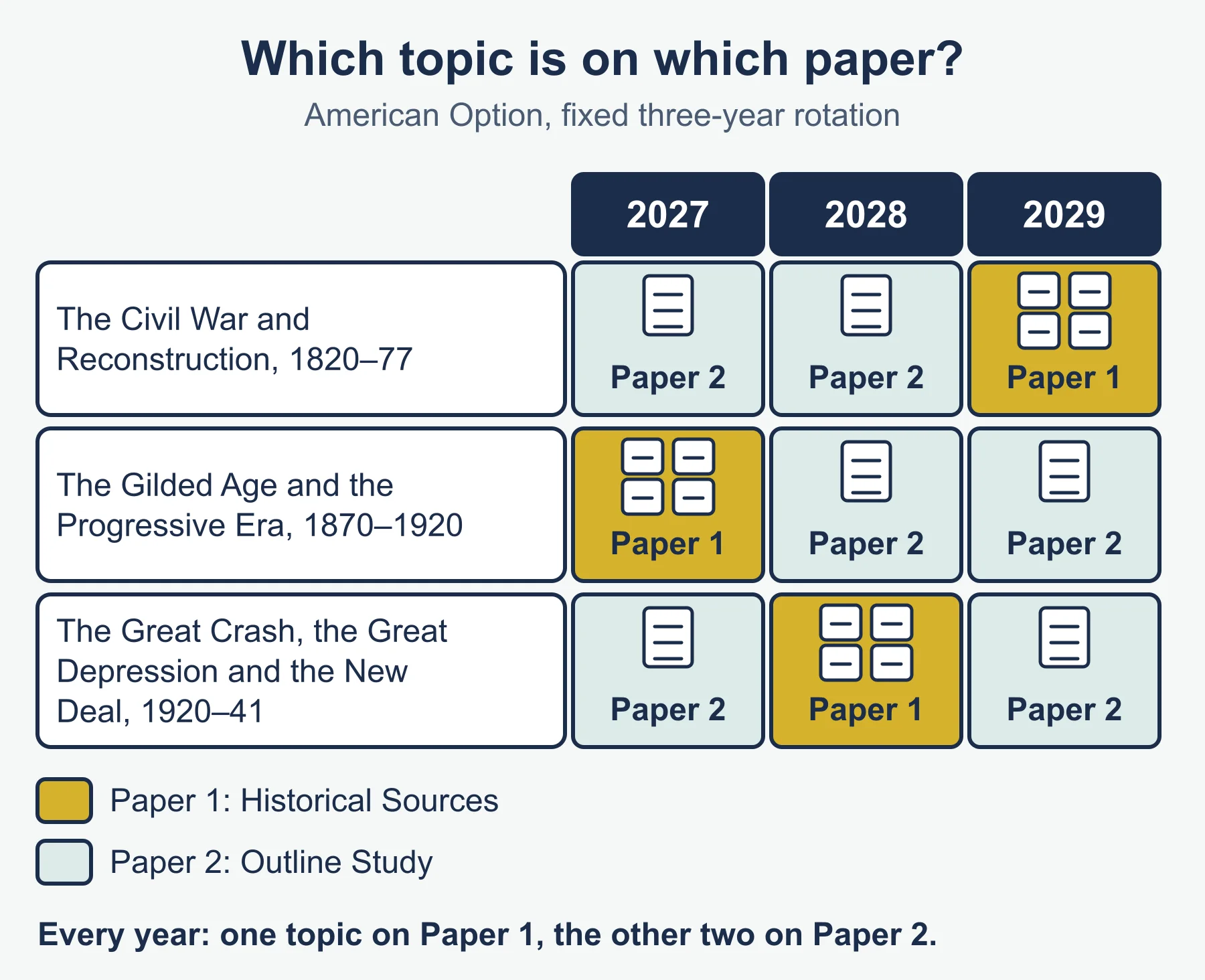
Under the 2027-2029 rotation, this topic is assessed on Paper 2 (Outline Study) in 2027 and 2028 and on Paper 1 (Historical Sources) in 2029. Paper 2 sets two-part questions: part (a), “Explain why”, for 10 marks, and part (b), a 20-mark comparative judgement. Paper 1 sets a 15-mark comparison of two sources and a 25-mark “How far do the sources support…” question on four sources. Revise with the Civil War and Reconstruction revision notes and test yourself with the Civil War and Reconstruction practice questions.
4.1 Why did tension grow between North and South before 1860?
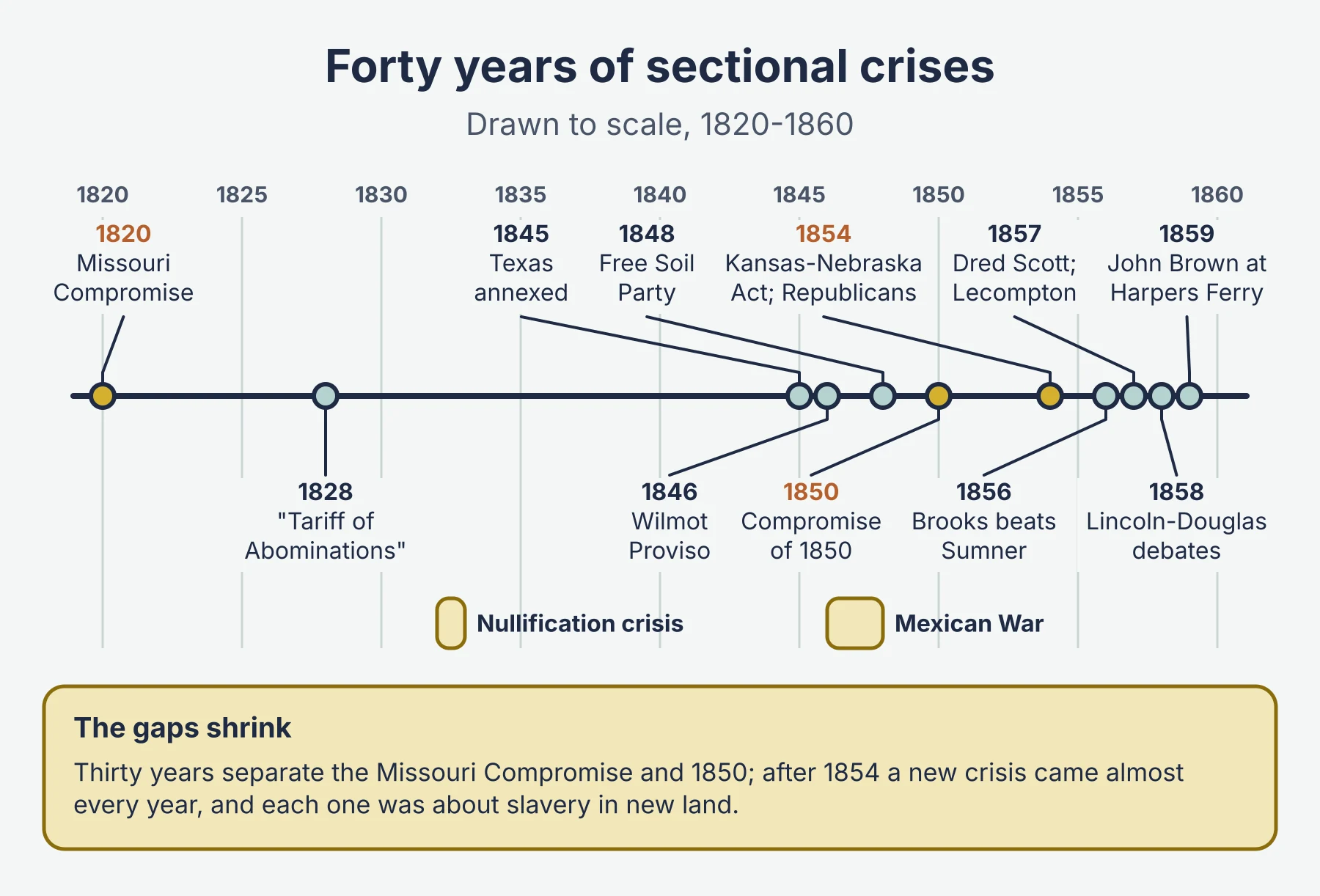
Two economies. The North industrialised, with factories, immigrant labour and growing cities; the South depended on cotton grown by enslaved people and exported to Britain. Northern manufacturers wanted protective tariffs; Southern planters, who bought manufactured goods and sold cotton abroad, saw tariffs as a tax on them. The “Tariff of Abominations” (1828) led South Carolina to claim the right to nullify federal law in 1832-33 – an early test of states’ rights.
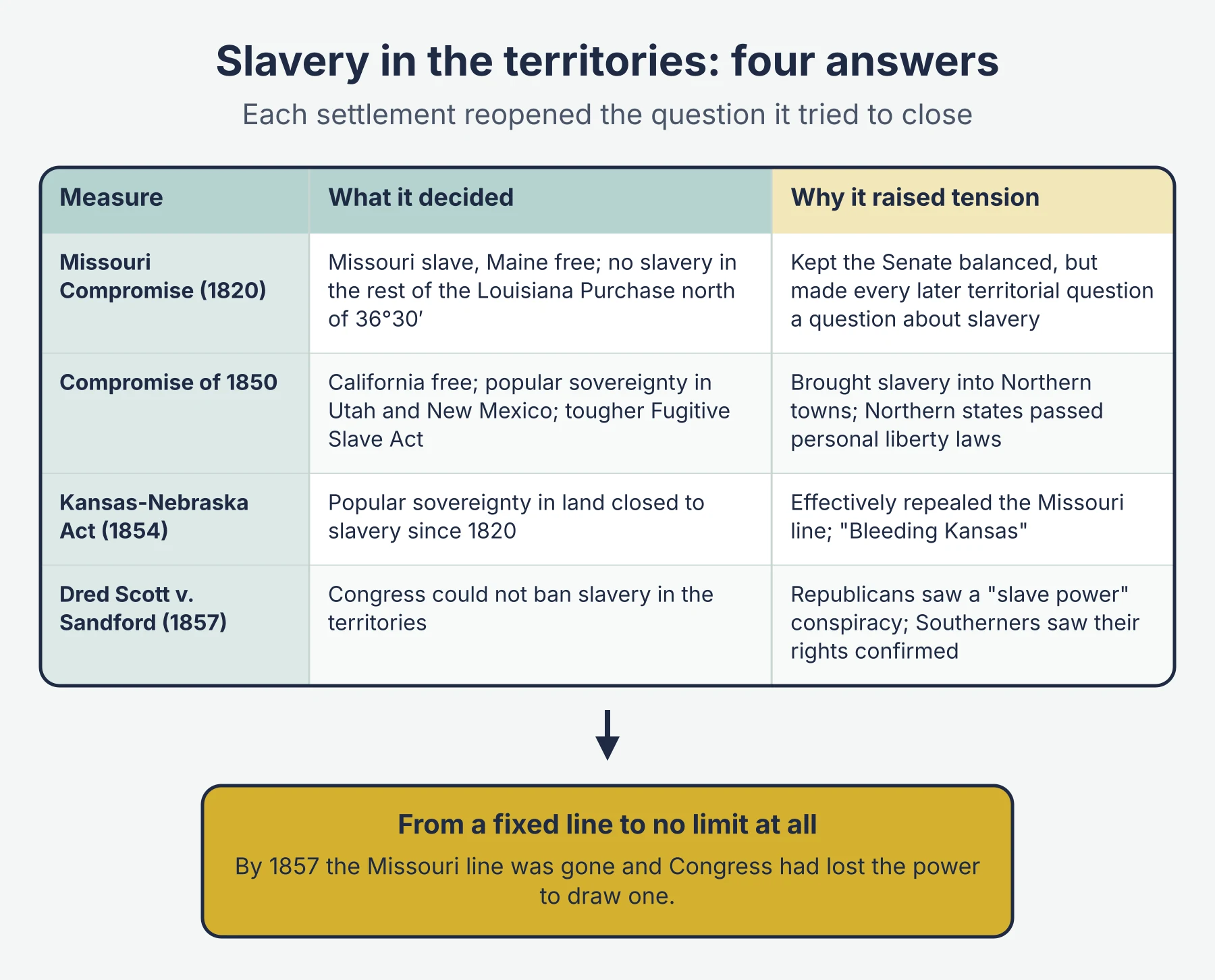
The Missouri Compromise (1820) admitted Missouri as a slave state and Maine as a free state, and banned slavery in the rest of the Louisiana Purchase north of latitude 36°30′. It kept the Senate balanced but made every later territorial question a question about slavery.
Expansion reopened the question. The annexation of Texas (1845) and victory in the Mexican War (1846-48) added vast lands. The Wilmot Proviso (1846), which would have banned slavery from any land taken from Mexico, passed the House but not the Senate; voting split by section rather than party. Northerners who disliked slavery mainly because it competed with free white labour formed the Free Soil movement (Free Soil Party, 1848).
The Compromise of 1850 admitted California as a free state, let popular sovereignty decide slavery in Utah and New Mexico, ended the slave trade in Washington DC, and passed a tougher Fugitive Slave Act. That last measure brought slavery into Northern towns, and Northern states answered with personal liberty laws. The Kansas-Nebraska Act (1854), Stephen Douglas’s measure, applied popular sovereignty to territory closed to slavery since 1820, effectively repealing the Missouri line. “Bleeding Kansas” followed as rival settlers fought; in May 1856 Congressman Preston Brooks beat Senator Charles Sumner unconscious in the Senate chamber after Sumner’s speech on Kansas. The pro-slavery Lecompton Constitution (1857), backed by President Buchanan but opposed by Douglas as a fraud, divided the Democrats.
The party system broke. The Whigs collapsed after 1852 because they could not hold Northern and Southern members together. The Republican Party (1854) was purely Northern, pledged to stop slavery’s expansion. In the Lincoln-Douglas debates (1858), Lincoln pressed Douglas to reconcile popular sovereignty with the Dred Scott ruling; Douglas’s Freeport Doctrine kept his Senate seat but cost him Southern trust.
4.2 Why did war break out in April 1861?
Abolitionism and Southern fear. Harriet Beecher Stowe’s Uncle Tom’s Cabin (1852) sold in huge numbers and made slavery a moral issue for many Northern readers; Southerners saw it as slander. John Brown’s raid on Harpers Ferry (October 1859), an attempt to arm enslaved people, failed, but Northern sympathy for Brown after his execution convinced many Southerners that the North intended to destroy them.
“Slave power” and states’ rights. In Dred Scott v. Sandford (1857) Chief Justice Taney ruled that Black Americans were not citizens and that Congress could not ban slavery in the territories. Republicans saw proof of a “slave power” conspiracy; Southerners saw their rights confirmed.
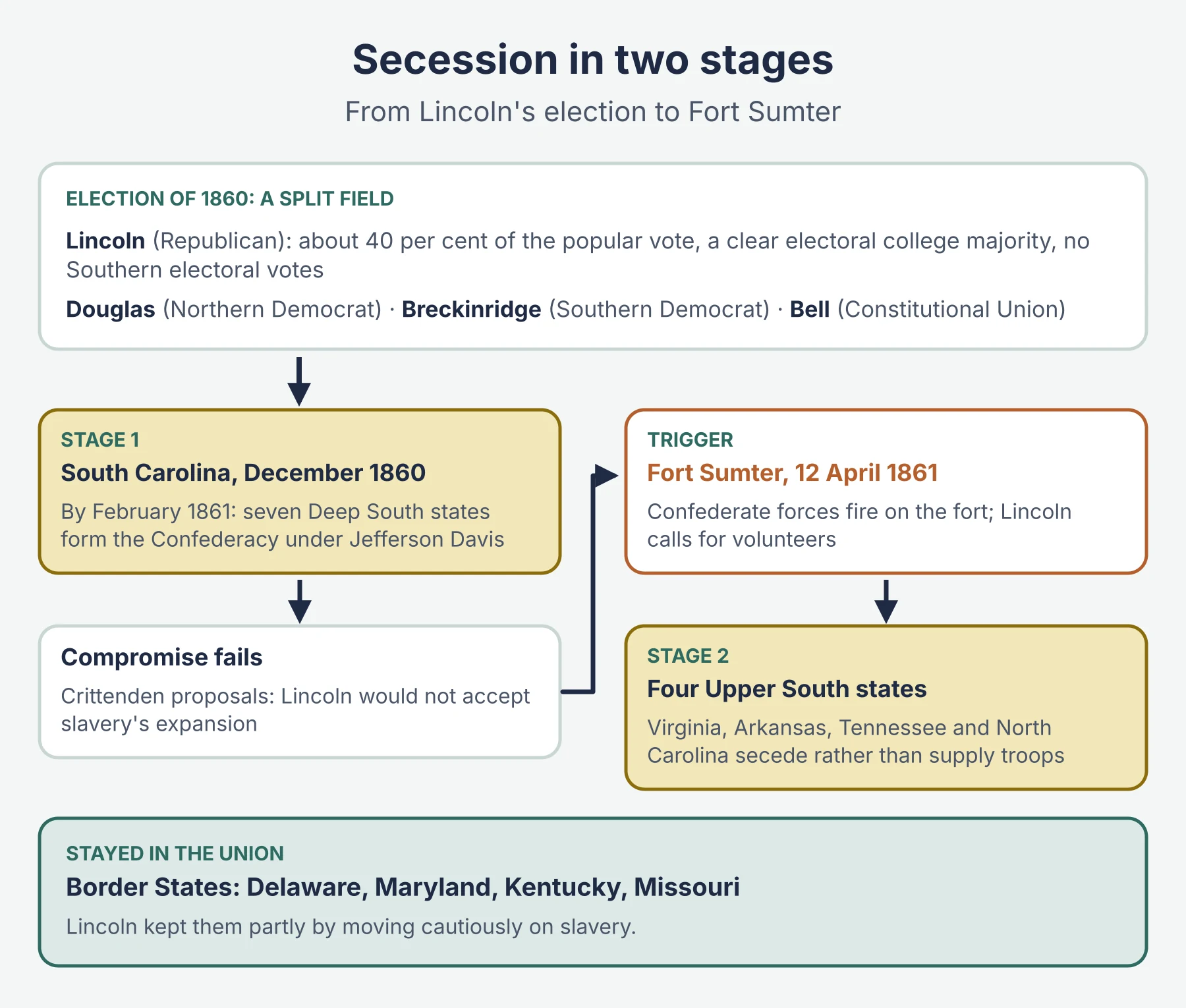
The election of 1860. The Democrats split into Northern (Douglas) and Southern (Breckinridge) wings; John Bell ran for the Constitutional Union Party. Lincoln won with about 40 per cent of the popular vote, carrying almost every free state and winning a clear majority in the electoral college without a single Southern electoral vote. To the Deep South this meant permanent rule by a hostile section.
Secession in two stages. South Carolina seceded in December 1860, and by February 1861 seven Deep South states had formed the Confederacy under Jefferson Davis. Compromise (the Crittenden proposals) failed because Lincoln would not accept slavery’s expansion. Lincoln’s inaugural (March 1861) promised not to touch slavery where it existed but to hold federal property. When Confederate forces fired on Fort Sumter (12 April 1861) and Lincoln called for volunteers, four Upper South states – Virginia, Arkansas, Tennessee and North Carolina – seceded rather than supply troops.
4.3 Why did the Civil War last four years?
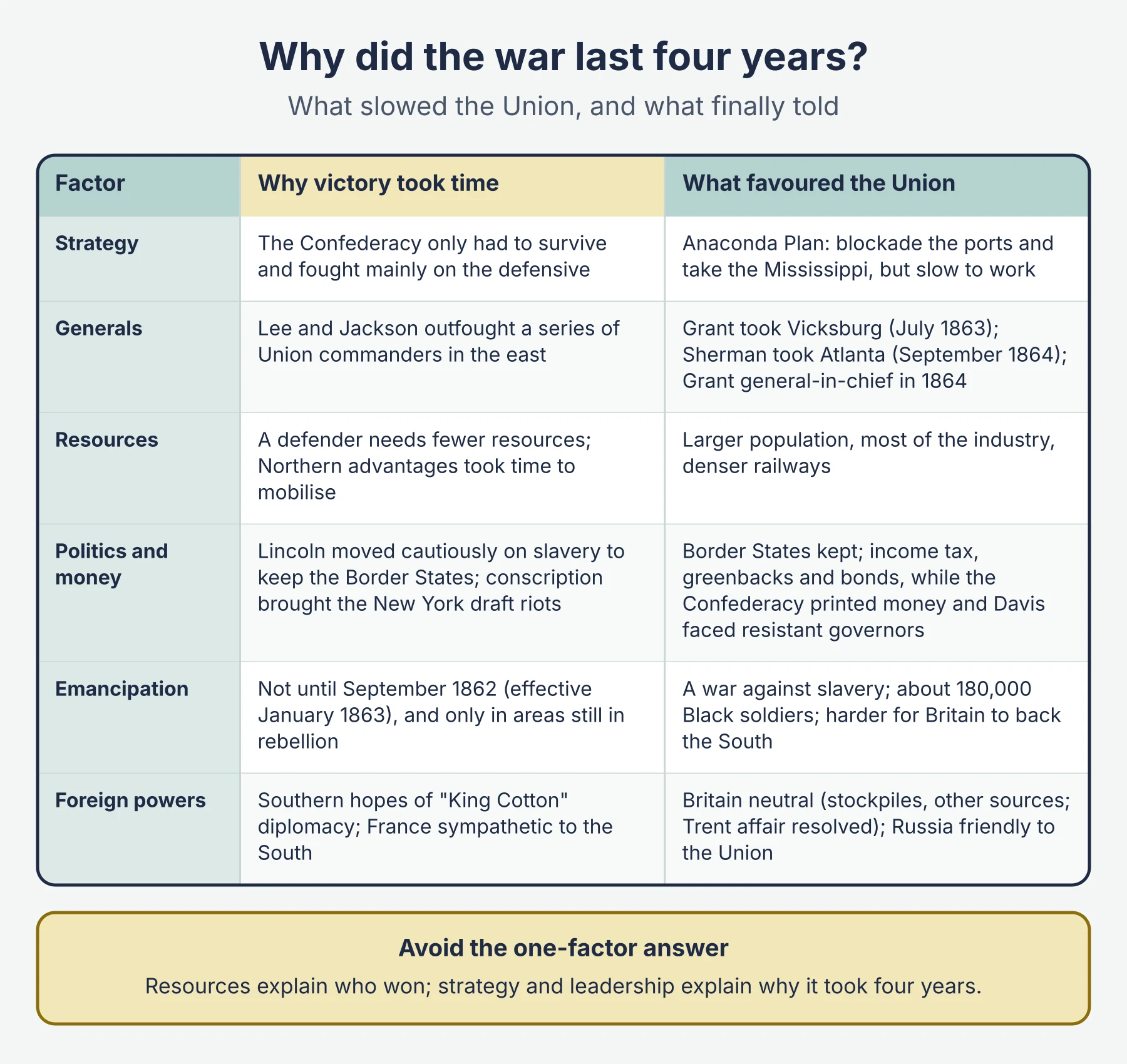
Strategy. The Union’s Anaconda Plan aimed to blockade Southern ports and take the Mississippi, splitting the Confederacy – a slow strategy that took years to work. The Confederacy only had to survive; it fought mainly on the defensive, but Lee twice invaded the North (Antietam, 1862; Gettysburg, 1863), hoping to break Northern will.
Leadership. Lee and Jackson outfought a series of Union commanders in the east, above all the cautious McClellan. The Union’s breakthroughs came in the west: Grant took Vicksburg (July 1863), and Sherman took Atlanta (September 1864) and marched to the sea. Grant’s appointment as general-in-chief in 1864 brought co-ordinated pressure on every front.
Resources. The North had a far larger population, most of the nation’s industry and the denser railway network. But a defender needs fewer resources, and those advantages took time to mobilise.
Political leadership. Lincoln kept the Border States (Delaware, Maryland, Kentucky, Missouri) in the Union, partly by moving cautiously on slavery. Both sides introduced conscription (the Confederacy in 1862, the Union in 1863, provoking the New York draft riots). The Union financed the war with an income tax, paper “greenbacks” and bonds; the Confederacy relied on printing money and suffered severe inflation. Davis faced resistance from state governors who resented central control. Lincoln limited civil liberties, suspending habeas corpus and arresting Copperhead critics such as Clement Vallandigham.
The Emancipation Proclamation (announced September 1862, effective January 1863) freed enslaved people in areas still in rebellion. It made the war a war against slavery, allowed Black men to enlist – around 180,000 served in the Union army – and made it politically harder for Britain to support the South.
Foreign powers. Britain stayed neutral: “King Cotton” diplomacy failed because Britain had stockpiles and other sources, and the Trent affair (1861) was resolved. France under Napoleon III was sympathetic to the South but would not act without Britain and was busy in Mexico. Russia was friendly to the Union.
4.4 What were the aims of Reconstruction and how successful was it?
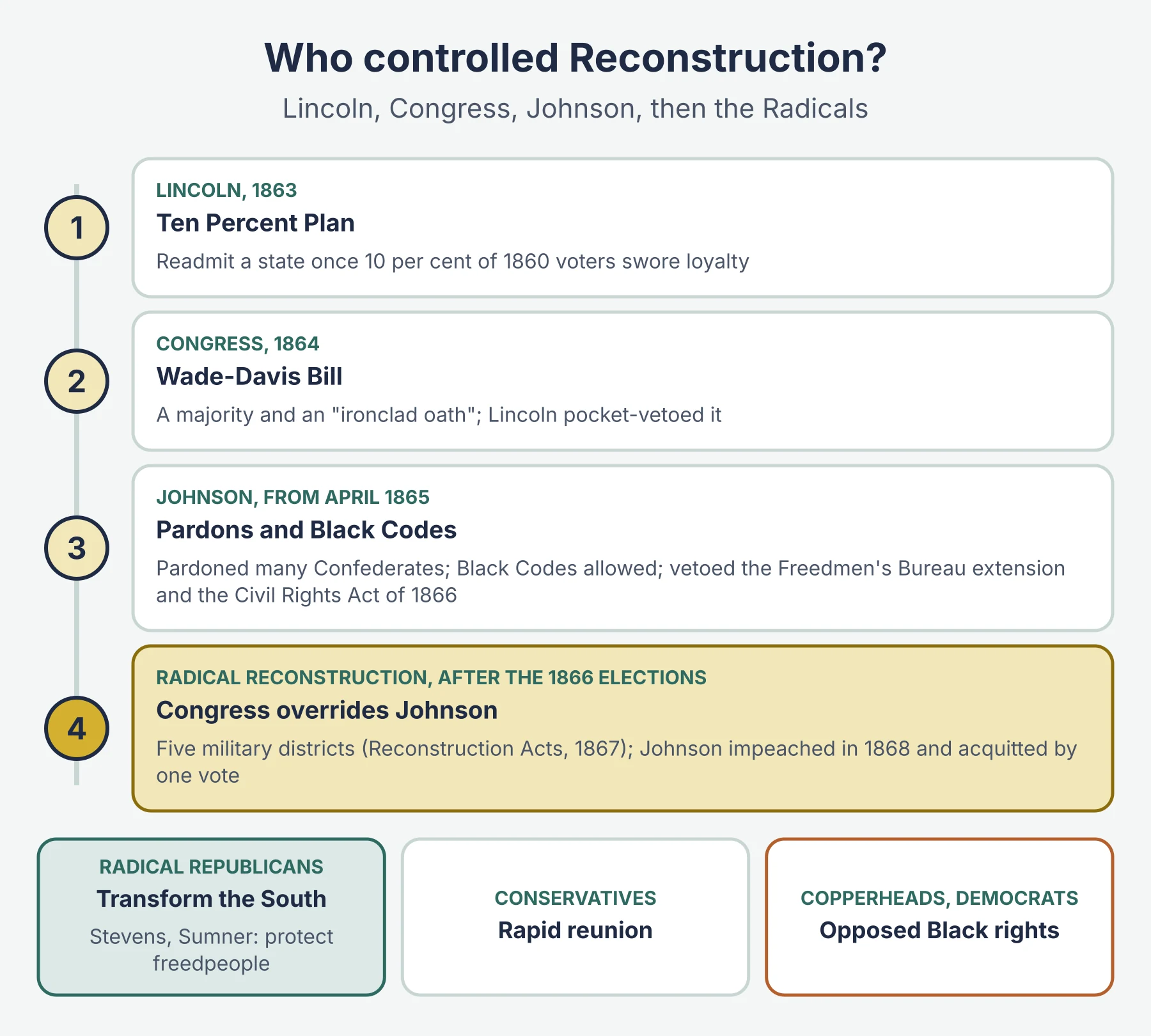
The problem in 1865. The South was devastated, four million people had been freed, and no one agreed on terms of readmission. Radical Republicans (Thaddeus Stevens, Charles Sumner) wanted to transform Southern society and protect freedpeople; Conservatives wanted rapid reunion; Copperheads and Democrats opposed Black rights.
Lincoln and Johnson. Lincoln’s Ten Percent Plan (1863) readmitted a state once 10 per cent of 1860 voters swore loyalty; Congress’s Wade-Davis Bill (1864) demanded a majority and an “ironclad oath”, and Lincoln pocket-vetoed it. After Lincoln’s assassination in April 1865, Andrew Johnson pardoned many Confederates and let Southern governments pass Black Codes restricting freedpeople’s movement and labour. He vetoed the Freedmen’s Bureau extension and the Civil Rights Act of 1866.
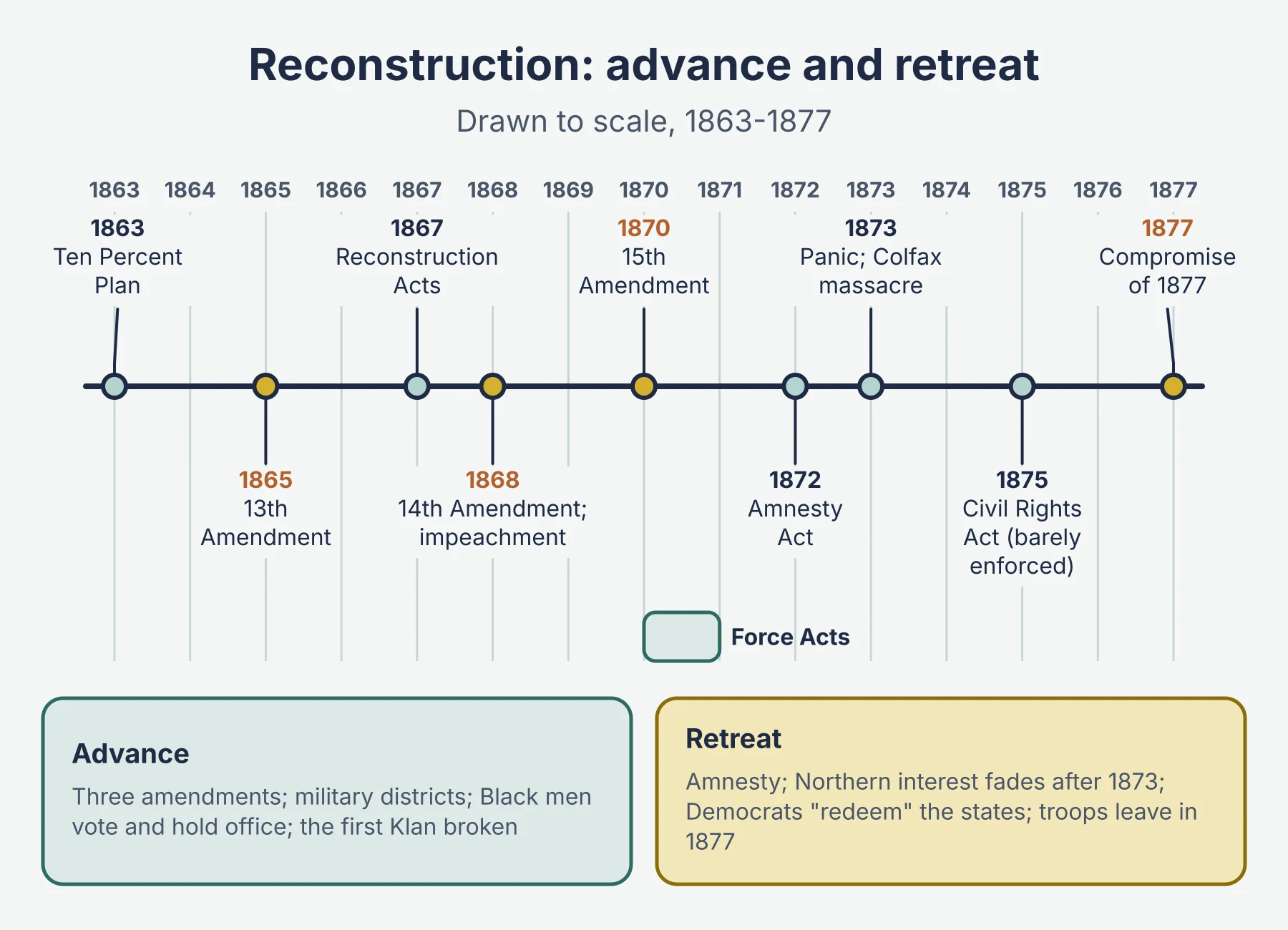
Radical Reconstruction. After the 1866 elections Congress overrode Johnson, placed the South under five military districts (Reconstruction Acts, 1867) and impeached him in 1868; he was acquitted by one vote. The 13th Amendment (1865) abolished slavery, the 14th (1868) defined citizenship and guaranteed equal protection, and the 15th (1870) barred denying the vote on grounds of race.
Freedpeople and the white South. The Freedmen’s Bureau provided food, schools and labour contracts, but land was not redistributed, and most freedpeople became sharecroppers, often tied by debt. Black men voted and held office in Republican state governments, which Southern Democrats attacked as rule by “carpetbaggers” and “scalawags”. The Ku Klux Klan and other groups used terror; massacres such as Colfax (1873) showed the rise in violence.
Grant and the end. Grant backed the Force Acts (1870-71), which broke the first Klan, but also signed the Amnesty Act (1872) restoring rights to most former Confederates; the Civil Rights Act of 1875 was barely enforced. Northern interest faded after the Panic of 1873 as Democrats “redeemed” state after state. In the Compromise of 1877, Democrats accepted the Republican Rutherford Hayes as President after the disputed 1876 election, and federal troops left the remaining Southern capitals.
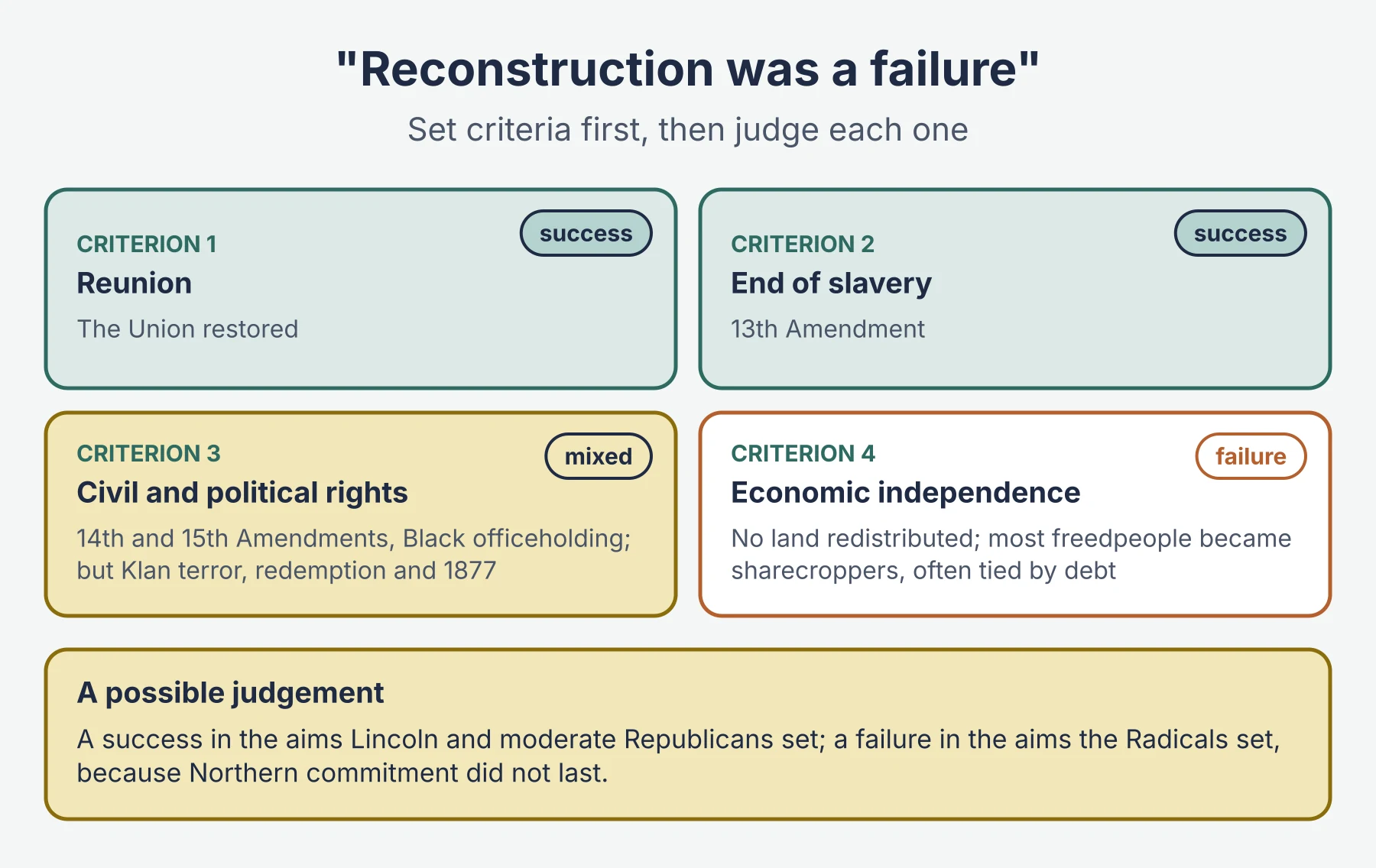
Success or failure? It succeeded in reuniting the nation, ending slavery and writing citizenship and equal protection into the Constitution – foundations later used in the civil rights era. It failed to give freedpeople land, security or lasting political rights, and white supremacy was restored in the South.
Worked example: a Paper 2 part (b)
“Reconstruction was a failure.” How far do you agree? [20]
A strong plan sets criteria first: reunion, the end of slavery, civil and political rights, economic independence for freedpeople. It then weighs failure (sharecropping, Black Codes, Klan violence, redemption, 1877) against success (the Union restored; three amendments; Black officeholding and schooling). The judgement might be that Reconstruction succeeded in its aims as Lincoln and moderate Republicans defined them but failed in the aims the Radicals set, because Northern commitment did not last.
Common mistakes
- Writing that the war began over slavery in the states where it already existed; the dispute before 1861 was about slavery’s expansion.
- Forgetting the two stages of secession and the role of Lincoln’s call for volunteers.
- Treating the Emancipation Proclamation as freeing all enslaved people; the 13th Amendment did that.
- Explaining the Union victory only by resources, without asking why it took four years.
Exam technique
For “Explain why” questions, give several reasons and show how they connect; for “How far” or “To what extent”, explain the stated factor first, then alternatives, then judge. In Paper 1, use the date and author of each source – a Southern newspaper in 1861 or a Radical speech in 1866 – to explain why it says what it says.
Official syllabus
Cambridge International AS & A Level History (9489) syllabus for 2027, 2028 and 2029 – cambridgeinternational.org (subject content, topic 4; Topics assessed on Paper 1 and Paper 2). Always check the current syllabus before an exam.
Related resources
-
Practice questions
Cambridge A Level World History (9489): The Civil War and Reconstruction, 1820-77 – Practice Questions
Twelve original practice questions on Cambridge 9489 Civil War and Reconstruction 1820-77, with invented Paper 1 sources, Paper 2 essays and full answers.
World History · Cambridge · AS Level
Try questions -
Revision notes
Cambridge A Level World History (9489): The Civil War and Reconstruction, 1820-77 – Revision Notes
Revision notes for Cambridge 9489 History, Civil War and Reconstruction 1820-77: compromises, secession, the war's length, Reconstruction and a self-test.
World History · Cambridge · AS Level
Revise topic -
Practice questions
Cambridge A Level World History (9489): The Gilded Age and the Progressive Era, 1870-1920 – Practice Questions
Twelve original practice questions on Cambridge 9489 Gilded Age and Progressive Era 1870-1920: recall, invented sources, essays and mark-scheme style answers.
World History · Cambridge · AS Level
Try questions
Get free revision emails (optional)
Occasional emails with practice questions, worked explanations and links to free resources for the qualification and subjects you choose. No spam, and you can unsubscribe from any email. The free tools on this site never need an email.