
Revision Notes
Cambridge A Level World History (9489): The Civil War and Reconstruction, 1820-77 – Revision Notes
Revision notes for Cambridge 9489 History, Civil War and Reconstruction 1820-77: compromises, secession, the war's length, Reconstruction and a self-test.
- Subject
- World History
- Level
- AS LEVEL
- Topic
- Paper 1 and Paper 2 – American Option: The History of the USA, 1820–1941
- Author
- Marlbridge Academic Team
- Updated
- Reviewed by
- Azam Siddique (what this means)
Aligned to Cambridge A Level World History (9489), 2027-2029. Official specification .
Syllabus page (what it covers and how it is assessed): Cambridge A Level World History.
Syllabus points this page covers
9489 (AS Level)
- 4 The Civil War and Reconstruction, 1820–77
Found an error? Report a correction.
Need help with this topic? Request a free trial class for A Level World History (9489).
These notes condense Cambridge 9489 AS topic 4, The Civil War and Reconstruction, 1820-77, into tables and lists for recall. The four key questions are: growing tension before 1860 (4.1), the outbreak of war in April 1861 (4.2), why the war lasted four years (4.3), and the aims and success of Reconstruction (4.4). Full explanations are in the Civil War and Reconstruction study guide; exam-style questions are in the Civil War and Reconstruction practice questions.
Rotation (2027-2029 syllabus): Paper 2 (Outline Study) in 2027 and 2028; Paper 1 (Historical Sources) in 2029.
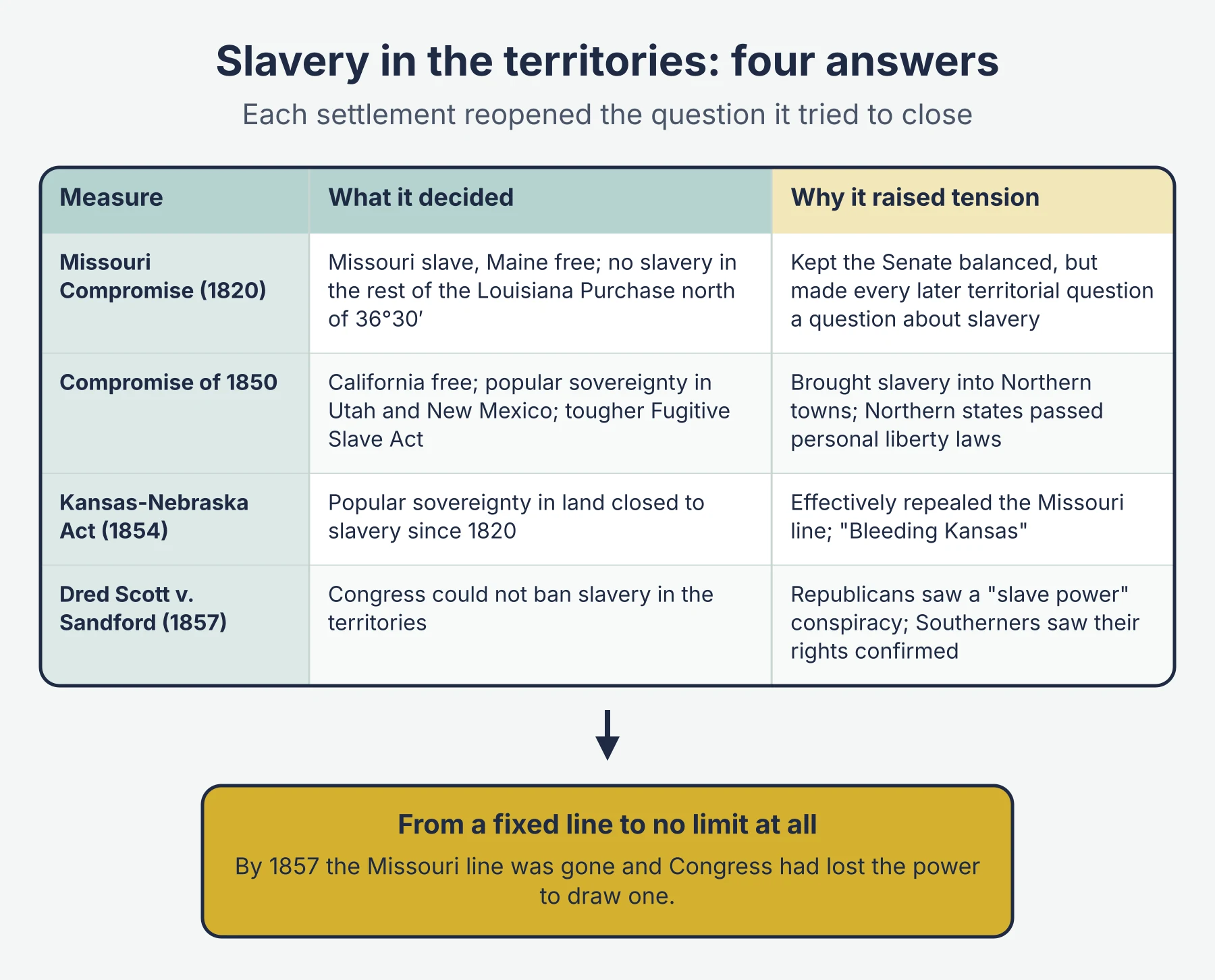
The compromises and why each one failed
| Measure | Terms | Why it did not settle the issue |
|---|---|---|
| Missouri Compromise, 1820 | Missouri slave, Maine free; no slavery north of 36°30′ in the Louisiana Purchase | Applied only to existing territory; new land from Mexico reopened the question |
| Wilmot Proviso, 1846 | Ban slavery in land won from Mexico | Passed House, failed Senate; showed voting by section, not party |
| Compromise of 1850 | California free; popular sovereignty in Utah and New Mexico; DC slave trade ended; new Fugitive Slave Act | Fugitive Slave Act brought enforcement of slavery into the North |
| Kansas-Nebraska Act, 1854 | Popular sovereignty in Kansas and Nebraska | Repealed the 1820 line in effect; caused “Bleeding Kansas” and the Republican Party |
| Lecompton Constitution, 1857 | Pro-slavery constitution for Kansas | Seen as fraudulent; split Buchanan from Douglas and the Democrats |
| Crittenden proposals, 1860-61 | Restore and extend the 36°30′ line to the Pacific | Lincoln would not accept any expansion of slavery |
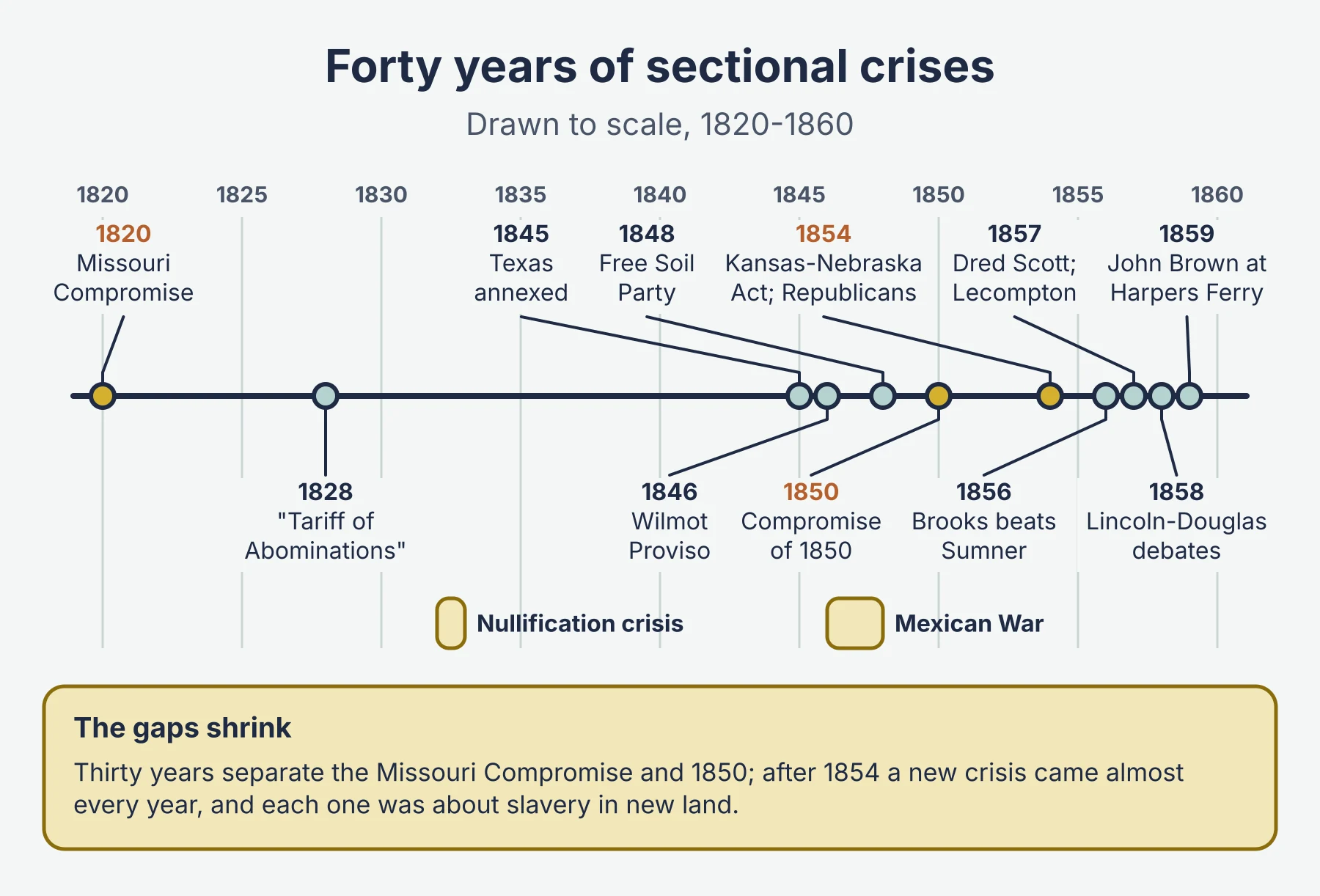
Chronology
| Date | Event |
|---|---|
| 1828-33 | “Tariff of Abominations”; Nullification Crisis |
| 1845-48 | Texas annexed; Mexican War; Treaty of Guadalupe Hidalgo (1848) |
| 1848 | Free Soil Party |
| 1852 | Uncle Tom’s Cabin |
| May 1856 | Sack of Lawrence; Pottawatomie killings; Brooks-Sumner incident |
| March 1857 | Dred Scott decision |
| 1858 | Lincoln-Douglas debates |
| Oct 1859 | Harpers Ferry raid |
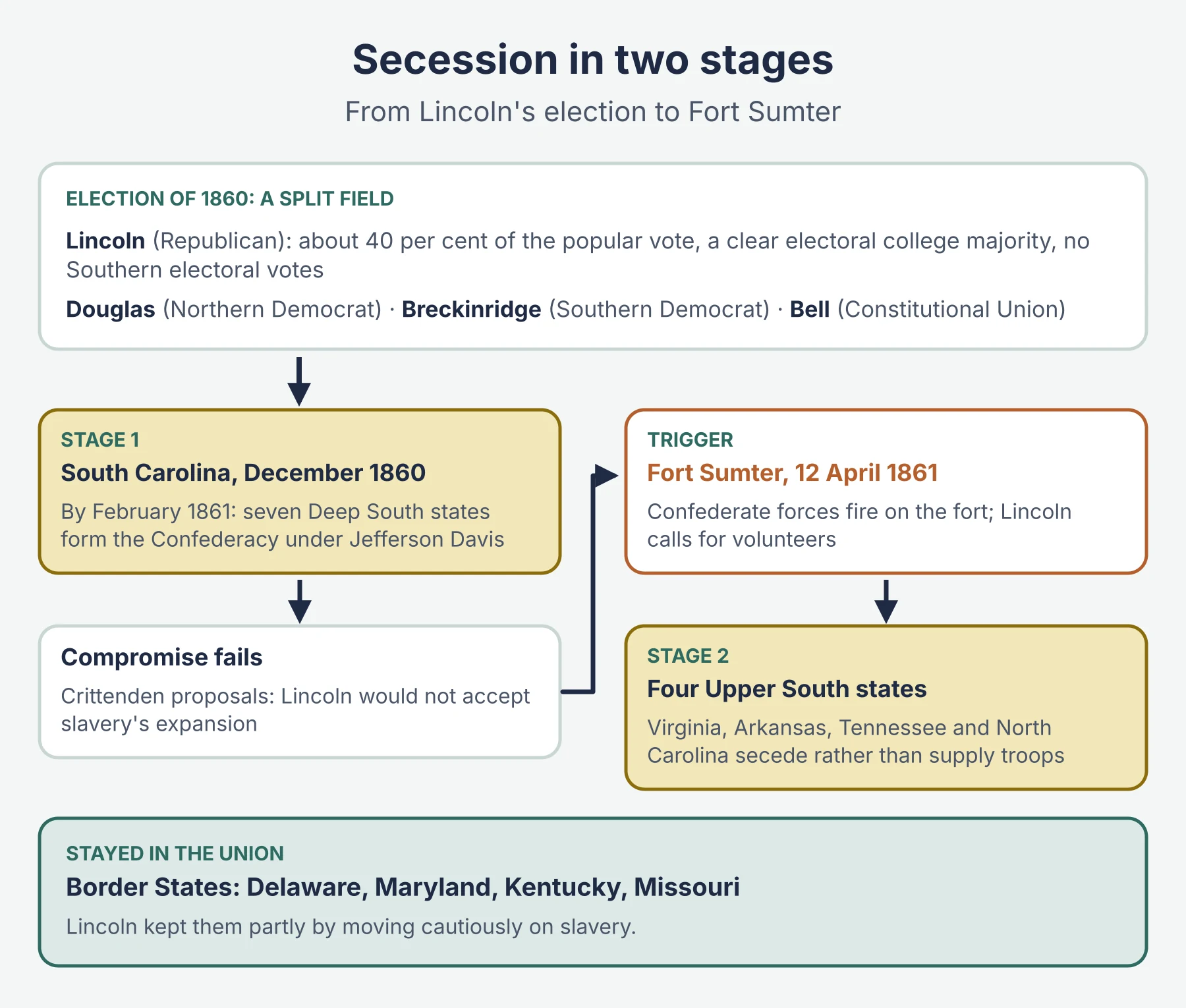
| Nov 1860 | Lincoln elected |
| Dec 1860-Feb 1861 | Seven states secede; Confederacy formed |
| 12 April 1861 | Fort Sumter; four more states secede after Lincoln’s call for troops |
| Sept 1862 | Antietam; preliminary Emancipation Proclamation |
| July 1863 | Gettysburg and Vicksburg; New York draft riots |
| Sept-Dec 1864 | Atlanta falls; Sherman’s march to the sea |
| April 1865 | Appomattox (9 April); Lincoln assassinated (14 April) |
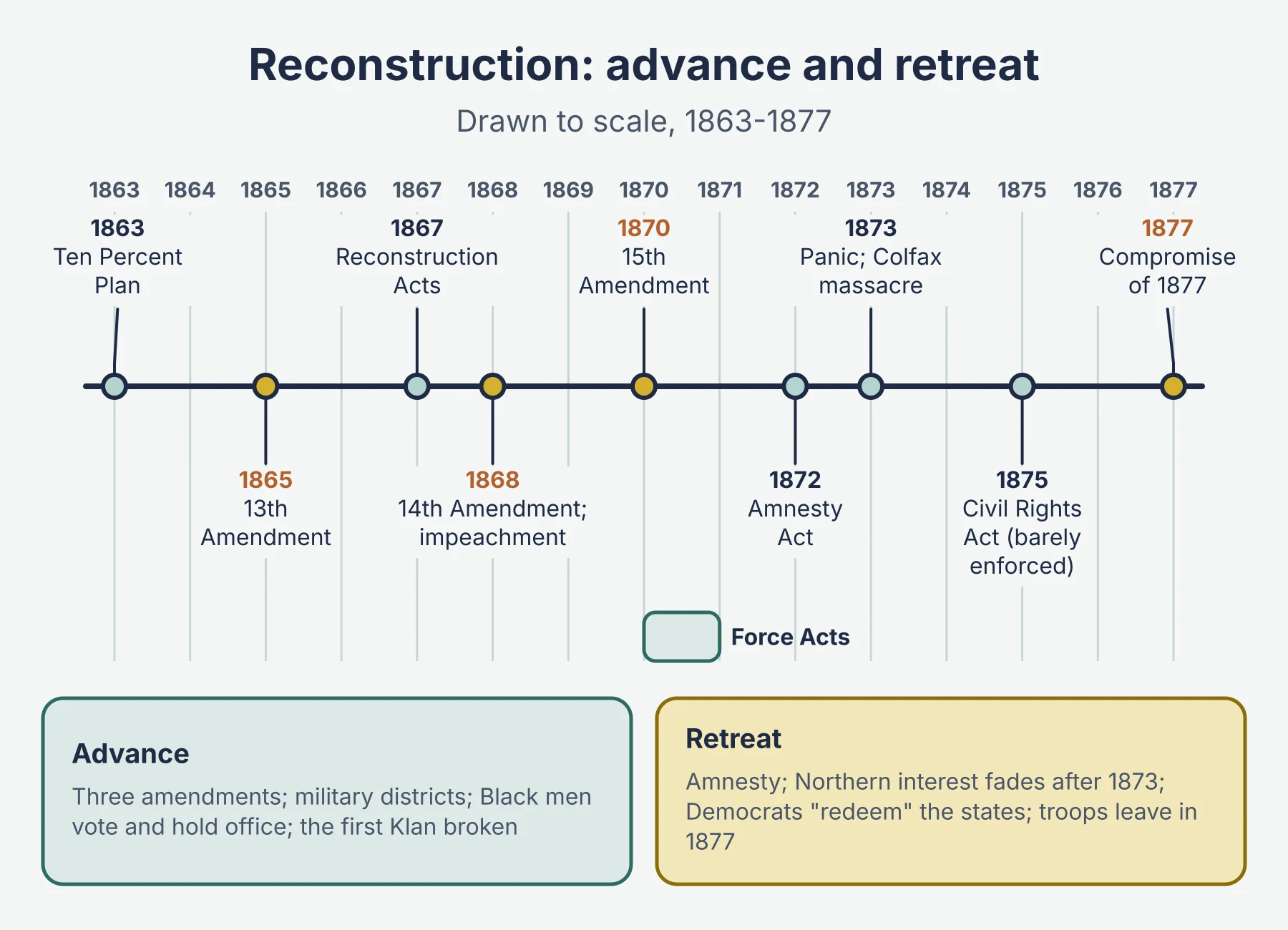
| 1865-66 | Black Codes; Freedmen’s Bureau; Civil Rights Act (1866) over Johnson’s veto |
| 1867 | Reconstruction Acts |
| 1868 | Johnson impeached and acquitted; 14th Amendment ratified |
| 1870 | 15th Amendment ratified |
| 1870-71 | Force (Enforcement) Acts |
| 1872 / 1875 | Amnesty Act / Civil Rights Act |
| 1873 | Panic of 1873; Colfax massacre |
| 1876-77 | Disputed election; Compromise of 1877 |
Key terms
| Term | Meaning |
|---|---|
| Sectionalism | Loyalty to North or South above the nation |
| Nullification | Claim that a state could refuse to enforce a federal law |
| Popular sovereignty | Settlers of a territory decide on slavery |
| Free Soil | Opposition to slavery’s expansion, often to protect free white labour |
| “Slave power” | Northern belief that slaveholders controlled the federal government |
| Secession | A state leaving the Union |
| Border States | Slave states that stayed in the Union: Delaware, Maryland, Kentucky, Missouri |
| Copperheads | Northern Peace Democrats who opposed the war |
| Habeas corpus | Right not to be held without trial; suspended by Lincoln |
| Black Codes | Southern laws of 1865-66 restricting freedpeople |
| Sharecropping | Farming land for a share of the crop, often trapping families in debt |
| Carpetbaggers / scalawags | Hostile terms for Northern newcomers / white Southern Republicans |
| Redeemers | Southern Democrats who regained control of state governments |
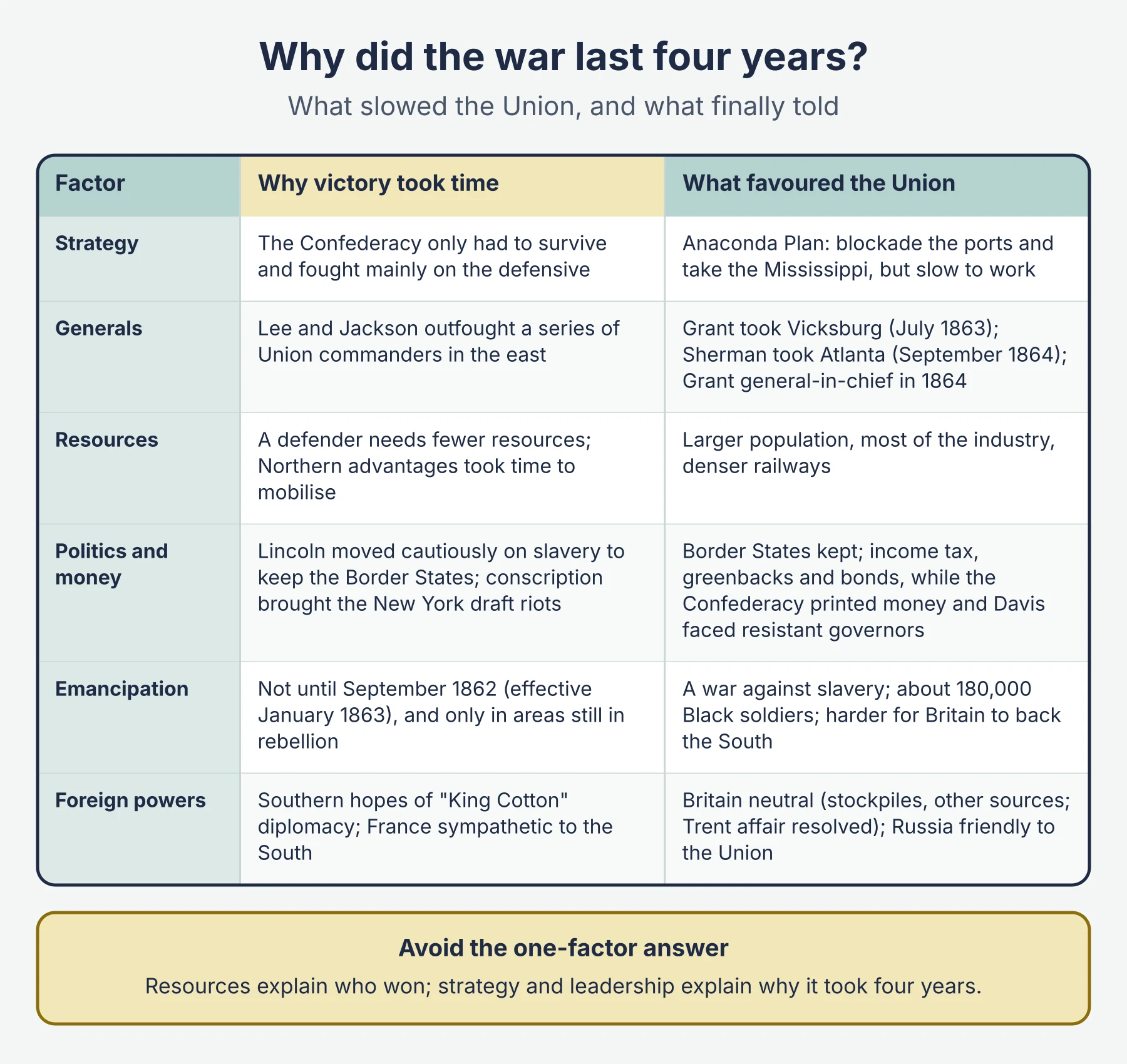
Why the war lasted four years – both sides of the ledger
| Union advantages | Confederate advantages |
|---|---|
| Larger population; immigrant recruits; Black soldiers after 1863 | Defending home ground with shorter internal lines |
| Most of the industry, railways and shipping | Able generals in the east (Lee, Jackson) |
| Navy enforced the blockade | Only needed to survive, not conquer |
| Stable finance: income tax, greenbacks, bonds | Hope of British or French recognition until 1862-63 |
| Lincoln’s political skill; Grant and Sherman by 1864 | Vast territory that took years to occupy |
Turning points: Antietam (stopped Lee and allowed emancipation); Gettysburg and Vicksburg (July 1863); Atlanta (secured Lincoln’s re-election in 1864).
Reconstruction in three phases
| Phase | Who led | Key features |
|---|---|---|
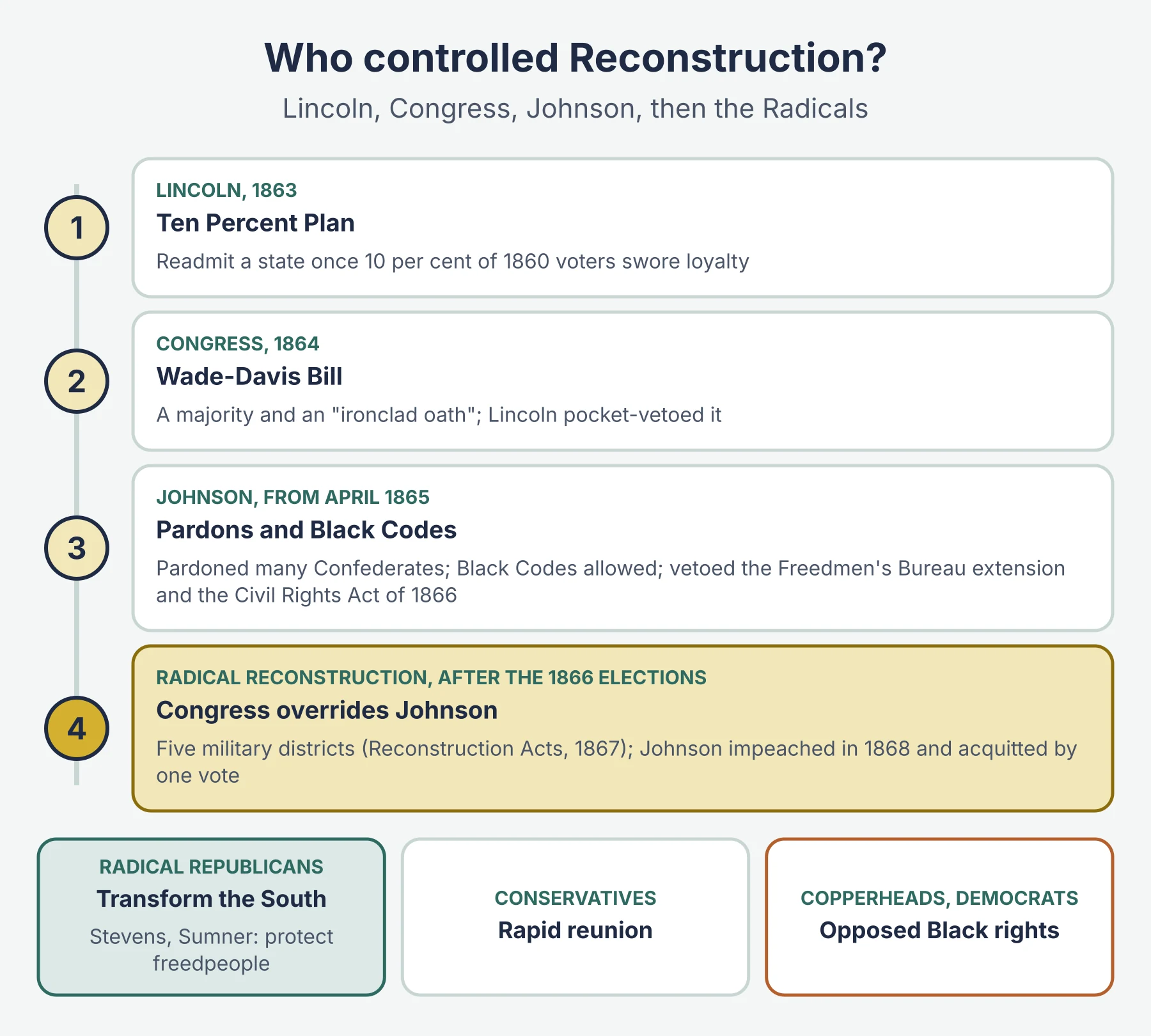
| Wartime, 1863-65 | Lincoln | Ten Percent Plan; Wade-Davis Bill pocket-vetoed; 13th Amendment passed by Congress |
| Presidential, 1865-67 | Johnson | Pardons; Black Codes; vetoes of the Freedmen’s Bureau and Civil Rights bills |
| Radical / Congressional, 1867-77 | Congress, then Grant | Military districts; 14th and 15th Amendments; Black officeholding; Force Acts; then retreat |
Exam traps
- Expansion, not abolition. Lincoln’s 1860 platform opposed slavery’s expansion; he promised not to touch it where it existed.
- The Emancipation Proclamation applied only to areas in rebellion, not to the Border States.
- Dred Scott declared the Missouri Compromise’s restriction unconstitutional – it did not create a new compromise.
- “The North won because it was bigger” is a description, not an argument; explain why advantages took four years to tell.
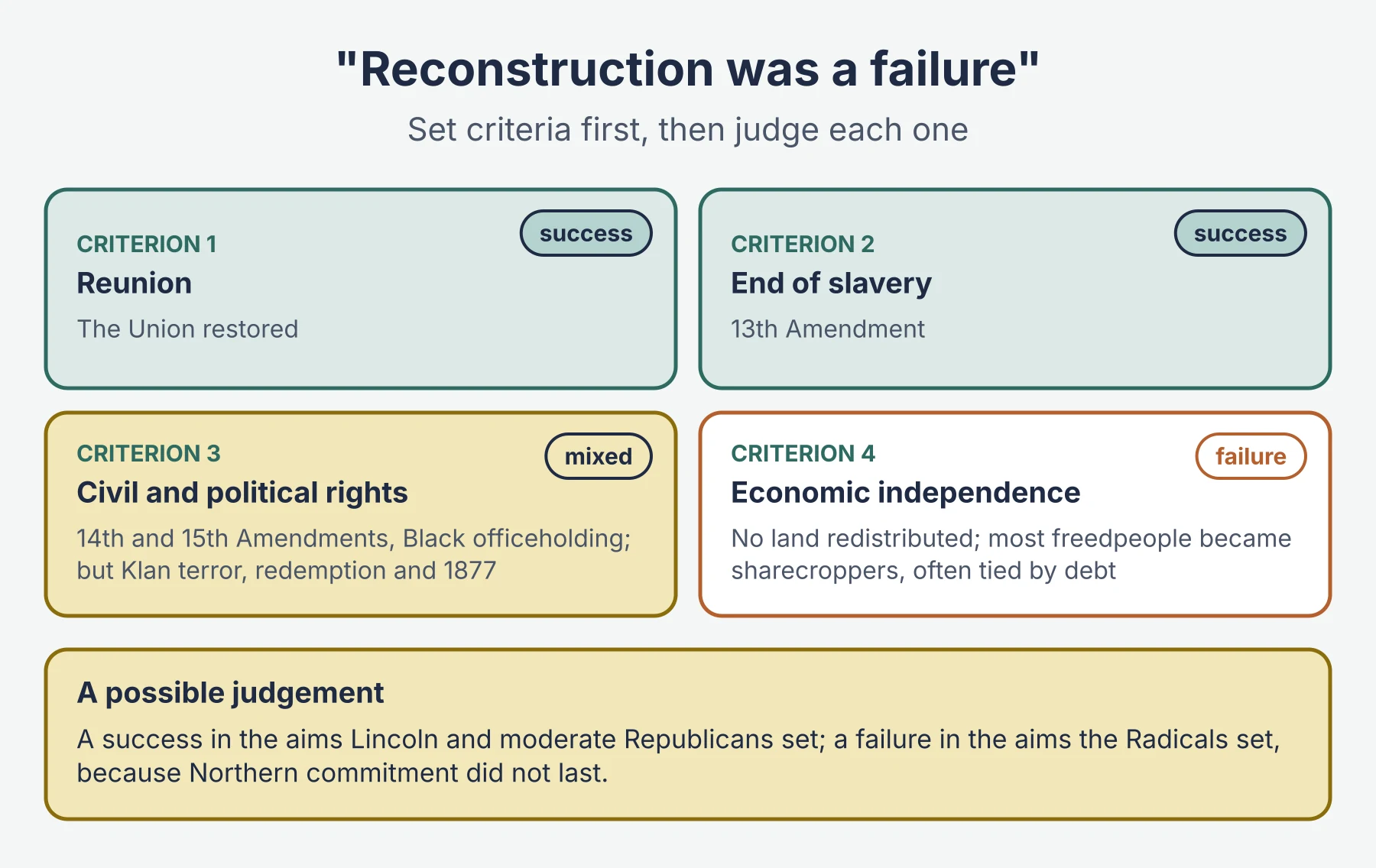
- Reconstruction success questions need criteria and evidence on both sides; a list of amendments is not a judgement.
- Paper 1. A Radical Republican speech and a Southern Democratic newspaper describe the same events very differently – explain the purpose behind each.
Self-test
- What line did the Missouri Compromise set? 36°30′ north: no slavery north of it in the Louisiana Purchase except Missouri.
- Why did the Wilmot Proviso matter even though it failed? Votes split by section rather than party, showing how slavery was dividing the parties.
- Which part of the Compromise of 1850 caused most anger in the North? The Fugitive Slave Act.
- What did Dred Scott v. Sandford rule? Black Americans were not citizens, and Congress could not ban slavery in the territories.
- Name the four candidates in the 1860 election. Lincoln, Douglas, Breckinridge and Bell.
- Which event caused the Upper South to secede? Lincoln’s call for volunteers after the attack on Fort Sumter.
- What were the two parts of the Anaconda Plan? A naval blockade and control of the Mississippi.
- Give two ways Lincoln limited civil liberties. Suspending habeas corpus; arresting critics such as Vallandigham; military trials of civilians.
- Why did Britain not recognise the Confederacy? Any two: cotton stockpiles and other suppliers; Union victories such as Antietam; the Emancipation Proclamation; fear of war with the Union.
- What did the Wade-Davis Bill require? A majority of a state’s white men to swear loyalty, and an “ironclad oath” for voters and officials.
- What did the 14th Amendment guarantee? Citizenship for all born in the USA and equal protection of the laws.
- What did Democrats gain in the Compromise of 1877? The withdrawal of federal troops from the South, ending Reconstruction.
Official syllabus
Cambridge International AS & A Level History (9489) syllabus for 2027, 2028 and 2029 – cambridgeinternational.org (subject content, topic 4; Topics assessed on Paper 1 and Paper 2).
Related resources
-
Practice questions
Cambridge A Level World History (9489): The Gilded Age and the Progressive Era, 1870-1920 – Practice Questions
Twelve original practice questions on Cambridge 9489 Gilded Age and Progressive Era 1870-1920: recall, invented sources, essays and mark-scheme style answers.
World History · Cambridge · AS Level
Try questions -
Study guides
Cambridge A Level World History (9489): The Great Crash, the Great Depression and the New Deal, 1920-41
Study guide to Cambridge 9489 History topic 6, 1920-41: causes of the Crash and Depression, Hoover's response, the First and Second New Deals and their impact.
World History · Cambridge · AS Level
Read guide -
Practice questions
Cambridge A Level World History (9489): The Great Crash, the Great Depression and the New Deal, 1920-41 – Practice Questions
Twelve original practice questions on Cambridge 9489 Crash, Depression and New Deal 1920-41, with invented Paper 1 sources, Paper 2 essays and full answers.
World History · Cambridge · AS Level
Try questions
Get free revision emails (optional)
Occasional emails with practice questions, worked explanations and links to free resources for the qualification and subjects you choose. No spam, and you can unsubscribe from any email. The free tools on this site never need an email.