
Study Guides
Cambridge A Level World History (9489): The Great Crash, the Great Depression and the New Deal, 1920-41
Study guide to Cambridge 9489 History topic 6, 1920-41: causes of the Crash and Depression, Hoover's response, the First and Second New Deals and their impact.
- Subject
- World History
- Level
- AS LEVEL
- Topic
- Paper 1 and Paper 2 – American Option: The History of the USA, 1820–1941
- Author
- Marlbridge Academic Team
- Updated
- Reviewed by
- Azam Siddique (what this means)
Aligned to Cambridge A Level World History (9489), 2027-2029. Official specification .
Syllabus page (what it covers and how it is assessed): Cambridge A Level World History.
Syllabus points this page covers
9489 (AS Level)
- 6 The Great Crash, the Great Depression and the New Deal, 1920–41
Found an error? Report a correction.
Need help with this topic? Request a free trial class for A Level World History (9489).
The Great Crash, the Great Depression and the New Deal, 1920-41 is the third topic of the American option at AS Level in Cambridge International History 9489. Its four key questions ask what caused the Crash and the Depression (6.1), what their impact was in the United States (6.2), how successful Roosevelt’s first New Deal was (6.3), and why there was a second New Deal and how successful it was (6.4). The topic rewards precise knowledge of legislation and a clear sense of criteria when you judge “success”. For the option as a whole, see the History of the USA, 1820-1941 study guide.
Where this fits in 9489
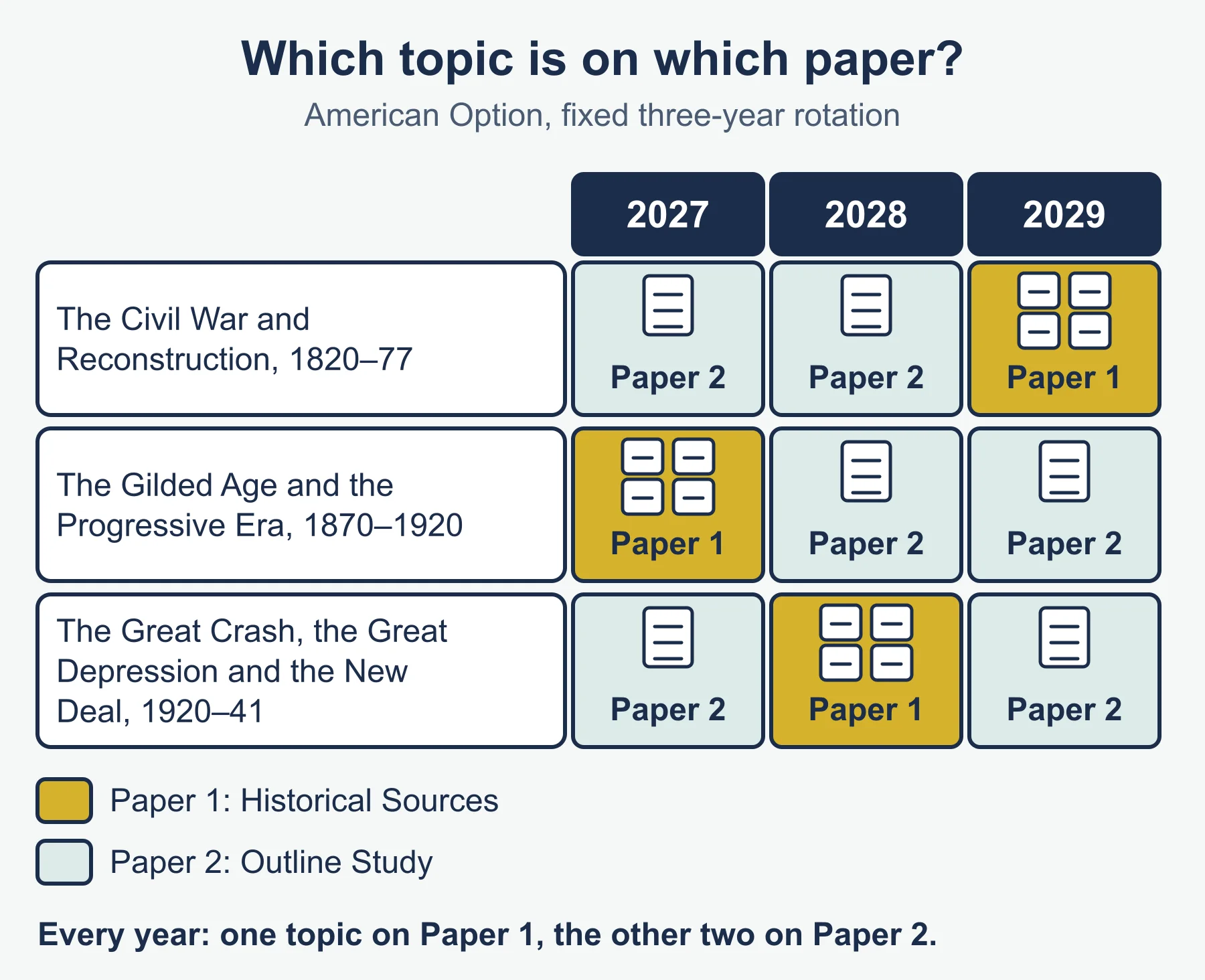
Under the 2027-2029 rotation this topic is on Paper 2 (Outline Study) in 2027 and 2029 and on Paper 1 (Historical Sources) in 2028. Paper 2 part (a) asks “Explain why…” for 10 marks and part (b) a 20-mark comparative judgement; Paper 1 sets a 15-mark comparison of two sources and a 25-mark question on four sources. Revise with the Great Depression and New Deal revision notes and practise with the Great Depression and New Deal practice questions.
6.1 What caused the Great Crash and the Great Depression?
Republican government, 1921-29. Presidents Harding and Coolidge, with Andrew Mellon at the Treasury, cut taxes on high incomes, kept regulation light and raised tariffs (Fordney-McCumber, 1922). Their belief that prosperity came from business confidence encouraged the boom but left it unsupervised.
The boom and its weaknesses. Mass production – above all of cars, electrical goods and radios – combined with advertising and instalment credit to drive growth. But gains went disproportionately to the wealthy, so demand from ordinary families depended on credit. Farmers never shared the boom: prices fell after 1920 as European production recovered, and Coolidge vetoed the McNary-Haugen farm relief bills. Coal, textiles and railways were also depressed. The urban/rural divide meant much of America was already struggling before 1929.
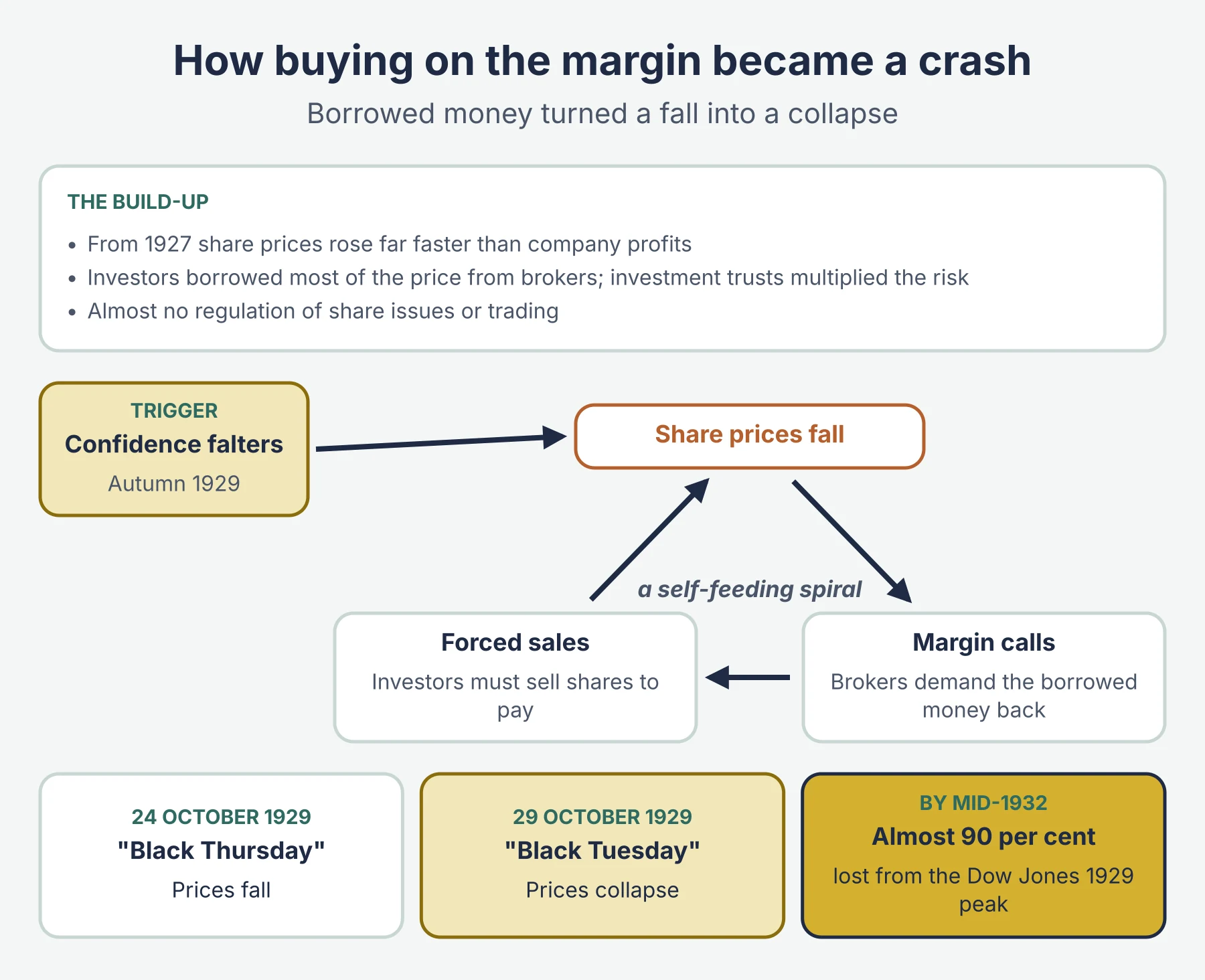
The Crash. From 1927 share prices rose far faster than company profits. Investors bought “on the margin”, borrowing most of the price from brokers; investment trusts multiplied the risk. There was almost no regulation of share issues or trading. When confidence faltered in autumn 1929, margin calls forced sales: prices fell on “Black Thursday” (24 October) and collapsed on “Black Tuesday” (29 October). By mid-1932 the Dow Jones index had lost almost 90 per cent of its 1929 peak.
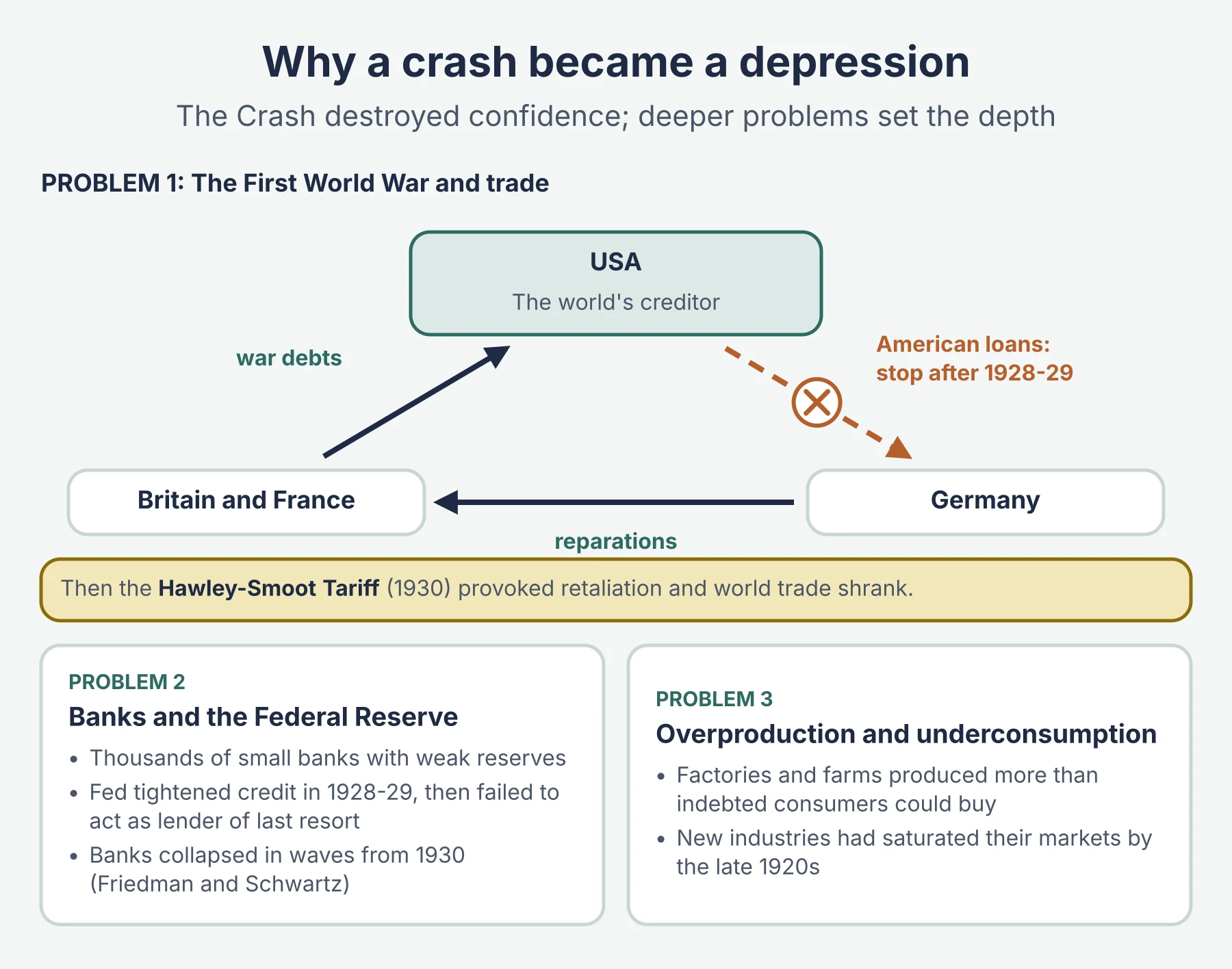
Why a crash became a depression. The Crash destroyed savings and confidence, but the Depression’s depth came from deeper problems:
- The First World War and trade. The USA emerged as the world’s creditor. Germany paid reparations with American loans, and Britain and France repaid war debts with reparations. When American lending stopped after 1928-29, the cycle broke. The Hawley-Smoot Tariff (1930) provoked retaliation and world trade shrank.
- Banks and the Federal Reserve. Thousands of small, independent banks held weak reserves; many had already failed in rural areas in the 1920s. The Federal Reserve tightened credit in 1928-29 and then failed to act as lender of last resort as banks collapsed in waves from 1930. Economists Milton Friedman and Anna Schwartz later made this the centre of their explanation.
- Overproduction and underconsumption. Factories and farms produced more than consumers, many already in debt, could buy. The new industries had saturated their markets by the late 1920s.
6.2 What was the impact of the Crash and the Depression?
Immediate effects. The fall in share values ruined speculators and many ordinary investors, and bankrupted brokers, banks and insurance companies. Demand for regulation of Wall Street grew.
The Depression. By 1933 about a quarter of the workforce was unemployed. Industrial output roughly halved. Deflation made debts harder to repay; farm prices fell so far that crops were left to rot and farms were foreclosed. There was no federal welfare: local charities and city relief funds ran out. Shanty towns of the homeless were nicknamed Hoovervilles. Discrimination worsened – African Americans were often “last hired, first fired”, and hundreds of thousands of Mexican Americans were pressured or deported to Mexico. Families delayed marriage, birth rates fell, and many men left home to search for work.
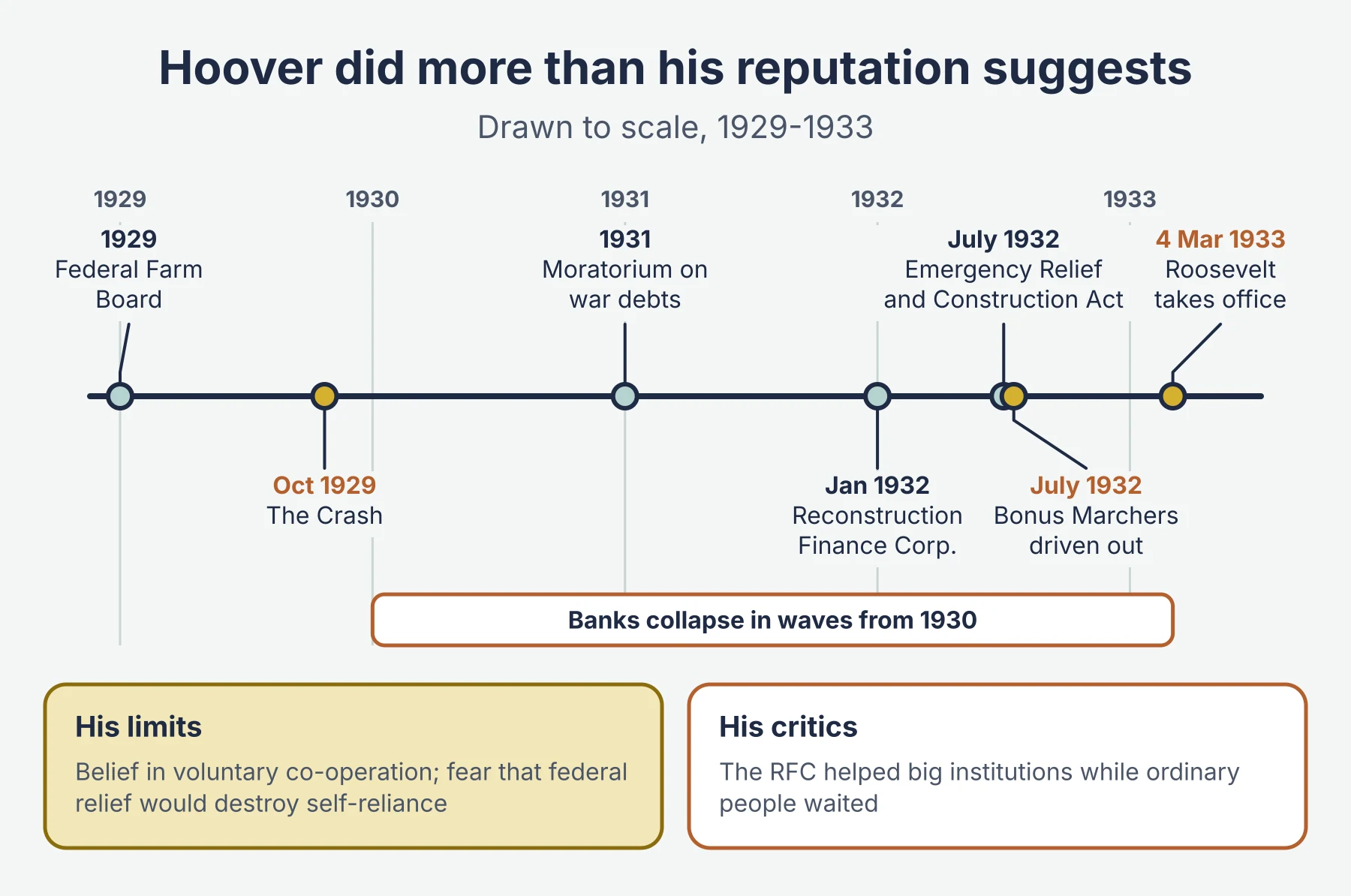
Hoover’s response. Hoover did more than his reputation suggests, but within limits set by his belief in voluntary co-operation and his fear that federal relief would destroy self-reliance. He persuaded business leaders to maintain wages (most could not), set up the Federal Farm Board under the Agricultural Marketing Act (1929) to support prices, declared a moratorium on war debts (1931), created the Reconstruction Finance Corporation (January 1932) to lend to banks, railways and insurers, set up Federal Home Loan Banks, and signed the Emergency Relief and Construction Act (July 1932), which lent money to states for relief and public works. Critics said the RFC helped big institutions while ordinary people waited. In July 1932 the army, under General MacArthur, drove the Bonus Marchers – veterans demanding early payment of a promised bonus – out of Washington; the images damaged Hoover badly.
The 1932 election. Franklin Roosevelt promised “a new deal for the American people” and won 42 of the 48 states. His victory began to build the New Deal coalition: urban workers, immigrants and their children, Catholics and Jews, the white South, many farmers and, increasingly, African Americans and union members.
6.3 How successful was the first New Deal?
March 1933. Between the election and the inauguration, banks failed across the country and many states declared bank holidays. Roosevelt took office on 4 March, telling Americans that “the only thing we have to fear is fear itself”. He relied on advisers from universities – the Brains Trust (including Raymond Moley, Rexford Tugwell and Adolf Berle) – and on large Democratic majorities in Congress.
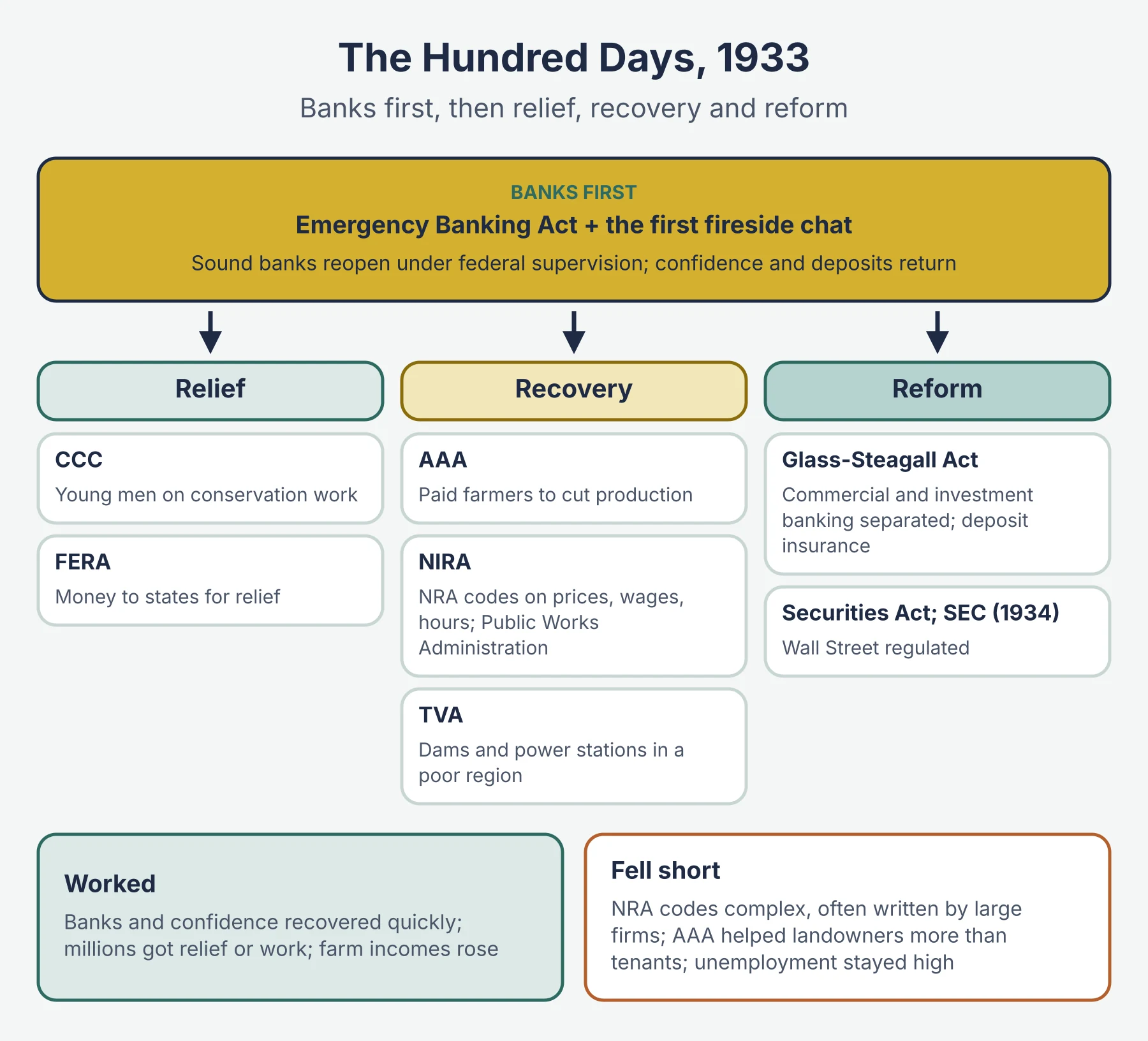
The Hundred Days. Congress passed the Emergency Banking Act, allowing sound banks to reopen under federal supervision; Roosevelt’s first radio “fireside chat” restored confidence, and deposits returned. The Glass-Steagall Act separated commercial and investment banking and created federal deposit insurance. The Civilian Conservation Corps employed young men on conservation work; the Federal Emergency Relief Administration gave money to states for relief; the Agricultural Adjustment Act paid farmers to cut production; the Tennessee Valley Authority built dams and power stations in a poor region; the National Industrial Recovery Act set up the NRA’s codes on prices, wages and hours and the Public Works Administration. The Securities Act and, in 1934, the Securities and Exchange Commission regulated Wall Street. By executive action Roosevelt took the dollar off the gold standard.
Success? Confidence and the banking system recovered quickly; millions received relief or work; farm incomes rose. But the NRA codes were complex and often written by large firms, the AAA helped landowners more than tenants, and unemployment remained high.
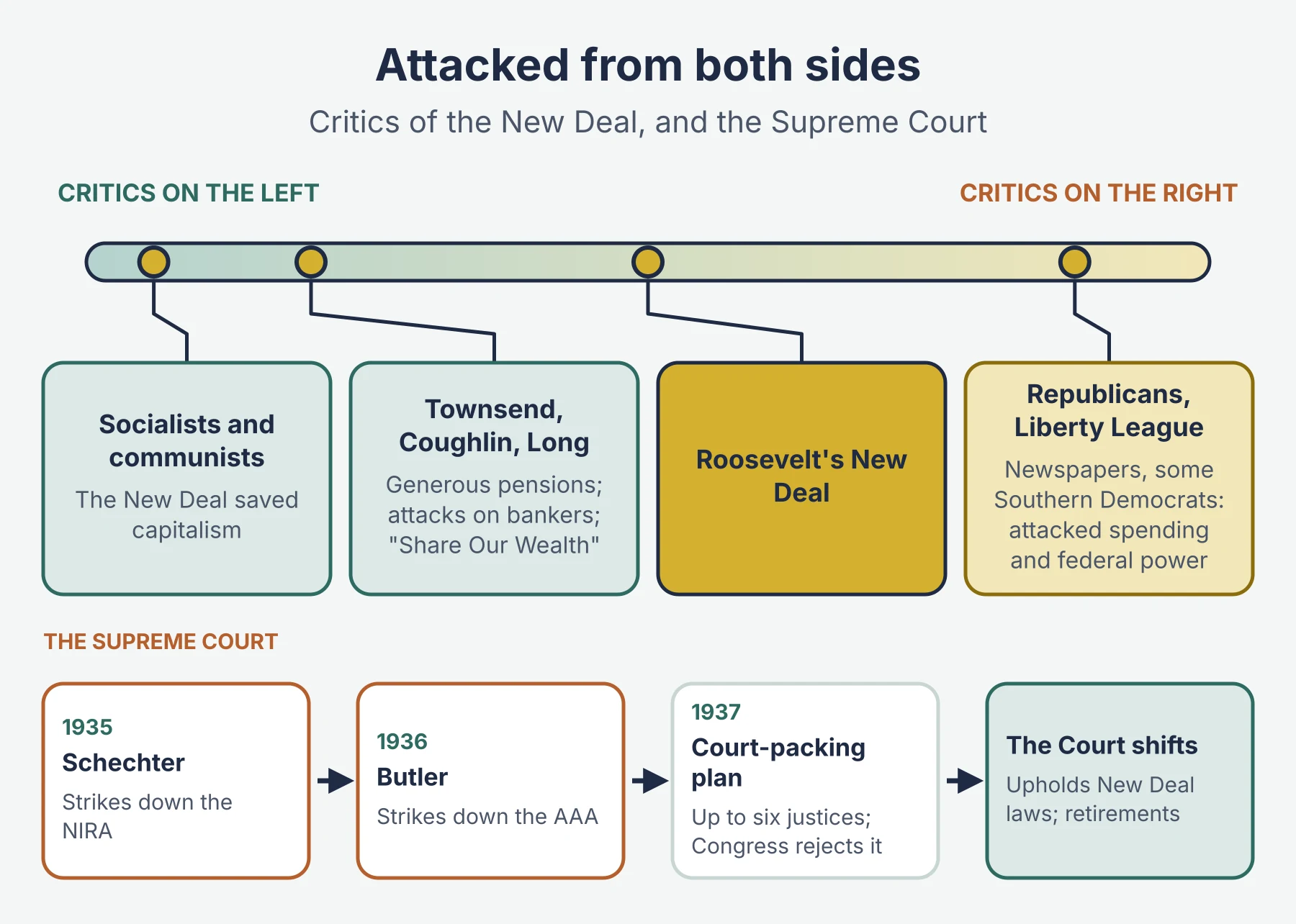
Critics and the Court. On the Left, socialists and communists said the New Deal saved capitalism; Dr Francis Townsend demanded generous pensions for the elderly; the radio priest Father Charles Coughlin attacked bankers; Senator Huey Long of Louisiana proposed “Share Our Wealth”. On the Right, Republicans, the business-funded American Liberty League, many newspapers and some Southern Democrats attacked spending and federal power. The Supreme Court struck down the NIRA (Schechter, 1935) and the AAA (Butler, 1936). After re-election, Roosevelt proposed in 1937 to add up to six justices – the court-packing plan. Congress rejected it, but the Court began upholding New Deal laws, and retirements let Roosevelt appoint new justices.
6.4 Why was there a second New Deal and how successful was it?
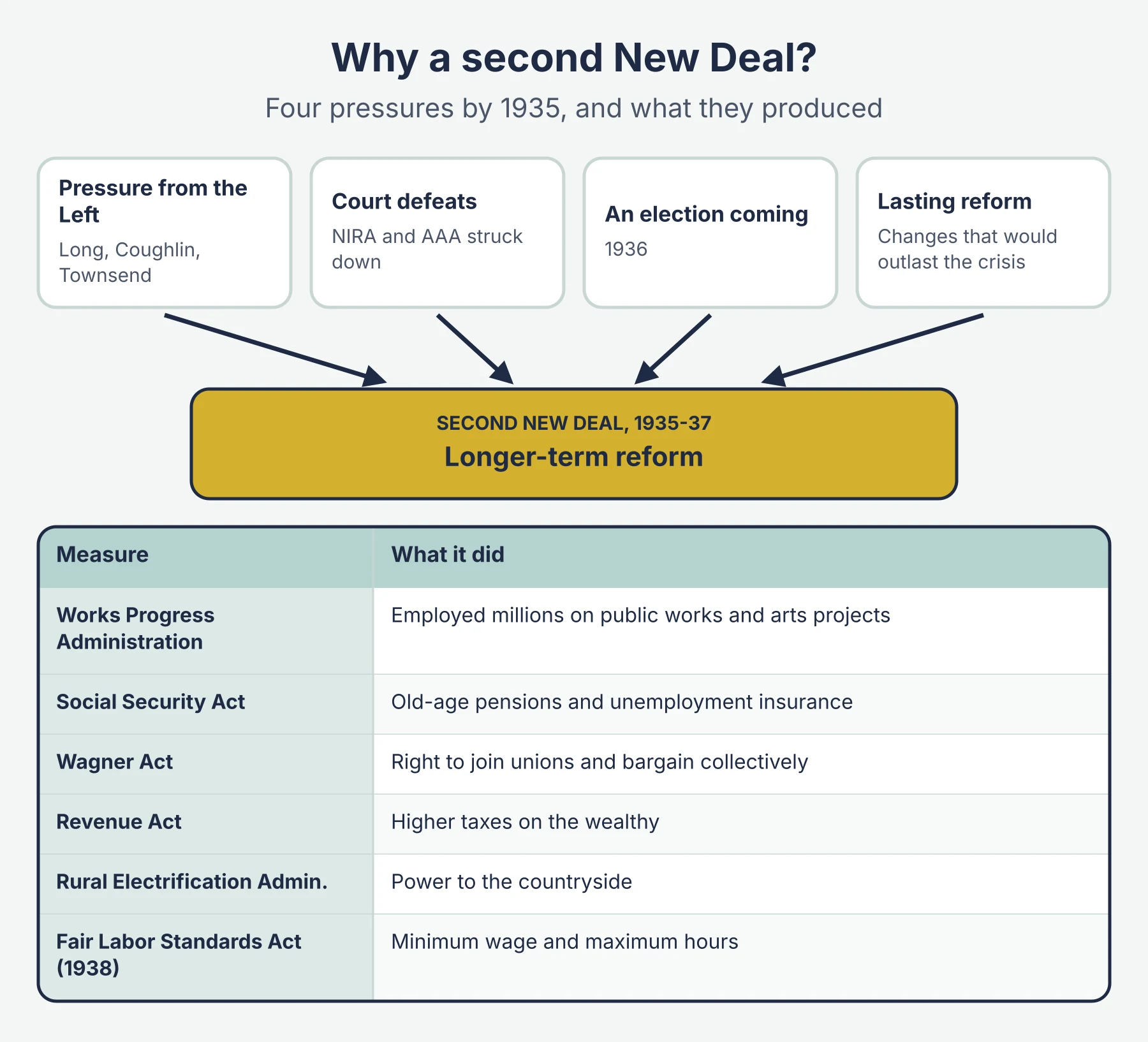
Motives. By 1935 Roosevelt faced pressure from the Left (Long, Coughlin, Townsend), Court defeats, and an approaching election; he also wanted reforms that would last.
Principal legislation, 1935-37. The Works Progress Administration employed millions on public works and arts projects; the Social Security Act created old-age pensions and unemployment insurance; the Wagner Act guaranteed workers the right to join unions and bargain collectively; the Revenue Act raised taxes on the wealthy; the Rural Electrification Administration took power to the countryside. Later measures included the Fair Labor Standards Act (1938), setting a minimum wage and maximum hours.
The 1936 election showed Roosevelt’s political skills: he carried every state except Maine and Vermont, using radio, patronage through the relief agencies and the loyalty of the New Deal coalition.
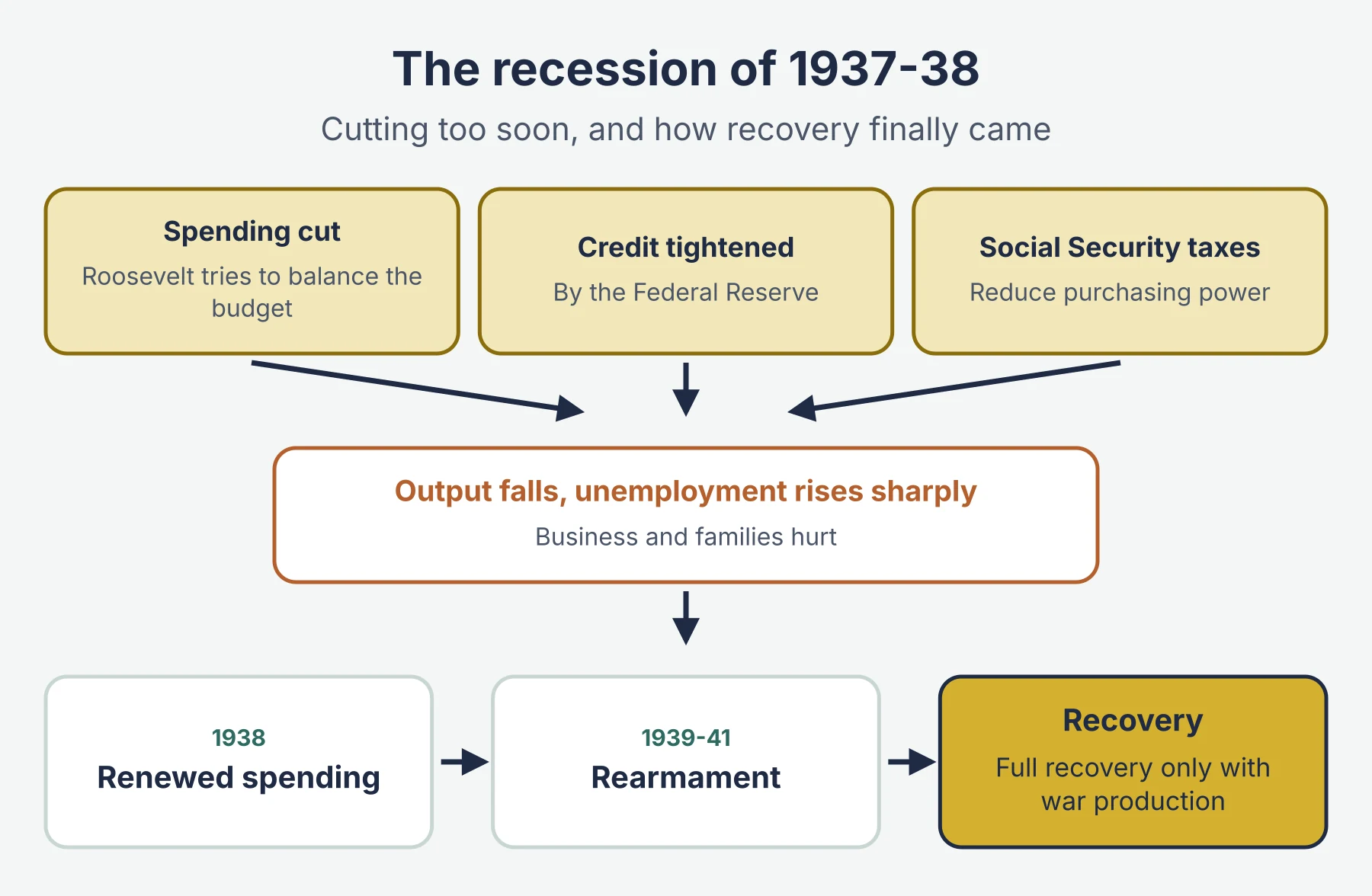
The recession of 1937-38. Believing recovery secure, Roosevelt cut spending to balance the budget; the Federal Reserve tightened credit and new Social Security taxes reduced purchasing power. Output fell and unemployment rose sharply, hurting business and families. Renewed spending in 1938 and, from 1939-41, rearmament brought recovery.
Impact by 1941. Unionised workers, the elderly, many farmers and homeowners gained. Sharecroppers, many African Americans (agricultural and domestic workers were excluded from Social Security), and women, often paid less under the codes, gained least. The federal government had taken permanent responsibility for welfare, banking regulation and labour relations. But full recovery came only with war production.
Worked example: a Paper 2 part (a)
Explain why the Supreme Court opposed parts of the New Deal. [10]
Explain several reasons and link them: the Court’s conservative majority held a narrow view of federal power over commerce within states (Schechter); it saw the NIRA as handing law-making power to the President and industry codes; it ruled the AAA’s processing tax unconstitutional as federal regulation of farming (Butler); its justices, appointed before 1933, shared a belief in limited government. Link them: the constitutional objection to federal reach was the root, which is why the Court changed once its membership did.
Common mistakes
- Blaming the Depression solely on the Crash.
- Calling Hoover a “do-nothing” President without his measures.
- Listing alphabet agencies without saying what each achieved.
- Treating the New Deal as one programme: distinguish relief, recovery and reform, and the first from the second New Deal.
- Forgetting the 1937-38 recession when judging success.
Official syllabus
Cambridge International AS & A Level History (9489) syllabus for 2027, 2028 and 2029 – cambridgeinternational.org (subject content, topic 6; Topics assessed on Paper 1 and Paper 2). Always check the current syllabus before an exam.
Related resources
-
Practice questions
Cambridge A Level World History (9489): The Great Crash, the Great Depression and the New Deal, 1920-41 – Practice Questions
Twelve original practice questions on Cambridge 9489 Crash, Depression and New Deal 1920-41, with invented Paper 1 sources, Paper 2 essays and full answers.
World History · Cambridge · AS Level
Try questions -
Revision notes
Cambridge A Level World History (9489): The Great Crash, the Great Depression and the New Deal, 1920-41 – Revision Notes
Revision notes for Cambridge 9489 History, 1920-41: causes of the Crash and Depression, Hoover, the agencies, critics, the Court, traps and a self-test.
World History · Cambridge · AS Level
Revise topic -
Revision notes
Cambridge A Level World History (9489): The Gilded Age and the Progressive Era – Revision Notes
Revision notes for Cambridge 9489 History topic 5, the Gilded Age and Progressive Era: key terms, timeline, the Progressive presidents, amendments and traps.
World History · Cambridge · AS Level
Revise topic
Get free revision emails (optional)
Occasional emails with practice questions, worked explanations and links to free resources for the qualification and subjects you choose. No spam, and you can unsubscribe from any email. The free tools on this site never need an email.