
Revision Notes
Cambridge A Level World History (9489): The Great Crash, the Great Depression and the New Deal, 1920-41 – Revision Notes
Revision notes for Cambridge 9489 History, 1920-41: causes of the Crash and Depression, Hoover, the agencies, critics, the Court, traps and a self-test.
- Subject
- World History
- Level
- AS LEVEL
- Topic
- Paper 1 and Paper 2 – American Option: The History of the USA, 1820–1941
- Author
- Marlbridge Academic Team
- Updated
- Reviewed by
- Azam Siddique (what this means)
Aligned to Cambridge A Level World History (9489), 2027-2029. Official specification .
Syllabus page (what it covers and how it is assessed): Cambridge A Level World History.
Syllabus points this page covers
9489 (AS Level)
- 6 The Great Crash, the Great Depression and the New Deal, 1920–41
Found an error? Report a correction.
Need help with this topic? Request a free trial class for A Level World History (9489).
These notes condense Cambridge 9489 AS topic 6, The Great Crash, the Great Depression and the New Deal, 1920-41, for fast recall. The key questions are the causes of the Crash and Depression (6.1), their impact (6.2), the success of the first New Deal (6.3), and the reasons for and success of the second (6.4). The full explanation is in the Great Depression and New Deal study guide; exam questions with answers are in the Great Depression and New Deal practice questions.
Rotation (2027-2029 syllabus): Paper 2 (Outline Study) in 2027 and 2029; Paper 1 (Historical Sources) in 2028.
Chronology
| Date | Event |
|---|---|
| 1921-23 / 1923-29 | Harding / Coolidge presidencies; Mellon at the Treasury |
| 1922 | Fordney-McCumber Tariff |
| 1927-28 | Coolidge vetoes McNary-Haugen farm bills |
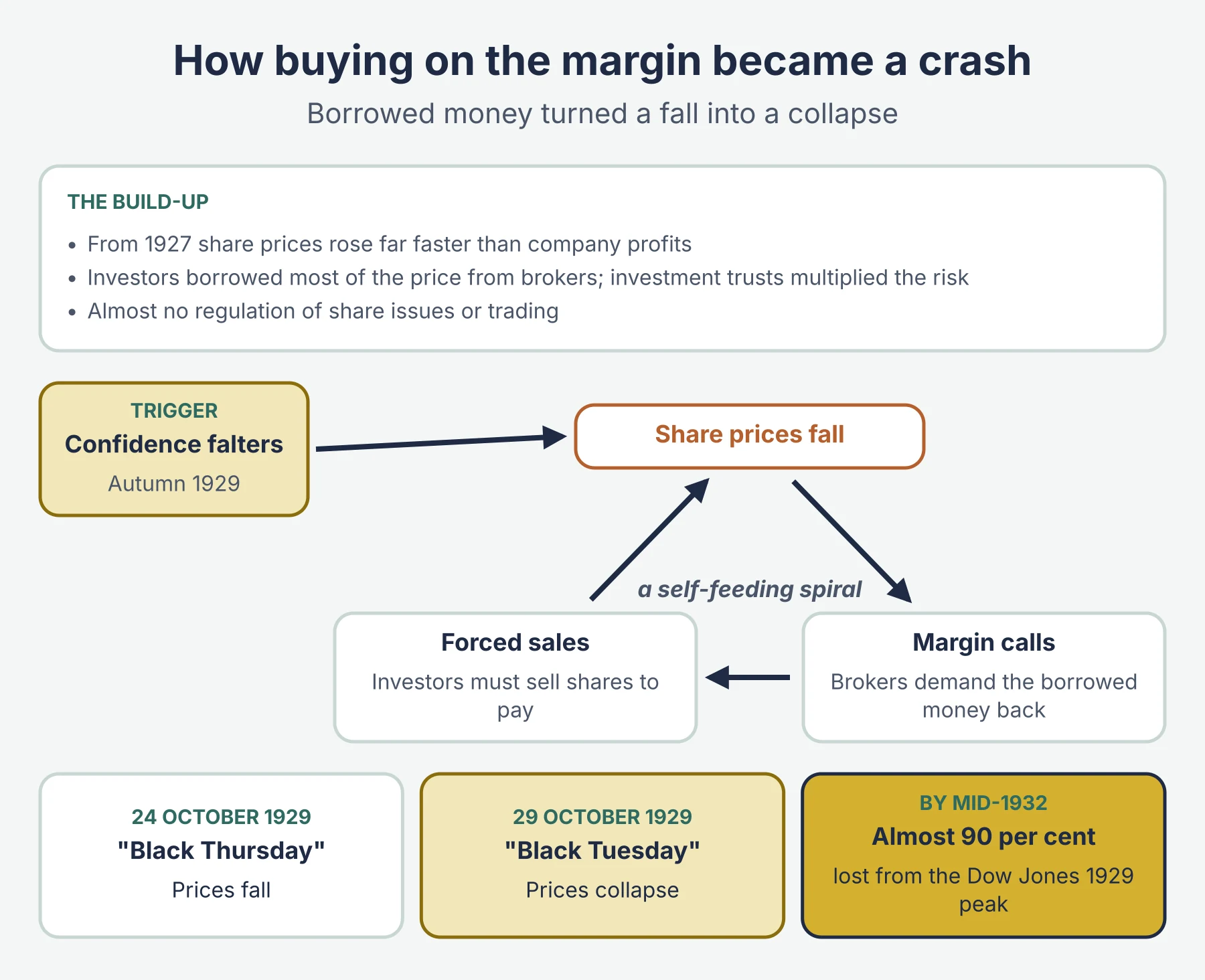
| 24 and 29 Oct 1929 | Black Thursday; Black Tuesday |
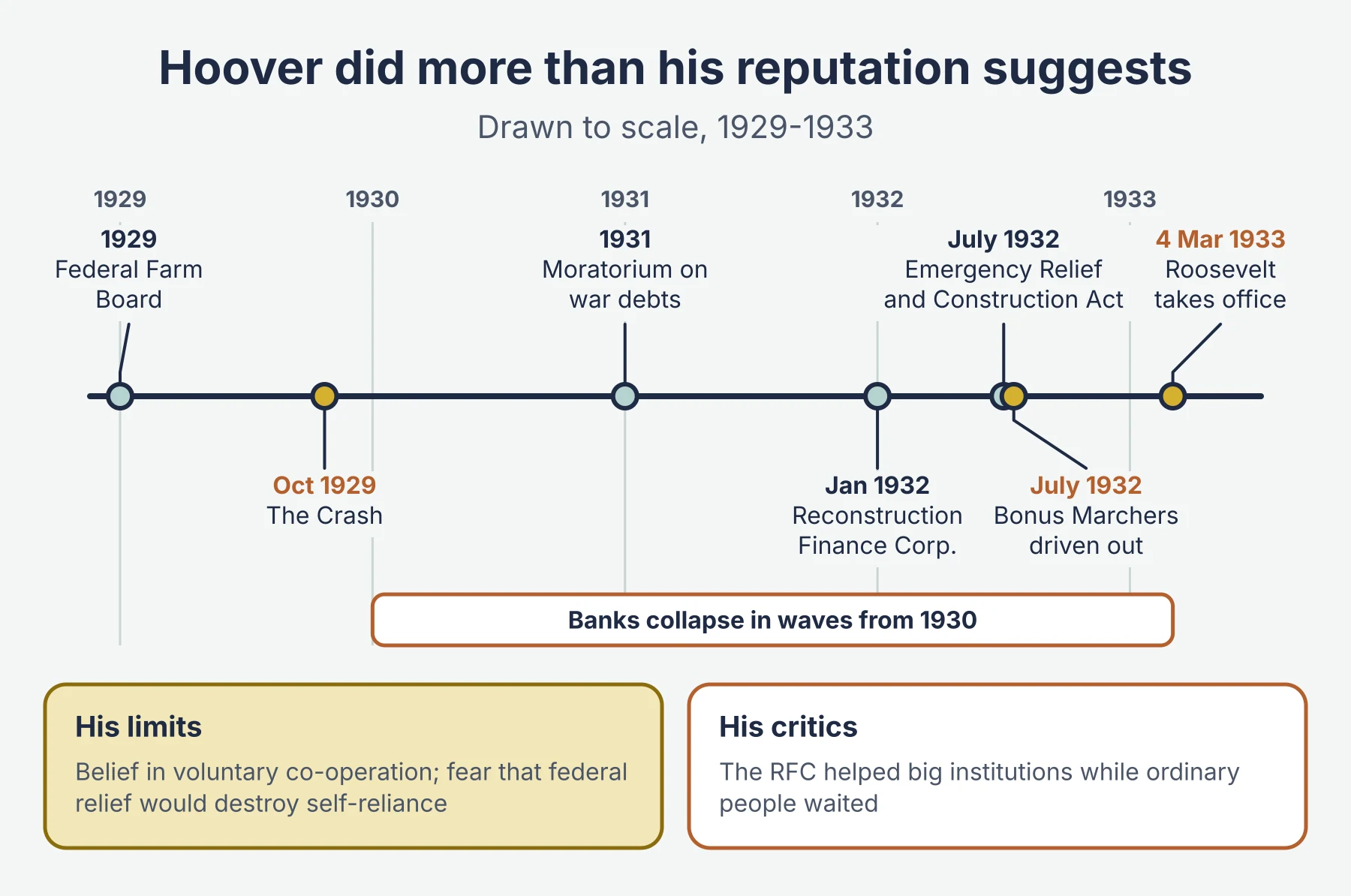
| 1929 | Agricultural Marketing Act (Federal Farm Board) |
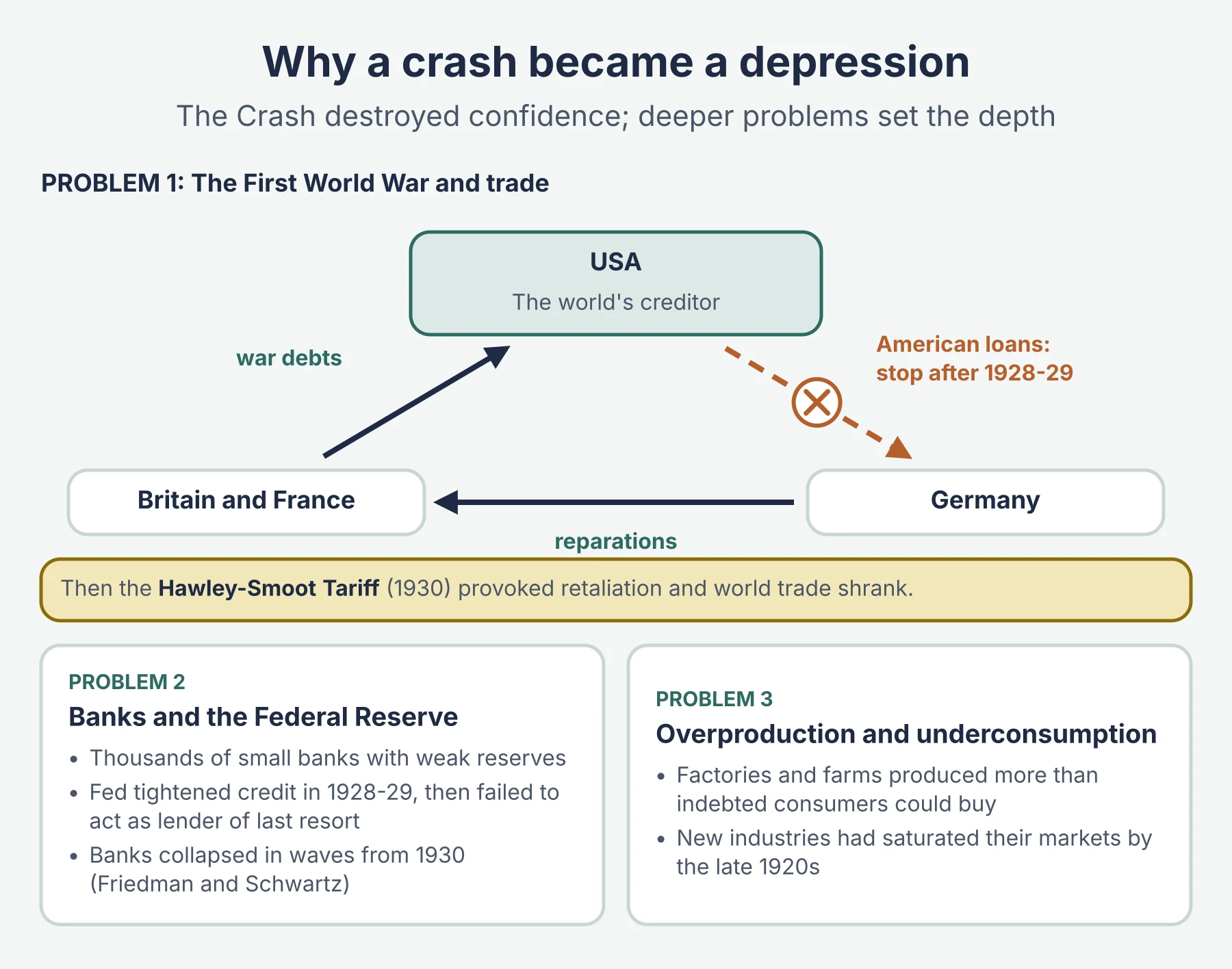
| 1930 | Hawley-Smoot Tariff; first wave of bank failures |
| 1931 | Hoover moratorium on war debts |
| Jan 1932 | Reconstruction Finance Corporation |
| July 1932 | Emergency Relief and Construction Act; Bonus Marchers evicted |
| Nov 1932 | Roosevelt elected |
| Feb-March 1933 | Banking crisis; Roosevelt inaugurated 4 March |
| March-June 1933 | The Hundred Days |
| 1934 | Securities and Exchange Commission; American Liberty League |
| May 1935 | Schechter ruling ends the NIRA |
| 1935 | WPA; Social Security Act; Wagner Act; Revenue (“Wealth Tax”) Act |
| Sept 1935 | Huey Long assassinated |
| Jan 1936 | Butler ruling ends the first AAA |
| Nov 1936 | Roosevelt re-elected, carrying 46 of 48 states |
| Feb 1937 | Court-packing plan announced |
| 1937-38 | Recession |
| 1938 | Fair Labor Standards Act; second AAA |
| 1941 | Lend-Lease; rearmament drives recovery |
Key terms
| Term | Meaning |
|---|---|
| Laissez-faire | Minimal government intervention in the economy |
| Buying on the margin | Buying shares with a small deposit and a broker’s loan |
| Speculation | Buying to profit from rising prices rather than from dividends |
| Margin call | Broker’s demand for repayment when share prices fall |
| Overproduction / underconsumption | Output outrunning what consumers could afford |
| Deflation | Falling prices, raising the real burden of debt |
| Rugged individualism | Hoover’s belief in self-reliance over federal relief |
| Hooverville | Shanty town of homeless people |
| Brains Trust | Roosevelt’s academic advisers |
| Relief, recovery, reform | The “three Rs” used to classify New Deal measures |
| Alphabet agencies | New Deal bodies known by initials (CCC, TVA, NRA, WPA) |
| Fireside chats | Roosevelt’s radio talks to the nation |
| Court-packing | 1937 plan to add justices to the Supreme Court |
| New Deal coalition | Alliance of voting groups behind the Democrats from 1932-36 |
The agencies – what each did
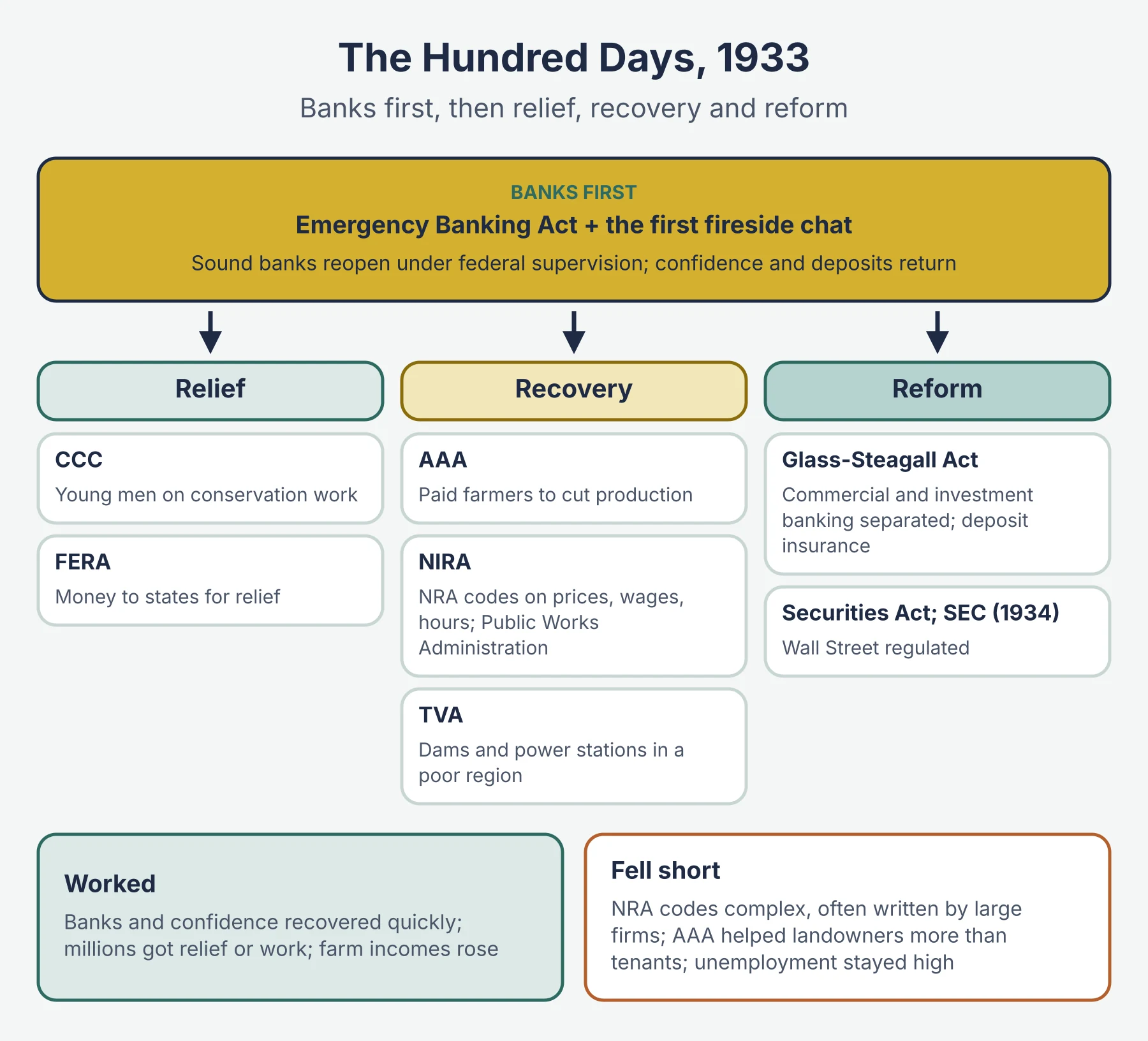
| Agency or Act | Year | Type | Purpose |
|---|---|---|---|
| Emergency Banking Act | 1933 | Recovery | Reopened sound banks under federal inspection |
| CCC | 1933 | Relief | Conservation jobs for young men |
| FERA | 1933 | Relief | Federal grants to states for relief |
| AAA | 1933 | Recovery | Paid farmers to cut output and raise prices |
| TVA | 1933 | Recovery and reform | Dams, electricity and flood control in a poor region |
| NIRA (NRA, PWA) | 1933 | Recovery | Industry codes; large public works |
| Glass-Steagall Act | 1933 | Reform | Separated banking types; deposit insurance |
| SEC | 1934 | Reform | Regulated the stock market |
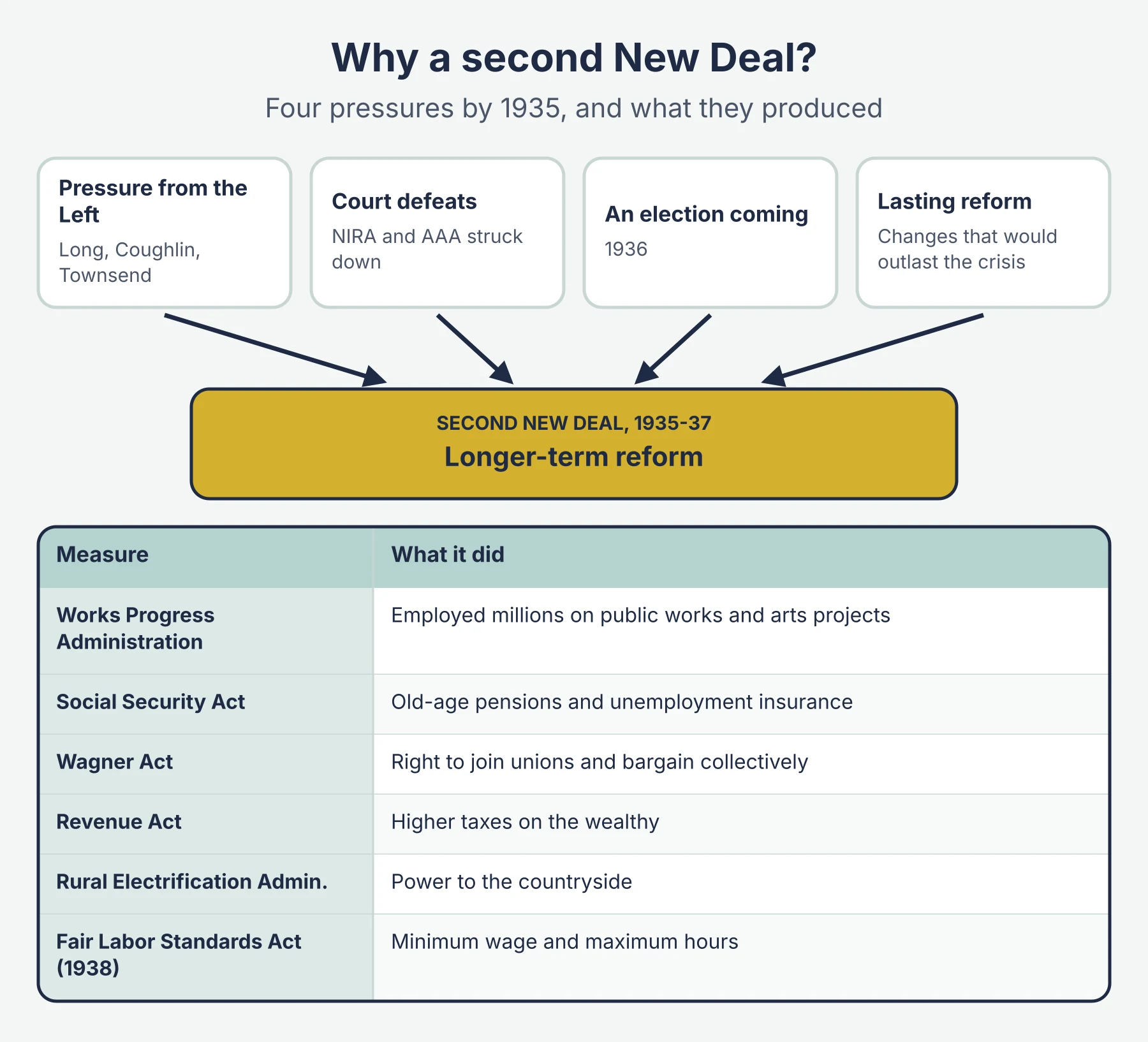
| WPA | 1935 | Relief | Mass public employment, including the arts |
| Social Security Act | 1935 | Reform | Pensions and unemployment insurance |
| Wagner Act | 1935 | Reform | Union rights and collective bargaining |
| Fair Labor Standards Act | 1938 | Reform | Minimum wage and maximum hours |
Critics at a glance
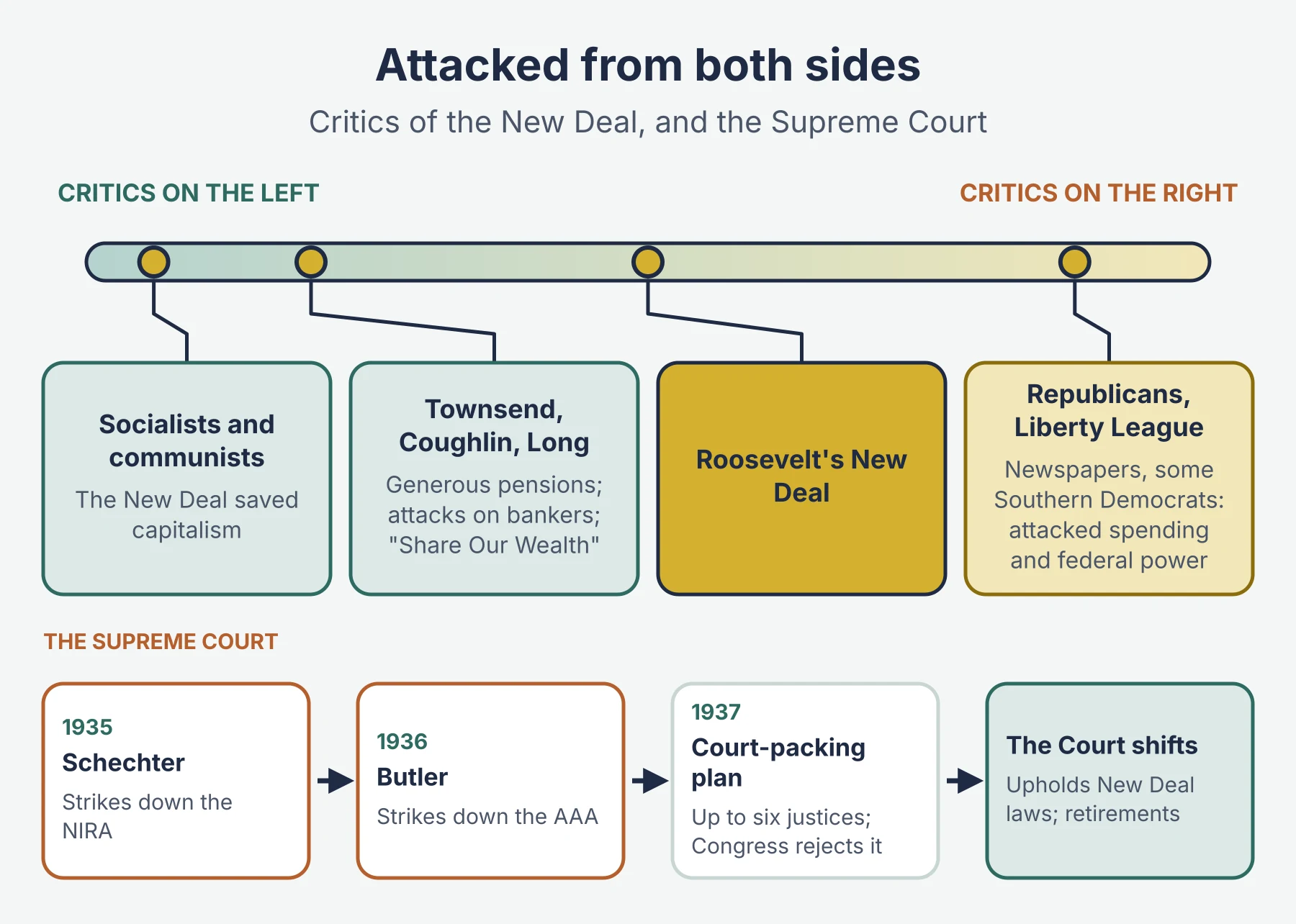
| From the Left | From the Right |
|---|---|
| Huey Long: “Share Our Wealth” redistribution | Republicans: unbalanced budgets and federal power |
| Father Coughlin: radio attacks on bankers | American Liberty League: business attack on “socialism” |
| Dr Townsend: generous old-age pensions | Southern Democrats: feared federal interference with race relations |
| Socialists and communists: New Deal saved capitalism | Much of the press and industry: union rights and taxes |
Exam traps
- Crash and Depression are different events. The Crash was October 1929; the Depression deepened through 1930-33 for structural and international reasons.
- Hoover’s record. He acted (RFC, Farm Board, Home Loan Banks, Relief and Construction Act), but rejected direct federal payments to individuals.
- Dates of the two New Deals. The second (1935-37) was more reforming and more pro-labour; do not place Social Security in the Hundred Days.
- The Court. The court-packing plan failed in Congress, yet the Court’s attitude changed anyway.
- Success criteria. Distinguish relief (short-term help), recovery (output and jobs) and reform (lasting change); the New Deal scored best on the first and third.
- Paper 1. Roosevelt’s fireside chats, Liberty League pamphlets and Long’s speeches all have political purposes; use them.
Self-test
- Who was Treasury Secretary under Harding and Coolidge? Andrew Mellon.
- Why did farmers not share in the 1920s boom? Prices fell after 1920 as European production recovered, leaving farmers in debt.
- Explain buying on the margin. Paying a small part of a share’s price and borrowing the rest from a broker.
- How did the Federal Reserve contribute to the Depression? It tightened credit in 1928-29 and failed to support banks as they failed after 1930.
- What did the Hawley-Smoot Tariff do to world trade? Provoked retaliation and helped shrink international trade.
- What was the RFC? Hoover’s 1932 corporation lending federal money to banks, railways and insurance companies.
- Why did the Bonus March damage Hoover? The army’s eviction of veterans from Washington made him appear harsh towards the suffering.
- What did the Emergency Banking Act do? Closed banks for inspection and reopened sound ones under federal supervision.
- Name the two Supreme Court cases that struck down the NIRA and the AAA. Schechter (1935) and Butler (1936).
- Give two reasons for the second New Deal. Any two: pressure from Long, Coughlin and Townsend; Court defeats; the 1936 election; the wish for lasting reform.
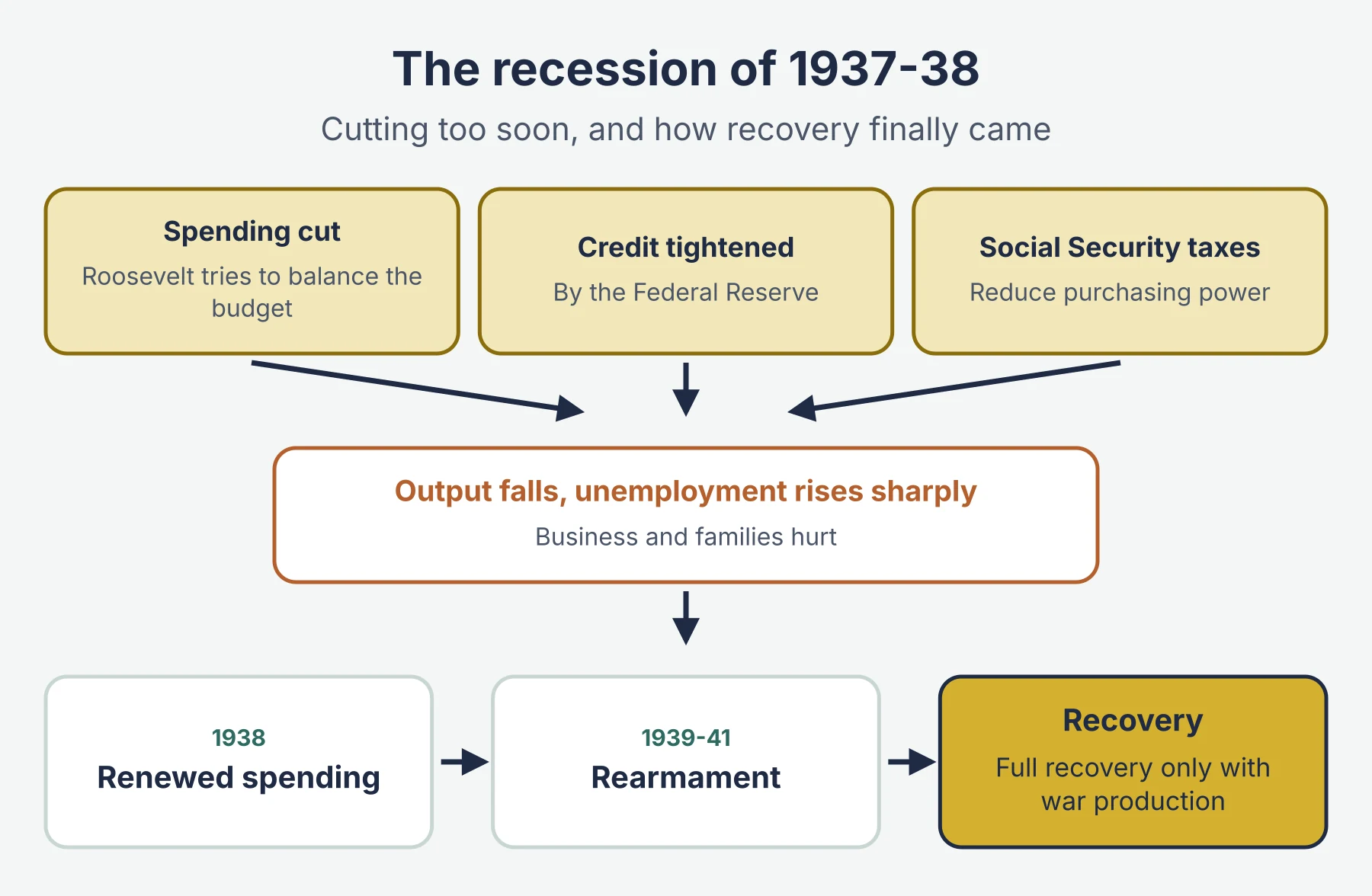
- What caused the 1937-38 recession? Spending cuts to balance the budget, tighter credit and new Social Security taxes reducing demand.
- Name two groups that gained least from the New Deal. Any two: sharecroppers and tenant farmers; African Americans; women; agricultural and domestic workers.
Official syllabus
Cambridge International AS & A Level History (9489) syllabus for 2027, 2028 and 2029 – cambridgeinternational.org (subject content, topic 6; Topics assessed on Paper 1 and Paper 2).
Related resources
-
Revision notes
Cambridge A Level World History (9489): The Gilded Age and the Progressive Era – Revision Notes
Revision notes for Cambridge 9489 History topic 5, the Gilded Age and Progressive Era: key terms, timeline, the Progressive presidents, amendments and traps.
World History · Cambridge · AS Level
Revise topic -
Study guides
Cambridge A Level World History (9489): The Gilded Age and the Progressive Era, 1870-1920 – Study Guide
Study guide to Cambridge 9489 History AS topic 5, the Gilded Age and Progressive Era: industrial growth, trusts, labour, Populism and Progressive reform.
World History · Cambridge · AS Level
Read guide -
Study guides
A Level World History: The History of the USA, 1820-1941 (Cambridge 9489)
The American option of Cambridge AS and A Level History 9489 (2027-2029): the Civil War and Reconstruction, Gilded Age and Progressive Era, and the New Deal.
World History · Cambridge · AS Level
Read guide
Get free revision emails (optional)
Occasional emails with practice questions, worked explanations and links to free resources for the qualification and subjects you choose. No spam, and you can unsubscribe from any email. The free tools on this site never need an email.