
Revision Notes
Cambridge A Level World History (9489): France, 1774-1814 – Revision Notes
Revision notes for Cambridge 9489 History, France 1774-1814: chronology, key terms, the three assemblies, Terror versus Directory, Napoleon and a self-test.
- Subject
- World History
- Level
- AS LEVEL
- Topic
- Paper 1 and Paper 2 – European Option: Modern Europe, 1774–1924
- Author
- Marlbridge Academic Team
- Updated
- Reviewed by
- Azam Siddique (what this means)
Aligned to Cambridge A Level World History (9489), 2027-2029. Official specification .
Syllabus page (what it covers and how it is assessed): Cambridge A Level World History.
Syllabus points this page covers
9489 (AS Level)
- 1 France, 1774–1814
Found an error? Report a correction.
Need help with this topic? Request a free trial class for A Level World History (9489).
These notes compress Cambridge 9489 AS topic 1, France, 1774-1814, into what you need to recall under time pressure. The topic has four key questions: the causes and immediate consequences of 1789 (1.1), how France became a republic by 1792 (1.2), how well France was governed in 1793-99 (1.3) and why Napoleon rose and fell (1.4). For full explanations, use the France, 1774-1814 study guide; for exam-style work, use the France, 1774-1814 practice questions.
Rotation (2027-2029 syllabus): Paper 1 (Historical Sources) in 2027; Paper 2 (Outline Study) in 2028 and 2029.
Chronology to fix in your head
| Date | Event | Why it matters |
|---|---|---|
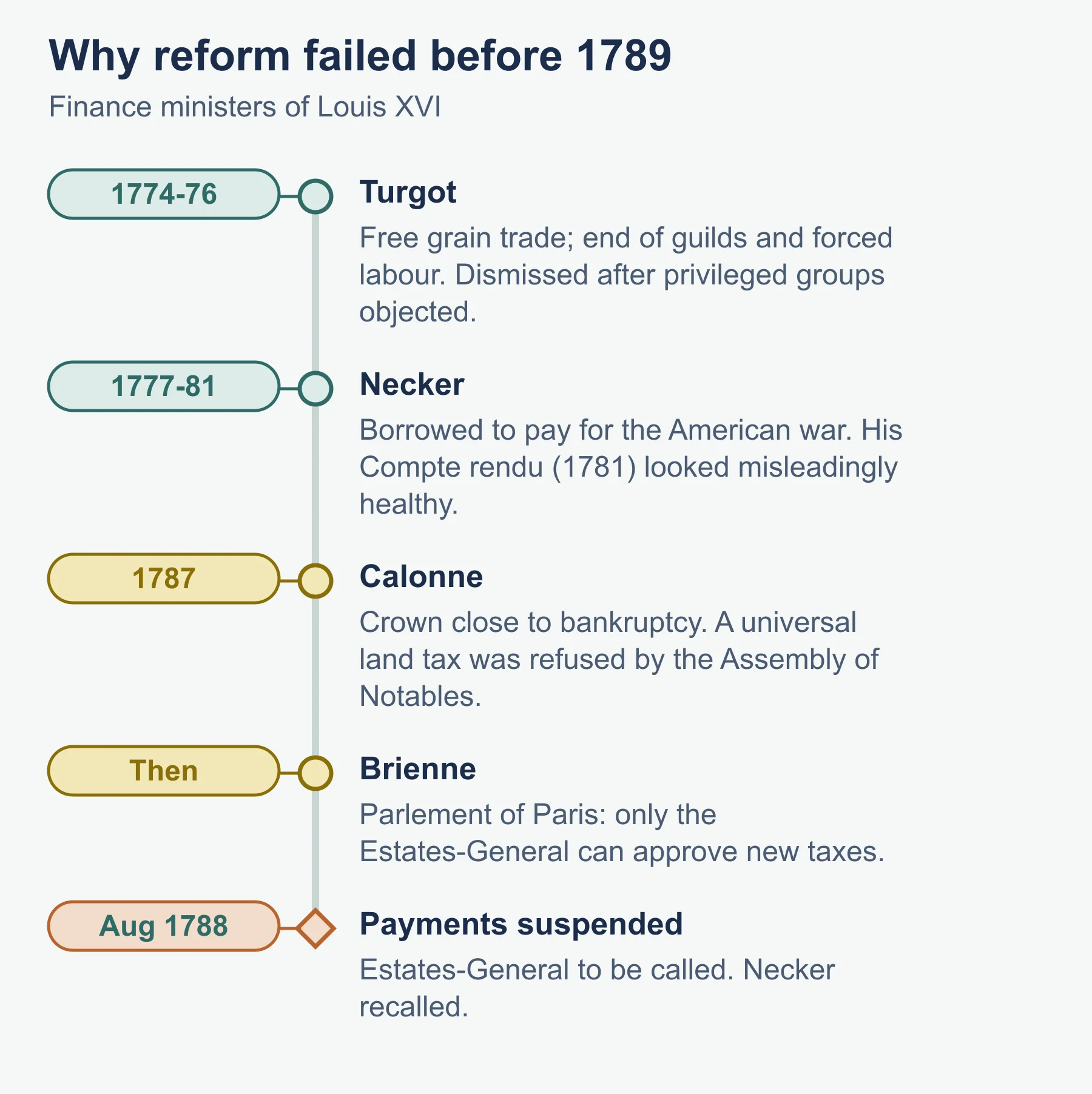
| 1774 | Louis XVI accedes; Turgot made Controller-General | Reform attempted from above |
| 1781 | Necker’s Compte rendu | Public believes finances are healthy |
| Feb 1787 | Assembly of Notables meets | Rejects Calonne’s land tax |
| Aug 1787 | Parlement of Paris exiled to Troyes | Brienne v. the Parlement: “only the Estates-General can consent” |
| Aug 1788 | Payments suspended; Necker recalled; Estates-General promised | Royal bankruptcy forces consultation |
| Jan 1789 | Sieyès, What is the Third Estate? | Third Estate claims to be the nation |
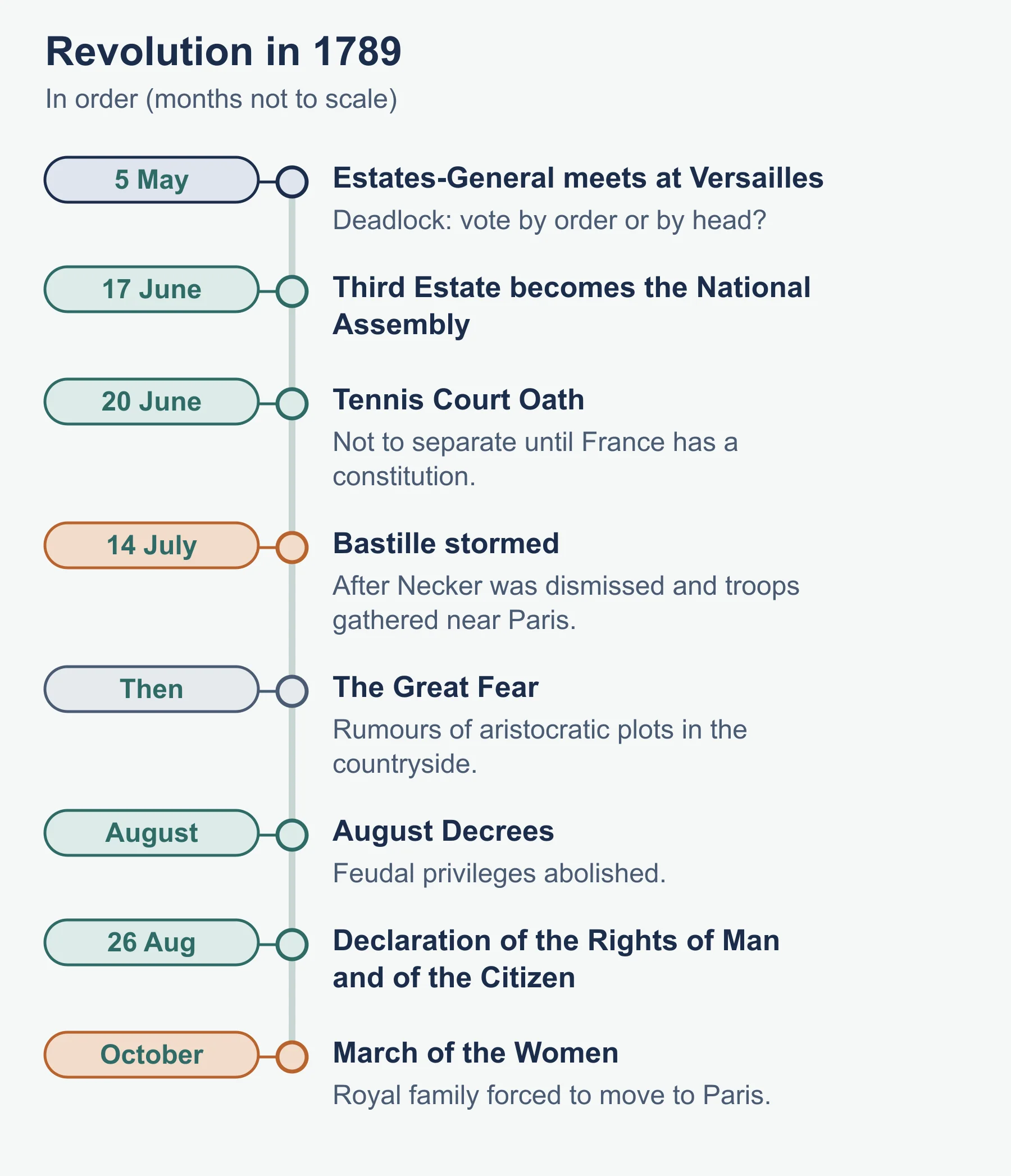
| 5 May 1789 | Estates-General opens | Deadlock over voting by order or by head |
| 17-20 June 1789 | National Assembly; Tennis Court Oath | Sovereignty transferred from King to nation |
| 14 July 1789 | Bastille | Paris crowd saves the Assembly |
| 4-11 Aug 1789 | August Decrees | Feudal privileges abolished |
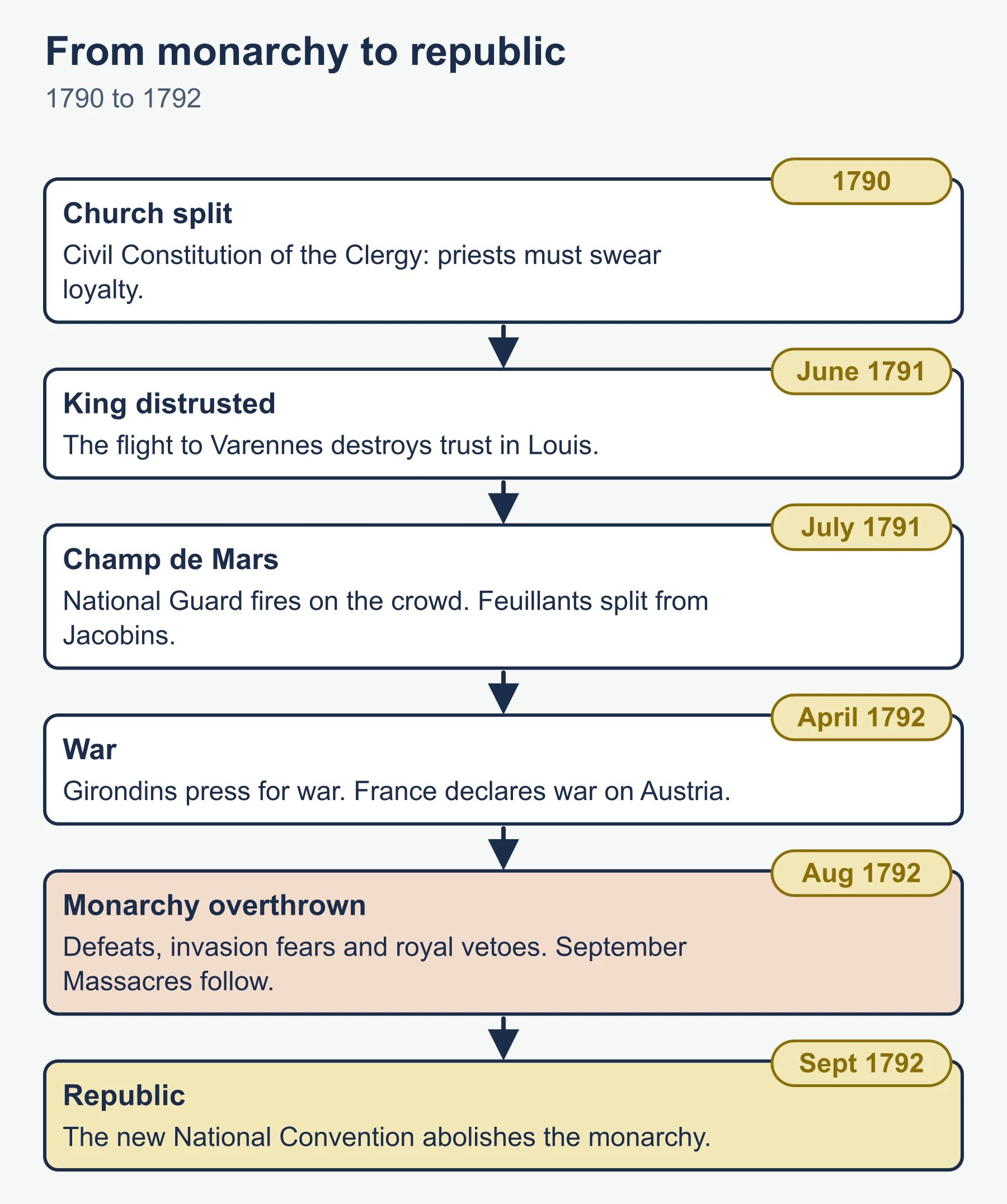
| July 1790 | Civil Constitution of the Clergy | Splits Church and nation |
| 20-21 June 1791 | Flight to Varennes | Constitutional monarchy discredited |
| 17 July 1791 | Champ de Mars | Jacobins split; Feuillants form |
| 20 Apr 1792 | War declared on Austria | Girondin policy; radicalises politics |
| 10 Aug 1792 | Tuileries stormed | Monarchy overthrown |
| 21 Sept 1792 | Monarchy abolished by Convention | Republic |
| 21 Jan 1793 | Louis XVI executed | War widens; Vendée rising follows in March |
| 2 June 1793 | Girondins purged | Mountain controls the Convention |
| Sept 1793 | Law of Suspects; General Maximum | Machinery of the Terror |
| 27-28 July 1794 | Thermidor: Robespierre falls and is executed | Terror ends |
| Oct 1795 | Vendémiaire royalist rising crushed | Bonaparte’s name made in Paris |
| Sept 1797 | Coup of Fructidor | Directory overrides elections |
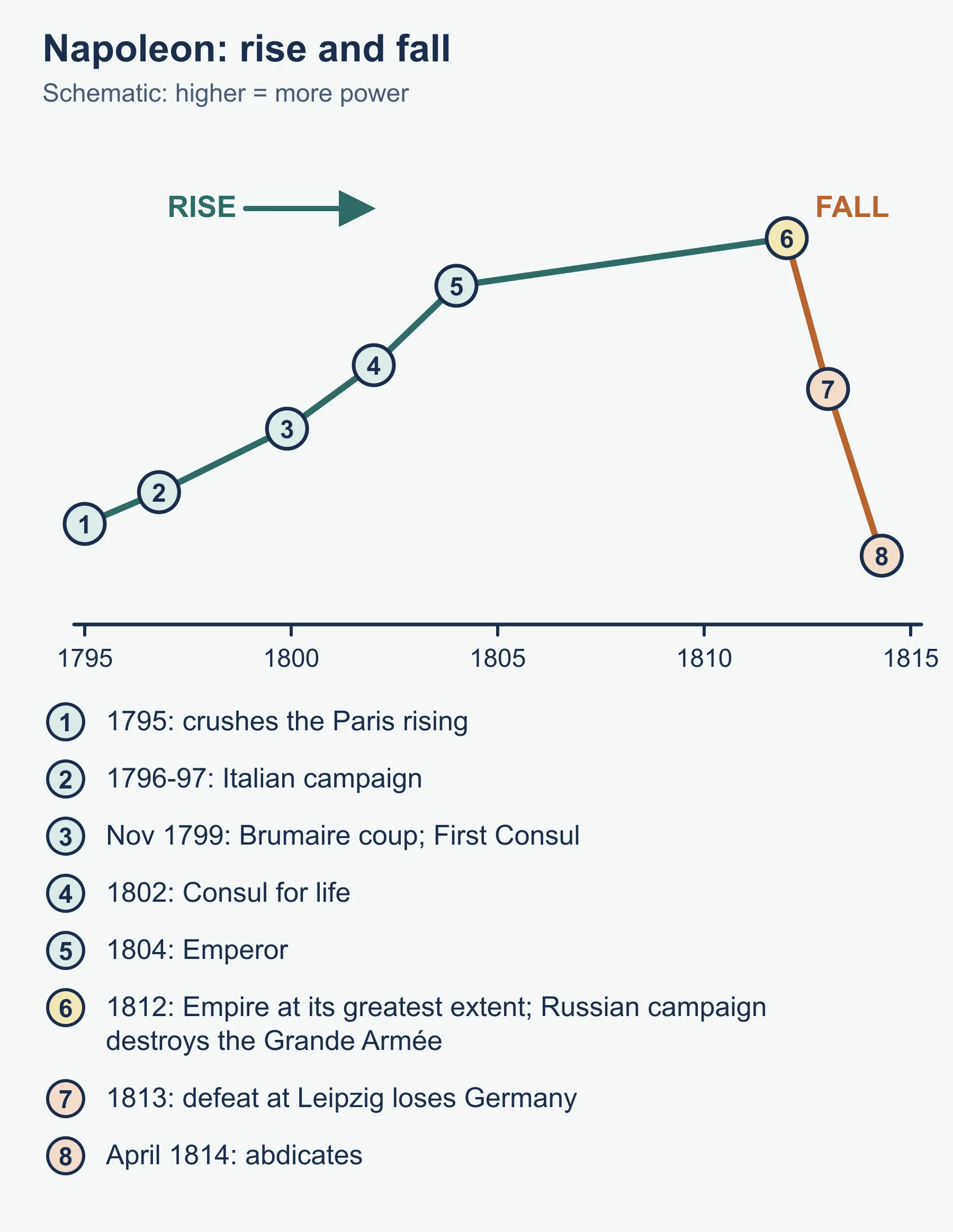
| Nov 1799 | Brumaire coup | Consulate established |
| 1801 | Concordat | Peace with the Church |
| 1804 | Civil Code; Napoleon crowned Emperor | Order and authority |
| 1812 | Russian campaign | Grande Armée destroyed |
| Apr 1814 | Abdication | End of the topic |
Key terms
| Term | Meaning |
|---|---|
| Ancien Régime | The pre-1789 system of absolute monarchy, privilege and corporate bodies |
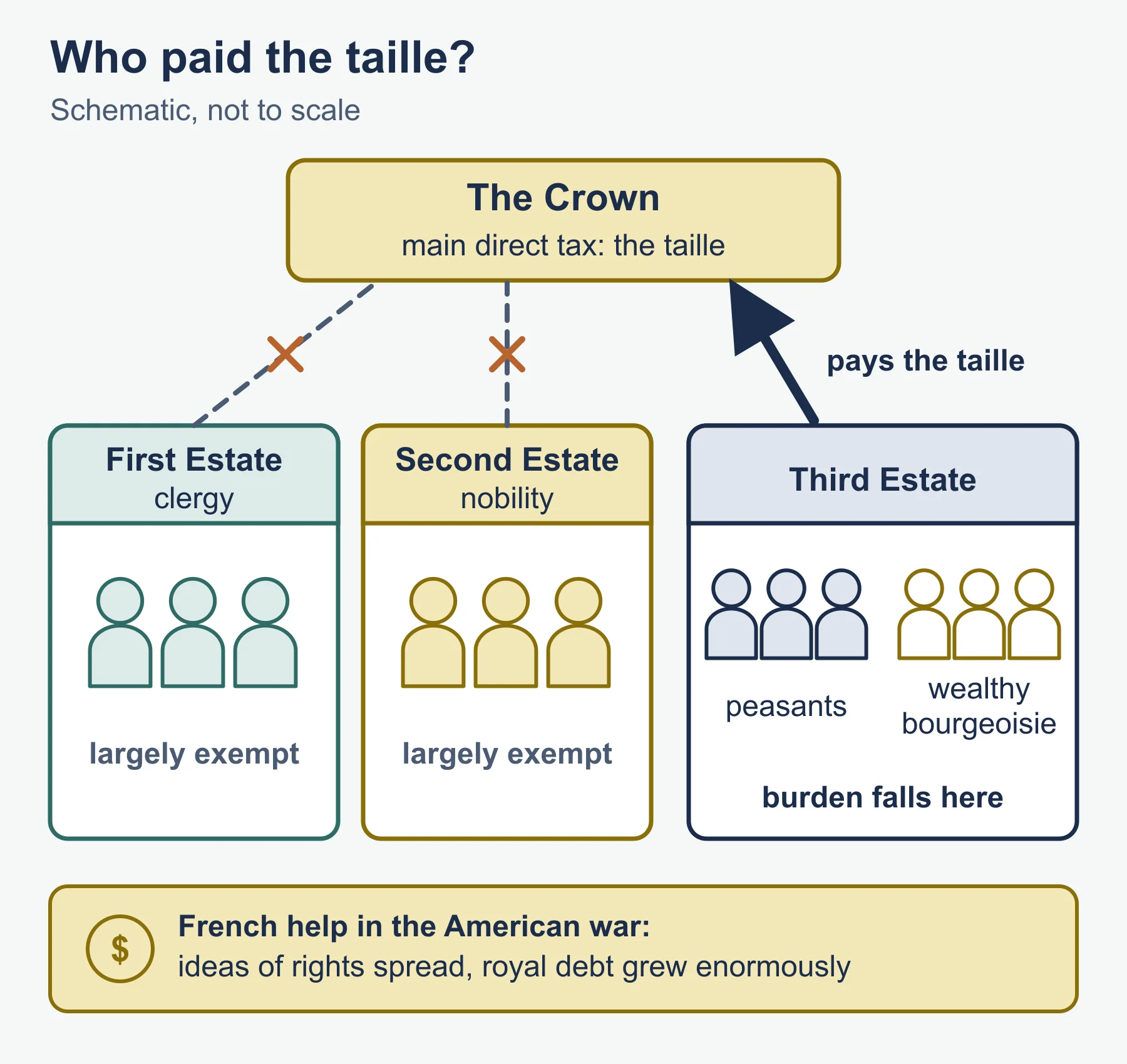
| Taille | Main direct tax, largely paid by the Third Estate |
| Parlements | Law courts that registered royal edicts and could protest against them |
| Cahiers de doléances | Lists of grievances drawn up for the 1789 elections |
| Assignats | Paper notes backed by confiscated Church land; lost value through over-issue |
| Refractory priests | Clergy who refused the oath to the Civil Constitution |
| Sans-culottes | Politically active Parisian artisans and shopkeepers |
| Mountain / Plain | Radical Jacobin deputies / uncommitted centre in the Convention |
| Federalist revolts | 1793 provincial risings (Lyon, Marseille, Toulon) against Paris |
| Levée en masse | Mass conscription decree, August 1793 |
| Maximum | Price (and wage) controls of 1793 |
| Thermidorians | Deputies who overthrew Robespierre and dismantled the Terror |
| Two-Thirds Decree | 1795 rule that two-thirds of the new councils must be former Convention members |
| Prefect | Centrally appointed head of a department under Napoleon |
The three assemblies – do not mix them up
| Assembly | Dates | Achievement | Weakness |
|---|---|---|---|
| National (Constituent) Assembly | 1789-91 | August Decrees, Declaration, departments, Civil Constitution, 1791 constitution | Left a King who did not accept the settlement |
| Legislative Assembly | Oct 1791-Sept 1792 | Declared war; faced royal vetoes | Swept away on 10 August |
| National Convention | Sept 1792-Oct 1795 | Republic, regicide, Terror, Thermidor, Year III constitution | Purges and coups replaced consent |
Key question summaries
1.1 Causes. Long-term: privilege, an inefficient tax system, Enlightenment criticism, American war debt. Short-term: the failure of Calonne and Brienne, the Parlement’s resistance, the 1788 harvest and bread prices. The “revolt of the nobility” (1787-88) opened the crisis; the Third Estate then turned it against privilege.
1.2 Republic. Reforms created winners (peasants freed from dues, purchasers of Church land) and losers (non-juring clergy, nobles). Louis’s flight, the war and fear of invasion made the King appear a traitor; the Girondins’ war gamble turned into the monarchy’s fall.
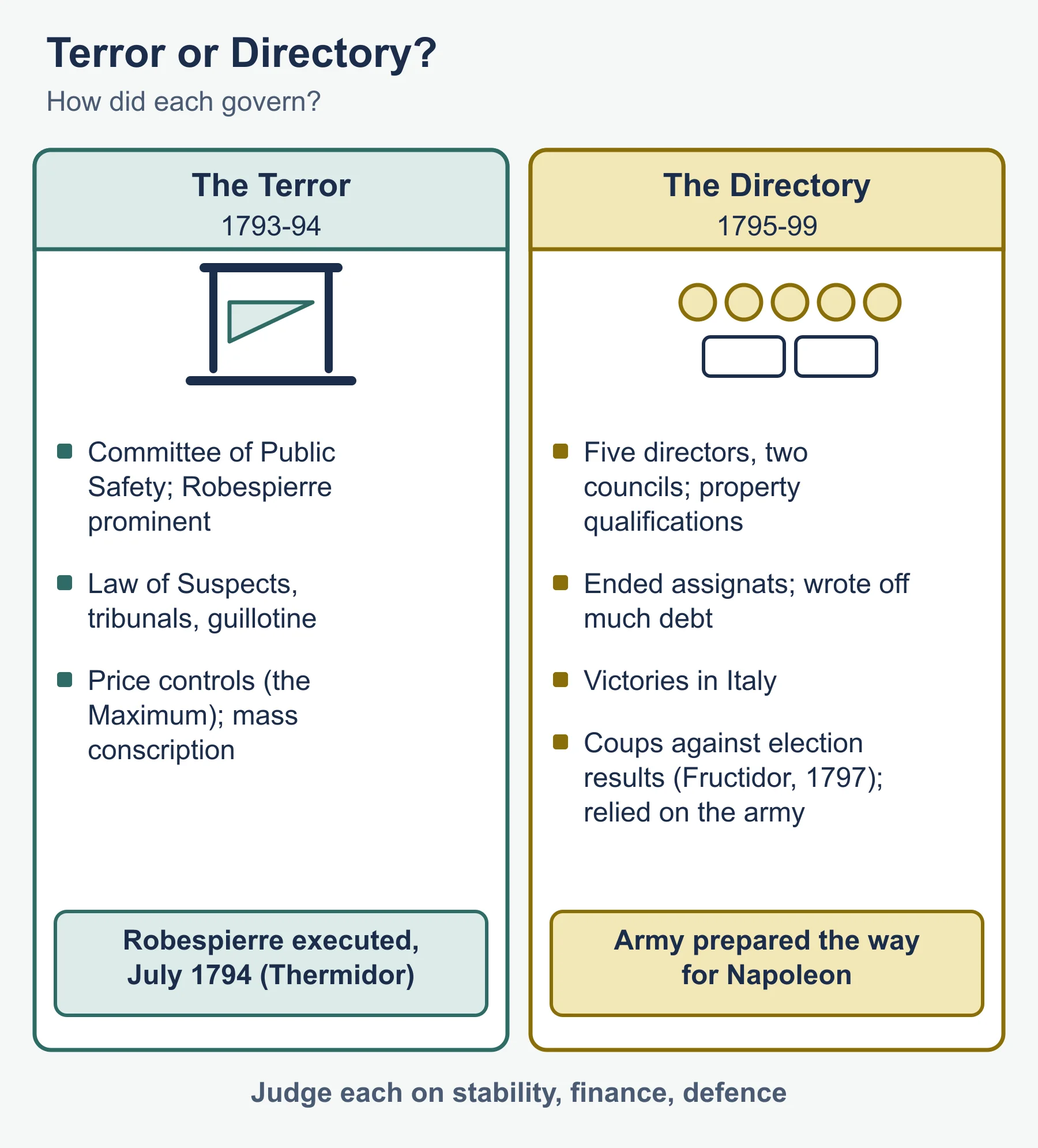
1.3 Government. Judge by criteria: did it keep France secure, solvent and stable? The Terror saved the Republic militarily but at a cost of liberty and lives; the Directory ended terror but depended on coups (Fructidor 1797, Floréal 1798) and the army.
1.4 Napoleon. Rise: reputation, the weakness of the Directory, Sieyès’s plot. Control: prefects, police, censorship, plebiscites. Reforms: Code, lycées, Bank of France, Concordat. Fall: conscription, economic strain from the Continental System, the Spanish “ulcer”, nationalism, Russia, Leipzig.
Exam traps
- “Bourgeois revolution” as the whole story. Sources from nobles and the Parlement in 1787-88 show privileged resistance began the crisis.
- Dates of the republic. The monarchy fell on 10 August 1792 but was abolished on 21 September 1792.
- Robespierre as dictator. He was one of twelve members of the Committee of Public Safety; the Convention could and did remove him.
- The Directory as pure failure. Credit financial stabilisation (the writing-off of two-thirds of the debt in 1797) and military success in Italy.
- Napoleon’s battles. Write about their effect inside France (taxes, conscription, trade, opinion), not the campaigns.
- Paper 1 (a). Compare two sources and explain why they differ through their authors and dates; content-matching alone stays in the lower levels.
Self-test
- Which body refused Calonne’s land tax in 1787? The Assembly of Notables.
- What did the Parlement of Paris argue in 1787? That only the Estates-General could approve new taxes.
- Why was the voting method at the Estates-General so important? Voting by order let the two privileged estates outvote the Third; voting by head, with the Third doubled, would give it a majority.
- What did the Tennis Court Oath commit deputies to? Not to separate until France had a constitution.
- Name two reforms of the Constituent Assembly. Any two: departments with elected officials; assignats; uniform taxation; elected judges and juries; the Civil Constitution of the Clergy.
- Why did the Civil Constitution of the Clergy weaken the Revolution? The oath split the clergy and gave Catholic opponents, especially in the west, a cause.
- What happened at the Champ de Mars? The National Guard fired on petitioners demanding the King’s removal, July 1791.
- Which group pressed hardest for war in 1792, and why? The Girondins, believing war would expose traitors and spread the Revolution.
- What two measures of September 1793 were central to the Terror? The Law of Suspects and the General Maximum.
- Why did Robespierre fall in July 1794? Victory (Fleurus) made the Terror seem unnecessary and fellow deputies feared they would be next.
- What was the Constitution of the Year III designed to prevent? Both dictatorship and popular rule: five Directors, two councils and property qualifications.
- Give two reasons Napoleon lost support inside France after 1810. Any two: conscription; economic hardship from the Continental System; losses in Spain and Russia; heavy taxation.
Official syllabus
Cambridge International AS & A Level History (9489) syllabus for 2027, 2028 and 2029 – cambridgeinternational.org (subject content, topic 1; Topics assessed on Paper 1 and Paper 2).
Related resources
-
Practice questions
Cambridge A Level World History (9489): Liberalism and nationalism in Germany, 1815-71 – Practice Questions
Twelve original practice questions on Cambridge 9489 Germany 1815-71: recall items, invented Paper 1 sources and Paper 2 essays, with mark-scheme style answers.
World History · Cambridge · AS Level
Try questions -
Revision notes
Cambridge A Level World History (9489): Liberalism and nationalism in Germany, 1815-71 – Revision Notes
Revision notes for Cambridge 9489 History, Germany 1815-71: chronology, key terms, liberal and nationalist aims, Bismarck's wars, exam traps and a self-test.
World History · Cambridge · AS Level
Revise topic -
Practice questions
Cambridge A Level World History (9489): Russia from autocracy to revolution, 1881-1924 – Practice Questions
Twelve original practice questions on Cambridge 9489 Russia 1881-1924: recall items, invented Paper 1 sources and Paper 2 essays, with full answers.
World History · Cambridge · AS Level
Try questions
Get free revision emails (optional)
Occasional emails with practice questions, worked explanations and links to free resources for the qualification and subjects you choose. No spam, and you can unsubscribe from any email. The free tools on this site never need an email.