
Revision Notes
Cambridge A Level World History (9489): Liberalism and nationalism in Germany, 1815-71 – Revision Notes
Revision notes for Cambridge 9489 History, Germany 1815-71: chronology, key terms, liberal and nationalist aims, Bismarck's wars, exam traps and a self-test.
- Subject
- World History
- Level
- AS LEVEL
- Topic
- Paper 1 and Paper 2 – European Option: Modern Europe, 1774–1924
- Author
- Marlbridge Academic Team
- Updated
- Reviewed by
- Azam Siddique (what this means)
Aligned to Cambridge A Level World History (9489), 2027-2029. Official specification .
Syllabus page (what it covers and how it is assessed): Cambridge A Level World History.
Syllabus points this page covers
9489 (AS Level)
- 2 Liberalism and nationalism in Germany, 1815–71
Found an error? Report a correction.
Need help with this topic? Request a free trial class for A Level World History (9489).
These notes condense Cambridge 9489 AS topic 2, Liberalism and nationalism in Germany, 1815-71, for fast recall. The four key questions are the causes of the 1848 revolutions (2.1), what happened in 1848-49 and with what consequences (2.2), why Bismarck was appointed and what he aimed for up to 1866 (2.3), and how and why unification was achieved by 1871 (2.4). The full narrative is in the Germany, 1815-71 study guide; exam-style questions are in the Germany, 1815-71 practice questions.
Rotation (2027-2029 syllabus): Paper 2 (Outline Study) in 2027 and 2029; Paper 1 (Historical Sources) in 2028.
Two threads, one topic
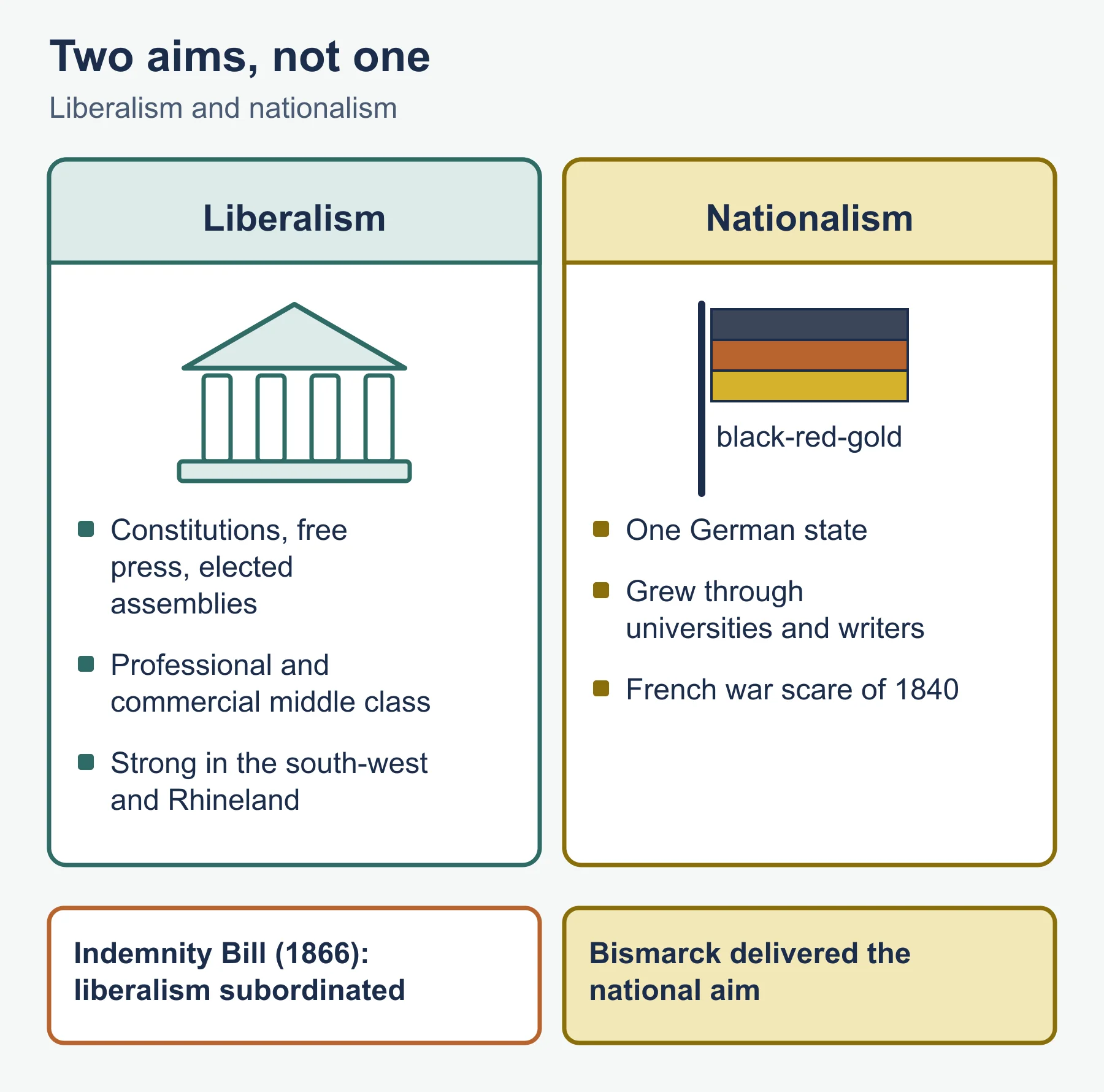
| Liberalism | Nationalism | |
|---|---|---|
| Aim | Constitutions, rights, a free press, elected parliaments controlling taxation | One German nation-state |
| Social base | Professional and commercial middle class, students, some officials | Students, writers, gymnasts, later businessmen wanting one market |
| Main enemy | Princes ruling without constitutions | The division of Germany into sovereign states |
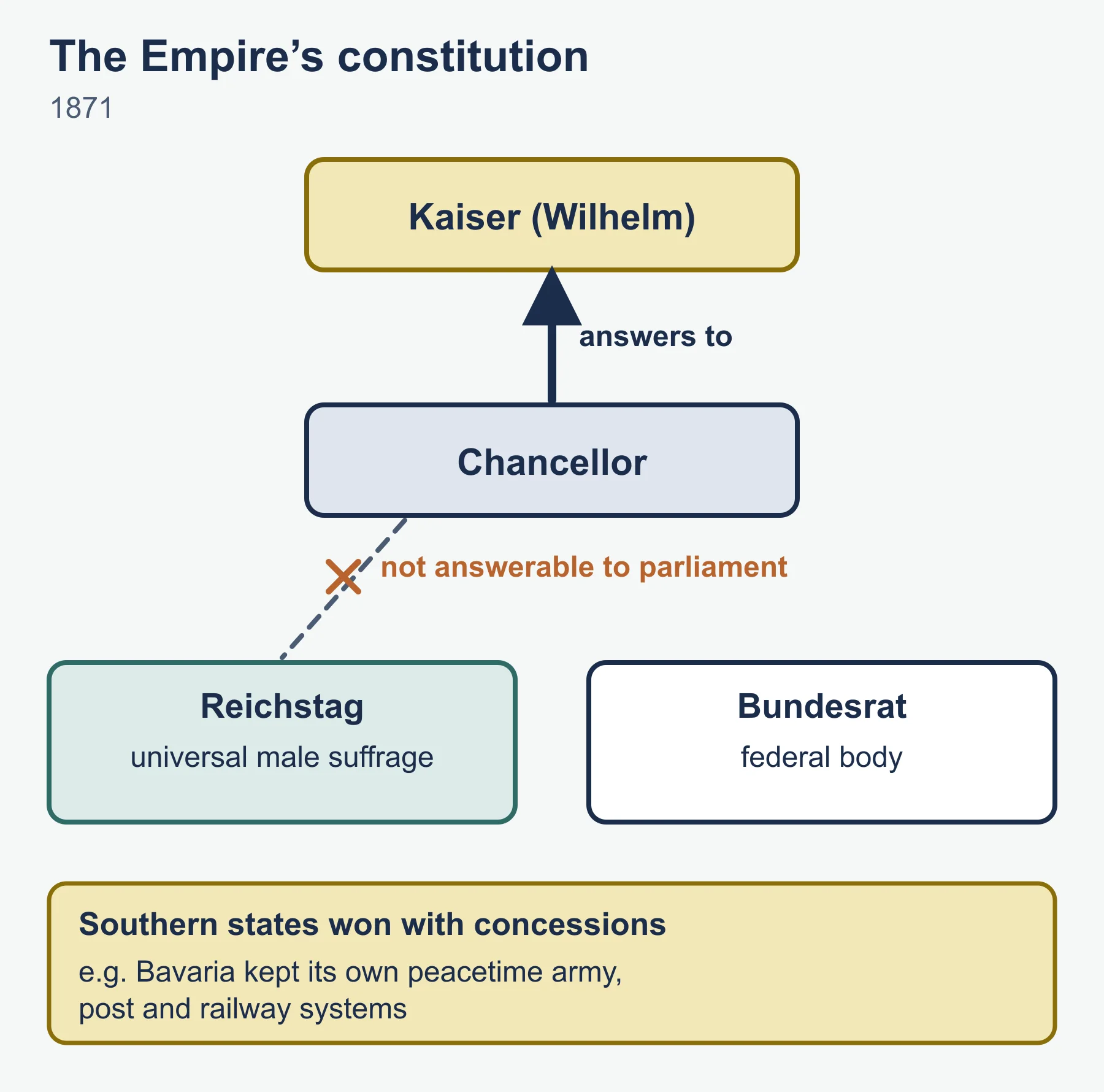
| Fate by 1871 | Subordinated: the Reich Chancellor answered to the Kaiser | Achieved in kleindeutsch form, without Austria |
Most exam questions reward you for showing that the two could pull apart – above all in 1866, when liberals forgave Bismarck’s unconstitutional rule because he had delivered national success.
Chronology
| Date | Event |
|---|---|
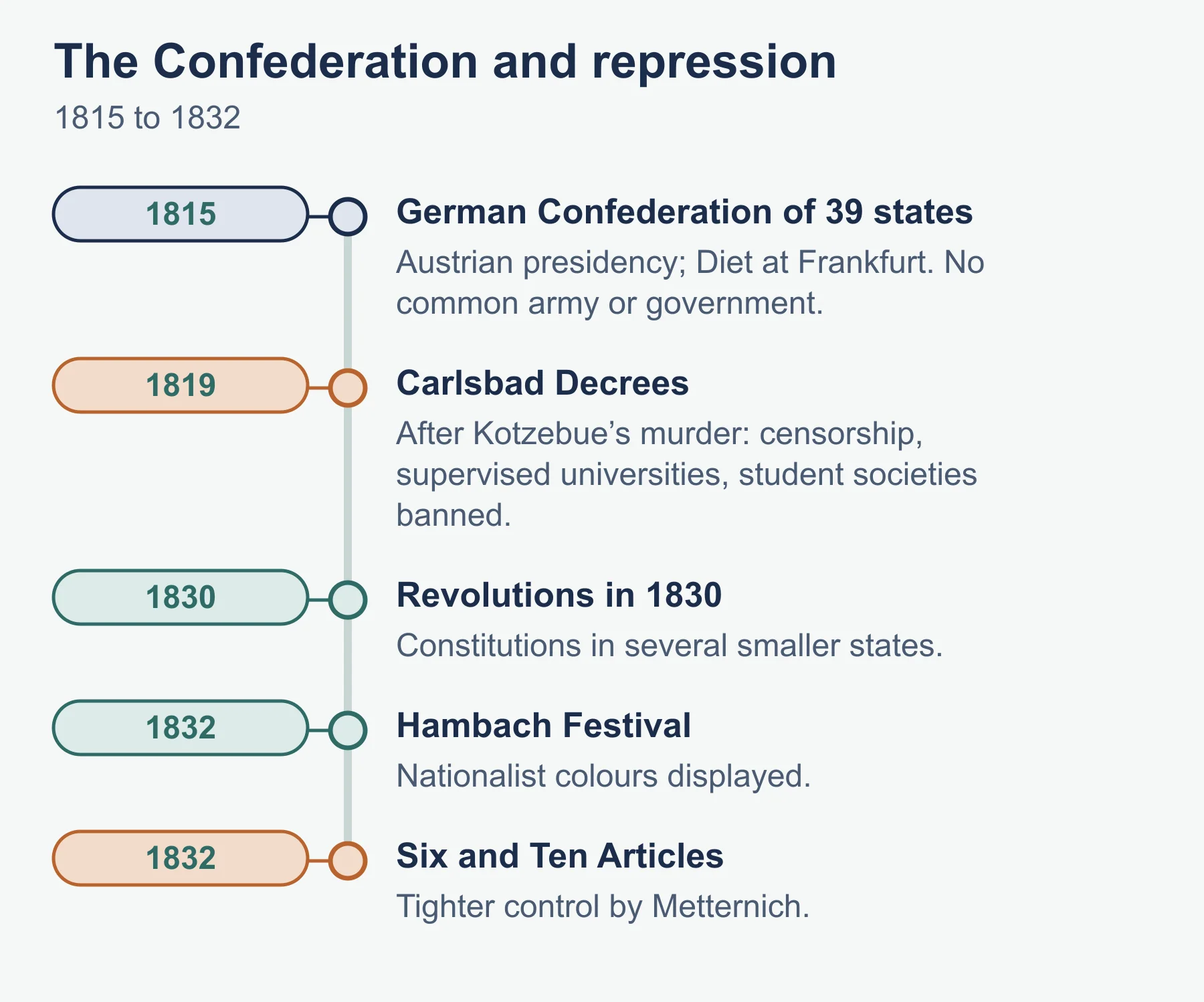
| 1815 | Congress of Vienna creates the German Confederation (Diet at Frankfurt, Austrian presidency) |
| 1817 | Wartburg Festival of student societies |
| 1819 | Kotzebue murdered; Carlsbad Decrees |
| 1818 / 1834 | Prussian customs union / Zollverein comes into force |
| 1832 | Hambach Festival; Six Articles and Ten Articles |
| 1835 | First German railway (Nuremberg-Fürth) |
| 1840 | Rhine crisis with France stirs national feeling |
| 1844 | Silesian weavers’ revolt |
| 1846-47 | Harvest failures and economic crisis |
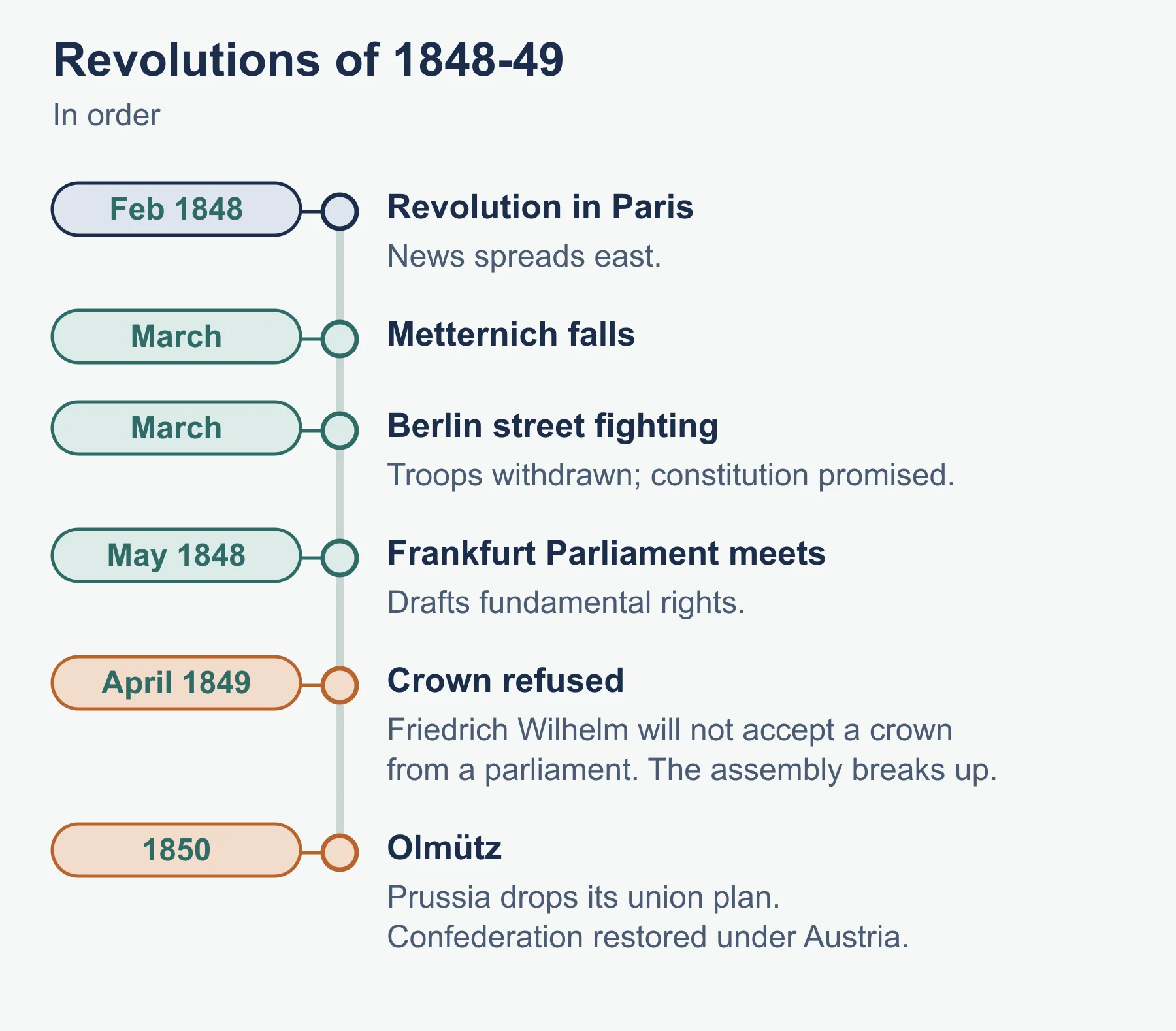
| March 1848 | Metternich falls; street fighting in Berlin |
| May 1848 | Frankfurt Parliament meets in St Paul’s Church |
| Aug-Sept 1848 | Malmö armistice over Schleswig-Holstein; Frankfurt riots |
| Nov-Dec 1848 | Prussian troops retake Berlin; King imposes a constitution |
| March-April 1849 | Frankfurt constitution; Friedrich Wilhelm IV refuses the crown |
| Nov 1850 | Olmütz: Prussia abandons the Erfurt Union |
| 1851-59 | Bismarck Prussian envoy to the Diet |
| 1861 | German Progressive Party founded |
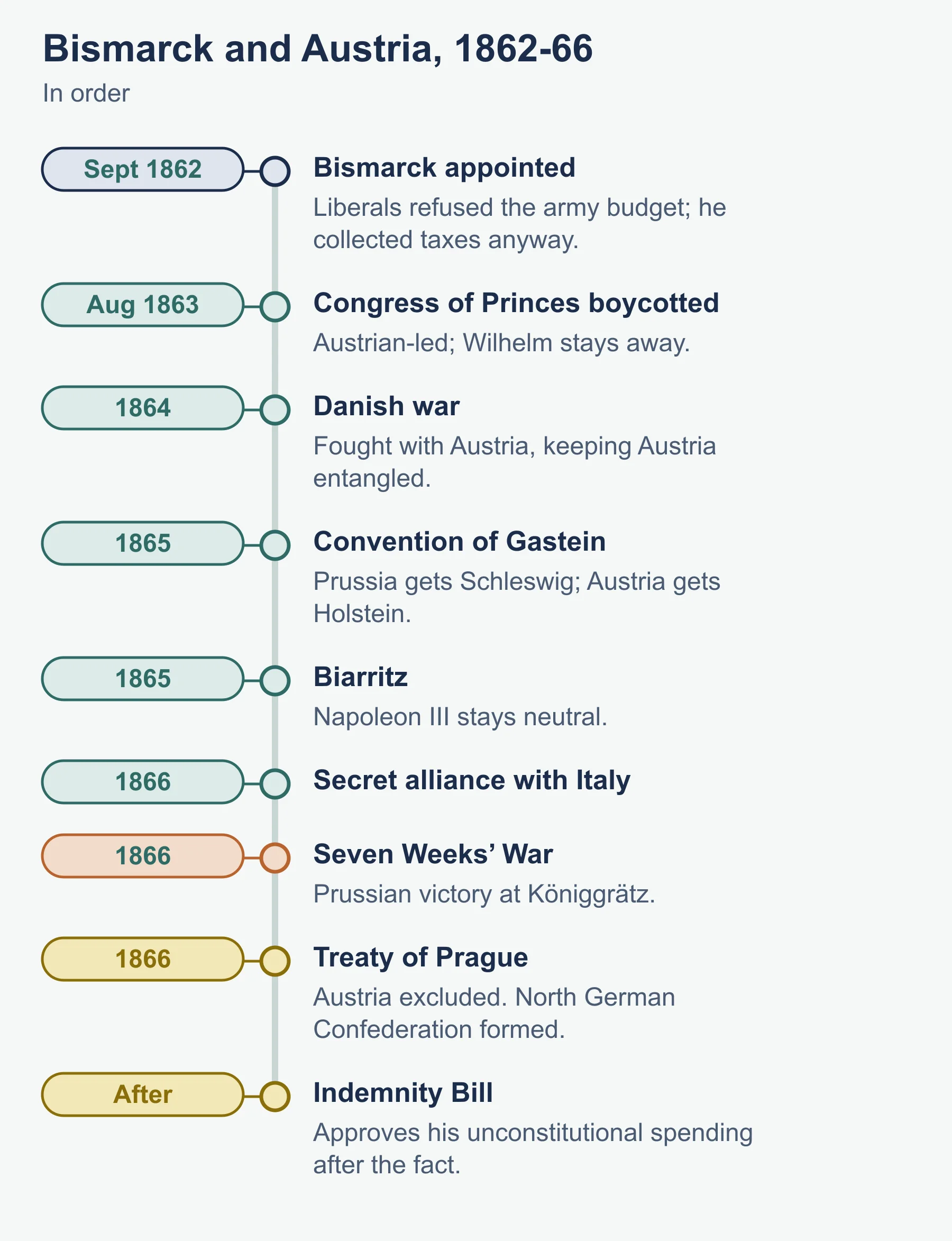
| Sept 1862 | Bismarck appointed; “iron and blood” speech |
| Aug 1863 | Congress of Princes boycotted by Prussia |
| 1864 | War with Denmark |
| Aug 1865 | Convention of Gastein |
| Oct 1865 | Bismarck meets Napoleon III at Biarritz |
| April 1866 | Secret alliance with Italy |
| July-Aug 1866 | Königgrätz; Treaty of Prague |
| Sept 1866 | Indemnity Bill passed |
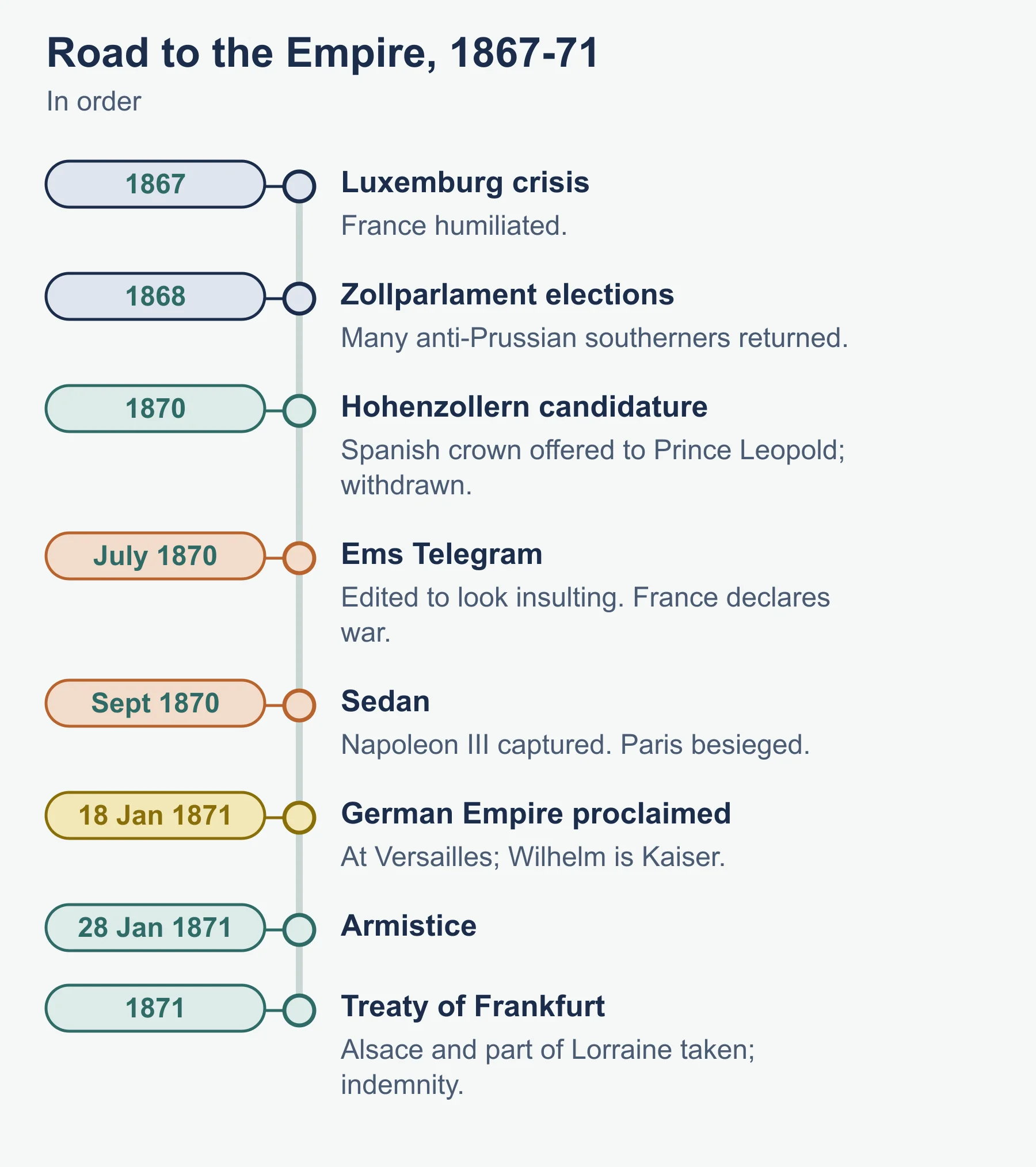
| 1867 | North German Confederation; Luxemburg crisis |
| 1868 | Zollparlament elections return anti-Prussian southern members |
| July 1870 | Hohenzollern candidature; Ems Telegram; France declares war |
| Sept 1870 | Sedan |
| 18 Jan 1871 | German Empire proclaimed at Versailles |
| 28 Jan / 10 May 1871 | Armistice / Treaty of Frankfurt |
Key terms
| Term | Meaning |
|---|---|
| Confederation (Bund) | Loose league of 39 sovereign states created in 1815 |
| Diet (Bundestag) | Assembly of state envoys at Frankfurt, not an elected parliament |
| Burschenschaften | Nationalist student societies, banned in 1819 |
| Carlsbad Decrees | Censorship, university supervision and a central investigating commission |
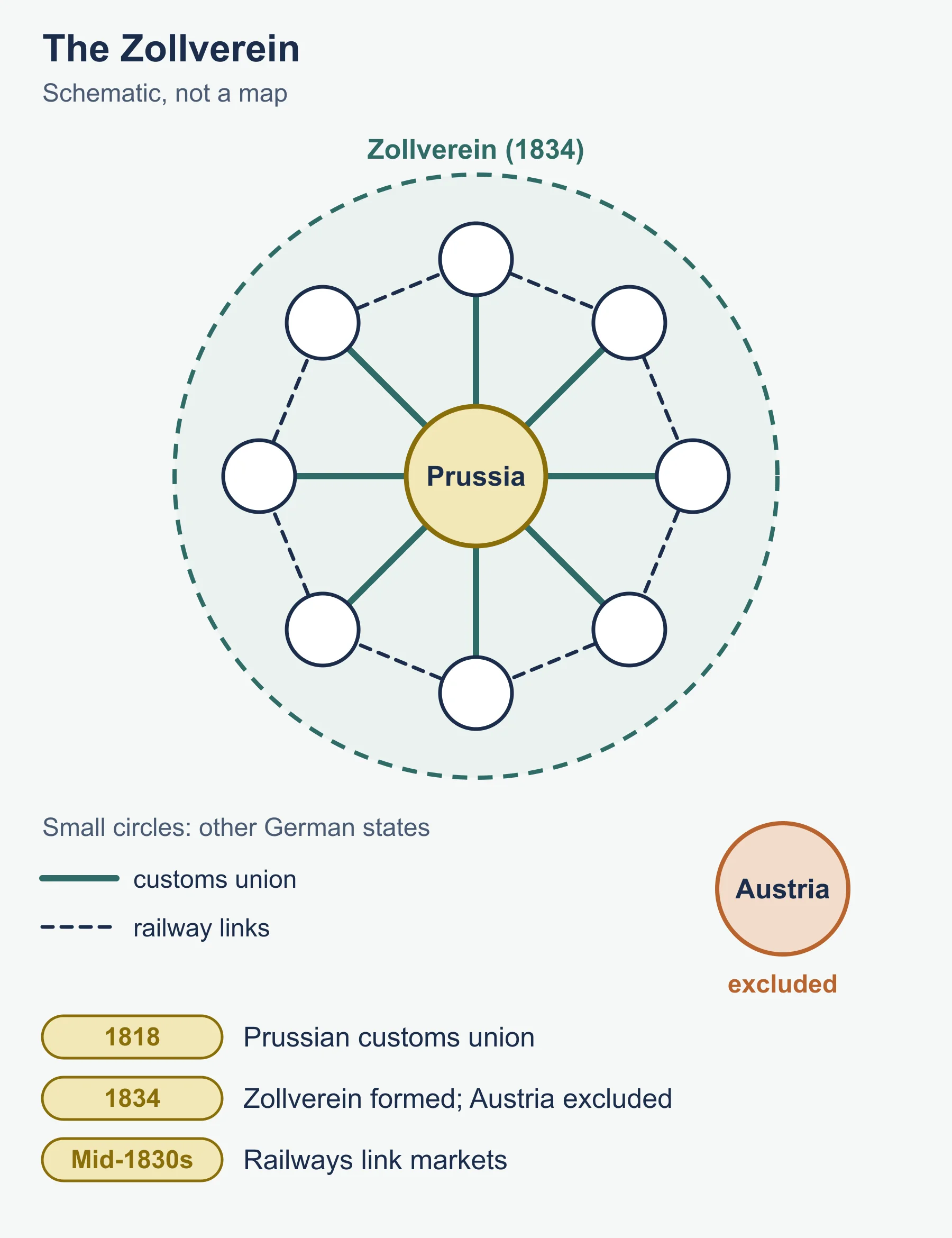
| Zollverein | Customs union led by Prussia, excluding Austria |
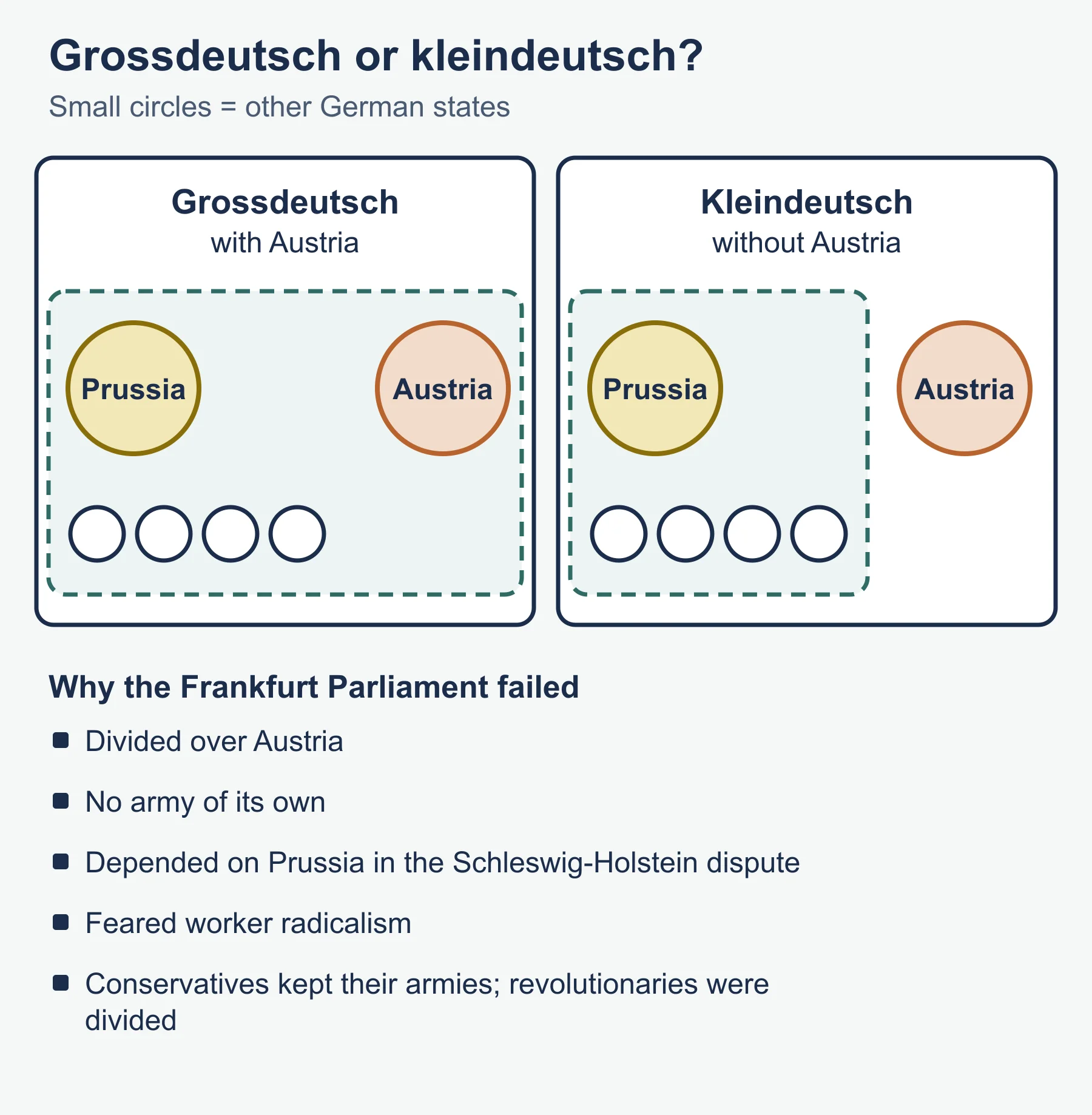
| Grossdeutsch / kleindeutsch | Greater Germany including Austria / Lesser Germany without it |
| Vorparlament | Pre-parliament of March-April 1848 that arranged elections to Frankfurt |
| Fundamental Rights | Frankfurt’s declaration of civil rights, December 1848 |
| Olmütz | 1850 agreement in which Prussia gave way to Austria |
| Realpolitik | Politics based on power and interest rather than principle |
| Indemnity Bill | 1866 law approving Bismarck’s spending without a budget |
| National Liberals | Liberals who backed Bismarck after 1866 |
| Bundesrat | Federal council of state governments in the 1867 and 1871 constitutions |
Key question summaries
2.1 Causes of 1848. Repression (Carlsbad, the 1832 Articles) suppressed but did not destroy liberal and national ideas; the middle class grew with trade and railways; the Zollverein linked the economies of the states without uniting them politically; the crisis of 1846-47 brought hunger, unemployment and artisan distress; the February revolution in Paris was the spark.
2.2 1848-49. Early success came because rulers were taken by surprise. Failure came because the revolutionaries were divided (liberals against radicals; grossdeutsch against kleindeutsch), Frankfurt had no army or money, the armies stayed loyal to the princes, and Friedrich Wilhelm IV would not accept a crown from a parliament. Consequences: Austrian recovery, the humiliation of Olmütz, and a widening economic gap as Prussia grew and Austria struggled.
2.3 Bismarck to 1866. He was appointed to win the army-budget conflict. He kept collecting taxes, then used foreign policy – Denmark, Gastein, Biarritz, Italy – to isolate Austria. Victory in 1866 converted much of the liberal opposition.
2.4 Unification. The southern states resisted Prussian leadership; French fear of Prussian power provided the national cause that overcame that resistance. Luxemburg humiliated France; the Hohenzollern candidature and Ems Telegram brought a war that France declared and Germany won.
Exam traps
- “Bismarck unified Germany.” Weigh Prussian economic strength, Moltke’s army, Austrian and French mistakes and nationalist opinion.
- The Zollverein as a direct cause. It created economic ties, but the 1868 Zollparlament showed the south was not politically pro-Prussian.
- Frankfurt “talked too much”. Name the structural reasons: no army, dependence on Prussia over Schleswig-Holstein, fear of the radicals.
- Planned or improvised? For 1866 and 1870, give evidence both ways – the Italian alliance suggests planning; the Hohenzollern affair suggests opportunism.
- Paper 1. Prussian official statements, liberal newspapers and French accounts each have obvious purposes; explain them.
Self-test
- What did the Carlsbad Decrees introduce? Censorship, supervision of universities, a ban on student societies and an investigating commission.
- Which event of 1832 prompted the Six Articles? The Hambach Festival.
- Why did the Zollverein benefit Prussia politically as well as economically? It drew the smaller states into Prussian-led trade and kept Austria out.
- Give two economic causes of the 1848 revolutions. Any two: harvest failures of 1846-47; high food prices; unemployment; urban overcrowding; artisans undercut by factory goods.
- Why did the Schleswig-Holstein question weaken the Frankfurt Parliament in 1848? It depended on the Prussian army, and Prussia signed the Malmö armistice without consulting it.
- What did Friedrich Wilhelm IV refuse in April 1849, and why? The imperial crown, because it was offered by a parliament rather than by fellow princes.
- What was agreed at Olmütz? Prussia abandoned its union plan and the Confederation was restored under Austrian leadership.
- What caused the Prussian constitutional crisis of 1861-62? Liberal refusal to approve the budget for army reforms proposed by Wilhelm I and Roon.
- What did the Convention of Gastein do? Gave Prussia the administration of Schleswig and Austria that of Holstein.
- What two diplomatic steps prepared war with Austria? The Biarritz meeting with Napoleon III and the secret alliance with Italy.
- Why was the Indemnity Bill significant? Most liberals accepted Bismarck’s past unconstitutional spending, putting national success ahead of parliamentary principle.
- What concession kept Bavaria in the Empire? Any one: its own army in peacetime; its own postal, telegraph and railway systems.
Official syllabus
Cambridge International AS & A Level History (9489) syllabus for 2027, 2028 and 2029 – cambridgeinternational.org (subject content, topic 2; Topics assessed on Paper 1 and Paper 2).
Related resources
-
Practice questions
Cambridge A Level World History (9489): Russia from autocracy to revolution, 1881-1924 – Practice Questions
Twelve original practice questions on Cambridge 9489 Russia 1881-1924: recall items, invented Paper 1 sources and Paper 2 essays, with full answers.
World History · Cambridge · AS Level
Try questions -
Revision notes
Cambridge A Level World History (9489): Russia from autocracy to revolution, 1881-1924 – Revision Notes
Revision notes for Cambridge 9489 History, Russia 1881-1924: chronology, key terms, 1905 and 1917 compared, Civil War factors, exam traps and a self-test.
World History · Cambridge · AS Level
Revise topic -
Study guides
Cambridge A Level World History (9489): France, 1774-1814 – Study Guide
Study guide to Cambridge 9489 History AS topic 1, France 1774-1814: causes of 1789, the road to the Republic, Terror and Directory, Napoleon's rise and fall.
World History · Cambridge · AS Level
Read guide
Get free revision emails (optional)
Occasional emails with practice questions, worked explanations and links to free resources for the qualification and subjects you choose. No spam, and you can unsubscribe from any email. The free tools on this site never need an email.