
Revision Notes
Cambridge IGCSE Commerce (0715): Wholesaling – Revision Notes
Recall notes for Cambridge IGCSE Commerce 0715 section 2.4: wholesaler functions, benefits to manufacturer and retailer, cash and carry and voluntary chains.
- Subject
- Commerce
- Level
- IGCSE
- Topic
- Topic 2 – Commercial Operations
- Author
- Marlbridge Academic Team
- Updated
- Reviewed by
- Salman Ahmad (what this means)
Aligned to Cambridge IGCSE Commerce (0715), 2028. Official specification .
Syllabus page (what it covers and how it is assessed): Cambridge IGCSE Commerce.
Syllabus points this page covers
0715
- 2.4 Wholesaling
Found an error? Report a correction.
Need help with this topic? Request a free trial class for IGCSE Commerce (0715).
Condensed notes for section 2.4 of Cambridge IGCSE Commerce (0715). For explanations, a worked price comparison and an annotated answer, use the wholesaling study guide.
The syllabus in three lines
2.4.1 asks for:
- The functions and services provided by the wholesaler.
- The importance of the wholesaler to the manufacturer and to the retailer.
- Why the independent wholesaler survives: cash and carry and voluntary chains.
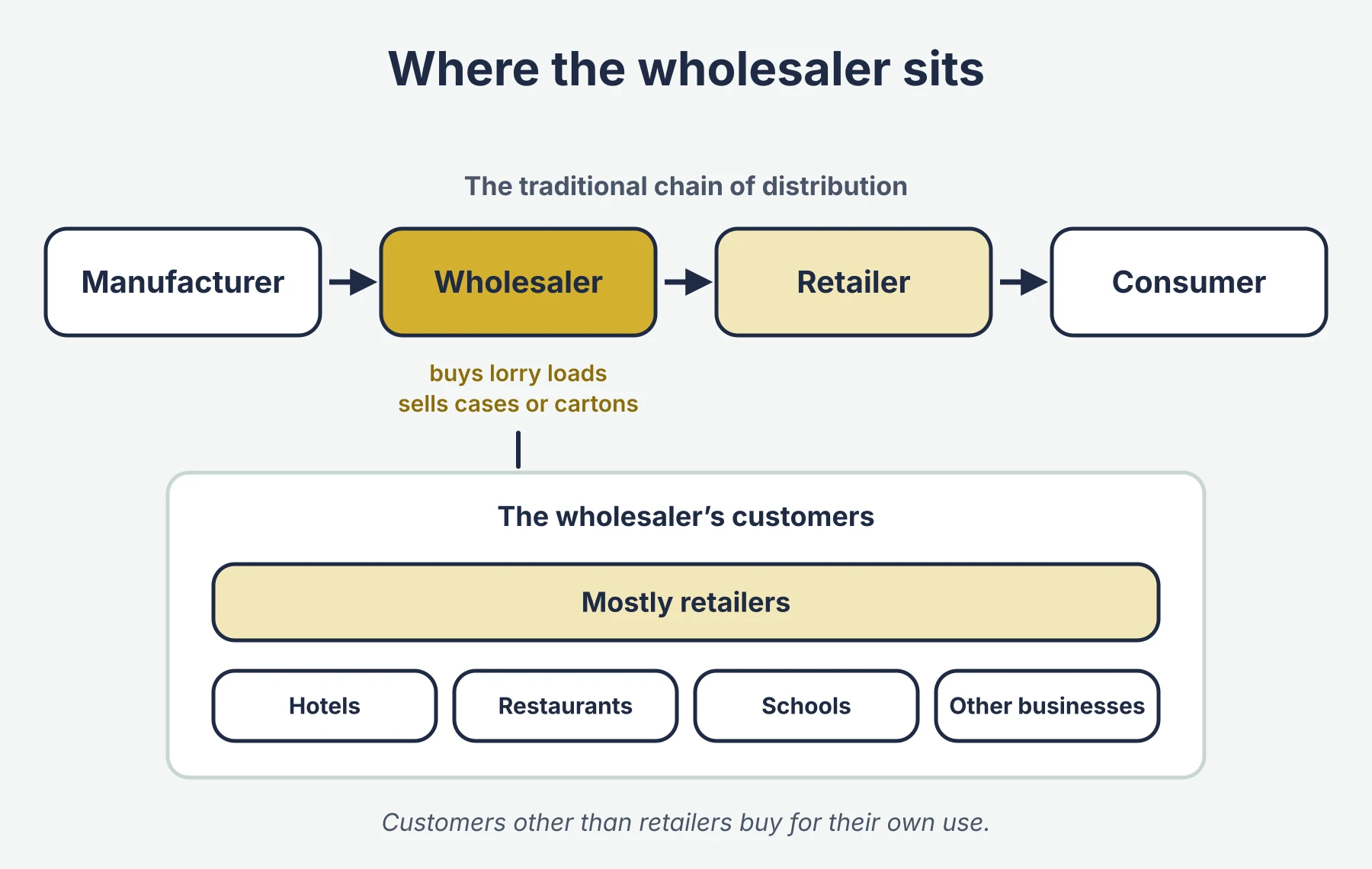
Nine functions to recall
Mnemonic “Big Stores Buy Any Tin, Can Add Packaging Prices”:
| Letter | Function | One-line meaning |
|---|---|---|
| B | Breaking bulk | Buys lorry loads, sells cases |
| S | Storage | Holds goods until needed |
| B | Bearing risk | Owns goods, so carries losses from price falls, damage, theft, fashion changes |
| A | Assortment | Range from many manufacturers in one place |
| T | Transport | Delivers to retailers |
| C | Credit | Retailers pay later |
| A | Advice and information | Passes demand information both ways |
| P | Packing and labelling | Grades, packs or labels some goods |
| P | Price stability | Stores in times of plenty, releases in times of shortage |
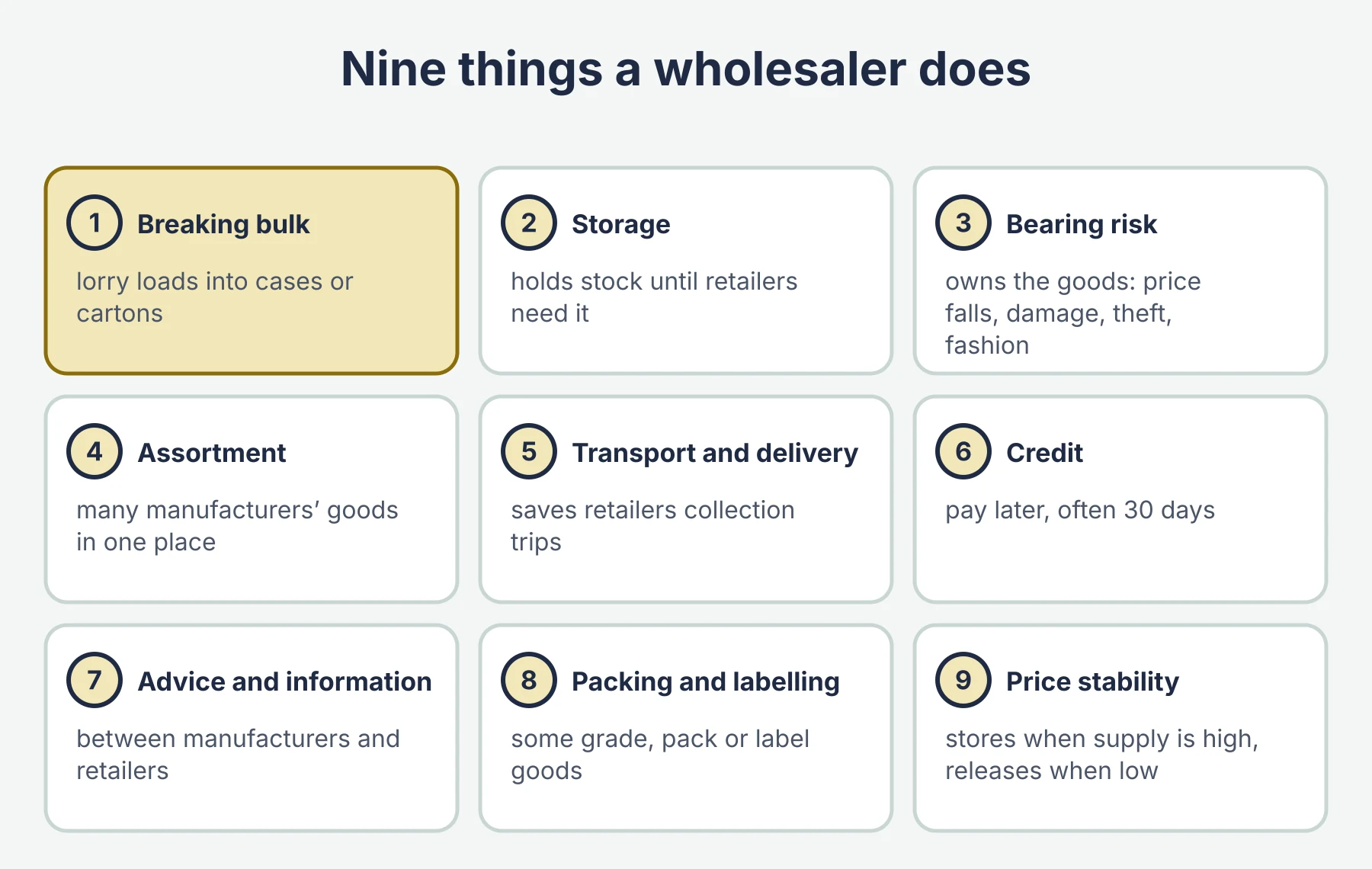
Importance: say who benefits
| To the manufacturer | To the retailer |
|---|---|
| Few large orders instead of many small ones | Buys small quantities |
| Less storage needed at the factory | Wide choice in one place |
| Continuous production all year | Less storage needed in the shop |
| Risk of unsold goods passes on | Credit helps cash flow |
| Information on what is selling | Delivery and product advice |
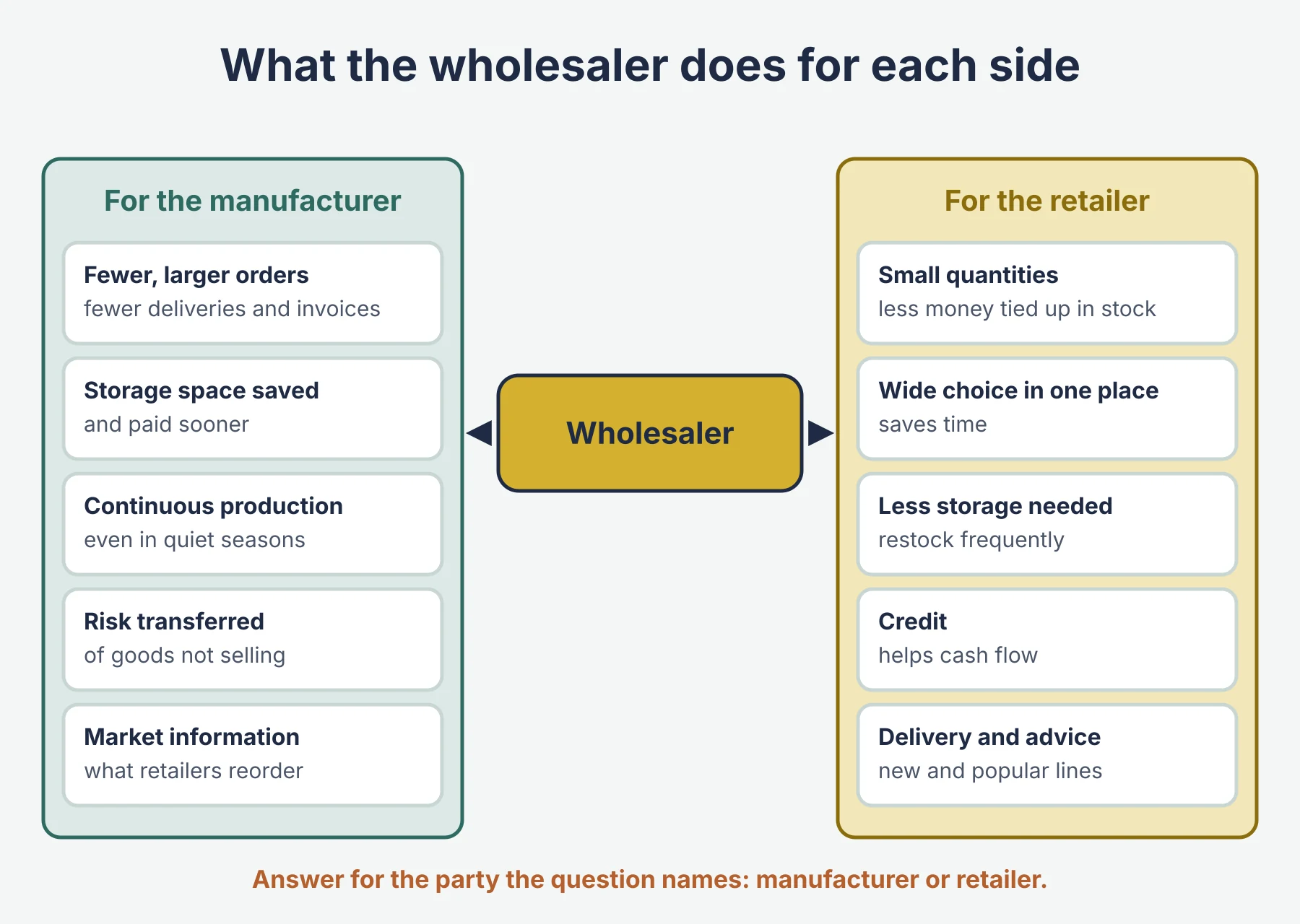
Why some bypass the wholesaler
- Large chains and supermarkets buy direct and run central warehouses.
- Manufacturers sell direct through own shops or websites.
- Ecommerce links producers straight to consumers.
- Perishable or made-to-order goods go direct.
The functions remain; someone else performs them and bears the cost.
Survival method 1: cash and carry
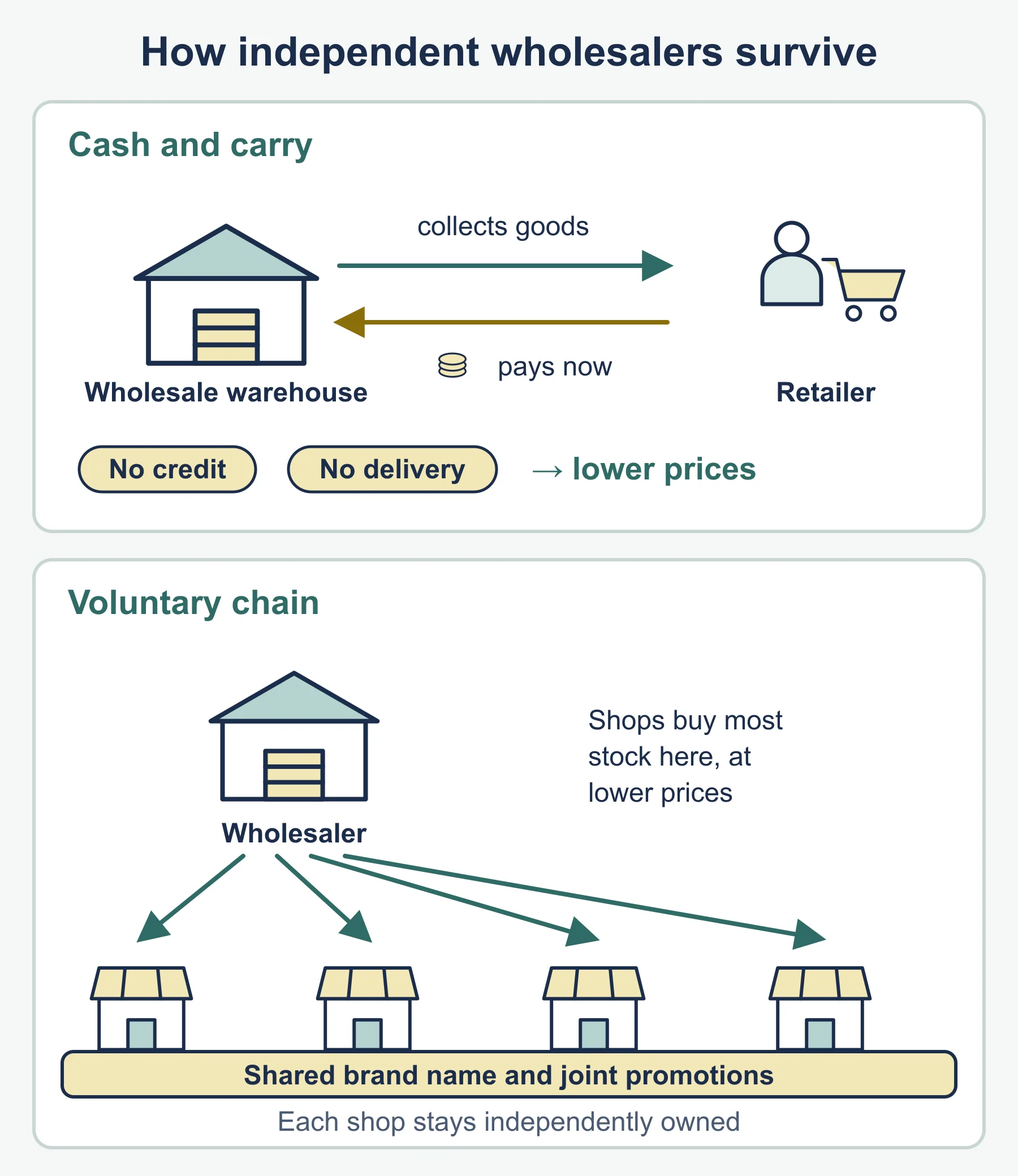
- Self service by trade customers in a large warehouse.
- Pay immediately: no credit.
- Collect in own transport: no delivery.
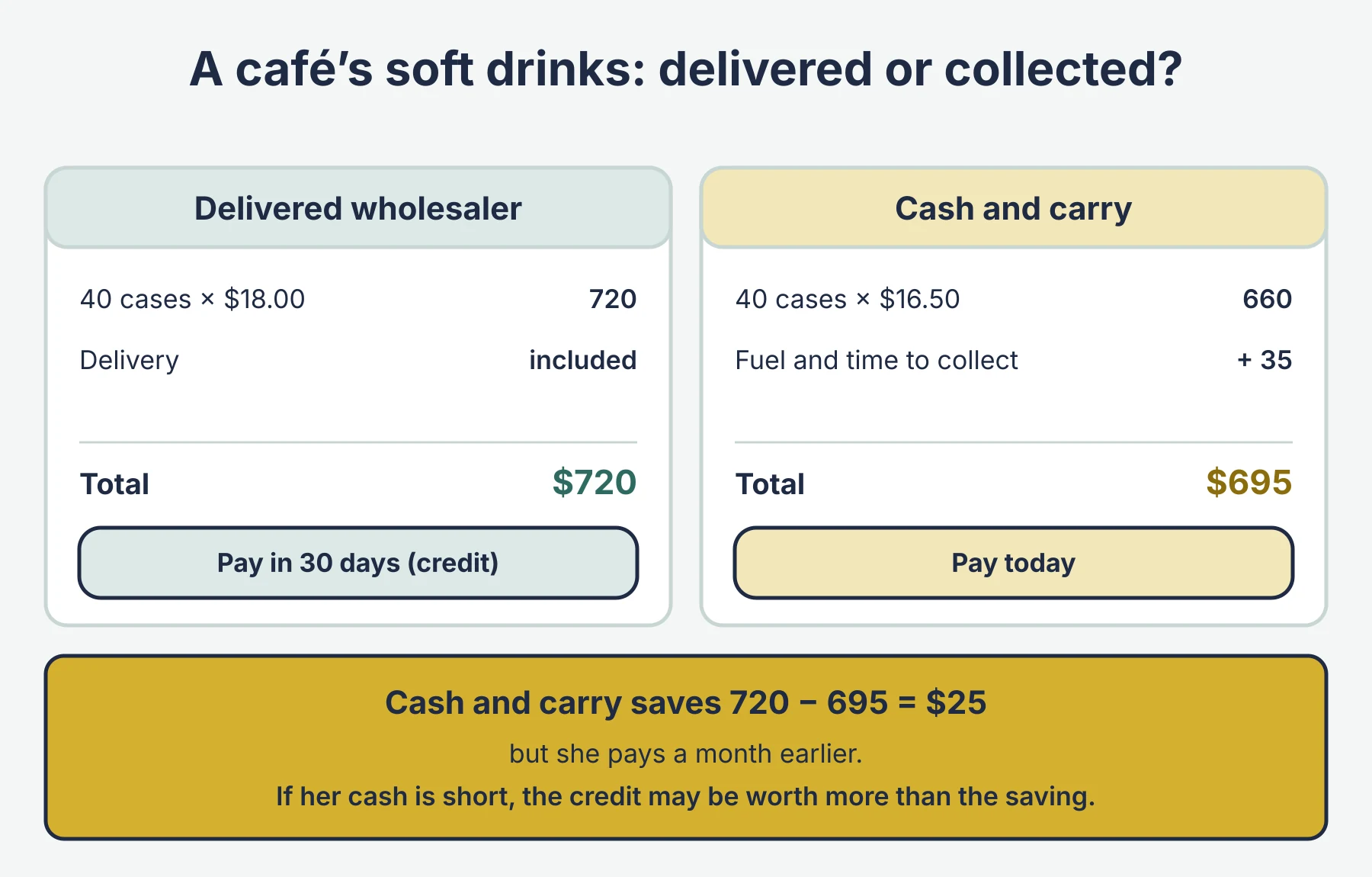
- Result: lower costs for the wholesaler, so lower prices; retailers buy when they choose and see goods first.
- Retailer’s drawbacks: collection time and cost; no credit.
Survival method 2: voluntary chain
- Wholesaler plus independent retailers agree to cooperate.
- Retailers remain independent owners, trade under a common name, buy much of their stock from the wholesaler.
- Wholesaler gains: regular guaranteed orders, so bulk buying power.
- Retailers gain: lower prices, own-brand goods, joint advertising, shop advice, recognisable image.
- Retailers lose: some independence; must follow group rules; may pay a fee.
Key terms
| Term | Meaning |
|---|---|
| Wholesaler | Business that buys in bulk from manufacturers and sells in smaller quantities to retailers |
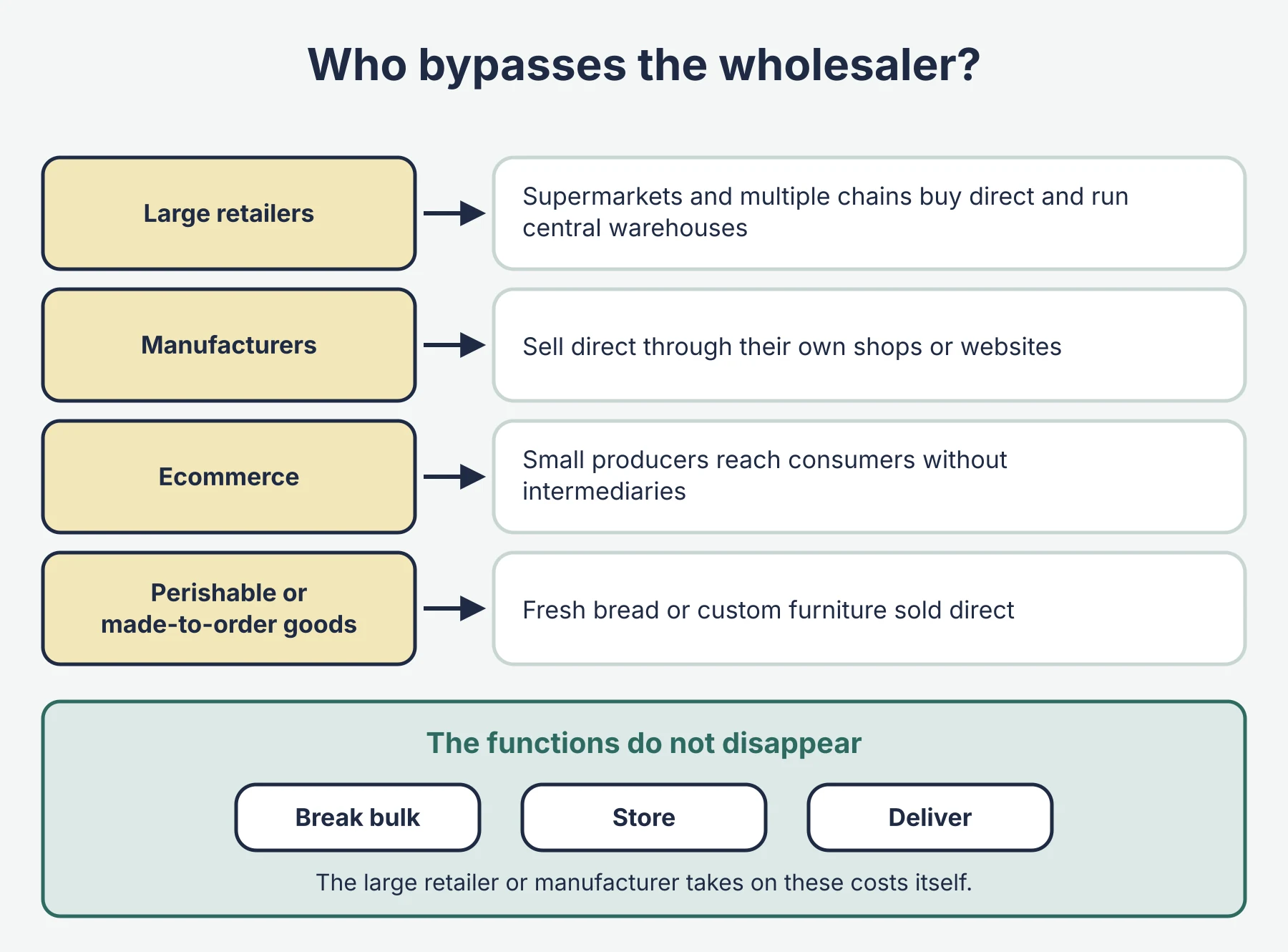
| Chain of distribution | Route from manufacturer to consumer: manufacturer, wholesaler, retailer, consumer |
| Breaking bulk | Dividing large quantities into smaller ones |
| Bearing risk | Accepting possible losses on goods owned |
| Trade credit | Time allowed to pay for goods already received |
| Cash and carry | Self-service wholesaler where customers pay at once and take the goods |
| Voluntary chain | Independent retailers linked with a wholesaler under a common name |
| Own brand | Goods sold under the group’s or retailer’s own name |
| Central warehouse | A large retailer’s own store that supplies its branches |
Exam traps
- Match the benefit to the party named: manufacturer or retailer.
- Cash and carry needs all three features.
- A voluntary chain is not a multiple chain store: in a voluntary chain the shops are separately owned.
- Bypassing the wholesaler moves its costs, it does not remove them.
- “Price stability” needs the mechanism: storing goods when supply is high.
Self-test
- Define a wholesaler.
- What is meant by breaking bulk?
- How does the wholesaler bear risk?
- Give two ways the wholesaler helps the manufacturer.
- Give two ways the wholesaler helps the retailer.
- How can a wholesaler help keep prices stable?
- Why do large supermarket chains often bypass the wholesaler?
- State the three features of a cash and carry wholesaler.
- Why can a cash and carry charge lower prices?
- Who owns the shops in a voluntary chain?
- State two benefits to a retailer of joining a voluntary chain.
- A shop buys 30 cartons at $12 delivered or $11 at cash and carry with $20 collection cost. Which is cheaper and by how much?
Answers
- A business that buys goods in large quantities from manufacturers and sells them in smaller quantities to retailers and other businesses.
- Buying goods in very large quantities and selling them in the smaller quantities a retailer can handle.
- It owns the goods while it stores them, so it suffers any loss from falling prices, damage, theft or goods going out of fashion.
- Any two: fewer, larger orders; less storage at the factory; continuous production; risk passed on; market information.
- Any two: small quantities; wide choice in one place; less storage needed; credit; delivery; advice.
- By storing goods when supply is plentiful and releasing them when supply is short, it evens out price changes.
- They buy such large quantities that they can deal directly with manufacturers and run their own central warehouses.
- Self service; immediate payment with no credit; customers transport goods themselves.
- It saves the costs of delivery, credit and sales staff.
- The independent retailers themselves; each remains a separate owner.
- Any two: lower prices through bulk buying; own-brand goods; joint advertising; shop advice; recognised group name.
- Delivered: 30 x 12 = $360. Cash and carry: 30 x 11 = $330 + $20 = $350. Cash and carry is cheaper by $10.
Related resources
-
Revision notes
Cambridge IGCSE Commerce: Commercial Operations — Revision Notes
Recall notes for Cambridge IGCSE Commerce 0715 Topic 2, exams from 2028: ownership types, outsourcing, retail, wholesale, trading documents and communication.
Commerce · Cambridge · IGCSE
Revise topic -
Study guides
Cambridge IGCSE Commerce: Commercial Operations (0715)
Ownership types, MNCs, franchises, location, retailing, trading documents and communication explained for Topic 2 of Cambridge IGCSE Commerce 0715 (2028).
Commerce · Cambridge · IGCSE
Read guide -
Study guides
Cambridge IGCSE Commerce: Outsourcing and Wholesaling (0715)
Why outsourcing through contract manufacturing and logistics has grown, and the wholesaler's functions, importance and survival, for IGCSE Commerce 0715.
Commerce · Cambridge · IGCSE
Read guide
Get free revision emails (optional)
Occasional emails with practice questions, worked explanations and links to free resources for the qualification and subjects you choose. No spam, and you can unsubscribe from any email. The free tools on this site never need an email.