
Study Guides
Cambridge IGCSE Commerce (0715): Wholesaling
Wholesaler functions, importance to manufacturers and retailers, cash and carry and voluntary chains, for Cambridge IGCSE Commerce 0715 section 2.4.
- Subject
- Commerce
- Level
- IGCSE
- Topic
- Topic 2 – Commercial Operations
- Author
- Marlbridge Academic Team
- Updated
- Reviewed by
- Salman Ahmad (what this means)
Aligned to Cambridge IGCSE Commerce (0715), 2028. Official specification .
Syllabus page (what it covers and how it is assessed): Cambridge IGCSE Commerce.
Syllabus points this page covers
0715
- 2.4 Wholesaling
Found an error? Report a correction.
Need help with this topic? Request a free trial class for IGCSE Commerce (0715).
A wholesaler buys goods in large quantities from manufacturers and sells them in smaller quantities to retailers and other businesses. Section 2.4 of the Cambridge IGCSE Commerce (0715) syllabus has one sub-section, 2.4.1, with three statements: the functions and services the wholesaler provides, its importance to the manufacturer and the retailer, and why the independent wholesaler survives, through cash and carry and voluntary chains. This page builds on the wholesaling section of the Outsourcing and Wholesaling study guide with more on how each function works, a worked comparison and an annotated answer.
Where does the wholesaler sit in the chain?
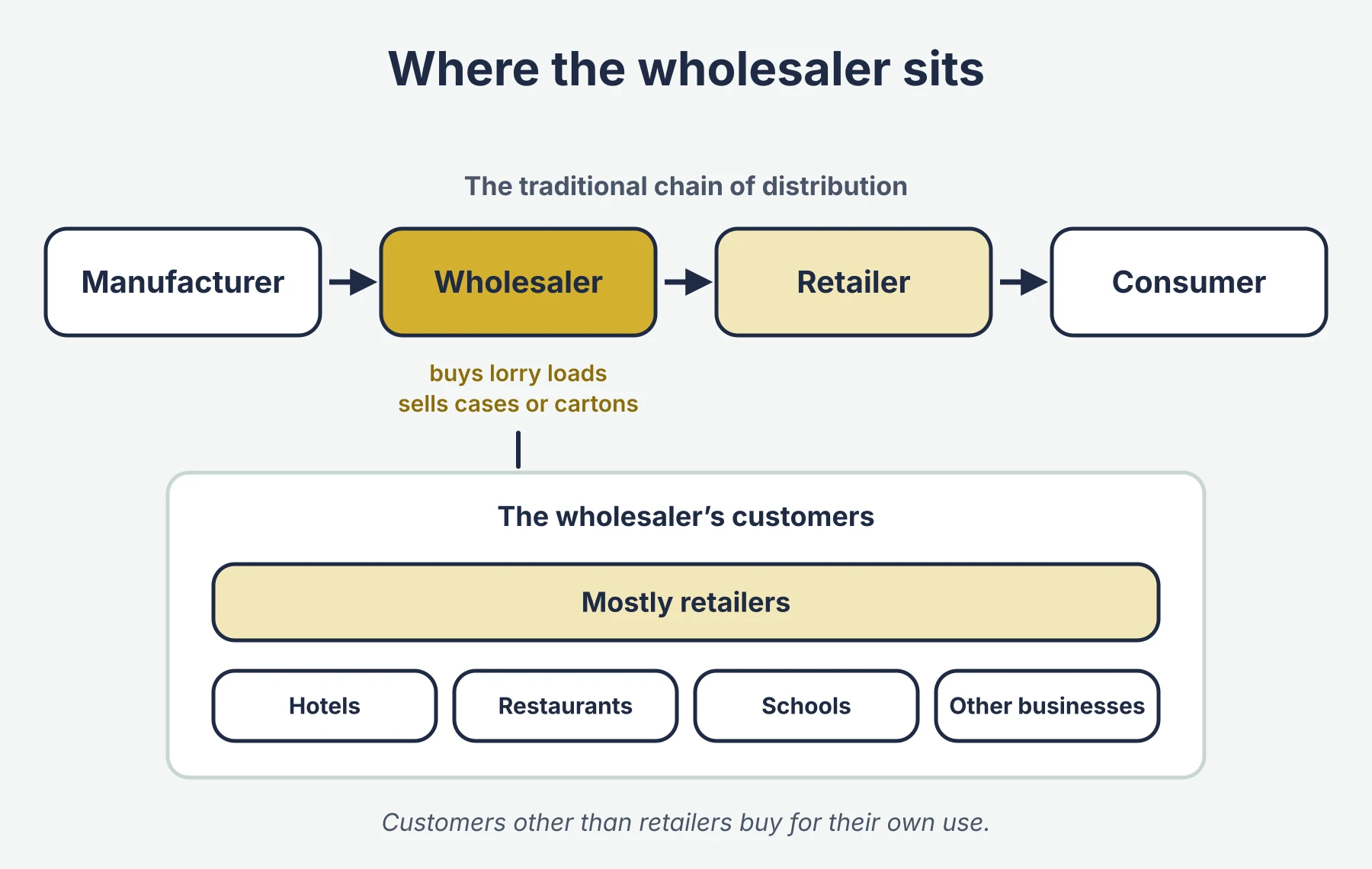
The traditional chain of distribution is manufacturer, then wholesaler, then retailer, then consumer. The wholesaler is a home trade intermediary (1.2.4). Its customers are mostly retailers, but also hotels, restaurants, schools and other businesses that buy for their own use.
What functions and services does a wholesaler provide?
| Function | What the wholesaler does |
|---|---|
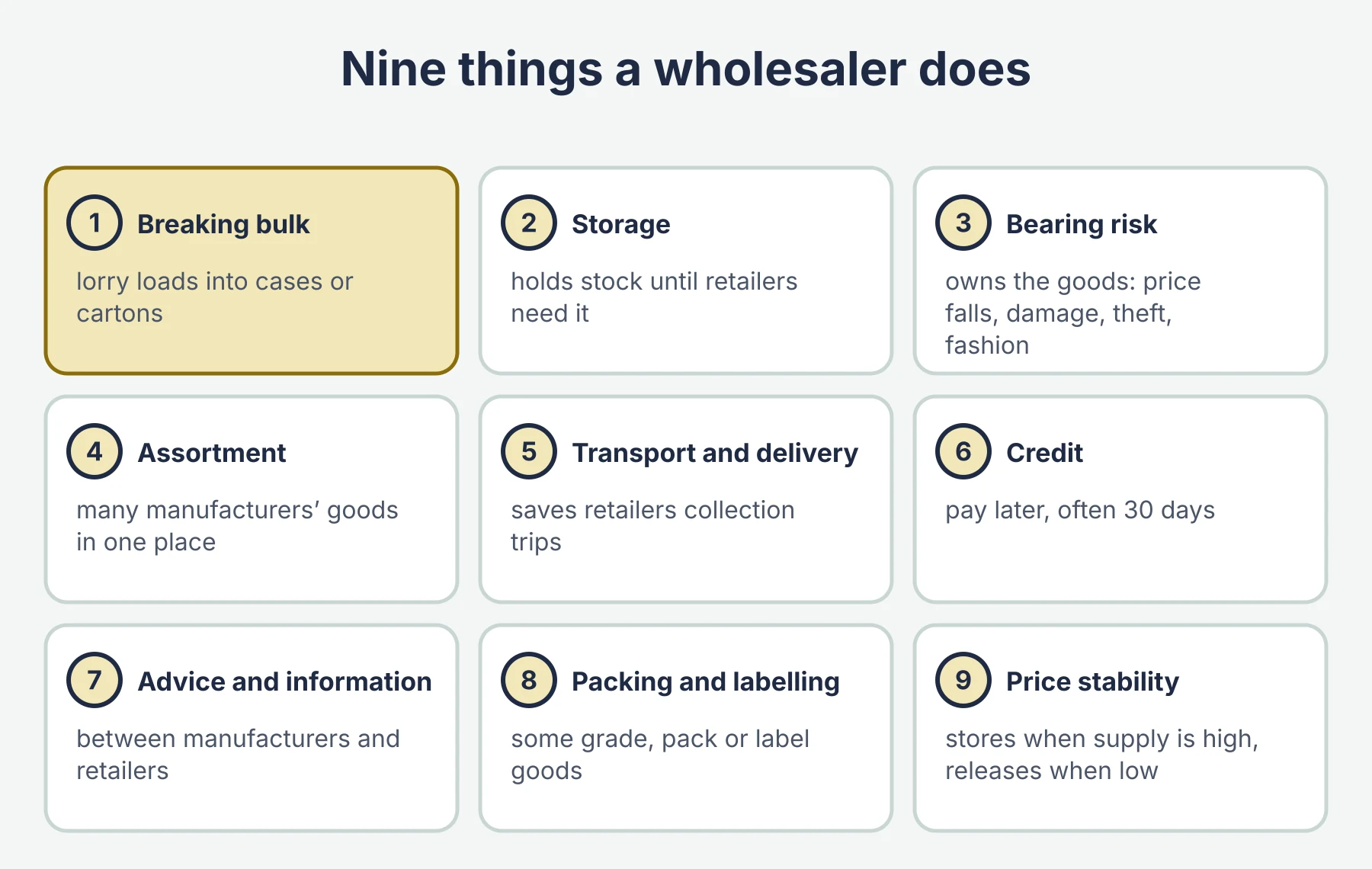
| Breaking bulk | Buys in very large quantities, such as lorry loads, and sells in cases or cartons a shop can manage |
| Storage (warehousing) | Holds stock in its warehouse until retailers need it |
| Bearing risk | Owns the goods while they are stored, so it bears losses from falling prices, damage, theft or goods going out of fashion |
| Assortment | Collects goods from many manufacturers so a retailer can buy a wide range from one place |
| Transport and delivery | Delivers to retailers, saving them collection trips |
| Credit | Allows retailers to pay later, often 30 days, so they can sell the goods before paying for them |
| Advice and information | Tells manufacturers which products sell well and passes news of new products to retailers |
| Packing and labelling | Some wholesalers grade, pack or label goods before selling them on |
| Price stability | By storing goods when supply is high and releasing them when it is low, it evens out price swings |
Why is the wholesaler important to the manufacturer?
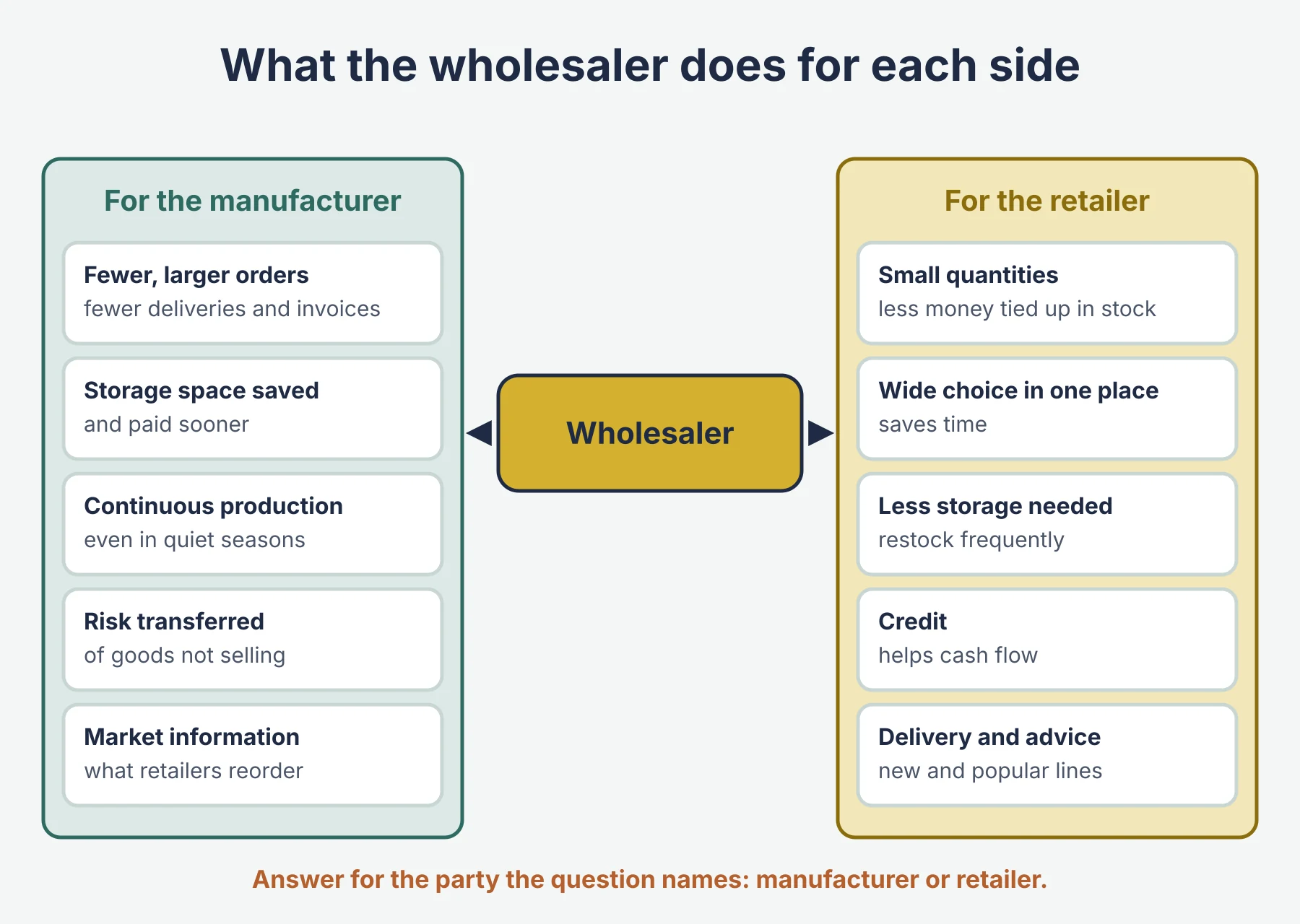
- Fewer, larger orders. The manufacturer sells to a few wholesalers instead of hundreds of shops, cutting selling, invoicing and delivery costs.
- Storage space saved. Goods leave the factory soon after they are made, so the manufacturer needs less warehouse space and gets paid sooner.
- Continuous production. The wholesaler buys ahead of demand, so the factory can keep producing through quiet seasons.
- Risk transferred. Once sold to the wholesaler, the risk of goods not selling or losing value passes to the wholesaler.
- Market information. The wholesaler reports what retailers are reordering, helping the manufacturer plan output.
Why is the wholesaler important to the retailer?
- Small quantities. A shop can buy a few cases instead of a whole lorry load, so it ties up less money in stock.
- Wide choice in one place. The retailer saves time by buying from many manufacturers through one wholesaler.
- Less storage needed. The wholesaler acts as the retailer’s store room, so the shop can restock frequently.
- Credit. Paying later helps the retailer’s cash flow.
- Delivery and advice. Goods come to the door, with information about new and popular lines.
Why do some businesses bypass the wholesaler?
The survival question makes more sense once you see the pressure on wholesalers:
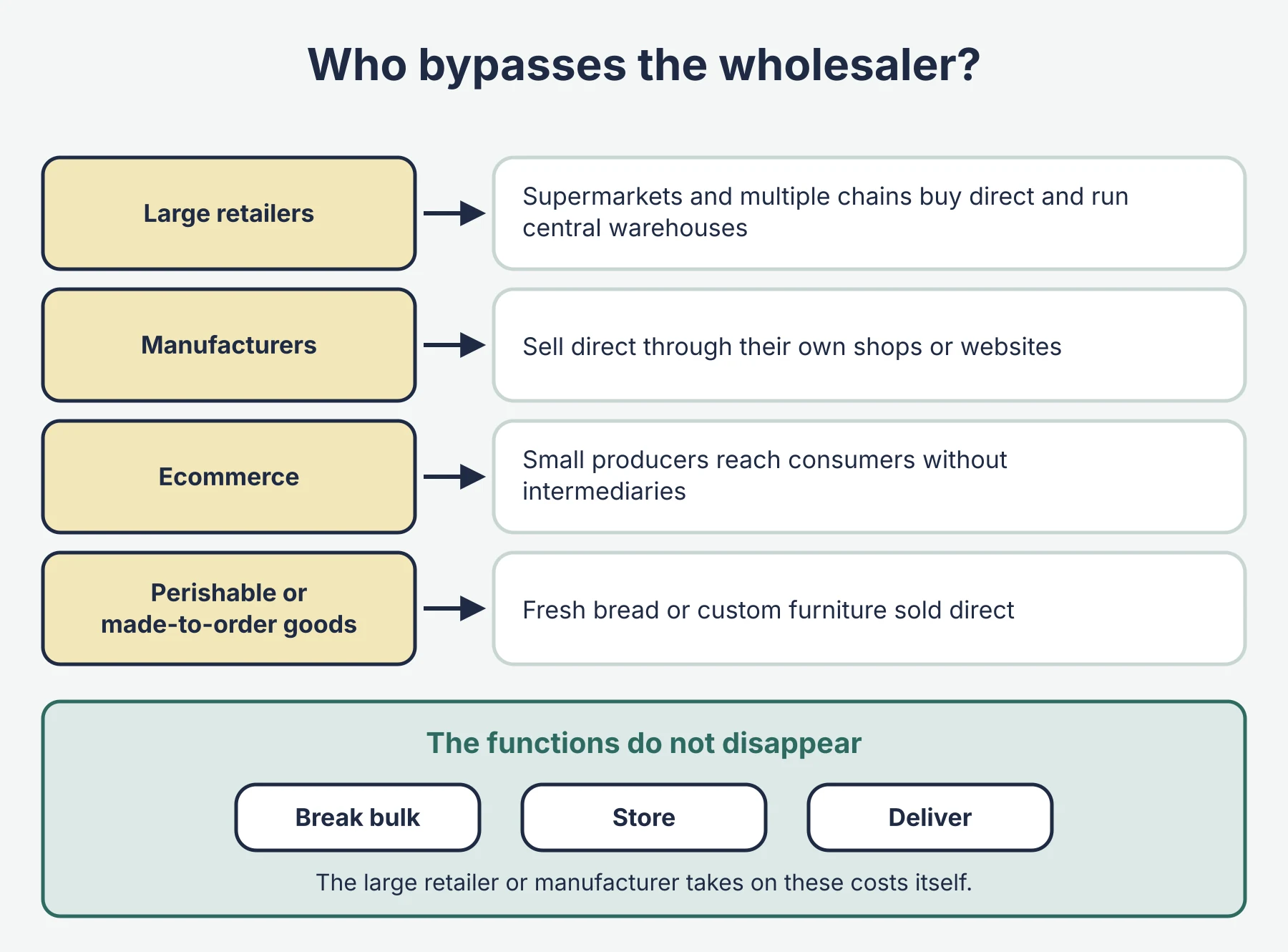
- Large retailers such as supermarket and multiple chains buy so much that they deal directly with manufacturers and run their own central warehouses.
- Manufacturers sell directly to consumers through their own shops or websites.
- Ecommerce allows small producers to reach consumers without intermediaries.
- Perishable or made-to-order goods, such as fresh bread or custom furniture, are often sold direct to keep them fresh or meet exact needs.
Removing the wholesaler does not remove its functions: someone still has to break bulk, store and deliver. The large retailer or manufacturer simply takes on those costs itself.
Why does the independent wholesaler survive? (2.4.1)
The syllabus names two ways.
Cash and carry
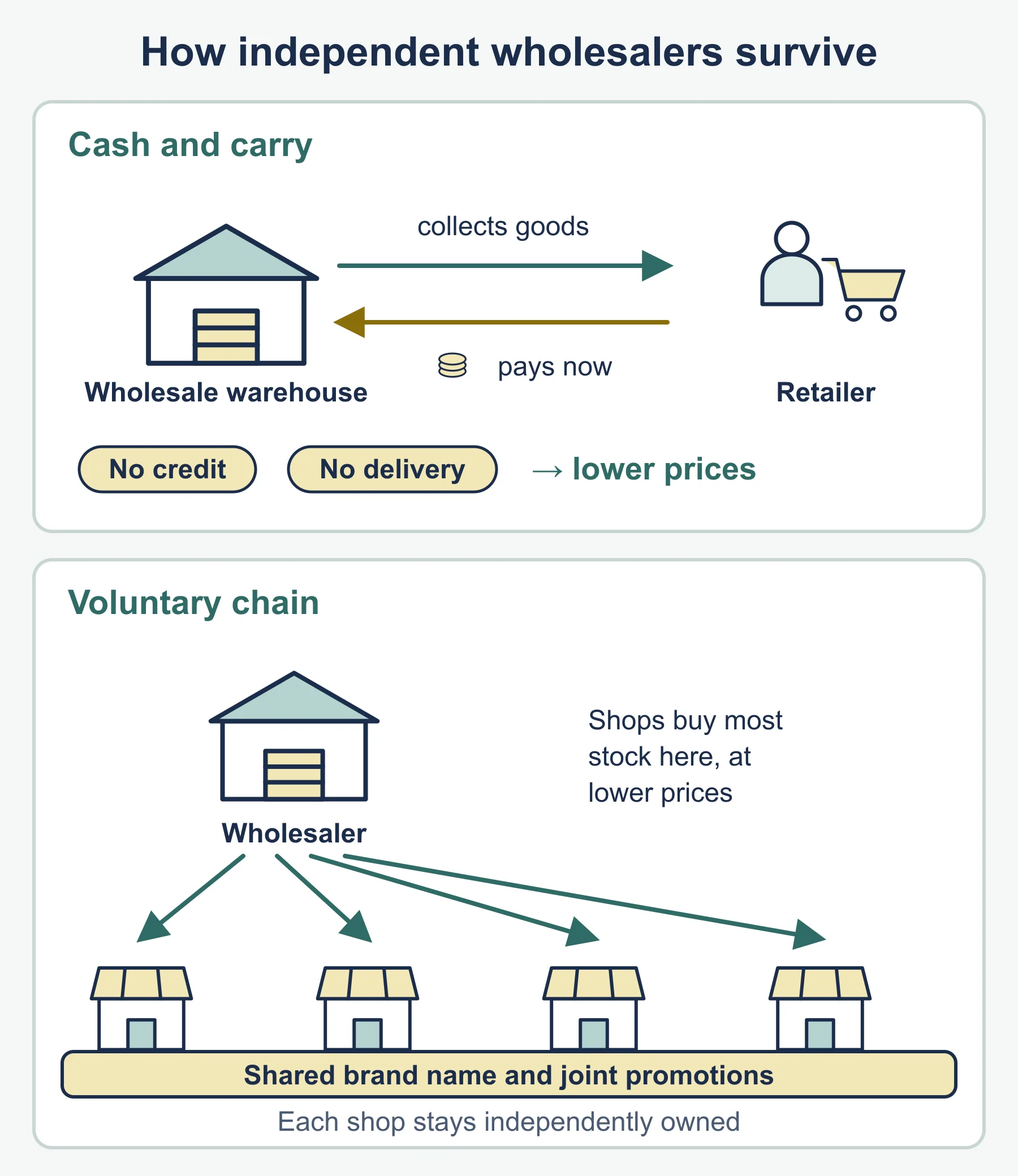
A cash and carry wholesaler runs a large self-service warehouse. Retailers and other trade customers:
- walk round and choose goods themselves;
- pay immediately (cash, card or electronic payment), with no credit;
- carry the goods away in their own vehicles, with no delivery.
Because the wholesaler saves on credit, delivery and sales staff, it can charge lower prices. Retailers can also buy when they need to, even daily, and see goods before buying. The disadvantages for the retailer are the time and cost of collecting, and the loss of credit.
Voluntary chains
A voluntary chain is formed when a wholesaler and a group of independent retailers agree to work together. The retailers stay independent owners but trade under a common name and agree to buy much of their stock from the wholesaler.
- The wholesaler gains guaranteed, regular orders, so it can buy in bulk from manufacturers at lower prices.
- The retailers gain lower prices, own-brand goods under the group name, joint advertising, shop-fitting advice and a recognisable shopfront, helping them compete with chain stores.
- The drawbacks for retailers: they must buy a share of stock from the group, follow its rules on layout and promotions, and may pay a membership fee, so they lose some independence.
Worked example: delivered wholesale or cash and carry? (invented figures)
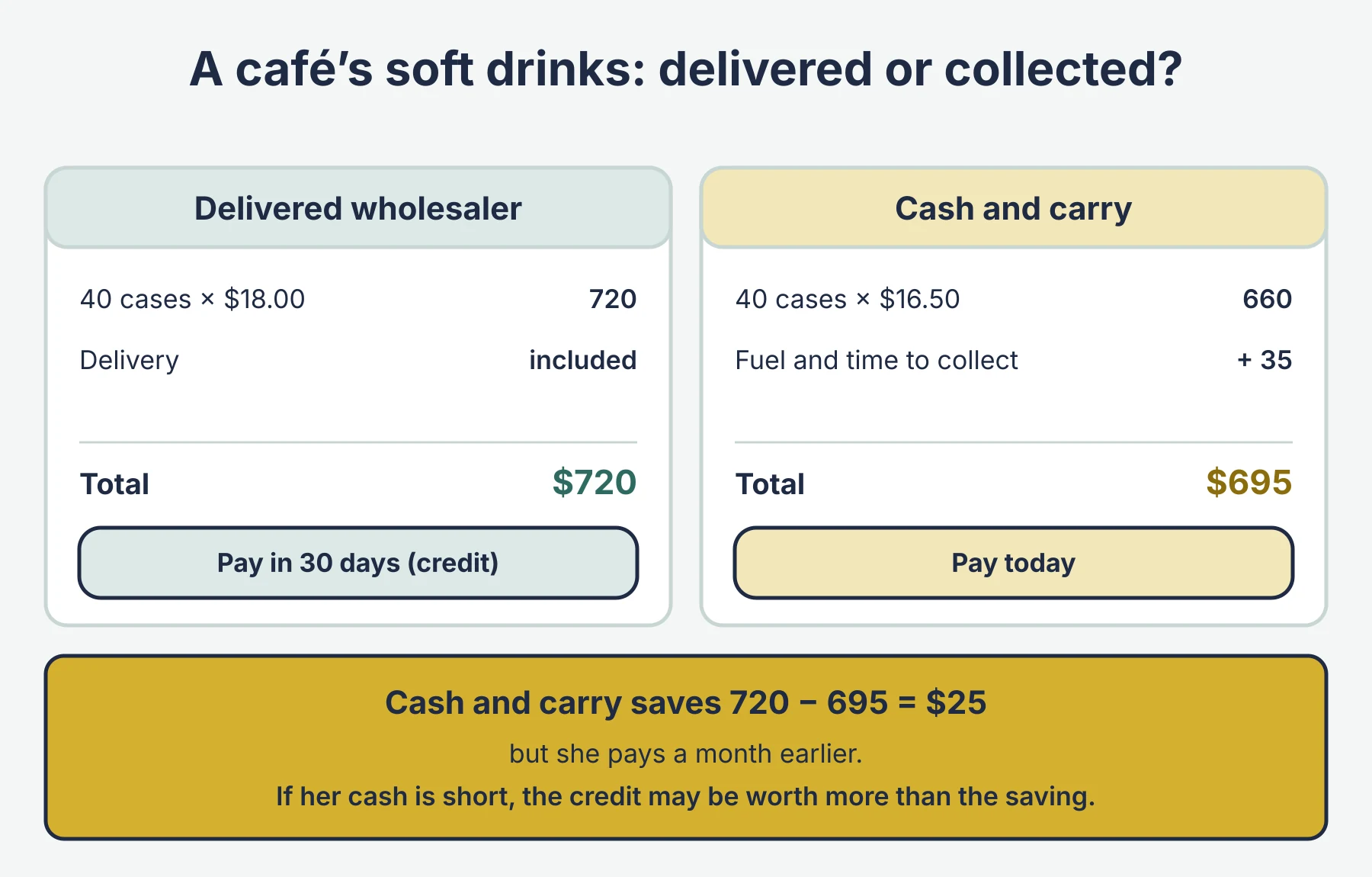
A café owner needs 40 cases of soft drinks. Her usual wholesaler delivers at $18.00 a case and gives 30 days’ credit. A cash and carry charges $16.50 a case, but she must collect, costing $35 in fuel and time.
- Delivered: 40 x 18.00 = $720, paid in 30 days.
- Cash and carry: 40 x 16.50 = $660, plus $35 = $695, paid today.
- Saving from cash and carry = 720 - 695 = $25.
The judgement: the cash and carry is $25 cheaper, but she pays a month earlier. If her cash is short, the delivered wholesaler’s credit may be worth more than the saving.
Annotated model answer
Question: Explain two reasons why a manufacturer of tinned food might sell through a wholesaler. [4]
The wholesaler breaks bulk [1]: the manufacturer can sell whole lorry loads to a few wholesalers instead of delivering a few cases to each of hundreds of grocery shops, which cuts its delivery and administration costs [1]. The wholesaler also stores the tins [1], so the manufacturer can keep producing all year and does not need a large warehouse of its own, freeing space and capital [1].
Why it scores: each function is named and then linked to a benefit for the manufacturer, not the retailer.
What are the common mistakes in 2.4?
- Explaining a benefit to the retailer when the question asks about the manufacturer, or the reverse.
- Describing cash and carry without its three features: self service, immediate payment, no delivery.
- Saying a voluntary chain is owned by one company; the retailers remain independent owners.
- Confusing a voluntary chain with a multiple chain store.
- Claiming the wholesaler’s functions disappear when it is bypassed.
Exam technique
- State a function: one or two words, such as “breaking bulk”.
- Explain a function: name it, then say how it helps the party in the question.
- Assess whether a retailer should use cash and carry: weigh price and choice against collection time and lack of credit, then decide for that retailer.
Where can I practise?
Revise with the wholesaling revision notes, then try the wholesaling practice questions. The wholesaler’s customers are covered in the retailing study guide.
Official syllabus
Cambridge IGCSE Commerce (0715) syllabus for 2028, section 2.4 Wholesaling: official syllabus PDF.
Related resources
-
Practice questions
Cambridge IGCSE Commerce (0715): Wholesaling – Practice Questions
Original Cambridge IGCSE Commerce 0715 questions with answers on wholesaler functions and importance, cash and carry and voluntary chains.
Commerce · Cambridge · IGCSE
Try questions -
Revision notes
Cambridge IGCSE Commerce (0715): Wholesaling – Revision Notes
Recall notes for Cambridge IGCSE Commerce 0715 section 2.4: wholesaler functions, benefits to manufacturer and retailer, cash and carry and voluntary chains.
Commerce · Cambridge · IGCSE
Revise topic -
Revision notes
Cambridge IGCSE Commerce: Commercial Operations — Revision Notes
Recall notes for Cambridge IGCSE Commerce 0715 Topic 2, exams from 2028: ownership types, outsourcing, retail, wholesale, trading documents and communication.
Commerce · Cambridge · IGCSE
Revise topic
Get free revision emails (optional)
Occasional emails with practice questions, worked explanations and links to free resources for the qualification and subjects you choose. No spam, and you can unsubscribe from any email. The free tools on this site never need an email.