
Revision Notes
Cambridge IGCSE Literature in English (0475): Section B: Prose — Revision Notes
Recall notes for 0475 Paper 1 Section B Prose: the task, narrative and character terms, passage and whole-text approaches, exam traps and a self-test.
- Subject
- English Literature
- Level
- IGCSE
- Topic
- Paper 1 – Poetry and Prose
- Author
- Marlbridge Academic Team
- Updated
- Reviewed by
- Ammar Bilal (what this means)
Aligned to Cambridge IGCSE English Literature (0475), 2026. Official specification .
Syllabus page (what it covers and how it is assessed): Cambridge IGCSE English Literature.
Syllabus points this page covers
0475
- 1.2 Section B: Prose
Found an error? Report a correction.
Need help with this topic? Request a free trial class for IGCSE English Literature (0475).
These notes condense Section B (Prose) of Paper 1 in Cambridge IGCSE Literature in English 0475. They cover what the task requires, the vocabulary for analysing fiction, two approaches you must be ready to use (a printed passage, and the text more widely), and the traps that cost marks. They apply to any prose set text; the list changes by year, so check it for your own series.
The task in brief
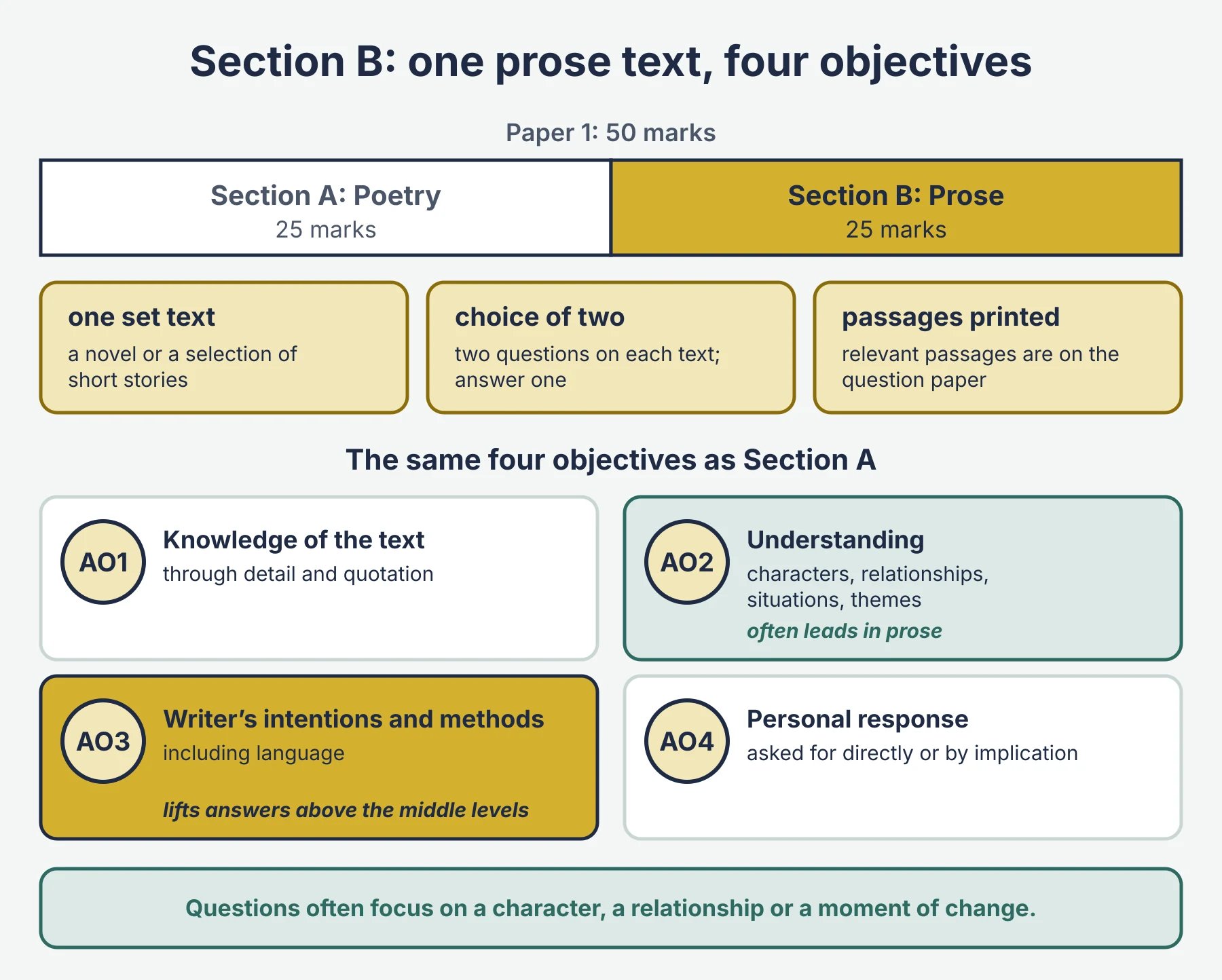
- Paper 1 is compulsory; Section B is the prose half.
- You answer one question on one prose set text (a novel or a set of short stories), from a choice of two questions on each text.
- Relevant passages are printed on the question paper; set texts may not be taken into the exam room.
- The question is worth 25 marks and tests AO1–AO4, with personal response asked for directly or by implication.
Key terms
| Term | Meaning | Why it matters in an answer |
|---|---|---|
| First-person narrator | A character tells the story as “I” | Intimacy; limited and possibly biased view |
| Third-person narrator | The story is told about “he”, “she”, “they” | Can range across characters or stay close to one |
| Omniscient narrator | Knows all characters’ thoughts and the whole story | Can comment, judge, foreshadow |
| Limited (close) third person | Follows one character’s perceptions | Shares their blind spots |
| Unreliable narrator | A narrator whose account we doubt | Creates irony; reader sees more than narrator |
| Free indirect speech | A character’s thoughts blended into narration | Lets us hear a character without quotation marks |
| Characterisation | How a writer presents a character | Through speech, action, description, others’ reactions |
| Foil | A character who contrasts with another | Highlights the other’s qualities |
| Foreshadowing | Hints of what is to come | Builds tension and unity |
| Pathetic fallacy | Setting or weather reflecting emotion | Links outer world and inner feeling |
| Motif / symbol | A repeated image or object with wider meaning | Connects moments and themes |
| Dramatic irony | Reader knows more than a character | Tension, sympathy or humour |
| Pace | Speed of narration | Slowing down marks importance |
| Climax / resolution | Point of highest tension / how it settles | Structure and meaning of the ending |
Approach 1: the printed passage
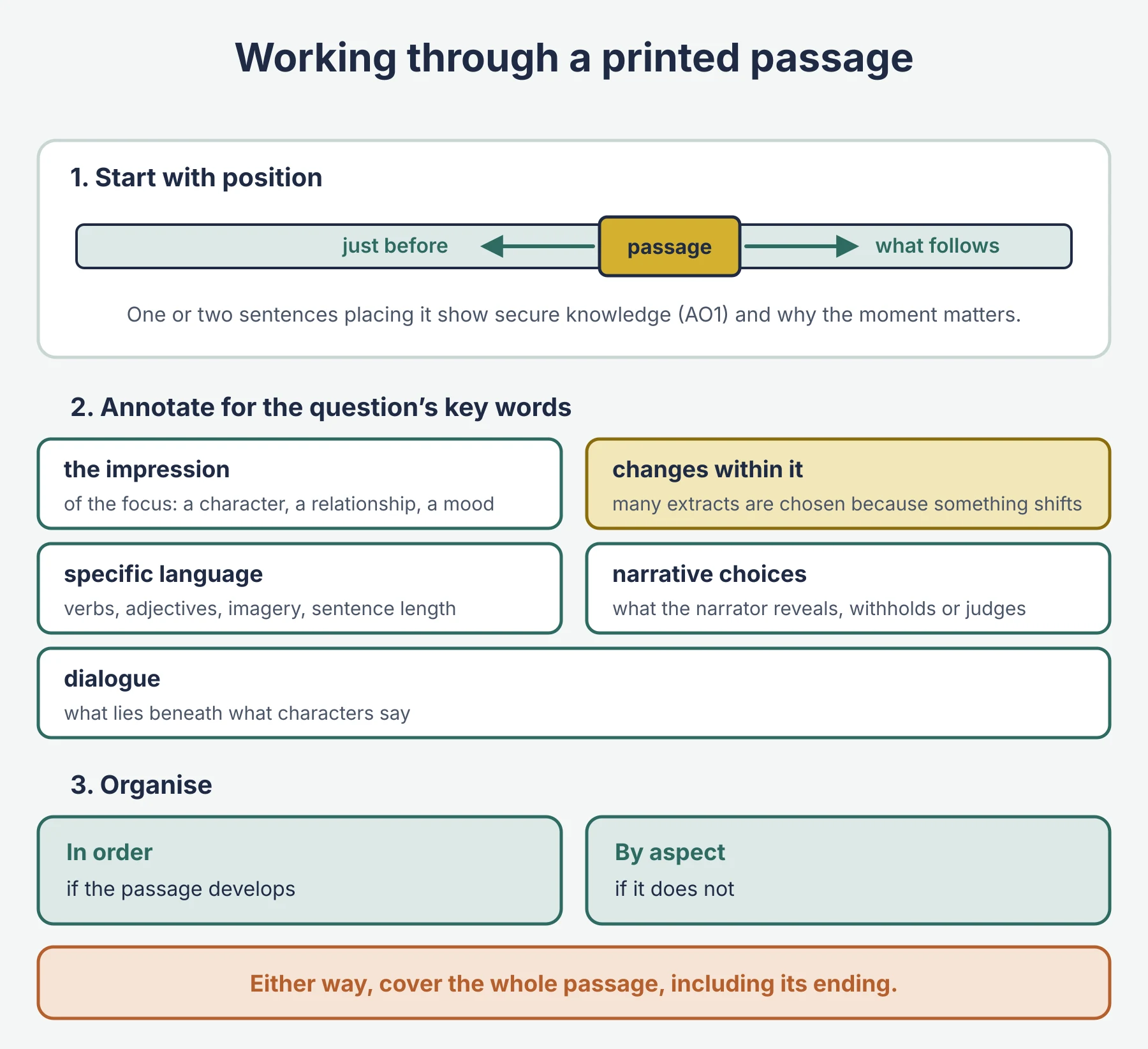
- Place it: one or two sentences on what has just happened and why the moment matters.
- Read for the question’s key words.
- Track change: what is different by the end of the passage?
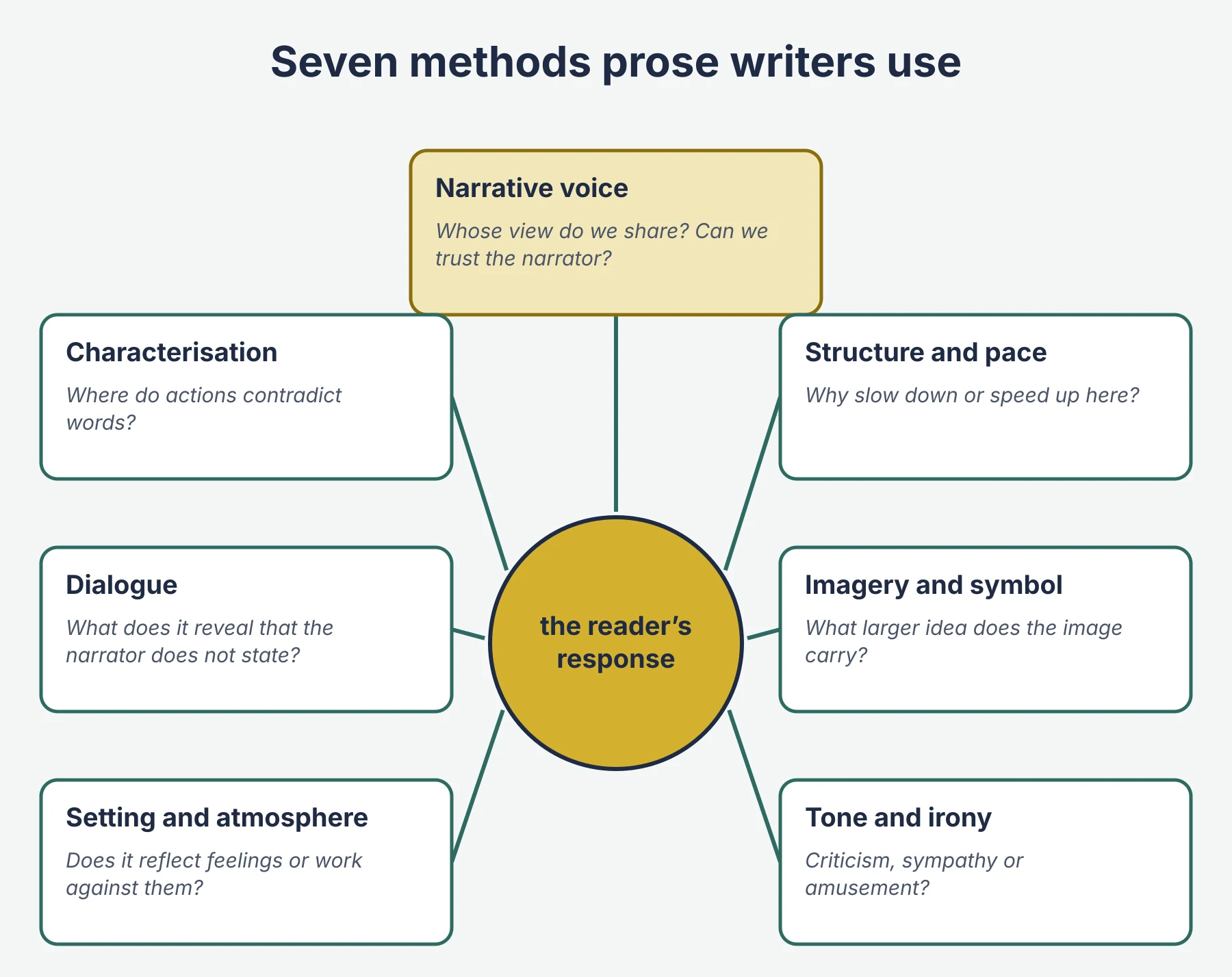
- Annotate methods: narrative voice, dialogue, imagery, setting, sentence length.
- Select: four or five moments across the whole passage, including the end.
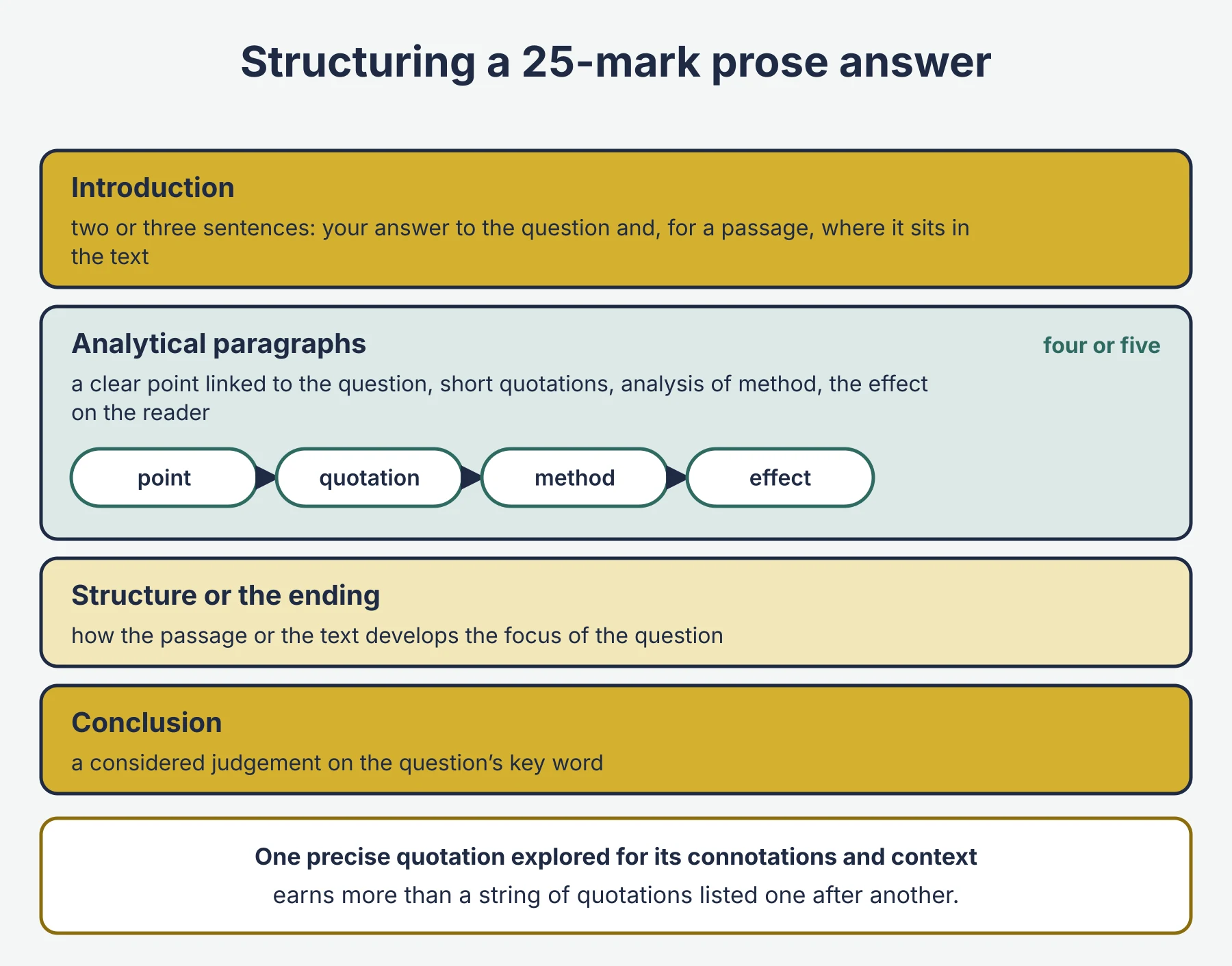
- Write: point, short quotation, analysis of method, effect on the reader, link to the question.
Approach 2: the text more widely
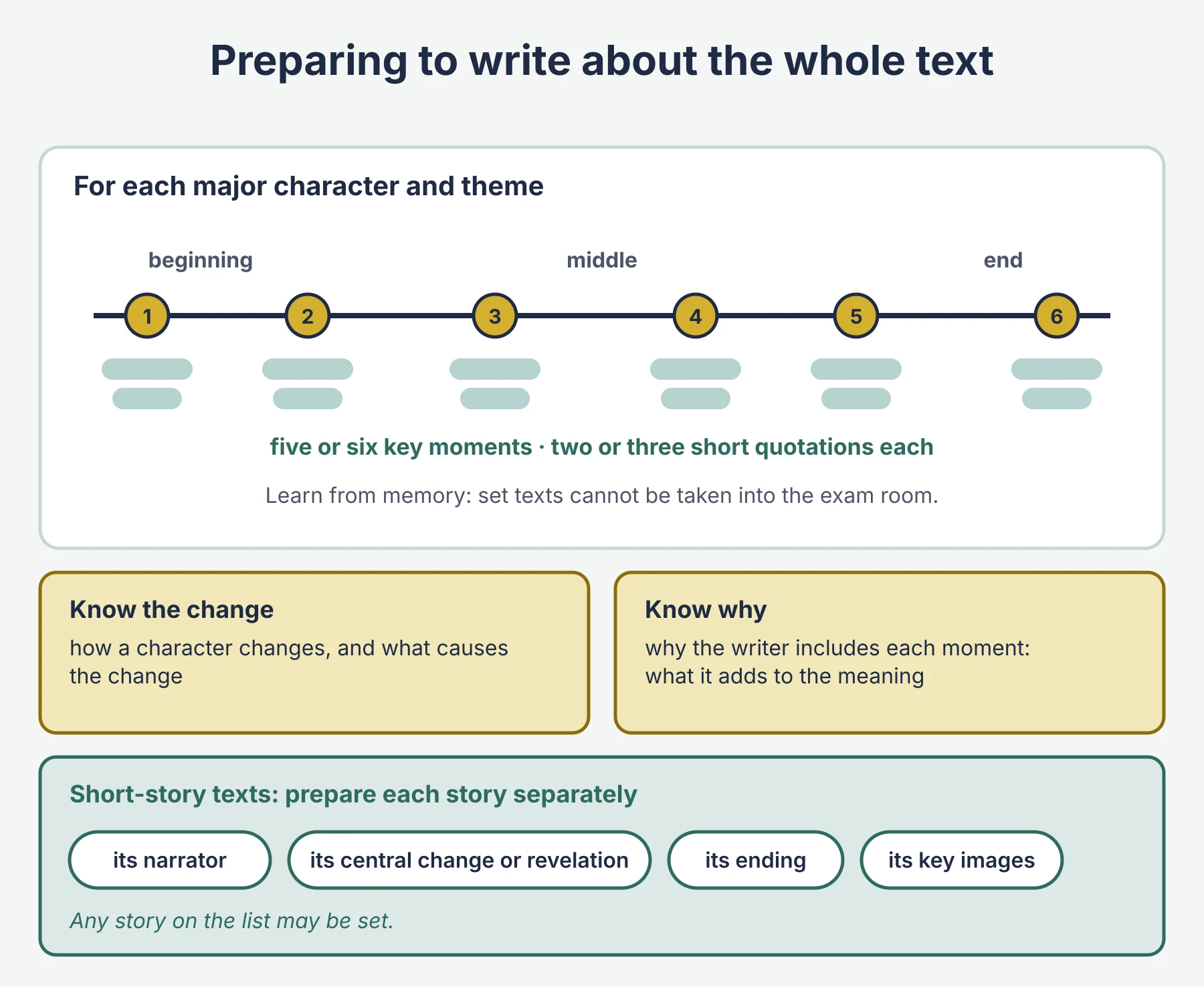
- Choose five or six key moments per major character or theme, spread across the text.
- Learn short quotations (a few words each) for each moment.
- Know how and why characters and relationships change.
- Organise the answer as an argument, not a plot summary in order.
- For short stories, revise each story separately: narrator, central change, ending, key images.
Building a paragraph
- Point: a claim that answers the question.
- Evidence: a brief, exact quotation or precise reference.
- Method: the writer’s choice (word, image, voice, structure).
- Effect: what it makes the reader think or feel.
- Link: back to the question, often with a personal judgement.
Context in one rule
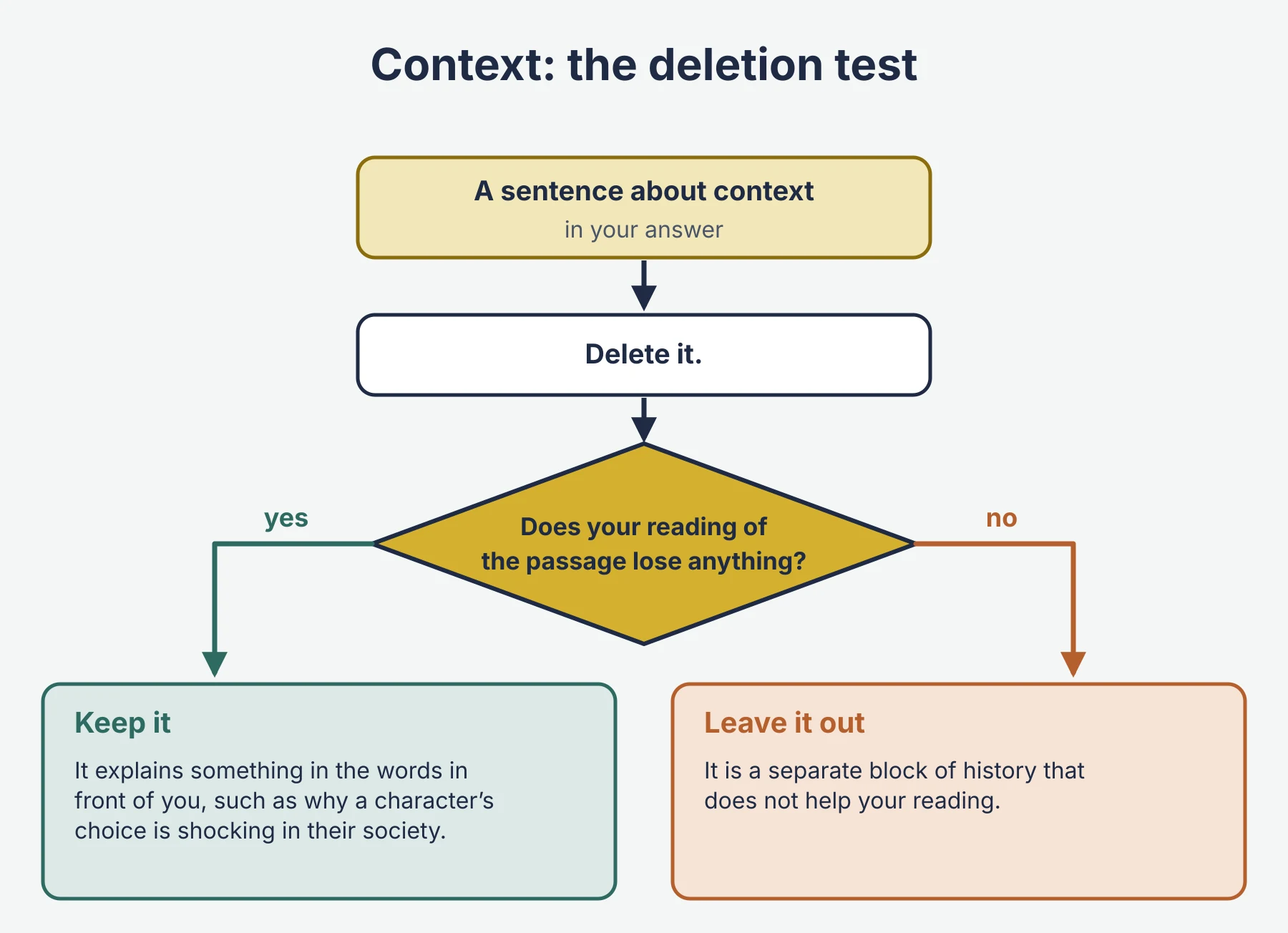
Use context only when it explains something in the passage or text you are discussing. A detached paragraph of background earns little.
What higher-level answers do
- Stay focused on the question’s key word in every paragraph.
- Analyse the narrator’s role, not only the characters’.
- Notice irony, contrast and change.
- Explore more than one meaning of a key image.
- Show a considered personal response grounded in evidence.
Exam traps
- Plot summary. Retelling is knowledge, not analysis.
- Characters as real people. Ask why the writer presents them this way.
- Missing the extract’s ending. The key change is often in the last lines.
- No quotations for the wider question. Learn short phrases from across the text.
- Generic context. Make it serve your reading.
- Running out of time. Section B and Section A each carry 25 marks.
Self-test
- How many prose questions do you answer in Section B?
- May you take your prose set text into the exam?
- Name three ways a writer can characterise someone.
- What is the difference between an omniscient and a limited third-person narrator?
- What is free indirect speech?
- What is dramatic irony, and what effect can it have?
- Why should you place a printed passage in the wider text?
- What is a foil?
- How should you prepare for a question about a character across the whole text?
- What should you look for at the end of a printed passage?
- When is a point about context worth including?
- In “The rain had not stopped for three days, and neither had her silence”, what method links the weather and the character?
Answers: 1. One. 2. No; relevant passages are printed on the paper. 3. Any three: what they say; what they do; description by the narrator; how other characters react to them; their thoughts. 4. An omniscient narrator knows all characters’ thoughts and the whole story; a limited narrator follows one character’s perceptions. 5. A character’s thoughts blended into the narration without quotation marks. 6. When the reader knows more than a character; it can create tension, sympathy or humour. 7. It shows knowledge of the text and explains why the moment matters. 8. A character who contrasts with another, highlighting their qualities. 9. Choose key moments from across the text, learn short quotations, and know how and why the character changes. 10. A change, a revelation or a final image that shifts the meaning. 11. When it explains something in the words you are analysing. 12. Pathetic fallacy, with a parallel sentence structure linking the two.
Related pages
- Section B: Prose study guide
- Section B: Prose practice questions
- Paper 1 Poetry and Prose revision notes
Source: Cambridge International, Cambridge IGCSE Literature in English 0475 syllabus for 2026, Paper 1 Poetry and Prose.
Related resources
-
Study guides
Cambridge IGCSE Literature in English (0475): Short Stories as a Prose Set Text
How to study a selection of short stories for 0475 Paper 1 Section B: story form, openings, turning points and endings, with an original worked passage.
English Literature · Cambridge · IGCSE
Read guide -
Practice questions
Cambridge IGCSE Literature in English (0475): Short Stories as a Prose Set Text — Practice Questions
Twelve original questions on short original story passages, practising openings, turning points, implication and endings for 0475 Section B, with full answers.
English Literature · Cambridge · IGCSE
Try questions -
Revision notes
Cambridge IGCSE Literature in English (0475): Short Stories as a Prose Set Text — Revision Notes
Condensed notes for answering on a short-story set text in 0475 Paper 1 Section B: story cards, key terms for short fiction, exam traps and a self-test.
English Literature · Cambridge · IGCSE
Revise topic
Get free revision emails (optional)
Occasional emails with practice questions, worked explanations and links to free resources for the qualification and subjects you choose. No spam, and you can unsubscribe from any email. The free tools on this site never need an email.