
Study Guides
Cambridge IGCSE Literature in English (0475): Section B: Prose
How to write about a prose set text for 0475 Paper 1 Section B: voice, character, setting, structure and dialogue, with a model on an original passage.
- Subject
- English Literature
- Level
- IGCSE
- Topic
- Paper 1 – Poetry and Prose
- Author
- Marlbridge Academic Team
- Updated
- Reviewed by
- Ammar Bilal (what this means)
Aligned to Cambridge IGCSE English Literature (0475), 2026. Official specification .
Syllabus page (what it covers and how it is assessed): Cambridge IGCSE English Literature.
Syllabus points this page covers
0475
- 1.2 Section B: Prose
Found an error? Report a correction.
Need help with this topic? Request a free trial class for IGCSE English Literature (0475).
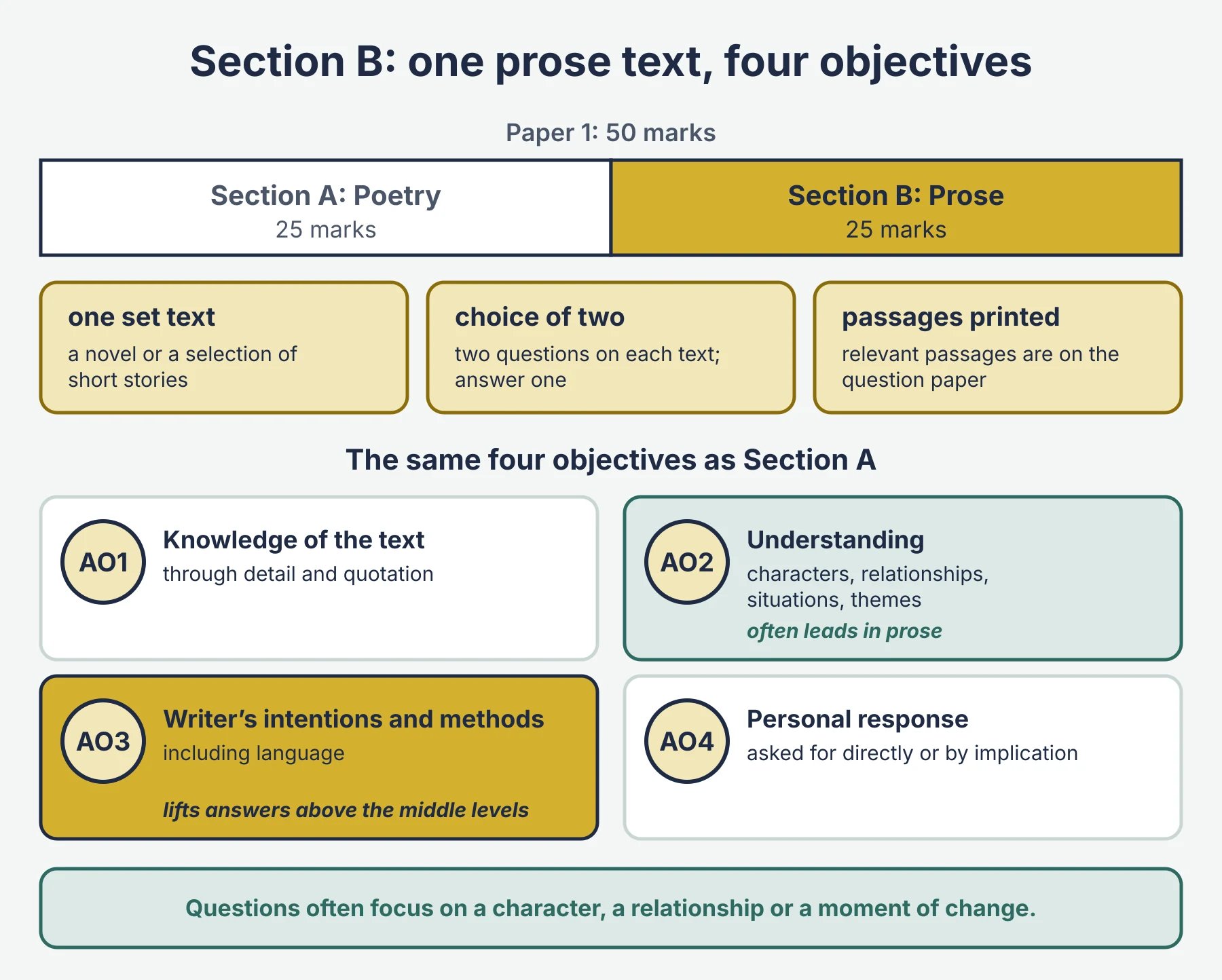
Section B of Paper 1 is the prose half of the compulsory paper in Cambridge IGCSE Literature in English 0475. You answer one question on one prose set text, which may be a novel or a selection of short stories. There is a choice of two questions on each text, relevant passages are printed on the question paper, and the answer is worth 25 marks. This guide explains the methods prose writers use, how to analyse a printed passage, how to write about a text more widely when you cannot take the book into the exam, and how to build an answer that meets all four assessment objectives. Set texts change by examination year, so check the list in the syllabus for your series.
What Section B tests
Every question tests the same four objectives as Section A: knowledge of the text through detail and quotation (AO1); understanding of characters, relationships, situations and themes (AO2); the writer’s intentions and methods, including language (AO3); and personal response, asked for directly or by implication (AO4). In prose, AO2 often leads: questions frequently focus on a character, a relationship or a moment of change. But the marks above the middle levels still depend on AO3, on showing how the writer shapes the reader’s response.
What methods do prose writers use?
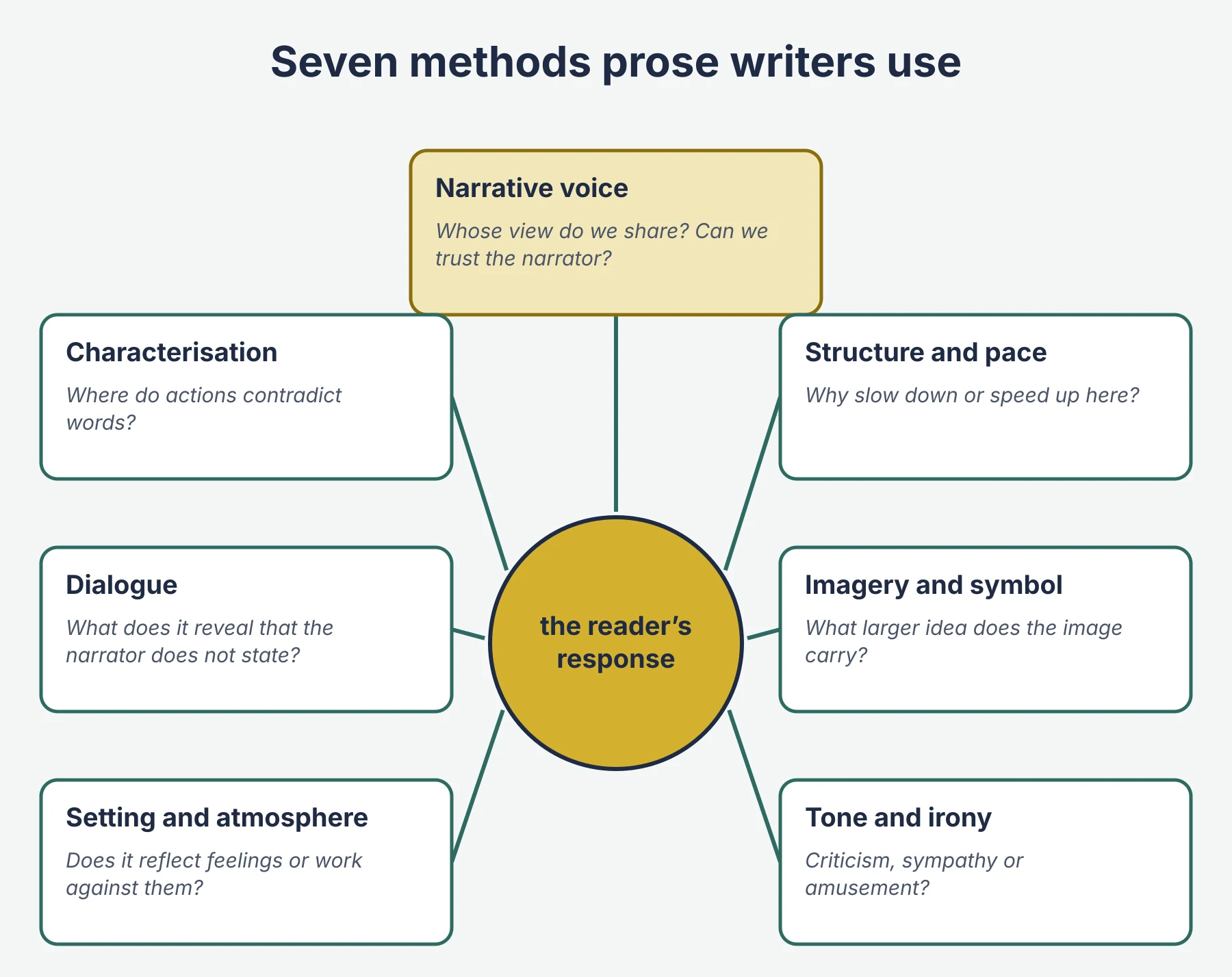
| Method | What to look for | Questions to ask |
|---|---|---|
| Narrative voice | First person or third; a narrator who knows everything or who is limited to one character | Whose view do we share? What are we not told? Can we trust the narrator? |
| Characterisation | What characters say and do, how others react, what the narrator tells us directly | Is our view of the character built up or changed? Where do actions contradict words? |
| Dialogue | Who speaks most, interruptions, silences, the way a character’s speech sounds | What does the conversation reveal that the narrator does not state? |
| Setting and atmosphere | Place, weather, time of day, objects | Does the setting reflect a character’s feelings or work against them? |
| Structure and pace | Where a passage sits in the text; long or short sentences; time jumps | Why does the writer slow down or speed up here? What changes? |
| Imagery and symbol | Repeated images, objects that gather meaning | What larger idea does the image carry? |
| Tone and irony | The gap between what is said and what is meant | Is the writer inviting criticism, sympathy or amusement? |
How should you analyse a printed passage?
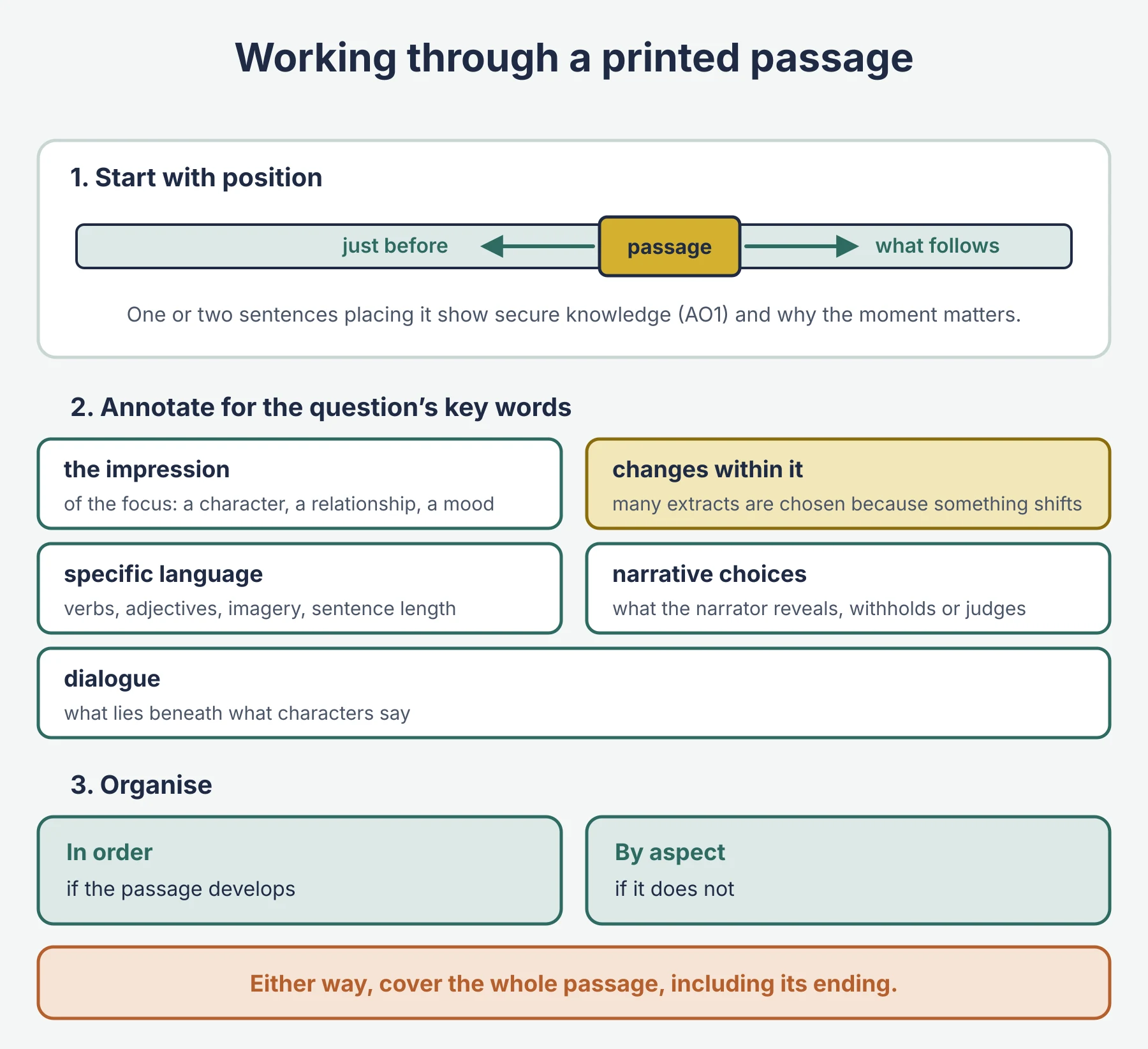
Start with position: what has happened just before this passage and what follows? One or two sentences placing it in the text show secure knowledge (AO1) and help you explain why the moment matters. Then read with the question’s key words in mind and annotate for:
- the impression the passage gives of the focus of the question (a character, a relationship, a mood);
- changes within the passage: many extracts are chosen because something shifts;
- specific language: verbs, adjectives, imagery, sentence length;
- narrative choices: what the narrator reveals, withholds or judges;
- dialogue: what lies beneath what characters say.
Write about the passage in order if it develops, or by aspect if it does not. Either way, cover the whole passage, including its ending, rather than only the first half.
How do you write about the text more widely?
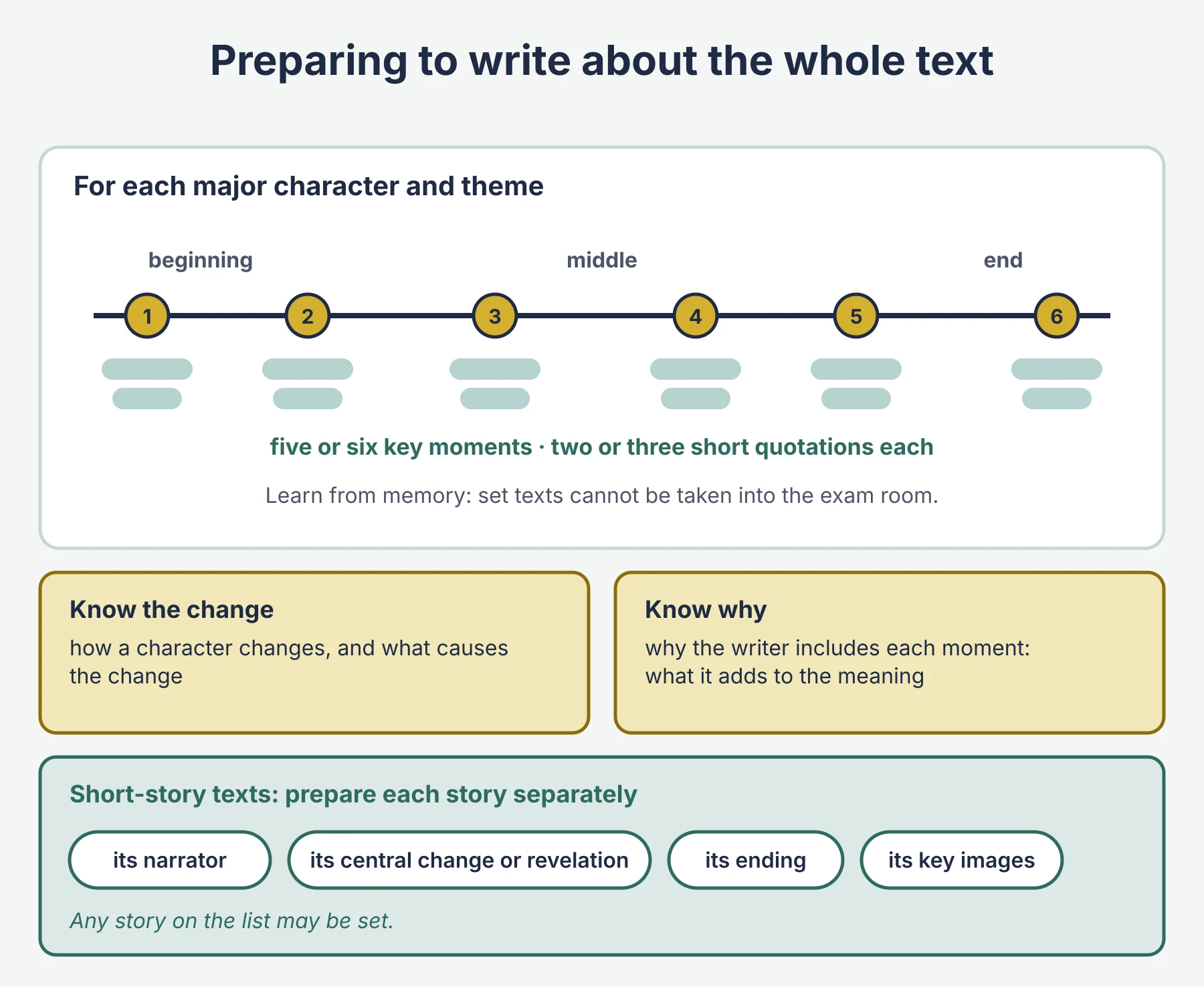
If a question asks about a character, relationship or theme across the text, you must recall details and quotations from memory, because set texts cannot be taken into the exam room. Prepare by:
- choosing five or six key moments for each major character and theme, from the beginning, middle and end of the text;
- learning two or three short quotations for each moment, often single phrases;
- knowing how a character changes, and what causes the change;
- being able to explain why the writer includes each moment: what it adds to the meaning.
In short-story texts, prepare each story separately: know its narrator, its central change or revelation, its ending and its most important images, because any story on the list may be set.
Worked example: an original passage
The passage below was written for this guide. It is not from a set text.
From “The Last Bus” (original passage)
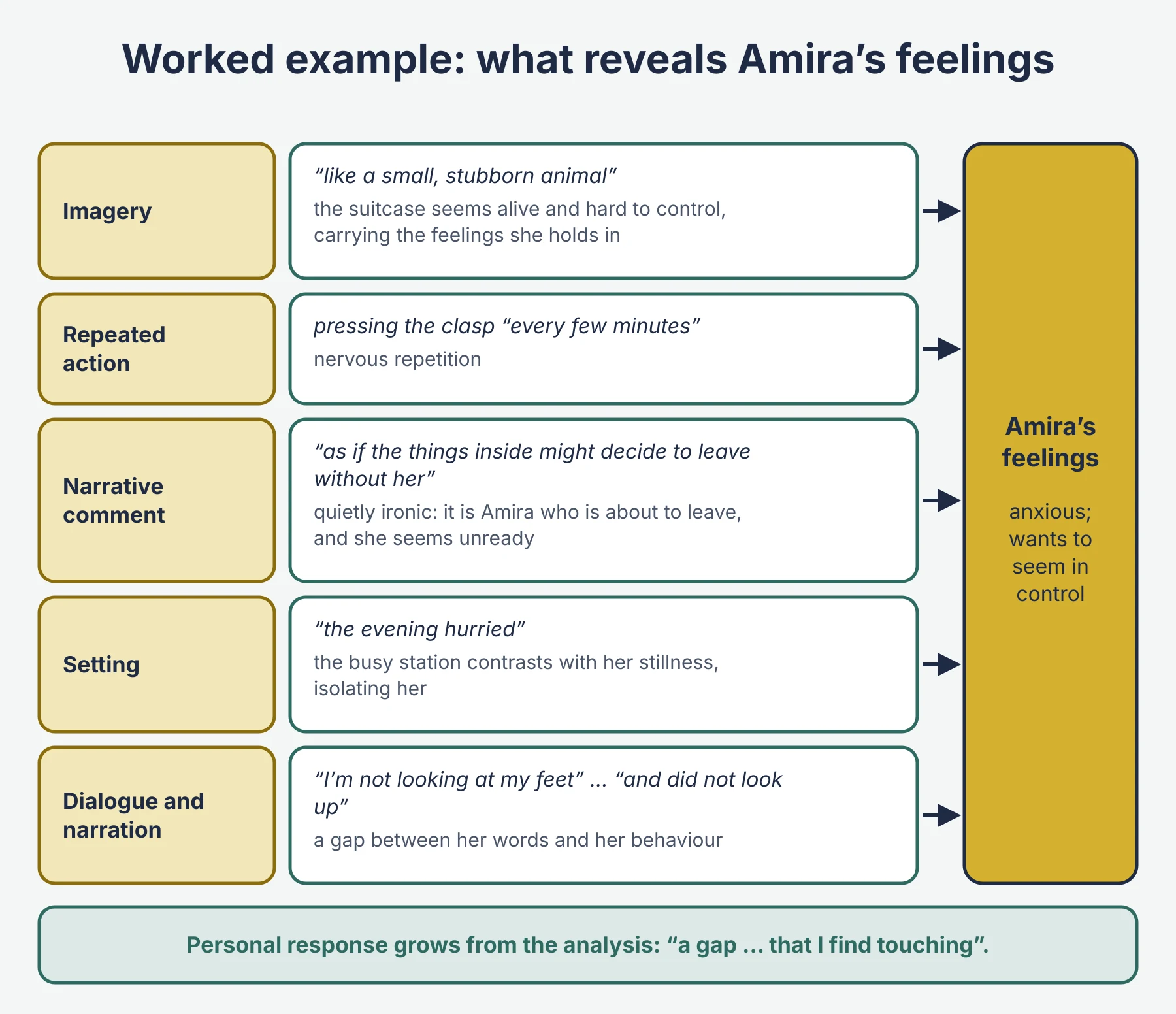
Amira had been sitting at the bus station for an hour, her grandmother’s brown suitcase upright between her knees like a small, stubborn animal. Around her the evening hurried: hawkers packing away oranges, a man shouting a destination nobody wanted. The suitcase had one broken clasp, and every few minutes she pressed it shut with her thumb, as if the things inside might decide to leave without her.
“You’ll miss it if you keep looking at your feet,” said the ticket man.
“I’m not looking at my feet,” Amira said, and did not look up.
Question: How does the writer make this moment so revealing about Amira’s feelings?
Model paragraph:
The writer reveals Amira’s anxiety less through what she says than through what she does with the suitcase. Describing it as “upright between her knees like a small, stubborn animal” makes it seem alive and difficult to control, as though it carries the feelings she is holding in. Her habit of pressing the broken clasp “every few minutes” suggests nervous repetition, and the narrator’s comment “as if the things inside might decide to leave without her” is quietly ironic, because it is Amira who is about to leave and who seems unready. The busy station, where “the evening hurried”, contrasts with her stillness, isolating her. Her final denial, “I’m not looking at my feet”, followed by the flat narrative “and did not look up”, shows a gap between her words and her behaviour that I find touching: she wants to seem in control but cannot quite face what is ahead.
Why it works: it answers “revealing” throughout; it uses imagery, narrative comment, setting and dialogue; it notices irony and contrast; and the personal response arises from the analysis.
Structuring a 25-mark prose answer
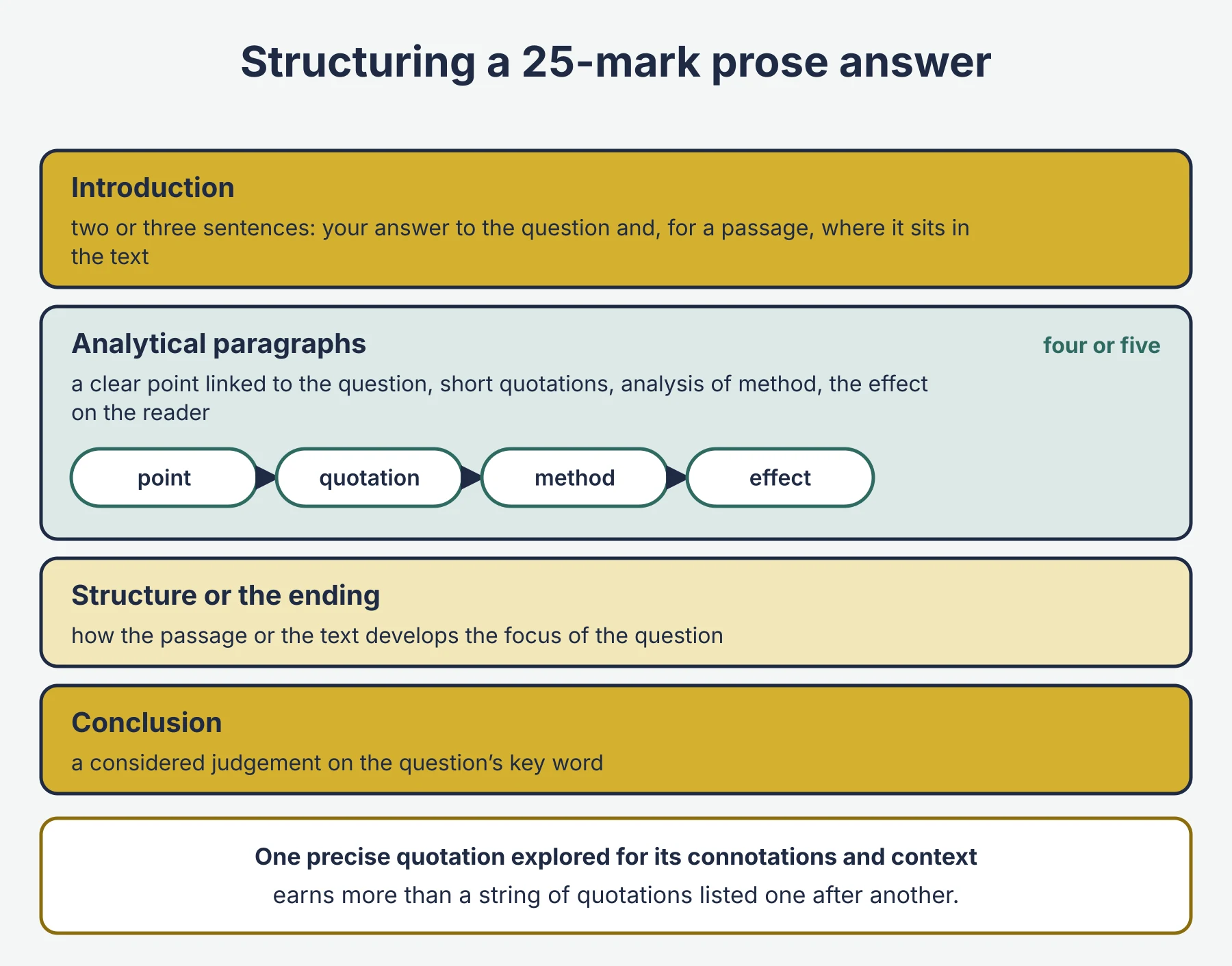
- Introduction (two or three sentences): your answer to the question and, for a passage, where it sits in the text.
- Four or five analytical paragraphs: each with a clear point linked to the question, short quotations, analysis of method, and the effect on the reader.
- A paragraph on structure or the ending: how the passage or the text develops the focus of the question.
- Conclusion: a considered judgement on the question’s key word.
Keep paragraphs focused. One precise quotation explored for its connotations and context earns more than a string of quotations listed one after another.
Context: how much is enough?
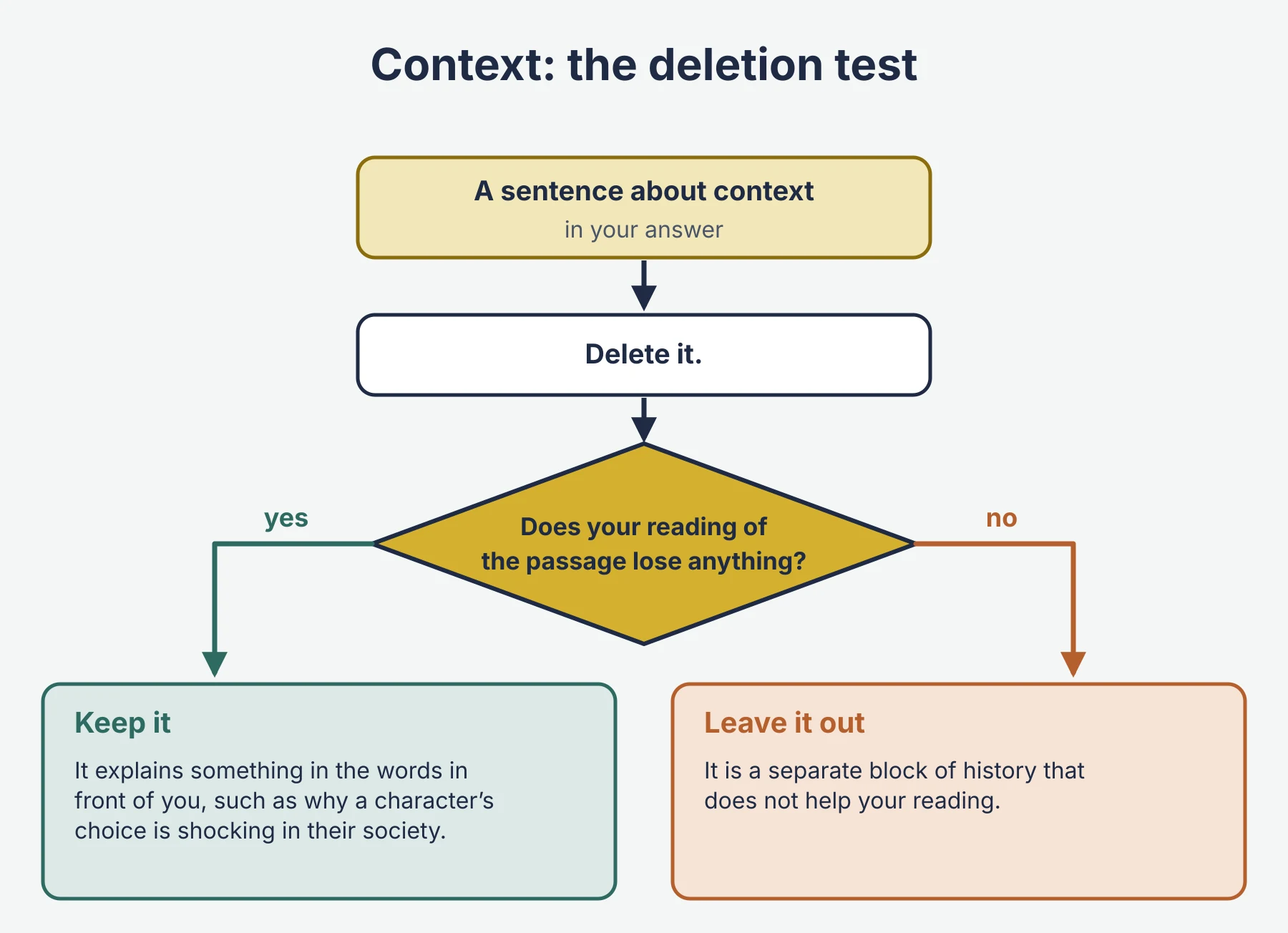
AO2 refers to understanding the meanings of texts and their contexts. Context helps when it explains something in the words in front of you: why a character’s choice is shocking in their society, or why a setting carries particular weight. It does not help as a separate block of history. A useful test: if you delete the sentence about context, does your reading of the passage lose anything? If not, leave it out.
Common mistakes
- Retelling the plot. Summary shows knowledge but not understanding of method.
- Treating characters as real people. Characters are constructed; ask why the writer presents them this way.
- Ignoring the narrator. The narrative voice shapes everything we see.
- Only half the passage. Endings of extracts often carry the key change.
- Unprepared wider questions. Learn short quotations from across the text.
- Equal coverage of everything. Select what best answers the question.
How to revise a prose set text
- Make a timeline of the text, marking turning points.
- For each major character, list key moments, quotations and how they change.
- For each theme, list where it appears and how it develops.
- Practise passage answers on extracts you choose yourself, timing each answer.
- For short stories, write a one-paragraph summary of each story’s narrator, change and ending.
Frequently asked questions
Do I need to know what happens before and after a printed passage? Yes. Placing the passage briefly in context shows knowledge and helps explain why the moment matters.
Can I write about a short story collection as a whole? Answer on the story or stories the question names; each story should be revised separately.
Should I use technical terms? Use terms such as “first-person narrator” or “irony” when they help explain an effect.
Related pages
- Section B: Prose revision notes
- Section B: Prose practice questions
- Section A: Poetry study guide
- Paper 1 Poetry and Prose study guide
Source: Cambridge International, Cambridge IGCSE Literature in English 0475 syllabus for 2026, Paper 1 Poetry and Prose.
Related resources
-
Practice questions
Cambridge IGCSE Literature in English (0475): Section B: Prose — Practice Questions
Twelve original prose-analysis questions on short original passages, building the skills for 0475 Paper 1 Section B, with full answers and marking points.
English Literature · Cambridge · IGCSE
Try questions -
Revision notes
Cambridge IGCSE Literature in English (0475): Section B: Prose — Revision Notes
Recall notes for 0475 Paper 1 Section B Prose: the task, narrative and character terms, passage and whole-text approaches, exam traps and a self-test.
English Literature · Cambridge · IGCSE
Revise topic -
Study guides
Cambridge IGCSE Literature in English (0475): Short Stories as a Prose Set Text
How to study a selection of short stories for 0475 Paper 1 Section B: story form, openings, turning points and endings, with an original worked passage.
English Literature · Cambridge · IGCSE
Read guide
Get free revision emails (optional)
Occasional emails with practice questions, worked explanations and links to free resources for the qualification and subjects you choose. No spam, and you can unsubscribe from any email. The free tools on this site never need an email.