
Study Guides
Cambridge IGCSE Literature in English (0475): Section A: Poetry
How to read and write about a set poem for 0475 Paper 1 Section A: voice, imagery, sound, form and structure, with a model paragraph on an original poem.
- Subject
- English Literature
- Level
- IGCSE
- Topic
- Paper 1 – Poetry and Prose
- Author
- Marlbridge Academic Team
- Updated
- Reviewed by
- Ammar Bilal (what this means)
Aligned to Cambridge IGCSE English Literature (0475), 2026. Official specification .
Syllabus page (what it covers and how it is assessed): Cambridge IGCSE English Literature.
Syllabus points this page covers
0475
- 1.1 Section A: Poetry
Found an error? Report a correction.
Need help with this topic? Request a free trial class for IGCSE English Literature (0475).
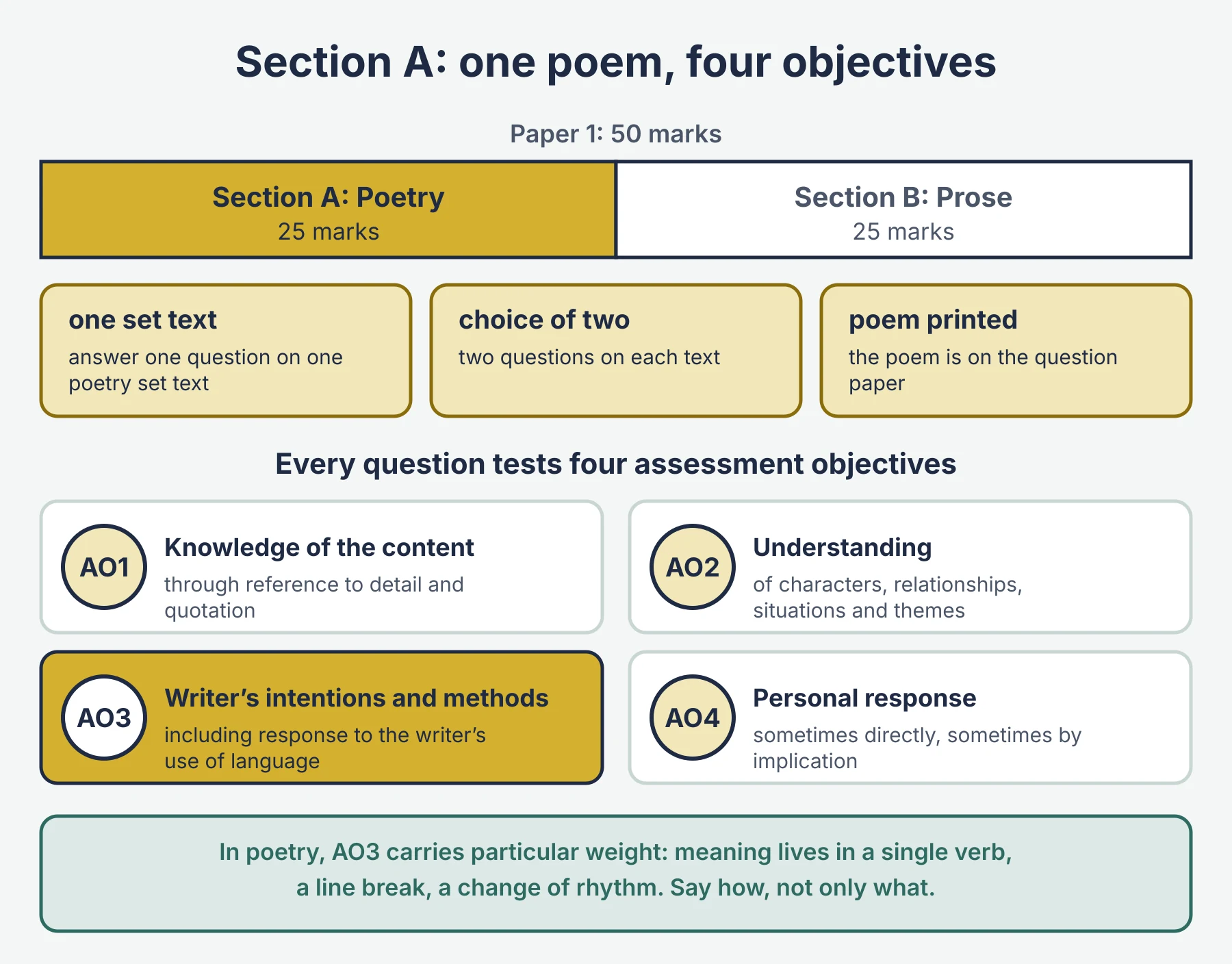
Section A of Paper 1 is the poetry half of the compulsory paper in Cambridge IGCSE Literature in English 0475. You answer one question on one poetry set text. There is a choice of two questions on each text, the poem you are asked about is printed on the question paper, and the answer is worth 25 of the paper’s 50 marks. This guide is about method: how to read a set poem so that you can explain how it creates meaning, and how to turn that reading into an answer that meets all four assessment objectives. It does not discuss particular set poems, because the list changes by examination year; check the set-text list in the syllabus for your own series.
What Section A asks of you
The syllabus says every Paper 1 question tests:
- AO1: knowledge of the content of the text, through reference to detail and quotation;
- AO2: understanding of characters, relationships, situations and themes;
- AO3: understanding of the writer’s intentions and methods, including response to the writer’s use of language;
- AO4: personal response, “sometimes directly” (questions such as “What do you think?” or “What are your feelings about…?”) and “sometimes by implication” (questions such as “Explore the ways in which…”).
In poetry, AO3 carries particular weight, because a poem’s meaning lives in compressed choices: a single verb, a line break, a change of rhythm. An answer that explains what the poem says but not how it says it will stay in the lower levels, however accurate it is.
How should you read a printed poem in the exam?
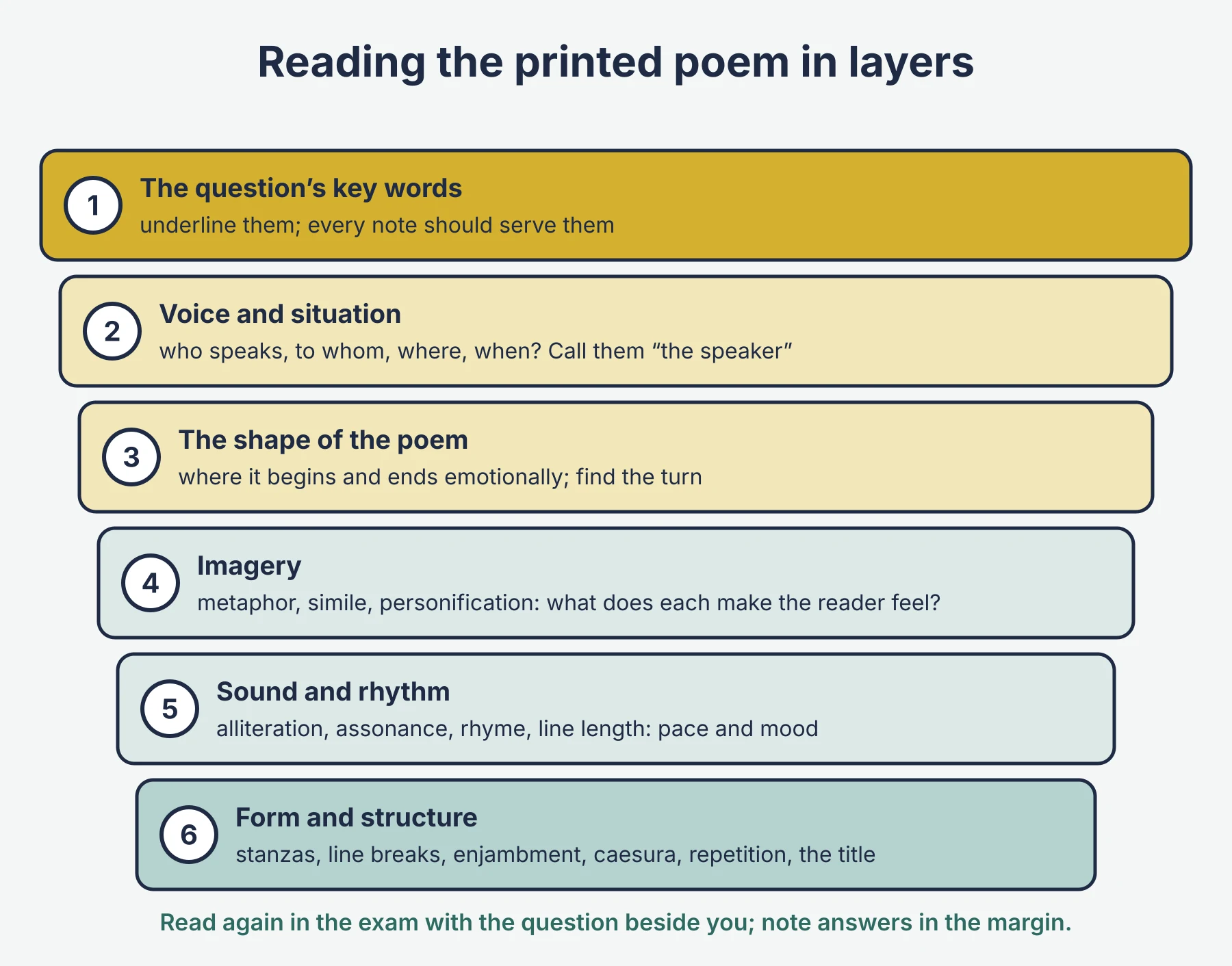
You will have studied the poem, but read it again in the exam with the question beside you. Work through these layers, noting answers in the margin.
- The question’s key words. Underline them: “vivid”, “sadness”, “the speaker’s feelings about the place”. Everything you annotate should serve them.
- Voice and situation. Who is speaking, to whom, where and when? The speaker is not automatically the poet: call them “the speaker” unless you know the poem is autobiographical.
- The shape of the poem. Where does it begin and end emotionally? Find the turn, the point where tone, time or attitude shifts. Many strong answers are built on the movement between the opening and the ending.
- Imagery. Look for metaphor, simile and personification, and ask what each comparison makes the reader feel, not only what it means.
- Sound and rhythm. Read lines in your head. Alliteration, assonance, rhyme and the length of lines all change pace and mood.
- Form and structure. Stanza pattern, line breaks, enjambment and caesura, repetition, and the title. Ask why the poem is arranged as it is.
What does it mean to analyse a method?
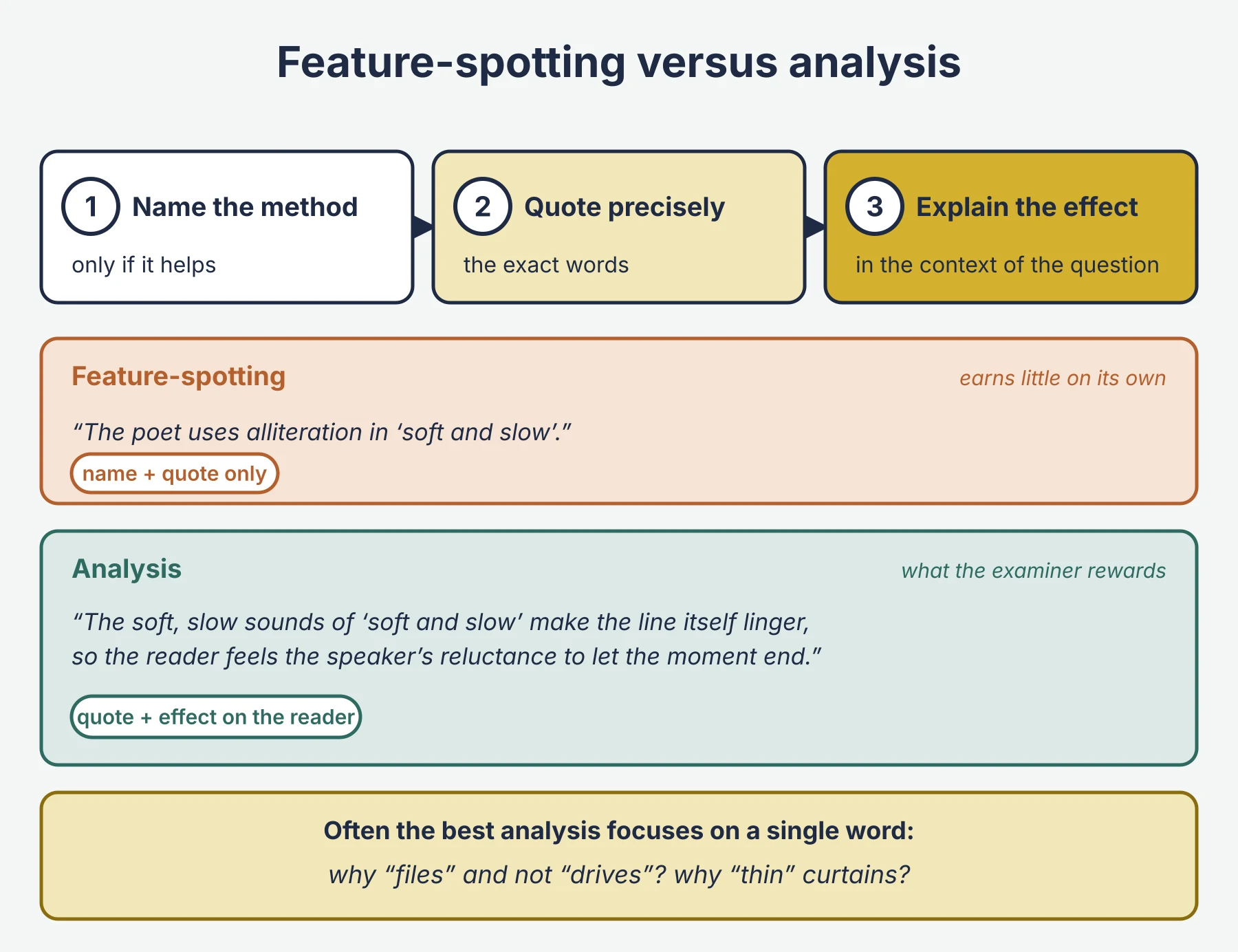
Analysis has three parts: name the method only if it helps, quote the words precisely, and explain the effect in the context of the question. Compare:
- Feature-spotting: “The poet uses alliteration in ‘soft and slow’.”
- Analysis: “The soft, slow sounds of ‘soft and slow’ make the line itself linger, so the reader feels the speaker’s reluctance to let the moment end.”
Naming a technique earns little on its own; the examiner rewards what you say about its effect. Often the best analysis focuses on a single word: why “files” and not “drives”, why “thin” curtains?
Worked example: an original poem
The poem below was written for this guide so that the method can be shown in full. It is not a set text.
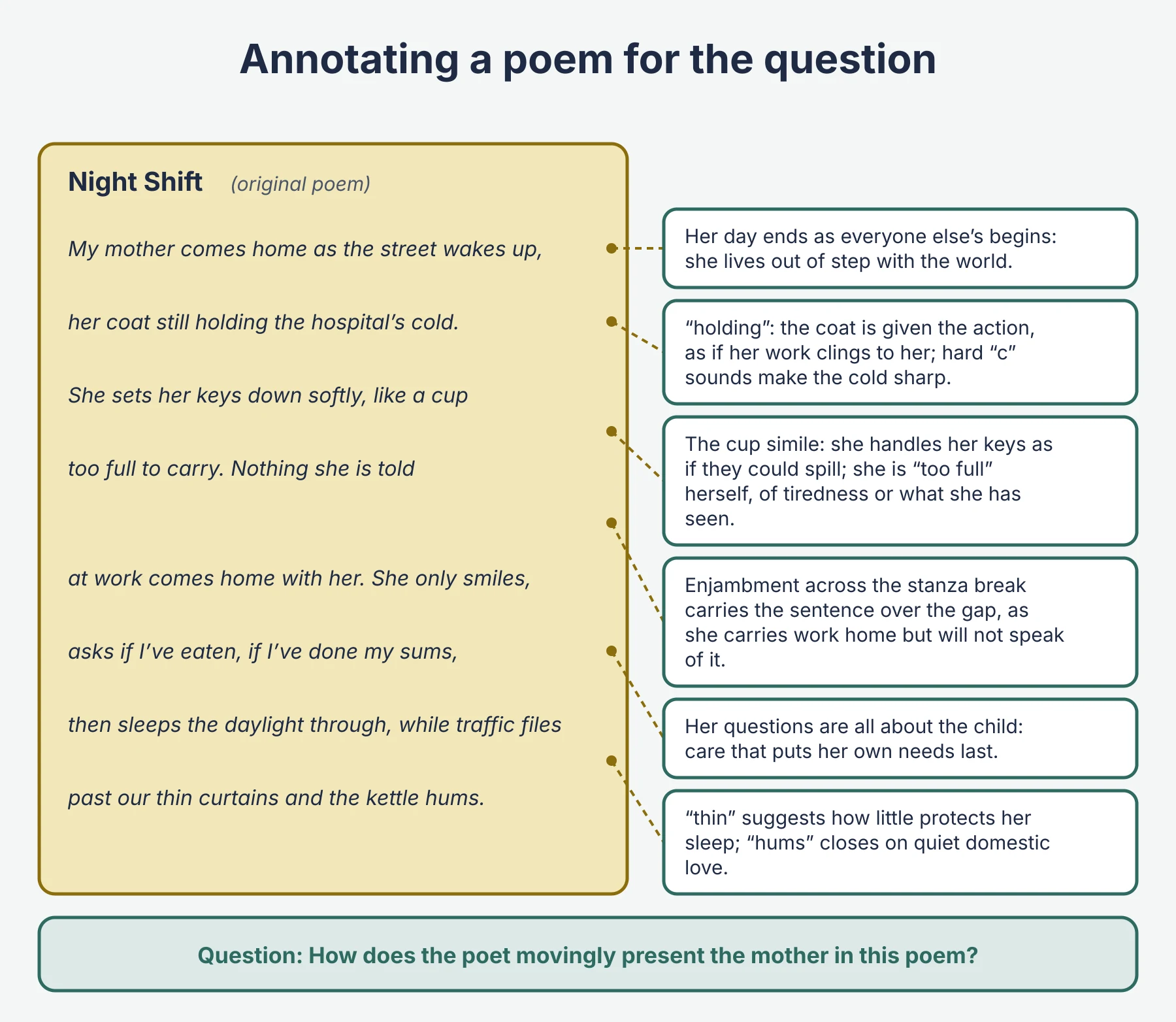
Night Shift (original poem)
My mother comes home as the street wakes up, her coat still holding the hospital’s cold. She sets her keys down softly, like a cup too full to carry. Nothing she is told
at work comes home with her. She only smiles, asks if I’ve eaten, if I’ve done my sums, then sleeps the daylight through, while traffic files past our thin curtains and the kettle hums.
Question: How does the poet movingly present the mother in this poem?
Annotations a strong candidate might make:
- Opening line: her day ends as everyone else’s begins, so she lives out of step with the world.
- “her coat still holding the hospital’s cold”: the coat, not the mother, is given the action of “holding”, as if her work clings to her; the hard “c” sounds make the cold feel sharp.
- The simile of the cup: she handles her keys as if they could spill, which suggests she is “too full” herself, of tiredness or of what she has seen.
- Enjambment across the stanza break (“Nothing she is told / at work”): the sentence is carried over the gap, mirroring the way she carries her work home while refusing to speak of it.
- Second stanza: her questions are all about the child; the short, ordinary questions show care that puts her own needs last.
- Ending: the noisy world goes on “past our thin curtains”; “thin” suggests how little protects her sleep, and the gentle “hums” closes the poem on quiet domestic love.
Model paragraph:
The poet presents the mother as someone who carries the weight of her work without passing it on to her child. The image of her coat “still holding the hospital’s cold” makes the coat seem to cling to her, as if the night shift cannot be left at the door, and the sharp “c” sounds let the reader feel that cold. Yet she sets her keys down “softly, like a cup / too full to carry”: the simile suggests that she herself is brimming with something, perhaps exhaustion or what she has witnessed, and the line break after “cup” makes the reader pause as if waiting for it to spill. That it never does is what I find most moving; her care shows in her silence and in her small questions about whether the speaker has “eaten” or done their “sums”.
Why it works: it answers the question’s key word (“movingly”) throughout; it quotes briefly and exactly; it analyses word choice, sound, imagery and structure; and the personal response (“what I find most moving”) grows out of the analysis rather than being added at the end.
Planning a 25-mark answer
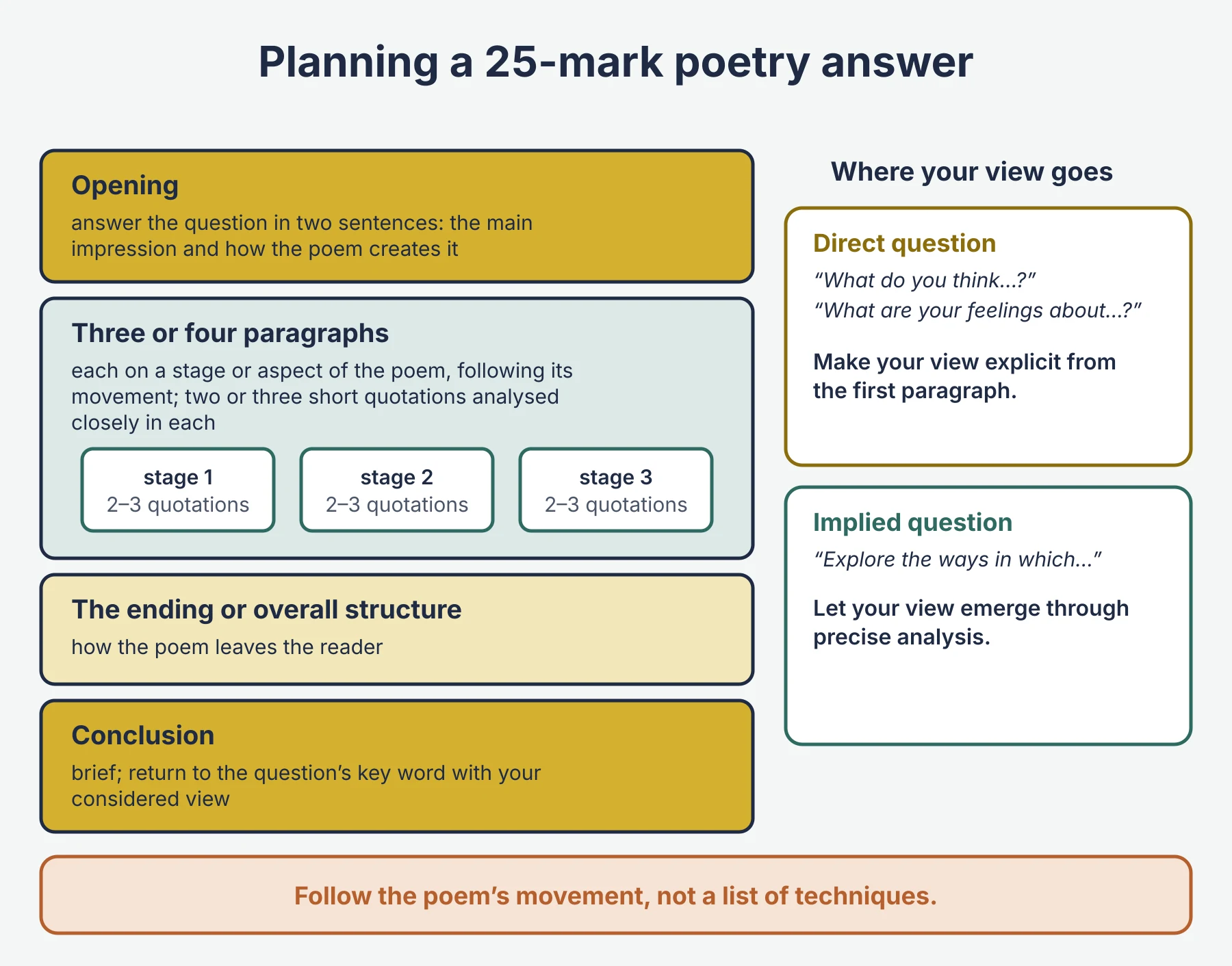
A secure plan has four or five points that follow the poem’s movement, not a list of techniques:
- An opening that answers the question in two sentences: the main impression and how the poem creates it.
- Three or four paragraphs, each on a stage or aspect of the poem, each with two or three short quotations analysed closely.
- A paragraph on the ending or the overall structure: how the poem leaves the reader.
- A brief conclusion that returns to the question’s key word with your considered view.
For a direct question (“What do you think…?” or “What are your feelings about…?”), make your view explicit from the first paragraph. For “Explore the ways in which…”, let the view emerge through precise analysis.
Common mistakes
- Paraphrasing line by line. Retelling the poem is not analysis; select the moments that answer the question.
- Ignoring the question’s focus. An answer on “the speaker’s anger” that discusses only imagery of nature has drifted.
- Labels without effects. “Enjambment is used” earns nothing unless you say what it does.
- Treating form as an afterthought. Rhyme, stanza breaks and line length are methods; use them in your argument.
- Forgetting the ending. The last lines often change how we read everything before them.
- Misquoting. The poem is in front of you: copy exactly.
How to revise the set poems
- For each poem, write a one-line summary of its situation and a one-line statement of its central feeling or idea.
- Identify the turn and be able to explain it.
- Choose five or six short quotations that carry the poem’s key methods, and practise explaining each in two sentences.
- Practise answering questions with different focuses on the same poem: the speaker, a place, a relationship, the mood, the ending.
- Because poems may be set from different parts of your poetry text, revise every poem on the list for your series.
Frequently asked questions
Do I need to compare poems in Section A? The syllabus asks you to answer on one set text and its questions are on the poem printed for you; a comparison is not part of the task described.
How much should I write about context? AO2 includes understanding of meanings and their contexts, but context should support your reading of the printed poem, not replace it.
Is it worth learning poetic terms? Yes, if you use them precisely to explain effects; a term alone is not rewarded.
Related pages
- Section A: Poetry revision notes
- Section A: Poetry practice questions
- Section B: Prose study guide
- Paper 1 Poetry and Prose study guide
Source: Cambridge International, Cambridge IGCSE Literature in English 0475 syllabus for 2026, Paper 1 Poetry and Prose.
Related resources
-
Practice questions
Cambridge IGCSE Literature in English (0475): Section A: Poetry — Practice Questions
Twelve original poetry-analysis questions on short original poems, building the skills for 0475 Paper 1 Section A, with full answers and marking points.
English Literature · Cambridge · IGCSE
Try questions -
Revision notes
Cambridge IGCSE Literature in English (0475): Section A: Poetry — Revision Notes
Recall notes for 0475 Paper 1 Section A Poetry: the task, poetic terms with their effects, a reading checklist, sentence frames, exam traps and a self-test.
English Literature · Cambridge · IGCSE
Revise topic -
Study guides
Cambridge IGCSE Literature in English (0475): Section B: Prose
How to write about a prose set text for 0475 Paper 1 Section B: voice, character, setting, structure and dialogue, with a model on an original passage.
English Literature · Cambridge · IGCSE
Read guide
Get free revision emails (optional)
Occasional emails with practice questions, worked explanations and links to free resources for the qualification and subjects you choose. No spam, and you can unsubscribe from any email. The free tools on this site never need an email.