
Revision Notes
Cambridge IGCSE Literature in English (0475): Section A: Poetry — Revision Notes
Recall notes for 0475 Paper 1 Section A Poetry: the task, poetic terms with their effects, a reading checklist, sentence frames, exam traps and a self-test.
- Subject
- English Literature
- Level
- IGCSE
- Topic
- Paper 1 – Poetry and Prose
- Author
- Marlbridge Academic Team
- Updated
- Reviewed by
- Ammar Bilal (what this means)
Aligned to Cambridge IGCSE English Literature (0475), 2026. Official specification .
Syllabus page (what it covers and how it is assessed): Cambridge IGCSE English Literature.
Syllabus points this page covers
0475
- 1.1 Section A: Poetry
Found an error? Report a correction.
Need help with this topic? Request a free trial class for IGCSE English Literature (0475).
These notes condense Section A (Poetry) of Paper 1 in Cambridge IGCSE Literature in English 0475. Use them to check that you know what the task requires, the terms you will use to analyse a poem, and the habits that separate analysis from description. They apply to whichever poetry set text you are studying; the set poems change by year, so check the list for your own series.
The task in brief
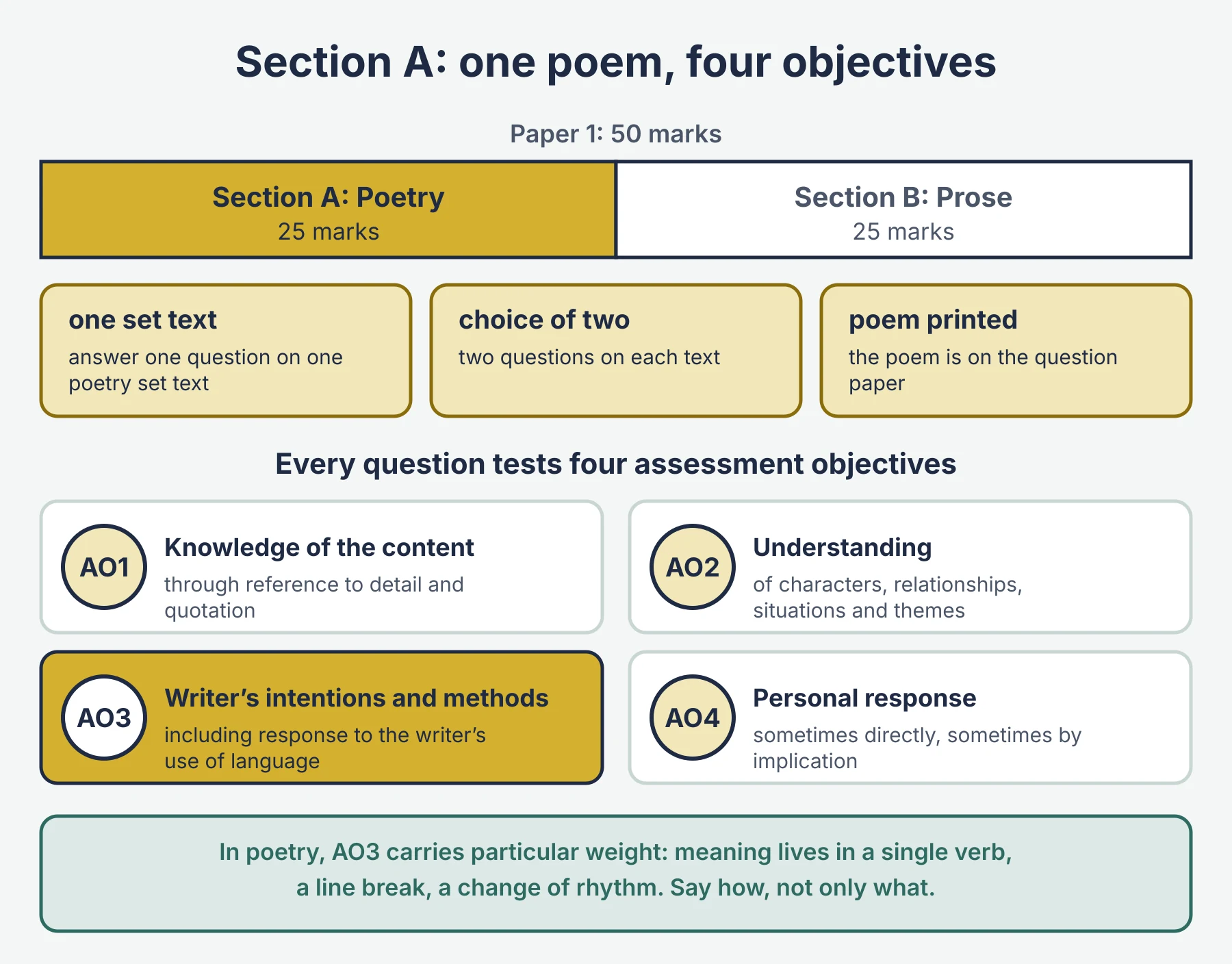
- Paper 1 is compulsory; Section A is the poetry half.
- You answer one question on one poetry set text, from a choice of two questions on each text.
- The poem is printed on the question paper; you may not take your set text into the exam room.
- The question is worth 25 marks and tests AO1–AO4.
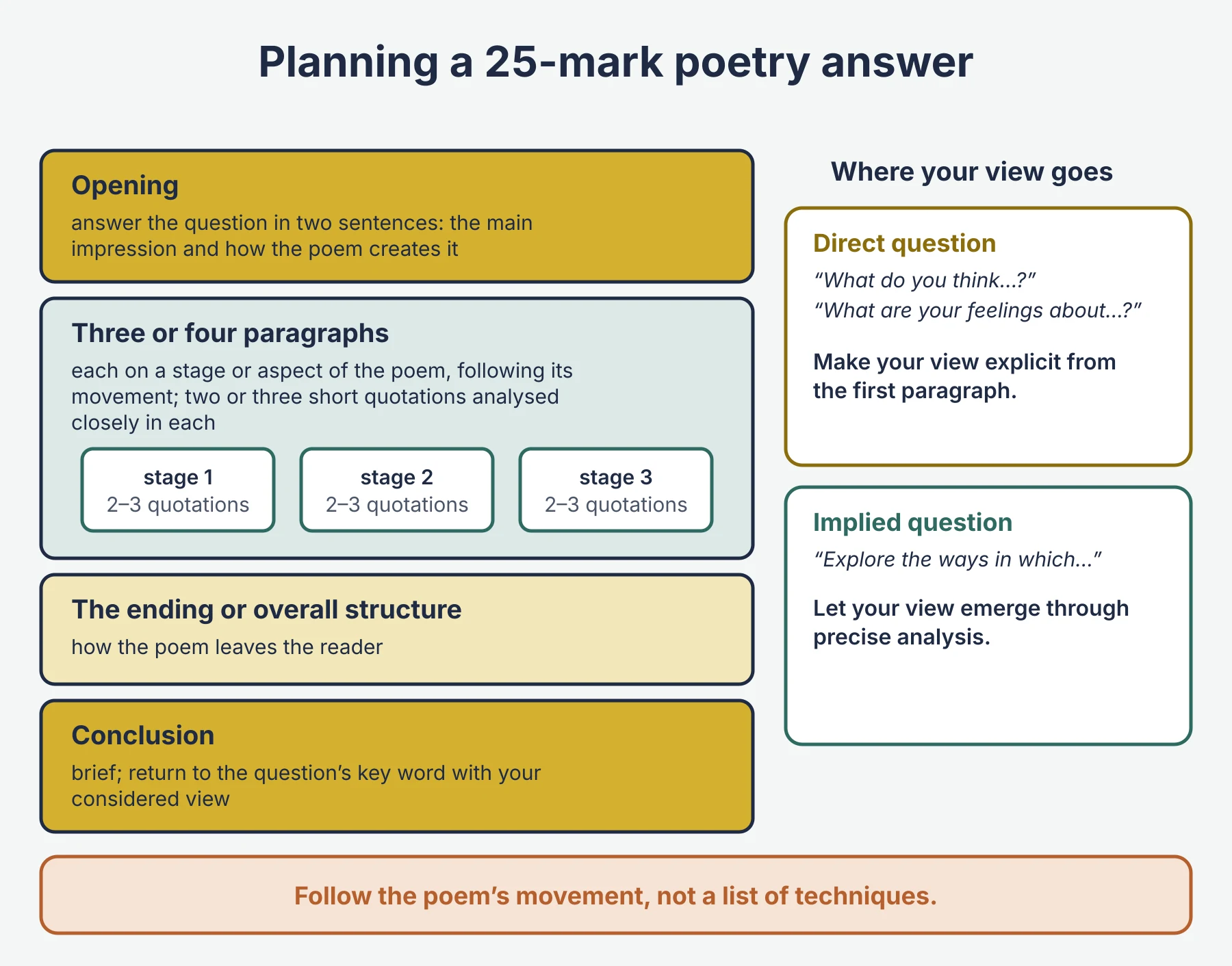
- Personal response may be asked for directly (“What do you think…?”, “What are your feelings about…?”) or by implication (“Explore the ways in which…”).
Key terms and what they do
| Term | Definition | Typical effect to discuss |
|---|---|---|
| Speaker / persona | The voice in the poem, not necessarily the poet | Whose view we share; how reliable it is |
| Imagery | Language that appeals to the senses | Makes an idea felt, not just understood |
| Metaphor | Describing one thing as another | Transfers qualities; often reveals attitude |
| Simile | Comparison using “like” or “as” | Makes the reader see a familiar thing freshly |
| Personification | Human qualities given to non-human things | Makes a setting or object seem active or threatening |
| Alliteration | Repeated initial consonant sounds | Emphasis; harsh or soft mood depending on sound |
| Assonance | Repeated vowel sounds | Can slow a line or create a musical, mournful tone |
| Onomatopoeia | Words imitating sounds | Immerses the reader in a scene |
| Enjambment | A sentence running over a line break | Momentum, surprise, or a thought that will not stop |
| Caesura | A pause within a line | Hesitation, shock, a sudden shift |
| End-stopped line | A line ending with punctuation | Finality, control, calm |
| Rhyme scheme | Pattern of end rhymes | Order, song-like tone, or irony when the content is dark |
| Stanza | A group of lines | Stages of thought; a break can mark a shift |
| Volta / turn | A shift in tone, time or argument | The poem’s change of mind or feeling |
| Tone | The attitude conveyed | Bitter, tender, ironic, nostalgic |
| Juxtaposition | Placing contrasting things side by side | Highlights difference or conflict |
| Repetition / refrain | Repeated words or lines | Insistence, obsession, emphasis |
Reading checklist for the exam
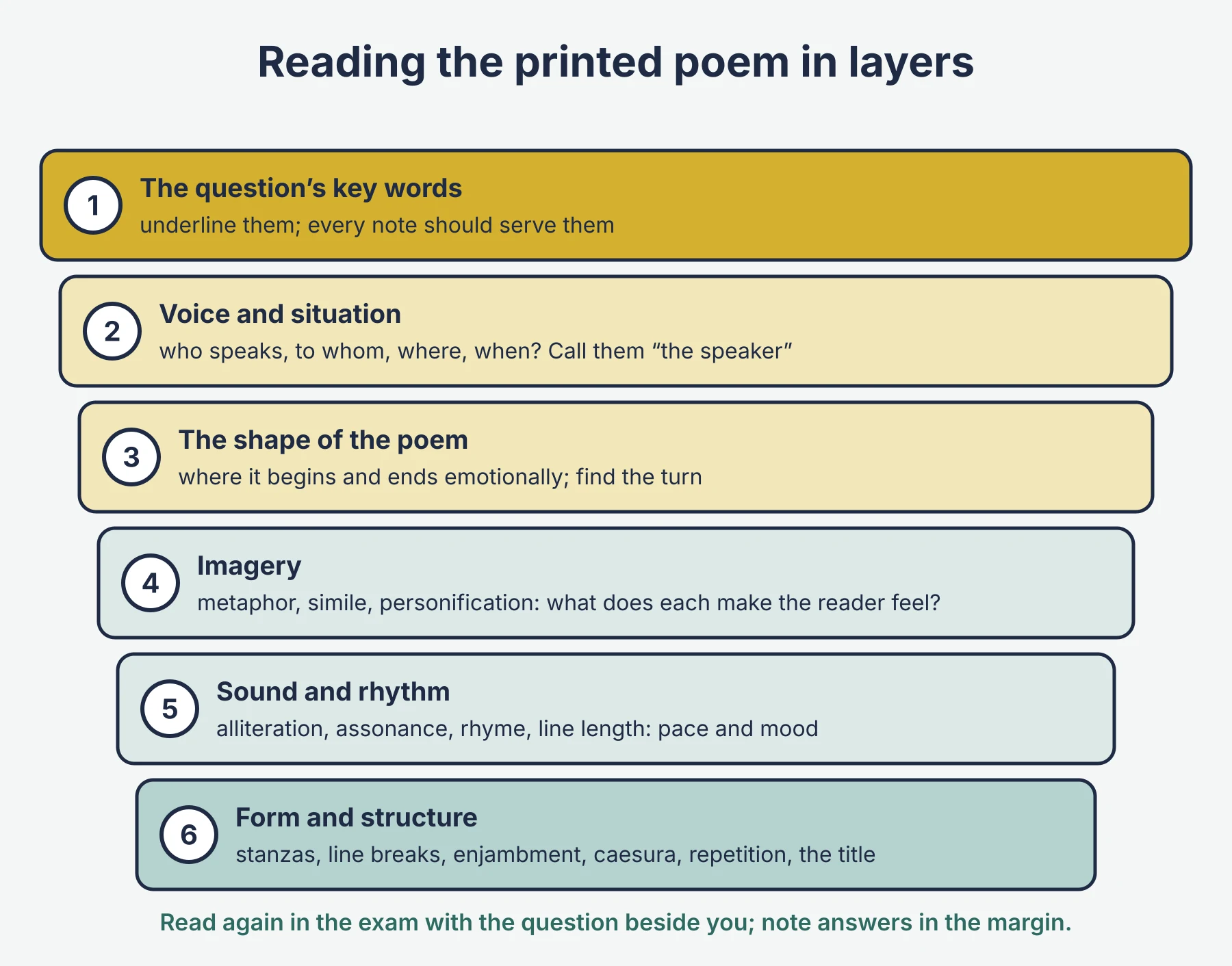
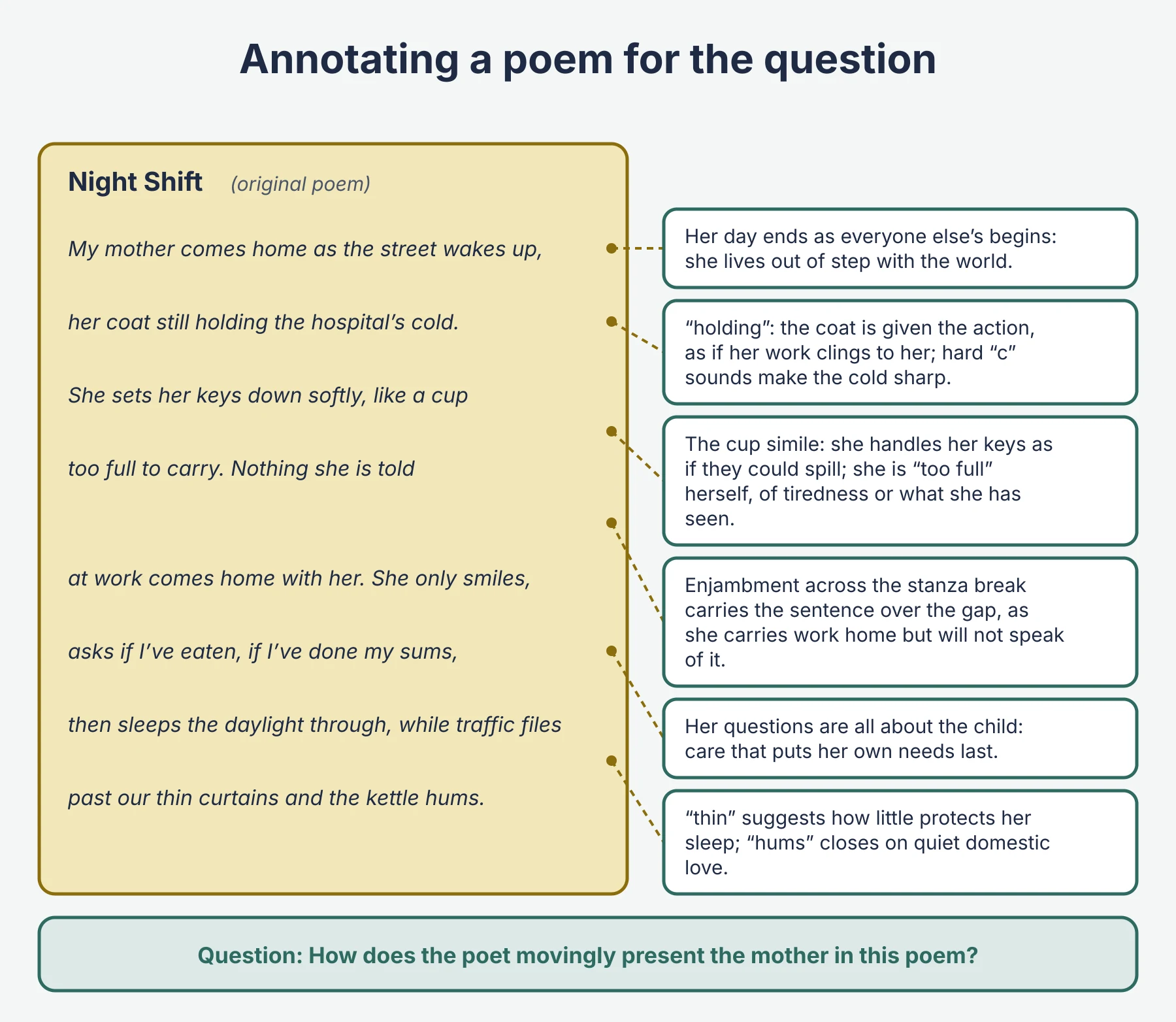
- Underline the key words in the question.
- Decide who is speaking, to whom, and in what situation.
- Mark the opening, the turn and the ending.
- Pick out the strongest images and ask what feeling each creates.
- Listen for sound and rhythm.
- Note how stanza shape, line breaks and punctuation support the meaning.
- Choose four or five moments that best answer the question.
Sentence frames for analysis
- “The word ‘…’ suggests…, which makes the reader feel…”
- “By placing ‘…’ at the end of the line, the poet…”
- “The shift from … to … in the final stanza shows…”
- “The image of … could also be read as…, which deepens the sense of…”
- “What I find most striking is…, because…”
Use them as starting points; vary them so your writing does not become mechanical.
What higher-level answers do
- Keep the question’s key word in view in every paragraph.
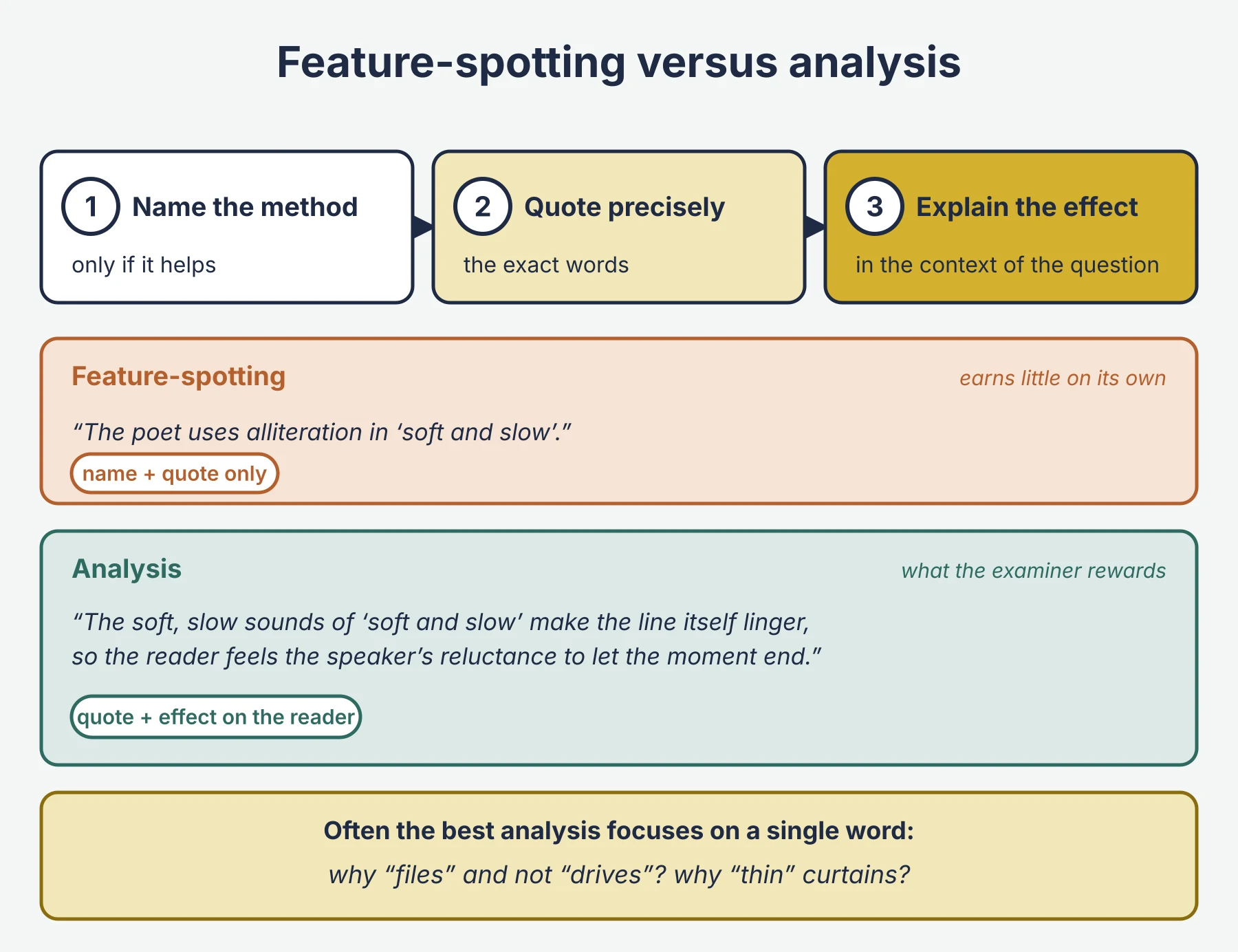
- Quote briefly and exactly, often a single word, and embed it in their own sentences.
- Explore more than one possible meaning of an image.
- Comment on structure: how the poem develops, not only on individual lines.
- Express a personal response that grows from the evidence.
Exam traps
- Line-by-line paraphrase. Select; do not retell.
- “The poet uses…” with no effect. Every method needs a “so what”.
- Confusing poet and speaker. Use “the speaker” unless the poem is clearly autobiographical.
- Long quotations. Copying three lines wastes time and blurs your point.
- Ignoring the ending. Many poems turn at the end.
- Generic context. Background that does not illuminate the printed poem gains little.
- Uneven timing. Section B is worth the same 25 marks; leave it enough time.
Self-test
- How many poetry questions do you answer in Section A, and on how many set texts?
- Is the poem printed on the paper?
- Which assessment objective covers the writer’s methods?
- Give one direct and one implied question form named in the syllabus.
- What is the difference between enjambment and caesura?
- Why should you refer to “the speaker” rather than “the poet”?
- What is a volta?
- In “the wind gnawed at the shutters”, what method is used and what is its effect?
- Why is naming a technique not enough?
- What effect might a regular rhyme scheme have in a poem about grief?
- What should a conclusion to a poetry answer do?
- Why should you revise every poem on the list for your series?
Answers: 1. One question, on one set text. 2. Yes, the relevant poem is printed. 3. AO3. 4. Direct: “What do you think…?” or “What are your feelings about…?”; implied: “Explore the ways in which…”. 5. Enjambment runs a sentence over a line break; caesura is a pause within a line. 6. The voice may be a persona and not the poet’s own. 7. A turn: a shift in tone, time or argument. 8. Personification: the wind “gnaws” like an animal, making it seem hungry and threatening. 9. Marks come from explaining the effect in relation to the question. 10. It may create a controlled, song-like surface that contrasts with the pain beneath, suggesting the speaker holding feelings in check. 11. Return to the question’s key word with a considered personal judgement. 12. Questions may be set on any poem from the text listed for that series.
Related pages
- Section A: Poetry study guide
- Section A: Poetry practice questions
- Paper 1 Poetry and Prose revision notes
Source: Cambridge International, Cambridge IGCSE Literature in English 0475 syllabus for 2026, Paper 1 Poetry and Prose.
Related resources
-
Study guides
Cambridge IGCSE Literature in English (0475): Section B: Prose
How to write about a prose set text for 0475 Paper 1 Section B: voice, character, setting, structure and dialogue, with a model on an original passage.
English Literature · Cambridge · IGCSE
Read guide -
Practice questions
Cambridge IGCSE Literature in English (0475): Section B: Prose — Practice Questions
Twelve original prose-analysis questions on short original passages, building the skills for 0475 Paper 1 Section B, with full answers and marking points.
English Literature · Cambridge · IGCSE
Try questions -
Revision notes
Cambridge IGCSE Literature in English (0475): Section B: Prose — Revision Notes
Recall notes for 0475 Paper 1 Section B Prose: the task, narrative and character terms, passage and whole-text approaches, exam traps and a self-test.
English Literature · Cambridge · IGCSE
Revise topic
Get free revision emails (optional)
Occasional emails with practice questions, worked explanations and links to free resources for the qualification and subjects you choose. No spam, and you can unsubscribe from any email. The free tools on this site never need an email.