
Study Guides
Cambridge IGCSE Sociology (0495): Research methods – How do sociologists approach the study of society?
Cambridge IGCSE Sociology 0495 key question 1.1 in depth: positivist and interpretivist approaches, combined methods and how to evaluate research choices.
- Subject
- Sociology
- Level
- IGCSE
- Topic
- Paper 1 – Research Methods, Identity and Inequality
- Author
- Marlbridge Academic Team
- Updated
- Reviewed by
- Naqiya Yousaf (what this means)
Aligned to Cambridge IGCSE Sociology (0495), 2025-2027. Official specification .
Syllabus page (what it covers and how it is assessed): Cambridge IGCSE Sociology.
Syllabus points this page covers
0495
- 1.1 Research methods – How do sociologists approach the study of society?
Found an error? Report a correction.
Need help with this topic? Request a free trial class for IGCSE Sociology (0495).
Key question 1.1 of Cambridge IGCSE Sociology (0495) asks How do sociologists approach the study of society? It is the theoretical base for the whole of Paper 1 Question 1. Whenever you explain why a researcher chose a questionnaire, criticise a source or plan your own study, you are using the ideas in this key question: the positivist approach, the interpretivist approach, ways of combining them, and the concepts used to evaluate any research choice.
This guide goes deeper than the research approaches, data and investigation overview, which covers all three methods key questions in one page.
Syllabus coverage
Cambridge IGCSE Sociology 0495, syllabus for 2025, 2026 and 2027, 1.1 How do sociologists approach the study of society?
| Content | Named points |
|---|---|
| 1.1.1 The positivist approach | the scientific method; a macro view; social facts; quantitative data; causation and correlation; patterns and trends; objectivity and reliability |
| 1.1.2 The interpretivist approach | a micro view; meanings and motivations; qualitative data; in-depth; subjectivity; validity and verstehen |
| 1.1.3 Approaches that combine different research methods and evidence | triangulation; longitudinal studies |
| 1.1.4 The analysis and evaluation of research choices | bias; interviewer effect; Hawthorne/observer effect; validity; reliability; representativeness; generalisability |
Why there are two approaches at all
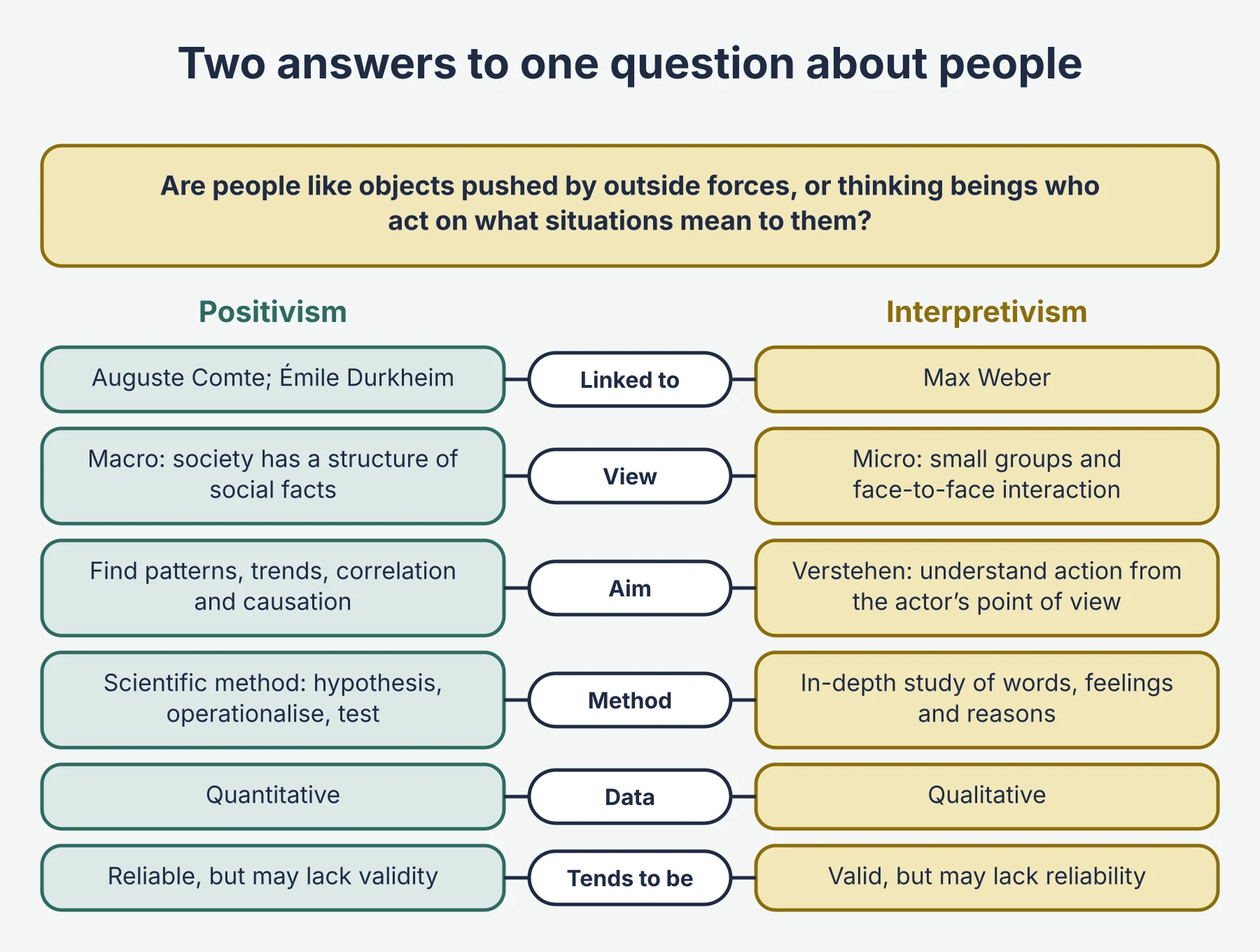
The disagreement starts with a question about people. Are human beings like objects in nature, whose behaviour is pushed by outside forces that can be measured? Or are they thinking beings who act on the basis of what situations mean to them? Positivists lean to the first answer, interpretivists to the second, and each answer leads to a different idea of what good evidence looks like.
Positivism takes its name from Auguste Comte, the nineteenth-century French thinker who also coined the word “sociology” and wanted a science of society modelled on the natural sciences. Positivists argue that society has a structure (a macro view) made of social facts — Émile Durkheim’s term for ways of acting and thinking that exist outside any one individual and constrain them, such as laws, religious rules or the expectation that children attend school. Because social facts are real and external, they can be counted, so research should follow the scientific method: state a hypothesis, operationalise the concepts, collect quantitative data, and test whether the predicted relationship appears.
Interpretivism is linked above all to Max Weber, who argued that sociology must understand the meaning behind social action. A wink and an involuntary twitch of the eye look identical to a measuring instrument but mean completely different things. Interpretivists therefore take a micro view, studying small groups and face-to-face interaction, and aim for verstehen — understanding an action from the actor’s own point of view. Their data is qualitative and in-depth: the words, feelings and reasons of the people studied.
The key terms explained through one example
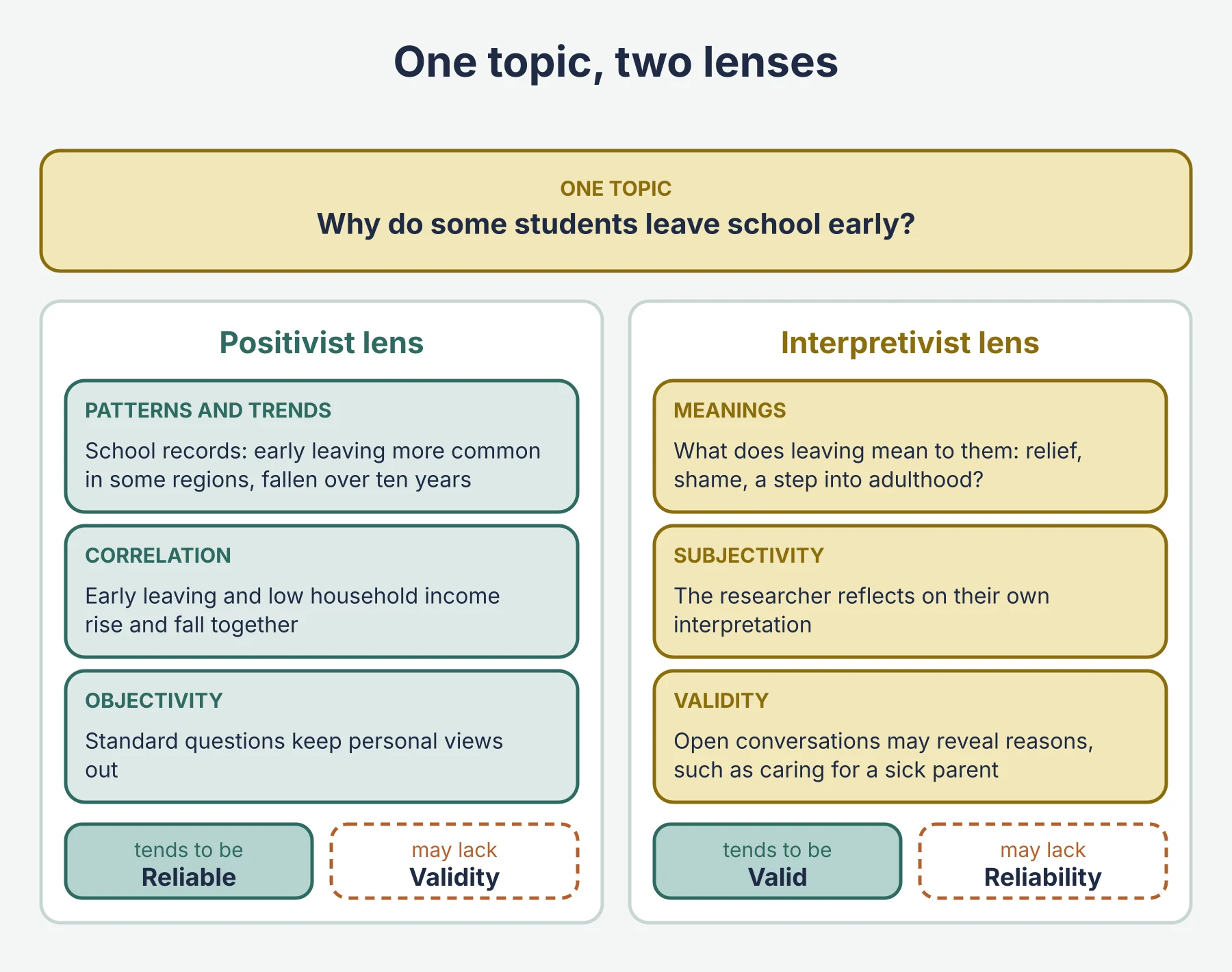
Take a single research topic — why some students leave school early — and see how each named syllabus point applies.
| Syllabus point | What it means for this topic |
|---|---|
| Patterns and trends | A positivist might use school records to show that early leaving is more common in some regions and has fallen over ten years |
| Correlation | Early leaving and low household income rise and fall together across regions |
| Causation | Showing that low income actually produces early leaving, for example because teenagers must earn money — a correlation alone cannot show this |
| Objectivity | The researcher uses standard questions so personal views about early leavers do not shape results |
| Reliability | Another researcher using the same questionnaire in another year would get comparable results |
| Meanings and motivations | An interpretivist asks what leaving school means to the young people: relief, shame, a step into adulthood? |
| Subjectivity | The interpretivist accepts that their own interpretation is part of the research and must be reflected on |
| Validity | Long, open conversations may reveal reasons a tick-box form would miss, such as caring for a sick parent |
The table shows the trade-off at the heart of 1.1: positivist research tends to be reliable but may lack validity; interpretivist research tends to be valid but may lack reliability.
Correlation and causation: three reasons a link can mislead
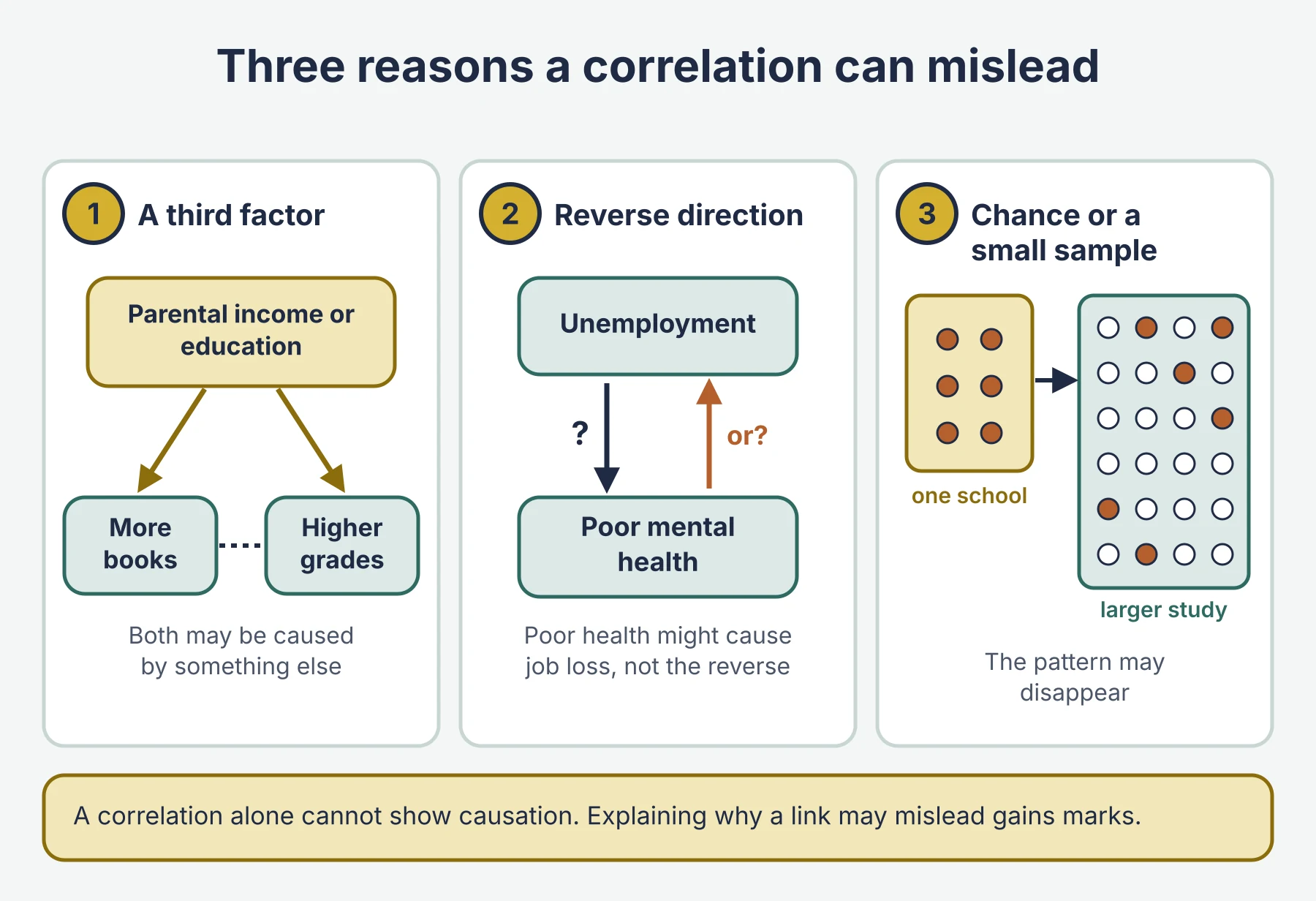
Exam sources often present a correlation. You gain marks by explaining why it may not show cause.
- A third factor. Students who own more books may get higher grades, but both could be caused by parental income or education.
- Reverse direction. Unemployment and poor mental health are linked; poor health might cause job loss rather than the other way round.
- Chance or a small sample. A pattern found in one school may disappear in a larger study.
Combining approaches (1.1.3)
Many sociologists reject a strict either-or choice.
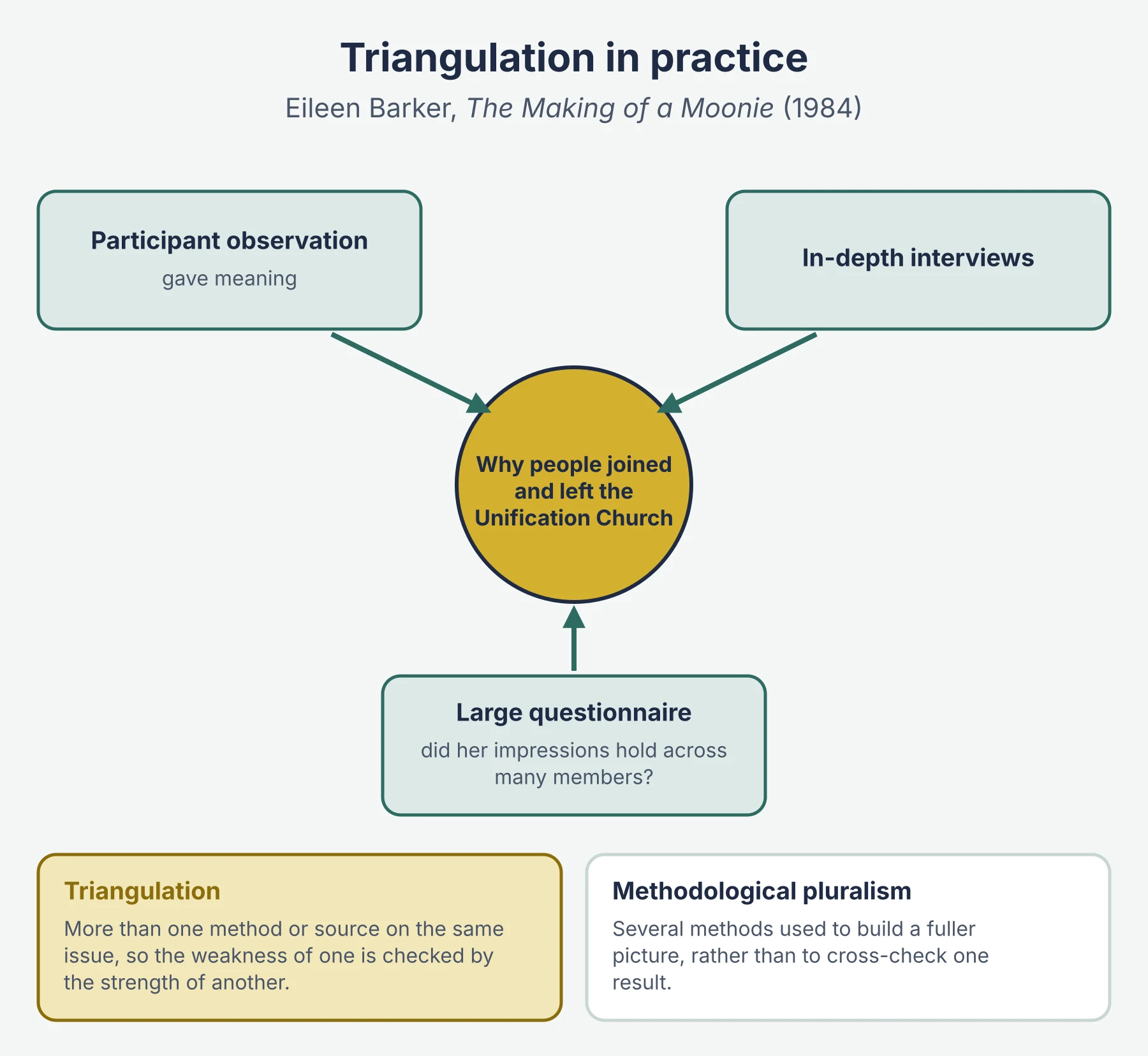
Triangulation means using more than one method or source to study the same issue, so that the weakness of one is checked by the strength of another. Eileen Barker’s study of the Unification Church, The Making of a Moonie (1984), is a well-known example: she combined participant observation, in-depth interviews and a large questionnaire to investigate why people joined and left the movement. The observation gave meaning; the questionnaire showed whether her impressions held across many members.
Methodological pluralism is a related idea — using several methods to build a fuller picture rather than to cross-check one result.
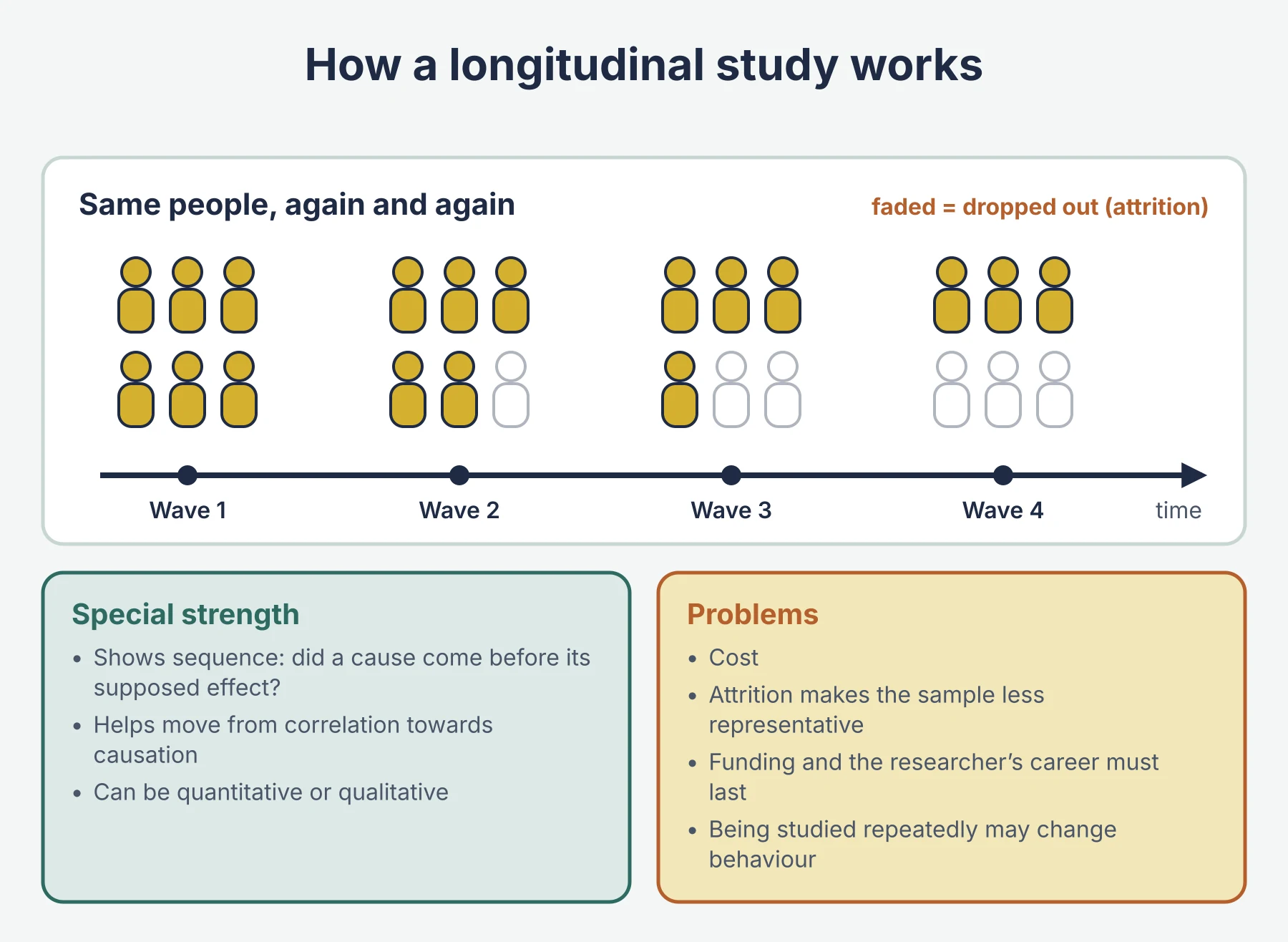
Longitudinal studies follow the same people over a period of time, collecting data at intervals. They can be quantitative (repeated questionnaires to a cohort) or qualitative (repeated interviews with a small group). Their special strength is showing sequence: whether a cause came before its supposed effect, which helps move from correlation towards causation. Problems include cost, attrition (people dropping out, so the remaining sample becomes less representative), the researcher’s funding and career needing to last as long as the study, and the possibility that being studied repeatedly changes participants’ behaviour.
Evaluating research choices (1.1.4)
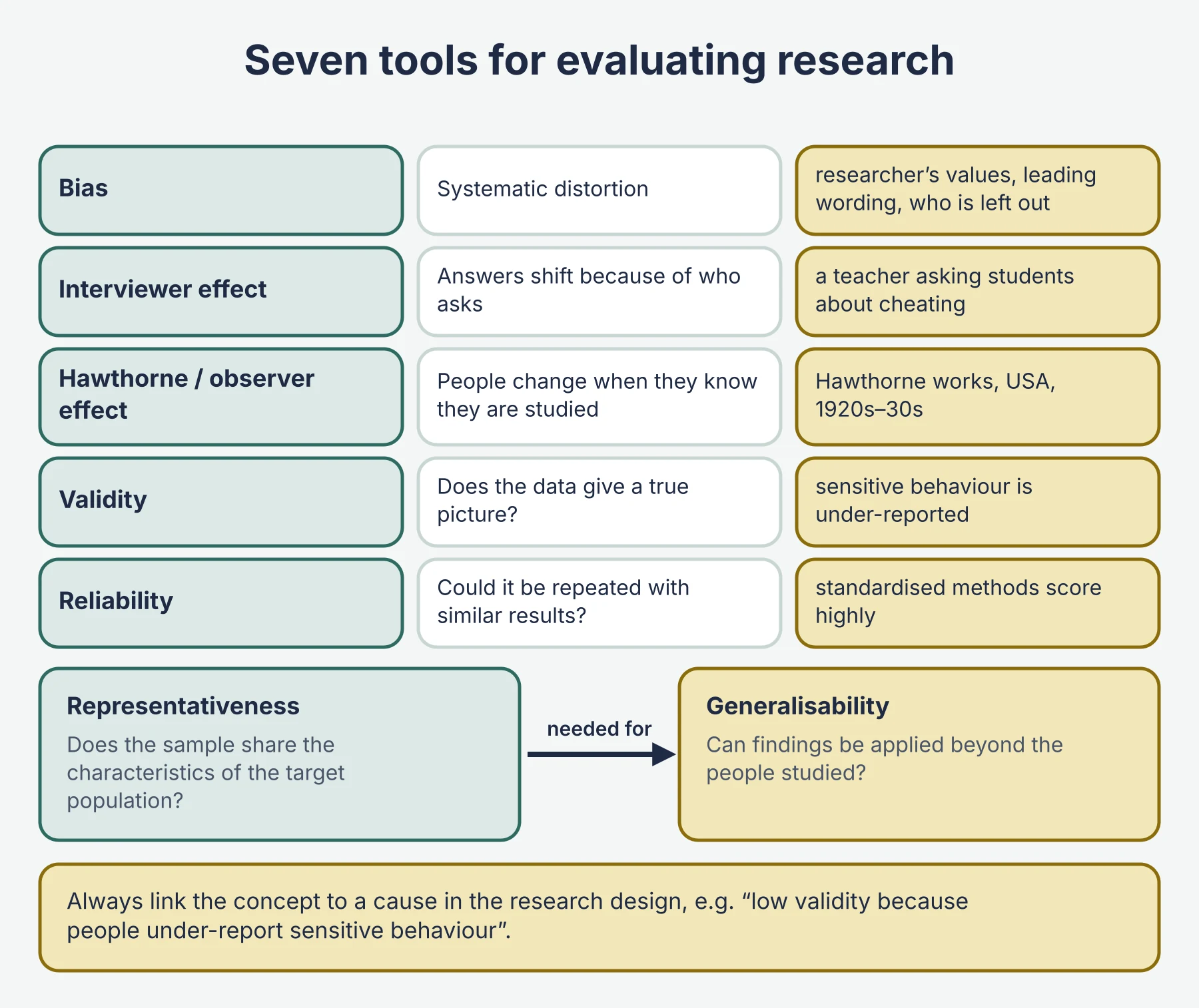
These seven concepts are the tools for every “explain a problem” and “evaluate” question. Learn to connect each one to a cause in the research design.
- Bias — any systematic distortion. It can come from the researcher’s values, from leading question wording (“Do you agree that homework is a waste of time?”) or from who is left out of a sample.
- Interviewer effect — respondents answer differently because of the interviewer’s characteristics or manner. A teacher asking students about cheating will hear less than an anonymous form would collect. Respondents may also give socially desirable answers.
- Hawthorne / observer effect — people change behaviour because they know they are being studied. The name comes from studies at the Western Electric Hawthorne works in the United States in the 1920s and 1930s, where workers’ output changed in response to being observed rather than to the conditions being tested.
- Validity — whether the data gives a true picture. Questions about sensitive behaviour often have low validity because people under-report.
- Reliability — whether the research could be repeated with similar results. Standardised methods score highly; one researcher’s unrecorded impressions do not.
- Representativeness — whether the sample has the same characteristics as the target population.
- Generalisability — whether findings can be applied beyond the people studied. It depends on representativeness: an unrepresentative sample cannot support general claims.
Worked example: Question 1(d)-style evaluation
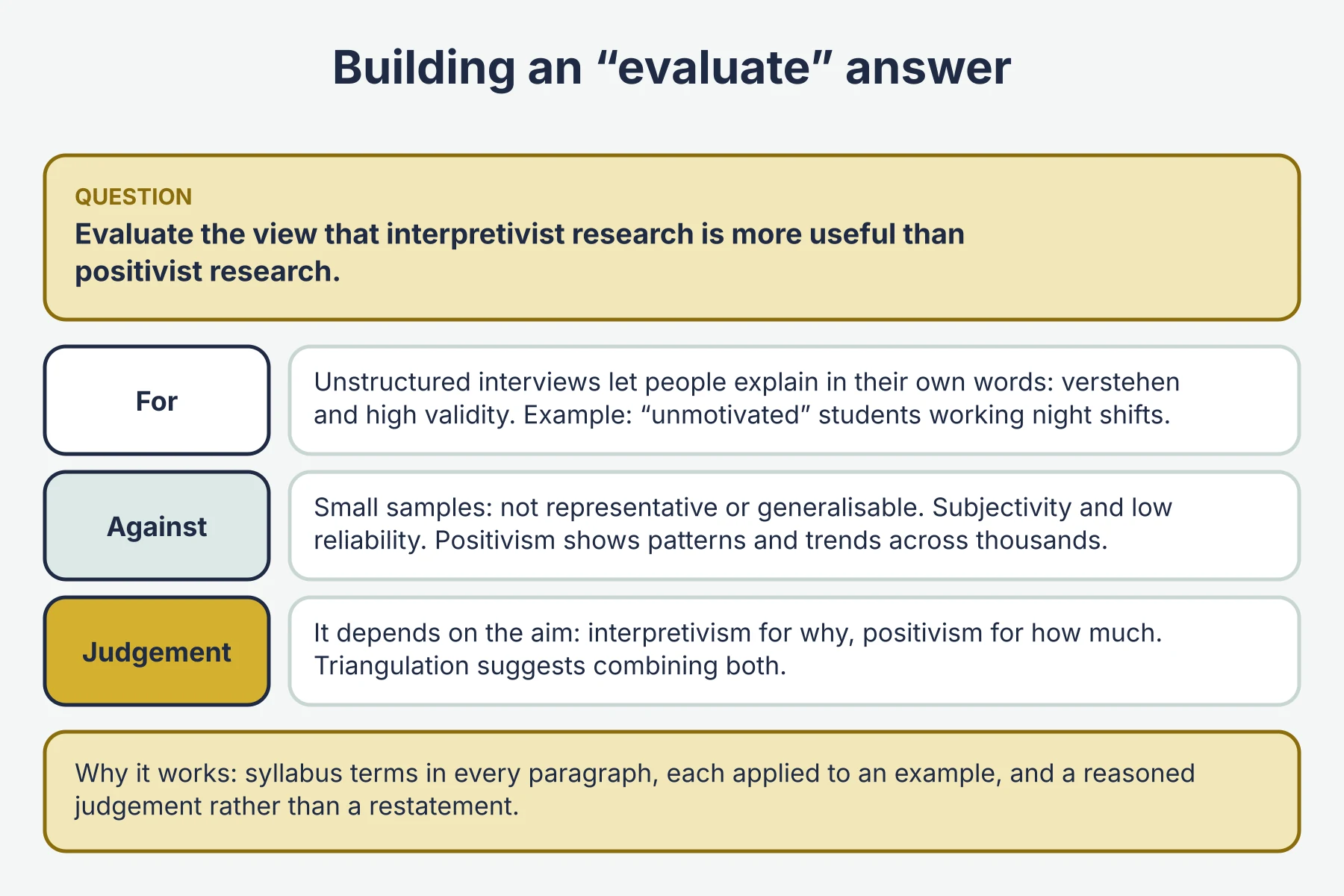
Evaluate the view that interpretivist research is more useful than positivist research.
For the view. Interpretivist methods such as unstructured interviews allow people to explain their actions in their own words, so the researcher can achieve verstehen. This gives high validity: for example, interviews could show that some students who appear “unmotivated” in school statistics are in fact working night shifts to support their family. Positivist questionnaires would impose the researcher’s categories and miss this meaning.
Against the view. However, interpretivist studies use small samples, so findings may not be representative or generalisable, which limits their use for governments planning policy. Results depend on one researcher’s interpretation, so subjectivity and low reliability are problems. Positivist research can identify patterns and trends across thousands of people and test correlations, which shows the scale of a problem.
Judgement. Usefulness depends on the research aim: interpretivism is more useful for understanding why, positivism for measuring how much. Triangulation, as in Barker’s study, suggests the most useful research combines both.
Why it works: each paragraph uses syllabus terms (verstehen, validity, representativeness, generalisability, reliability, patterns and trends), applies them to an example, and the judgement is reasoned rather than a restatement.
Common mistakes
- Treating positivism and interpretivism as lists of methods rather than views about what society is and how it should be studied. Explain the reason behind each preference.
- Saying positivists are “objective” and interpretivists “biased”. Interpretivists aim to be rigorous; they simply see some subjectivity as unavoidable.
- Describing a longitudinal study as “a long study”. It must study the same group at intervals.
- Claiming triangulation makes research “100% accurate”. It increases confidence; it does not guarantee truth.
- Naming an evaluation concept without linking it to the design (for example, “this lacks validity” with no reason).
Exam technique for 0495 command words
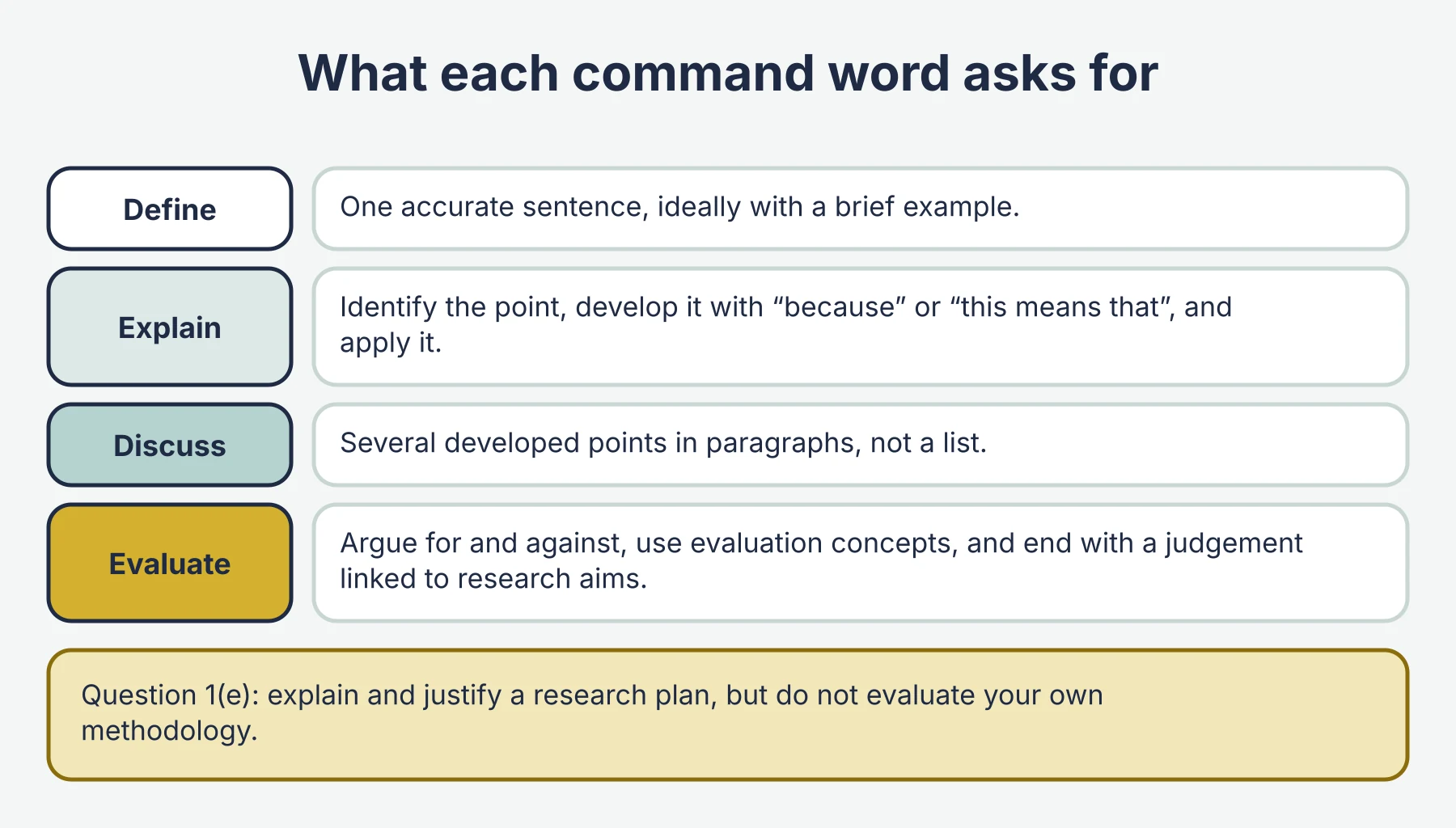
- Define (give precise meaning): one accurate sentence, ideally with a brief example — “social facts are features of society external to individuals that shape their behaviour, such as laws”.
- Explain (set out reasons, say why or how, supported by evidence): identify the point, then develop it with “because” or “this means that”, and apply it.
- Evaluate (judge the quality or value): argue both for and against, use evaluation concepts, and finish with a judgement linked to research aims.
- Discuss (write in depth in a structured way): build several developed points in paragraphs rather than a list.
Under the syllabus, Question 1(e) asks you to explain and justify a research plan but does not expect you to evaluate your own methodology — your knowledge of 1.1 is used there to give reasons, for instance choosing interviews “to gain valid data on meanings”.
Revise this content with the positivism and interpretivism revision notes and test yourself with the positivism and interpretivism practice questions. Key question 1.2 on data and evidence follows in the types of data and evidence study guide.
Related resources
-
Study guides
Cambridge IGCSE Sociology (0495): Research methods – What types of data and evidence do sociologists use?
Cambridge IGCSE Sociology 0495 key question 1.2: primary and secondary data, qualitative and quantitative evidence, and how to analyse tables and graphs.
Sociology · Cambridge · IGCSE
Read guide -
Practice questions
Cambridge IGCSE Sociology (0495): Research methods – What types of data and evidence do sociologists use? – Practice Questions
Original Cambridge IGCSE Sociology 0495 practice on key question 1.2: data types, official statistics, documents and reading sources, with answers.
Sociology · Cambridge · IGCSE
Try questions -
Revision notes
Cambridge IGCSE Sociology (0495): Research methods – What types of data and evidence do sociologists use? – Revision Notes
Revision notes for Cambridge IGCSE Sociology 0495 key question 1.2: types of data, official statistics, documents, digital and media sources, and data analysis.
Sociology · Cambridge · IGCSE
Revise topic
Related articles
Get free revision emails (optional)
Occasional emails with practice questions, worked explanations and links to free resources for the qualification and subjects you choose. No spam, and you can unsubscribe from any email. The free tools on this site never need an email.