
Revision Notes
Cambridge IGCSE World History (0470): Depth Study A: The First World War, 1914-18 – Revision Notes
Recall notes for Cambridge IGCSE History 0470 Depth Study A, the First World War: stalemate, a world war, other fronts and the 1918 armistice, with a self-test.
- Subject
- World History
- Level
- IGCSE
- Topic
- Depth Studies
- Author
- Marlbridge Academic Team
- Updated
- Reviewed by
- Azam Siddique (what this means)
Aligned to Cambridge IGCSE World History (0470), 2024-2026. Official specification .
Syllabus page (what it covers and how it is assessed): Cambridge IGCSE World History.
Syllabus points this page covers
0470
- 3.1 Depth study A: The First World War, 1914–18
Found an error? Report a correction.
Need help with this topic? Request a free trial class for IGCSE World History (0470).
These notes condense Depth Study A: The First World War, 1914-18 in Cambridge IGCSE History 0470. It has four key questions: why there was stalemate on the Western Front, to what extent it was a world war, how important other fronts were, and why Germany asked for an armistice in 1918. For explanation and worked answers, read the Depth Study A study guide; to apply the facts, try the Depth Study A practice questions.
Key question 1: Why was there stalemate on the Western Front?
The Schlieffen Plan in practice
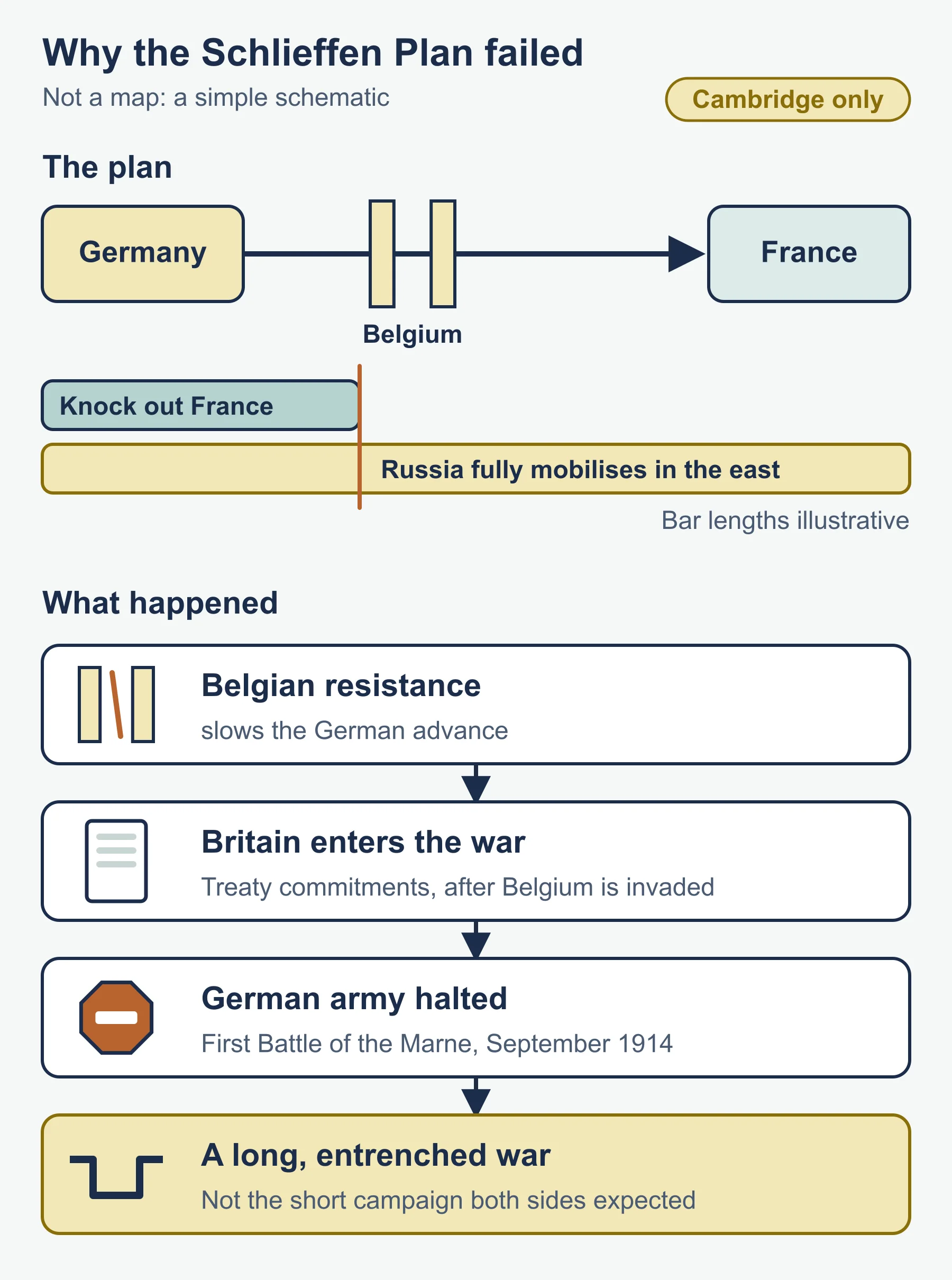
- Germany aimed to defeat France in about six weeks by sweeping through Belgium, then turn east against Russia.
- Belgian forts at Liège held up the advance; Britain entered the war on 4 August 1914 because Belgium was invaded.
- The BEF slowed the Germans at Mons (23 August 1914) before retreating.
- Russia mobilised faster than expected and invaded East Prussia, so Moltke moved troops east.
- The German right wing turned east of Paris instead of round it; the French and British counter-attacked at the Marne (September 1914) and the Germans fell back to the Aisne and dug in.
From movement to trenches
- Race to the sea (autumn 1914): each side tried to outflank the other northwards.
- First Ypres (October-November 1914): the BEF held the town at heavy cost; the line now ran from the Channel to Switzerland.
Trench life: front-line, support and reserve trenches linked by communication trenches; rats, lice, mud, trench foot, shell shock; units rotated in and out of the line.
New methods of warfare
| Weapon | First notable use | Impact |
|---|---|---|
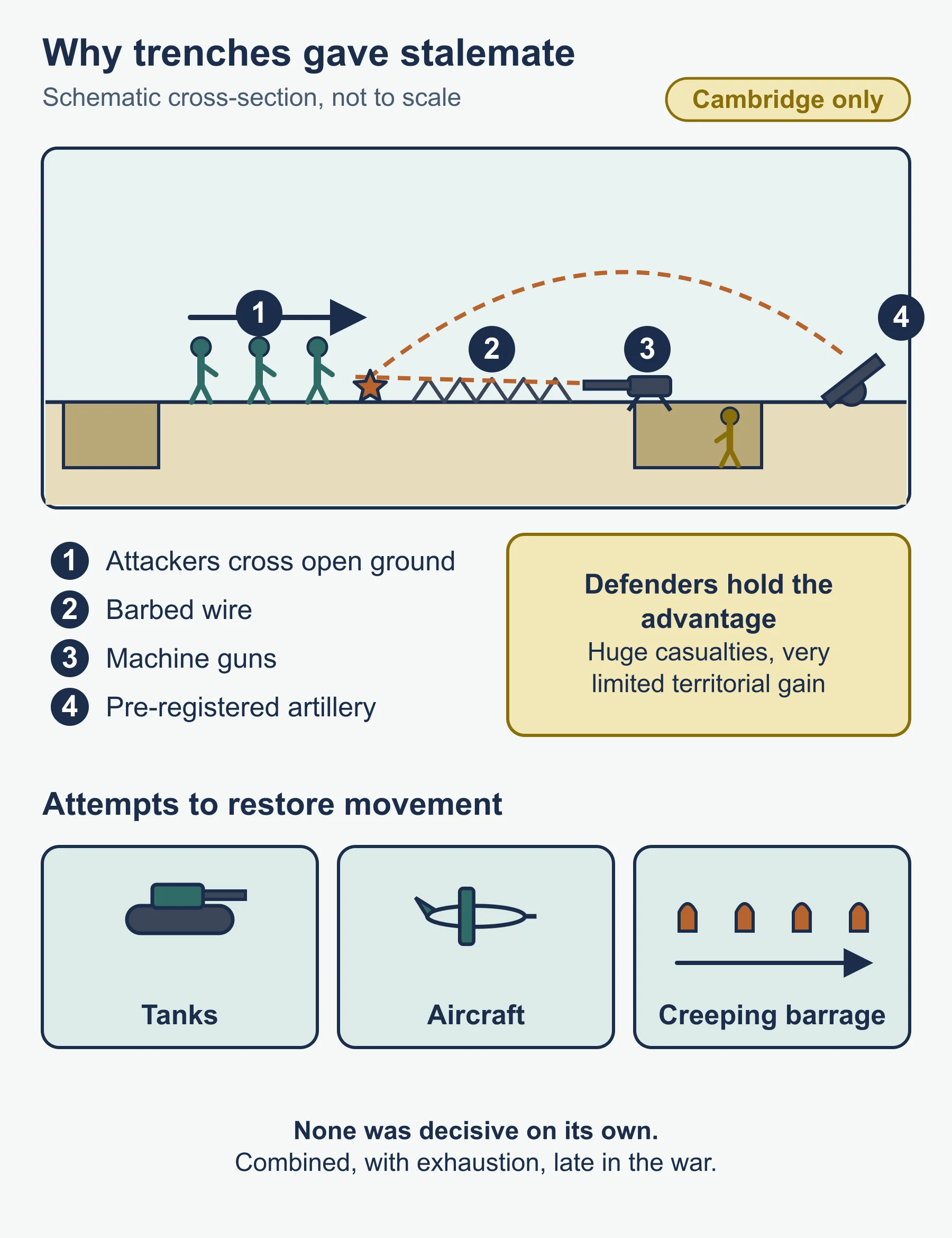
| Machine gun | From 1914 | Gave defenders the advantage; cut down infantry in the open |
| Gas | Chlorine, Second Ypres, April 1915 | Terrifying but rarely decisive once masks were issued |
| Tank | Flers-Courcelette (Somme), September 1916 | Unreliable at first; massed use at Cambrai (1917) and in 1918 |
| Aircraft | Reconnaissance from 1914 | Spotting for artillery; later fighters and bombers |
| Artillery | Throughout | Caused most casualties; creeping barrages developed |
Verdun and the Somme
- Verdun (February-December 1916): Falkenhayn aimed to “bleed France white”; Pétain organised the defence; huge losses on both sides.
- Somme (July-November 1916): launched partly to relieve Verdun; a week-long bombardment failed to cut the wire; about 57,000 British casualties on 1 July; the Allies advanced only a few miles. Debate on Haig: “butcher” who wasted lives, or a commander who wore down the German army and learned lessons used in 1918.
Key question 2: To what extent was it a world war?
- Indian troops reached the Western Front in autumn 1914, fought at Ypres and Neuve Chapelle (1915) and earned Victoria Crosses, including Khudadad Khan’s; most infantry were moved to the Middle East by the end of 1915.
- Canadian troops faced the first gas attack at Second Ypres (1915) and captured Vimy Ridge (April 1917).
- German East Africa: the British-Indian landing at Tanga (1914) failed; Lettow-Vorbeck fought a guerrilla campaign and surrendered only after the Armistice. Thousands of African carriers died.
- South West Africa: South African forces under Botha conquered the colony by July 1915.
- Japan: took Tsingtao (November 1914) with British help, seized German Pacific islands and escorted convoys, including in the Mediterranean from 1917.
- Arab Revolt (from June 1916): led by Sharif Hussein of Mecca and his son Faisal, advised by T. E. Lawrence; attacked the Hejaz railway, took Aqaba (1917) and helped capture Damascus (1918).
Key question 3: How important were other fronts?
- War at sea: the British blockade starved Germany of imports. At Jutland (May-June 1916) Britain lost more ships and men, but the German High Seas Fleet never seriously challenged it again.
- U-boats: the sinking of the Lusitania (1915) angered the USA; unrestricted submarine warfare (February 1917) almost starved Britain until convoys cut losses from mid-1917.
- Gallipoli (1915-16): aim to knock out Turkey and open a sea route to Russia; naval attack failed in March 1915; landings in April at Cape Helles and ANZAC Cove; Turkish defence under Mustafa Kemal; evacuation by January 1916.
- Eastern Front: defeat at Tannenberg (1914); heavy losses in 1915; the Brusilov Offensive (1916); revolution in 1917; Treaty of Brest-Litovsk (March 1918) freed German troops for the west.
- Civilians: DORA and censorship in Britain; conscription from 1916; women in munitions; Zeppelin and Gotha raids; rationing in Britain in 1918; hunger in Germany, including the “turnip winter” of 1916-17.
Key question 4: Why did Germany ask for an armistice in 1918?
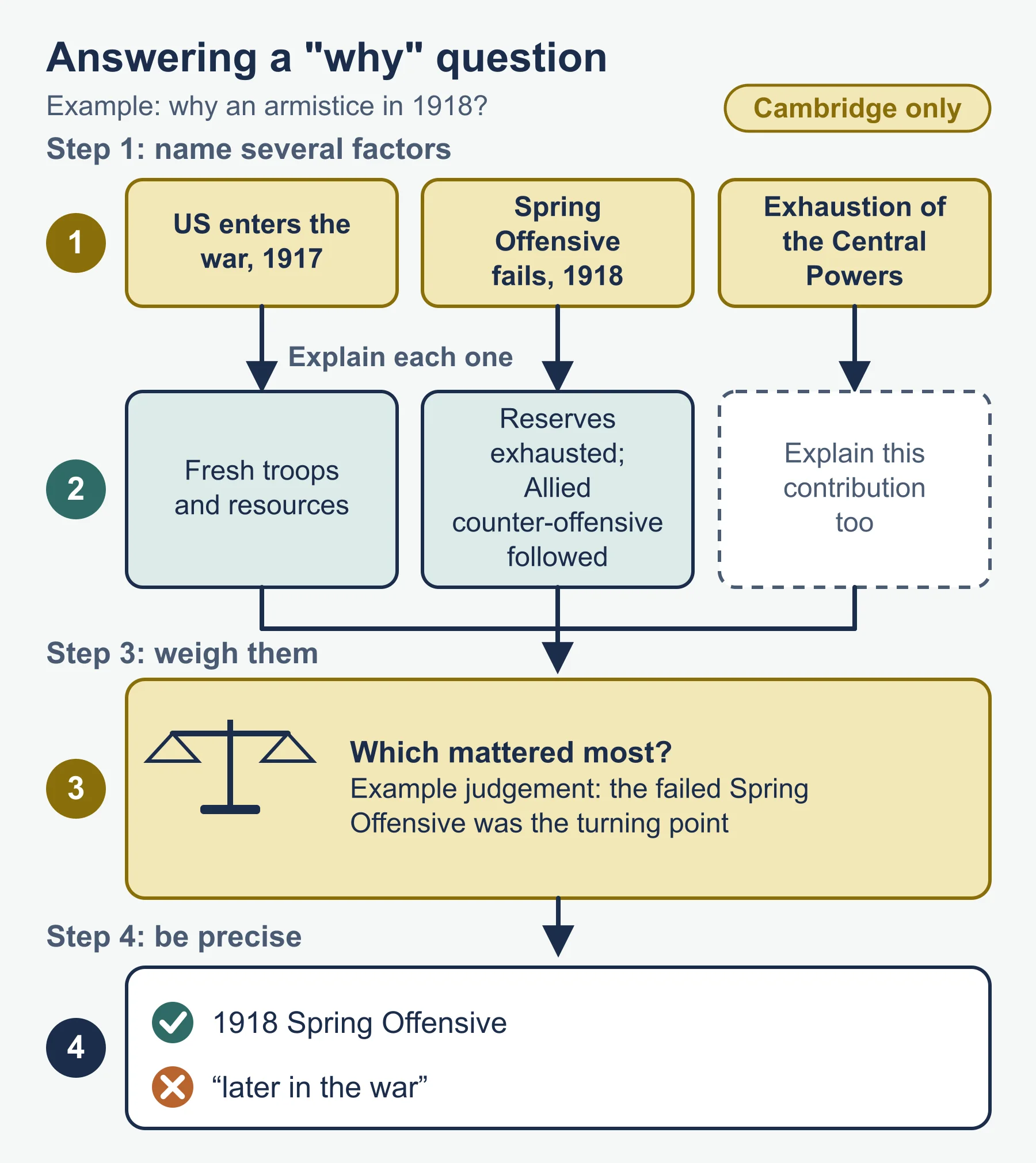
- American entry (April 1917): fresh troops and supplies; about two million Americans in France by late 1918.
- Ludendorff Spring Offensive (from 21 March 1918): stormtroopers broke through and advanced far, but outran supplies, lost elite troops and created a longer line to defend.
- Allied counter-attack: Foch as supreme commander; the Battle of Amiens (8 August 1918), the “black day” of the German army; the Hindenburg Line broken in late September.
- Allies collapse: Bulgaria, Turkey and Austria-Hungary left the war in September-November 1918.
- Home front: shortages, strikes and war-weariness; Ludendorff advised an armistice at the end of September; a new government under Prince Max of Baden asked for terms in October.
- Revolution: sailors at Kiel mutinied rather than sail on a final mission; councils spread; the Kaiser abdicated on 9 November; the Armistice was signed at Compiègne on 11 November 1918.
Key terms
| Term | Meaning |
|---|---|
| Stalemate | Deadlock in which neither side can advance |
| Attrition | Wearing down the enemy through losses |
| No man’s land | Ground between opposing trenches |
| Creeping barrage | Artillery fire moving forward just ahead of advancing infantry |
| BEF | British Expeditionary Force, the regular army sent in 1914 |
| ANZAC | Australian and New Zealand Army Corps |
| Convoy | Merchant ships sailing together under naval escort |
| Unrestricted submarine warfare | Sinking any ship in a war zone without warning |
| Stormtroopers | Specialist German assault troops used in 1918 |
| Armistice | Agreement to stop fighting |
Exam traps
- The plan versus its failure. Describe how Schlieffen was meant to work before saying why it failed.
- Jutland’s result. Do not call it a simple British victory or defeat; explain the strategic outcome.
- Indian troops’ role. Most Indian infantry left the Western Front in 1915; do not exaggerate their time there.
- The order of events in 1918. Ludendorff asked for an armistice before the Kiel Mutiny.
- Gas and tanks. Important, but neither ended the stalemate alone; say why.
Self-test
- Which battle in September 1914 ended German hopes of a quick victory? The Marne.
- Why did Moltke move troops east in August 1914? Russia mobilised and invaded East Prussia faster than expected.
- Where was chlorine gas first used on a large scale? Second Ypres, April 1915.
- When were tanks first used? September 1916, at Flers-Courcelette during the Somme.
- What was Falkenhayn’s aim at Verdun? To “bleed France white” by attrition.
- Which ridge did Canadian troops capture in April 1917? Vimy Ridge.
- Who led German forces in East Africa? Paul von Lettow-Vorbeck.
- Which German base in China did Japan capture in 1914? Tsingtao.
- Why was Jutland important despite heavier British losses? The German fleet stayed in port for the rest of the war.
- Which method cut shipping losses to U-boats from 1917? The convoy system.
- What did the Treaty of Brest-Litovsk allow Germany to do? Move troops from the Eastern Front to the West for 1918.
- Why was 8 August 1918 called the “black day” of the German army? The Allied attack at Amiens broke through and many Germans surrendered.
Related resources
-
Practice questions
Cambridge IGCSE World History (0470): Depth Study B: Germany, 1918-45 – Practice Questions
Thirteen original questions with mark-scheme answers on Cambridge IGCSE History 0470 Depth Study B, Germany 1918-45, from Weimar to wartime Nazi rule.
World History · Cambridge · IGCSE
Try questions -
Revision notes
Cambridge IGCSE World History (0470): Depth Study B: Germany, 1918-45 – Revision Notes
Recall notes for Cambridge IGCSE History 0470 Depth Study B, Germany 1918-45: Weimar, the Nazi rise, control, daily life and the war, with a self-test.
World History · Cambridge · IGCSE
Revise topic -
Practice questions
Cambridge IGCSE World History (0470): Depth Study C: Russia, 1905-41 – Practice Questions
Thirteen original questions with mark-scheme answers on Cambridge IGCSE History 0470 Depth Study C, Russia 1905-41, from 1905 to Stalin's Five-Year Plans.
World History · Cambridge · IGCSE
Try questions
Get free revision emails (optional)
Occasional emails with practice questions, worked explanations and links to free resources for the qualification and subjects you choose. No spam, and you can unsubscribe from any email. The free tools on this site never need an email.