
Revision Notes
Cambridge IGCSE World History (0470): Depth Study B: Germany, 1918-45 – Revision Notes
Recall notes for Cambridge IGCSE History 0470 Depth Study B, Germany 1918-45: Weimar, the Nazi rise, control, daily life and the war, with a self-test.
- Subject
- World History
- Level
- IGCSE
- Topic
- Depth Studies
- Author
- Marlbridge Academic Team
- Updated
- Reviewed by
- Azam Siddique (what this means)
Aligned to Cambridge IGCSE World History (0470), 2024-2026. Official specification .
Syllabus page (what it covers and how it is assessed): Cambridge IGCSE World History.
Syllabus points this page covers
0470
- 3.2 Depth study B: Germany, 1918–45
Found an error? Report a correction.
Need help with this topic? Request a free trial class for IGCSE World History (0470).
These notes condense Depth Study B: Germany, 1918-45 in Cambridge IGCSE History 0470. Its key questions ask whether the Weimar Republic was doomed from the start, why Hitler was able to dominate Germany by 1934, how effectively the Nazis controlled Germany from 1933 to 1945, and what it was like to live in Nazi Germany. For explanation and a worked (c) plan, read the Depth Study B study guide; to apply the facts, try the Depth Study B practice questions.
Key question 1: Was the Weimar Republic doomed from the start?
Political divisions. Proportional representation meant no party won a majority, so every government was a coalition. The parties to know:
| Party | Position | Attitude to the Republic |
|---|---|---|
| SPD (Social Democrats) | Moderate left | Founded and defended it |
| Centre Party | Catholic, centre | Usually in coalitions |
| DDP (Democrats) | Liberal | Supported it |
| DVP (People’s Party) | Right-liberal, Stresemann’s party | Accepted it |
| DNVP (Nationalists) | Conservative right | Wanted the monarchy back |
| KPD (Communists) | Revolutionary left | Wanted a Soviet-style state |
| NSDAP (Nazis) | Extreme right | Wanted to destroy it |
The army. The Ebert-Groener agreement (November 1918) traded army support against revolution for the Republic leaving the officer corps alone. The army crushed the left but would not fire on the right in the Kapp Putsch.
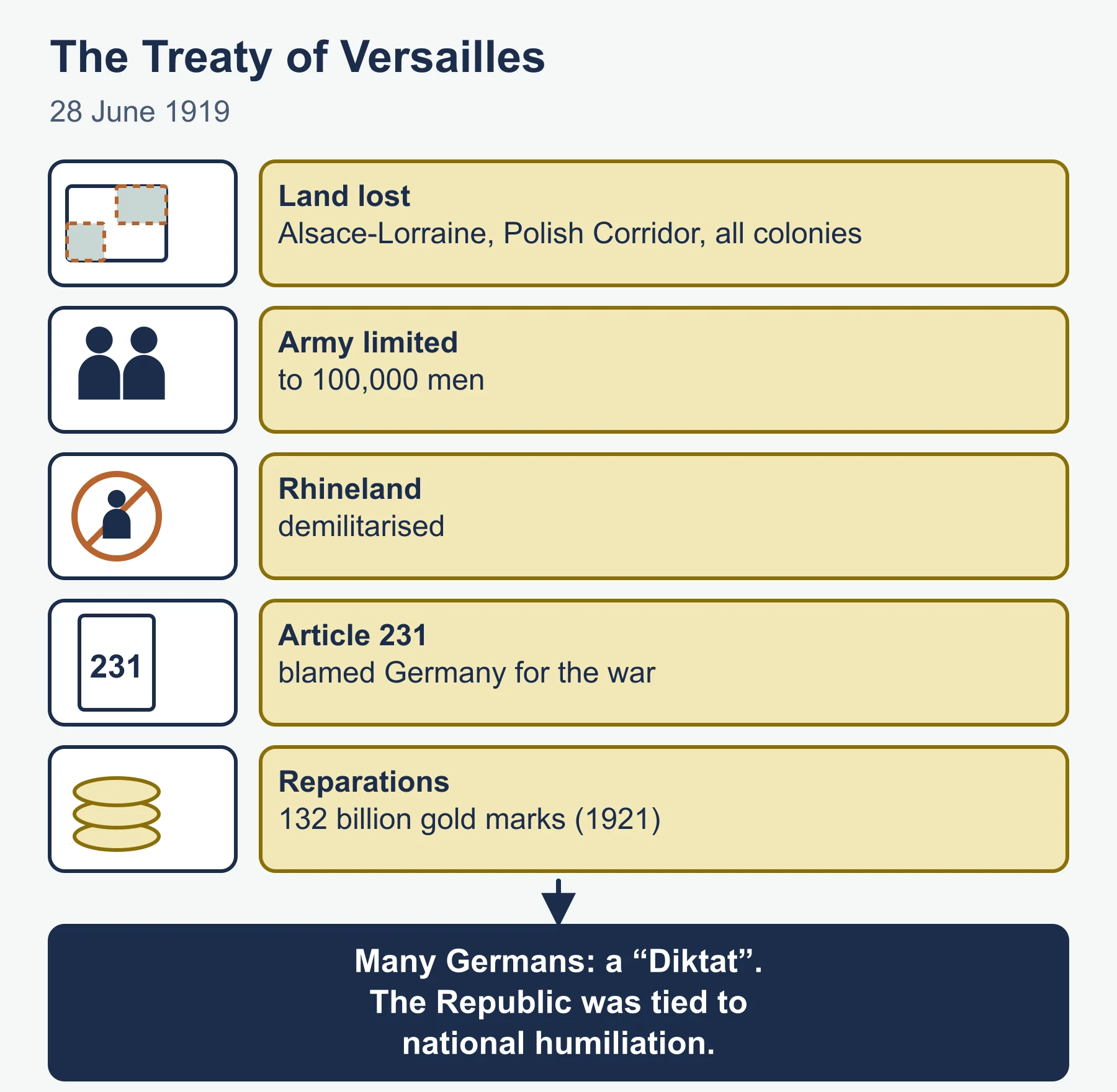
Weak points from the start: Article 48; coalitions; the “stab in the back” myth; judges and civil servants loyal to the old regime, who punished left-wing rebels harshly and right-wing ones lightly.
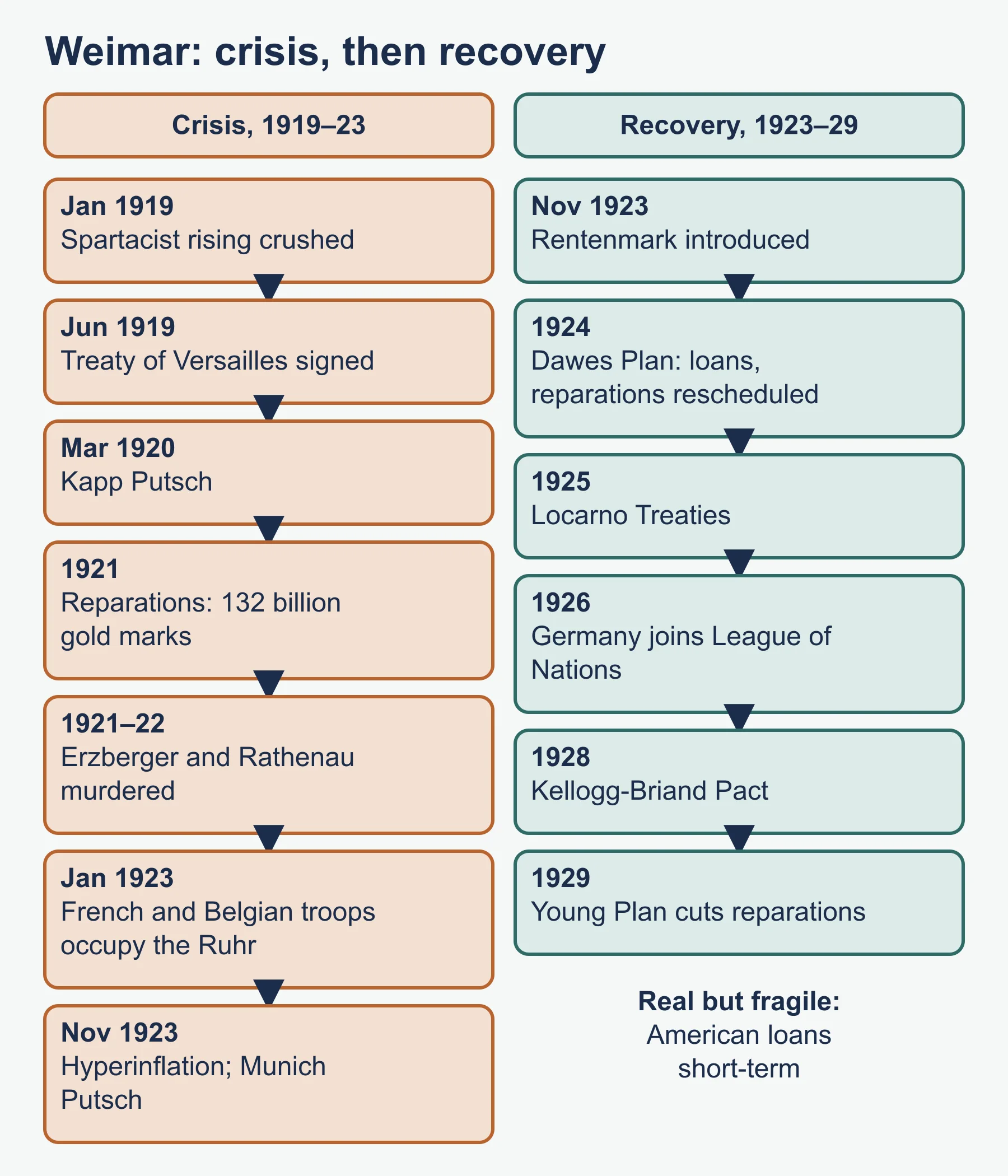
Recovery, 1924-29: stable currency; American loans under the Dawes Plan; new roads, housing and factories; Germany accepted abroad. Limits: dependence on short-term loans; farm prices falling before 1929; unemployment never disappeared; anti-democratic parties survived.
Achievements: the Bauhaus, expressionist art (such as Otto Dix’s war paintings), cinema, cabaret and jazz; greater freedom for women, who could vote and enter more professions.
Key question 2: Why was Hitler able to dominate Germany by 1934?
Nazi ideas: the Twenty-Five Point Programme (1920); destroy Versailles; unite all German speakers; Lebensraum in the east; anti-Semitism and racial purity; a strong leader instead of democracy; anti-communism.
Methods after 1923: after the Munich Putsch, Hitler decided to win power legally through elections; the party was reorganised with local branches; the SS (1925) and Hitler Youth (1926) were founded; Goebbels became the party’s leader in Berlin in 1926.
Leaders to know: Goebbels (propaganda), Göring (Reichstag president from 1932, later head of the Four-Year Plan), Himmler (SS), Röhm (SA).
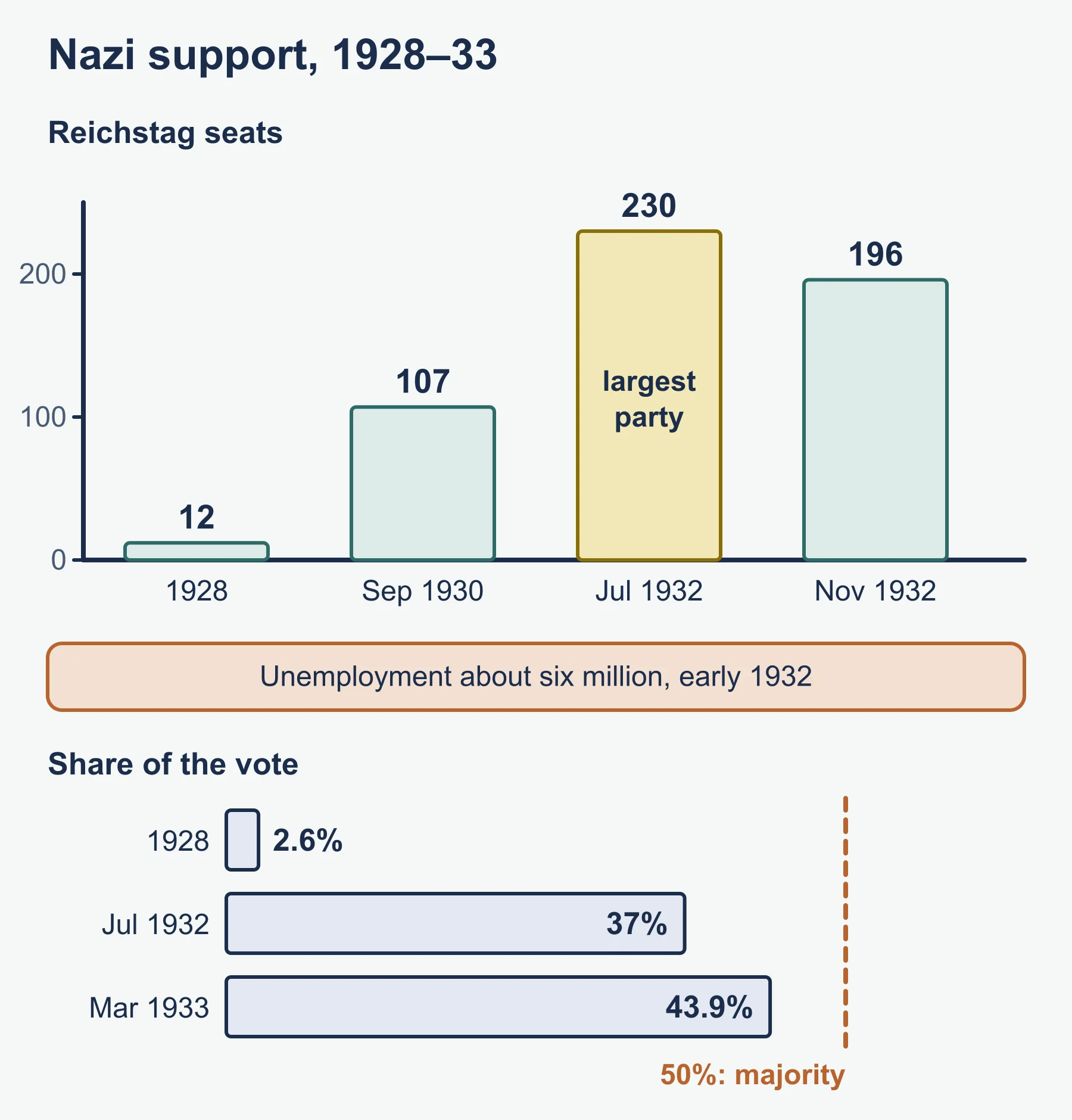
Crisis of 1930-33: Brüning’s government ruled by Article 48 decree and cut spending; Papen and then Schleicher followed; in the 1932 presidential election Hindenburg beat Hitler in a second round; the KPD vote also grew, frightening business and the middle class.
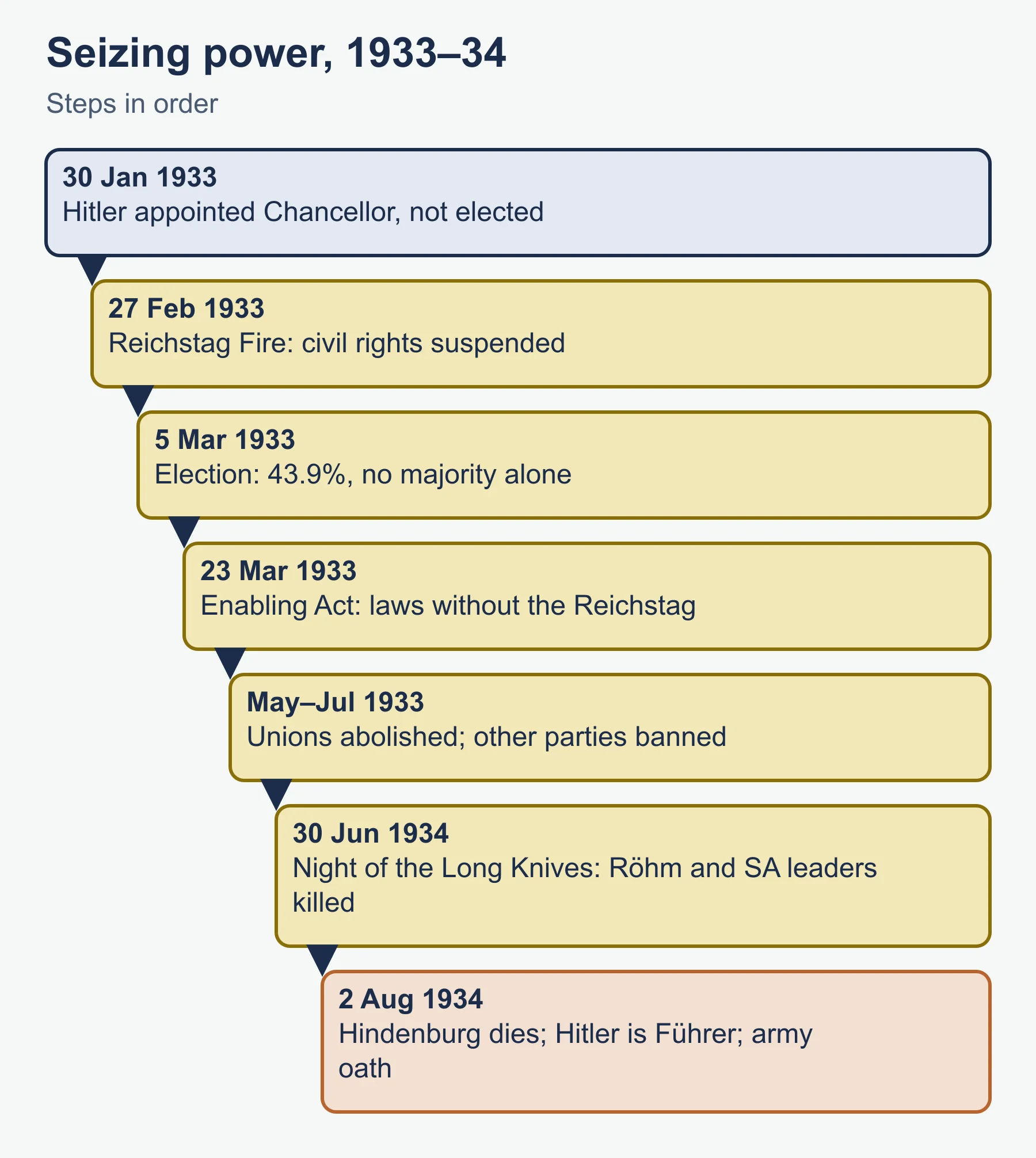
Consolidation chain: Chancellor (January 1933) → Reichstag Fire → emergency decree → March election → Enabling Act (passed by 444 votes to 94; only the SPD voted against among the parties present) → trade unions abolished and the German Labour Front set up (May 1933) → other parties banned (July 1933) → Night of the Long Knives → Hindenburg’s death and the army oath.
Key question 3(a): How effectively did the Nazis control Germany?
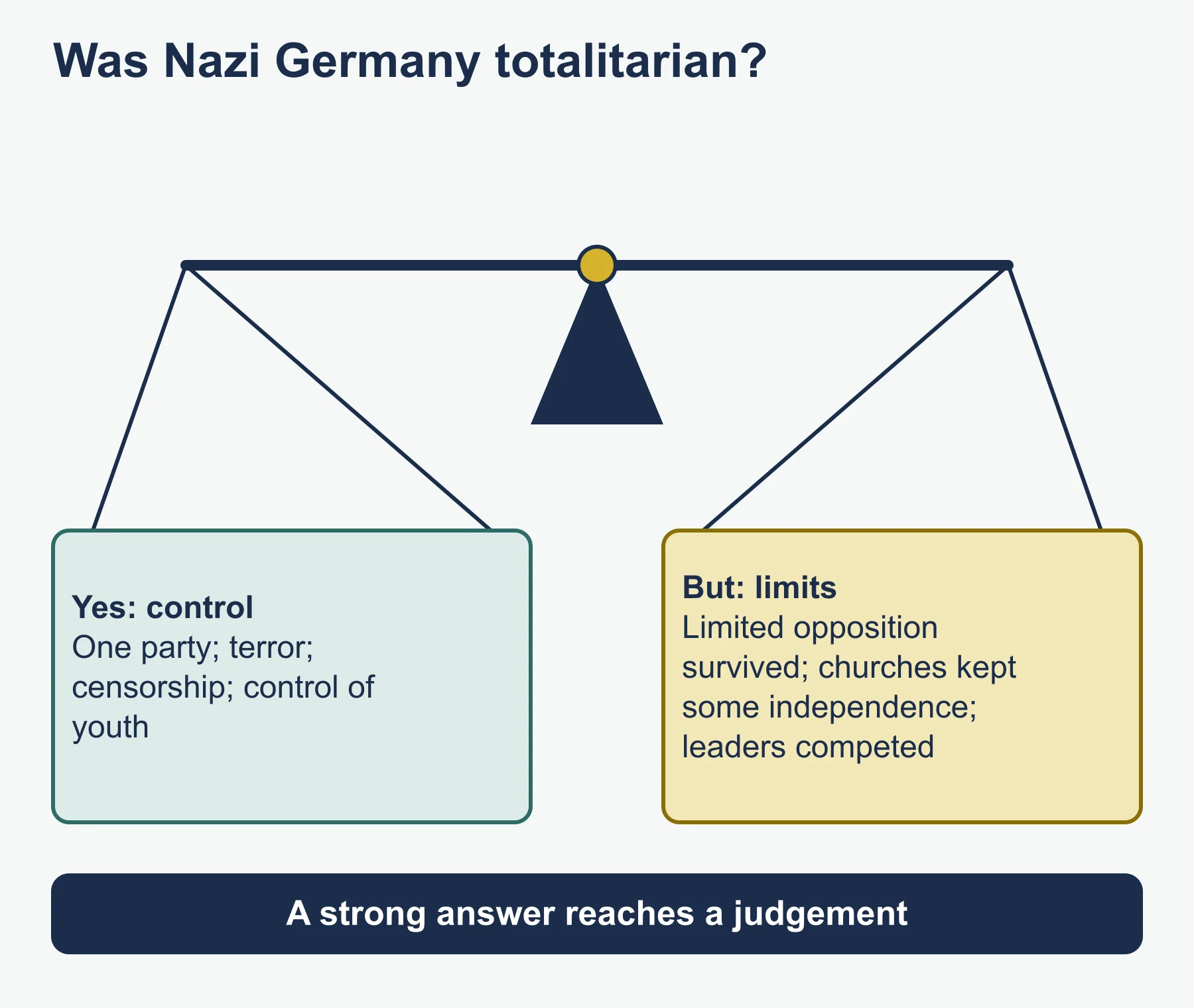
- Police state: SS under Himmler; Gestapo; SD security service under Heydrich; concentration camps; People’s Courts; block wardens reporting on neighbours.
- Propaganda: Ministry of Popular Enlightenment and Propaganda (March 1933); cheap People’s Receiver radios; Nuremberg rallies; Leni Riefenstahl’s films; the 1936 Berlin Olympics.
- Censorship and culture: book burnings (May 1933); the Reich Chamber of Culture; the “Degenerate Art” exhibition (1937); jazz and modern art attacked.
- Churches: Concordat with the Pope (1933); a Nazi-controlled Reich Church; Pastor Niemöller sent to a camp; the papal letter With Burning Concern (1937) criticised the regime; Bishop von Galen protested against the killing of disabled people (1941).
- Persecution: boycott of Jewish shops (April 1933); Jews dismissed from the civil service (1933); Nuremberg Laws (1935); Kristallnacht (1938); sterilisation law (1933) and the murder of disabled people from 1939; persecution of Roma, homosexuals, Jehovah’s Witnesses and the “work-shy”.
- Opposition: limited and divided; the left was crushed early; some church leaders spoke out; youth groups; the White Rose; the July 1944 bomb plot led by Claus von Stauffenberg.
Key question 3(b): What was it like to live in Nazi Germany?
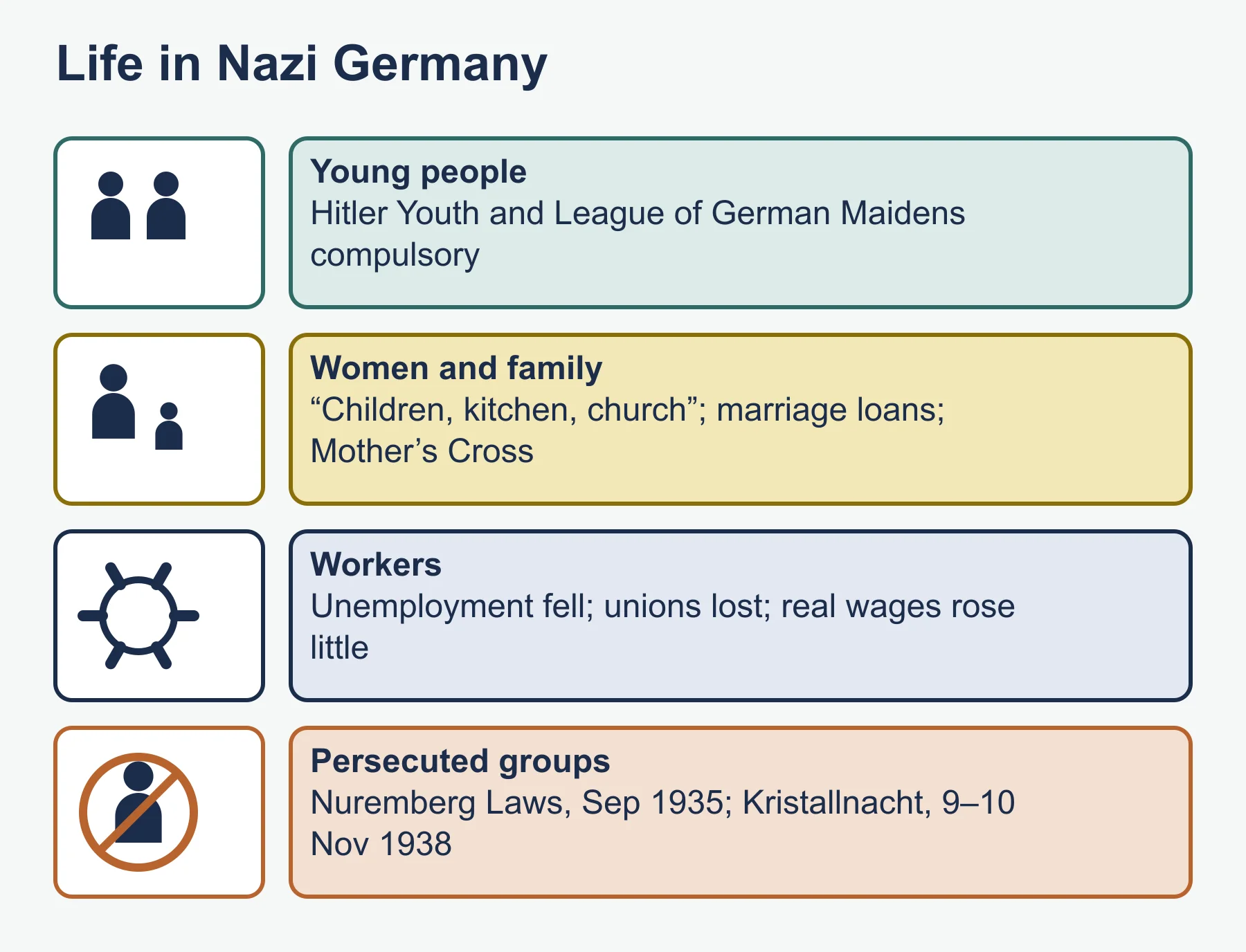
- Young people: Jungvolk and Jungmädel (10-14), Hitler Youth and League of German Maidens (14-18); membership made compulsory by law; camps, sport, marching; school textbooks rewritten around race. Many enjoyed it; Swing Youth and Edelweiss Pirates rejected it.
- Women: marriage loans, a quarter of which was cancelled for each child born; Mother’s Cross awards; women pushed out of the civil service, law and medicine; from 1937 and especially in war, women needed in factories.
- Workers and the economy: Schacht’s economic policies; public works such as the autobahns; the Reich Labour Service; conscription (1935); the Four-Year Plan under Göring (1936) aimed at self-sufficiency for war; the DAF replaced unions; Strength Through Joy holidays and the Volkswagen savings scheme.
- The coming of war: rationing from 1939; women and foreign workers in industry; Speer raised arms production from 1942; total war from 1943; bombing of cities; the Final Solution: mass shootings by the Einsatzgruppen in the East from 1941, then death camps after the Wannsee Conference (1942).
Key terms
| Term | Meaning |
|---|---|
| Diktat | A dictated peace, the German view of Versailles |
| Freikorps | Armed ex-soldier groups used against the left in 1919-20 |
| Putsch | An attempt to seize power by force |
| Hyperinflation | Extremely rapid price rises that destroy a currency’s value |
| Gleichschaltung | Co-ordination: bringing every organisation under Nazi control |
| Volksgemeinschaft | The “people’s community” the Nazis claimed to build |
| Lebensraum | Living space for Germans in eastern Europe |
| Autarky | Economic self-sufficiency |
| Totalitarian | A state controlling every aspect of life |
| Final Solution | The Nazi plan to murder all of Europe’s Jews |
Exam traps
- Chancellor versus Führer. Hitler became Chancellor in January 1933 and Führer in August 1934.
- The Enabling Act was passed legally, but after communists were arrested and with SA men surrounding the building.
- “Recovery” in 1924-29 had limits. Always include the dependence on American loans.
- Consent as well as terror. Many Germans supported the regime; a judgement on control must weigh both.
- Date range. Depth Study B ends in 1945; the war years on the home front are part of it.
Self-test
- What was the Ebert-Groener agreement? Army support for the government in return for leaving the officer corps alone.
- Which party did Stresemann lead? The DVP (German People’s Party).
- Name one cultural achievement of the Weimar period. The Bauhaus school of design.
- Why did Hitler change tactics after 1923? The failed putsch showed he needed to win power legally through elections.
- Who ruled by Article 48 decree from 1930? Chancellor Heinrich Brüning.
- What happened to trade unions in May 1933? They were abolished and replaced by the German Labour Front.
- What was the Concordat? The 1933 agreement with the Pope that the Nazis would not interfere with the Catholic Church.
- Who led the July 1944 bomb plot? Claus von Stauffenberg.
- What were the Nuremberg Laws? 1935 laws removing Jews’ citizenship and banning marriage between Jews and non-Jews.
- What did the Four-Year Plan aim for? Self-sufficiency and readiness for war.
- What was Strength Through Joy? A Nazi organisation providing leisure and holidays for workers.
- What was decided at the Wannsee Conference in 1942? The co-ordination of the Final Solution.
Related resources
-
Practice questions
Cambridge IGCSE World History (0470): Depth Study C: Russia, 1905-41 – Practice Questions
Thirteen original questions with mark-scheme answers on Cambridge IGCSE History 0470 Depth Study C, Russia 1905-41, from 1905 to Stalin's Five-Year Plans.
World History · Cambridge · IGCSE
Try questions -
Revision notes
Cambridge IGCSE World History (0470): Depth Study C: Russia, 1905-41 – Revision Notes
Recall notes for Cambridge IGCSE History 0470 Depth Study C, Russia 1905-41: Tsarism's collapse, Bolshevik rule, Stalin's power and economic change.
World History · Cambridge · IGCSE
Revise topic -
Practice questions
Cambridge IGCSE World History (0470): Depth Study D: The United States, 1919-41 – Practice Questions
Thirteen original questions with mark-scheme answers on Cambridge IGCSE History 0470 Depth Study D, the USA 1919-41, from the boom to the New Deal.
World History · Cambridge · IGCSE
Try questions
Get free revision emails (optional)
Occasional emails with practice questions, worked explanations and links to free resources for the qualification and subjects you choose. No spam, and you can unsubscribe from any email. The free tools on this site never need an email.