
Revision Notes
Cambridge IGCSE World History (0470): Depth Study C: Russia, 1905-41 – Revision Notes
Recall notes for Cambridge IGCSE History 0470 Depth Study C, Russia 1905-41: Tsarism's collapse, Bolshevik rule, Stalin's power and economic change.
- Subject
- World History
- Level
- IGCSE
- Topic
- Depth Studies
- Author
- Marlbridge Academic Team
- Updated
- Reviewed by
- Azam Siddique (what this means)
Aligned to Cambridge IGCSE World History (0470), 2024-2026. Official specification .
Syllabus page (what it covers and how it is assessed): Cambridge IGCSE World History.
Syllabus points this page covers
0470
- 3.3 Depth study C: Russia, 1905–41
Found an error? Report a correction.
Need help with this topic? Request a free trial class for IGCSE World History (0470).
These notes condense Depth Study C: Russia, 1905-41 in Cambridge IGCSE History 0470. Its four key questions ask why the Tsarist regime collapsed in 1917, how the Bolsheviks gained power and consolidated their rule, how Stalin gained and held on to power, and what the impact of Stalin’s economic policies was. For explanation and a worked (b) answer, read the Depth Study C study guide; to apply the facts, try the Depth Study C practice questions.
Dates for 1917 are given in the western calendar, which the syllabus uses (the March and November revolutions). Russia then used an older calendar, so many books call them the February and October revolutions.
Key question 1: Why did the Tsarist regime collapse in 1917?
Ruling Russia before 1914
- Autocracy: Nicholas II (Tsar from 1894) believed he ruled by divine right; no elected parliament before 1906.
- Control: the Okhrana (secret police), censorship, the Orthodox Church and Russification of minorities.
- Society: a huge peasant majority short of land; a small but growing working class in crowded factory cities; a small middle class wanting a say in government.
- Opponents: liberals (later the Kadets), Socialist Revolutionaries (peasant-based) and the Marxist Social Democrats, split from 1903 into Bolsheviks (Lenin) and Mensheviks.
The 1905 Revolution and survival
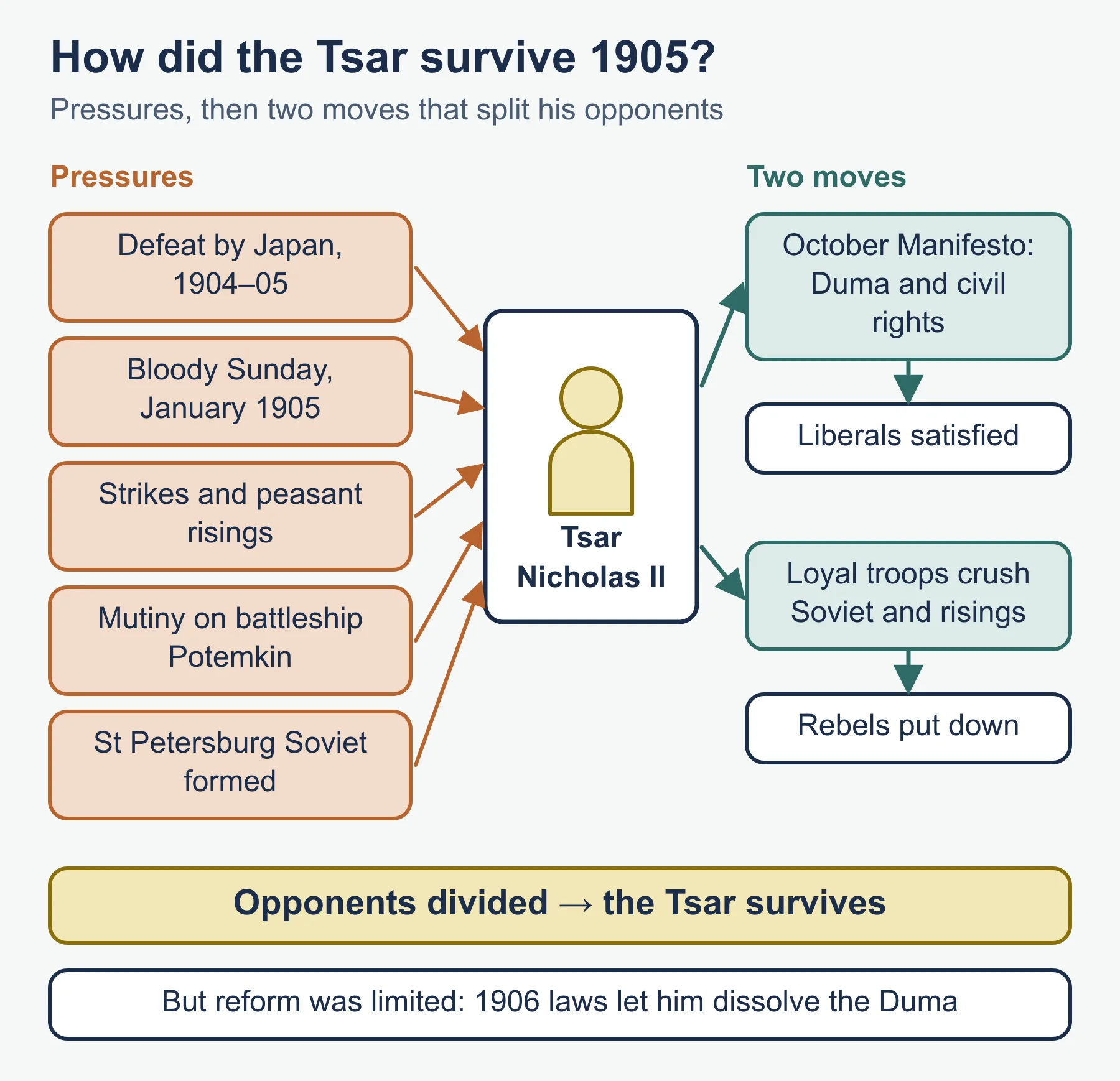
- Defeat by Japan (1904-05) exposed the regime’s weakness.
- Bloody Sunday (January 1905): troops fired on a peaceful march led by Father Gapon.
- Strikes, peasant risings, the Potemkin mutiny and the St Petersburg Soviet followed.
- How the Tsar survived: the October Manifesto promised a Duma and civil rights, splitting liberals from socialists; peace with Japan freed loyal troops; the army stayed loyal and crushed the Soviet and peasant risings.
- Aftermath: the Fundamental Laws (1906) kept the Tsar’s power; the first two Dumas were dissolved and voting rules changed to favour landowners; Stolypin combined repression (the hangman’s noose became known as “Stolypin’s necktie”) with land reform to create prosperous peasant farmers; he was assassinated in 1911. Troops shot striking miners at the Lena goldfields in 1912.
The First World War
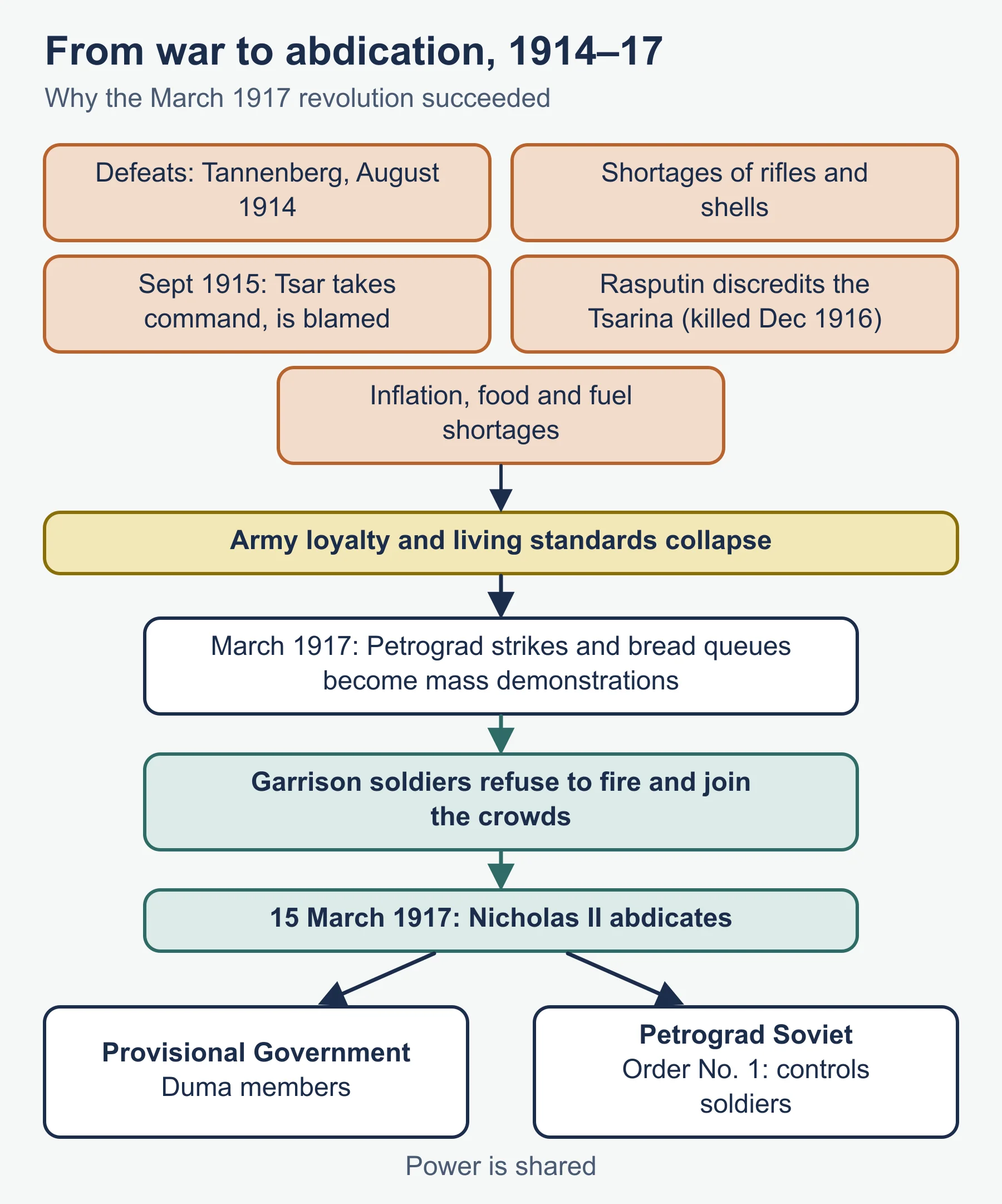
- Defeats at Tannenberg (1914) and huge losses in 1915.
- The Tsar became commander-in-chief (September 1915), so defeats were blamed on him personally.
- The Tsarina and Rasputin influenced ministers in Petrograd; Rasputin was murdered in December 1916.
- Inflation, food and fuel shortages, and railways overloaded with military traffic.
March 1917: bread queues and strikes in Petrograd, starting on International Women’s Day; soldiers mutinied and joined the crowds; the Duma set up a Provisional Government; the Petrograd Soviet was formed; generals advised the Tsar to go, and he abdicated.
Key question 2: How did the Bolsheviks gain power and consolidate their rule?
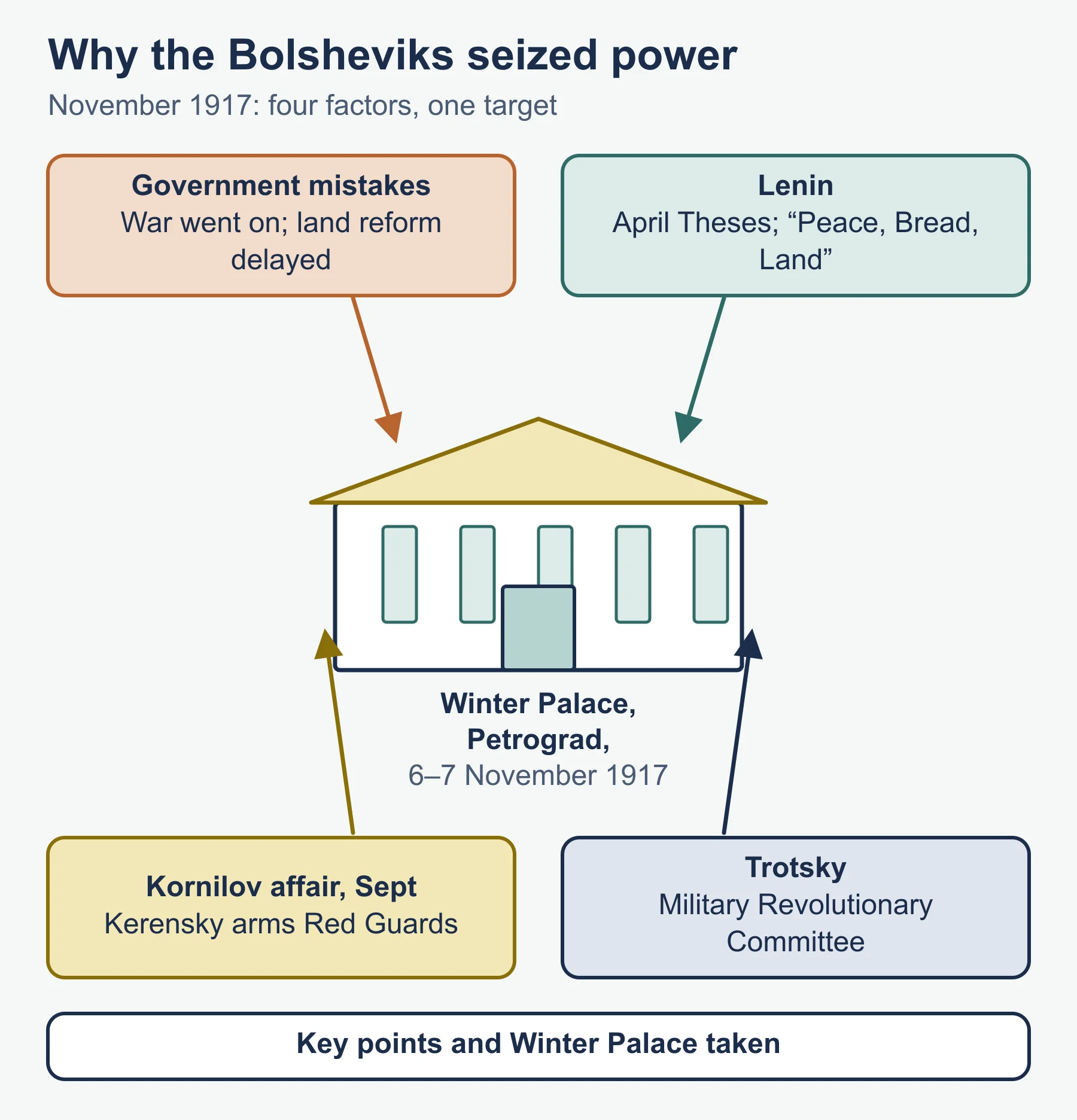
- Dual power: the Provisional Government shared authority with the Petrograd Soviet, whose Order No. 1 told soldiers to obey the Soviet first.
- Provisional Government’s mistakes: kept fighting (the June Offensive failed); delayed land reform and elections to a Constituent Assembly.
- Lenin’s return (April 1917): the April Theses – no support for the government, “all power to the Soviets”, “peace, bread, land”.
- July Days: failed armed demonstrations; Lenin fled to Finland.
- Kornilov affair (August-September): Kerensky armed the Red Guards to stop the general’s march on Petrograd, restoring Bolshevik prestige; the Bolsheviks won a majority in the Petrograd Soviet.
- Seizure of power (6-7 November): Trotsky’s Military Revolutionary Committee took key points; the Winter Palace fell. Decrees on Peace and Land followed.
- Consolidation: the Cheka (December 1917); the Constituent Assembly, in which the Socialist Revolutionaries were the largest party, closed after one day (January 1918); Brest-Litovsk (March 1918) ended the war at a heavy price in land.
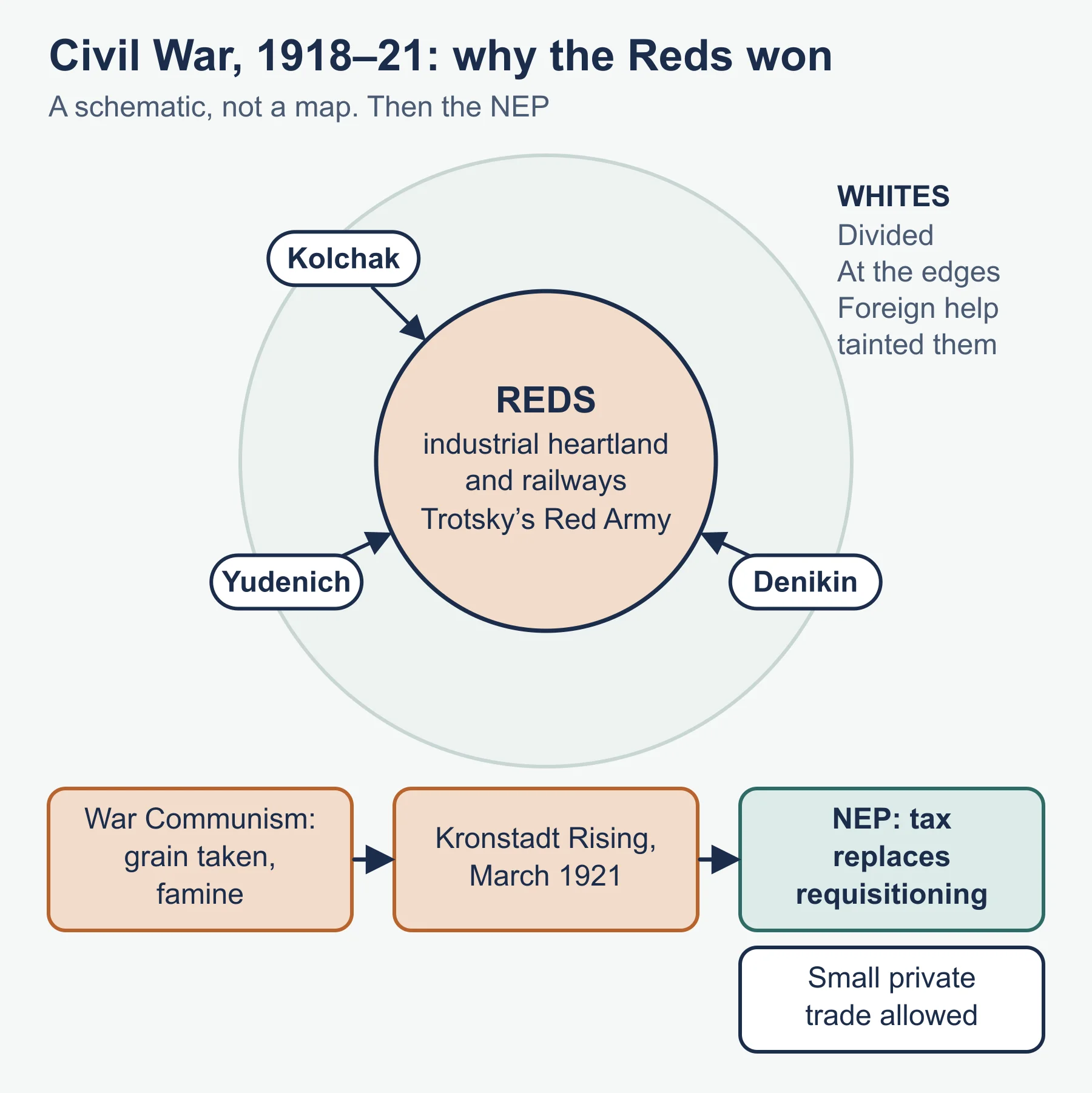
- Civil War (1918-21): Reds held the central core, railways and industry; Trotsky built a disciplined Red Army with commissars and former Tsarist officers; Whites (Kolchak, Denikin, Yudenich, Wrangel) were divided and far apart; foreign intervention helped Bolshevik propaganda; the Tsar’s family was shot in 1918.
- War Communism: grain requisitioning, nationalisation, rationing; famine and unrest followed.
- Kronstadt (March 1921): sailors who had backed the revolution rebelled and were crushed; Lenin introduced the New Economic Policy: private trade and small businesses allowed, a tax in kind replaced requisitioning. Food production recovered, but “NEPmen” were resented by many communists.
Key question 3: How did Stalin gain and hold on to power?
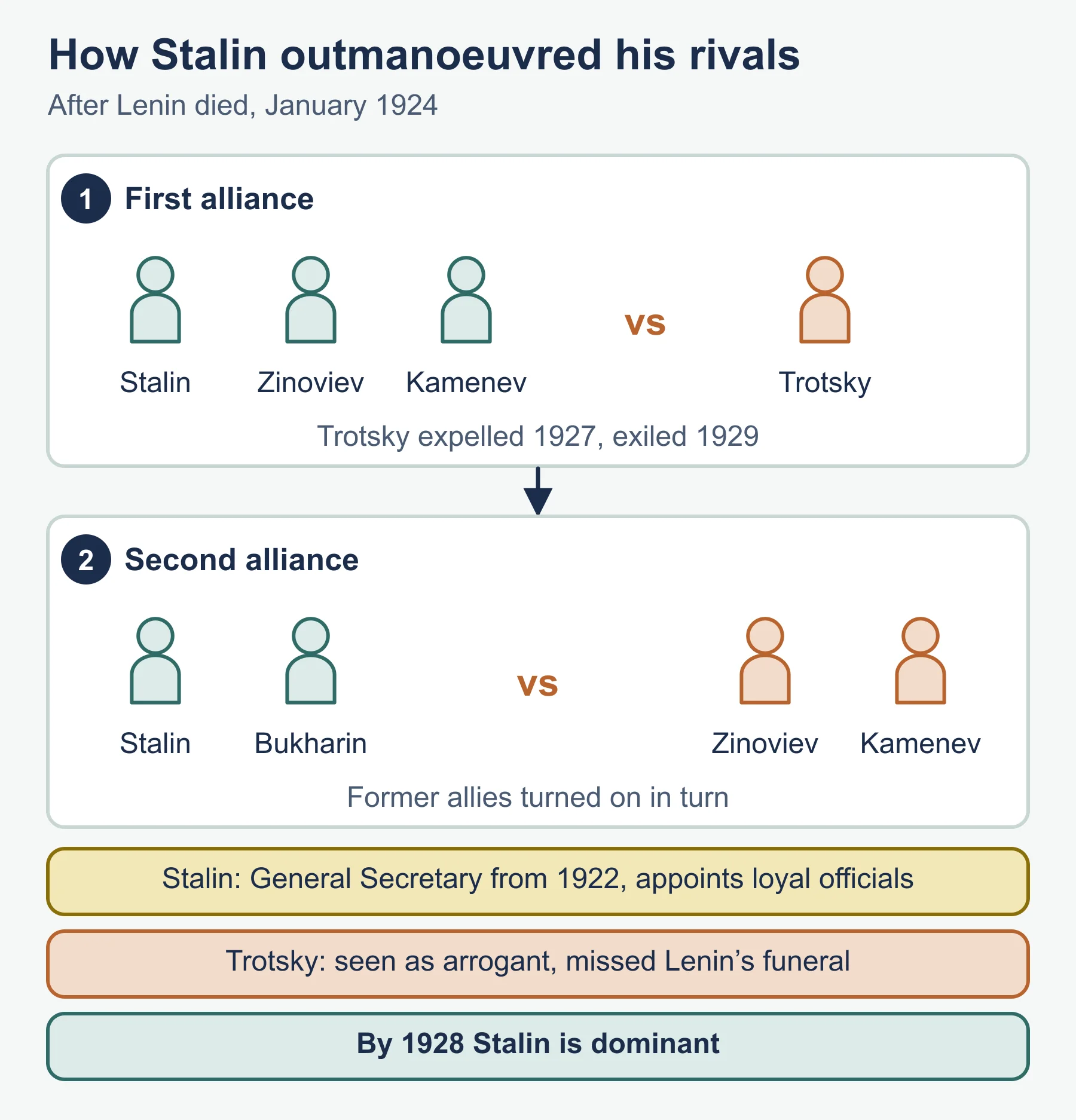
- Positions: General Secretary from 1922, controlling appointments; he placed loyal supporters in the party.
- Lenin’s Testament criticised Stalin but was not published.
- Trotsky’s errors: missed Lenin’s funeral; seen as arrogant; his “permanent revolution” seemed less attractive than Stalin’s “socialism in one country”.
- Shifting alliances: with Zinoviev and Kamenev against Trotsky; with Bukharin against them; then against Bukharin and the Right.
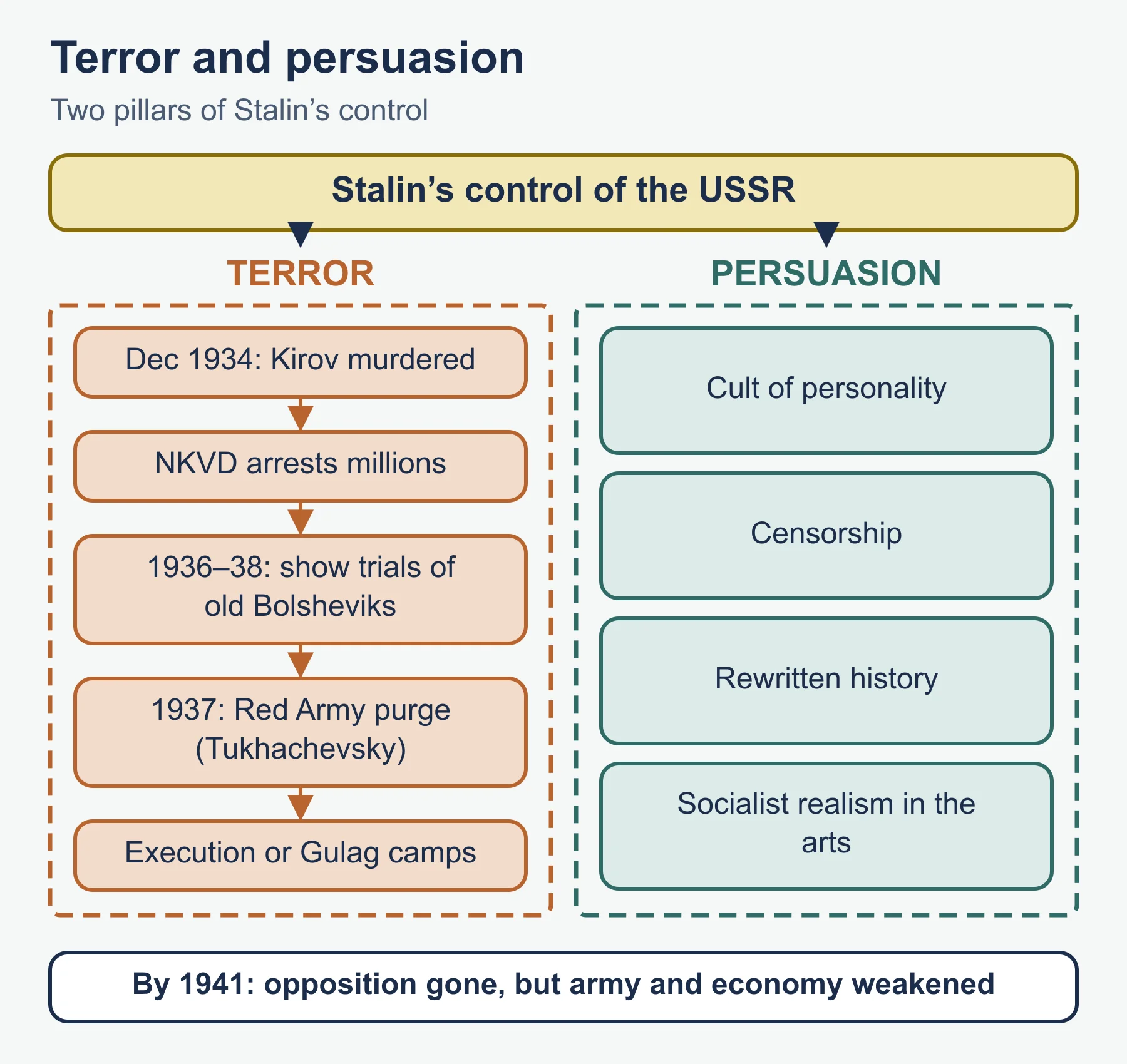
- The Purges: Kirov’s murder (December 1934); show trials of Old Bolsheviks (1936-38); the army purge including Marshal Tukhachevsky (1937); the NKVD; millions arrested and sent to the gulag labour camps.
- Propaganda and culture: cult of personality; history rewritten; socialist realism in art and literature.
- The 1936 Constitution promised rights that were not honoured.
Key question 4: What was the impact of Stalin’s economic policies?
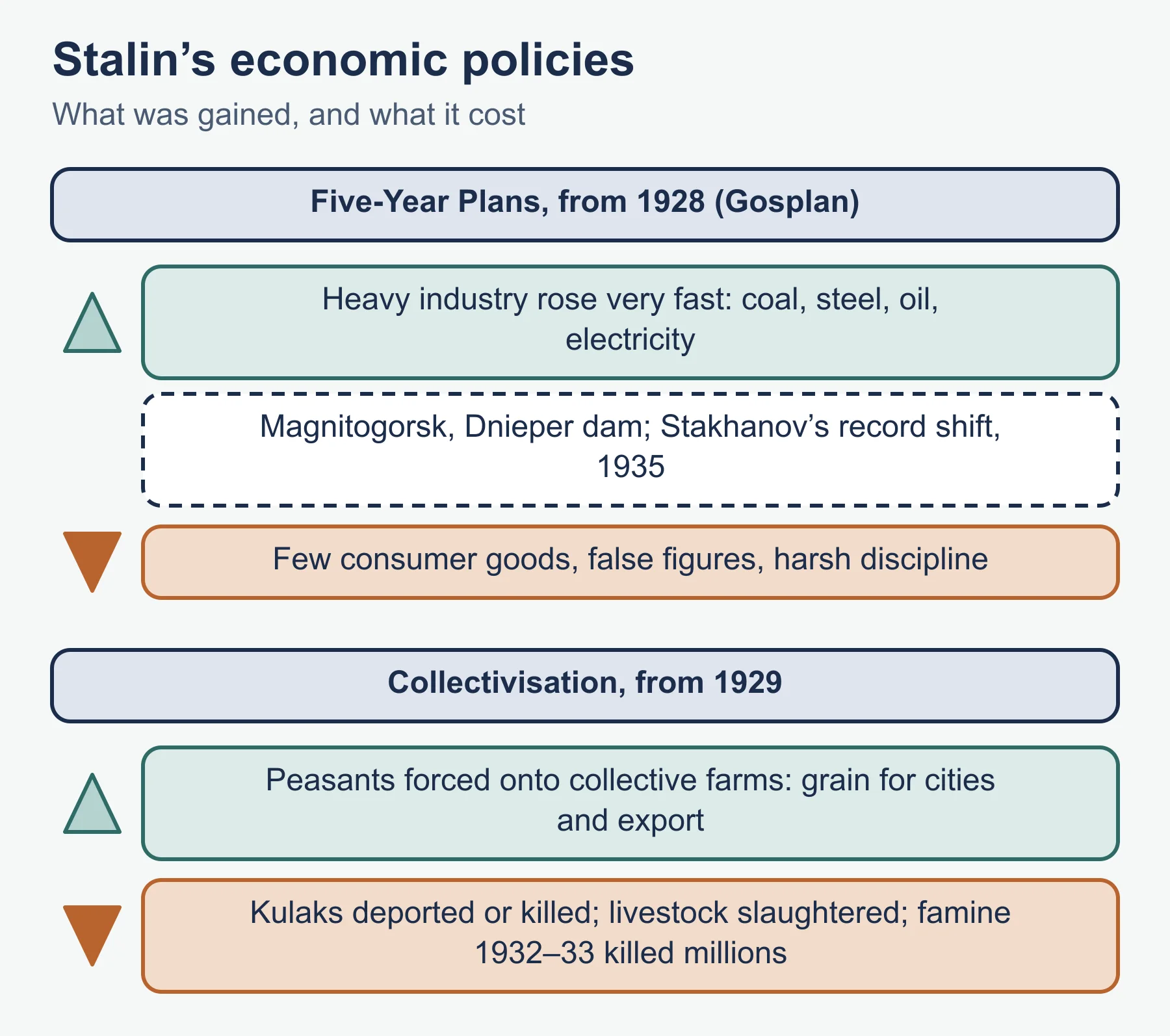
- Five-Year Plans (from 1928), set by Gosplan: heavy industry, coal, steel, oil, electricity; projects such as Magnitogorsk and the Dnieper dam; Stakhanov’s record coal shift (1935) used to push workers harder.
- Collectivisation (from 1929): peasant farms merged into collective farms; kulaks “liquidated as a class”; peasants slaughtered livestock rather than hand it over; famine in 1932-33, especially in Ukraine and Kazakhstan.
- Social groups: skilled workers and party officials gained; peasants lost most; women entered industry in large numbers but kept domestic burdens; divorce was made harder and abortion banned in 1936; minorities faced Russification and deportation.
Key terms
| Term | Meaning |
|---|---|
| Autocracy | Rule by one person with unlimited power |
| Duma | Russian parliament created after 1905 |
| Soviet | Council of workers’ and soldiers’ deputies |
| Dual power | Shared authority of the Provisional Government and the Petrograd Soviet |
| Cheka | Bolshevik secret police founded in 1917 |
| War Communism | Bolshevik economic policy during the Civil War |
| NEP | New Economic Policy (1921), allowing limited private trade |
| Kulak | A richer peasant, the target of collectivisation |
| Collective farm | Large farm run jointly, delivering quotas to the state |
| Gulag | System of Soviet labour camps |
| Show trial | Public trial with a fixed verdict, used for propaganda |
| Socialist realism | Art showing Soviet life positively and heroically |
Exam traps
- Two revolutions in 1917. March removed the Tsar; November brought the Bolsheviks to power.
- The Provisional Government was not Bolshevik. It was led by liberals, then Kerensky.
- NEP was a retreat, not a step towards communism; Lenin called it temporary.
- Stalin was not Lenin’s chosen successor. The Testament warned against him.
- Date range. Depth Study C ends in 1941, before the German invasion.
Self-test
- What happened on Bloody Sunday? Troops fired on a peaceful march to the Winter Palace in January 1905.
- How did the October Manifesto help the Tsar survive? It split the liberals from the socialists by promising a Duma.
- What were Stolypin’s two approaches? Repression of opponents and land reform for peasants.
- Why was the Tsar’s decision of September 1915 so damaging? As commander-in-chief he was blamed for every defeat.
- What was Order No. 1? The Soviet’s instruction that soldiers obey it before the Provisional Government.
- What slogan summed up the April Theses? “Peace, bread, land” and “all power to the Soviets”.
- How did the Kornilov affair help the Bolsheviks? Red Guards were armed to defend Petrograd and the Bolsheviks gained credit.
- Why did Lenin close the Constituent Assembly? The Socialist Revolutionaries, not the Bolsheviks, had won most seats.
- Who built the Red Army? Trotsky.
- What event in 1921 persuaded Lenin to introduce the NEP? The Kronstadt Rising.
- Whose murder in 1934 began the Purges? Sergei Kirov’s.
- Why did livestock numbers fall during collectivisation? Peasants slaughtered animals rather than hand them to collective farms.
Related resources
-
Practice questions
Cambridge IGCSE World History (0470): Depth Study D: The United States, 1919-41 – Practice Questions
Thirteen original questions with mark-scheme answers on Cambridge IGCSE History 0470 Depth Study D, the USA 1919-41, from the boom to the New Deal.
World History · Cambridge · IGCSE
Try questions -
Revision notes
Cambridge IGCSE World History (0470): Depth Study D: The United States, 1919-41 – Revision Notes
Recall notes for Cambridge IGCSE History 0470 Depth Study D, the USA 1919-41: the boom, 1920s society, the Crash and the New Deal, with a self-test.
World History · Cambridge · IGCSE
Revise topic -
Practice questions
Cambridge IGCSE World History (0470): Depth Study E: The Second World War in Europe and the Asia-Pacific, 1939-c.1945 – Practice Questions
Thirteen original questions with mark-scheme answers on Cambridge IGCSE History 0470 Depth Study E, the Second World War in Europe and the Asia-Pacific.
World History · Cambridge · IGCSE
Try questions
Get free revision emails (optional)
Occasional emails with practice questions, worked explanations and links to free resources for the qualification and subjects you choose. No spam, and you can unsubscribe from any email. The free tools on this site never need an email.