
Revision Notes
Cambridge IGCSE World History (0470): Depth Study D: The United States, 1919-41 – Revision Notes
Recall notes for Cambridge IGCSE History 0470 Depth Study D, the USA 1919-41: the boom, 1920s society, the Crash and the New Deal, with a self-test.
- Subject
- World History
- Level
- IGCSE
- Topic
- Depth Studies
- Author
- Marlbridge Academic Team
- Updated
- Reviewed by
- Azam Siddique (what this means)
Aligned to Cambridge IGCSE World History (0470), 2024-2026. Official specification .
Syllabus page (what it covers and how it is assessed): Cambridge IGCSE World History.
Syllabus points this page covers
0470
- 3.4 Depth study D: The United States, 1919–41
Found an error? Report a correction.
Need help with this topic? Request a free trial class for IGCSE World History (0470).
These notes condense Depth Study D: The United States, 1919-41 in Cambridge IGCSE History 0470. Its four key questions ask how far the economy boomed in the 1920s, how far society changed, what the causes and consequences of the Wall Street Crash were, and how successful the New Deal was. For explanation and a worked (c) plan, read the Depth Study D study guide; to apply the facts, try the Depth Study D practice questions.
Key question 1: How far did the US economy boom in the 1920s?
Factors behind the boom
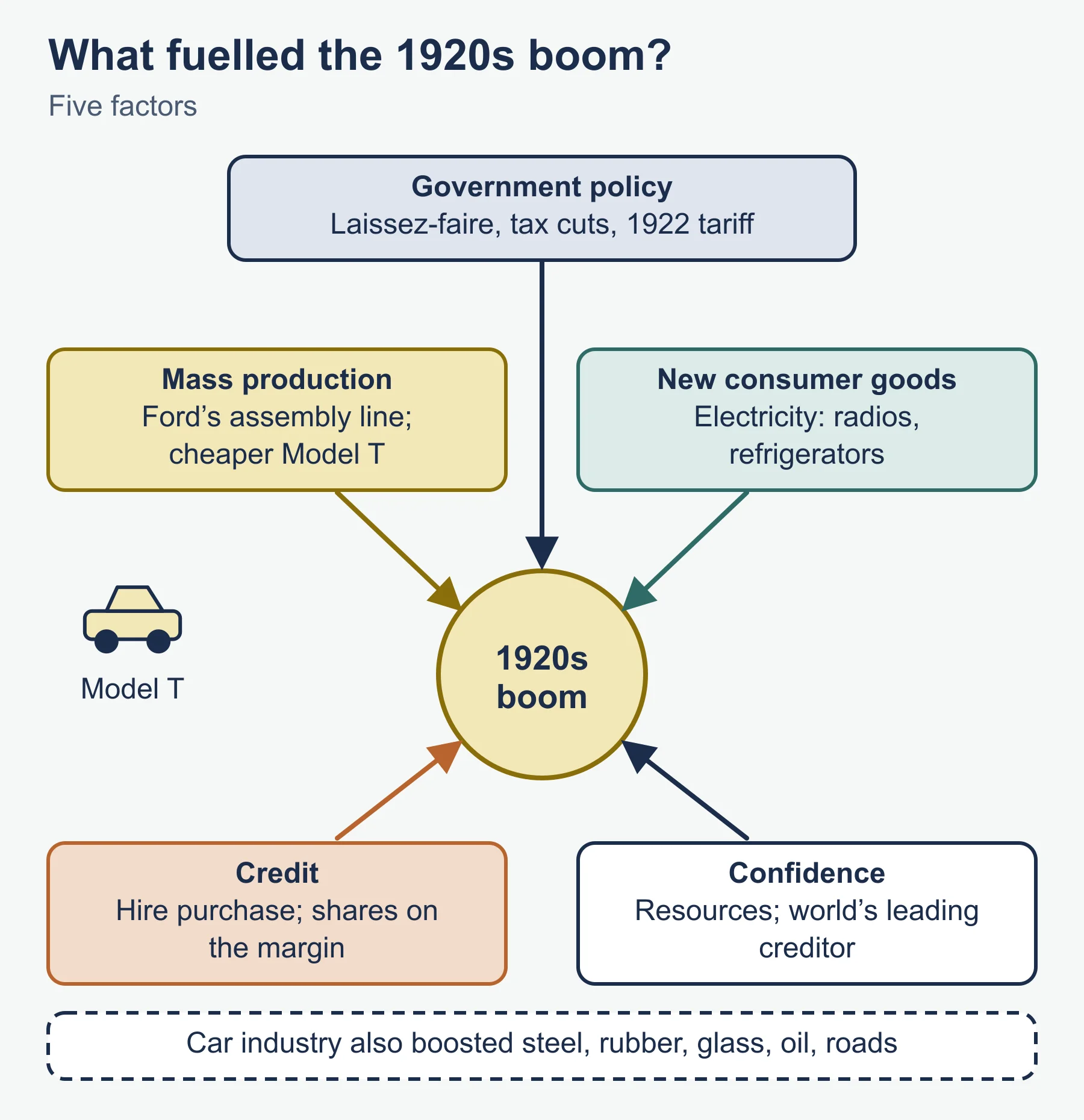
- Republican presidents Harding, Coolidge and Hoover followed laissez-faire: low taxes (Treasury Secretary Andrew Mellon), little regulation, and high tariffs such as Fordney-McCumber (1922) to protect American industry.
- The First World War had left the USA rich in raw materials and industry while European rivals recovered.
- Mass production: Ford’s moving assembly line cut the time and cost of building a Model T, so ordinary families could afford cars. The car industry boosted steel, rubber, glass, oil and road building.
- New consumer goods: radios, refrigerators, vacuum cleaners and washing machines, made possible by the spread of electricity.
- Credit and hire purchase: goods bought in instalments; advertising created demand.
- Confidence: rising share prices encouraged spending and investment.
Who did not share in it
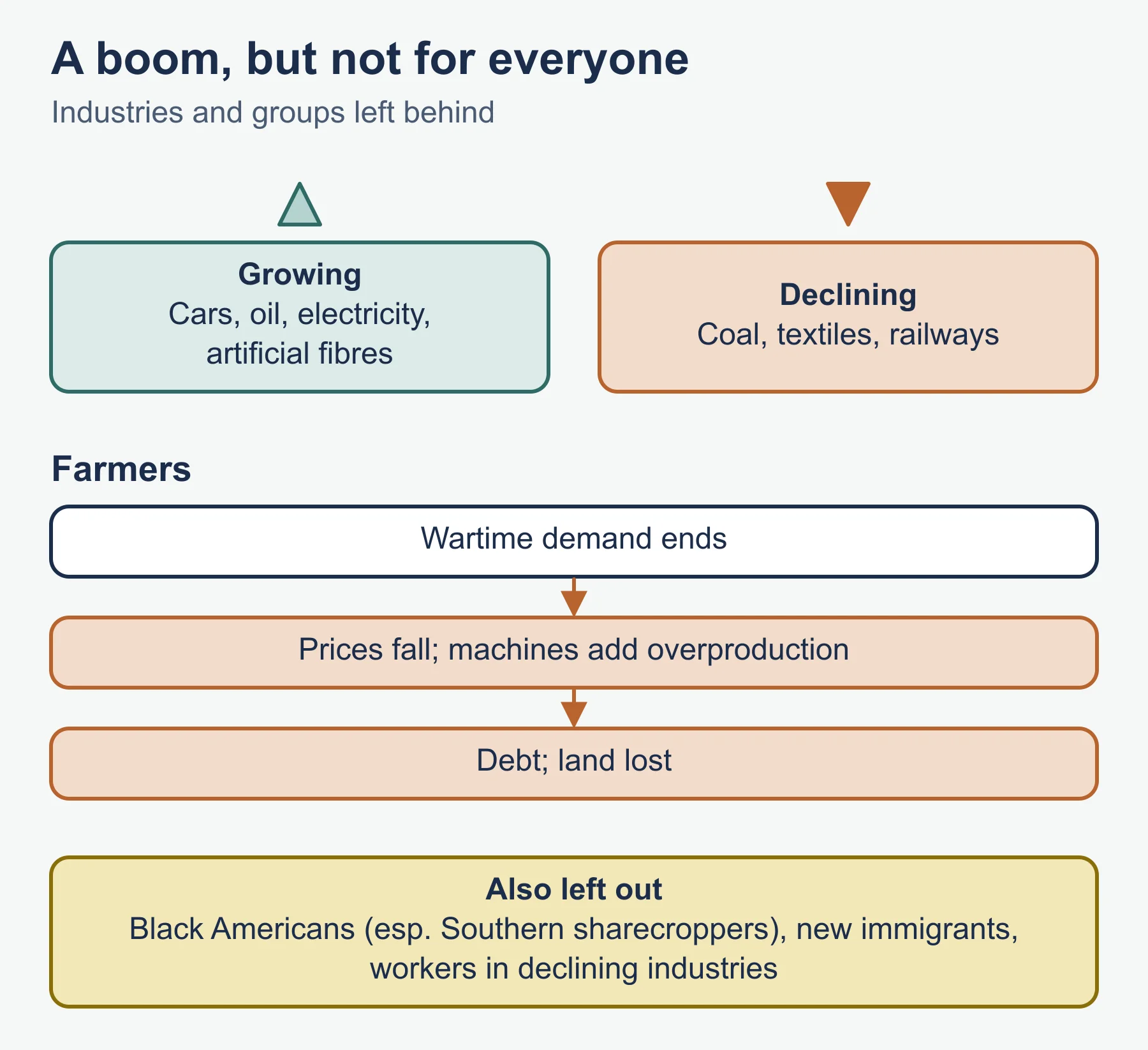
- Older industries: coal lost markets to oil and electricity; cotton textiles suffered from new artificial fibres and lower wages in the South; railways faced competition from road transport.
- Farmers: wartime demand ended; overproduction and falling prices; new machinery increased output further; many fell into debt.
- Black Americans in the South, many as poor sharecroppers; Native Americans on reservations; new immigrants in low-paid jobs.
- Weaknesses by 1929: wealth was very unevenly shared, so demand for goods began to fall; tariffs led other countries to retaliate; banks were small and unregulated.
Key question 2: How far did US society change in the 1920s?
- Roaring Twenties: jazz spread from New Orleans to Chicago and New York; dances such as the Charleston; the Harlem Renaissance in Black American writing and music.
- Film and media: Hollywood studios; stars such as Charlie Chaplin; The Jazz Singer (1927), the first major “talkie”; radio networks; mass-circulation magazines; spectator sports.
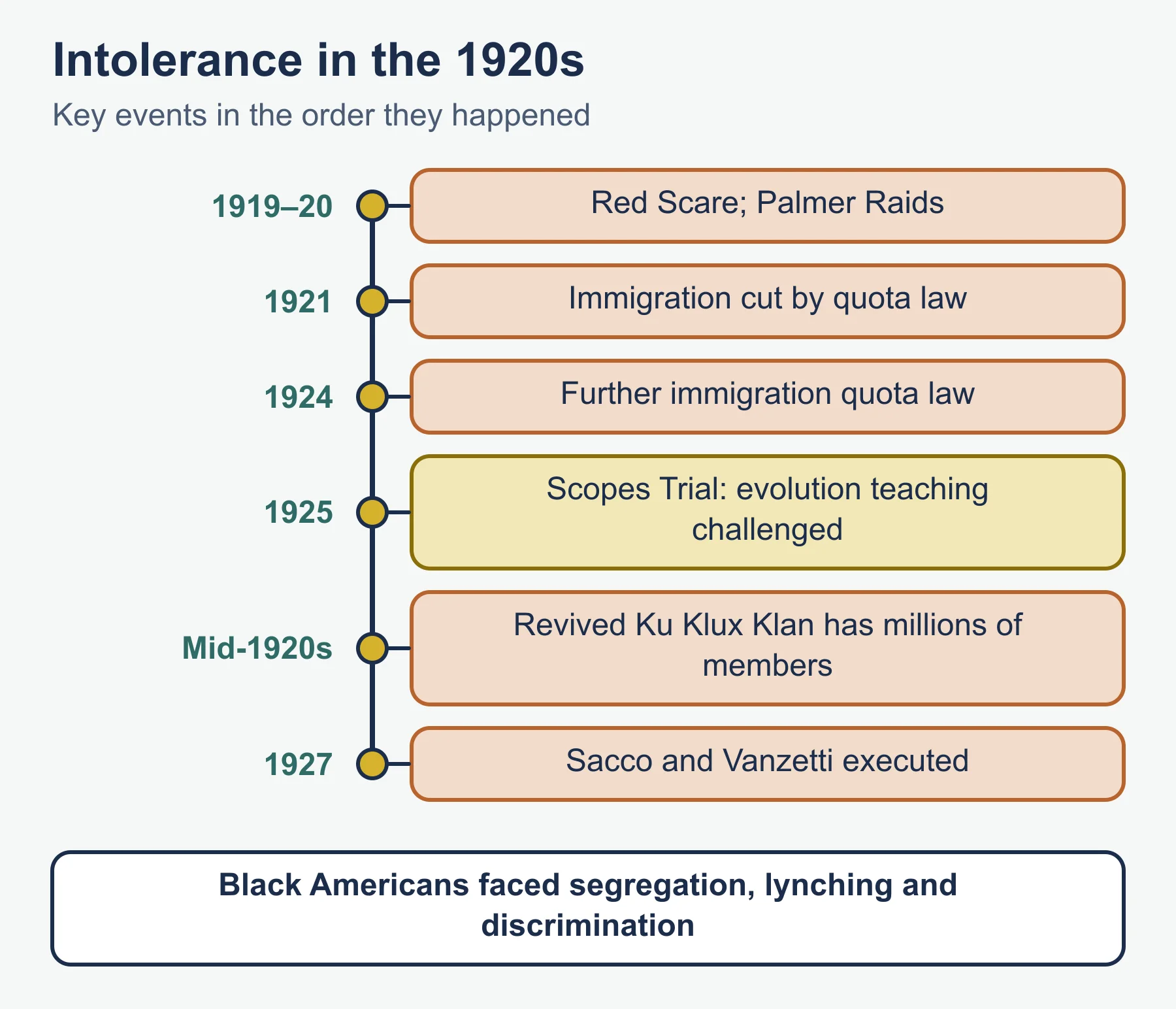
- Intolerance: the Red Scare and Palmer Raids (1919-20); the trial of Sacco and Vanzetti, executed in 1927; immigration quotas (1921 and 1924) favouring northern Europeans; the Monkey Trial (1925), when John Scopes was prosecuted for teaching evolution in Tennessee.
- Ku Klux Klan: revived in 1915; attacked Black Americans, Catholics, Jews and immigrants; declined after scandal in the mid-1920s.
- Discrimination: Jim Crow segregation laws in the South; lynchings; many Black Americans moved north in the Great Migration but met discrimination there too.
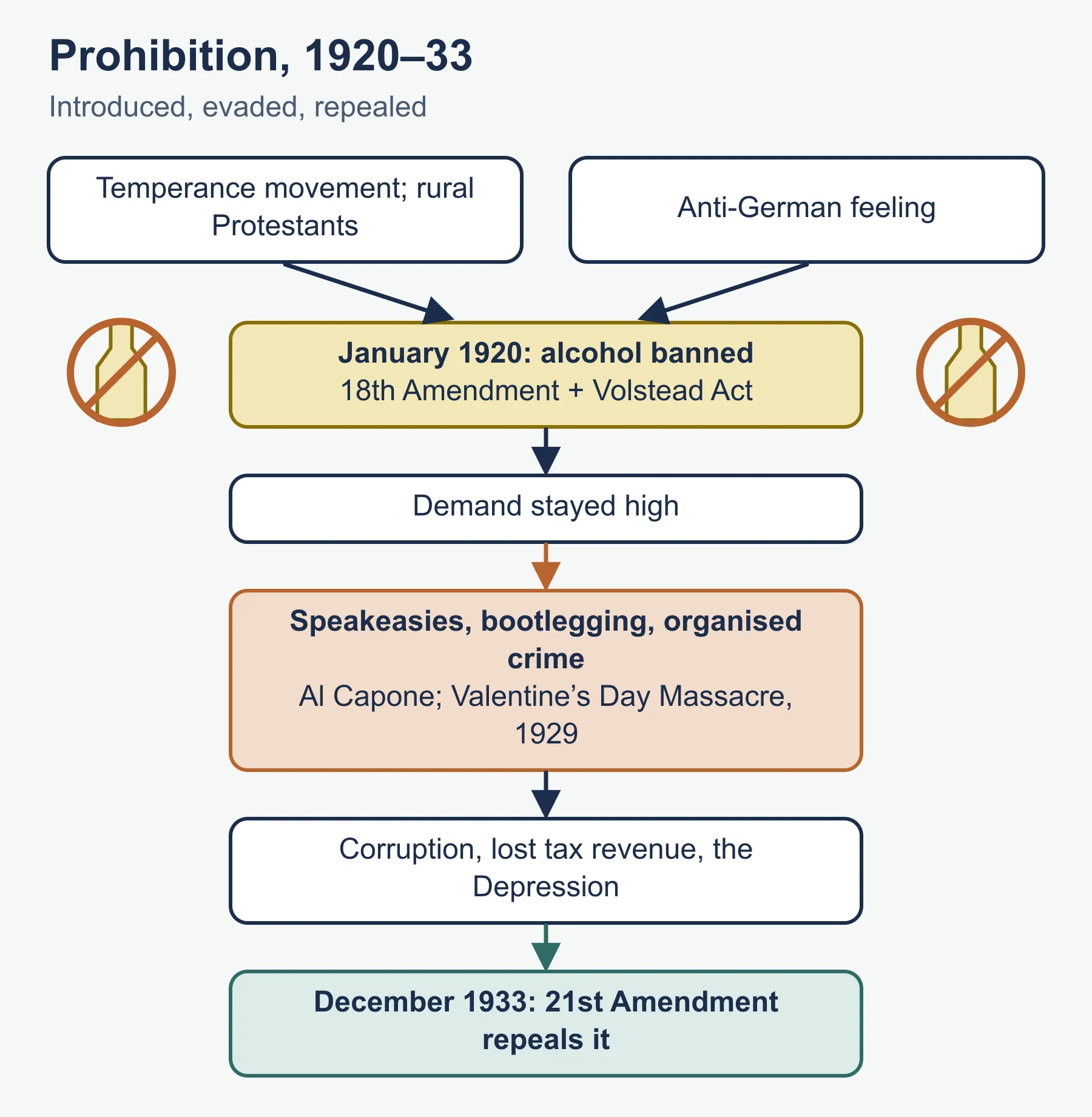
- Prohibition: the Eighteenth Amendment and the Volstead Act banned alcohol from 1920; speakeasies, bootleggers and gangsters such as Al Capone; the St Valentine’s Day Massacre (1929); corruption of police and officials; repealed by the Twenty-first Amendment (1933).
- Women: the vote (1920); flappers in the cities with short hair and new freedoms; more office and shop work; but most women, especially in rural areas, kept traditional roles and were paid less than men.
Key question 3: What were the causes and consequences of the Wall Street Crash?
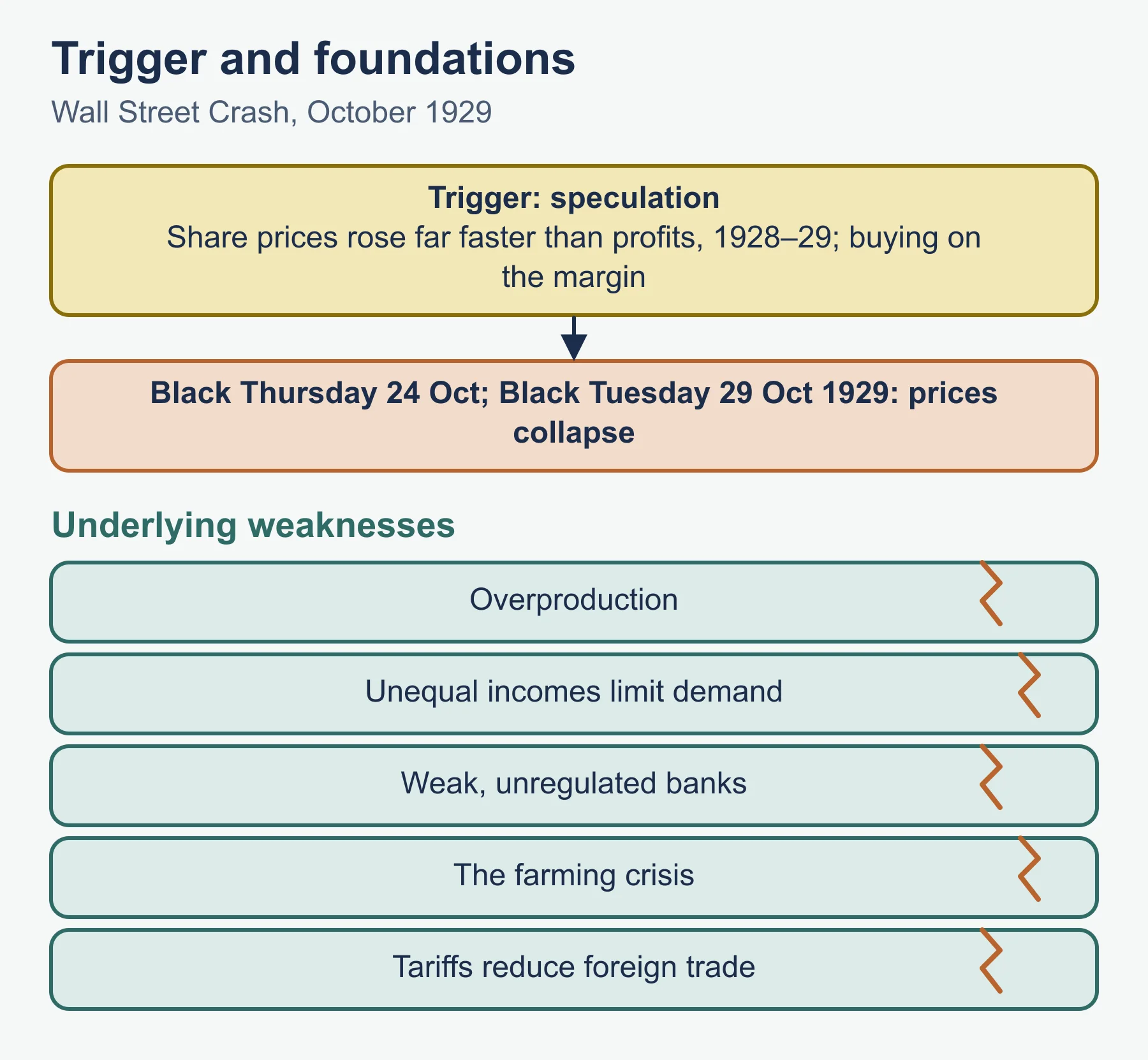
Causes: speculation and buying on the margin; overproduction and saturated markets; unequal wealth; weak banks; falling farm incomes; tariffs reducing exports.
The Crash: prices fell from early October 1929; panic selling on Black Thursday (24 October) and Black Tuesday (29 October); bankers’ attempts to support prices failed.
Economic effects: investors ruined; banks failed as borrowers could not repay; businesses closed; trade collapsed; unemployment rose to about a quarter of the workforce by 1933.
Social effects: shanty towns called Hoovervilles; soup kitchens and bread queues; evictions; families broken up as men travelled in search of work; the Dust Bowl drove farmers from the Great Plains; the Bonus Army of war veterans was driven out of Washington by troops in 1932.
Hoover’s response: believed in “rugged individualism” and that recovery would come; the Reconstruction Finance Corporation (1932) lent to banks and businesses; the Hawley-Smoot tariff (1930) worsened world trade.
1932 election: Roosevelt promised a “New Deal”, appeared energetic and optimistic, and won by a landslide; Hoover was blamed for doing too little.
Key question 4: How successful was the New Deal?
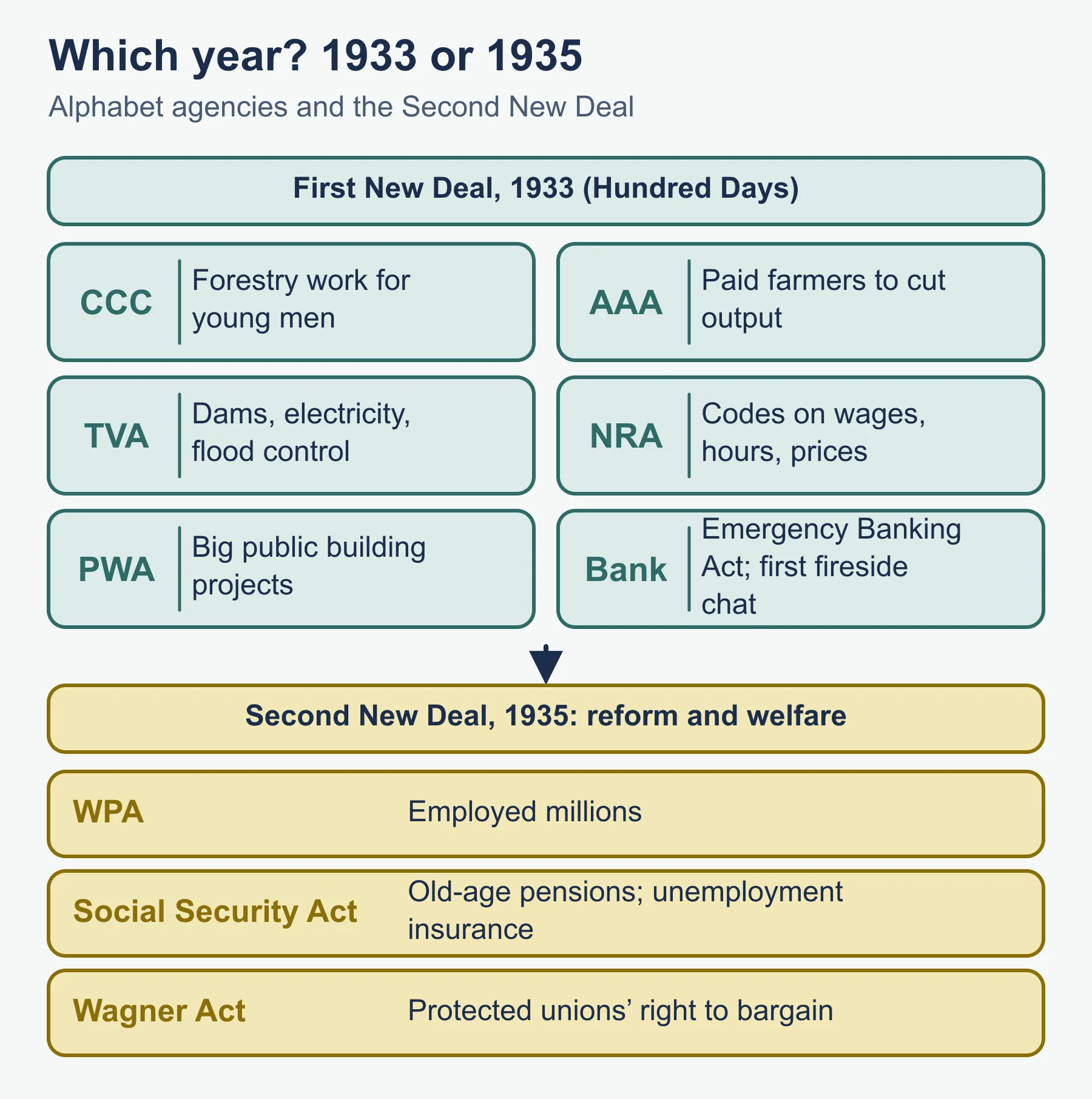
First New Deal (1933): the Emergency Banking Act and a bank holiday; Roosevelt’s radio “fireside chats”; the Civilian Conservation Corps (CCC) for young men; the Agricultural Adjustment Administration (AAA) paid farmers to produce less; the Tennessee Valley Authority (TVA); the National Industrial Recovery Act set up the NRA and public works; federal relief for the unemployed.
Second New Deal (from 1935): the Works Progress Administration (WPA); the Social Security Act (pensions and unemployment insurance); the Wagner Act gave workers the right to join unions; higher taxes on the rich.
Opposition: Republicans and the rich (the Liberty League) said it was too expensive and like socialism; business disliked regulation and union rights; the Supreme Court struck down the NIRA (1935) and the AAA (1936), and Roosevelt’s 1937 plan to add judges failed; radicals such as Huey Long (“Share Our Wealth”), Father Coughlin and Dr Townsend said it did too little.
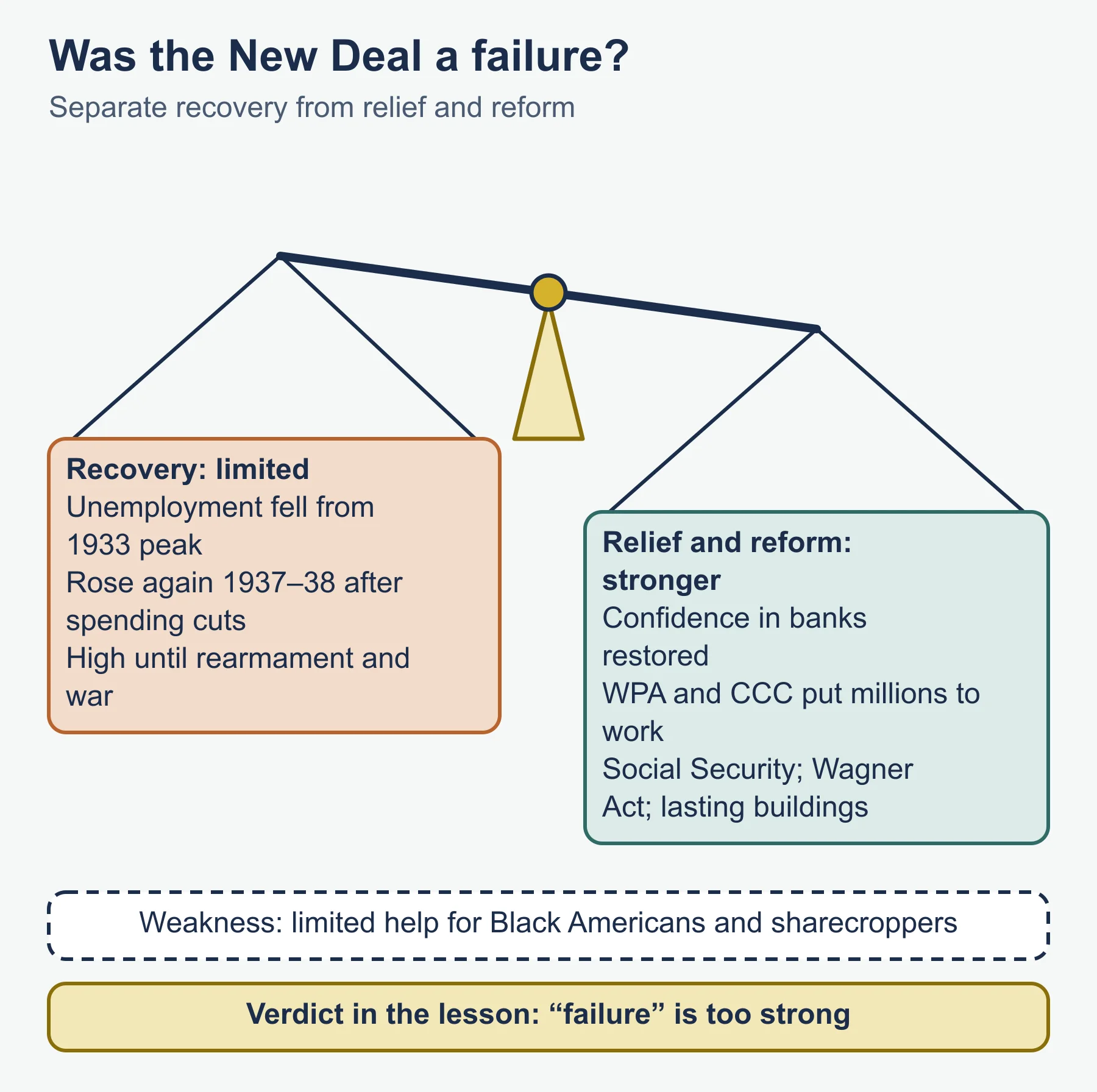
Unemployment persisted: many schemes were temporary; spending cuts brought a new recession in 1937-38; business confidence stayed low; full employment came only with rearmament and the Second World War.
Key terms
| Term | Meaning |
|---|---|
| Laissez-faire | Government leaving the economy to run itself |
| Tariff | Tax on imported goods |
| Hire purchase | Buying goods by paying in instalments |
| Buying on the margin | Buying shares with borrowed money |
| Speculation | Buying shares to sell quickly for profit |
| Sharecropper | Tenant farmer paying rent with part of the crop |
| Bootlegger | Someone who made or smuggled illegal alcohol |
| Hooverville | Shanty town of the homeless during the Depression |
| Alphabet agencies | New Deal bodies known by their initials |
| Fireside chats | Roosevelt’s radio talks to the nation |
Exam traps
- “Boom” needs balance. Every boom answer should include the groups left out.
- Crash versus Depression. The Crash was October 1929; the Depression was the years of hardship that followed.
- Hoover did act, but too little and too late; do not say he did nothing.
- Agencies in the right New Deal. The CCC, AAA, TVA and NIRA were 1933; the WPA, Social Security and Wagner Acts were 1935.
- Supreme Court opposition was about the constitution, not only politics.
Self-test
- What was the Fordney-McCumber tariff? A 1922 tax on imports protecting American industry.
- How did the assembly line reduce car prices? It cut the time and labour needed to build each car.
- Why did the coal industry decline? Competition from oil and electricity.
- What was the Great Migration? The movement of Black Americans from the South to northern cities.
- What did the Volstead Act do? It defined and enforced the ban on alcohol from 1920.
- Why were Sacco and Vanzetti’s trial and execution controversial? Many believed they were convicted because they were Italian immigrants and anarchists.
- What happened on 29 October 1929? Black Tuesday, the worst day of panic selling in the Crash.
- What was the Bonus Army? War veterans who marched to Washington in 1932 demanding early payment of a promised bonus.
- What did the AAA do? Paid farmers to produce less in order to raise prices.
- What did the Social Security Act provide? Old-age pensions and unemployment insurance.
- Why did the Supreme Court strike down the NIRA? It ruled that the federal government had exceeded its powers.
- What finally ended mass unemployment? Rearmament and the Second World War.
Related resources
-
Practice questions
Cambridge IGCSE World History (0470): Depth Study E: The Second World War in Europe and the Asia-Pacific, 1939-c.1945 – Practice Questions
Thirteen original questions with mark-scheme answers on Cambridge IGCSE History 0470 Depth Study E, the Second World War in Europe and the Asia-Pacific.
World History · Cambridge · IGCSE
Try questions -
Revision notes
Cambridge IGCSE World History (0470): Depth Study E: The Second World War in Europe and the Asia-Pacific, 1939-c.1945 – Revision Notes
Recall notes for Cambridge IGCSE History 0470 Depth Study E, the Second World War: Europe, the Asia-Pacific, civilians, resistance and Allied victory.
World History · Cambridge · IGCSE
Revise topic -
Practice questions
Depth Studies A-E (Cambridge 0470): Practice Questions
Original Paper 1 Section B questions for all five Cambridge IGCSE History 0470 depth studies, with (a), (b) and (c) parts and level-based mark schemes.
World History · Cambridge · IGCSE
Try questions
Get free revision emails (optional)
Occasional emails with practice questions, worked explanations and links to free resources for the qualification and subjects you choose. No spam, and you can unsubscribe from any email. The free tools on this site never need an email.