
Revision Notes
Cambridge IGCSE World History (0470): How Secure Was the USSR's Control Over Eastern Europe, 1948-c.1989? – Revision Notes
Recall notes for Cambridge IGCSE History 0470 key question 2.6: Hungary, Czechoslovakia, the Berlin Wall, Solidarity and 1989, with key terms and a self-test.
- Subject
- World History
- Level
- IGCSE
- Topic
- Core Content – Option B: International Relations since 1919
- Author
- Marlbridge Academic Team
- Updated
- Reviewed by
- Azam Siddique (what this means)
Aligned to Cambridge IGCSE World History (0470), 2024-2026. Official specification .
Syllabus page (what it covers and how it is assessed): Cambridge IGCSE World History.
Syllabus points this page covers
0470
- 2.6 How secure was the USSR’s control over Eastern Europe, 1948–c.1989?
Found an error? Report a correction.
Need help with this topic? Request a free trial class for IGCSE World History (0470).
These notes condense key question 6 of Core Content Option B in Cambridge IGCSE History 0470: “How secure was the USSR’s control over Eastern Europe, 1948-c.1989?” The specified content has four parts: resistance in Hungary (1956) and Czechoslovakia (1968), the Berlin Wall, Solidarity in Poland, and Gorbachev and the collapse of Soviet control. For explanation and worked answers, read the Soviet control study guide; to apply the facts, try the Soviet control practice questions.
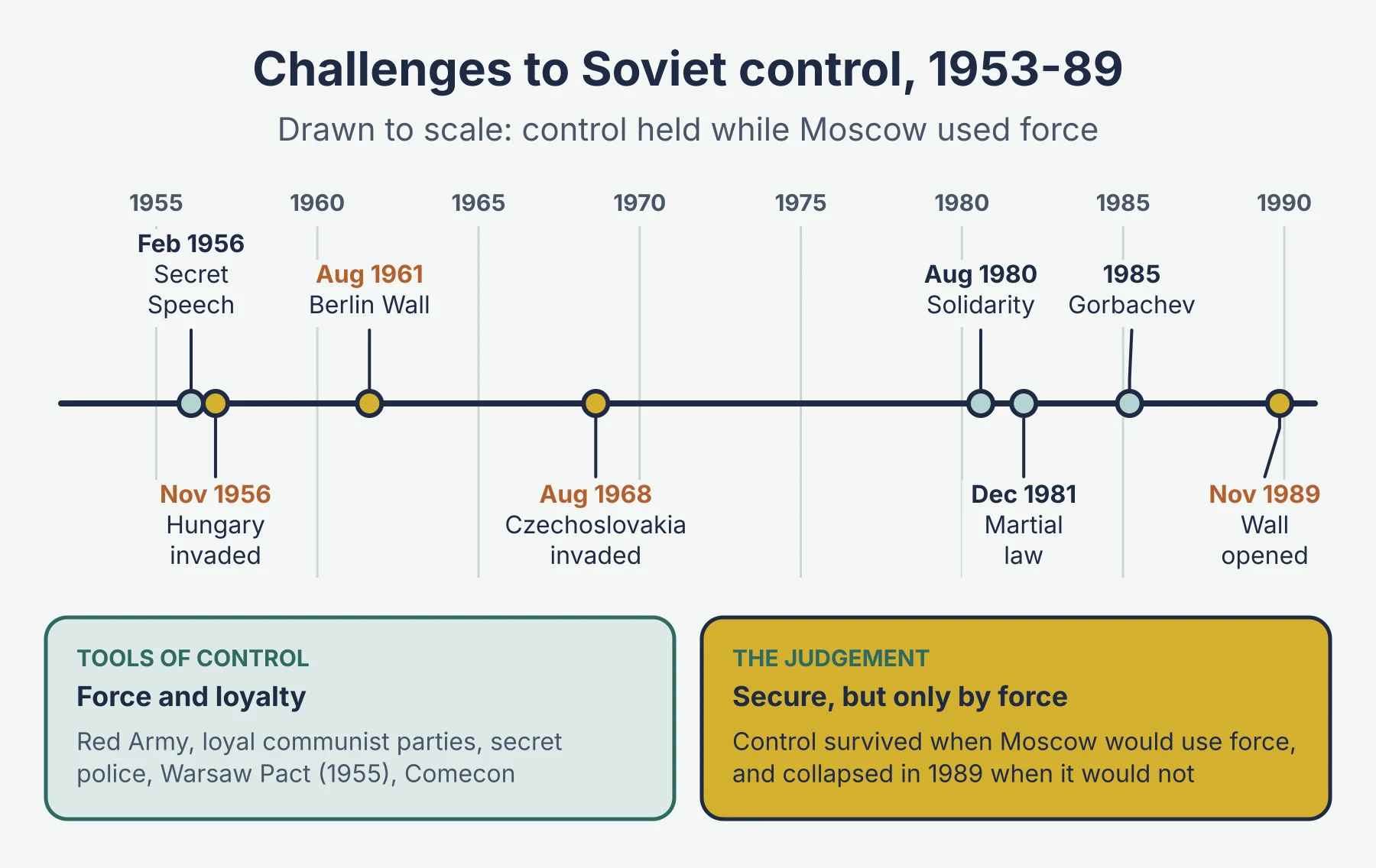
How control was kept
- Military: Red Army garrisons; the Warsaw Pact (1955) bound the satellites into a Soviet-led alliance.
- Political: loyal communist parties; leaders approved by Moscow; secret police in every state.
- Economic: Comecon (1949) organised trade around Soviet needs.
- Ideological: censorship and propaganda; the Brezhnev Doctrine (1968) justified intervention.
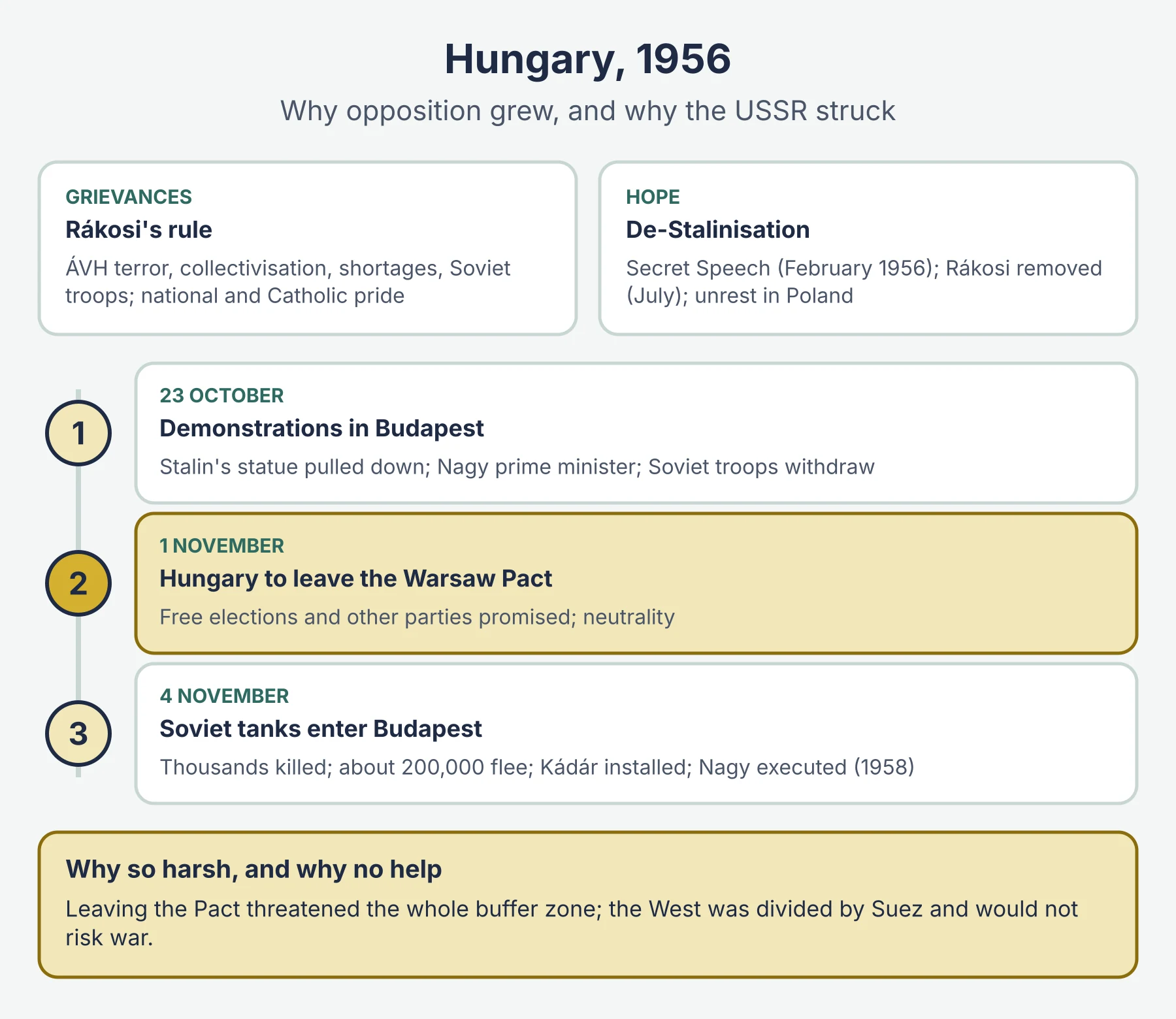
Hungary, 1956: sequence
- February 1956 – Khrushchev’s Secret Speech attacks Stalin.
- July 1956 – Rákosi removed but replaced by another hard-liner, Gerő.
- 23 October – students and workers demonstrate in Budapest; Stalin’s statue toppled; fighting begins.
- 24 October onwards – Imre Nagy becomes prime minister; Soviet troops pull back from Budapest.
- 1 November – Nagy announces neutrality and withdrawal from the Warsaw Pact.
- 4 November – Soviet tanks crush the rising; Kádár installed.
- Aftermath – thousands killed, about 200,000 refugees; Nagy executed in 1958.
Shows about security: control could be restored only by force; the West would not intervene.
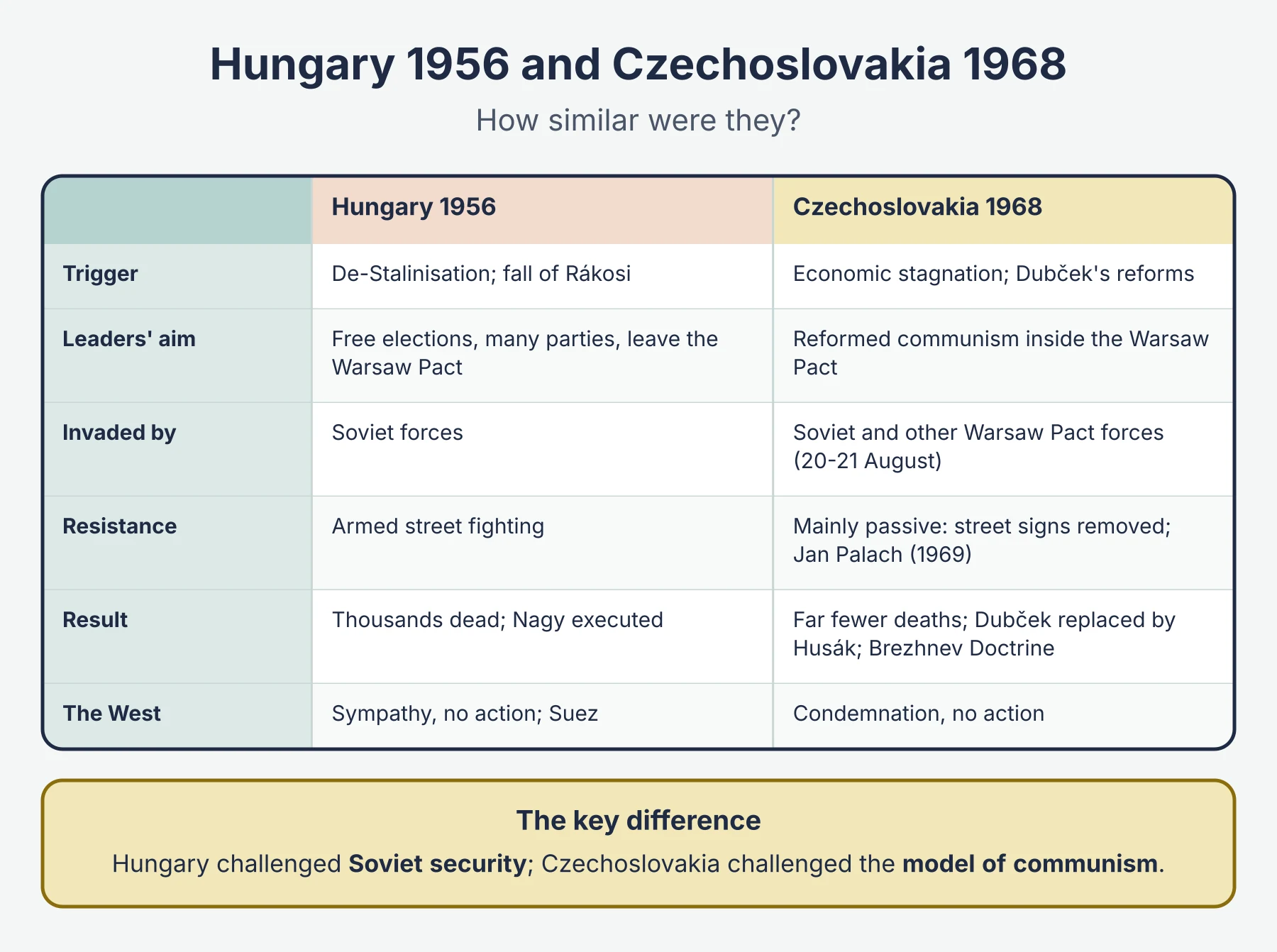
Czechoslovakia, 1968: sequence
- January 1968 – Dubček replaces Novotný.
- April 1968 – Action Programme: “socialism with a human face”.
- Spring-summer – censorship ends; open debate; Warsaw Pact leaders alarmed.
- 20-21 August – Warsaw Pact invasion led by the USSR; Romania takes no part.
- Resistance – non-violent; Jan Palach’s self-burning (January 1969).
- April 1969 – Dubček replaced by Husák; “normalisation” restores hard-line rule.
Shows about security: even reform within communism was not allowed; the Brezhnev Doctrine made intervention policy.
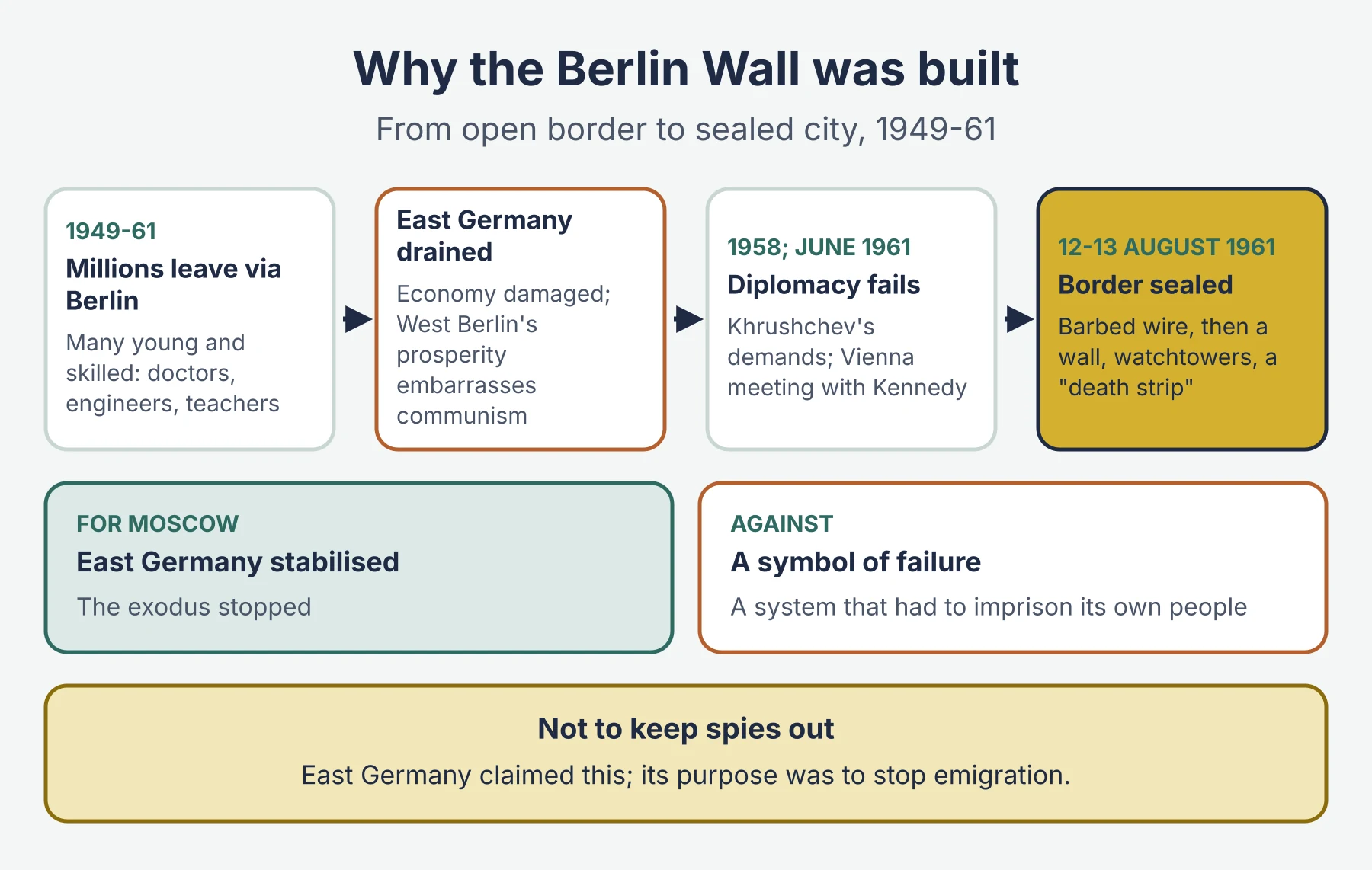
The Berlin Wall
- Cause: mass emigration from East to West through Berlin; loss of skilled workers; propaganda damage.
- Background: Khrushchev’s Berlin ultimatum (1958); failed Vienna summit with Kennedy (June 1961).
- Built: night of 12-13 August 1961; wire first, then concrete.
- Results: emigration stopped; East Germany stabilised; tension at Checkpoint Charlie (October 1961); Kennedy’s Berlin visit (June 1963); symbol of division until 9 November 1989.
Shows about security: control of East Germany needed a physical barrier.
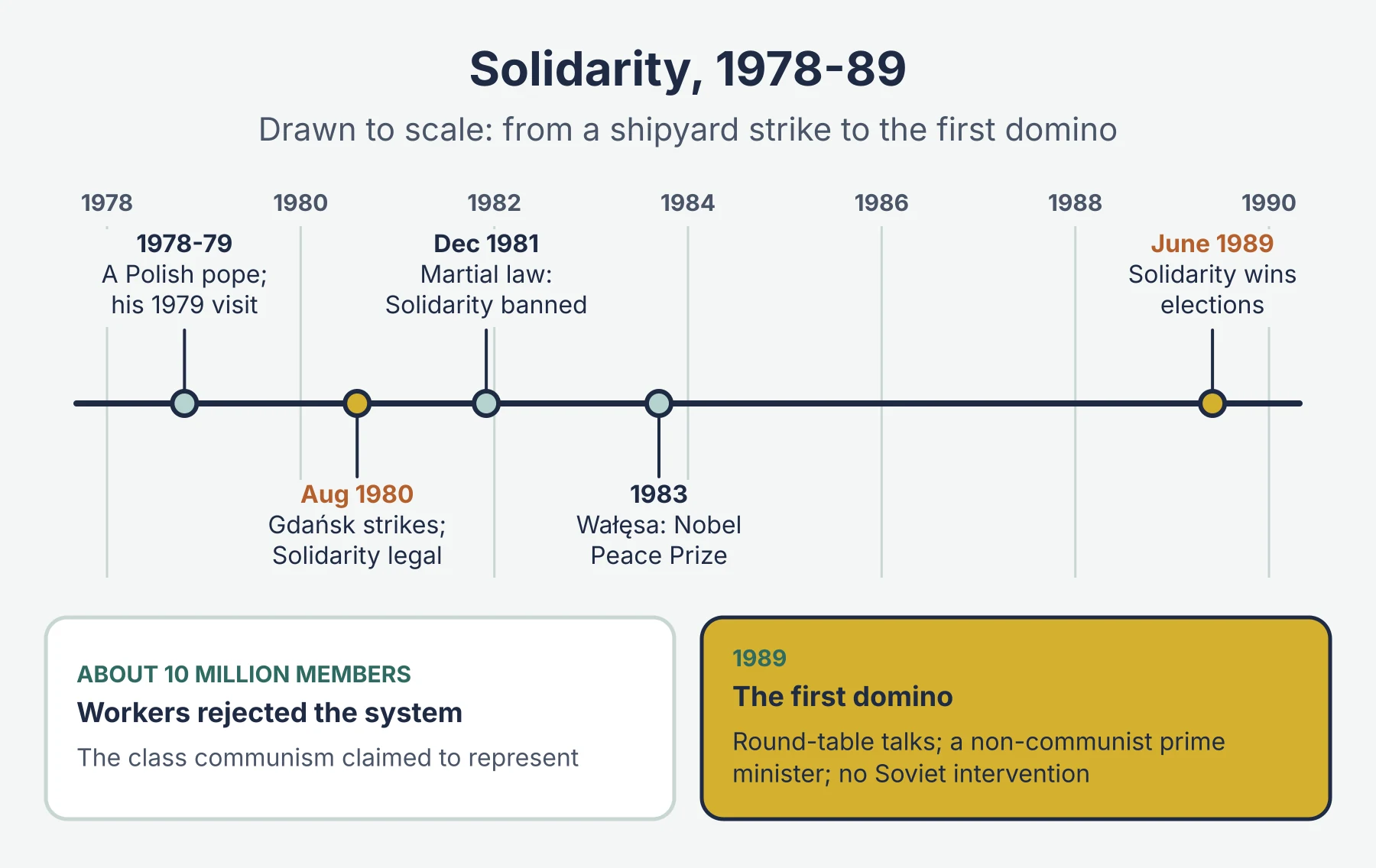
Solidarity, 1980-89
| Date | Event |
|---|---|
| 1978-79 | Polish pope John Paul II elected and visits Poland |
| August 1980 | Gdańsk shipyard strikes led by Lech Wałęsa; Gdańsk Agreement |
| 1980-81 | Solidarity grows to about 10 million members |
| December 1981 | Martial law under General Jaruzelski; Solidarity banned |
| 1983 | Wałęsa awarded the Nobel Peace Prize |
| February-April 1989 | Round-table talks between government and Solidarity |
| June 1989 | Partly free elections; Solidarity wins almost every seat it can contest |
| August-September 1989 | First non-communist prime minister in the bloc |
Shows about security: workers themselves rejected communism; martial law delayed but did not end opposition.
1989: the collapse
- Hungary opens its border with Austria; East Germans escape west.
- East Germany: mass demonstrations in Leipzig; Honecker replaced; Berlin Wall opened on 9 November 1989.
- Czechoslovakia: the “Velvet Revolution”; Václav Havel becomes president in December.
- Bulgaria: Zhivkov removed in November.
- Romania: violent revolution; Ceaușescu executed in December.
- Afterwards: Germany reunited (October 1990); Warsaw Pact dissolved (1991).
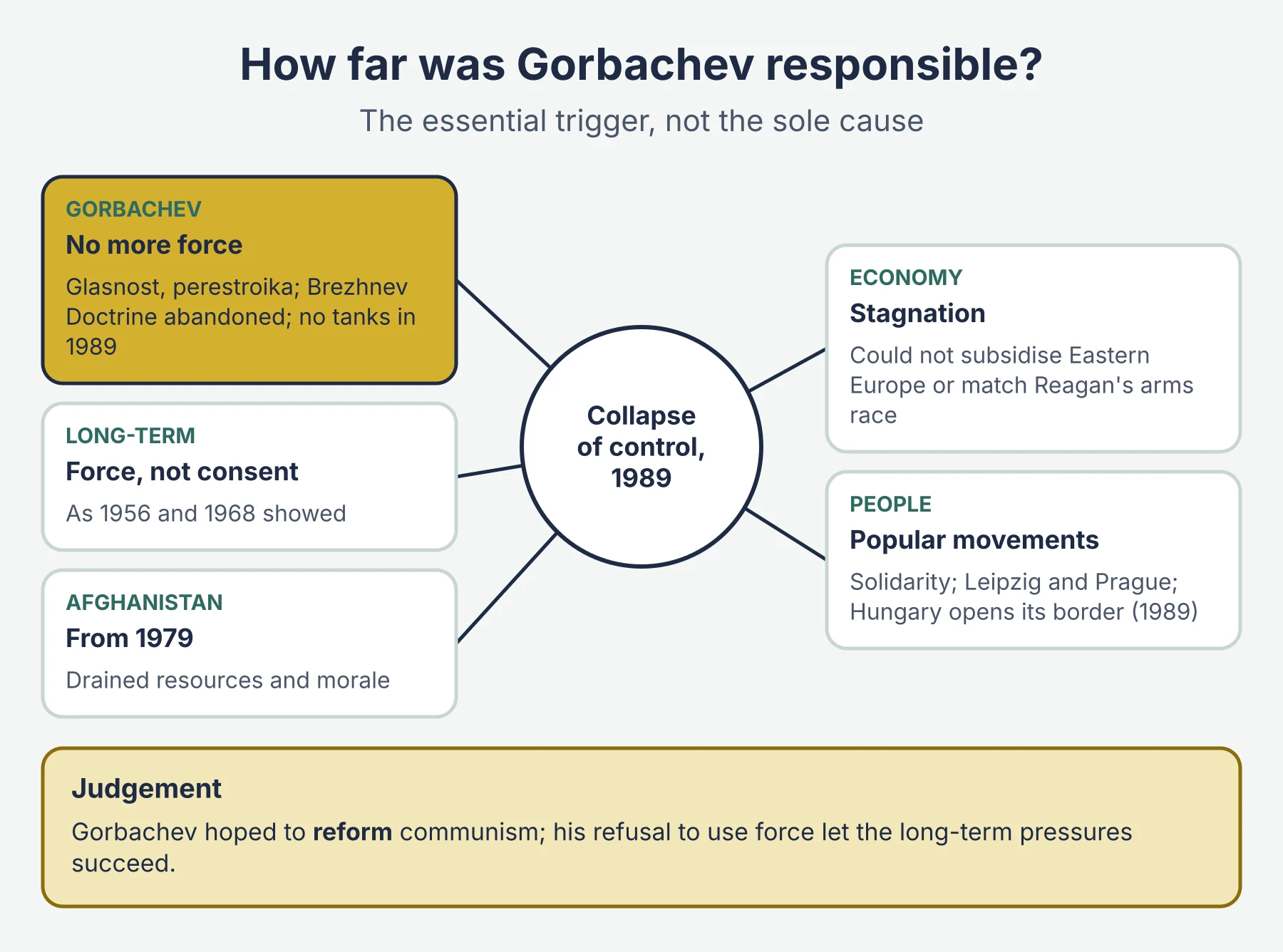
Gorbachev: responsible or not?
| Gorbachev responsible | Other causes |
|---|---|
| Glasnost and perestroika encouraged demands for change | Soviet economy stagnating; arms race costs |
| Abandoned the Brezhnev Doctrine: no tanks in 1989 | Afghanistan war drained resources |
| Troop cuts announced in 1988 | Solidarity and popular movements forced the pace |
| Told satellite leaders they must reform | Communism had never won consent; force had held it |
Key terms
| Term | Meaning |
|---|---|
| De-Stalinisation | Khrushchev’s criticism of Stalin and relaxation of terror after 1956 |
| ÁVH | Hungary’s hated secret police |
| Prague Spring | Period of reform in Czechoslovakia in 1968 |
| Socialism with a human face | Dubček’s slogan for a freer, reformed communism |
| Brezhnev Doctrine | Claim that the bloc could intervene to protect socialism in any member state |
| Normalisation | Restoration of hard-line control in Czechoslovakia after 1968 |
| Solidarity | Independent Polish trade union founded in 1980 |
| Martial law | Military rule with civil rights suspended |
| Glasnost | Openness: more freedom of speech and information |
| Perestroika | Restructuring of the Soviet economy |
Exam traps
- Nagy versus Dubček. Nagy wanted to leave the Warsaw Pact; Dubček did not.
- Who invaded in 1968. Warsaw Pact forces led by the USSR, not the USSR alone.
- Berlin dates. Blockade 1948-49; Wall built 1961; opened 1989.
- Solidarity was not crushed for good. Banned in 1981, legal again and winning elections in 1989.
- Gorbachev’s aim. Reform, not the end of communism; a judgement must weigh other factors.
Self-test
- What did Khrushchev’s Secret Speech of February 1956 do? It denounced Stalin’s crimes and encouraged hopes of reform.
- Who became Hungarian prime minister during the rising? Imre Nagy.
- What announcement on 1 November 1956 triggered the Soviet invasion? Hungary’s withdrawal from the Warsaw Pact.
- Who replaced Nagy? János Kádár.
- What was the Action Programme of 1968? Dubček’s reform plan, including an end to censorship.
- Which Warsaw Pact state refused to take part in the 1968 invasion? Romania.
- Who replaced Dubček in 1969? Gustáv Husák.
- Why was the Berlin Wall built? To stop East Germans emigrating to the West through Berlin.
- In which city did Solidarity begin? Gdańsk.
- Who declared martial law in Poland in December 1981? General Jaruzelski.
- What did Hungary do in 1989 that helped East Germans escape? Opened its border with Austria.
- On what date was the Berlin Wall opened? 9 November 1989.
Related resources
-
Study guides
US Containment of Communism: Korea, Cuba and Vietnam (Cambridge 0470 and 2147)
Guide to Cambridge 0470 and 2147 key question 2.5: US containment in Korea 1950–53, Cuba 1959–62 and Vietnam 1955–75, and how effective each case was.
World History · Cambridge · IGCSE, O Level
Read guide -
Practice questions
US Containment of Communism: Practice Questions
Original structured questions with mark guidance on US containment in Korea, Cuba and Vietnam, for Cambridge IGCSE History 0470 and O Level History 2147.
World History · Cambridge · IGCSE, O Level
Try questions -
Revision notes
US Containment of Communism: Revision Notes
Recall notes on the three containment case studies, Korea, Cuba and Vietnam: dates, tactics and verdicts, for Cambridge IGCSE 0470 and O Level 2147 History.
World History · Cambridge · IGCSE, O Level
Revise topic
Get free revision emails (optional)
Occasional emails with practice questions, worked explanations and links to free resources for the qualification and subjects you choose. No spam, and you can unsubscribe from any email. The free tools on this site never need an email.