
Study Guides
Cambridge IGCSE World History (0470): How Secure Was the USSR's Control Over Eastern Europe, 1948-c.1989?
Study guide to Cambridge IGCSE History 0470 key question 2.6: Hungary 1956, Czechoslovakia 1968, the Berlin Wall, Solidarity and Gorbachev's role in 1989.
- Subject
- World History
- Level
- IGCSE
- Topic
- Core Content – Option B: International Relations since 1919
- Author
- Marlbridge Academic Team
- Updated
- Reviewed by
- Azam Siddique (what this means)
Aligned to Cambridge IGCSE World History (0470), 2024-2026. Official specification .
Syllabus page (what it covers and how it is assessed): Cambridge IGCSE World History.
Syllabus points this page covers
0470
- 2.6 How secure was the USSR’s control over Eastern Europe, 1948–c.1989?
Found an error? Report a correction.
Need help with this topic? Request a free trial class for IGCSE World History (0470).
This guide covers key question 6 of Core Content Option B in Cambridge IGCSE History 0470 (2024-2026): “How secure was the USSR’s control over Eastern Europe, 1948-c.1989?” The five focus points ask why there was opposition in Hungary in 1956 and Czechoslovakia in 1968 and how the USSR reacted, how similar the two crises were, why the Berlin Wall was built in 1961, the significance of Solidarity in Poland, and how far Gorbachev was personally responsible for the collapse of Soviet control. The specified content names exactly those four areas: resistance in Hungary and Czechoslovakia, the Berlin Wall, Solidarity, and Gorbachev and the collapse of Soviet control.
Condensed facts are in the Soviet control revision notes and you can test yourself with the Soviet control practice questions. For the whole of Option B, see the Twentieth Century 1919-1989 guide.
Where this key question is examined
On Paper 1 it can appear in Section A as one of the two Option B questions set from key questions 4-6. The syllabus names it as the Paper 2 prescribed topic for March 2024 (India only); prescribed topics change each series, so check which one applies to your exam.
The big idea: secure, but only by force
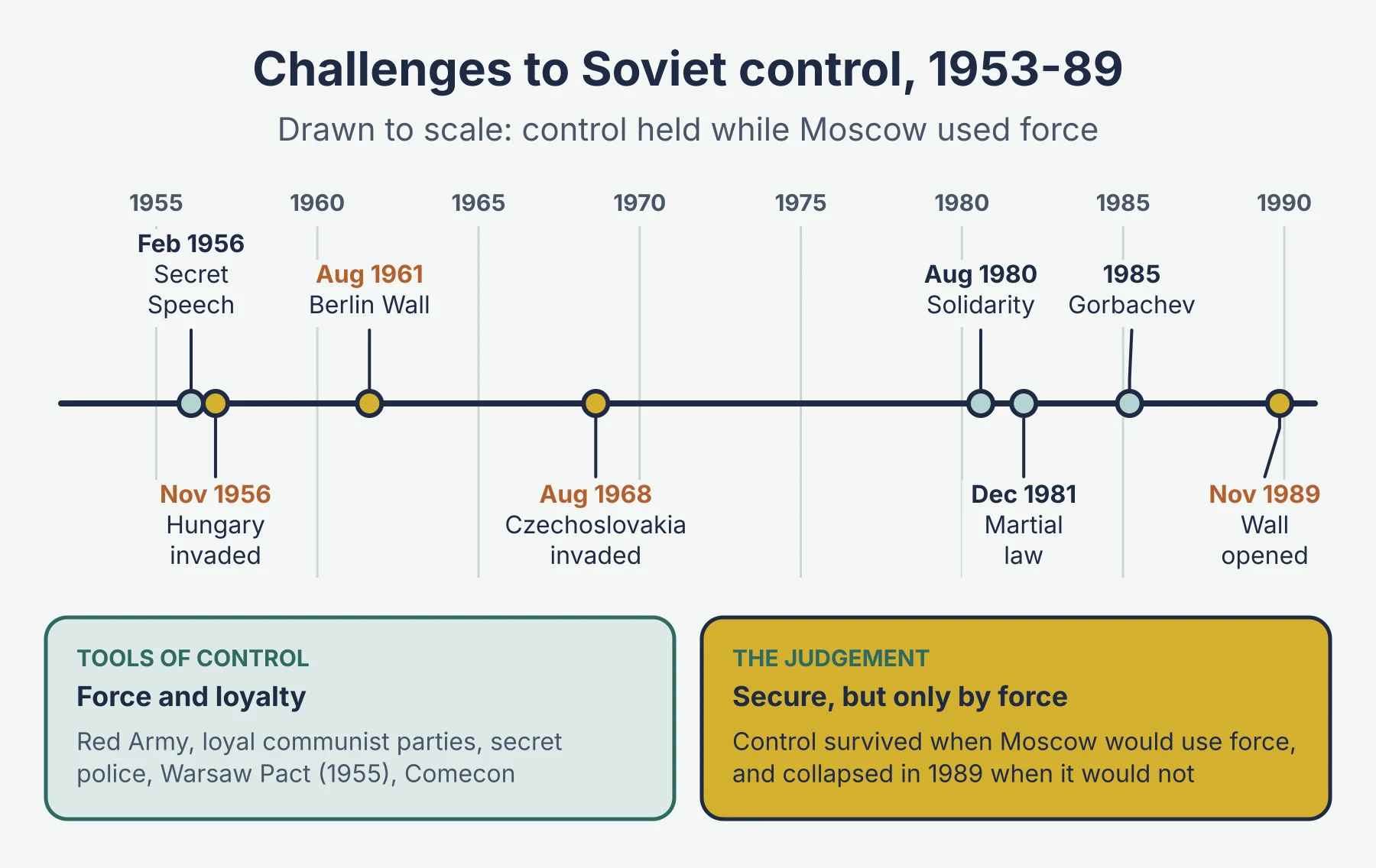
The question asks how secure, so keep a running judgement. Soviet control rested on the Red Army, communist parties loyal to Moscow, secret police, the Warsaw Pact (1955) and Comecon. Each crisis showed that control survived when Moscow was willing to use force, and collapsed in 1989 when it was not.
Hungary, 1956
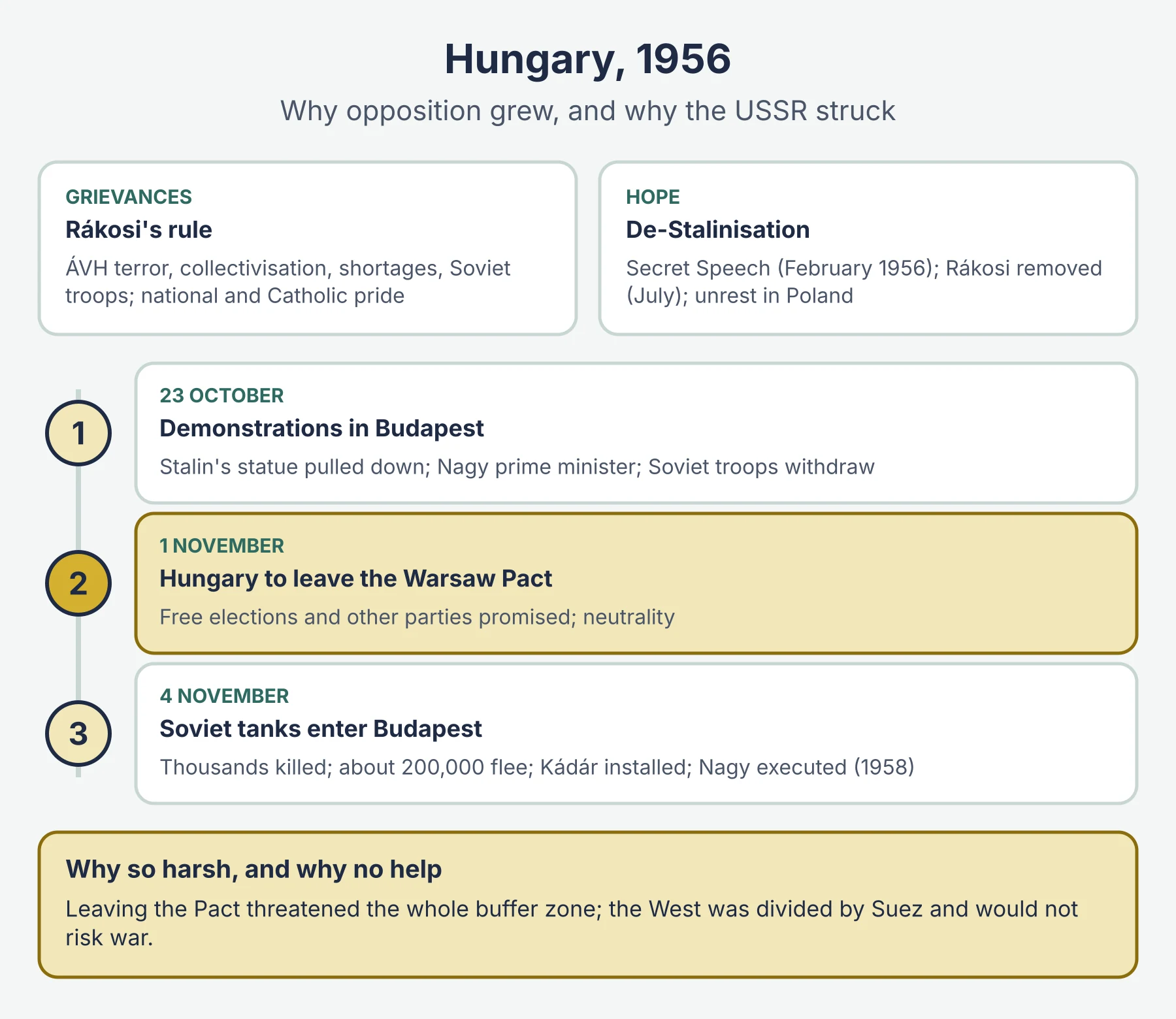
Why opposition grew. Rákosi’s Stalinist rule brought secret police terror (the ÁVH), forced collectivisation, shortages and the presence of Soviet troops. Hungarians were proud of their national identity and many were Catholic. After Stalin’s death (1953), Khrushchev’s Secret Speech (February 1956) denounced Stalin’s crimes, which suggested change was possible. Rákosi was removed in July 1956, and unrest in Poland that autumn encouraged hopes that a national road to communism would be tolerated.
Events. On 23 October 1956 students and workers demonstrated in Budapest and pulled down Stalin’s statue. Imre Nagy became prime minister and Soviet troops at first withdrew from the city. Nagy promised free elections, allowed other parties and on 1 November announced that Hungary would leave the Warsaw Pact and become neutral. On 4 November Soviet tanks entered Budapest. Thousands of Hungarians were killed, about 200,000 fled abroad, János Kádár was installed as leader and Nagy was later tried and executed (1958).
Why the USSR reacted so harshly. Leaving the Warsaw Pact threatened the whole buffer zone: if Hungary went, others might follow. The West was divided by the Suez Crisis, and despite encouragement from western radio broadcasts, the USA would not risk war in the Soviet sphere.
Czechoslovakia, 1968
Why opposition grew. The economy was stagnating, censorship stifled writers and students, and Slovaks resented control from Prague. In January 1968 Alexander Dubček replaced Novotný as party leader.
The Prague Spring. Dubček’s Action Programme (April 1968) promised “socialism with a human face”: an end to censorship, more freedom to travel, some economic decentralisation, greater rights for Slovakia, and debate within the party. Crucially, Dubček insisted Czechoslovakia would stay communist and stay in the Warsaw Pact.
The Soviet reaction. Brezhnev and the leaders of East Germany and Poland feared the ideas would spread. After talks in the summer failed to reassure them, on the night of 20-21 August 1968 Soviet and other Warsaw Pact forces invaded. Czechs and Slovaks resisted mostly without violence: removing street signs, arguing with soldiers, and protest such as the self-burning of the student Jan Palach in January 1969. Dubček was replaced by Gustáv Husák in April 1969. The Brezhnev Doctrine declared that the bloc had the right to intervene where socialism was threatened in any member state.
How similar were Hungary and Czechoslovakia?
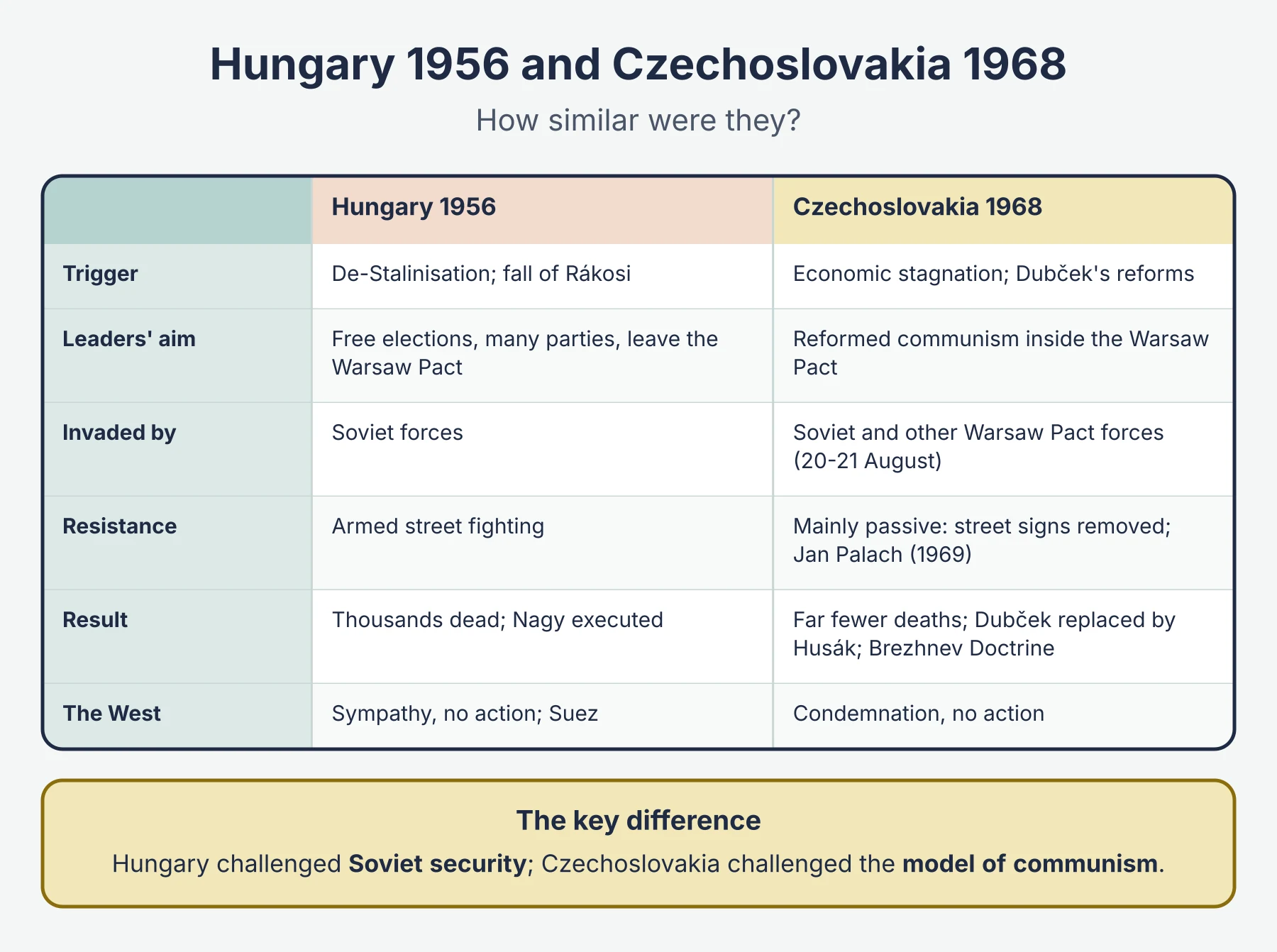
| Hungary 1956 | Czechoslovakia 1968 | |
|---|---|---|
| Trigger | De-Stalinisation; fall of Rákosi | Economic stagnation; Dubček’s reforms |
| Aim of leaders | Free elections, multi-party rule, leave the Warsaw Pact | Reformed communism inside the Warsaw Pact |
| Who invaded | Soviet forces | Soviet and other Warsaw Pact forces |
| Popular resistance | Armed street fighting | Mainly passive and non-violent |
| Result | Thousands dead; Nagy executed | Far fewer deaths; Dubček demoted, not executed |
| Western response | Sympathy but no action; distracted by Suez | Condemnation but no action |
Both ended in invasion and a hard-line leader, and both proved the West would not intervene. The key difference is that Hungary challenged Soviet security directly, while Czechoslovakia challenged the model of communism.
Why was the Berlin Wall built in 1961?
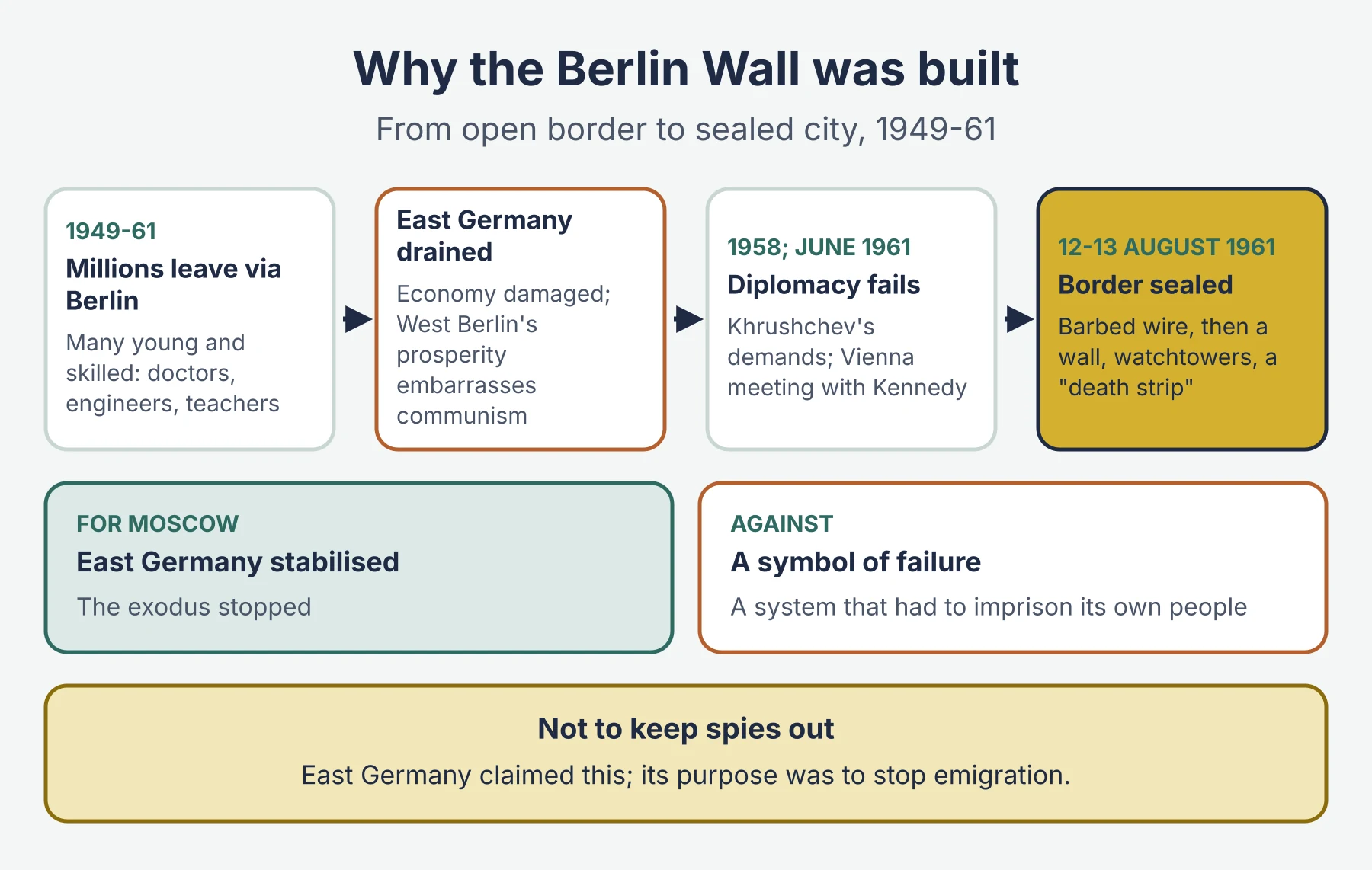
East Germans could cross freely into West Berlin and from there to West Germany. Millions left between 1949 and 1961, many of them young and skilled: doctors, engineers and teachers. This drained the East German economy and embarrassed communism, because West Berlin’s prosperity was visible every day. Khrushchev’s demands that the western powers leave Berlin (from 1958) and his meeting with Kennedy at Vienna (June 1961) produced no agreement, and the flow of refugees rose. On the night of 12-13 August 1961 East German forces sealed the border with barbed wire, later replaced by a concrete wall with watchtowers and a “death strip”.
Significance. The exodus stopped and East Germany stabilised. But the Wall became the clearest symbol of communism’s failure: a system that had to imprison its own people. Kennedy’s visit in June 1963 showed the West would defend West Berlin, but also accepted the division.
Solidarity in Poland
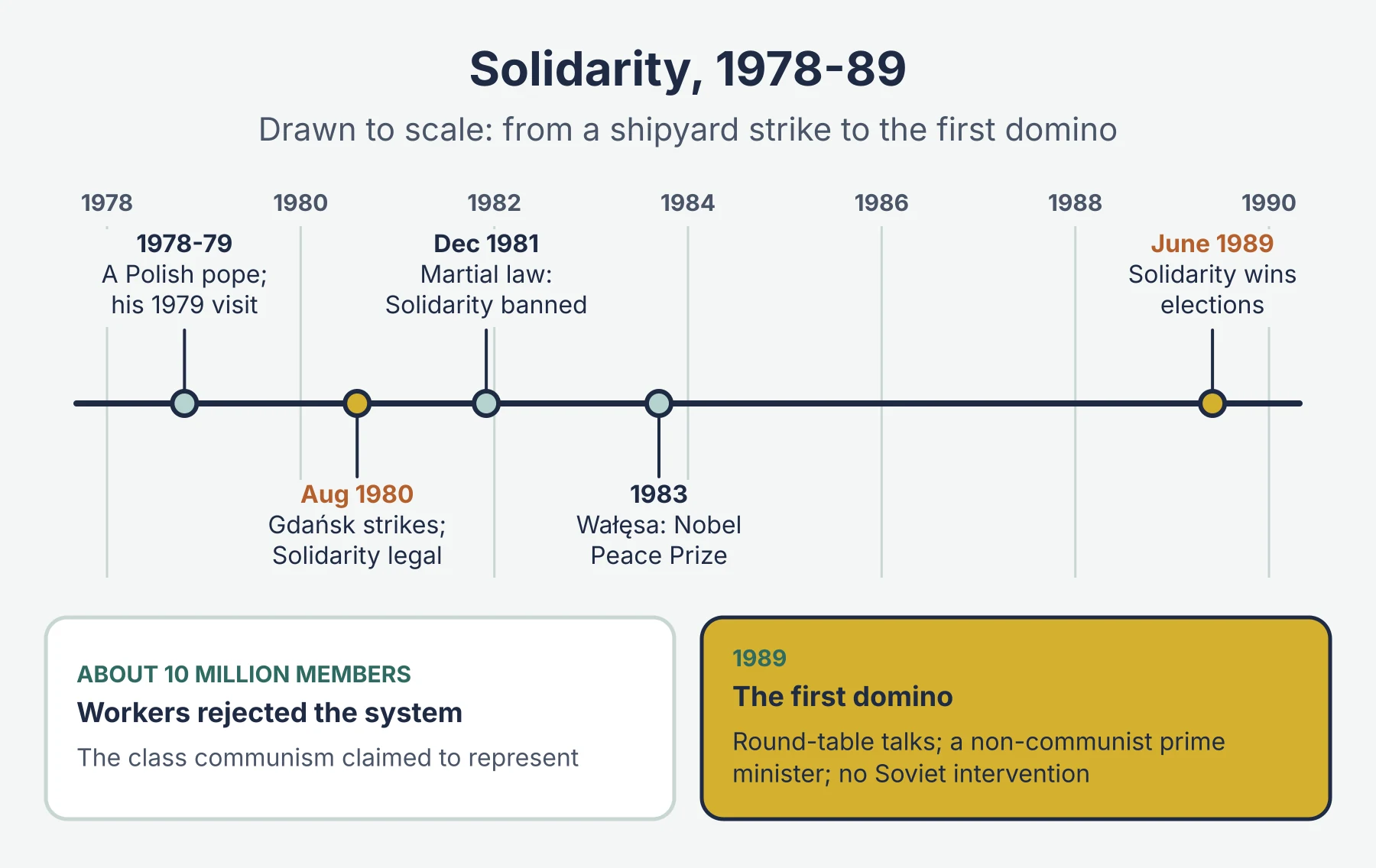
Origins. Price rises and food shortages led to strikes in August 1980 at the Lenin Shipyard in Gdańsk, led by the electrician Lech Wałęsa. The Gdańsk Agreement (August 1980) allowed Solidarity, the first independent trade union in the Soviet bloc. It grew to about 10 million members. The election of a Polish pope, John Paul II, in 1978, and his visit to Poland in 1979, had strengthened national and Catholic confidence.
Repression and survival. Under Soviet pressure General Jaruzelski declared martial law in December 1981; Solidarity was banned and its leaders were arrested. It survived underground, Wałęsa received the Nobel Peace Prize in 1983, and economic failure continued.
Significance. Solidarity showed that millions of workers, the class communism claimed to represent, rejected the system. In 1989, round-table talks led to partly free elections in June, which Solidarity won overwhelmingly, and a non-communist prime minister took office. Poland was the first domino of 1989, and the USSR did not intervene.
How far was Gorbachev responsible for the collapse of Soviet control?
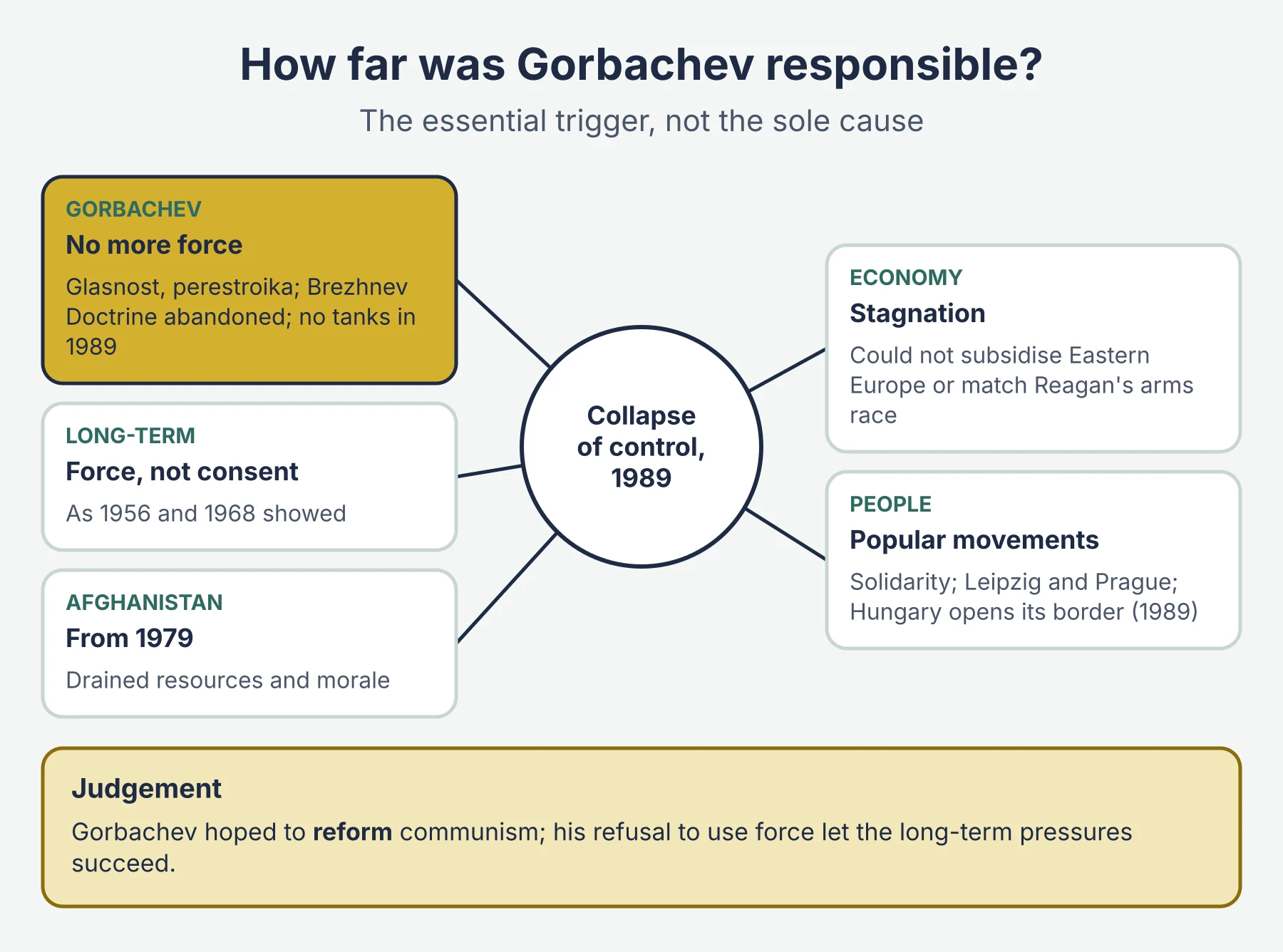
Gorbachev’s role. He became Soviet leader in 1985 and introduced glasnost (openness) and perestroika (restructuring). He withdrew Soviet troops from Afghanistan, announced troop cuts in Europe in 1988, and made clear that the USSR would no longer use force to keep communist governments in power, abandoning the Brezhnev Doctrine. When East Germans demonstrated in 1989, he would not send tanks. The Berlin Wall was opened on 9 November 1989, and communist governments fell in Czechoslovakia, Bulgaria and Romania by the end of the year.
Other factors.
- Economic failure: the Soviet economy was stagnating and could no longer afford to subsidise Eastern Europe or compete in the arms race with the USA under Reagan.
- The war in Afghanistan (from 1979) had drained resources and morale.
- Popular movements: Solidarity in Poland, mass demonstrations in Leipzig and Prague, and Hungary’s opening of its border with Austria in 1989, which let East Germans escape west.
- Long-term weakness: Soviet control had always rested on force rather than consent, as 1956 and 1968 showed.
Judgement. Gorbachev did not plan the collapse; he hoped to reform communism. But his refusal to use force was the condition that let the long-term pressures succeed, so many answers argue he was the essential trigger rather than the sole cause.
Worked example: a (b) answer
Why did the USSR invade Czechoslovakia in 1968? [6]
One reason was fear that the reforms would spread. Dubček ended censorship, so ideas critical of communism could circulate and reach East Germany and Poland, whose leaders demanded action. A second reason was the threat to Soviet security. Although Dubček promised to stay in the Warsaw Pact, Brezhnev feared that a freer Czechoslovakia could not be relied on, and it bordered West Germany, so the Soviet defensive buffer would be weakened.
Common mistakes
- Saying Dubček wanted to leave the Warsaw Pact. That was Nagy in 1956.
- Writing that the Berlin Wall was built to keep western spies out; East Germany claimed this, but its purpose was to stop emigration.
- Placing the fall of the Berlin Wall before the Polish elections. Poland came first.
- Claiming Gorbachev wanted to end communism. He wanted to reform it.
- Ignoring the question “how secure”: every paragraph should say what the event shows about the strength of Soviet control.
Official syllabus
Cambridge IGCSE History (0470) syllabus for 2024, 2025 and 2026, Core Content Option B, key question 6 – cambridgeinternational.org.
Related resources
-
Practice questions
Cambridge IGCSE World History (0470): How Secure Was the USSR's Control Over Eastern Europe, 1948-c.1989? – Practice Questions
Twelve original questions with mark-scheme answers on Hungary, Czechoslovakia, the Berlin Wall, Solidarity and Gorbachev for Cambridge IGCSE History 0470.
World History · Cambridge · IGCSE
Try questions -
Revision notes
Cambridge IGCSE World History (0470): How Secure Was the USSR's Control Over Eastern Europe, 1948-c.1989? – Revision Notes
Recall notes for Cambridge IGCSE History 0470 key question 2.6: Hungary, Czechoslovakia, the Berlin Wall, Solidarity and 1989, with key terms and a self-test.
World History · Cambridge · IGCSE
Revise topic -
Study guides
US Containment of Communism: Korea, Cuba and Vietnam (Cambridge 0470 and 2147)
Guide to Cambridge 0470 and 2147 key question 2.5: US containment in Korea 1950–53, Cuba 1959–62 and Vietnam 1955–75, and how effective each case was.
World History · Cambridge · IGCSE, O Level
Read guide
Get free revision emails (optional)
Occasional emails with practice questions, worked explanations and links to free resources for the qualification and subjects you choose. No spam, and you can unsubscribe from any email. The free tools on this site never need an email.