
Revision Notes
Cambridge IGCSE World History (0470): How Effectively Did the United States Contain the Spread of Communism? – Revision Notes
Recall notes for Cambridge IGCSE History 0470 key question 2.5: decision timelines for Korea, Cuba and Vietnam, key terms, exam traps and a self-test.
- Subject
- World History
- Level
- IGCSE
- Topic
- Core Content – Option B: International Relations since 1919
- Author
- Marlbridge Academic Team
- Updated
- Reviewed by
- Azam Siddique (what this means)
Aligned to Cambridge IGCSE World History (0470), 2024-2026. Official specification .
Syllabus page (what it covers and how it is assessed): Cambridge IGCSE World History.
Syllabus points this page covers
0470
- 2.5 How effectively did the United States contain the spread of communism?
Found an error? Report a correction.
Need help with this topic? Request a free trial class for IGCSE World History (0470).
These notes condense key question 5 of Core Content Option B in Cambridge IGCSE History 0470: “How effectively did the United States contain the spread of communism?” The syllabus sets three case studies: Korea (1950-53), Cuba (1959-62) and Vietnam (1955-75). For explanation and worked answers, read the containment study guide; to apply the facts, try the containment practice questions.
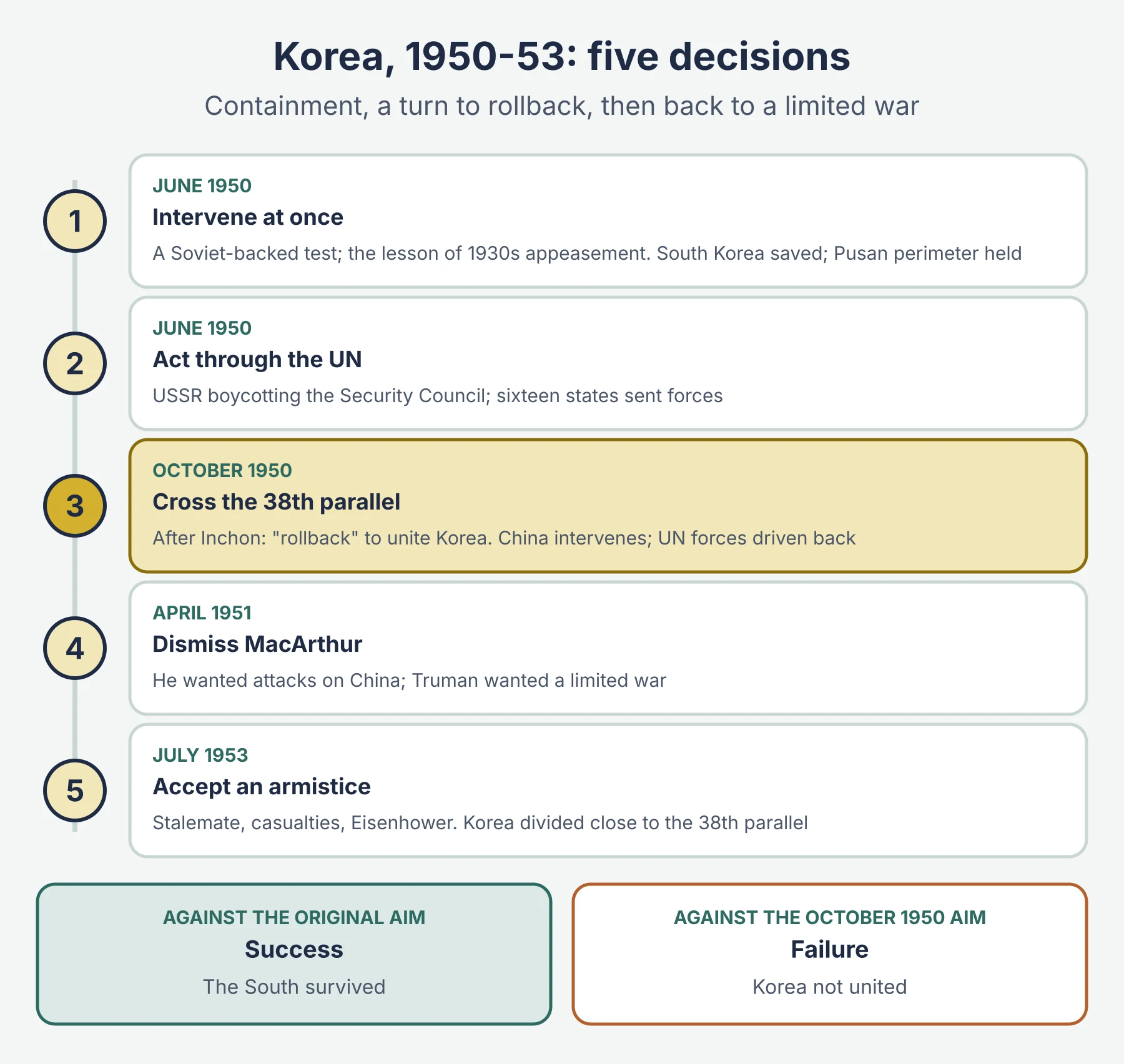
Korea, 1950-53: decision timeline
| Date | Event | Containment link |
|---|---|---|
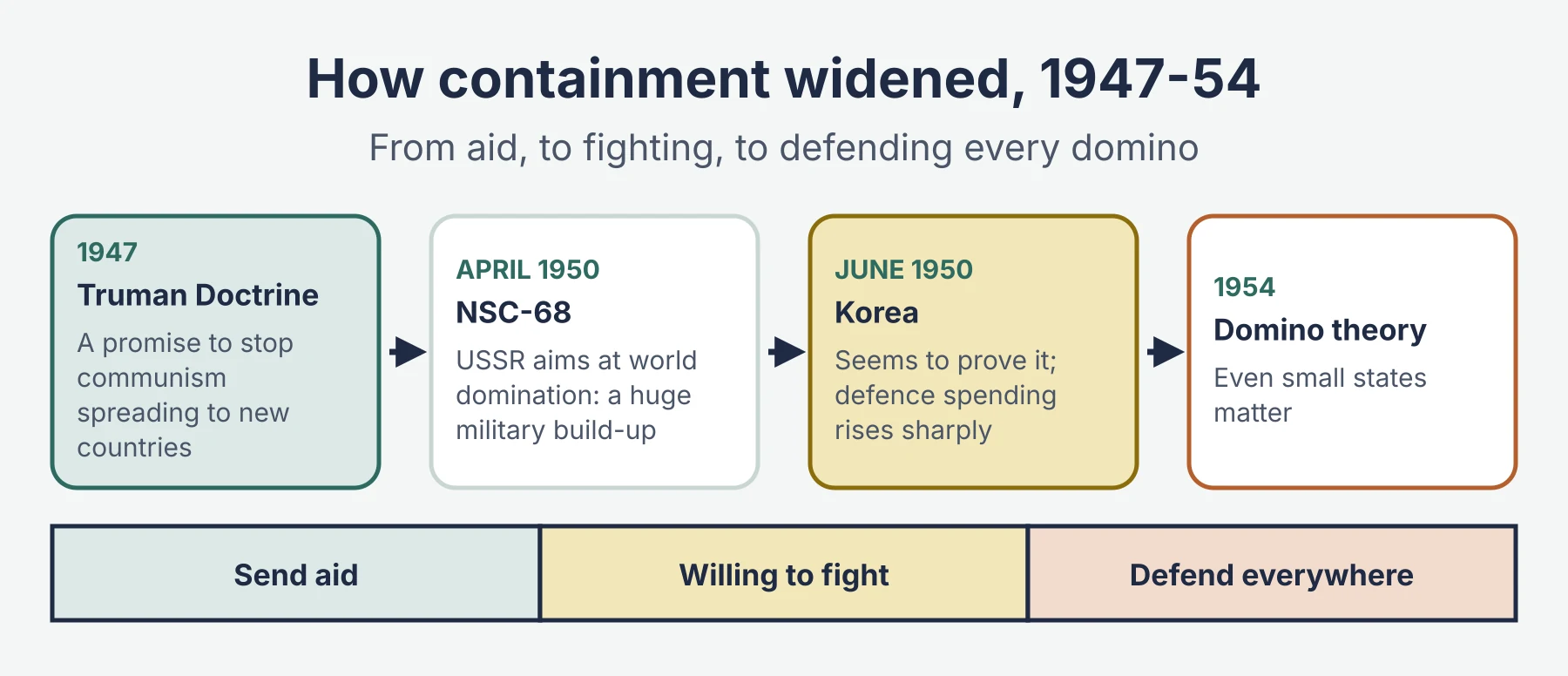
| April 1950 | NSC-68 calls for a massive US military build-up | Containment becomes global and military |
| 25 June 1950 | North Korea invades the South | Seen in Washington as a Soviet-backed test |
| June-July 1950 | Security Council resolutions; USSR absent; UN Command under MacArthur | Action given UN legitimacy |
| August-September 1950 | UN forces hold the Pusan perimeter | South Korea survives |
| 15 September 1950 | Inchon landing behind North Korean lines | North Koreans driven back |
| October 1950 | UN forces cross the 38th parallel towards the Yalu | Shift from containment to rollback |
| October-November 1950 | Chinese forces enter the war | UN driven back south; Seoul lost again in January 1951 |
| April 1951 | Truman dismisses MacArthur; Ridgway takes over | Limited war chosen over a war with China |
| July 1951 | Armistice talks begin; front settles near the 38th parallel | Two years of stalemate follow |
| 27 July 1953 | Armistice at Panmunjom | South Korea stays non-communist |
Verdict line: the original aim succeeded; rollback failed; China became a lasting enemy.
Cuba, 1959-62: decision timeline
| Date | Event | Containment link |
|---|---|---|
| January 1959 | Castro takes power | Revolution not at first openly communist |
| 1960 | Soviet trade deal; US cuts sugar imports; embargo on most US exports | Pressure pushes Cuba towards Moscow |
| January 1961 | USA breaks off diplomatic relations | Isolation policy |
| April 1961 | Bay of Pigs: CIA-trained exiles defeated | Humiliation; Castro turns to the USSR for protection |
| January 1962 | Cuba expelled from the Organisation of American States | Regional isolation |
| 14-16 October 1962 | U-2 photographs of missile sites shown to Kennedy | Threat on America’s doorstep |
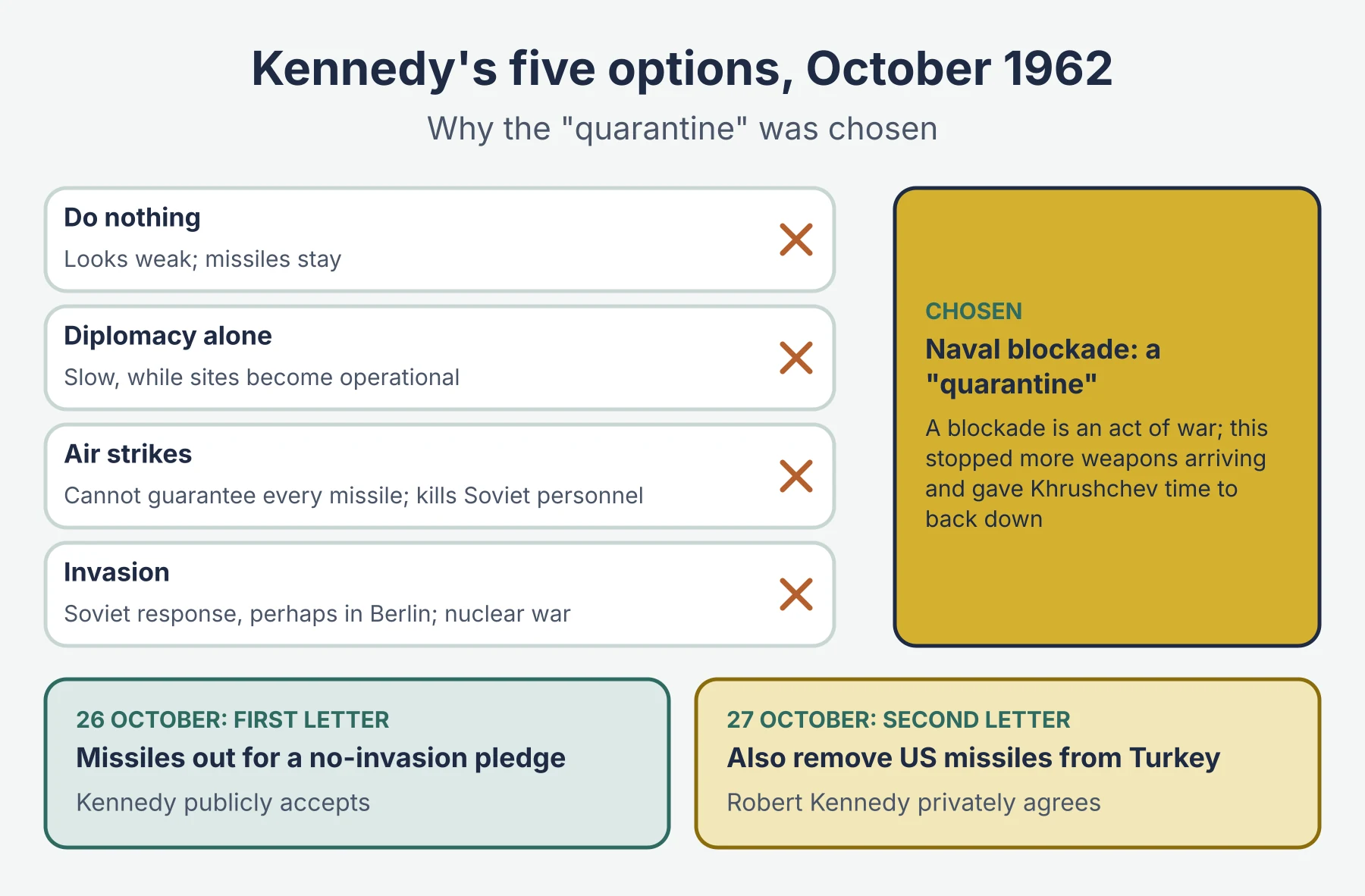
| 22 October 1962 | Kennedy announces a naval quarantine | Firmness without an attack |
| 26-27 October 1962 | Khrushchev’s two letters; U-2 shot down over Cuba | Most dangerous moment |
| 28 October 1962 | Khrushchev agrees to remove the missiles | Public no-invasion pledge; secret Turkey deal |
| 1963 | Hotline; Partial Test Ban Treaty; Jupiter missiles leave Turkey | Start of more cautious relations |
Verdict line: failed to stop or remove communism in Cuba; succeeded in removing the missiles without war.
Vietnam, 1955-75: decision timeline
| Date | Event | Containment link |
|---|---|---|
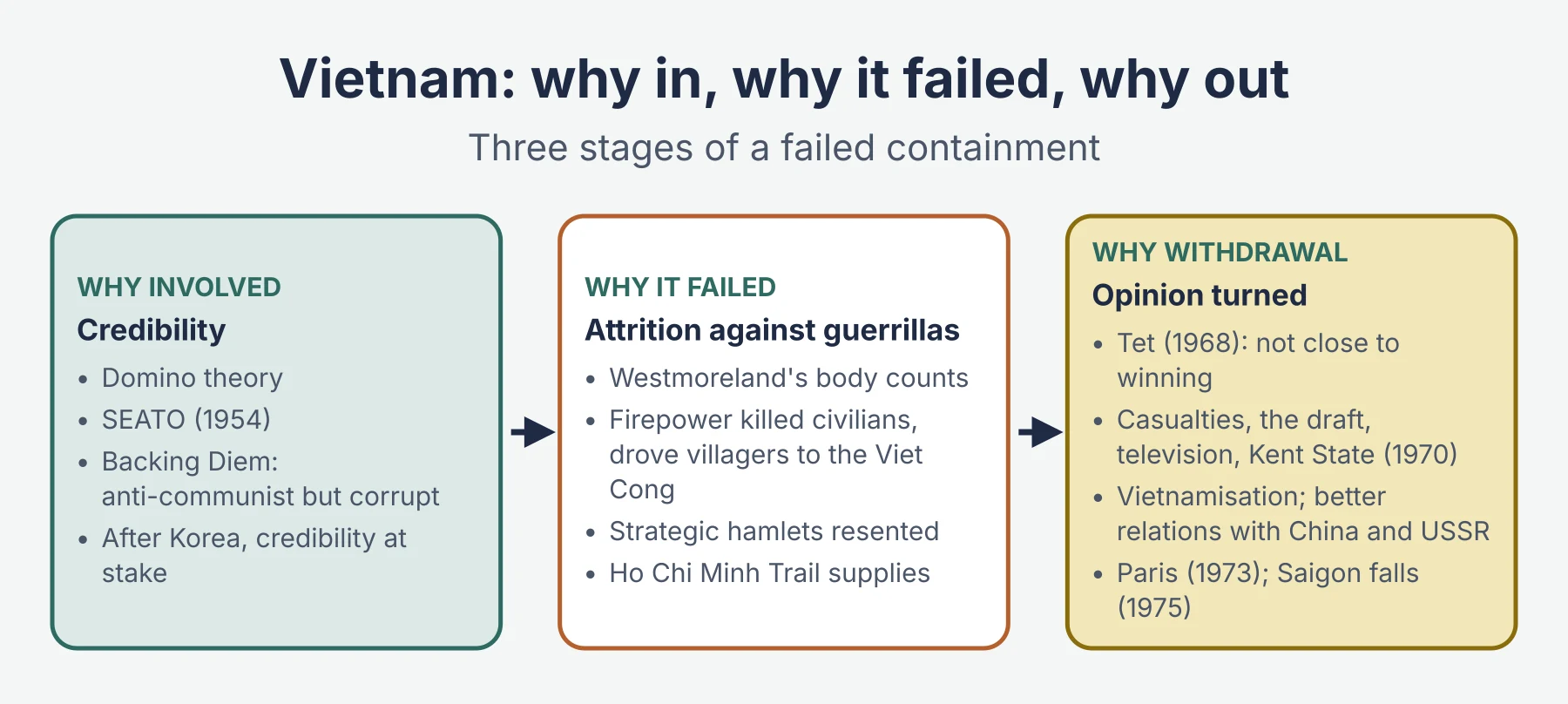
| 1954 | Geneva Accords divide Vietnam; SEATO formed | USA takes over from France as protector of the South |
| 1955-56 | Diem’s republic; reunification elections not held | USA backs an unpopular anti-communist |
| 1961-63 | Kennedy expands advisers; strategic hamlets | Deeper commitment |
| November 1963 | Diem overthrown and killed in a coup | Instability in the South |
| August 1964 | Gulf of Tonkin incident and Resolution | Johnson gains power to use force |
| March 1965 | Rolling Thunder bombing; Marines land at Da Nang | Combat war begins |
| January 1968 | Tet Offensive | Public confidence collapses |
| 1969 onwards | Nixon’s Vietnamisation and troop withdrawals | Exit strategy |
| 1970 | Attacks on bases in Cambodia; Kent State shootings | Protest intensifies |
| January 1973 | Paris Peace Accords | US combat role ends |
| April 1975 | Fall of Saigon; Laos and Cambodia also communist | Containment failed in Indochina |
Verdict line: clear failure by its own aim; huge cost in lives, money and reputation.
Key terms
| Term | Meaning |
|---|---|
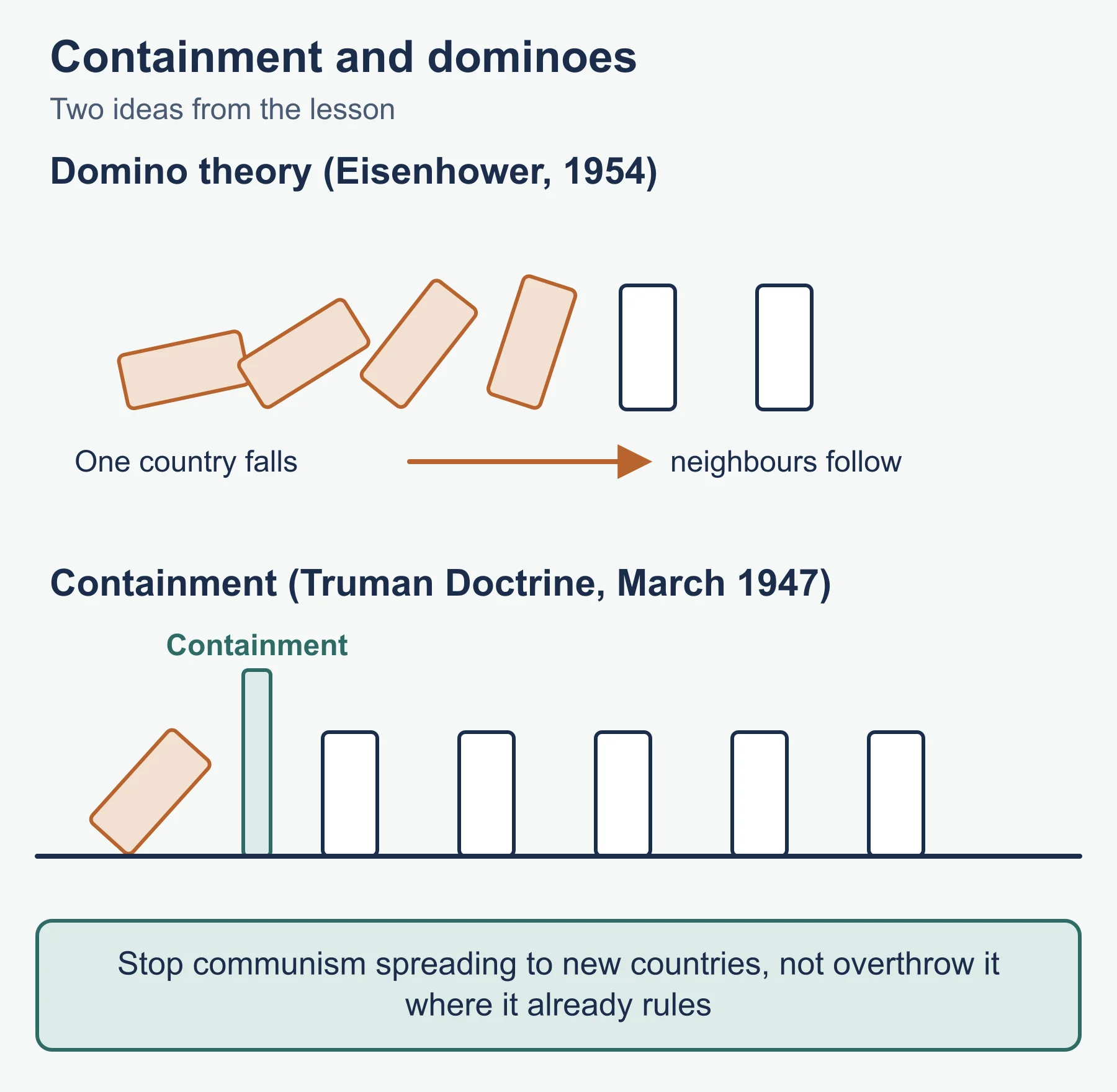
| Containment | Stopping communism spreading to new countries |
| Rollback | Pushing communism back from a country where it already ruled |
| NSC-68 | 1950 policy paper calling for a large US military build-up |
| Limited war | A war fought for restricted aims without using full force, such as nuclear weapons |
| Domino theory | Belief that if one state fell to communism its neighbours would follow |
| ExComm | Kennedy’s group of advisers during the Missile Crisis |
| Quarantine | Kennedy’s term for the 1962 naval blockade of Cuba |
| Brinkmanship | Pushing a crisis to the edge of war to force the other side to back down |
| SEATO | South-East Asia Treaty Organisation (1954), a defensive alliance |
| Attrition | Wearing down the enemy by inflicting losses faster than they can be replaced |
| Search and destroy | Missions to find and kill Viet Cong fighters, then withdraw |
| Vietnamisation | Nixon’s policy of handing the fighting to South Vietnamese forces |
| Ho Chi Minh Trail | Supply route from North Vietnam through Laos and Cambodia |
Comparing the three cases
| Korea | Cuba | Vietnam | |
|---|---|---|---|
| Who attacked or changed first | North Korea invaded | Castro’s revolution | Communist insurgency in the South |
| Main US method | UN war | Pressure, invasion attempt, blockade | Advisers, then full-scale war |
| Allies | UN members | OAS support in 1962 | Few allies; little UN role |
| Outcome | South saved | Castro stayed; missiles removed | Whole of Vietnam communist |
Exam traps
- Korea and the UN. It was a UN action; the Soviet absence from the Security Council explains why there was no veto.
- Containment versus rollback. Crossing the 38th parallel was rollback; credit only the defence of the South as containment.
- Cuba’s two crises. The Bay of Pigs (1961) and the Missile Crisis (1962) are separate events.
- Tet. A military failure for the communists but a political turning point in the USA.
- Vietnam’s start date. The syllabus starts in 1955, not with the combat troops of 1965.
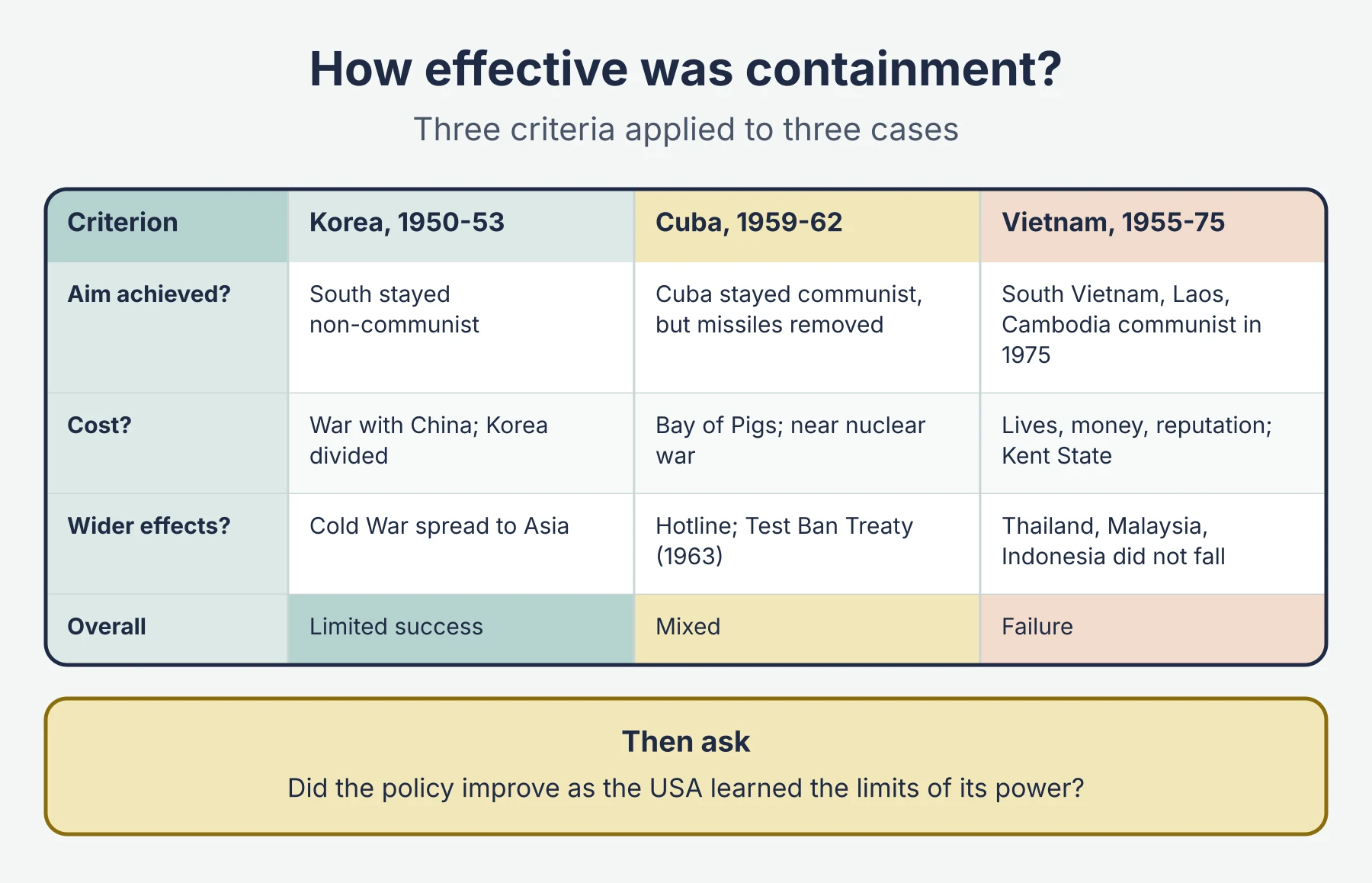
- Judging without criteria. “Effective” needs a measure: aim, cost or wider consequences.
Self-test
- What did NSC-68 recommend? A massive increase in American military strength to resist communism everywhere.
- Why could the USSR not veto UN action in Korea in June 1950? It was boycotting the Security Council over China’s seat.
- Where did the UN force land in September 1950? Inchon.
- Why was MacArthur dismissed? He publicly demanded a wider war against China, against Truman’s policy of limited war.
- Where was the Korean armistice signed? Panmunjom, in July 1953.
- Give one American economic measure against Cuba in 1960. Cutting imports of Cuban sugar, or an embargo on most exports.
- Why did Kennedy call his blockade a “quarantine”? A blockade was an act of war under international law.
- What did Khrushchev’s second letter demand? Removal of American missiles from Turkey.
- Name two agreements of 1963 that followed the crisis. The hotline and the Partial Test Ban Treaty.
- What did the Gulf of Tonkin Resolution allow? It let President Johnson use armed force in Vietnam without a declaration of war.
- What was Vietnamisation? Nixon’s policy of withdrawing US troops while South Vietnam’s army took over the fighting.
- Which three countries became communist in 1975? Vietnam, Laos and Cambodia.
Related resources
-
Study guides
Cambridge IGCSE World History (0470): How Far Was Hitler’s Foreign Policy to Blame for the Outbreak of War in Europe in 1939?
Study guide to Cambridge IGCSE History 0470 key question 2.3: Hitler's aims, the steps to war, appeasement, the Nazi-Soviet Pact and September 1939.
World History · Cambridge · IGCSE
Read guide -
Practice questions
Cambridge IGCSE World History (0470): How Far Was Hitler’s Foreign Policy to Blame for the Outbreak of War in Europe in 1939? – Practice Questions
Twelve original questions with mark-scheme answers on Hitler's aims, appeasement, Munich and the Nazi-Soviet Pact, for Cambridge IGCSE History 0470.
World History · Cambridge · IGCSE
Try questions -
Revision notes
Cambridge IGCSE World History (0470): How Far Was Hitler’s Foreign Policy to Blame for the Outbreak of War in Europe in 1939? – Revision Notes
Recall notes for Cambridge IGCSE History 0470 key question 2.3: Hitler's aims, steps to war 1933-39, appeasement, the Nazi-Soviet Pact and a self-test.
World History · Cambridge · IGCSE
Revise topic
Get free revision emails (optional)
Occasional emails with practice questions, worked explanations and links to free resources for the qualification and subjects you choose. No spam, and you can unsubscribe from any email. The free tools on this site never need an email.