
Revision Notes
Cambridge IGCSE World History (0470): How Far Was Hitler’s Foreign Policy to Blame for the Outbreak of War in Europe in 1939? – Revision Notes
Recall notes for Cambridge IGCSE History 0470 key question 2.3: Hitler's aims, steps to war 1933-39, appeasement, the Nazi-Soviet Pact and a self-test.
- Subject
- World History
- Level
- IGCSE
- Topic
- Core Content – Option B: International Relations since 1919
- Author
- Marlbridge Academic Team
- Updated
- Reviewed by
- Azam Siddique (what this means)
Aligned to Cambridge IGCSE World History (0470), 2024-2026. Official specification .
Syllabus page (what it covers and how it is assessed): Cambridge IGCSE World History.
Syllabus points this page covers
0470
- 2.3 How far was Hitler’s foreign policy to blame for the outbreak of war in Europe in 1939?
Found an error? Report a correction.
Need help with this topic? Request a free trial class for IGCSE World History (0470).
Key question 2.3, Cambridge IGCSE History 0470: “How far was Hitler’s foreign policy to blame for the outbreak of war in Europe in 1939?” Learn Hitler’s aims, each step from rearmament to Poland, the arguments over appeasement, the Nazi-Soviet Pact and why Britain and France declared war. Explanations are in the Hitler’s foreign policy study guide; practise with the Hitler’s foreign policy practice questions.
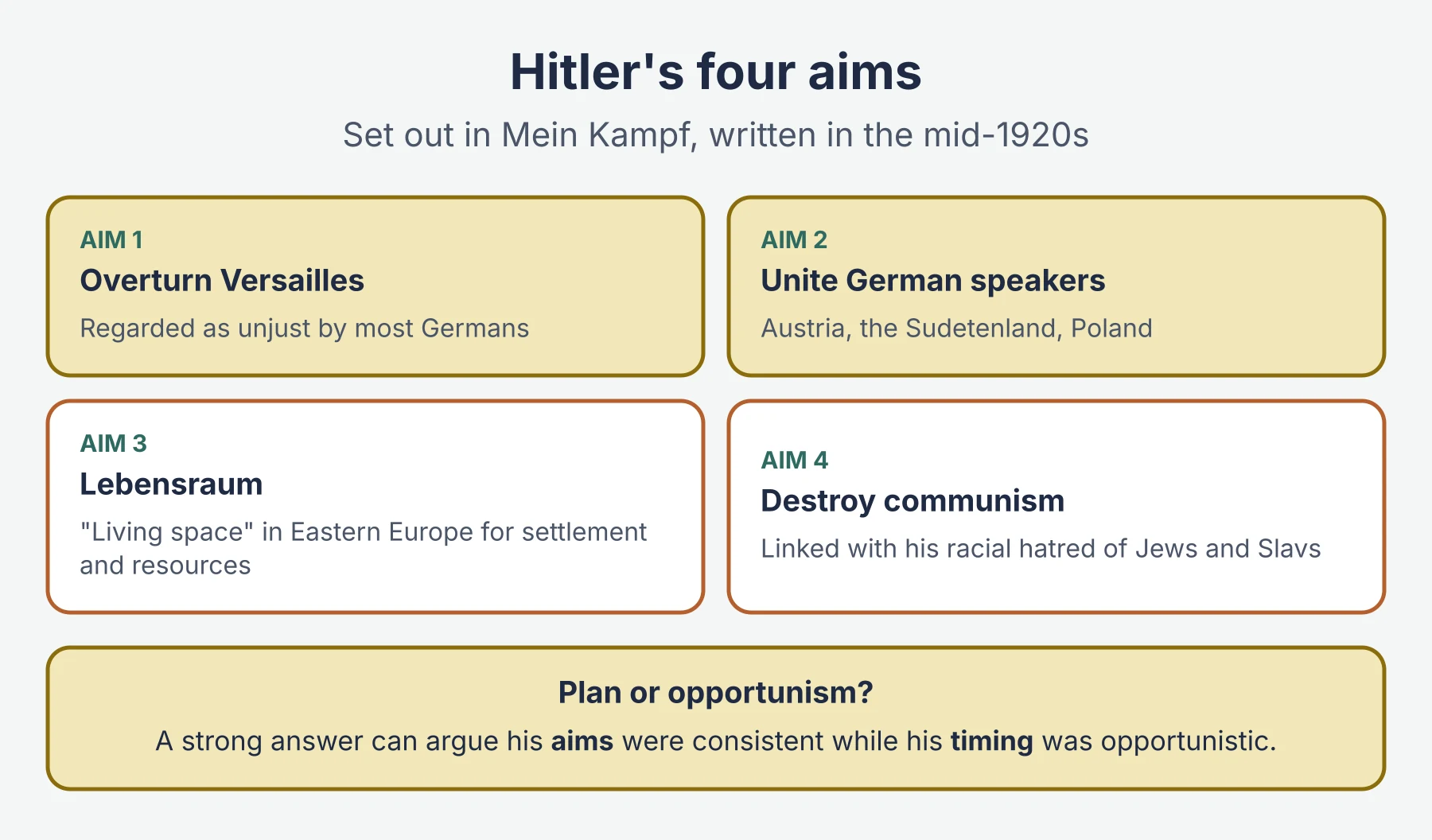
Hitler’s four aims
- Overturn the Treaty of Versailles.
- Unite all German speakers in one Reich.
- Gain Lebensraum in the East.
- Destroy communism.
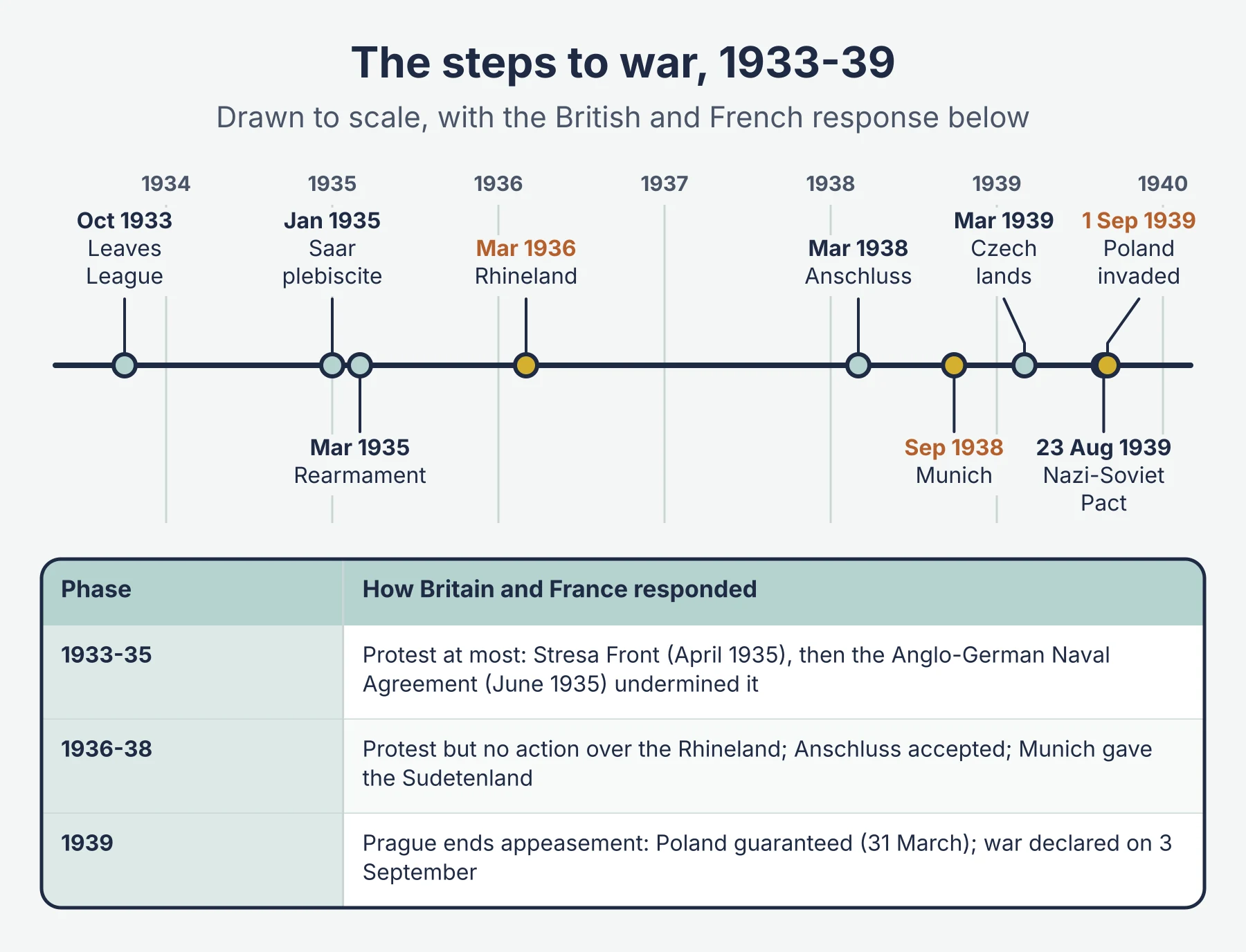
The steps to war: what happened and why it mattered
| Step | Date | Why it mattered |
|---|---|---|
| Leaves Disarmament Conference and League | October 1933 | Freed Germany from international control |
| Rearmament: conscription and the Luftwaffe | March 1935 | Open breach of Versailles; Stresa Front protested but did nothing |
| Saar plebiscite | January 1935 | Over 90% for Germany: a legal success that boosted Hitler’s prestige |
| Anglo-German Naval Agreement | June 1935 | Britain itself accepted a breach of Versailles, splitting Stresa |
| Rhineland remilitarised | March 1936 | A gamble while the world watched Abyssinia; no resistance |
| Spanish Civil War | 1936-39 | Tested weapons and tactics (Guernica, 1937); drew Hitler and Mussolini together |
| Rome-Berlin Axis; Anti-Comintern Pact | 1936 (Italy joins pact 1937) | Germany no longer isolated |
| Anschluss | March 1938 | Austria absorbed; Czechoslovakia surrounded on three sides |
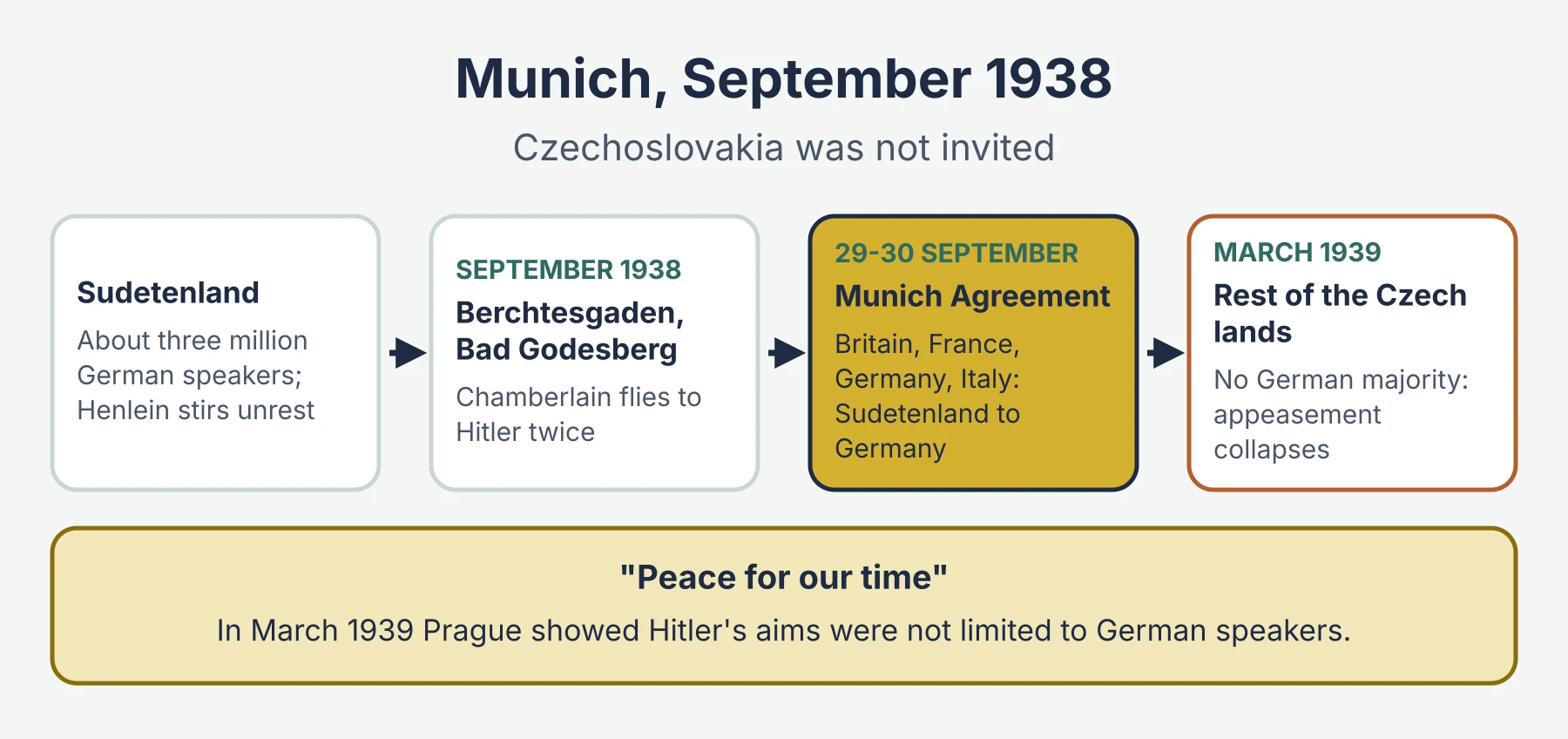
| Munich Agreement | 29-30 September 1938 | Sudetenland handed over; Czechoslovakia not consulted |
| Occupation of the Czech lands | March 1939 | First non-German territory taken; end of appeasement |
| British guarantee to Poland | 31 March 1939 | Commitment to fight if Poland attacked |
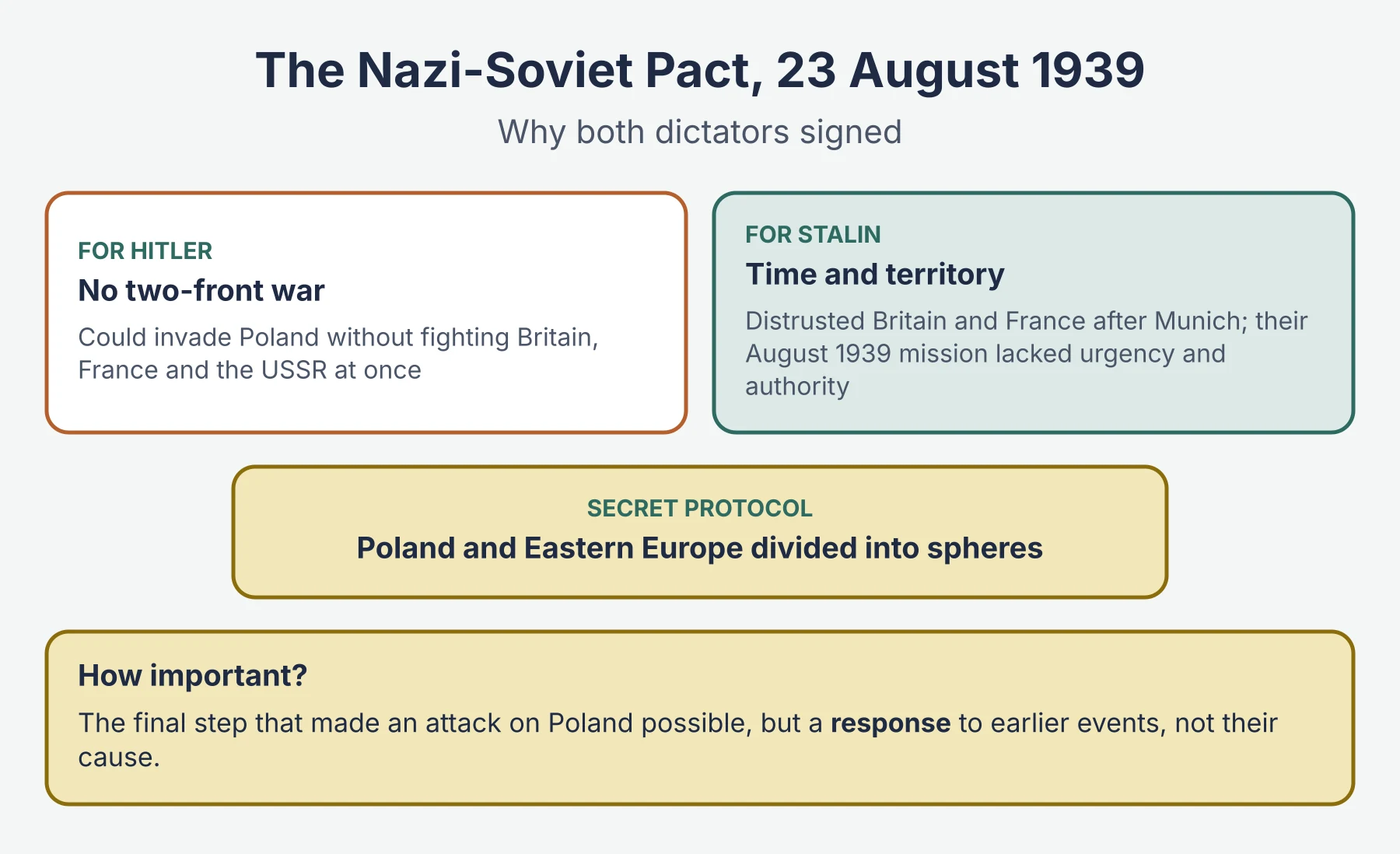
| Nazi-Soviet Pact | 23 August 1939 | No two-front war; secret plan to divide Poland |
| Invasion of Poland | 1 September 1939 | Britain and France declare war on 3 September |
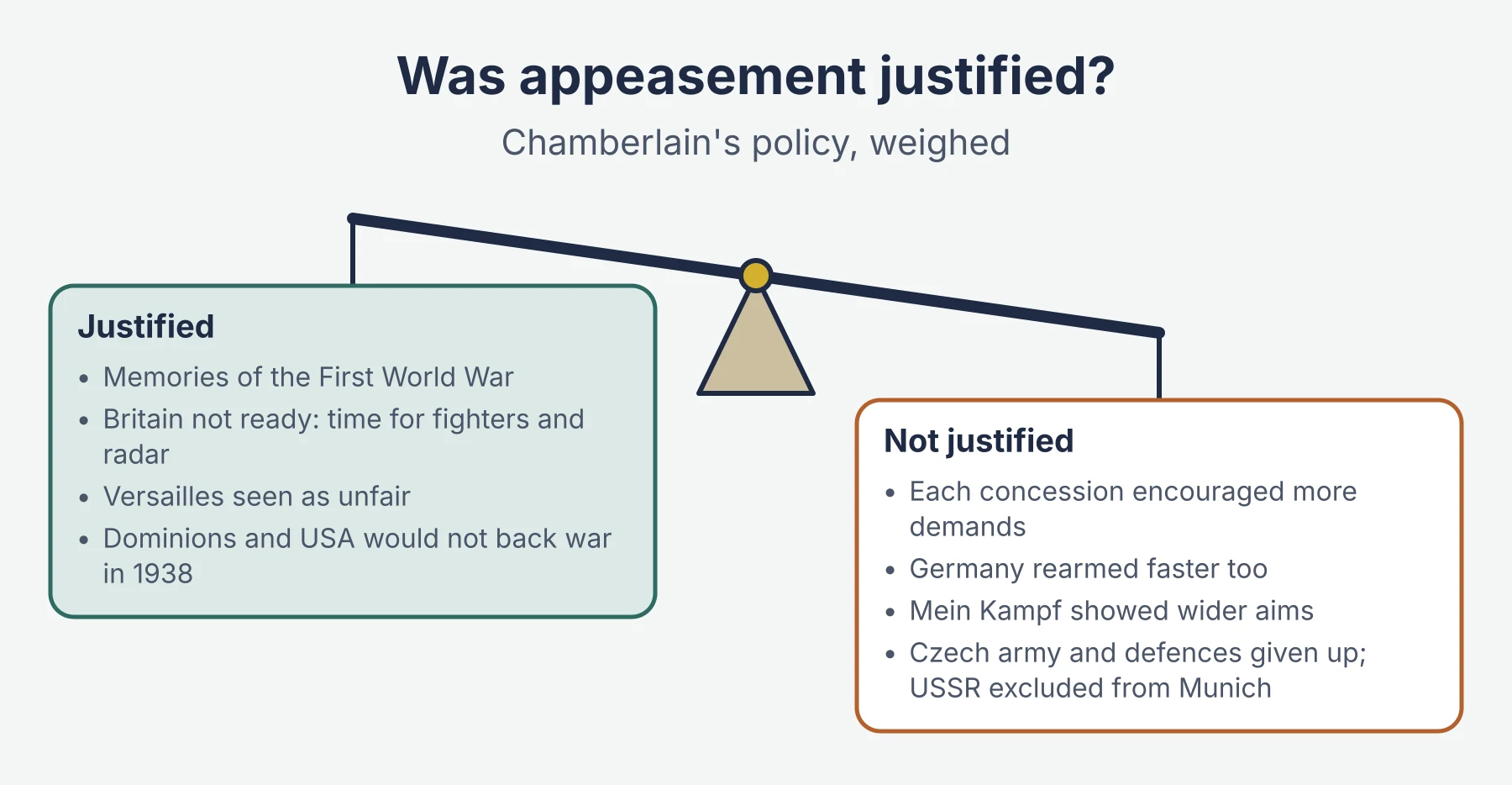
Appeasement: the debate
| For | Against |
|---|---|
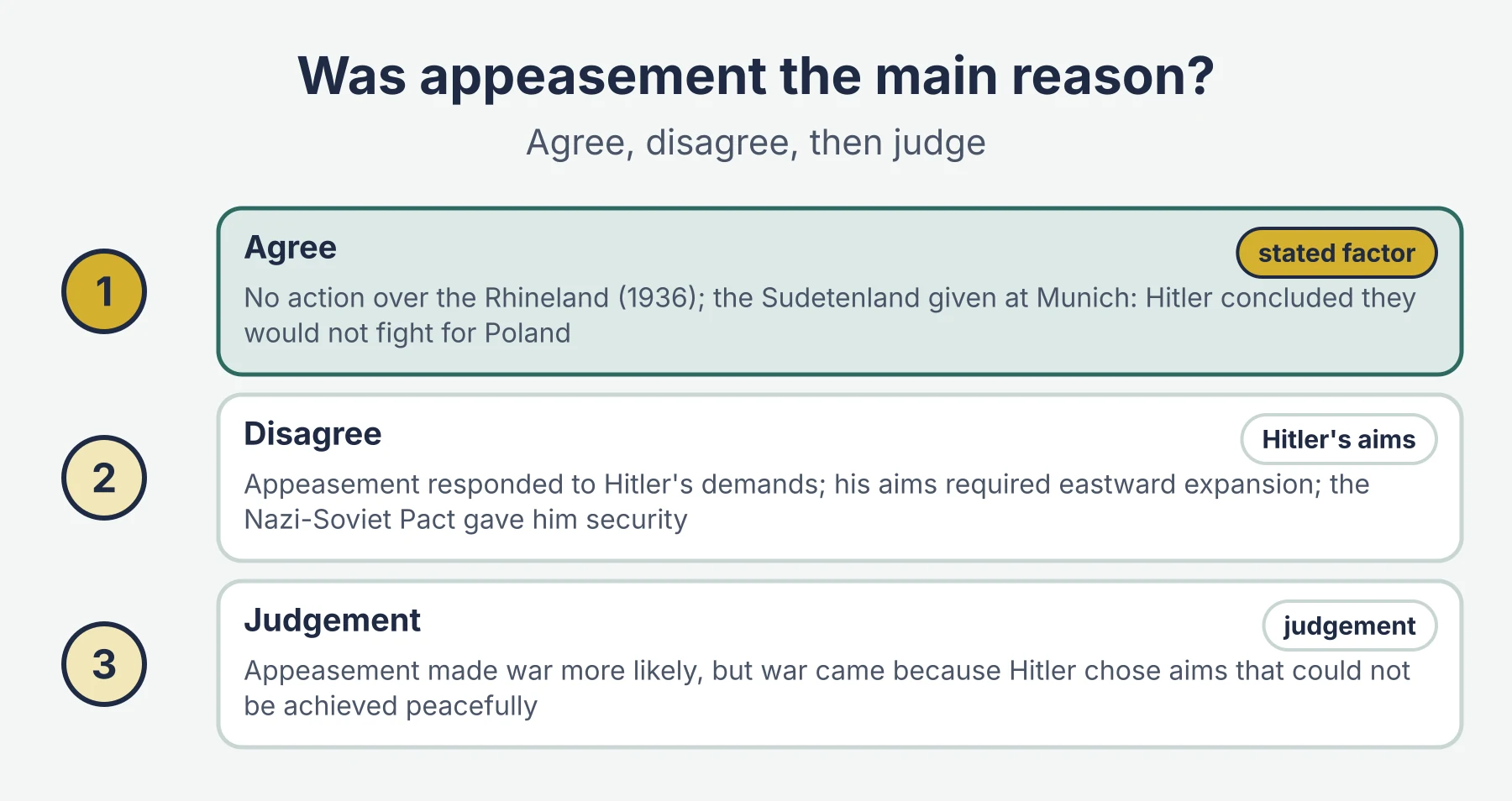
| Public horror of another world war | Encouraged further demands |
| Britain needed time to rearm (fighters, radar) | Germany rearmed faster in the same time |
| Versailles widely seen as unfair | Hitler’s aims went beyond Versailles |
| No support from the USA or the Dominions | Gave away Czechoslovakia’s army and defences |
| Fear of communism | Alienated Stalin, who was not invited to Munich |
Why Stalin signed the Nazi-Soviet Pact
- Distrust of Britain and France after Munich.
- The Anglo-French military mission to Moscow (August 1939) was slow and low-level.
- Time to strengthen Soviet forces.
- Territory in Poland and the Baltic under the secret protocol.
Weighing the causes of war
| Factor | Contribution |
|---|---|
| Hitler’s aims and actions | Expansion eastward required war; he chose to invade Poland |
| Versailles | Grievances that won German support and British sympathy |
| League failures | Showed aggression went unpunished; pushed Italy towards Germany |
| Appeasement | Encouraged Hitler to believe Britain and France would not fight |
| Nazi-Soviet Pact | Removed the last obstacle to invading Poland |
Key terms
| Term | Meaning |
|---|---|
| Lebensraum | “Living space”: land in Eastern Europe for German settlement |
| Rearmament | Building up armed forces, banned for Germany by Versailles |
| Stresa Front | Brief 1935 agreement of Britain, France and Italy against German rearmament |
| Remilitarisation | Moving troops back into the demilitarised Rhineland |
| Anschluss | Union of Germany and Austria, March 1938 |
| Sudetenland | Border area of Czechoslovakia with about three million German speakers |
| Appeasement | Meeting an aggressor’s demands to avoid war |
| Axis | The alliance of Germany and Italy, later Japan |
| Anti-Comintern Pact | Agreement against international communism, Germany and Japan 1936 |
| Secret protocol | Hidden part of the Nazi-Soviet Pact dividing Eastern Europe |
One-line answers to the focus points
- Long-term consequences of Versailles? Grievances over the Rhineland, the Saar, the Corridor and Anschluss that Hitler could exploit, with British sympathy for many of them.
- Consequences of the League’s failures? Collective security collapsed after Abyssinia, Italy joined Germany, and Hitler saw that aggression went unpunished.
- Was appeasement justified? Understandable in 1938, given public opinion and British unreadiness, but it encouraged Hitler and rested on a misreading of his aims.
- How important was the Nazi-Soviet Pact? It removed the threat of a two-front war and made the invasion of Poland possible within days.
- Why did Britain and France declare war? Their guarantee to Poland, Hitler’s broken promises over Czechoslovakia, and a shift in public opinion against further concessions.
Exam traps
- Britain declared war over Poland, not Czechoslovakia.
- The Saar was a legal plebiscite, not an invasion.
- The Anglo-German Naval Agreement shows Britain helping to break Versailles.
- Munich versus March 1939. Munich gave the Sudetenland; the rest of the Czech lands were taken later.
- Do not stop at Hitler. “How far” needs other factors weighed against him.
Self-test
- What was Lebensraum? Living space for Germans in Eastern Europe.
- When did Germany leave the League? October 1933.
- What was the result of the Saar plebiscite? Over 90% voted to return to Germany.
- What did the Anglo-German Naval Agreement allow? A German navy up to 35% of the size of Britain’s.
- Why did Hitler choose March 1936 to enter the Rhineland? Britain and France were distracted by Abyssinia and divided.
- Name one way Germany was involved in the Spanish Civil War. The Condor Legion’s air support for Franco, including the bombing of Guernica.
- Which countries signed the Munich Agreement? Britain, France, Germany and Italy.
- Why did the occupation of Prague in March 1939 end appeasement? It was the first land seized with no German majority, proving Hitler’s aims went beyond uniting Germans.
- What did Britain promise Poland on 31 March 1939? To support it if its independence was threatened.
- Give two reasons Stalin signed the Nazi-Soviet Pact. Distrust after Munich; to gain time; to gain territory (any two).
- What did the secret protocol of the pact do? Divided Poland and Eastern Europe between German and Soviet spheres.
- When did Britain and France declare war on Germany? 3 September 1939.
Related resources
-
Study guides
Cambridge IGCSE World History (0470): To What Extent Was the League of Nations a Success?
Study guide to Cambridge IGCSE History 0470 key question 2.2: League structure, 1920s disputes, humanitarian work, Manchuria and Abyssinia.
World History · Cambridge · IGCSE
Read guide -
Practice questions
Cambridge IGCSE World History (0470): To What Extent Was the League of Nations a Success? – Practice Questions
Twelve original questions with mark-scheme answers on the League's structure, disputes, humanitarian work and 1930s crises, for Cambridge IGCSE 0470.
World History · Cambridge · IGCSE
Try questions -
Revision notes
Cambridge IGCSE World History (0470): To What Extent Was the League of Nations a Success? – Revision Notes
Recall notes for Cambridge IGCSE History 0470 key question 2.2: League structure, 1920s disputes, humanitarian work, the 1930s crises and a self-test.
World History · Cambridge · IGCSE
Revise topic
Get free revision emails (optional)
Occasional emails with practice questions, worked explanations and links to free resources for the qualification and subjects you choose. No spam, and you can unsubscribe from any email. The free tools on this site never need an email.