
Study Guides
Cambridge IGCSE World History (0470): To What Extent Was the League of Nations a Success?
Study guide to Cambridge IGCSE History 0470 key question 2.2: League structure, 1920s disputes, humanitarian work, Manchuria and Abyssinia.
- Subject
- World History
- Level
- IGCSE
- Topic
- Core Content – Option B: International Relations since 1919
- Author
- Marlbridge Academic Team
- Updated
- Reviewed by
- Azam Siddique (what this means)
Aligned to Cambridge IGCSE World History (0470), 2024-2026. Official specification .
Syllabus page (what it covers and how it is assessed): Cambridge IGCSE World History.
Syllabus points this page covers
0470
- 2.2 To what extent was the League of Nations a success?
Found an error? Report a correction.
Need help with this topic? Request a free trial class for IGCSE World History (0470).
This guide covers key question 2 of Core Content Option B in Cambridge IGCSE History 0470 (2024-2026): “To what extent was the League of Nations a success?” The focus points ask how far weaknesses in the League’s organisation and membership made failure inevitable, how successful its peacekeeping was in the 1920s, how important its humanitarian work was, and how far the Depression made its work more difficult in the 1930s. The specified content names exactly which cases to know: Vilna (1920), the Aaland Islands (1920-21), Corfu (1923) and Bulgaria (1925); humanitarian work on refugees, health, working conditions and slavery; and the Manchurian and Abyssinian crises. The League was the Paper 2 prescribed topic in March 2025 (India only) and June 2025.
Pair this guide with the League of Nations revision notes and the League of Nations practice questions. The Twentieth Century 1919-1989 guide shows how the League links to the Treaty of Versailles and the road to war.
Structure, aims and membership
The League was set up by the Covenant, written into each of the peace treaties of 1919-20, and was based in Geneva. Its aims were to prevent war through collective security, encourage disarmament, and improve living and working conditions worldwide.
| Body | Role |
|---|---|
| Assembly | All members, one vote each; met once a year; decisions had to be unanimous |
| Council | Met more often; permanent members at first Britain, France, Italy and Japan, with non-permanent members elected by the Assembly; could impose sanctions |
| Secretariat | Civil service that kept records and organised the League’s work |
| Permanent Court of International Justice | At The Hague; ruled on legal disputes between states if they asked it to, but could not enforce rulings |
| International Labour Organization (ILO) | Brought together governments, employers and workers to improve working conditions |
| Commissions | Including the Mandates, Refugees, Slavery and Health bodies |
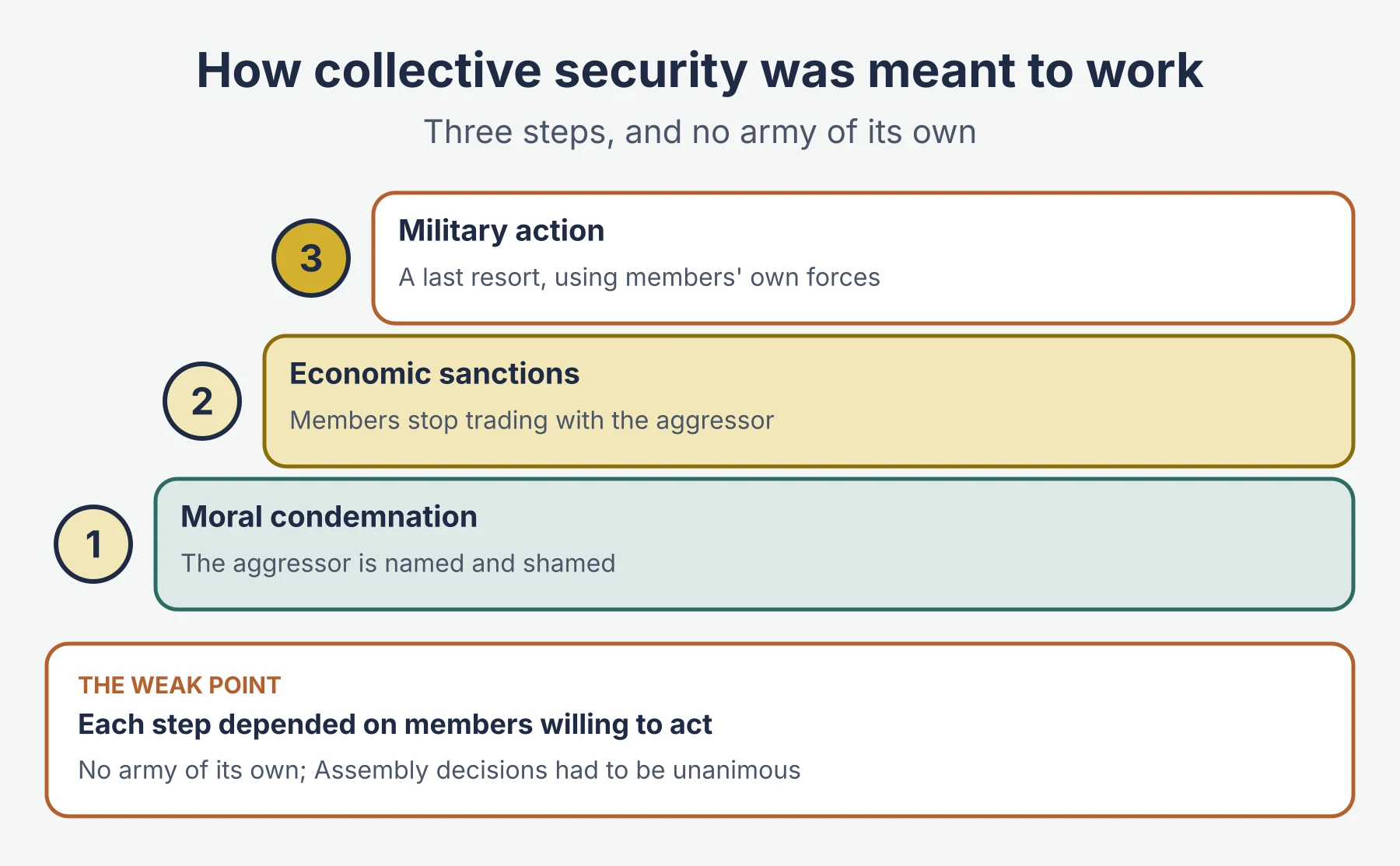
Collective security relied on three steps: moral condemnation, economic sanctions, and as a last resort military action using members’ own forces. The League had no army of its own.
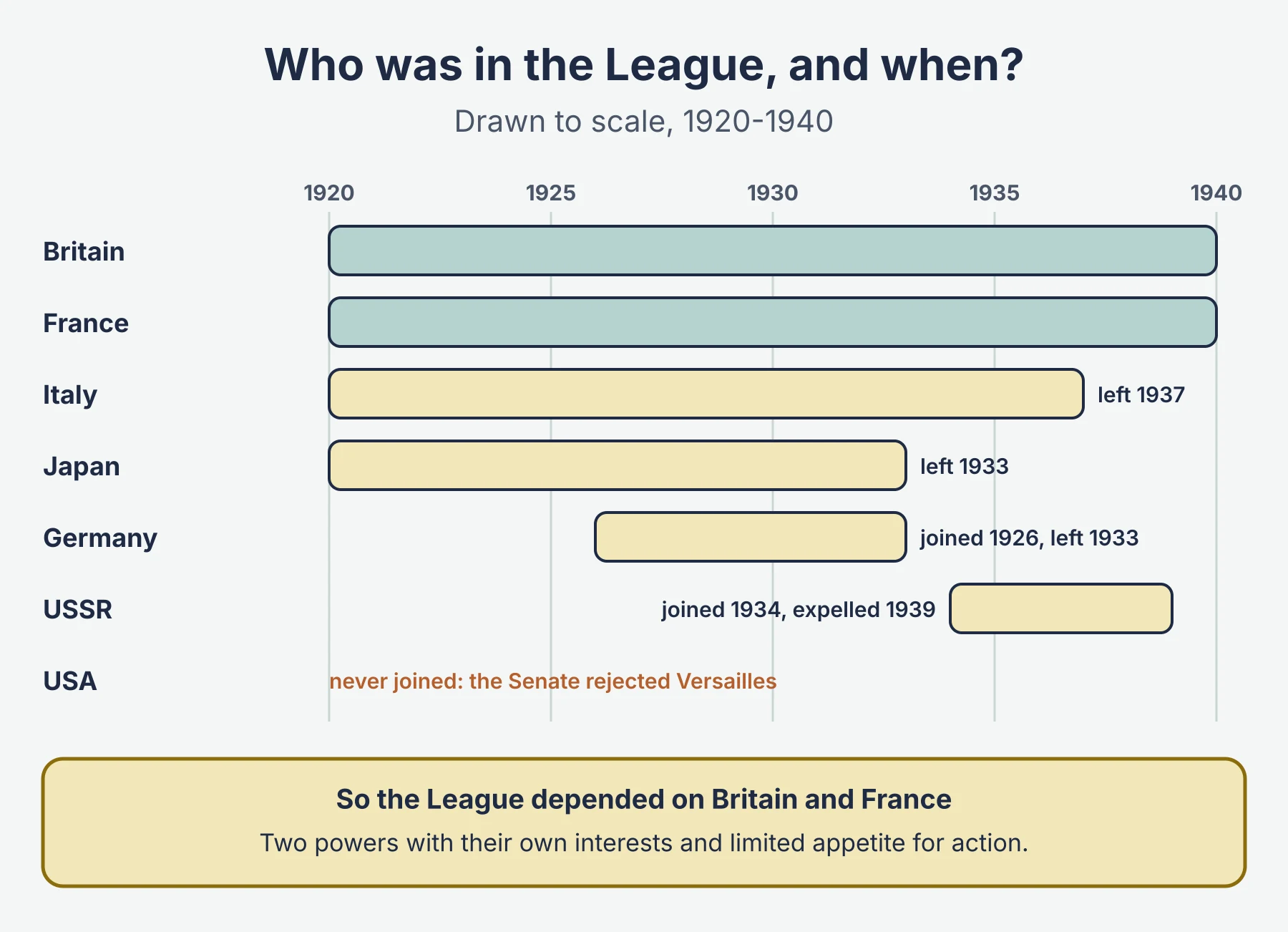
Membership problems: the USA never joined, because the Senate rejected the Treaty of Versailles. Germany was excluded until 1926 and left in 1933. The USSR joined only in 1934 and was expelled in 1939. Japan left in 1933 and Italy in 1937. The League therefore depended on Britain and France, who had their own interests and limited appetite for action.
Did these weaknesses make failure inevitable?
The case for: without the USA, economic sanctions could be undermined by American trade; unanimity made decisions slow; without an army, action depended on members who were reluctant to fight. The case against: the League did solve disputes in the 1920s with the same structure, which suggests that failure depended on circumstances, especially the attitude of the great powers and the economic crisis after 1929.
Peacekeeping in the 1920s
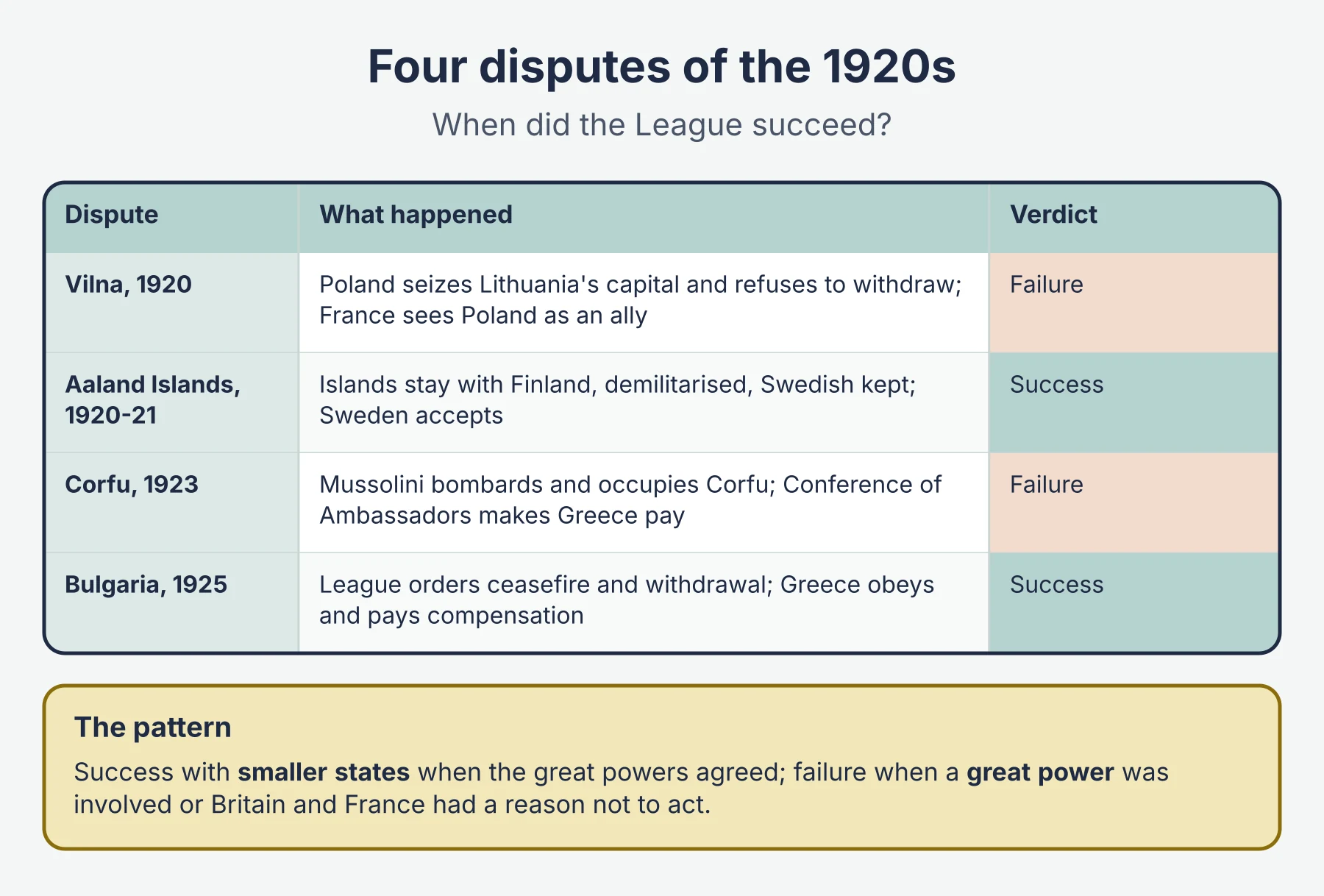
| Dispute | What happened | Verdict |
|---|---|---|
| Vilna, 1920 | Polish forces seized Vilna, capital of newly independent Lithuania. Lithuania appealed; the League asked Poland to withdraw, but Poland refused. France saw Poland as an ally against Germany and Britain would not act alone | Failure: a member kept land taken by force |
| Aaland Islands, 1920-21 | Sweden and Finland both claimed the islands, whose people were mostly Swedish speakers. The League ruled that they should stay with Finland, be demilitarised and keep Swedish language and self-government. Sweden accepted | Success: two smaller states accepted a ruling |
| Corfu, 1923 | An Italian general, Tellini, was murdered while mapping the Greek-Albanian border. Mussolini demanded compensation and bombarded and occupied the Greek island of Corfu. The Conference of Ambassadors, not the League alone, made Greece apologise and pay Italy; Italy then left Corfu | Failure: a great power used force and gained |
| Bulgaria, 1925 | After shootings on the border, Greek troops invaded Bulgaria. The League ordered a ceasefire and withdrawal; Greece obeyed and was ordered to pay compensation. Greeks complained that Italy had been treated differently in 1923 | Success: the League stopped a war quickly |
Pattern to explain: the League succeeded when the disputing countries were smaller states and the great powers agreed; it failed when a great power was involved or when Britain and France had a reason not to act.
Humanitarian work
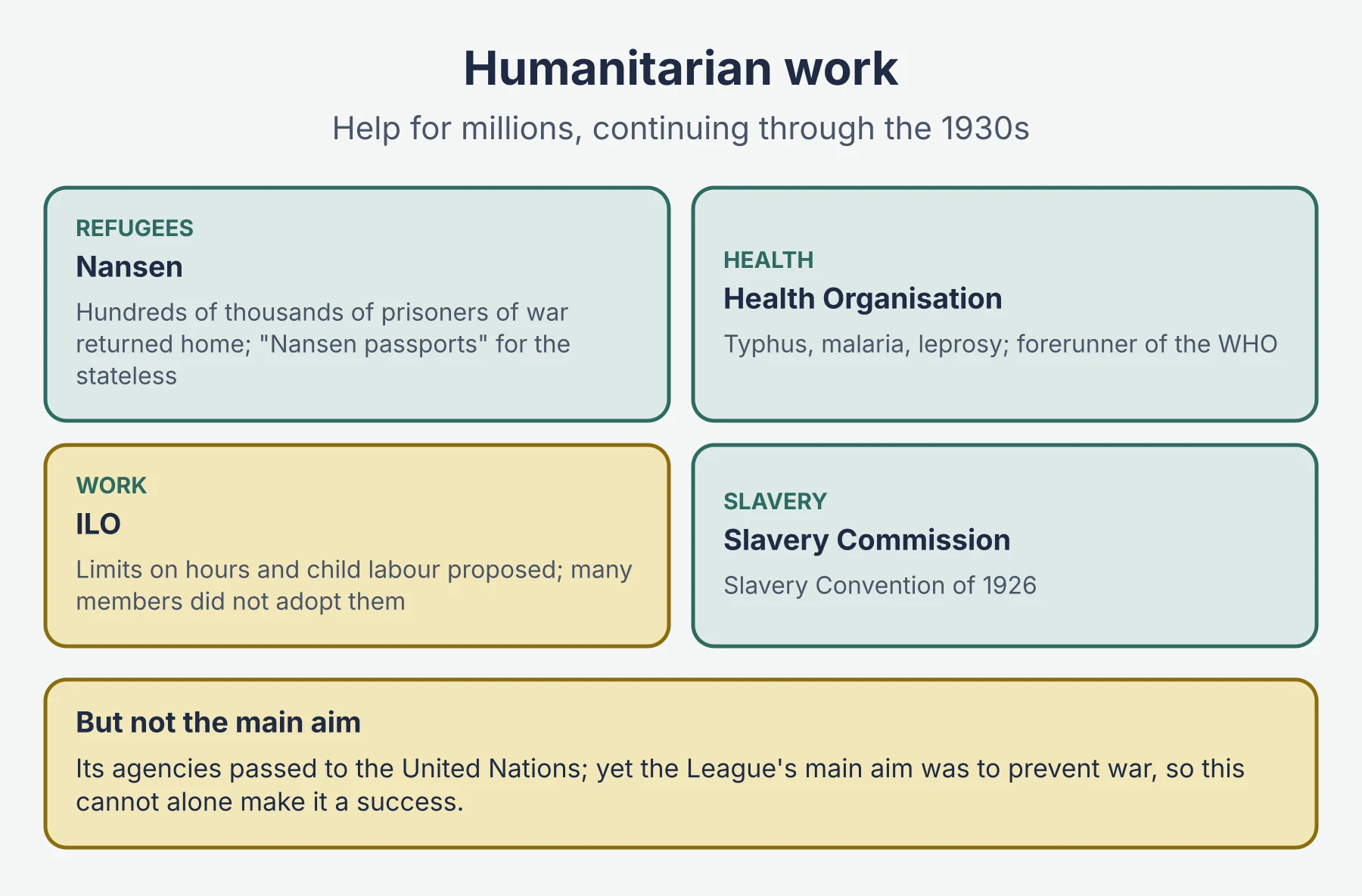
| Area | What the League did |
|---|---|
| Refugees | The Refugee Commission, led by Fridtjof Nansen, helped return hundreds of thousands of former prisoners of war home after 1920, and the “Nansen passport” gave stateless refugees identity papers |
| Health | The Health Organisation worked against epidemics such as typhus in Eastern Europe, and on diseases including malaria and leprosy; it was the forerunner of the World Health Organization |
| Working conditions | The ILO proposed limits on working hours and on child labour; many members did not adopt its recommendations because of the cost |
| Slavery | The Slavery Commission investigated forced labour and the slave trade, and the League adopted the Slavery Convention of 1926 |
How important was it? This work helped millions of people and continued through the 1930s, even when peacekeeping failed. Some historians regard it as the League’s most lasting achievement, because its agencies and methods passed to the United Nations. But it was not the League’s main aim, which was to prevent war, so it cannot on its own make the League a success.
The 1930s: the Depression, Manchuria and Abyssinia
The Wall Street Crash (1929) and the Depression that followed changed the context. Governments put their own economies first and were reluctant to use trade sanctions that would hurt their own exporters. Unemployment and poverty helped militarist and nationalist groups gain influence in Japan, Germany and Italy, where expansion abroad seemed a solution.
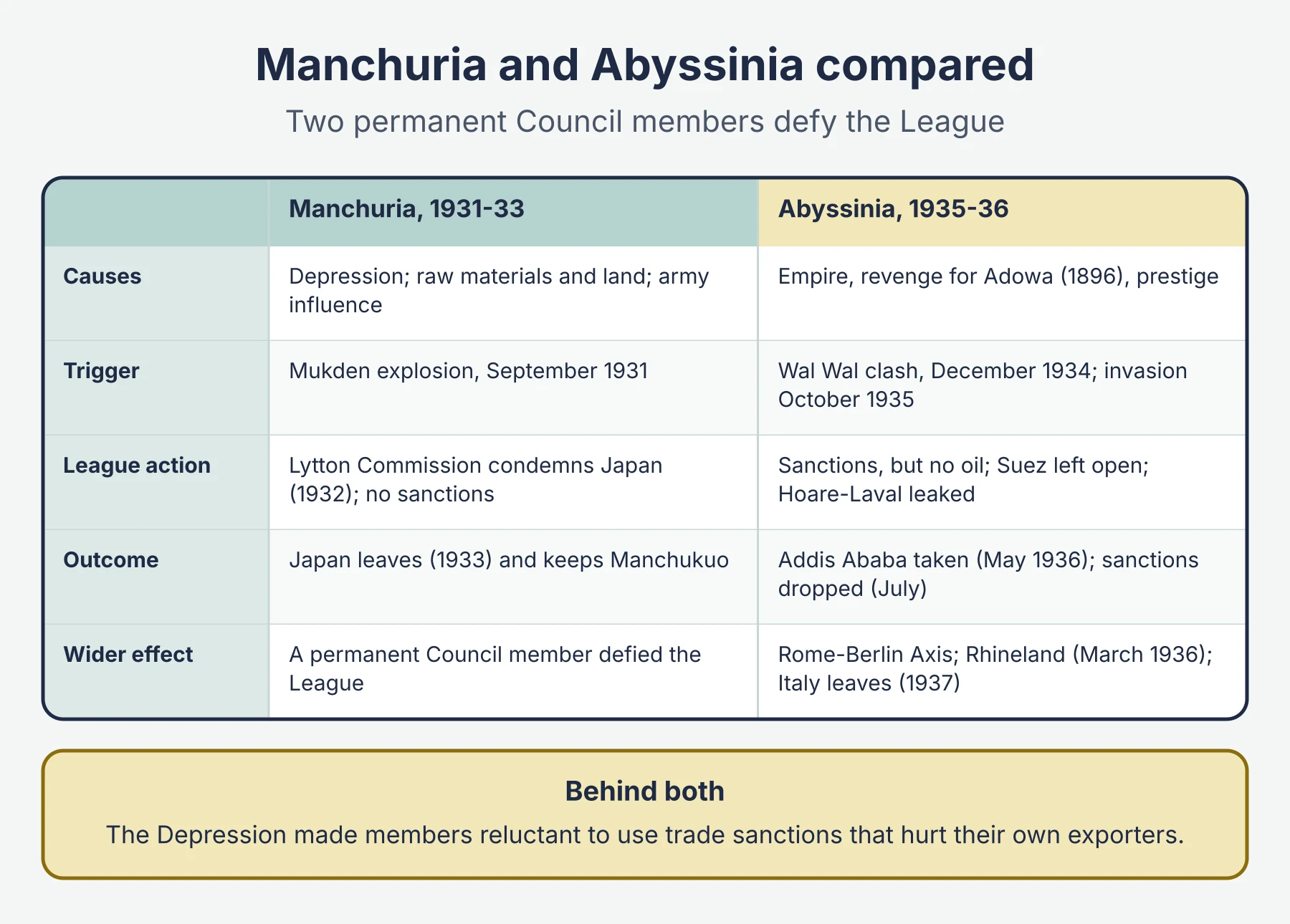
Manchuria, 1931-33
- Causes: Japan’s economy was hit hard by the Depression; Manchuria offered raw materials and land; the army had growing influence over government.
- Events: after an explosion on the Japanese-owned South Manchurian Railway near Mukden (September 1931), the Japanese army occupied Manchuria and set up the puppet state of Manchukuo (1932) under the last Chinese emperor, Puyi. China appealed to the League, which sent the Lytton Commission. Its report (1932) condemned Japan.
- Consequences: Japan left the League in 1933 and kept Manchuria. No sanctions were imposed: Britain and France were not prepared to risk war in the Far East, and the USA, a major trading partner of Japan, was not a member. The League had been defied by a permanent Council member.
Abyssinia, 1935-36
- Causes: Mussolini wanted an empire, revenge for Italy’s defeat by Abyssinia at Adowa in 1896, and prestige.
- Events: after a clash at Wal Wal (December 1934), Italy invaded in October 1935. The League condemned Italy and imposed economic sanctions, but oil was not included, and Britain did not close the Suez Canal to Italian ships. In December 1935 the Hoare-Laval Pact, a secret British and French plan to give Italy much of Abyssinia, was leaked and caused public outrage. Italy took the capital, Addis Ababa, in May 1936; Emperor Haile Selassie appealed to the League in person, and sanctions were dropped in July 1936.
- Consequences: collective security was discredited; Italy moved towards Germany (the Rome-Berlin Axis, 1936) and left the League in 1937; while attention was on Abyssinia, Hitler remilitarised the Rhineland (March 1936).
Annotated model answer
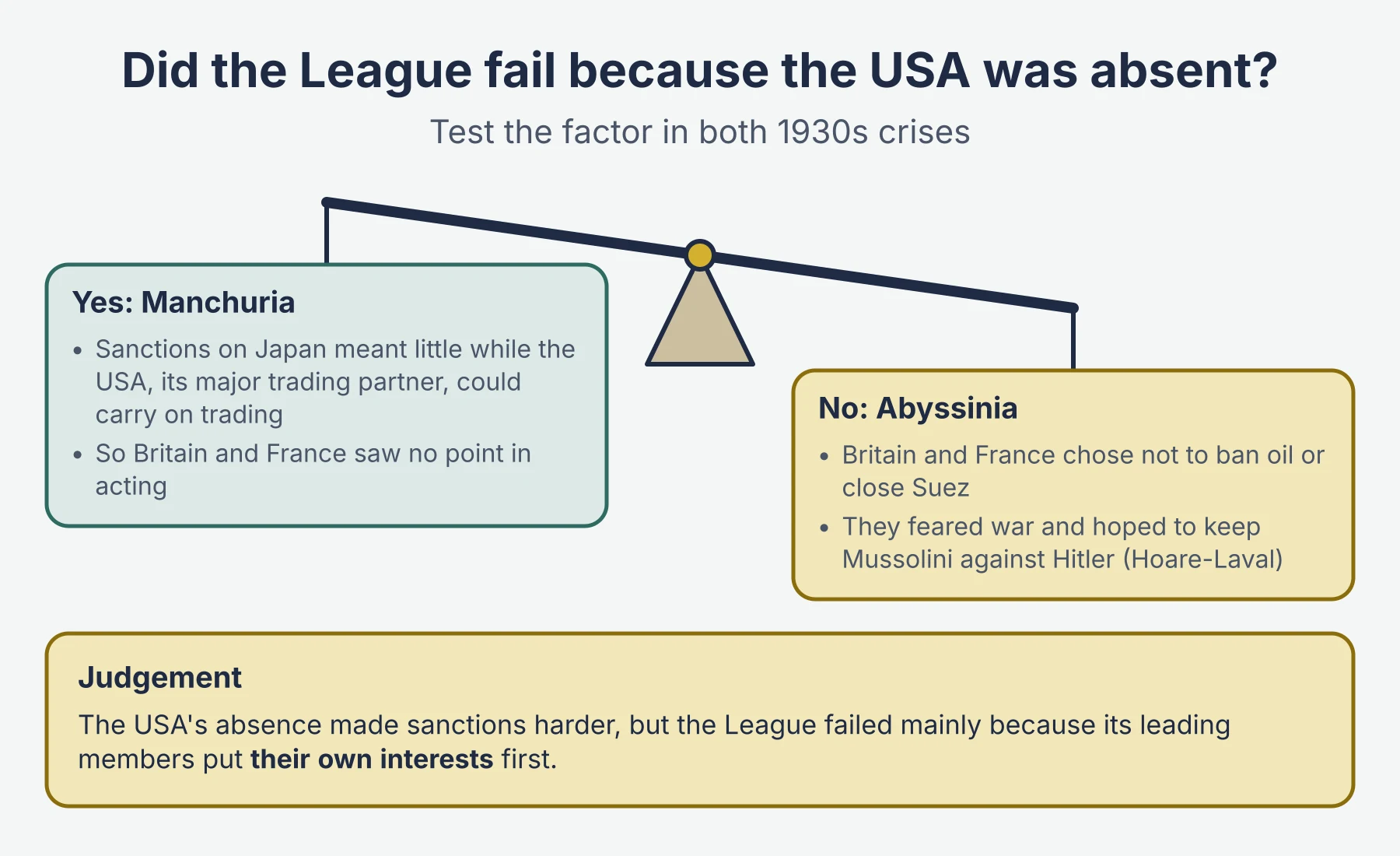
An original practice question: “The League of Nations failed because the USA was not a member.” How far do you agree? [10]
American absence weakened the League. In Manchuria, sanctions on Japan would have meant little while the USA, Japan’s major trading partner, could carry on trading, so Britain and France saw no point in acting. [Agree, explained.] However, in Abyssinia sanctions failed because Britain and France chose not to ban oil or close the Suez Canal, fearing war with Italy and hoping to keep Mussolini as an ally against Hitler, as the Hoare-Laval Pact showed. [Disagree, explained.] The USA’s absence made sanctions harder, but the League failed mainly because its leading members put their own interests before collective security. [Judgement.]
Common mistakes
- Treating Corfu as a League success because Italy left the island. Mussolini got the compensation he demanded.
- Forgetting that the Conference of Ambassadors, not the League, settled Corfu.
- Describing the humanitarian agencies without judging their importance.
- Saying the League had no sanctions against Italy. It imposed some, but not on oil.
Exam technique
Choose a clear criterion for “success”: keeping peace between great powers, solving smaller disputes, or improving lives. Different criteria give different answers, and examiners reward a judgement that states its criterion.
Official syllabus
Cambridge IGCSE History (0470) syllabus for 2024, 2025 and 2026, Core Content Option B, key question 2 – cambridgeinternational.org.
Related resources
-
Practice questions
Cambridge IGCSE World History (0470): To What Extent Was the League of Nations a Success? – Practice Questions
Twelve original questions with mark-scheme answers on the League's structure, disputes, humanitarian work and 1930s crises, for Cambridge IGCSE 0470.
World History · Cambridge · IGCSE
Try questions -
Revision notes
Cambridge IGCSE World History (0470): To What Extent Was the League of Nations a Success? – Revision Notes
Recall notes for Cambridge IGCSE History 0470 key question 2.2: League structure, 1920s disputes, humanitarian work, the 1930s crises and a self-test.
World History · Cambridge · IGCSE
Revise topic -
Study guides
Cambridge IGCSE World History (0470): Was the Treaty of Versailles Fair?
Study guide to Cambridge IGCSE History 0470 key question 2.1: the Big Three, the terms, the impact on Germany to 1923 and opinions of the Treaty.
World History · Cambridge · IGCSE
Read guide
Get free revision emails (optional)
Occasional emails with practice questions, worked explanations and links to free resources for the qualification and subjects you choose. No spam, and you can unsubscribe from any email. The free tools on this site never need an email.