
Study Guides
Cambridge IGCSE World History (0470): Was the Treaty of Versailles Fair?
Study guide to Cambridge IGCSE History 0470 key question 2.1: the Big Three, the terms, the impact on Germany to 1923 and opinions of the Treaty.
- Subject
- World History
- Level
- IGCSE
- Topic
- Core Content – Option B: International Relations since 1919
- Author
- Marlbridge Academic Team
- Updated
- Reviewed by
- Azam Siddique (what this means)
Aligned to Cambridge IGCSE World History (0470), 2024-2026. Official specification .
Syllabus page (what it covers and how it is assessed): Cambridge IGCSE World History.
Syllabus points this page covers
0470
- 2.1 Was the Treaty of Versailles fair?
Found an error? Report a correction.
Need help with this topic? Request a free trial class for IGCSE World History (0470).
This guide covers key question 1 of Core Content Option B in Cambridge IGCSE History 0470 (2024-2026): “Was the Treaty of Versailles fair?” The four focus points ask what the motives and aims of the Big Three were, why the victors did not get everything they wanted, what the impact of the Treaty on Germany was up to the end of 1923, and whether the Treaty could be justified at the time. The specified content is: the roles of Wilson, Clemenceau and Lloyd George; the terms of the Treaty; its social, economic and political impact in Germany to the end of 1923; and contemporary opinions about it. “Was the Treaty of Versailles fair?” is the Paper 2 prescribed topic for the June 2026 series, so contemporary opinions in sources need special attention.
Recall facts with the Versailles revision notes and practise with the Versailles practice questions. For how this key question leads into the League and the road to war, see the Twentieth Century 1919-1989 guide.
The Big Three: motives and aims
The Paris Peace Conference opened in January 1919. Germany was not invited to negotiate, and Russia, now under Bolshevik rule, was not represented.
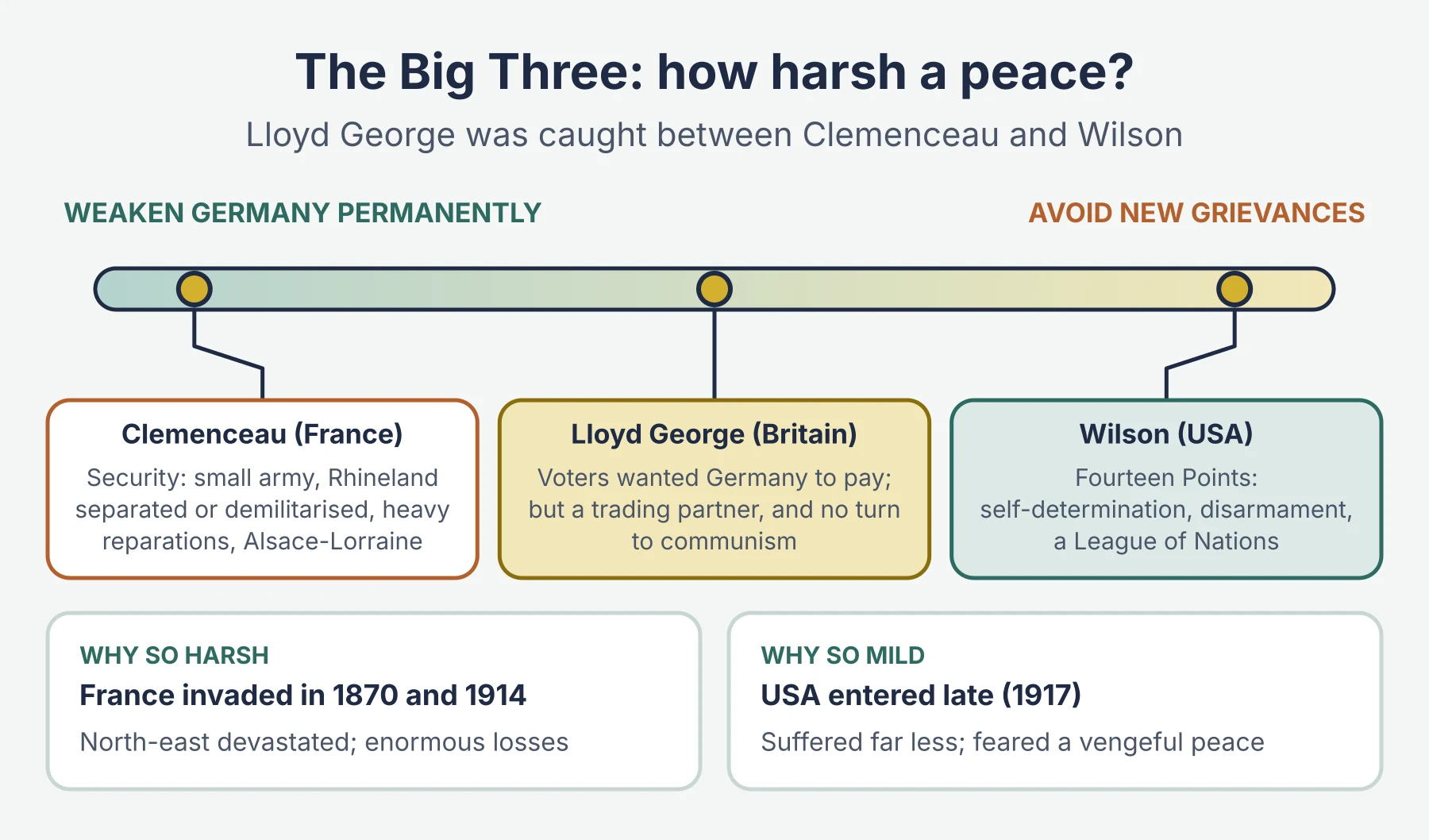
Georges Clemenceau (France) wanted security above all. France had been invaded in 1870 and 1914; its north-east had been devastated and it had suffered enormous military losses. He wanted Germany weakened permanently: a small army, the Rhineland separated from Germany or at least demilitarised, heavy reparations to rebuild France, and the return of Alsace-Lorraine. French public opinion demanded that Germany pay.
Woodrow Wilson (USA) had set out his Fourteen Points in January 1918. He wanted a peace that would not create new grievances: self-determination for national groups, disarmament, free trade, freedom of the seas, open diplomacy and a League of Nations. The USA had entered the war late (1917) and suffered far less, so he could afford to be less harsh. He believed a vengeful peace would cause another war.
David Lloyd George (Britain) was caught between the two. He won the December 1918 general election when many voters wanted Germany to pay. But he also wanted Germany to recover as a trading partner for Britain and feared that a humiliated Germany might turn to communism, as Russia had. In the Fontainebleau Memorandum (March 1919) he warned against a peace that would leave Germany with a grievance. Britain’s own aims, the destruction of the German navy and gains of German colonies, were largely met.
The terms of the Treaty
The Treaty was signed in the Hall of Mirrors at Versailles on 28 June 1919, five years to the day after the Sarajevo assassination.
| Category | Terms |
|---|---|
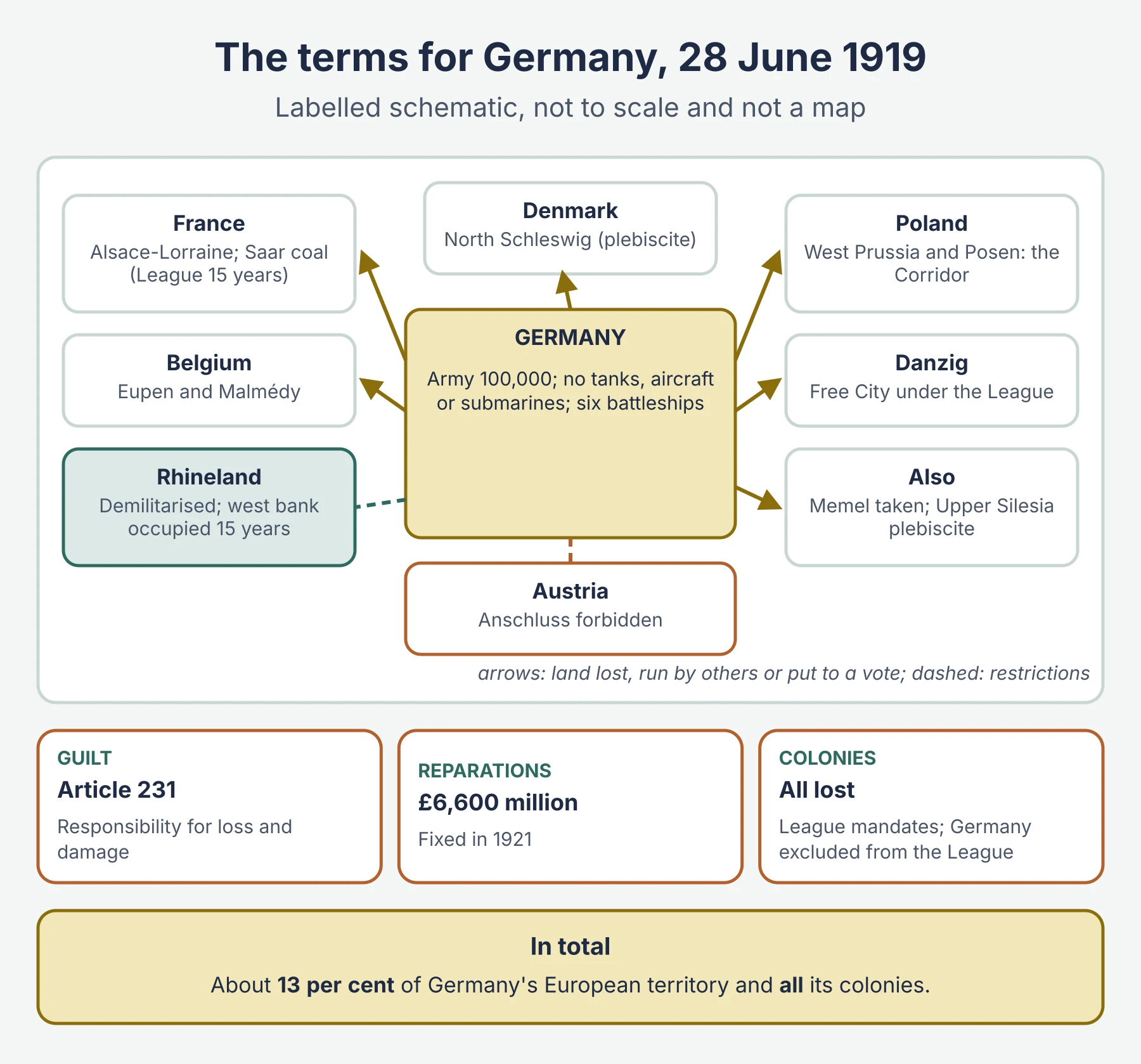
| Guilt | Article 231: Germany accepted responsibility for the loss and damage caused by the war |
| Reparations | Amount fixed in 1921 at £6,600 million |
| Military | Army limited to 100,000, no conscription; no tanks, no military aircraft; navy limited to six battleships, no submarines |
| Rhineland | Demilitarised; Allied troops to occupy the west bank for 15 years |
| Territory in the west | Alsace-Lorraine to France; Eupen and Malmédy to Belgium; the Saar run by the League for 15 years, with France taking its coal |
| Territory in the east and north | West Prussia and Posen to Poland, creating the Polish Corridor; Danzig a Free City under the League; Memel taken; North Schleswig to Denmark after a plebiscite; a plebiscite in Upper Silesia |
| Other | Anschluss (union with Austria) forbidden; colonies became League mandates run by Britain, France and others; Germany excluded from the League |
Germany lost about 13% of its European territory and all its overseas colonies.
Why the victors did not get everything they wanted
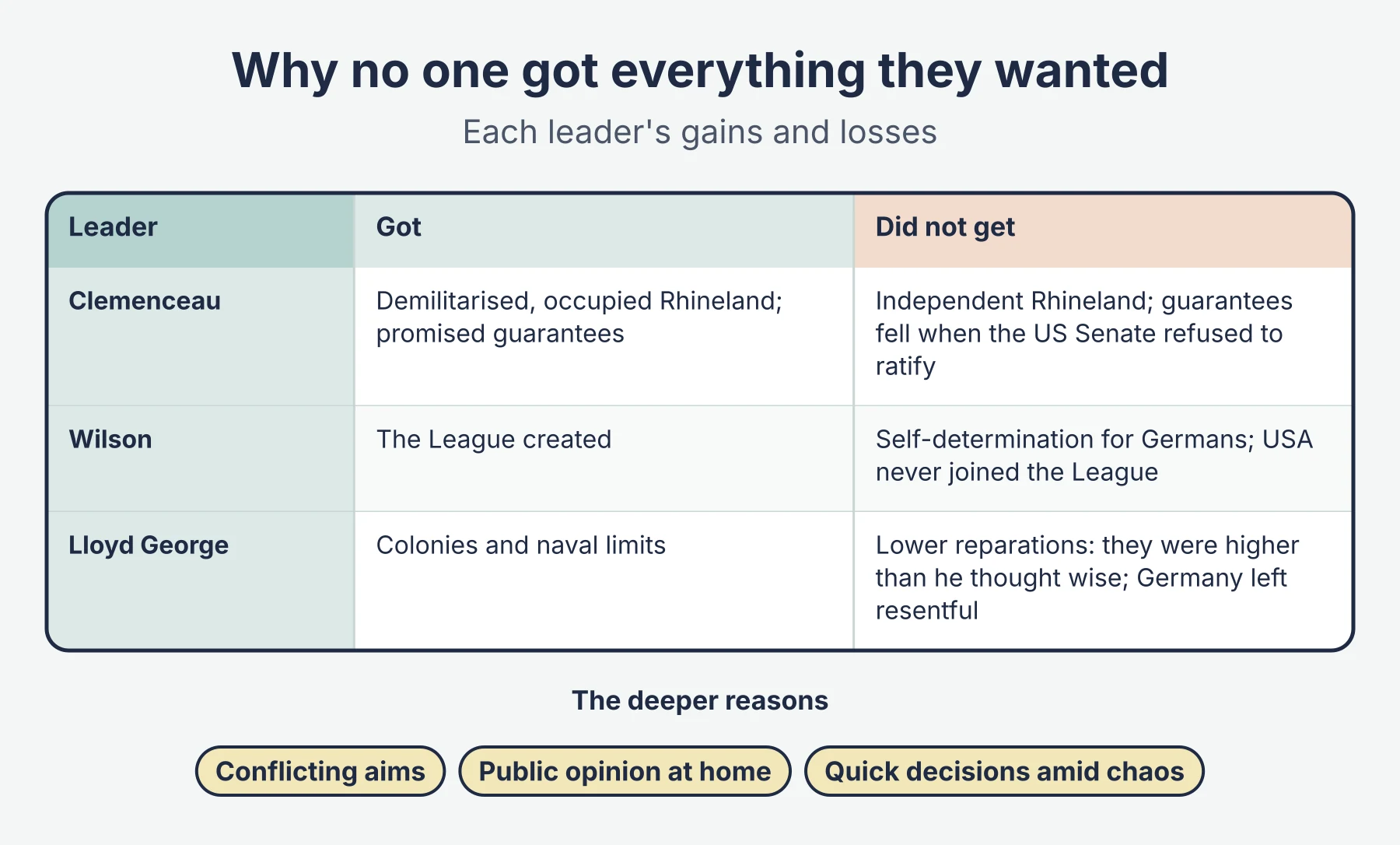
- Clemenceau did not get an independent Rhineland or the permanent breaking-up of Germany; he accepted demilitarisation and occupation plus a promise of British and American guarantees. When the US Senate refused to ratify the Treaty, the American guarantee fell, and Britain’s fell with it.
- Wilson saw self-determination ignored where it would have helped Germany: German speakers were placed under Poland and Czechoslovakia, and union with Austria was banned. His League was created, but the USA never joined it.
- Lloyd George got the colonies and naval limits he wanted, but reparations were higher than he believed was wise, and Germany was left resentful.
The deeper reasons: the three leaders’ aims conflicted; each faced public opinion at home; and the conference had to make decisions quickly amid chaos in Central Europe.
The impact on Germany to the end of 1923
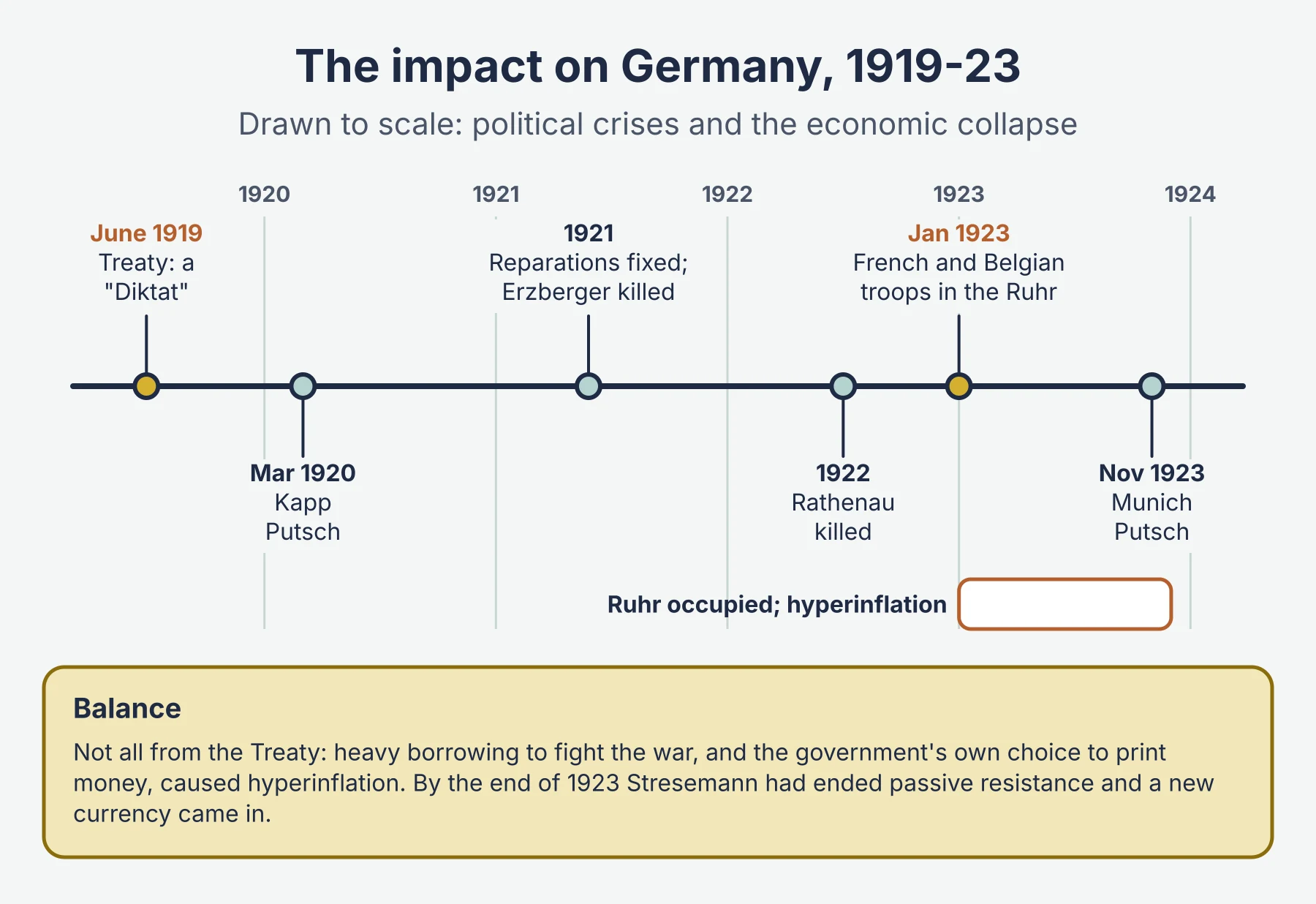
Political: Germans called the Treaty a Diktat, a dictated peace, because they had no say. The politicians who signed it, and who had agreed the armistice, were branded the “November criminals”, and the “stab in the back” myth claimed the army had been betrayed. Discontent fed extremism: the right-wing Kapp Putsch (March 1920) was triggered partly by orders to disband Freikorps units, as the army had to be cut; the minister who had signed the armistice, Matthias Erzberger, was murdered in 1921, and the foreign minister Walther Rathenau in 1922; Hitler attempted the Munich Putsch in November 1923.
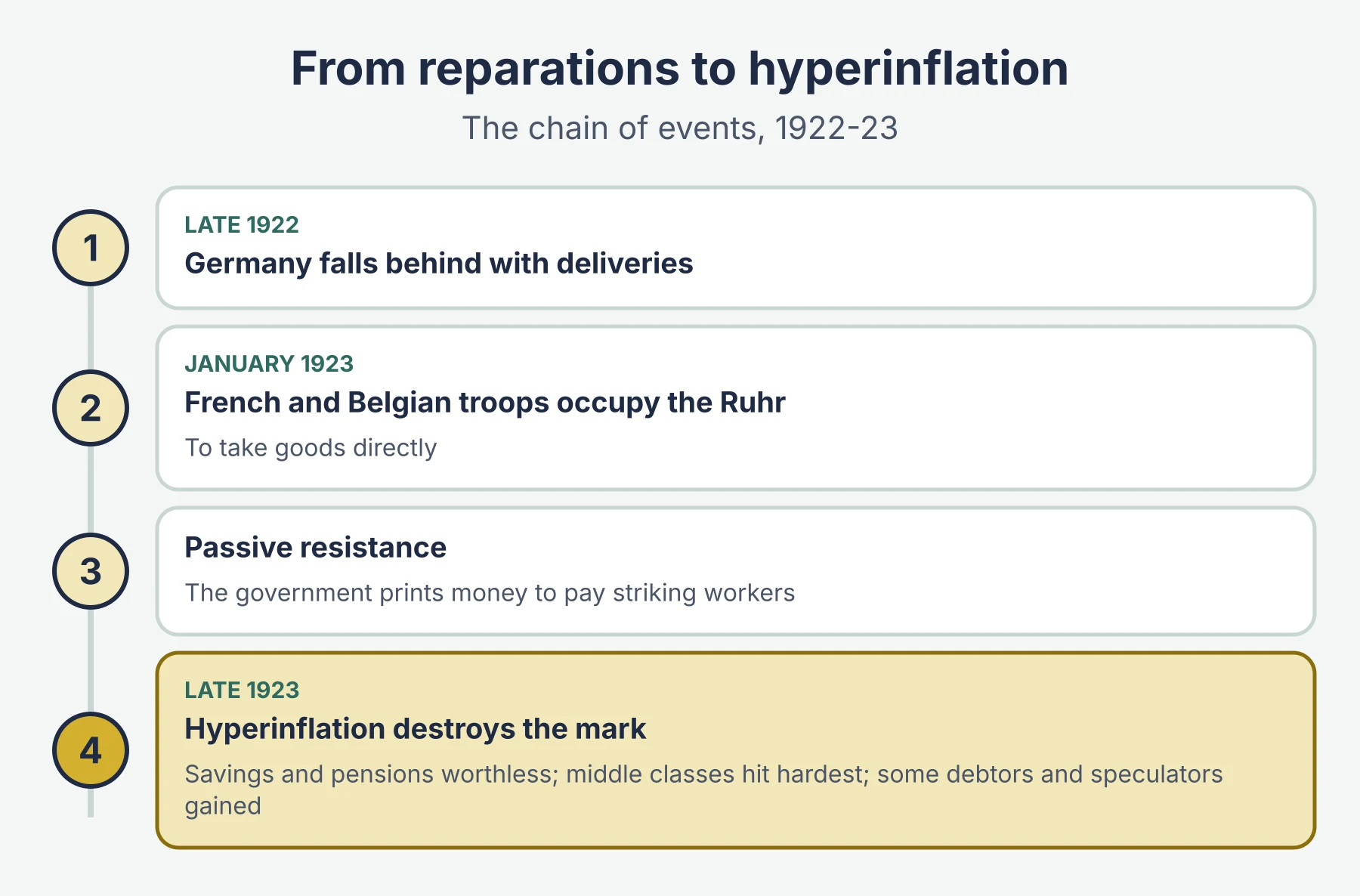
Economic: Germany struggled to pay reparations. When it fell behind with deliveries in late 1922, French and Belgian troops occupied the Ruhr in January 1923 to take goods directly. The government urged passive resistance and printed money to pay striking workers, and hyperinflation destroyed the mark by late 1923.
Social: savings and pensions became worthless, hitting the middle classes hardest; people on fixed incomes went hungry, while some debtors and speculators gained. The humiliation of the Treaty became a shared grievance across German society.
Balance: not all of Germany’s problems came from the Treaty. Germany had borrowed heavily to fight the war, and the government’s own decision to print money caused hyperinflation. By the end of 1923 Stresemann had ended passive resistance and a new currency was introduced.
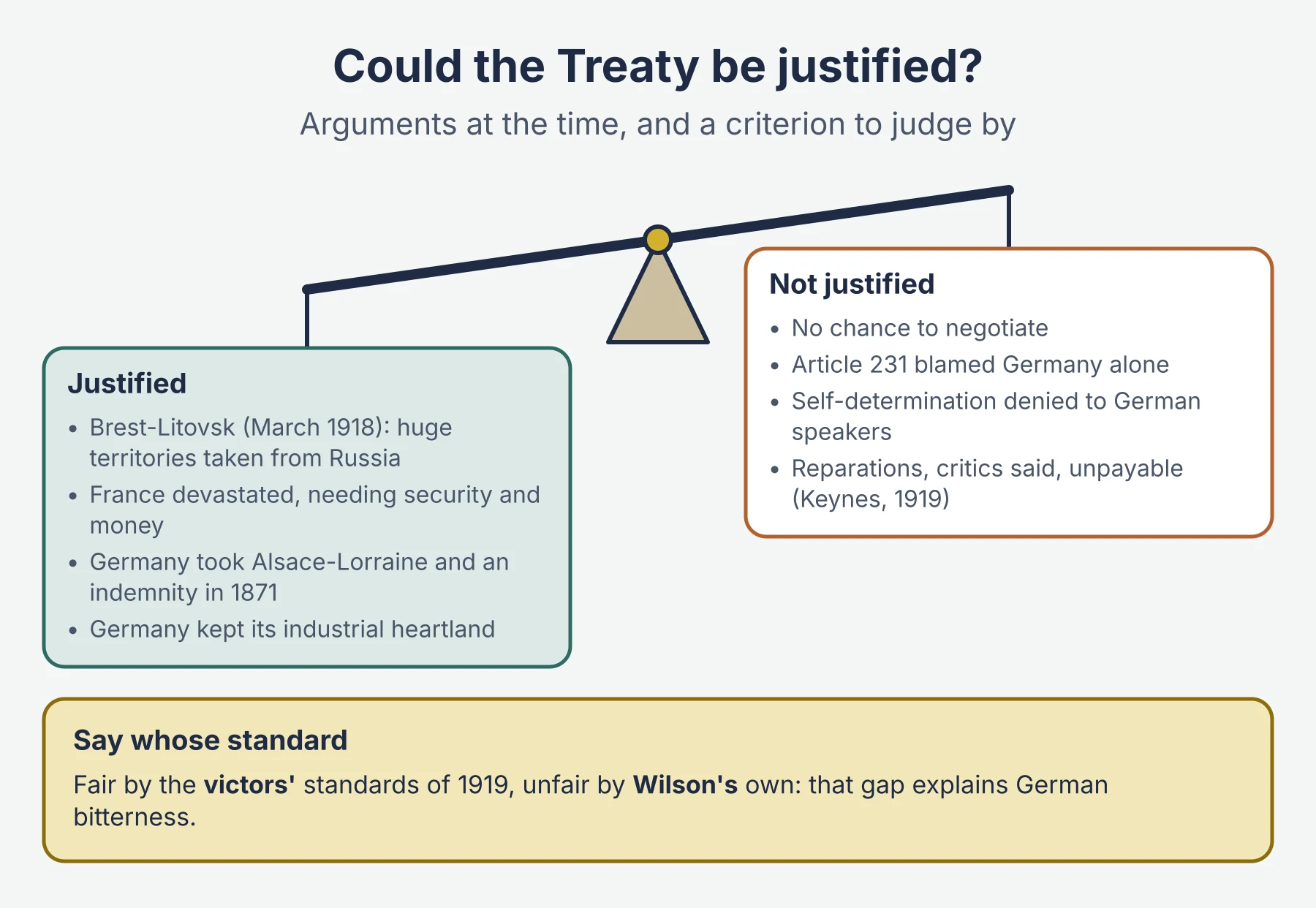
Could the Treaty be justified at the time?
| Arguments that it was justified | Arguments that it was not |
|---|---|
| Germany’s Treaty of Brest-Litovsk (March 1918) took huge territories from Russia, so Germans could expect harsh terms | Germany was given no chance to negotiate |
| France had been devastated and needed security and money to rebuild | Article 231 blamed Germany alone for a war with many causes |
| Germany had taken Alsace-Lorraine and an indemnity from France in 1871 | Self-determination was applied to others but not to German speakers |
| Germany kept its industrial heartland and remained a potential great power | Reparations were, critics argued, more than Germany could pay |
Contemporary opinions differed sharply. Germans of almost all parties condemned it. Many French people thought it too lenient; Marshal Foch is reported to have said it was “an armistice for twenty years”. In Britain, the economist John Maynard Keynes attacked the reparations in The Economic Consequences of the Peace (1919), arguing they would damage the whole European economy. In the USA, the Senate rejected the Treaty, partly because of opposition to the League.
Annotated model answer
An original practice question: “The Treaty of Versailles was a fair settlement.” How far do you agree? [10]
In the context of 1919, the Treaty can be seen as fair. Germany had imposed the Treaty of Brest-Litovsk on Russia in 1918, and France had suffered invasion and devastation, so making Germany pay for repairs and limiting its army responded to real damage. [Agree, explained.] However, the Treaty broke the principle of self-determination that Germany had been led to expect, placing German speakers under Polish rule and banning union with Austria, and Germany had no part in the negotiations, so Germans saw it as a Diktat. [Disagree, explained.] It was fair by the standards of victors in 1919, but unfair by Wilson’s own standards, and that gap explains German bitterness. [Judgement with a criterion.]
Common mistakes
- Writing that the Treaty dealt with Austria, Hungary or Turkey. Those were separate treaties; this key question is about Germany.
- Blaming the Treaty alone for hyperinflation.
- Giving the reparations figure as agreed in 1919. It was fixed in 1921.
- Treating “fair” as obvious. State whose standard you are using: Germany’s, France’s, or Wilson’s.
Exam technique
For Paper 2 in June 2026, identify each source’s nationality and date: a French cartoon of 1919 and a German poster of 1923 will judge the Treaty very differently, and explaining why is where the marks are.
Official syllabus
Cambridge IGCSE History (0470) syllabus for 2024, 2025 and 2026, Core Content Option B, key question 1 – cambridgeinternational.org.
Related resources
-
Practice questions
Cambridge IGCSE World History (0470): Was the Treaty of Versailles Fair? – Practice Questions
Twelve original questions with mark-scheme answers on the Big Three, the terms and Germany to 1923, for Cambridge IGCSE History 0470 key question 2.1.
World History · Cambridge · IGCSE
Try questions -
Revision notes
Cambridge IGCSE World History (0470): Was the Treaty of Versailles Fair? – Revision Notes
Recall notes for Cambridge IGCSE History 0470 key question 2.1: the Big Three, the terms, Germany to 1923, opinions of the Treaty and a self-test.
World History · Cambridge · IGCSE
Revise topic -
Study guides
Cambridge IGCSE World History (0470): How Secure Was the USSR's Control Over Eastern Europe, 1948-c.1989?
Study guide to Cambridge IGCSE History 0470 key question 2.6: Hungary 1956, Czechoslovakia 1968, the Berlin Wall, Solidarity and Gorbachev's role in 1989.
World History · Cambridge · IGCSE
Read guide
Get free revision emails (optional)
Occasional emails with practice questions, worked explanations and links to free resources for the qualification and subjects you choose. No spam, and you can unsubscribe from any email. The free tools on this site never need an email.