
Revision Notes
Cambridge IGCSE World History (0470): Was the Treaty of Versailles Fair? – Revision Notes
Recall notes for Cambridge IGCSE History 0470 key question 2.1: the Big Three, the terms, Germany to 1923, opinions of the Treaty and a self-test.
- Subject
- World History
- Level
- IGCSE
- Topic
- Core Content – Option B: International Relations since 1919
- Author
- Marlbridge Academic Team
- Updated
- Reviewed by
- Azam Siddique (what this means)
Aligned to Cambridge IGCSE World History (0470), 2024-2026. Official specification .
Syllabus page (what it covers and how it is assessed): Cambridge IGCSE World History.
Syllabus points this page covers
0470
- 2.1 Was the Treaty of Versailles fair?
Found an error? Report a correction.
Need help with this topic? Request a free trial class for IGCSE World History (0470).
Key question 2.1, Cambridge IGCSE History 0470: “Was the Treaty of Versailles fair?” You need the roles of Wilson, Clemenceau and Lloyd George, the terms, the impact on Germany to the end of 1923 and contemporary opinions. It is the Paper 2 prescribed topic for June 2026. Explanations are in the Versailles study guide; test yourself with the Versailles practice questions.
The Big Three at a glance
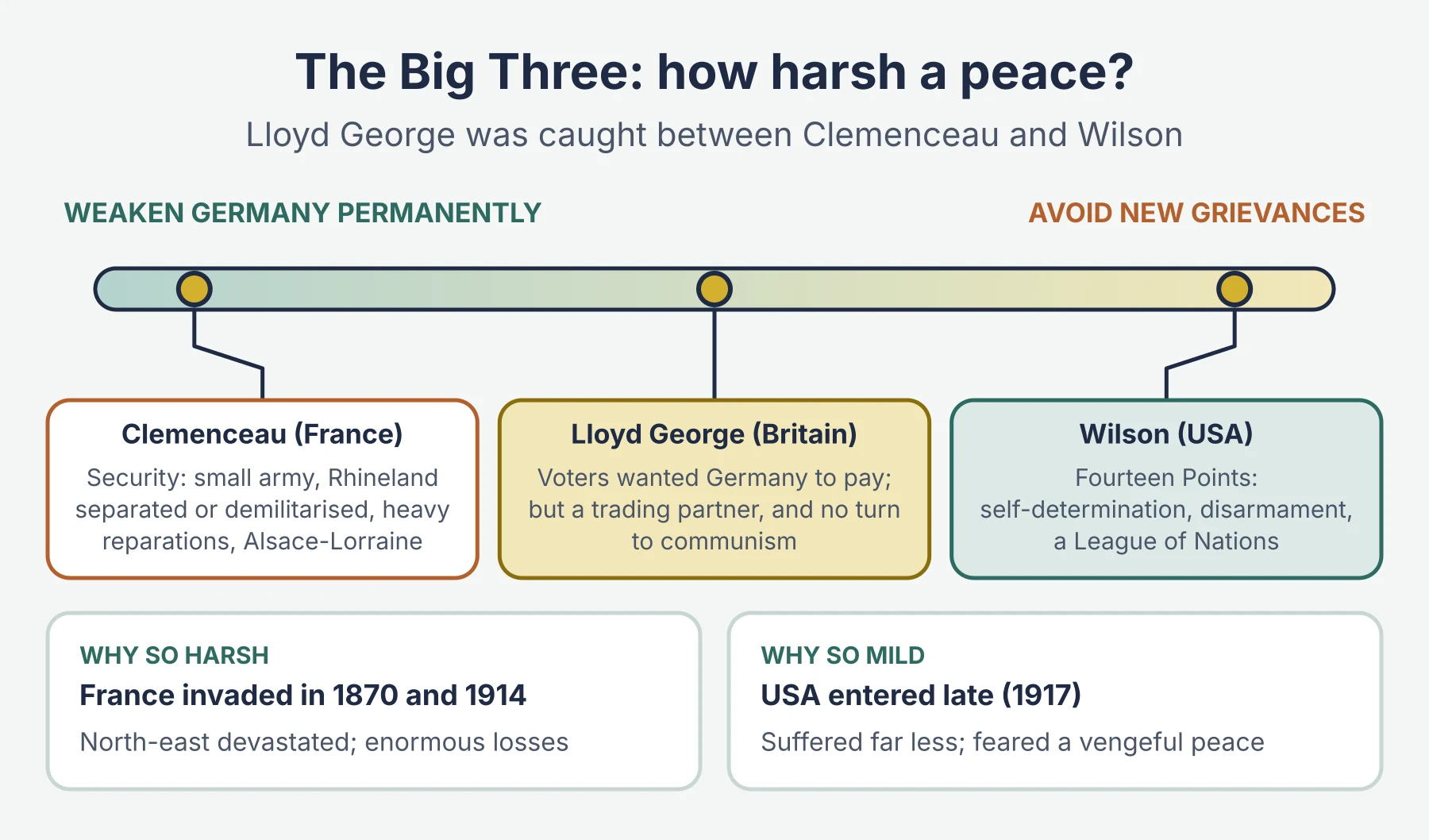
| Clemenceau (France) | Wilson (USA) | Lloyd George (Britain) | |
|---|---|---|---|
| Main aim | Security against future German attack | A just, lasting peace | A balanced peace that let Germany recover |
| Wanted | Huge reparations; tiny army; Rhineland separated; Alsace-Lorraine | Fourteen Points; self-determination; League of Nations | German navy and colonies removed; reparations; trade revived |
| Pressure | French public demanding revenge | Senate and voters wary of commitments | Voters demanding Germany pay (1918 election) |
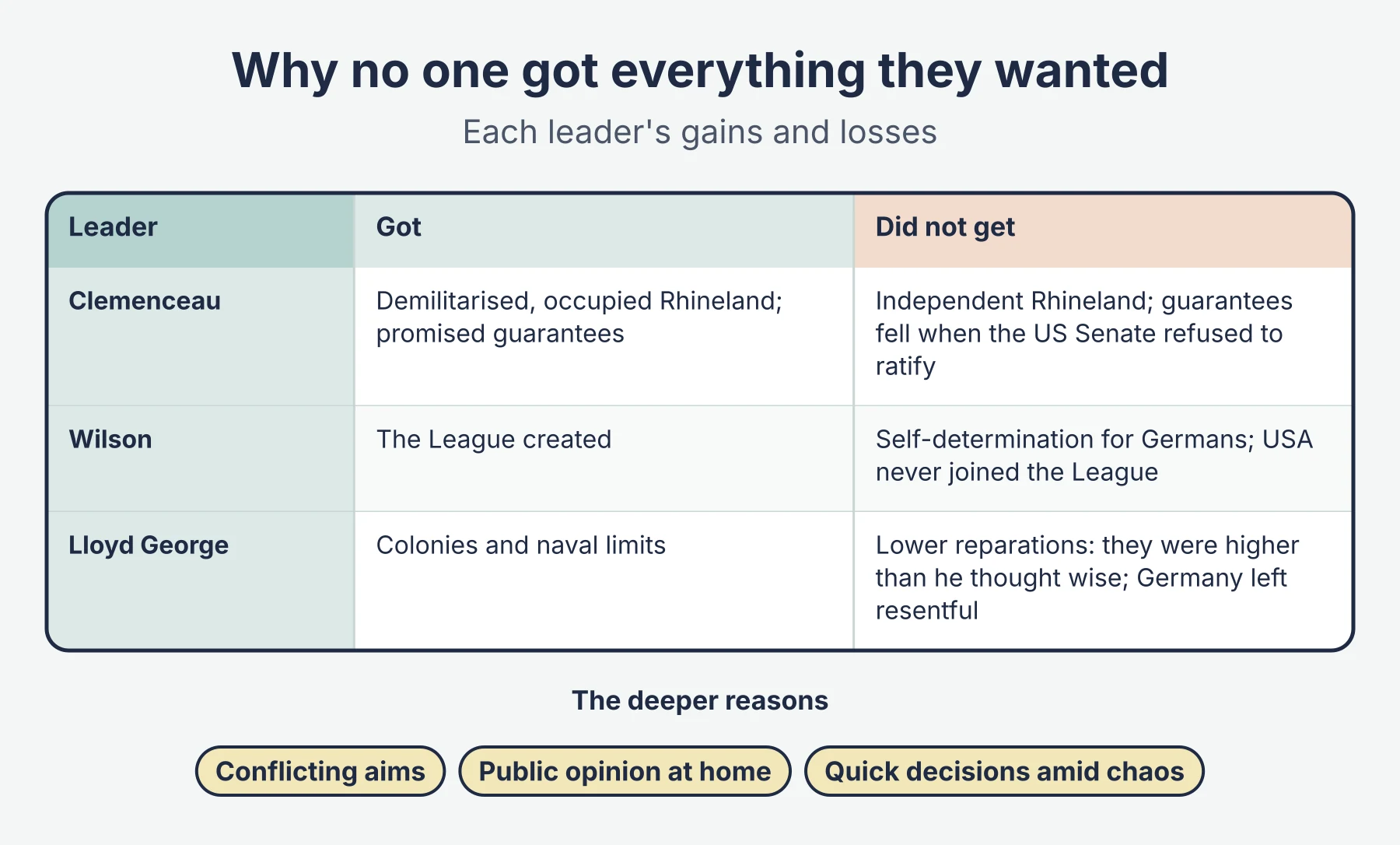
| Got | Alsace-Lorraine, reparations, military limits, Rhineland demilitarised | League created; new nation states | Navy limited, colonies taken as mandates |
| Did not get | Independent Rhineland; lasting guarantees | US membership of the League; self-determination for Germans | A moderate reparations bill |
Terms to learn (remember “LAMB”)
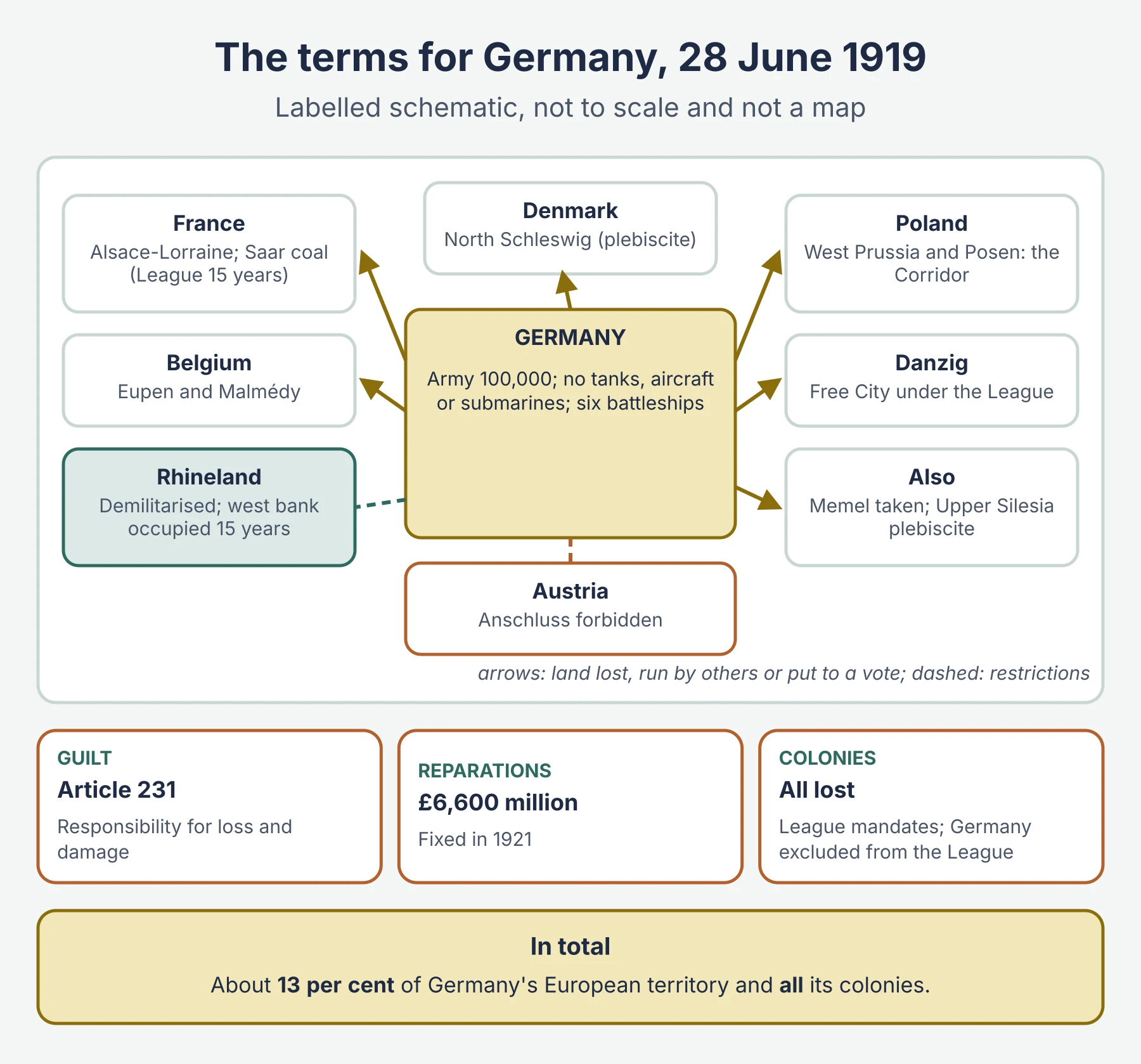
- Land: Alsace-Lorraine (France); Eupen and Malmédy (Belgium); North Schleswig (Denmark); West Prussia and Posen (Poland, the Corridor); Danzig Free City; Memel; Saar under the League for 15 years; colonies as mandates; about 13% of European territory lost.
- Army: 100,000 men; no conscription; no tanks or military aircraft; six battleships; no submarines; Rhineland demilitarised and occupied for 15 years.
- Money: reparations, fixed in 1921 at £6,600 million.
- Blame: Article 231, the “war guilt” clause.
- Also: Anschluss forbidden; Germany excluded from the League.
Impact on Germany to the end of 1923
| Type | Evidence |
|---|---|
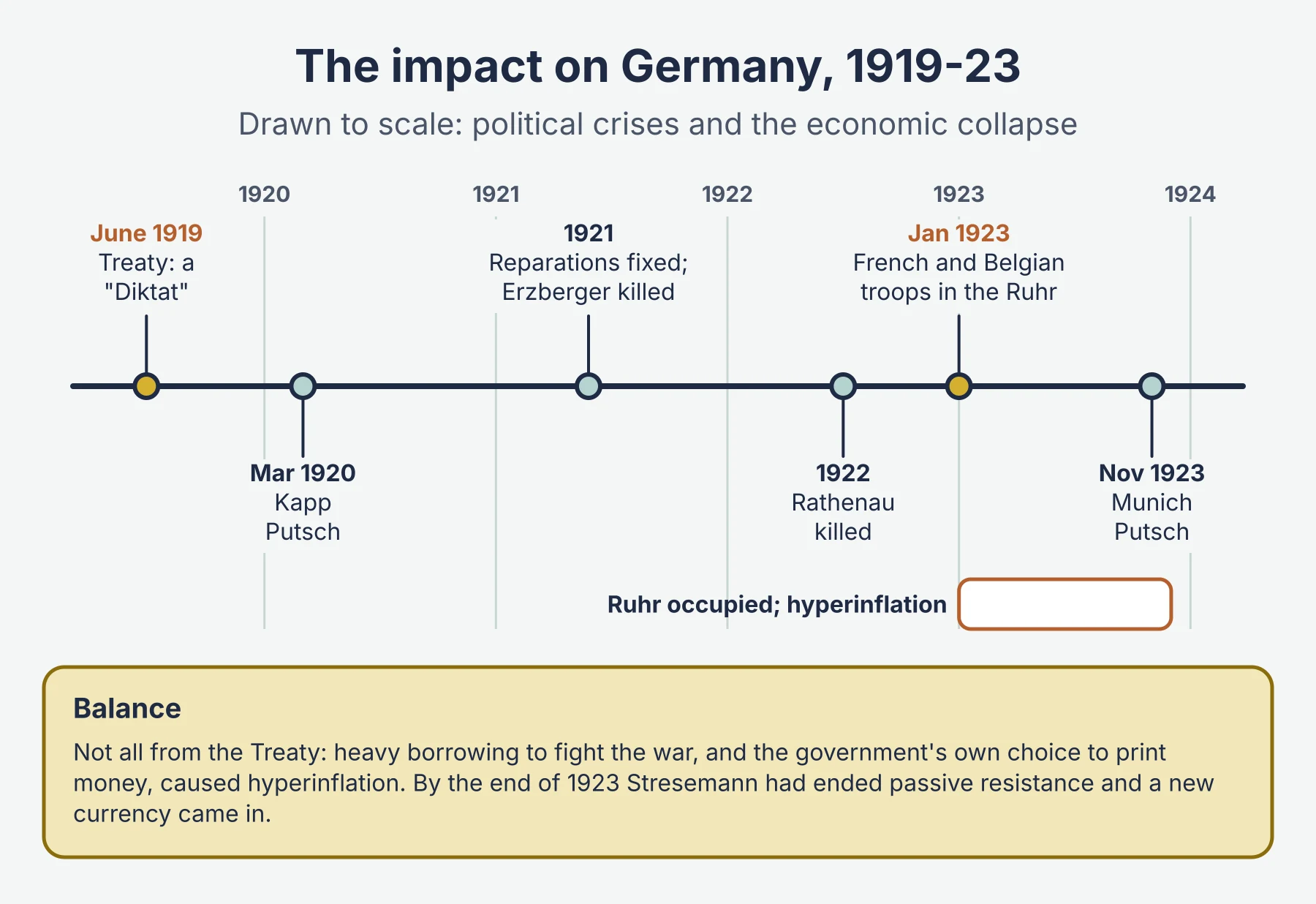
| Political | Diktat; “November criminals”; “stab in the back” myth; Kapp Putsch (March 1920); murders of Erzberger (1921) and Rathenau (1922); Munich Putsch (November 1923) |
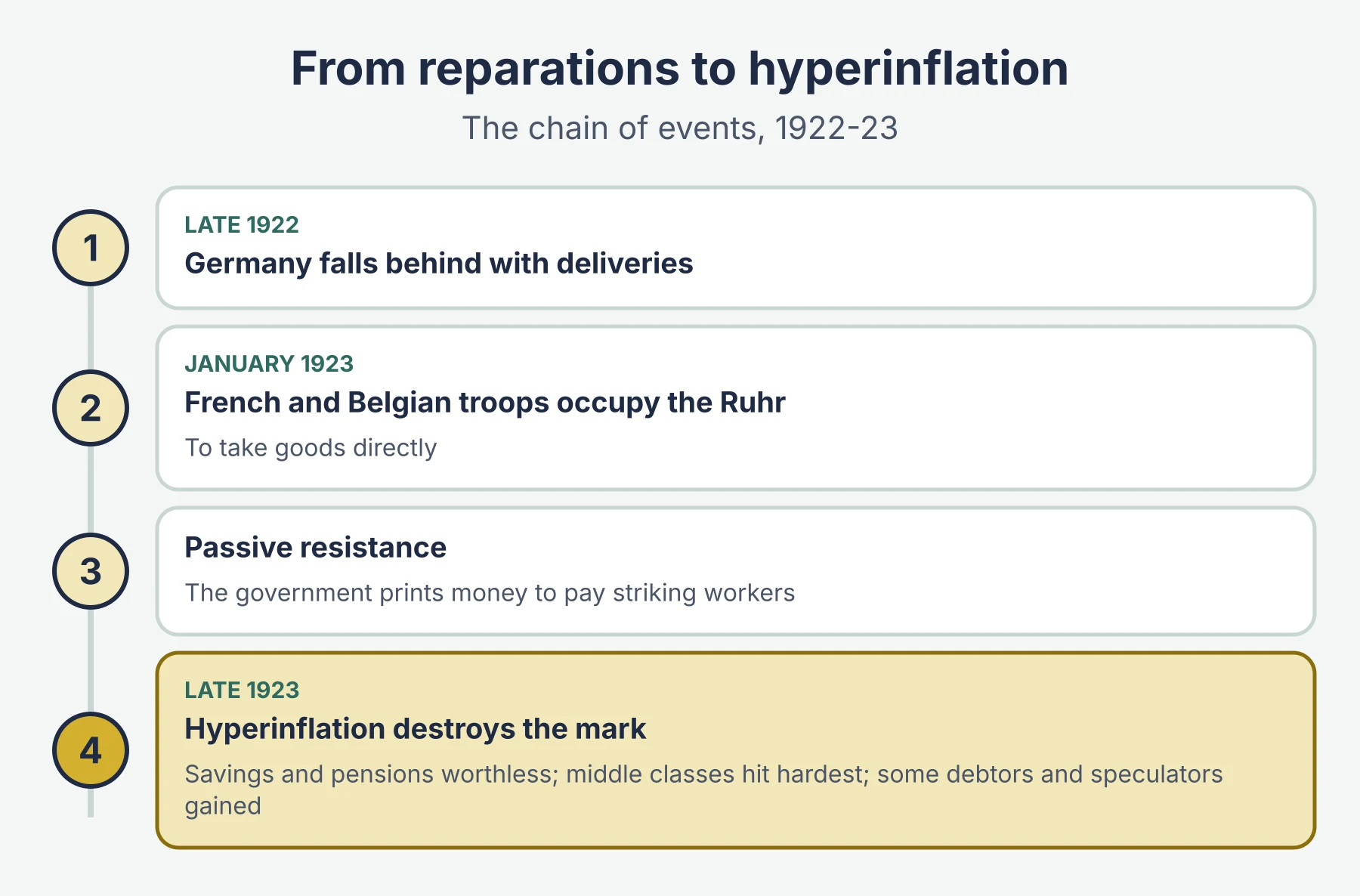
| Economic | Reparations; default on deliveries (late 1922); French and Belgian occupation of the Ruhr (January 1923); passive resistance; hyperinflation |
| Social | Savings and pensions wiped out; middle classes hit hardest; hunger for those on fixed incomes; shared sense of humiliation |
| Limits | War debts and government money-printing also caused inflation; Stresemann ended passive resistance and a new currency arrived in late 1923 |
Contemporary opinions
| Who | View |
|---|---|
| Most Germans | A Diktat and a national humiliation |
| Many in France | Too lenient; Foch reportedly called it “an armistice for twenty years” |
| Keynes, The Economic Consequences of the Peace (1919) | Reparations would wreck Europe’s economy |
| US Senate | Rejected the Treaty, mainly over the League’s commitments |
| Lloyd George, Fontainebleau Memorandum (March 1919) | Warned against terms that would leave Germany seeking revenge |
Key terms
| Term | Meaning |
|---|---|
| Fourteen Points | Wilson’s January 1918 programme for peace |
| Self-determination | The right of national groups to rule themselves |
| Reparations | Payments for war damage |
| Article 231 | Clause in which Germany accepted responsibility for war loss and damage |
| Diktat | A dictated peace, imposed without negotiation |
| Mandate | A former colony run by a victor on behalf of the League |
| Polish Corridor | Strip of land giving Poland access to the sea, separating East Prussia from Germany |
| Anschluss | Union of Germany and Austria, forbidden by the Treaty |
| Demilitarised zone | Area where no troops or fortifications are allowed |
| Brest-Litovsk | Harsh treaty imposed by Germany on Russia in March 1918 |
One-line answers to the focus points
- What were the Big Three’s motives and aims? Clemenceau wanted security and reparations, Wilson a just peace based on the Fourteen Points, and Lloyd George a balance that punished Germany but let it recover.
- Why did the victors not get everything they wanted? Their aims conflicted, each faced pressure from home, and the US Senate’s rejection removed the guarantees France had accepted.
- What was the impact on Germany to 1923? Political violence and resentment, the Ruhr occupation and hyperinflation, and the ruin of middle-class savings.
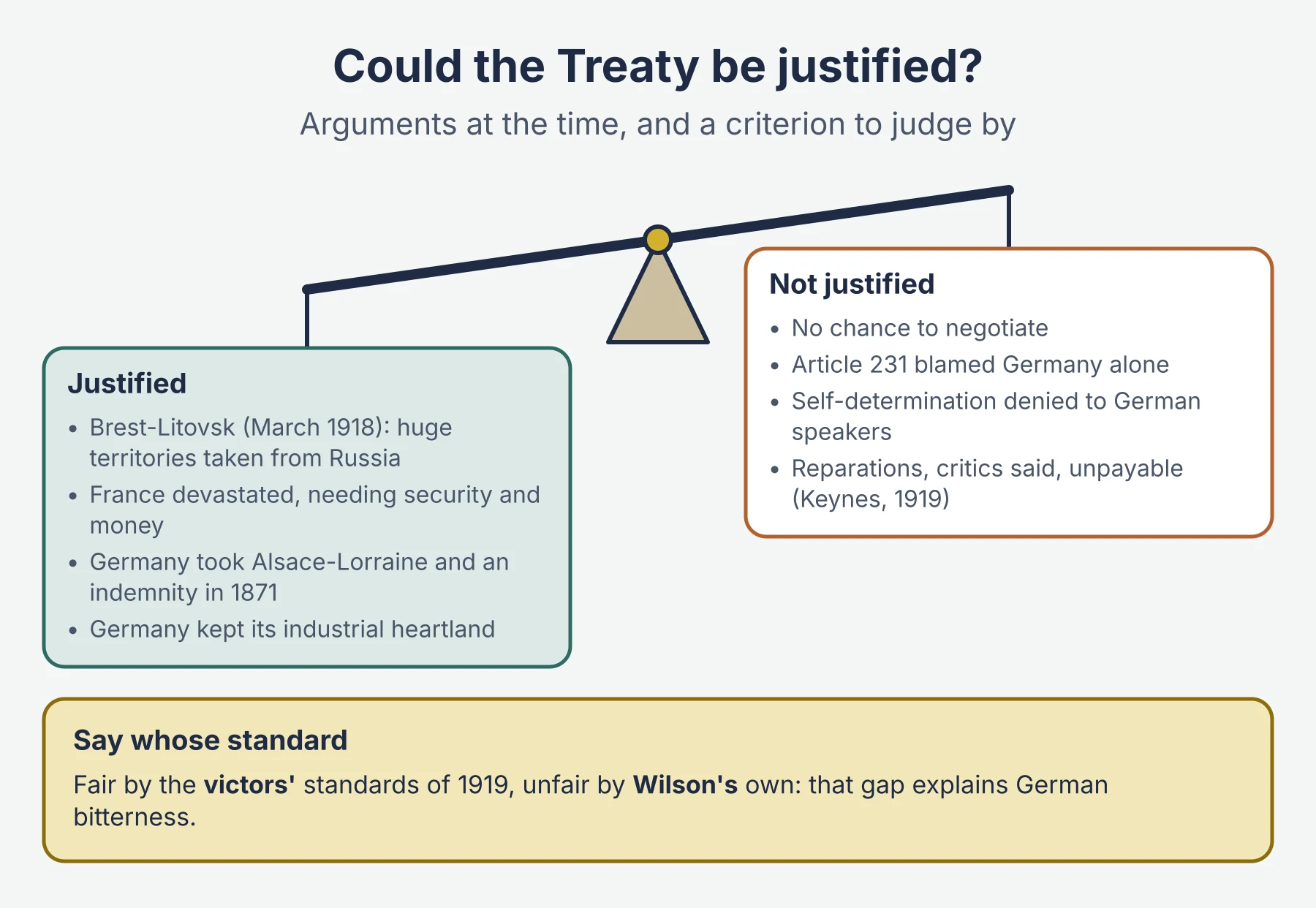
- Could the Treaty be justified at the time? Yes by the standards of 1919, given Brest-Litovsk and the damage to France; less so by Wilson’s own principles, because Germany was not consulted and self-determination was denied to Germans.
Exam traps
- Versailles is about Germany only. Do not use terms from the treaties with Austria, Hungary, Bulgaria or Turkey.
- Reparations date. The total was set in 1921, not 1919.
- Hyperinflation had several causes. Explain the government’s printing of money too.
- Impact stops at 1923 for this key question; later effects belong to key question 2.3.
- “Fair” needs a standard. Judge by the views of 1919, not only by hindsight.
Self-test
- What was Clemenceau’s main aim? Security for France against another German attack.
- Name three of Wilson’s Fourteen Points. Any three: self-determination; a League of Nations; disarmament; free trade; freedom of the seas; open diplomacy.
- Why did Lloyd George not want Germany crushed? He wanted it as a trading partner and feared the spread of communism.
- What did Article 231 say? Germany accepted responsibility for the loss and damage of the war.
- How large could the German army be? 100,000 men.
- What happened to the Saar? It was run by the League for 15 years, with France taking its coal.
- What was the Polish Corridor? Land given to Poland for access to the sea, cutting off East Prussia.
- Why did Clemenceau accept less than he wanted on the Rhineland? He was promised British and American guarantees in return.
- Why did the Ruhr occupation happen? Germany fell behind with reparations deliveries, so France and Belgium sent troops in January 1923.
- Who were the “November criminals”? The politicians blamed by nationalists for the armistice and the Treaty.
- What did Keynes argue in 1919? That reparations were too high and would damage Europe’s economy.
- Give one reason the Treaty could be justified at the time. Germany had imposed the harsh Treaty of Brest-Litovsk on Russia, or France needed security and repair (either).
Related resources
-
Study guides
Cambridge IGCSE World History (0470): How Secure Was the USSR's Control Over Eastern Europe, 1948-c.1989?
Study guide to Cambridge IGCSE History 0470 key question 2.6: Hungary 1956, Czechoslovakia 1968, the Berlin Wall, Solidarity and Gorbachev's role in 1989.
World History · Cambridge · IGCSE
Read guide -
Practice questions
Cambridge IGCSE World History (0470): How Secure Was the USSR's Control Over Eastern Europe, 1948-c.1989? – Practice Questions
Twelve original questions with mark-scheme answers on Hungary, Czechoslovakia, the Berlin Wall, Solidarity and Gorbachev for Cambridge IGCSE History 0470.
World History · Cambridge · IGCSE
Try questions -
Revision notes
Cambridge IGCSE World History (0470): How Secure Was the USSR's Control Over Eastern Europe, 1948-c.1989? – Revision Notes
Recall notes for Cambridge IGCSE History 0470 key question 2.6: Hungary, Czechoslovakia, the Berlin Wall, Solidarity and 1989, with key terms and a self-test.
World History · Cambridge · IGCSE
Revise topic
Get free revision emails (optional)
Occasional emails with practice questions, worked explanations and links to free resources for the qualification and subjects you choose. No spam, and you can unsubscribe from any email. The free tools on this site never need an email.